

|
시장보고서
상품코드
2119606
미국의 연속 혈당 모니터링 : 시장 점유율 분석, 업계 동향과 통계, 성장 예측(2026-2031년)United States Continuous Glucose Monitoring - Market Share Analysis, Industry Trends & Statistics, Growth Forecasts (2026 - 2031) |
||||||
 Mordor Intelligence
Mordor Intelligence에 따르면 2026년 연속 혈당 모니터링 시장의 규모는 74억 3,000만 달러로 추정되고 있으며, 2025년 62억 8,000만 달러에서 성장하며, 2031년에는 171억 6,000만 달러에 달할 것으로 예측됩니다.
2026-2031년까지의 연평균 성장률(CAGR)은 18.23%에 달할 것으로 전망됩니다.
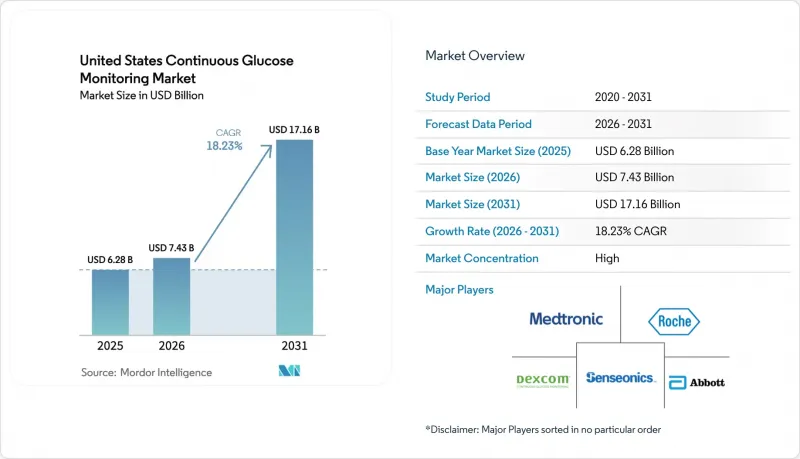
이 보고서는 구성 요소(센서, 송신기, 수신기), 최종사용자(병원·진료소, 가정·개인 사용), 대상(성인, 소아) 및 지역(미국)별로 분류되어 있습니다. 시장 전망은 금액(달러) 기준으로 제시되어 있습니다.
미국 연속 혈당 모니터링 시장의 동향 및 인사이트
당뇨병 유병률 상승과 조기 진단
CDC의 감시 보고에 따르면 성인의 당뇨병 유병률은 1999-2000년의 9.7%에서 2021-2023년에는 15.8%로 상승했으며, 이는 연속 혈당 모니터링 시장의 솔루션으로부터 혜택을 받을 가능성이 있는 미국인이 3,840만 명에 달한다는 것을 의미합니다. 젊은 성인을 대상으로 한 선별 검사가 조기에 이루어짐에 따라 질병의 경과에 있으며, CGM 도입 시기가 앞당겨지고 있습니다. 보험사들은 CGM을 심각한 저혈당이나 고액의 입원을 예방하는 일선 치료법으로 인식하게 되었으며, 이로 인해 보험 급여 승인이 용이해지고 있습니다. 의료 제공자들은 CGM을 첨단 추가 치료가 아닌 기본적인 자가 관리 툴로 자리매김하고 있으며, 이러한 인식의 변화가 대상 환자층을 확대시키고 있습니다. 그 결과, 제1형 및 제2형 환자층 모두로부터 지속적 혈당 모니터링 시장은 지속적인 수요의 호재를 누리고 있으며, 현재 이들 환자의 치료 계획은 실시간 데이터 피드백을 핵심으로 하고 있습니다.
제2형 당뇨병의 기초 인슐린 단독 요법 환자에 대한 메디케어/메디케이드 적용 확대
2023년 4월, CMS(미국 의료보험서비스센터)는 기초 인슐린만을 사용하는 제2형 당뇨병 환자를 대상으로 적용 범위를 확대하여, 추가로 150만 명의 수급자가 CGM 적용 대상이 되었습니다. 도입 속도는 각 주의 메디케이드 정책에 따라 다르지만, 첨단인 주에서는 이미 승인률이 높으며 도입이 가속화되고 있습니다. 이 정책 결정의 배경에는 CGM이 응급실 방문 및 입원 비용을 절감한다는 증거가 있으며, 이러한 이점은 가치 기반 의료 계약과 부합합니다. 약국 급여 제도는 지속적으로 진화하고 있으므로, 각 제약사는 내구성 의료기기의 청구 규정 차이에 대응하기 위해 유통 채널과 환자 지원 프로그램을 확대하고 있습니다. 그 결과, 공적 및 민간 보험사 양측의 급여 설계가 조화를 이루어 감에 따라 중기적으로는 판매 대수가 급증할 것으로 전망됩니다.
GLP-1에 의한 혈당 수치 정상화가 CGM 도입을 감소시킨다
세마글루타이드 등 GLP-1 수용체 작용제의 급속한 보급으로 인해 많은 환자의 HbA1c 수치가 정상 범위에 들어감에 따라 지속적인 모니터링의 필요성이 낮아지고 있는 것으로 인식되고 있습니다. 연구에 따르면 당뇨병 환자가 아닌 사용자의 약 46%가 1년 이내에 GLP-1 제제 사용을 중단하고 있으며, 이로 인해 센서 수요가 예측 불가능한 상황입니다. 조기 중단은 모니터링의 지속성에 단절을 초래하여, 의료진이 CGM 처방을 정당화하기 어렵게 만들고 있습니다. 그러나 용량 조절 기간 중이나 적극적인 치료를 받고 있는 환자 집단에서 저혈당을 조기에 발견하는 데 있으며, CGM 사용을 지원하는 새로운 근거도 나오고 있습니다. 현재 각 제약사는 약물 요법이 효과적인 경우에도 CGM이 수행하는 보완적 역할에 대해 임상의들에게 인식 제고를 하고 있으며, 이를 통해 시간이 지남에 따라 이러한 부정적 영향이 완화될 가능성이 있습니다.
부문 분석
센서는 2025년에 연속 혈당 모니터링 시장의 87.32%를 차지하며, 2031년까지 연평균 18.05%의 복합 성장률로 확대될 것으로 전망됩니다. 이러한 압도적인 점유율은 14-15일마다 교체되는 주기 덕분에 구독 서비스와 같은 수익의 예측 가능성이 생기기 때문입니다. 센서 하드웨어 기반 연속 혈당 모니터링 시장 규모는 양산에 따른 비용 우위와 AI 지원 데이터 출력에 힘입어 2031년까지 142억 달러를 넘어설 것으로 전망됩니다. 2025년 4월에 승인된 Dexcom사의 G7 15일용 센서는 8.0%의 MARD 정확도를 유지하고 있으며, 성능의 점진적인 향상이 프리미엄 가격 책정을 어떻게 지원하고 있는지를 보여줍니다. 착용 기간의 연장 및 블루투스를 통한 스마트폰과의 직접 연결로 인해 전용 수신기의 역할은 최소화되었으며, 당뇨병 환자 이외의 계층으로도 널리 보급될 길이 열렸습니다.
내구성이 뛰어난 구성 요소(수신기, 송신기)는 12.68%의 점유율을 차지하고 있으며, 예측 기간 중 성장률은 19.35%에 그칠 것으로 보입니다. 이러한 성장 둔화 추세는 스마트폰의 보급으로 인해 전용 디스플레이가 더 이상 필요하지 않게된 점을 반영합니다. 90-180일간 지속되는 송신기는 교체 빈도를 낮추며, 규제 당국의 감독으로 인해 제조사들은 제품 수명을 더욱 연장해야 하는 압박을 받고 있습니다. 단가 상승이 매출을 지원하고 있지만, 센서가 시스템 가치의 대부분을 차지하므로 전체적인 점유율은 하락하고 있습니다. 따라서 경쟁의 초점은 폐쇄 루프 펌프와의 연동을 간소화하기 위한 송신기의 소형화 및 방수 기능 강화에 집중되고 있습니다.
기타 혜택:
- 엑셀 형식의 시장 예측(ME) 시트
- 3개월간의 애널리스트 지원
자주 묻는 질문
목차
제1장 서론
제2장 조사 방법
제3장 개요
제4장 시장 구도
제5장 시장 규모와 성장 예측
제6장 경쟁 구도
제7장 시장 기회와 향후 전망
KSA 26.09.02According to Mordor Intelligence, the continuous glucose monitoring market size in 2026 is estimated at USD 7.43 billion, growing from 2025 value of USD 6.28 billion with 2031 projections showing USD 17.16 billion, growing at 18.23% CAGR over 2026-2031.
This report is Segmented by Component (Sensors, Transmitters, Receivers), End User (Hospitals/Clinics, Home/Personal Use), Demography (Adult, Pediatric), and Geography (United States). The Market Forecasts are Provided in Terms of Value (USD).
United States Continuous Glucose Monitoring Market Trends and Insights
Rising Diabetes Prevalence and Earlier Diagnoses
CDC surveillance shows adult diabetes prevalence rising from 9.7% in 1999-2000 to 15.8% in 2021-2023, translating to 38.4 million Americans who potentially benefit from continuous glucose monitoring market solutions. Younger adults are being screened sooner, which pushes CGM adoption earlier in the disease course. Payers increasingly view CGM as a frontline therapy that prevents severe hypoglycemia and costly hospitalizations, making reimbursement justification easier. Providers treat CGM as a foundational self-management tool rather than an advanced add-on, a perception shift that enlarges the addressable base. As a result, the continuous glucose monitoring market gains sustained volume tailwinds from both Type-1 and Type-2 cohorts, whose treatment plans now anchor around real-time data feedback.
Medicare/Medicaid Expansion for Type-2 Basal-Only Patients
In April 2023, CMS broadened coverage to include Type-2 patients using basal insulin only, opening CGM eligibility to an extra 1.5 million beneficiaries. Adoption momentum varies by state Medicaid policy, yet progressive states already report higher authorization rates that speed volume uptake. The policy decision rests on evidence that CGM reduces emergency visits and inpatient costs, benefits that resonate with value-based care contracts. Pharmacy benefit pathways continue to evolve, so manufacturers are expanding distribution channels and patient support programs to navigate differing durable-equipment billing rules. The net effect is a medium-term surge in unit sales as both public and commercial payers harmonize benefit designs.
GLP-1 Induced Glucose Normalization Reduces CGM Starts
Rapid uptake of GLP-1 receptor agonists such as semaglutide brings many patients to normalized HbA1c levels, lowering perceived need for continuous monitoring. Studies show approximately 46% of non-diabetic users discontinue GLP-1 within a year, causing unpredictable sensor demand. Early discontinuation produces gaps in monitoring continuity, making it difficult for providers to justify CGM prescriptions. Nonetheless, emerging evidence supports CGM use during dose titration and to catch hypoglycemia in aggressively treated cohorts. Manufacturers now educate clinicians on complementary roles for CGM even when pharmacotherapy remains effective, which may soften this negative impact over time.
Other drivers and restraints analyzed in the detailed report include:
- Sensor Price Erosion Below USD 60 per 14-Day Wear Period
- Shift to OTC Wellness CGMs Expands Addressable Base
- Patch-Pump and CGM Bundles Limit Stand-Alone Sensor Sales
For complete list of drivers and restraints, kindly check the Table Of Contents.
Segment Analysis
Sensors captured 87.32% of the continuous glucose monitoring market in 2025 and are forecast to compound at an 18.05% rate through 2031. This dominance stems from 14- to 15-day replacement cycles that create subscription-like revenue predictability. The continuous glucose monitoring market size for sensor hardware is on track to surpass USD 14.2 billion by 2031, underpinned by mass-production cost advantages and AI-ready data output. Dexcom's G7 15-day sensor, cleared in April 2025, sustains 8.0% MARD accuracy, demonstrating how incremental performance gains support premium price points. Longer wear times and Bluetooth direct-to-phone links minimize the role of dedicated receivers, paving the way for consumer-scale adoption well beyond diabetes.
Durable components-receivers and transmitters-hold 12.68% share and grow at just 19.35% through the forecast. Their decelerating curve reflects smartphone ubiquity that makes proprietary displays obsolete. Transmitters lasting 90-180 days dampen replacement frequency, and regulatory scrutiny pushes manufacturers to extend life cycles further. Higher per-unit prices cushion revenue, yet overall share slips as sensors absorb much of the system's value. Competitive focus, therefore, centers on transmitter miniaturization and waterproofing to simplify closed-loop pump pairing.
Complete Report Scope:
- By Component
- Sensors
- Transmitters
- Receivers
- By End User
- Hospitals/Clinics
- Home/Personal Use
- By Demography
- Adult
- Pediatric
List of Companies Covered in this Report:
- Abbott Laboratories
- Medtronic
- Dexcom
- Senseonics
- Roche
- A. Menarini Diagnostics S.r.l.
- I-Sens
- Medtrum Technologies Inc.
- Nemaura Medical Inc.
- Zhejiang POCTech Co.,Ltd.
- MicroTech Medical
Additional Benefits:
- The market estimate (ME) sheet in Excel format
- 3 months of analyst support
TABLE OF CONTENTS
1 Introduction
- 1.1 Study Assumptions & Market Definition
- 1.2 Scope of the Study
2 Research Methodology
3 Executive Summary
4 Market Landscape
- 4.1 Market Overview
- 4.2 Market Drivers
- 4.2.1 Rising Diabetes Prevalence and Earlier Diagnoses
- 4.2.2 Medicare/Medicaid Expansion For Type-2 Basal-Only Patients
- 4.2.3 Price Erosion Of Sensors Below USD 60 Per 14-Day Wear Period
- 4.2.4 Shift To OTC Wellness CGMs (Stelo, Lingo) Expands Addressable Base
- 4.2.5 AI-Driven Dosing Algorithms Boost Clinical Outcomes and Adoption
- 4.2.6 Hospital Ward Pilots Proving Cost-Savings Over POC Testing
- 4.3 Market Restraints
- 4.3.1 GLP-1 Induced Glucose Normalization Reduces CGM Starts
- 4.3.2 Patch-Pump/CGM Bundles Limit Stand-Alone Sensor Sales
- 4.3.3 Data-Overload Fatigue Among Non-Insulin Users
- 4.3.4 Uneven State-Level Medicaid Coverage Creates Access Gaps
- 4.4 Supply-Chain Analysis
- 4.5 Regulatory Landscape
- 4.6 Technological Outlook
- 4.7 Porter's Five Forces Analysis
- 4.7.1 Bargaining Power of Suppliers
- 4.7.2 Bargaining Power of Consumers
- 4.7.3 Threat of New Entrants
- 4.7.4 Threat of Substitute Products
- 4.7.5 Intensity of Competitive Rivalry
- 4.8 Market Indicators
- 4.8.1 Type-1 Diabetes Population
- 4.8.2 Type-2 Diabetes Population
5 Market Size & Growth Forecasts (Value)
- 5.1 By Component
- 5.1.1 Sensors
- 5.1.2 Transmitters
- 5.1.3 Receivers
- 5.2 By End User
- 5.2.1 Hospitals/Clinics
- 5.2.2 Home/Personal Use
- 5.3 By Demography
- 5.3.1 Adult
- 5.3.2 Pediatric
6 Competitive Landscape
- 6.1 Market Concentration
- 6.2 Market Share Analysis
- 6.3 Company Profiles (includes Global level Overview, Market level overview, Core Segments, Financials as available, Strategic Information, Market Rank/Share for key companies, Products & Services, and Recent Developments)
- 6.3.1 Abbott Laboratories
- 6.3.2 Medtronic plc
- 6.3.3 Dexcom Inc.
- 6.3.4 Senseonics Holdings Inc.
- 6.3.5 F. Hoffmann-La Roche Ltd
- 6.3.6 A. Menarini Diagnostics S.r.l.
- 6.3.7 i-SENS, Inc.
- 6.3.8 Medtrum Technologies Inc.
- 6.3.9 Nemaura Medical Inc.
- 6.3.10 Zhejiang POCTech Co.,Ltd.
- 6.3.11 MicroTech Medical
7 Market Opportunities & Future Outlook
- 7.1 White-space & Unmet-need Assessment


