

|
시장보고서
상품코드
2119619
발진기 : 시장 점유율 분석, 업계 동향과 통계, 성장 예측(2026-2031년)Oscillator - Market Share Analysis, Industry Trends & Statistics, Growth Forecasts (2026 - 2031) |
||||||
 Mordor Intelligence
Mordor Intelligence에 따르면 2026년 발진기 시장의 규모는 68억 7,000만 달러로 추정되고 있으며, 2025년 64억 4,000만 달러에서 확대하며, 2031년에는 95억 2,000만 달러에 달할 것으로 예측됩니다.
2026-2031년까지 연평균 성장률(CAGR) 6.73%로 성장할 것으로 전망됩니다.
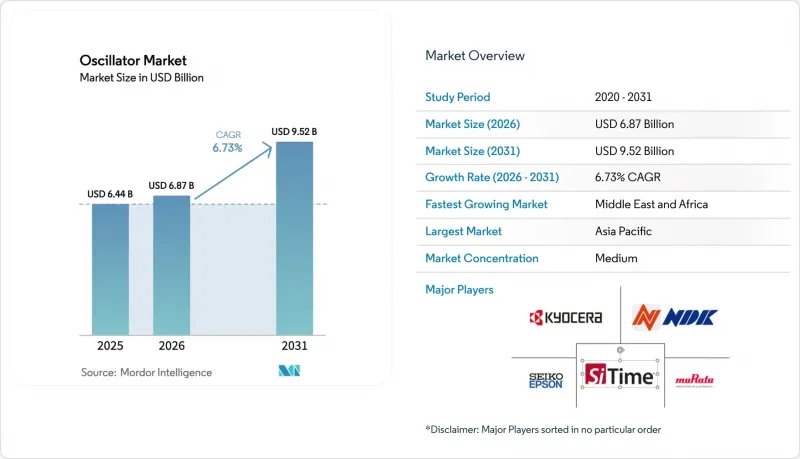
이 보고서는 제품 유형(온도 보상형 XO(TCXO), 전압 제어형 XO(VCXO) 등), 실장 방식(표면 실장 소자(SMD),스루홀형), 소재(석영 등), 주파수 범위(20MHz 이하, 20-80MHz, 기타), 최종사용자 산업별(소비자용 전자기기, 통신·네트워크, 기타) 및 지역별(북미, 남미, 유럽, 아시아태평양, 중동 및 아프리카)로 분류되어 있습니다.
세계 발진기 시장의 동향 및 인사이트
초저지터 TCXO가 필요한 5G 스몰셀의 전개
5G의 대규모 고밀도화로 인해 통신 사업자들은 수백만 개의 스몰 셀을 구축할 수밖에 없게 되었으며, 각 스몰 셀에는 ±130 ns의 타이밍 정밀도가 요구되었습니다. 이에 따라 각 제조사는 -40°C에서 +105°C 범위에서 안정성을 유지하는 CTS Corporation의 535/536 시리즈 등, 지터가 0.1 ppm 이하인 TCXO를 설계했습니다. 이러한 도입을 주도한 것은 아시아였으며, 중국과 한국이 하이엔드 클럭 시장의 대부분을 차지했습니다. 4G의 GPS 동기화 방식에서 IEEE 1588 PTP로 전환됨에 따라 관련 수요가 확대된 한편, 북미 및 유럽의 네트워크 사업자들은 상호 운용성을 유지하기 위해 아시아의 사양을 따랐습니다. 그 결과, 수요 증가에 힘입어 수정 발진기 및 MEMS 발진기 두 분야 모두에서 발진기 시장이 꾸준히 확대되었습니다.
ADAS 도메인 컨트롤러의 전동화가 MEMS 발진기의 평균 판매 가격(ASP)을 끌어올렸고
각 자동차 제조사는 분산되어 있던 여러 전자제어 장치를, 센서 퓨전 처리 부하를 통합하는 중앙 집중형 ADAS 도메인 컨트롤러로 대체했습니다. Renesas의 R-Car V4H SoC는 34 TOPS의 AI 추론을 지원하는 프로그래머블 클럭 생성기를 통합하고 있으며, 발진기에 대한 정밀도 요구 사항이 높아지고 있음을 보여줍니다. MEMS 디바이스가 선호되게된 이유는 단결정 실리콘 구조가 30,000 g의 충격을 견디고 g 감도가 낮다는 특성을 가지고 있기 때문입니다. 이는 가혹한 자동차 환경에서 필수적인 특성입니다. 차량이 존(zone)형 아키텍처로 전환됨에 따라 차량당 타이밍 부품 수가 증가하면서, 발진기 시장의 구성 비율은 수익성이 높은 MEMS 제품으로 이동하고 있습니다.
일본산 수정 블랭크 공급망내 단일 공급원에 대한 의존
고품질 수정 블랭크의 약 80%가 일본에서 공급되고 있으며, 전 세계 제조사들은 지정학적 요인이나 자연재해로 인한 공급 차단의 위험에 노출되어 있었습니다. 결정 성장 및 연마에 긴 주기가 소요되므로 문제 발생시 복구 속도는 더욱 제한적이었습니다. 이에 대응하여 각 디바이스 벤더들은 북미, 유럽,아시아 각지에 위치한 표준 반도체 팹에서 제조된 MEMS 발진기를 조달원으로 추가하는 듀얼 소싱 방식에 대응했습니다. 그러나 여전히 기존 석영 등급을 필요로 하는 미션 크리티컬 고객들은 보수적인 인증 방침을 고수하고 있으며, 발진기 시장의 일부에서 단기적인 대체를 제한하고 있습니다.
부문 분석
2025년, TCXO는 발진기 시장 점유율에서 가장 높은 33.60%를 계속 차지했습니다. 이는 통신 장비 OEM 업체들이 그 비용 대비 성능의 균형을 높이 평가했기 때문입니다. 한편, MEMS 디바이스는 연평균 성장률(CAGR) 17.4%를 기록할 것으로 전망되며, 이는 향후 발진기 시장의 확장을 실리콘 기반 설계로 이끌고 있습니다. 크리스탈보다 50배 높은 신뢰성에 더해 2mm² 미만의 마이크로 패키지 형태를 갖추고 있으며, MEMS는 웨어러블 기기, 드론, 전기자동차(EV) 분야에서 매력적인 선택지로 자리 잡고 있습니다. OCXO는 ±5 ppb의 안정성이 절대 조건으로 요구되는 위성 페이로드 분야에서 여전히 주류를 이루고 있습니다. SPXO는 가격에 민감한 가제트용이며, 반면 VCXO는 주파수 조정 성능이 필요한 영상 방송 기기에 공급되고 있습니다.
발진기 업계에서는 구조에 기반한 분류에서 용도 중심의 정의로 전환되는 추세가 나타났습니다. 항공우주 분야에서는 현재 내방사선성 EMXO가 요구되고 있으며, IoT 통합 업체들로부터는 현장 프로그래밍이 가능한 FCXO가 요구되고 있습니다. 이러한 재분류로 인해 소규모 혁신 기업은 대형 수정 제조사와 정면으로 경쟁하기보다는 틈새 시장을 공략할 수 있게 되었습니다. 그 결과, 과거 수정이 독점하던 분야에서 MEMS 중심 기업이 설계 채택을 확보함에 따라 경쟁 구도가 변화했습니다. 발진기 시장은 이러한 전문화의 혜택을 누리고 있습니다. 왜냐하면 진동, 방사선, 극한 온도 등 각 성능 요구 사항에 대해 획일적인 디바이스가 아닌, 각각에 최적화된 솔루션 세트가 제공되게 되었기 때문입니다.
2025년에는 픽 앤 플레이스(pick-and-place) 공정 효율화와 기판 면적 축소로 인해 표면 실장 패키지가 발진기 시장의 76.40%를 차지했습니다. 예상되는 연평균 성장률(CAGR) 6.05%는 OEM의 로드맵이 웨어러블 센서용으로 도입된 1.6×1.2 mm의 외형 치수 등, 점점 더 소형화되는 풋프린트를 중시하고 있음을 나타냅니다. 스루홀 부품은 기판의 강성이 크기보다 우선시되는 철도, 항공 전자 기기, 중공업 플랫폼에서 계속 사용되고 있습니다.
첨단 패키징 기술을 통해 여러 발진기, 전압 조정기 및 분압기가 단일 시스템 인 패키지(SiP) 블록으로 통합되어 설계자의 부품 수가 대폭 감소했습니다. 자동차 및 의료 분야의 고객들은 납땜 접합부 감소를 통한 신뢰성 향상을 도모하는 동시에, 부품표(BOM) 항목 수를 줄이기 위해 이러한 통합을 적극적으로 추진했습니다. 예측 기간 중, 자동 광학 검사(AOI)의 허용 기준 및 리플로우 온도 제약으로 인해 심한 진동이나 유지보수성 요건으로 인해 소켓 사용이 필요한 경우를 제외하고, 발진기 시장은 표면 실장(SMD) 전용 구성으로 더욱 전환될 것입니다.
지역별 분석
아시아태평양은 중국의 스마트폰 생산 거점, 일본의 수정 진동자 공급 우위, 그리고 한국의 5G 스몰 셀 조기 도입에 힘입어 2025년 매출의 58.50%를 차지했습니다. 대만의 파운드리 및 TXC Corporation과 같은 타이밍 부품 공급업체들이 지역의 자급자족을 지원하는 한편, 인도는 Rakon과 같은 기업의 그린필드 공장 유치를 통해 공급 다각화를 도모했습니다. 견고한 내수 수요와 수출 호조가 맞물려, 국지적인 무역 마찰이 있었음에도 불구하고 발진기 시장의 성장 곡선은 가파른 상승세를 유지했습니다.
북미는 2위를 차지했습니다. 이 지역의 주요 방위 기업과 뉴 스페이스 발사 사업자들은 고품질 OCXO 및 방사선 내성 MEMS를 구매했습니다. 데이터센터 사업자들은 AI 클러스터에서 GPU의 유휴 주기를 단축하는 슈퍼 TCXO 도입을 추진하며, 국내 개발 자금을 지원했습니다. 미국 및 캐나다에 거점을 둔 자동차 Tier 1 공급업체들은 집중형 ADAS 연산을 위한 MEMS 클럭 검증을 수행하며, 해당 지역의 발진기 시장을 더욱 확대시켰습니다.
유럽은 계속해서 영향력을 유지하고 있으며, 특히 독일의 자동차 생태계와 유럽 대륙의 강력한 산업 자동화 기반에서 두드러졌습니다. 유럽연합 집행위원회의 주파수 대역 규제를 충족하기 위해 밀리미터파 백홀 링크에서 SC 컷 크리스탈의 인기가 높아졌습니다. 수출 통제 체계로 인해 고정밀 군용 발진기의 출하 주기가 때때로 지연되기도 했으나, 프랑스와 영국의 주요 국내 기업은 특수 제품 생산을 유지했습니다. 중동 및 아프리카에서는 걸프 국가들의 스마트 시티 프로젝트와 아프리카의 통신망 확장으로 인프라 현대화가 진행되어 9.05%라는 가장 높은 연평균 성장률(CAGR)이 예상됩니다. 브라질을 필두로 한 남미에서는 4G/5G 네트워크 업그레이드에 따라 꾸준하지만 완만한 수요 증가가 나타났습니다. 이러한 지역별 동향이 맞물리면서 발진기 시장은 지역적으로 다양한 수요 구조를 유지하게 되었습니다.
기타 혜택:
- 엑셀 형식의 시장 예측(ME) 시트
- 3개월간의 애널리스트 지원
자주 묻는 질문
목차
제1장 서론
제2장 조사 방법
제3장 개요
제4장 시장 구도
제5장 시장 규모와 성장 예측
제6장 경쟁 구도
제7장 시장 기회와 향후 전망
KSA 26.09.02According to Mordor Intelligence, oscillator market size in 2026 is estimated at USD 6.87 billion, growing from 2025 value of USD 6.44 billion with 2031 projections showing USD 9.52 billion, growing at 6.73% CAGR over 2026-2031.
This report is Segmented by Product Type (Temperature-Compensated XO, Voltage-Controlled XO, and More), by Mounting Scheme (Surface-Mount Device, Through-Hole), by Material (Quartz, and More), by Frequency Range (<=20 MHz, 20-80 MHz, and More), by End-User Industry (Consumer Electronics, Telecom and Networking, and More) and by Geography (North America, South America, Europe, Asia-Pacific, and Middle East and Africa ).
Global Oscillator Market Trends and Insights
5G Small-Cell Roll-outs Requiring Ultra-Low-Jitter TCXOs
Extensive 5G densification forced operators to deploy millions of small cells, each needing timing accuracy of +-130 ns. Manufacturers, therefore, designed TCXOs with <=0.1 ppm jitter, such as CTS Corporation's 535/536 series, which sustained stability from -40 °C to +105 °C. Asia led these installations, with China and South Korea consuming the bulk of premium clocks. Migration from GPS-disciplined timing in 4G toward IEEE 1588 PTP widened addressable demand, while network operators in North America and Europe mirrored Asian specifications to maintain interoperability. Resulting pull-through volumes steadily enlarged the oscillator market across both quartz and MEMS variants.
Electrification of ADAS Domain Controllers Elevating MEMS Oscillator ASPs
Vehicle OEMs replaced multiple distributed electronic control units with centralized ADAS domain controllers that consolidate sensor fusion workloads. The Renesas R-Car V4H SoC integrates a programmable clock generator to support 34 TOPS of AI inferencing, illustrating rising oscillator precision requirements. MEMS devices gained preference because their single-crystal silicon structure survives 30,000 g shock and offers low g-sensitivity-attributes essential in harsh automotive environments. As vehicles move to zonal architectures, timing components per car increase, tilting the oscillator market mix toward higher-margin MEMS products.
Supply-Chain Single-Source Dependency on Quartz Blanks from Japan
Roughly 80% of high-grade quartz blanks came from Japan, exposing global manufacturers to geopolitical or natural-disaster disruptions Seiko. Lengthy crystal-growing and polishing cycles further constrained recovery speeds when incidents occurred. Device vendors countered by dual-sourcing with MEMS oscillators fabricated in standard semiconductor fabs located across North America, Europe, and Asia. Nevertheless, mission-critical clients that still require legacy quartz grades retained conservative qualification policies, limiting short-term substitution in parts of the oscillator market.
Other drivers and restraints analyzed in the detailed report include:
- Migration from Legacy MCU Clocks to Programmable XOs in Over-the-Air Updatable IoT Modules
- Aerospace LEO-Satellite Fleet Expansion Fueling OCXO Demand
- MEMS-XO Phase-Noise Limitation Below 100 kHz Offset
For complete list of drivers and restraints, kindly check the Table Of Contents.
Segment Analysis
TCXOs retained the largest 33.60% slice of oscillator market share in 2025 because telecom OEMs valued their cost-to-performance balance. MEMS devices, however, recorded an 17.4% CAGR outlook that is steering future oscillator market expansion toward silicon-based designs. Reliability at 50 X quartz levels, coupled with micro-packaged form factors below 2 mm2, makes MEMS attractive for wearables, drones, and EVs. OCXOs still dominate satellite payloads where +-5 ppb stability is non-negotiable. SPXOs serve price-sensitive gadgets, whereas VCXOs supply video broadcast equipment requiring frequency pullability.
The oscillator industry witnessed a migration from construction-based labels toward application-centred definitions; aerospace now requests radiation-tolerant EMXOs, and IoT integrators demand field-programmable FCXOs. This re-categorisation helped smaller innovators target niches rather than compete head-on with large quartz companies. Consequently, competitive dynamics shifted as MEMS-centric firms secured design wins in spaces once monopolised by quartz. The oscillator market benefits from this specialization because each performance envelope-be it vibration, radiation or temperature extremes-receives a tailored solution set rather than a one-size-fits-all device.
Surface-mount packages controlled 76.40% of the oscillator market in 2025, owing to pick-and-place efficiency and reduced board real estate. The 6.05% projected CAGR illustrates how OEM roadmaps favour ever-smaller footprints, such as 1.6 X 1.2 mm outlines introduced for wearable sensors. Through-hole parts remained in rail, avionics and heavy-industrial platforms where board rigidity outranks size.
Advanced packaging merged multiple resonators, voltage regulators and dividers into single system-in-package blocks, slashing component counts for designers. Automotive and medical customers championed such integration to shrink bill-of-material line items while raising reliability via reduced solder joints. Over the forecast horizon, automated optical inspection thresholds and reflow temperature constraints will further push the oscillator market toward surface-mount exclusivity except where severe vibration or serviceability dictates sockets.
Complete Report Scope:
- By Product Type
- Temperature-Compensated XO (TCXO)
- Voltage-Controlled XO (VCXO)
- Oven-Controlled XO (OCXO)
- Simple-Packaged XO (SPXO)
- Frequency-Controlled XO (FCXO)
- MEMS Oscillator (Si-MEMS)
- Evacuated Miniature XO (EMXO)
- By Mounting Scheme
- Surface-Mount Device (SMD)
- Through-Hole
- By Material
- Quartz
- Silicon-Based MEMS
- Ceramic / SAW
- By Frequency Range
- <=20 MHz
- 20-80 MHz
- 80-150 MHz
- >150 MHz
- By End-User Industry
- Consumer Electronics
- Telecom and Networking
- Automotive
- Aerospace and Defense
- Industrial and Manufacturing
- Medical and Research
- Other End-Users
- By Geography
- North America
- United States
- Canada
- Mexico
- South America
- Brazil
- Argentina
- Rest of South America
- Europe
- Germany
- United Kingdom
- France
- Italy
- Spain
- Rest of Europe
- Asia-Pacific
- China
- Japan
- Taiwan
- South Korea
- India
- Rest of Asia-Pacific
- Middle East and Africa
- Middle East
- GCC Countries
- Turkey
- Saudi Arabia
- Turkey
- Rest of Middle East
- Africa
- South Africa
- Nigeria
- Rest of Africa
- Middle East
- North America
Geography Analysis
Asia-Pacific dominated 58.50% of 2025 revenue, propelled by China's smartphone production hubs, Japan's quartz supply dominance and South Korea's early adoption of 5G small cells. Taiwan's foundries and timing-component vendors such as TXC Corporation anchored regional self-sufficiency, while India attracted greenfield fabs from companies like Rakon to diversify supply. Strong local demand plus export momentum kept the oscillator market growth curve steep despite pockets of trade tension.
North America ranked second; its defense primes and New-Space launch providers bought premium OCXOs and radiation-tolerant MEMS. Data-center operators pursued super-TCXOs that cut GPU idle cycles in AI clusters, reinforcing domestic development funding. Automotive tier-1s based in the United States and Canada validated MEMS clocks for centralised ADAS compute, further enlarging the regional oscillator market.
Europe remained influential, particularly within Germany's vehicle ecosystem and the continent's strong industrial automation base. SC-cut crystals gained popularity in mmWave backhaul links to meet European Commission spectrum mandates. Export-control frameworks occasionally slowed shipment cycles for high-precision military oscillators, yet domestic champions in France and the United Kingdom kept specialty production alive. The Middle East and Africa recorded the fastest 9.05% CAGR outlook as Gulf smart-city projects and African telecom expansions modernised infrastructure. South America, led by Brazil, showed steady but modest uptake tied to 4G/5G network upgrades. Collectively, these regional patterns ensured the oscillator market retained a geographically diverse demand structure.
- Abracon LLC
- Bliley Technologies Inc.
- Connor-Winfield Corporation
- CTS Corporation
- Daishinku Corp. (KDS)
- ECS Inc. International
- Euroquartz Ltd.
- Harmony Electronics Corp.
- Hosonic Electronic Co. Ltd.
- IQD Frequency Products Ltd.
- Kyocera Corporation
- Micro Crystal AG
- Microchip Technology (Vectron)
- Murata Manufacturing Co. Ltd.
- NEL Frequency Controls, Inc.
- Nihon Dempa Kogyo (NDK) Co. Ltd.
- Pletronics Inc.
- Rakon Ltd.
- River Eletec Corporation
- Seiko Epson Corp.
- SiTime Corporation
- Siward Crystal Technology Co. Ltd.
- Taitien Electronics Co. Ltd.
- TXC Corporation
- Vectron International (Microchip)
Additional Benefits:
- The market estimate (ME) sheet in Excel format
- 3 months of analyst support
TABLE OF CONTENTS
1 INTRODUCTION
- 1.1 Study Assumptions and Market Definition
- 1.2 Scope of the Study
2 RESEARCH METHODOLOGY
3 EXECUTIVE SUMMARY
4 MARKET LANDSCAPE
- 4.1 Market Overview
- 4.2 Market Drivers
- 4.2.1 5G Small-Cell Roll-outs Requiring Ultra-Low-Jitter TCXOs (Asia)
- 4.2.2 Electrification of ADAS Domain-Controllers Elevating MEMS Oscillator ASPs (NA and EU)
- 4.2.3 Migration from Legacy MCU Clocks to Programmable XOs in Over-the-Air Updatable IoT Modules (Global)
- 4.2.4 Aerospace LEO-Satellite Fleet Expansion Fueling OCXO Demand (US, China)
- 4.2.5 SC-Cut Crystal Adoption for mmWave Backhaul Links (EU)
- 4.2.6 Emergence of Automotive Ethernet-TSN Synchronisation Driving VCXO Volumes (Japan, Korea)
- 4.3 Market Restraints
- 4.3.1 Supply-Chain Single-Source Dependency on Quartz Blanks from Japan
- 4.3.2 MEMS-XO Phase-Noise Limitation Below 100 kHz Offset (5G Infrastructure)
- 4.3.3 Design-in Cycles >5 Years in Tier-1 Automotive ECUs Slowing New Vendor Entry
- 4.3.4 Export-Control Regimes on OCXO/EMXO for Military End-Use (US/EU)
- 4.4 Value Chain Analysis
- 4.5 Regulatory and Technological Outlook
- 4.6 Porter's Five Forces
- 4.6.1 Bargaining Power of Suppliers
- 4.6.2 Bargaining Power of Buyers
- 4.6.3 Threat of New Entrants
- 4.6.4 Threat of Substitutes
- 4.6.5 Intensity of Competitive Rivalry
- 4.7 Impact of Macroeconomic factors
5 MARKET SIZE AND GROWTH FORECASTS (VALUE)
- 5.1 By Product Type
- 5.1.1 Temperature-Compensated XO (TCXO)
- 5.1.2 Voltage-Controlled XO (VCXO)
- 5.1.3 Oven-Controlled XO (OCXO)
- 5.1.4 Simple-Packaged XO (SPXO)
- 5.1.5 Frequency-Controlled XO (FCXO)
- 5.1.6 MEMS Oscillator (Si-MEMS)
- 5.1.7 Evacuated Miniature XO (EMXO)
- 5.2 By Mounting Scheme
- 5.2.1 Surface-Mount Device (SMD)
- 5.2.2 Through-Hole
- 5.3 By Material
- 5.3.1 Quartz
- 5.3.2 Silicon-Based MEMS
- 5.3.3 Ceramic / SAW
- 5.4 By Frequency Range
- 5.4.1 <=20 MHz
- 5.4.2 20-80 MHz
- 5.4.3 80-150 MHz
- 5.4.4 >150 MHz
- 5.5 By End-User Industry
- 5.5.1 Consumer Electronics
- 5.5.2 Telecom and Networking
- 5.5.3 Automotive
- 5.5.4 Aerospace and Defense
- 5.5.5 Industrial and Manufacturing
- 5.5.6 Medical and Research
- 5.5.7 Other End-Users
- 5.6 By Geography
- 5.6.1 North America
- 5.6.1.1 United States
- 5.6.1.2 Canada
- 5.6.1.3 Mexico
- 5.6.2 South America
- 5.6.2.1 Brazil
- 5.6.2.2 Argentina
- 5.6.2.3 Rest of South America
- 5.6.3 Europe
- 5.6.3.1 Germany
- 5.6.3.2 United Kingdom
- 5.6.3.3 France
- 5.6.3.4 Italy
- 5.6.3.5 Spain
- 5.6.3.6 Rest of Europe
- 5.6.4 Asia-Pacific
- 5.6.4.1 China
- 5.6.4.2 Japan
- 5.6.4.3 Taiwan
- 5.6.4.4 South Korea
- 5.6.4.5 India
- 5.6.4.6 Rest of Asia-Pacific
- 5.6.5 Middle East and Africa
- 5.6.5.1 Middle East
- 5.6.5.1.1 GCC Countries
- 5.6.5.1.2 Turkey
- 5.6.5.1.3 Saudi Arabia
- 5.6.5.1.4 Turkey
- 5.6.5.1.5 Rest of Middle East
- 5.6.5.2 Africa
- 5.6.5.2.1 South Africa
- 5.6.5.2.2 Nigeria
- 5.6.5.2.3 Rest of Africa
- 5.6.5.1 Middle East
- 5.6.1 North America
6 COMPETITIVE LANDSCAPE
- 6.1 Market Concentration
- 6.2 Strategic Moves (MandA, Funding, Capacity Adds)
- 6.3 Market Share Analysis
- 6.4 Company Profiles (includes Global-level Overview, Market-level Overview, Core Segments, Financials, Strategic Info, Market Rank/Share, Products and Services, Recent Developments)
- 6.4.1 Abracon LLC
- 6.4.2 Bliley Technologies Inc.
- 6.4.3 Connor-Winfield Corporation
- 6.4.4 CTS Corporation
- 6.4.5 Daishinku Corp. (KDS)
- 6.4.6 ECS Inc. International
- 6.4.7 Euroquartz Ltd.
- 6.4.8 Harmony Electronics Corp.
- 6.4.9 Hosonic Electronic Co. Ltd.
- 6.4.10 IQD Frequency Products Ltd.
- 6.4.11 Kyocera Corporation
- 6.4.12 Micro Crystal AG
- 6.4.13 Microchip Technology (Vectron)
- 6.4.14 Murata Manufacturing Co. Ltd.
- 6.4.15 NEL Frequency Controls, Inc.
- 6.4.16 Nihon Dempa Kogyo (NDK) Co. Ltd.
- 6.4.17 Pletronics Inc.
- 6.4.18 Rakon Ltd.
- 6.4.19 River Eletec Corporation
- 6.4.20 Seiko Epson Corp.
- 6.4.21 SiTime Corporation
- 6.4.22 Siward Crystal Technology Co. Ltd.
- 6.4.23 Taitien Electronics Co. Ltd.
- 6.4.24 TXC Corporation
- 6.4.25 Vectron International (Microchip)
7 MARKET OPPORTUNITIES AND FUTURE OUTLOOK
- 7.1 White-Space and Unmet-Need Assessment


