

|
시장보고서
상품코드
2119664
신경계 질환 치료제 : 시장 점유율 분석, 업계 동향과 통계, 성장 예측(2026-2031년)Neurological Disorder Drugs - Market Share Analysis, Industry Trends & Statistics, Growth Forecasts (2026 - 2031) |
||||||
 Mordor Intelligence
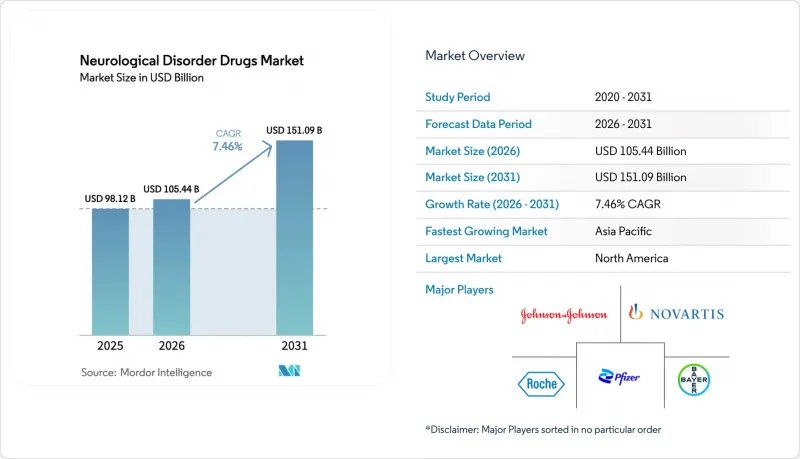
Mordor Intelligence에 따르면 신경계 질환 치료제 시장 규모는 2025년에 981억 2,000만 달러로 평가되며, 2026년 1,054억 4,000만 달러에서 2031년까지 1,510억 9,000만 달러에 달할 것으로 예측되며, 예측 기간(2026-2031년) 동안 CAGR은 7.46%가 될 전망입니다.
본 보고서는 적응증(알츠하이머병, 파킨슨병 등), 약물 분류(콜린에스테라제 억제제, NMDA 수용체 길항제 등), 투여 경로(경구, 정맥주사 등), 유통 채널(병원 약국, 소매 약국 등), 및 지역(북미 등)별로 분류되어 있습니다. 시장 예측은 금액(달러) 기준으로 제시되어 있습니다.
세계 신경계 질환 치료제 시장의 동향 및 인사이트
고령화와 중추신경계 질환 유병률의 증가
평균 수명의 연장에 따라 만성 신경 질환 환자의 절대 수가 증가하고 있습니다. 이러한 추세는 2050년까지 60세 이상 고령자가 인구의 30% 이상을 차지할 것으로 예상되는 고소득 국가에서 가장 두드러지게 나타나고 있습니다. 유럽에서는 이미 690만 명의 알츠하이머병 환자가 보고되었으며, 이 수치는 21세기 중반까지 두 배로 증가할 가능성이 있어, 보험사들은 더 조기적이고 고액의 치료에 대한 보험금 지급을 피할 수 없게 되었습니다. 파킨슨병, 간질, 다발성 경화증에서도 유사한 유병률 추세가 관찰되고 있으며, 지역 내 생산을 확대하는 제약 기업들은 선구자로서 판매량 우위를 확보할 수 있게 되었습니다. 또한 각국 정부는 예방적 선별 검사에 자금을 지원하고 있으며, 역설적이긴 하지만 이로 인해 진단된 유병률이 상승하고, 치료제의 대상이 되는 환자층이 확대되고 있습니다. 직접적인 경제적 부담이 규제 당국의 승인 절차를 가속화하고 있으며, 과학적 발견에서 임상 현장 도입에 이르는 피드백 루프가 긴밀해짐에 따라 신경계 질환 치료제 시장의 지속적인 확장이 뒷받침되고 있습니다.
획기적인 질환 수정 약물의 승인이 시장 신뢰를 뒷받침
레켄비의 정식 승인과 도나네맙의 3상 임상시험에서 나온 긍정적인 데이터는 아밀로이드를 표적으로 하는 치료 경로가 임상적 및 상업적 성공을 거둘 수 있음을 입증했으며, 고위험 신경퇴행성 질환 표적 치료의 유효성을 뒷받침했습니다. 매출의 급증은 고가의 정가에도 불구하고 지불 주체들의 강한 수용을 보여주고 있으며, 자본 시장은 헌팅턴병, ALS, 전두측두형 치매를 대상으로 한 차세대 질환 수정제 후보에 대한 지원 의지를 강화하고 있습니다. 유럽의약품청(EMA)은 레켄비에 대한 기존 입장을 재검토했습니다. 이는 미충족 의료 수요가 극히 높은 경우, 규제 당국이 혜택-위험 비율을 재평가할 의향이 있음을 보여줍니다. 이에 따라 각 기업은 신청까지의 기간을 단축하는 전략을 가속화하고 있으며, 전 세계 3상 임상시험의 피험자 모집을 강화하고 있습니다. 이러한 움직임은 상용화 주기를 단축하고 신경계 질환 치료제 시장을 더욱 확대할 것입니다.
개발 후기 단계의 높은 중도 탈락률과 연구개발비가 개발의 장벽으로 작용하고 있습니다
신경학 분야는 주요 치료 영역 중 3상 임상시험 성공률이 가장 낮으며, 종양학의 58%에 비해 30% 전후를 기록하고 있습니다. 복잡한 평가 지표, 위약 효과, 그리고 이질적인 병리생리학으로 인해 프로그램 비용의 중앙값은 20억 달러를 초과하여, 단일 자산에 의존하는 중소기업의 발목을 잡고 있습니다. 알츠하이머병 치료제의 주목할 만한 실패 사례에 여전히 경계심을 품고 있는 투자자들은 공동 개발을 통한 위험 분담을 요구하고 있으며, 이는 이익 확대를 저해하고 있습니다. 대기업들은 포트폴리오 다각화를 통해 이러한 문제를 완화하고 있지만, 막대한 지출로 인해 초기 탐색적 프로그램에서 자원이 빼앗기면서 신경 질환 치료제 산업으로의 단기적인 자금 유입이 둔화되고 있습니다.
부문별 분석
2025년, 알츠하이머병은 고가의 질병 수정 약물의 출시를 배경으로 신경계 질환 치료제 시장 매출의 28.67%를 차지했습니다. 보험사가 바이오마커로 확인된 초기 단계에서의 사용을 승인함에 따라 이 플랫폼은 확대되고 있으며, 높은 평균 판매 가격(ASP)을 뒷받침하여 신경계 질환 치료제 시장 전체의 규모를 끌어올리고 있습니다. 같은 기간 동안 희귀 및 난치성 신경계 질환은 희귀 의약품 독점권과 공공 보조금 지원에 힘입어 연평균 8.01%의 가장 빠른 성장률을 기록했습니다. 이러한 성장률의 차이는 포트폴리오 균형을 맞추는 데 있어 그 가치를 시사합니다. 즉, 폭넓은 환자층을 대상으로 하는 알츠하이머병 치료제는 예측 가능한 판매량을 창출하는 반면, 규모는 작지만 독점권이 높은 질환 영역은 이익률 향상을 가져옵니다.
헌팅턴병 및 레트 증후군 분야의 파이프라인 성과는 틈새 적응증이 어떻게 희석되지 않는 자금 조달로 전환되어, 기업이 매출 정점에 도달하기 전에 과학적 성과를 수익화할 수 있는지를 보여줍니다. 파킨슨병이나 간질 분야에서는 서방형L-도파나 3세대 나트륨 채널 차단제와 같은 점진적인 혁신이 한 자릿수 중반대의 성장을 유지하고 있지만, 상대적인 시장 점유율은 영향력이 큰 질병 수정 치료제에 점차 양보하고 있습니다. 편두통 분야에서는 CGRP 억제제가 트립탄 불응 환자 이외의 대상까지 예방 요법을 확대하고, 보다 유연한 임상 지침 하에서 여러 브랜드의 공존을 강화하는 등 바이오로직스 주도의 변혁이 계속되고 있습니다. 전반적으로, 적응증의 다양성은 단일 자산 위험에 대한 노출을 헤지하여 신경계 질환 치료제 시장을 안정적인 성장 궤도에 유지하고 있습니다.
항간질제는 확고한 처방 패턴과 폭넓은 보험 적용 범위 덕분에 2025년에도 신경계 질환 치료제 시장 점유율의 24.01%를 유지했습니다. 제네릭 의약품이 여전히 많은 환자 수를 차지하고 있지만, 브랜드 의약품의 정밀 분자가 희귀질환 치료제로서 보험 적용을 확보함에 따라 매출 집중도는 변화하고 있습니다. 한편, CGRP 단일클론 항체는 8.29%라는 최고 연평균 성장률(CAGR)을 기록하며, 지금까지 4종류 이상의 예방약군을 시도해 온 3,600만 명의 만성 편두통 환자라는 잠재 시장을 확대하고 있습니다.
콜린에스테라제 억제제와 NMDA 수용체 길항제는 여전히 알츠하이머병 치료의 주력이지만, 실세계 데이터에 따르면 레켄비나 도나네맙에 의한 점진적인 대체가 진행되고 있으며, 대증요법에서 질병 수정 요법으로의 전환이 재확인되고 있습니다. 도파민 작용제는 파킨슨병의 운동 증상 조절에 여전히 중요한 역할을 하고 있지만, 비운동 증상에 대한 평가 지표가 병용요법에 대한 수요를 견인하고 있습니다. 면역조절제, 특히 S1P 수용체 조절제는 다발성 경화증의 관해 지속 기간을 연장하는 한편, 바이오시밀러 인터페론은 비용 절감을 가져와 지불 주체가 신약에 대한 자금 지원을 가능하게 하고 있습니다. 이러한 구성의 변화는 다양한 약물 군의 동향이 신경계 질환 치료제 시장 전체의 회복력을 어떻게 강화하고 있는지를 여실히 보여주고 있습니다.
지역별 분석
북미는 2025년 신경계 질환 치료제 시장 규모의 39.35%를 차지했습니다. 이는 FDA 승인 질환 수정 약물의 조기 도입과 민간 보험사의 광범위한 보장 범위에 힘입은 결과입니다. 이 지역에서 고가 치료제에 대한 지불 기관의 수용성과 잘 갖춰진 임상시험 인프라가 결합되어, 영향력이 큰 의약품의 경우 출시 후 매출이 두 자릿수 성장을 유지하고 있습니다. 공공 정책도 수요를 뒷받침하고 있습니다. 메디케어의 아밀로이드 표적 치료제 보험 적용 결정 재검토는 사실상 수십억 달러 규모의 환급 경로를 열어주어, 해당 의약품을 보유한 기업의 매출 성장세를 가속화하고 있습니다.
유럽은 두 번째로 큰 시장 규모를 자랑하지만, 해당 지역의 환급 위원회가 비용 대비 효과 기준을 의무화하고 있기 때문에 시장 출시 시 가격 책정은 억제되고 있습니다. 유럽의약품청(EMA)의 조건부 승인에서는 일반적으로 실세계 데이터(RWE) 수집이 요구되며, 제약 기업들은 전 세계적으로 활용 가능한 결과 등록부를 운영할 수밖에 없습니다. 가격 규제는 엄격하지만, EU 전역에 걸친 희귀질환 의약품에 대한 우대 조치(10년간의 독점권 및 연구개발 세액 공제) 덕분에 희귀 신경 질환 적응증 분야에서 활기찬 하위 시장이 형성되고 있습니다. 독일의 DiGA 프로그램과 프랑스의 ETAPES 원격 모니터링 제도에 따른 디지털 헬스 시범 사업은 원격 진료의 통합을 촉진하고 있으며, 복약 순응도 지원 도구를 통해 간접적으로 처방전 조제 건수를 늘리고 있습니다.
아시아태평양은 가장 빠르게 성장하는 지역으로, 급속한 도시화, 소득 증가, 규제 조화를 통해 연평균 성장률(CAGR) 8.70%로 확대되고 있습니다. 중국의 국가 보험 의약품 목록에는 현재 여러 해외산 신경계 생물학적 제제가 포함되어 있어, 환자의 본인 부담금을 대폭 경감시키고 판매량 확대로 이어지고 있습니다. 일본의 선행 승인 제도는 심사 신속화를 통해 전 세계 개발 기업들을 계속해서 유치하고 있는 반면, 호주의 치료용 의약품청(TGA)은 FDA의 조치 후 몇 주 이내에 표시 변경을 조정함으로써 해당 지역 내 시장 출시를 효율화하고 있습니다. 인도 및 한국의 현지 생산에 대한 우대 조치는 CDMO에 대한 투자를 유치하여 공급망을 단축하는 동시에, 이익률 하락을 억제하는 현지 생산능력 구축으로 이어지고 있습니다. 이러한 종합적인 모멘텀을 바탕으로 아시아태평양은 향후 10년 동안 신경계 질환 치료제 시장을 확대하기 위한 전략적 거점으로서의 입지를 확고히 하고 있습니다.
기타 혜택:
- 엑셀 형식의 시장 예측(ME) 시트
- 3개월간의 애널리스트 지원
자주 묻는 질문
목차
제1장 소개
제2장 조사 방법
제3장 주요 요약
제4장 시장 구도
제5장 시장 규모와 성장 예측
제6장 경쟁 구도
제7장 시장 기회와 향후 전망
KSM 26.09.03According to Mordor Intelligence, the neurological disorder drugs market size was valued at USD 98.12 billion in 2025 and estimated to grow from USD 105.44 billion in 2026 to reach USD 151.09 billion by 2031, at a CAGR of 7.46% during the forecast period (2026-2031).
This report is Segmented by Indication (Alzheimer's Disease, Parkinson's Disease, and More), Drug Class (Cholinesterase Inhibitors, NMDA Receptor Antagonists, and More), Route of Administration (Oral, Intravenous, and More), Distribution Channel (Hospital Pharmacies, Retail Pharmacies, and More), and Geography (North America, and More). The Market Forecasts are Provided in Terms of Value (USD).
Global Neurological Disorder Drugs Market Trends and Insights
Ageing Population & Rising Prevalence of CNS Disorders
Longer life expectancy is increasing the absolute number of patients with chronic neurological illnesses, a trend most visible in high-income economies where individuals aged >= 60 will represent more than 30% of the population by 2050. Europe already reports 6.9 million Alzheimer's cases, a figure that could double before mid-century, prompting insurers to reimburse earlier and costlier interventions. Similar prevalence curves are appearing in Parkinson's disease, epilepsy, and multiple sclerosis, allowing manufacturers that expand regional production to secure first-mover volume advantages. Governments are also financing preventive screening that paradoxically lifts diagnosed prevalence and enlarges the addressable pool for therapeutics. The direct economic burden is pushing regulators to accelerate approvals, tightening the feedback loop between scientific discovery and bedside adoption and thereby supporting sustained expansion of the neurological disorder drugs market.
Breakthrough Disease-Modifying Approvals Drive Market Confidence
Leqembi's full approval and Donanemab's positive Phase III data have proven that amyloid-targeting pathways can achieve clinical and commercial success, validating high-risk neurodegenerative targets. Revenue ramp-ups have signaled strong payer acceptance despite high list prices, emboldening capital markets to back next-generation disease-modifying candidates across Huntington's disease, ALS, and frontotemporal dementia. The European Medicines Agency revised its earlier stance on Leqembi, highlighting regulators' willingness to re-assess benefit-risk when unmet need is compelling. Companies are reacting by accelerating time-to-submission strategies and intensifying global Phase III enrolment, moves that shorten commercialization cycles and further enlarge the neurological disorder drugs market.
High Late-Stage Attrition & R&D Costs Create Development Barriers
Neurology maintains the lowest Phase III success rate among major therapeutic areas, hovering near 30% compared with 58% for oncology. Complex endpoints, placebo effects, and heterogeneous pathophysiology drive median program costs above USD 2 billion, throttling smaller companies reliant on single assets. Investors, still wary from high-profile Alzheimer's failures, require co-development risk-sharing that dilutes upside. Large firms mitigate through diversified portfolios, but the absolute spend siphons resources from early exploratory programs, dampening near-term asset flow into the neurological disorder drugs industry.
Other drivers and restraints analyzed in the detailed report include:
- Expansion of Orphan-Drug Incentives Accelerates Rare-Disease Development
- AI-Enabled Neuro-Drug Discovery Transforms Pipeline Development
- Patent Cliff Pressures Intensify Competitive Dynamics
For complete list of drivers and restraints, kindly check the Table Of Contents.
Segment Analysis
Alzheimer's disease generated 28.67% of neurological disorder drugs market revenue in 2025 on the back of high-ticket disease-modifying launches. The platform is widening as payers approve biomarker-confirmed early-stage use, anchoring premium ASPs and elevating the overall neurological disorder drugs market size. In the same period, rare & orphan neurologic diseases grew fastest, advancing at an 8.01% CAGR owing to orphan-drug exclusivity and public-grant co-funding. The differential growth rates signal portfolio-balancing value: broad-based Alzheimer's drugs produce predictable volume while smaller, high-exclusivity disorders deliver margin upside.
Pipeline readouts in Huntington's and Rett syndrome illustrate how niche indications can pivot to non-dilutive financing, allowing firms to monetize science before peak-sales maturity. Across Parkinson's and epilepsy, incremental innovation-such as extended-release L-dopa and third-generation sodium-channel blockers-sustains mid-single-digit growth but cedes relative share to high-impact disease-modifiers. Migraine continues its biologics-driven transformation, as CGRP inhibitors expand prophylaxis beyond triptan non-responders, reinforcing multi-brand coexistence under roomier clinical guidelines. Collectively, indication diversity hedges exposure to single-asset risk and keeps the neurological disorder drugs market on a stable expansion path.
Antiepileptics retained 24.01% of the neurological disorder drugs market share in 2025 thanks to entrenched prescribing patterns and broad insurance coverage. Their generics bulk still provides high patient volume, but revenue concentration is shifting as branded precision molecules secure orphan reimbursement. CGRP monoclonal antibodies, however, recorded the highest 8.29% CAGR, scaling an addressable pool of 36 million chronic migraine patients who previously cycled through four or more preventive classes.
Cholinesterase inhibitors and NMDA antagonists remain Alzheimer's mainstays, yet real-world evidence indicates gradual slot replacement by Leqembi and Donanemab, reaffirming the transition from symptomatic to disease-modifying therapy. Dopamine agonists preserve relevance in Parkinson's motor-symptom control, but non-motor endpoints drive demand for combination protocols. Immunomodulators, notably S1P receptor modulators, widen multiple-sclerosis remission durability, while biosimilar interferons introduce cost offsets that allow payors to fund novel agents. This compositional shift underscores how diversified drug-class dynamics reinforce resilience across the neurological disorder drugs market.
Complete Report Scope:
- By Indication
- Alzheimer's Disease
- Parkinson's Disease
- Epilepsy
- Multiple Sclerosis
- Migraine
- ADHD & Other Psychiatric CNS
- Rare & Orphan Neurological Disorders
- By Drug Class
- Cholinesterase Inhibitors
- NMDA Receptor Antagonists
- Dopamine Agonists & Precursors
- Antiepileptics
- CGRP & Other Novel Biologics
- Immunomodulators
- Neuroprotective / Disease-Modifying Agents
- By Route of Administration
- Oral
- Intravenous
- Intranasal
- Others
- By Distribution Channel
- Hospital Pharmacies
- Retail Pharmacies
- Online Pharmacies
- By Geography
- North America
- United States
- Canada
- Mexico
- Europe
- Germany
- United Kingdom
- France
- Italy
- Spain
- Rest of Europe
- Asia-Pacific
- China
- India
- Japan
- South Korea
- Australia
- Rest of Asia-Pacific
- South America
- Brazil
- Argentina
- Rest of South America
- Middle East and Africa
- GCC
- South Africa
- Rest of Middle East and Africa
- North America
Geography Analysis
North America generated 39.35% of the neurological disorder drugs market size in 2025, underpinned by early uptake of FDA-approved disease-modifying agents and broad private-payer coverage. The region's payer tolerance for premium therapies, combined with strong clinical-trial infrastructure, sustains double-digit launch trajectories for high-impact assets. Public policy also fuels demand: Medicare's revised coverage decision for amyloid-targeting drugs effectively opens a multi-billion-dollar reimbursement channel, accelerating top-line momentum for asset holders.
Europe follows as the second-largest arena, though its reimbursement committees mandate cost-effectiveness thresholds that temper launch pricing. The EMA's conditional endorsements typically require real-world evidence collection, compelling manufacturers to run outcome registries that can be leveraged globally. Despite tighter price discipline, pan-EU orphan-drug incentives-ten-year exclusivity and R&D tax credits-create vibrant sub-markets for rare neurological indications. Digital-health pilots in Germany's DiGA program and France's ETAPES tele-monitoring scheme are catalyzing remote-care integration, indirectly boosting prescription fills through adherence tools.
Asia-Pacific is the fastest-growing cluster, advancing at a 8.70% CAGR thanks to rapid urbanization, rising incomes, and regulatory harmonization. China's National Reimbursement Drug List now incorporates several foreign neurological biologics, substantially reducing patient copays and unlocking volume. Japan's Sakigake pathway continues to entice global developers with expedited review, while Australia's Therapeutic Goods Administration aligns labeling changes within weeks of FDA actions, streamlining regional launches. Local manufacturing incentives in India and South Korea attract CDMO investment, shortening supply chains and building indigenous capacity that keeps margin erosion under control. The collective momentum positions Asia-Pacific as a strategic focal point for scaling the neurological disorder drugs market over the next decade.
- Biogen
- Pfizer
- Novartis
- Johnson & Johnson
- Eli Lilly and Company
- Merck
- Roche
- Takeda Pharmaceuticals
- Eisai
- Abbvie
- Teva Pharmaceutical Industries
- UCB
- Lundbeck
- Sanofi
- Amgen
- Jazz Pharmaceuticals
- Neurocrine Biosciences
- Acadia Pharmaceuticals
- Sage Therapeutics
- Sunovion (Sumitomo)
Additional Benefits:
- The market estimate (ME) sheet in Excel format
- 3 months of analyst support
TABLE OF CONTENTS
1 Introduction
- 1.1 Study Assumptions & Market Definition
- 1.2 Scope of the Study
2 Research Methodology
3 Executive Summary
4 Market Landscape
- 4.1 Market Overview
- 4.2 Market Drivers
- 4.2.1 Ageing population & rising prevalence of CNS disorders
- 4.2.2 Breakthrough disease-modifying approvals (e.g., Leqembi, Donanemab)
- 4.2.3 Expansion of orphan-drug incentives for rare neurologic diseases
- 4.2.4 AI-enabled neuro-drug discovery accelerating early pipelines
- 4.2.5 Novel BBB & intranasal delivery platforms reach late-stage trials
- 4.2.6 Venture funding surge in psychedelic-assisted neurotherapeutics
- 4.3 Market Restraints
- 4.3.1 High late-stage attrition & R&D costs in CNS
- 4.3.2 Wave of blockbuster patent expiries (2025-29)
- 4.3.3 Supply shortage of cGMP neuro-APIs & sterile injectables
- 4.3.4 Rising regulatory scrutiny on CNS drug misuse & addiction
- 4.4 Value / Supply-Chain Analysis
- 4.5 Regulatory Landscape
- 4.6 Technological Outlook
- 4.7 Porter's Five Forces
- 4.7.1 Threat of New Entrants
- 4.7.2 Bargaining Power of Buyers
- 4.7.3 Bargaining Power of Suppliers
- 4.7.4 Threat of Substitutes
- 4.7.5 Competitive Rivalry
5 Market Size & Growth Forecasts (Value, USD)
- 5.1 By Indication
- 5.1.1 Alzheimer's Disease
- 5.1.2 Parkinson's Disease
- 5.1.3 Epilepsy
- 5.1.4 Multiple Sclerosis
- 5.1.5 Migraine
- 5.1.6 ADHD & Other Psychiatric CNS
- 5.1.7 Rare & Orphan Neurological Disorders
- 5.2 By Drug Class
- 5.2.1 Cholinesterase Inhibitors
- 5.2.2 NMDA Receptor Antagonists
- 5.2.3 Dopamine Agonists & Precursors
- 5.2.4 Antiepileptics
- 5.2.5 CGRP & Other Novel Biologics
- 5.2.6 Immunomodulators
- 5.2.7 Neuroprotective / Disease-Modifying Agents
- 5.3 By Route of Administration
- 5.3.1 Oral
- 5.3.2 Intravenous
- 5.3.3 Intranasal
- 5.3.4 Others
- 5.4 By Distribution Channel
- 5.4.1 Hospital Pharmacies
- 5.4.2 Retail Pharmacies
- 5.4.3 Online Pharmacies
- 5.5 By Geography
- 5.5.1 North America
- 5.5.1.1 United States
- 5.5.1.2 Canada
- 5.5.1.3 Mexico
- 5.5.2 Europe
- 5.5.2.1 Germany
- 5.5.2.2 United Kingdom
- 5.5.2.3 France
- 5.5.2.4 Italy
- 5.5.2.5 Spain
- 5.5.2.6 Rest of Europe
- 5.5.3 Asia-Pacific
- 5.5.3.1 China
- 5.5.3.2 India
- 5.5.3.3 Japan
- 5.5.3.4 South Korea
- 5.5.3.5 Australia
- 5.5.3.6 Rest of Asia-Pacific
- 5.5.4 South America
- 5.5.4.1 Brazil
- 5.5.4.2 Argentina
- 5.5.4.3 Rest of South America
- 5.5.5 Middle East and Africa
- 5.5.5.1 GCC
- 5.5.5.2 South Africa
- 5.5.5.3 Rest of Middle East and Africa
- 5.5.1 North America
6 Competitive Landscape
- 6.1 Market Concentration
- 6.2 Market Share Analysis
- 6.3 Company Profiles (includes Global level Overview, Market level overview, Core Segments, Financials as available, Strategic Information, Market Rank/Share for key companies, Products & Services, and Recent Developments)
- 6.3.1 Biogen
- 6.3.2 Pfizer
- 6.3.3 Novartis
- 6.3.4 Johnson & Johnson (Janssen)
- 6.3.5 Eli Lilly
- 6.3.6 Merck & Co.
- 6.3.7 Roche
- 6.3.8 Takeda
- 6.3.9 Eisai
- 6.3.10 AbbVie
- 6.3.11 Teva Pharmaceutical
- 6.3.12 UCB
- 6.3.13 Lundbeck
- 6.3.14 Sanofi
- 6.3.15 Amgen
- 6.3.16 Jazz Pharmaceuticals
- 6.3.17 Neurocrine Biosciences
- 6.3.18 Acadia Pharmaceuticals
- 6.3.19 Sage Therapeutics
- 6.3.20 Sunovion (Sumitomo)
7 Market Opportunities & Future Outlook
- 7.1 White-space & Unmet-need Assessment


