|
시장보고서
상품코드
2119665
의약품용 카트리지 : 시장 점유율 분석, 업계 동향과 통계, 성장 예측(2026-2031년)Pharmaceutical Cartridges - Market Share Analysis, Industry Trends & Statistics, Growth Forecasts (2026 - 2031) |
||||||
 Mordor Intelligence
Mordor Intelligence에 따르면 의약품용 카트리지 시장 규모는 2025년 18억 6,000만 달러에서 2026년에는 20억 1,000만 달러로 확대되고, 2026년부터 2031년까지 CAGR 7.80%를 기록하며 2031년까지 29억 2,000만 달러에 달할 것으로 예측됩니다.
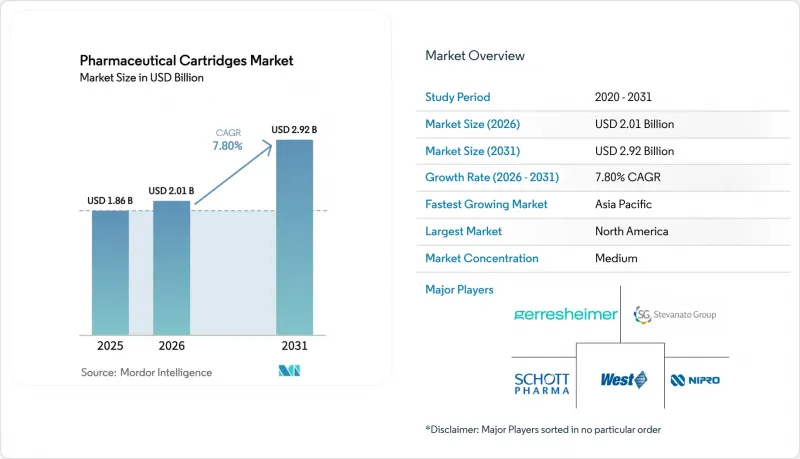
본 보고서는 소재(유리[타입 I 등], 엔지니어링 플라스틱[COP/COC 등] 등), 투여 기기와 호환성(재사용 가능한 펜형 주사기, 자동 주사기 등), 용량(3mL 미만, 3-5mL 등), 치료 분야(안과 등), 최종사용자(제약 회사 등), 및 지역별로 분류되어 있습니다. 시장 예측은 금액(달러) 기준으로 제시되어 있습니다.
세계 의약품용 카트리지 시장의 동향 및 인사이트
자가 주사용 펜 및 웨어러블 주사기에 대한 수요 증가
펜형 주사기 및 웨어러블 펌프는 현재 환자 중심 치료의 기반이 되고 있으며, 환자가 진료소를 방문하지 않고도 만성 질환을 치료할 수 있게 해줍니다. Ypsomed사는 2024년에 재사용 가능한 펜 1,200만 개 이상, 프리필드 펜 17억 개 이상을 판매하여 이러한 보급 규모를 뒷받침하고 있습니다. 2형 당뇨병 환자가 약 5억 명, 비만으로 고통받는 사람이 10억 명에 달하는 가운데, 빈번한 투약을 지원하는 사용하기 쉬운 기기는 필수적입니다. 임상 연구에 따르면 최대 10mL의 피하 주사도 환자의 79%가 수용 가능하며, 통증은 30분 이내에 기준치로 돌아오는 것으로 나타났습니다. 따라서 카트리지 용량을 확대하는 것은 소비자의 편의성 기준을 충족시키는 것이 됩니다. 또한, 커넥티드 펜은 투여 데이터를 기록하여 복약 순응도를 모니터링할 수 있게 되었으며, 투여용 하드웨어가 실제 세계 데이터(REW)의 도구로 기능함으로써 제약 기업의 가치 제안을 강화하고 있습니다. 재택 치료가 예외에서 표준으로 전환됨에 따라, 이러한 추세는 의약품용 카트리지 시장에 안정적인 수요를 가져오고 있습니다.
GLP-1 계열 비만 치료제 및 고점도 바이오의약품의 카트리지 투여로의 전환
GLP-1 수용체 작용제는 가장 빠르게 성장하는 의약품 군으로, 당뇨병 치료에서 비만 치료로 용도가 확대됨에 따라 카트리지의 신규 수주를 견인하고 있습니다. West Pharmaceutical Services는 주로 이 분야를 대상으로 한 다년간의 엘라스토머 공급 계약을 체결했으며, 자사의 독자적인 사업 부문 매출의 73%를 이미 자가 주사용 제품이 차지하고 있습니다. 15 cP를 초과하는 고점도 제제에 대응하기 위해 BD사는 Ypsomed사와 제휴하여 Neopak XtraFlow 유리 주사기를 자동 주사기와 결합함으로써 원활한 피하 투여를 실현했습니다. 특허 조사에 따르면, GLP-1 관련 출원의 57%는 분자 자체가 아닌 투여 메커니즘에 관한 것으로, 이는 제네릭 의약품에 의한 시장 잠식을 지연시키면서 카트리지 수요를 높게 유지할 수 있는 경쟁 우위를 보여줍니다. 리필이 가능한 자동 주사기는 보다 친환경적이고 저비용인 대안으로 부상하고 있지만, 여전히 여러 번의 작동에 견딜 수 있도록 설계된 견고한 카트리지에 의존하고 있습니다. 이러한 동향으로 인해 의약품용 카트리지 시장 전반에서 생산능력 확충이 시급한 과제가 되고 있습니다.
복잡한 다단계 제조 공정과 엄격한 cGMP 검증
카트리지 제조에는 인출력, 미끄럼력, 플런저 이동량에 대해 정밀한 공차가 요구됩니다. USP(382)에서는 현재 개별 부품 검사 대신 용기·밀폐 시스템 시험이 의무화되어 있어 새로운 검증 단계가 추가되었습니다. 각 변수에 대해 통계적 검증이 이루어지기 때문에 개발 주기가 12-18개월 정도 길어질 가능성이 있습니다. 규제 당국은 성능 지표 외에도 알고리즘의 논리를 요구하고 있으므로, AI 도구의 도입을 통해 투명성을 확보해야 할 필요성이 더욱 커지고 있습니다. 고등급 클린룸, 배리어 아이솔레이터 및 검증 완료된 피로겐 제거 오븐은 설비 투자 장벽을 높여 신규 진입을 저해하고, 의약품용 카트리지 시장의 생산능력 확대를 지연시키고 있습니다.
부문 분석
2025년 현재, 유리는 의약품용 카트리지 시장 전체의 72.88% 점유율을 차지하고 있으며, 이는 수십 년에 걸친 규제 당국의 신뢰와 유리의 불활성 및 투명한 특성을 반영한 것입니다. 이 부문은 충전 및 마무리 시설 전반에 걸친 광범위한 라인과의 호환성과 풍부한 기존 설비의 혜택을 받고 있습니다. 엔지니어링 플라스틱, 특히 COC 및 COP는 파손에 강하고 높은 pH의 생체 환경에도 내성이 있어 신규 항암제에 유리하며, 11.71%의 연평균 성장률(CAGR)로 성장하고 있습니다. TOPAS Advanced Polymers가 사이클로올레핀 소재로서는 최초로 USP 661.1 규격 준수를 획득함으로써 규제 당국의 승인을 받았습니다.
의약품용 카트리지 업계의 각사는 유리 생산 속도에 필적하는 폴리머 생산 라인에 투자하고 있지만, 유리 공급업체 측은 외관상의 불량품을 줄이기 위해 SCHOTT EVERIC 등의 강화 붕규산 유리를 도입하여 대응하고 있습니다. 극저온 보관이 필요한 항암제 파이프라인에서는 저온에서의 밀봉 성능이 유리보다 우수하기 때문에 폴리머가 선호되고 있습니다. 지속가능성을 둘러싼 논의도 긴장감을 높이고 있습니다. 폴리머는 에너지 절약형 성형이 가능한 반면, 유리는 이미 입증된 재활용성을 강점으로 내세우고 있습니다. 양 진영이 의약품용 카트리지 시장 점유율 확보를 목표로 첨단 코팅 및 실리콘화 처리 개선을 내세우면서 경쟁은 더욱 치열해질 것입니다.
재사용 가능한 펜형 주사기는 수십 년에 걸친 인슐린 요법에서의 정착으로 인해 2025년에는 의약품용 카트리지 시장 규모의 43.55%를 차지했습니다. 그러나 체내 착용형 펌프는 자택에서 주 1회 GLP-1이나 항암 생물학적 제제를 투여하기 위한 5-10mL 카트리지를 내장하고 있어, 2031년까지 연평균 성장률(CAGR) 10.98%로 성장할 것으로 예측됩니다. BD Libertas사의 웨어러블 주사기는 최대 50 cP의 약물을 피하 투여하는 데 성공하여 기술적 실용성을 입증했습니다.
현재 의료기기 제조업체들은 플랫폼에 관계없이 유리 및 엘라스토머의 적합성을 확보하기 위한 다중 공급업체 네트워크를 구축하고 있으며, Ypsomed사는 15개 이상의 파트너사와 협력하여 전 세계 재고 확보에 힘쓰고 있습니다. 점도가 높은 약물을 안전하게 취급하기 위해 기존의 스프링 대신 가스 구동식 드라이버와 AI를 통한 구동력 모니터링이 도입되고 있습니다. Aktiv Medical Systems사에서는 5.5mL 용량을 상정한 자동 주사기가 출시되어, 고용량화 추세가 나타나고 있습니다. 이러한 변화는 선택의 폭을 넓혀 의약품용 카트리지 시장 전체를 견인하고 있습니다.
지역별 분석
북미는 2025년,Novo Nordisk사의 41억 달러 규모의 충전·포장 캠퍼스와 노스캐롤라이나주에 위치한 SCHOTT Pharma사의 3억 7,100만 달러 규모의 폴리머 주사기 공장 등 대규모 자본 프로젝트에 힘입어, 의약품용 카트리지 시장에서 38.21%의 점유율을 차지했습니다. FDA의 첨단 제조 기술 장려 정책이 AI 및 모듈형 아이솔레이터 도입을 가속화하며, 이 지역을 차세대 생산의 세계적 벤치마크로 자리매김하고 있습니다.
유럽은 RTU(즉시 사용형) 채택을 촉진하는 부속서 1의 무균성 개혁에 힘입어 북미에 근소한 차이로 뒤를 잇고 있습니다. Stevanato Group의 시스테르나 디 라티나(Cisterna di Latina) 신규 시설은 이 지역의 EZ-fill 카트리지 생산능력을 강화하고 있으며, 현지 생산을 통한 공급 안정화를 목표로 하는 EU의 중요 의약품법에 부합합니다. 공동 임상 평가 규정 및 향후 시행될 의료 기술 평가 규정에 따라 수요가 통일되어, 여러 시장에서 적합성이 입증된 공급업체에 유리하게 작용하고 있습니다.
아시아태평양은 2031년까지 연평균 성장률(CAGR) 9.84%로 성장할 것으로 예측되며, 이는 세계에서 가장 빠른 속도입니다. 인도의 Kapoor Glass사는 카트리지 생산량의 90%를 유럽 및 미국 고객에게 수출하고 있으며, 이 지역의 비용 효율성이 뛰어난 제조 기반을 뒷받침하고 있습니다. 아시아 제약협회 파트너십 회의를 통한 규제 조화로 국경을 초월한 승인 절차가 원활해지고 있습니다. 한국과 싱가포르 등 여러 국가는 바이오기술 거점 육성에 주력하고 있는 반면, 중국에서는 바이오의약품 부문의 확대에 따라 고품질 밀봉 기술에 대한 수요가 증가하고 있습니다. 이러한 노력들이 결합되어 아시아태평양은 의약품용 카트리지 시장에서 매우 중요한 성장 엔진으로서의 입지를 확고히 하고 있습니다.
기타 혜택:
- 엑셀 형식의 시장 예측(ME) 시트
- 3개월간의 애널리스트 지원
자주 묻는 질문
목차
제1장 소개
제2장 조사 방법
제3장 주요 요약
제4장 시장 구도
제5장 시장 규모와 성장 예측
제6장 경쟁 구도
제7장 시장 기회와 향후 전망
KSM 26.09.03According to Mordor Intelligence, the pharmaceutical cartridge market size is expected to grow from USD 1.86 billion in 2025 to USD 2.01 billion in 2026 and is forecast to reach USD 2.92 billion by 2031 at 7.80% CAGR over 2026-2031.
This report is Segmented by Material (Glass [Type I and More], Engineering Plastics [COP/COC and More] and More), Delivery Device Compatibility (Reusable Pen Injectors, Autoinjectors and More), Capacity (<3ml, 3ml-5ml, and More), Therapeutic Area (Ophthalmology and More), End User (Pharmaceutical Companies, and More), and Geography. The Market Forecasts are Provided in Terms of Value (USD).
Global Pharmaceutical Cartridges Market Trends and Insights
Rising Demand for Self-Injection Pen and Wearable Injector Formats
Pen injectors and wearable pumps now anchor patient-centred treatment, letting individuals administer chronic therapies without clinic visits. Ypsomed sold over 12 million reusable pens and 1.7 billion prefilled pens in 2024, underscoring adoption scale. With roughly 500 million people living with type 2 diabetes and 1 billion affected by obesity, user-friendly devices that support frequent dosing have become essential. Clinical work shows subcutaneous injections up to 10 mL win 79% patient acceptance and pain returns to baseline within 30 minutes, so expanding cartridge volumes meets consumer comfort thresholds.Connected pens now log dosing data for adherence monitoring, turning delivery hardware into real-world evidence tools that strengthen pharma value propositions. The trend adds steady volume to the pharmaceutical cartridge market as home therapy shifts from exception to norm.
Shift of GLP-1 Obesity and High-Viscosity Biologics to Cartridge Delivery
GLP-1 receptor agonists have become the fastest-growing pharmaceutical class and their migration from diabetes into obesity care drives new cartridge orders. West Pharmaceutical Services secured multiyear elastomer deals chiefly aimed at this vertical, with self-injection products already forming 73% of its proprietary segment sales. To handle formulations thicker than 15 cP, BD partnered with Ypsomed to pair Neopak XtraFlow glass syringes with autoinjectors, ensuring smooth subcutaneous delivery. Patent reviews show 57% of GLP-1 filings address delivery mechanisms rather than molecules, revealing competitive moats that could slow generic erosion while keeping cartridge demand high. Reloadable autoinjectors are surfacing as greener, lower-cost alternatives, but they still rely on rugged cartridges engineered for multiple actuations. These developments are injecting urgency into capacity build-outs across the pharmaceutical cartridge market.
Complex Multi-Step Manufacturing and Stringent cGMP Validation
Cartridge fabrication requires precision tolerances for break-loose force, glide force, and plunger travel. USP (382) now mandates container-closure system testing rather than individual component checks, adding fresh validation layers. Development cycles can lengthen 12-18 months as each variable undergoes statistical validation. AI tools add transparency demands because regulators want algorithm logic alongside performance metrics. High-grade cleanrooms, barrier isolators, and validated depyrogenation ovens raise capital thresholds, deterring new entrants and slowing capacity additions within the pharmaceutical cartridge market.
Other drivers and restraints analyzed in the detailed report include:
- Emergence of Large-Volume Wearable On-Body Injector Cartridges (>= 10 mL)
- EU MDR Annex 1 Sterility Rules Spurring RTU Cartridge Adoption
- Substitution Risk from Pre-Filled Syringes in <= 3 mL Range
For complete list of drivers and restraints, kindly check the Table Of Contents.
Segment Analysis
Glass held 72.88% of overall pharmaceutical cartridge market share in 2025, reflecting decades of regulatory confidence and its inert, transparent nature. The segment benefits from broad line compatibility and ample legacy tooling across fill-finish sites. Engineering plastics, notably COC and COP, are rising at a 11.71% CAGR because they resist breakage and tolerate high-pH biology, advantageous for novel oncology agents. Regulatory endorsement arrived when TOPAS Advanced Polymers secured the first USP 661.1 compliance for cyclic olefins.
Pharmaceutical cartridge industry players invest in polymer lines that match glass output speeds, but glass suppliers reply with strengthened borosilicate such as SCHOTT EVERIC to cut cosmetic rejects. Oncology pipelines that require cryogenic storage lean toward polymer because its seal integrity outperforms glass at low temperatures. Sustainability debates add tension; polymers allow energy-lite molding, while glass touts proven recyclability. Competition will intensify as both camps market advanced coatings and siliconization upgrades to capture share within the pharmaceutical cartridge market.
Reusable pen injectors secured 43.55% of pharmaceutical cartridge market size in 2025, entrenched by decades of insulin therapy familiarity. Yet wearable on-body pumps are forecast to grow 10.98% CAGR through 2031 because they house 5-10 mL cartridges that deliver weekly GLP-1 or oncology biologics at home. BD Libertas wearable injectors proved subcutaneous delivery for agents up to 50 cP, confirming technical readiness.
Device makers now forge multi-supplier networks ensuring glass and elastomer fit across platforms, as Ypsomed coordinates more than 15 partners to secure global inventory. Gas-driven drivers and AI-monitored actuation force replace traditional springs to handle viscous drugs safely. Autoinjectors targeting 5.5 mL volumes arrive from Aktiv Medical Systems, pointing to higher-dose standards. These changes expand choice and lift the overall pharmaceutical cartridge market.
Complete Report Scope:
- By Material
- Glass
- Type I (Borosilicate)
- Type II (Soda-lime treated)
- Type III (Soda-lime)
- Engineering Plastics
- COP/COC (Cyclic Olefin)
- PETG/Other Polymers
- Elastomers & Rubber Components
- Glass
- By Delivery-Device Compatibility
- Reusable pen injectors
- Disposable pen injectors
- Wearable on-body pumps
- Dental local-anaesthesia syringes
- Autoinjectors
- By Capacity (mL)
- < 3
- 3 - 5
- 5 - 10
- > 10 (large-volume)
- By Therapeutic Area
- Ophthalmology
- Respiratory
- Neurology
- Oncology
- Immunology (incl. mAbs)
- Cardiology
- Diabetes (insulins, GLP-1)
- Dental Anaesthesia
- Other Therapies
- By End User
- Pharmaceutical Companies
- Biotechnology Firms
- CMOs / CDMOs
- Other End-users (animal health, dental clinics)
- By Geography
- North America
- United States
- Canada
- Mexico
- Europe
- Germany
- United Kingdom
- France
- Italy
- Spain
- Rest of Europe
- Asia-Pacific
- China
- Japan
- India
- Australia
- South Korea
- Rest of Asia-Pacific
- Middle East and Africa
- GCC
- South Africa
- Rest of Middle East and Africa
- South America
- Brazil
- Argentina
- Rest of South America
- North America
Geography Analysis
North America held 38.21% pharmaceutical cartridge market share in 2025 backed by heavy capital projects such as Novo Nordisk's USD 4.1 billion fill-finish campus and SCHOTT Pharma's USD 371 million polymer syringe plant in North Carolina. FDA encouragement of advanced manufacturing accelerates AI and modular isolator uptake, positioning the region as a global benchmark for next-gen production.
Europe follows closely owing to Annex 1 sterility reforms that push RTU adoption. Stevanato Group's new Cisterna di Latina facility adds regional capacity for EZ-fill cartridges, aligning with the EU Critical Medicines Act that seeks supply-security via local output. Joint clinical-assessment rules and the forthcoming Health Technology Assessment Regulation unify demand, favouring suppliers with proven conformity across multiple markets.
Asia Pacific is forecast to grow 9.84% CAGR through 2031, the fastest worldwide. India's Kapoor Glass exports 90% of its cartridge output to Western clients, underpinning the region's cost-efficient manufacturing base. Regulatory harmonization through the Asia Partnership Conference of Pharmaceutical Associations sparks smoother cross-border approvals. Countries like South Korea and Singapore nurture biotech hubs, while China's expanding biologics sector heightens need for high-quality containment. Collectively these initiatives cement Asia Pacific as a pivotal growth engine for the pharmaceutical cartridge market.
- Stevanato Group
- SCHOTT
- West Pharmaceutical Services
- Gerresheimer
- Nipro
- Datwyler Holding
- AptarGroup
- Merck KGaA (Sigma Aldrich cartridges)
- Transcoject GmbH
- Shandong Medicinal Glass
- Terumo
- Becton Dickinson & Co.
- Ypsomed
- Haselmeier GmbH (medmix)
- Vetter Pharma International
- Owen Mumford
- Cole Parmer (Glass Cartridges)
- Baxter
- CordenPharma Integra Plastics
- SGD Pharma
Additional Benefits:
- The market estimate (ME) sheet in Excel format
- 3 months of analyst support
TABLE OF CONTENTS
1 Introduction
- 1.1 Study Assumptions and Market Definition
- 1.2 Scope of the Study
2 Research Methodology
3 Executive Summary
4 Market Landscape
- 4.1 Market Overview
- 4.2 Market Drivers
- 4.2.1 Rising Demand For Self-Injection Pen & Wearable Injector Formats
- 4.2.2 Shift Of GLP-1 Obesity & High-Viscosity Biologics To Cartridge Delivery
- 4.2.3 Emergence Of Large-Volume Wearable On-Body Injector Cartridges (>=10 Ml)
- 4.2.4 EU MDR Annex 1 Sterility Rules Spurring RTU Cartridge Adoption
- 4.2.5 AI-Driven Fill-Finish Automation Cutting Glass Breakage & Scrap
- 4.2.6 UDI-Enabled Smart Laser-Marked Glass For Traceability
- 4.3 Market Restraints
- 4.3.1 Complex Multi-Step Manufacturing & Stringent Cgmp Validation
- 4.3.2 Substitution Risk From Pre-Filled Syringes In <=3 Ml Range
- 4.3.3 Global Borosilicate Tubing Shortages Due To Solar-Glass Demand
- 4.3.4 Rising Investment In Needle-Free Micro-Array Patches
- 4.4 Value / Supply-Chain Analysis
- 4.5 Regulatory Landscape
- 4.6 Technology Outlook
- 4.7 Porter's Five Forces Analysis
- 4.7.1 Bargaining Power of Suppliers
- 4.7.2 Bargaining Power of Buyers
- 4.7.3 Threat of New Entrants
- 4.7.4 Threat of Substitutes
- 4.7.5 Intensity of Competitive Rivalry
5 Market Size and Growth Forecasts (Value-USD)
- 5.1 By Material
- 5.1.1 Glass
- 5.1.1.1 Type I (Borosilicate)
- 5.1.1.2 Type II (Soda-lime treated)
- 5.1.1.3 Type III (Soda-lime)
- 5.1.2 Engineering Plastics
- 5.1.2.1 COP/COC (Cyclic Olefin)
- 5.1.2.2 PETG/Other Polymers
- 5.1.3 Elastomers & Rubber Components
- 5.1.1 Glass
- 5.2 By Delivery-Device Compatibility
- 5.2.1 Reusable pen injectors
- 5.2.2 Disposable pen injectors
- 5.2.3 Wearable on-body pumps
- 5.2.4 Dental local-anaesthesia syringes
- 5.2.5 Autoinjectors
- 5.3 By Capacity (mL)
- 5.3.1 < 3
- 5.3.2 3 - 5
- 5.3.3 5 - 10
- 5.3.4 > 10 (large-volume)
- 5.4 By Therapeutic Area
- 5.4.1 Ophthalmology
- 5.4.2 Respiratory
- 5.4.3 Neurology
- 5.4.4 Oncology
- 5.4.5 Immunology (incl. mAbs)
- 5.4.6 Cardiology
- 5.4.7 Diabetes (insulins, GLP-1)
- 5.4.8 Dental Anaesthesia
- 5.4.9 Other Therapies
- 5.5 By End User
- 5.5.1 Pharmaceutical Companies
- 5.5.2 Biotechnology Firms
- 5.5.3 CMOs / CDMOs
- 5.5.4 Other End-users (animal health, dental clinics)
- 5.6 By Geography
- 5.6.1 North America
- 5.6.1.1 United States
- 5.6.1.2 Canada
- 5.6.1.3 Mexico
- 5.6.2 Europe
- 5.6.2.1 Germany
- 5.6.2.2 United Kingdom
- 5.6.2.3 France
- 5.6.2.4 Italy
- 5.6.2.5 Spain
- 5.6.2.6 Rest of Europe
- 5.6.3 Asia-Pacific
- 5.6.3.1 China
- 5.6.3.2 Japan
- 5.6.3.3 India
- 5.6.3.4 Australia
- 5.6.3.5 South Korea
- 5.6.3.6 Rest of Asia-Pacific
- 5.6.4 Middle East and Africa
- 5.6.4.1 GCC
- 5.6.4.2 South Africa
- 5.6.4.3 Rest of Middle East and Africa
- 5.6.5 South America
- 5.6.5.1 Brazil
- 5.6.5.2 Argentina
- 5.6.5.3 Rest of South America
- 5.6.1 North America
6 Competitive Landscape
- 6.1 Market Concentration
- 6.2 Market Share Analysis
- 6.3 Company profiles (includes Global level Overview, Market level overview, Core Segments, Financials as available, Strategic Information, Market Rank/Share for key companies, Products and Services, and Recent Developments)
- 6.3.1 Stevanato Group
- 6.3.2 Schott AG
- 6.3.3 West Pharmaceutical Services
- 6.3.4 Gerresheimer AG
- 6.3.5 Nipro Corporation
- 6.3.6 Datwyler Holding
- 6.3.7 AptarGroup
- 6.3.8 Merck KGaA (Sigma Aldrich cartridges)
- 6.3.9 Transcoject GmbH
- 6.3.10 Shandong Medicinal Glass
- 6.3.11 Terumo Corporation
- 6.3.12 Becton Dickinson & Co.
- 6.3.13 Ypsomed AG
- 6.3.14 Haselmeier GmbH (medmix)
- 6.3.15 Vetter Pharma International
- 6.3.16 Owen Mumford Ltd.
- 6.3.17 Cole Parmer (Glass Cartridges)
- 6.3.18 Baxter International Inc.
- 6.3.19 CordenPharma Integra Plastics
- 6.3.20 SGD Pharma
7 Market Opportunities and Future Outlook
- 7.1 White-Space and Unmet-Need Assessment