

|
시장보고서
상품코드
2119674
의료용 복합재료 시장 : 점유율 분석, 업계 동향과 통계, 성장 예측(2026-2031년)Medical Composites - Market Share Analysis, Industry Trends & Statistics, Growth Forecasts (2026 - 2031) |
||||||
 Mordor Intelligence
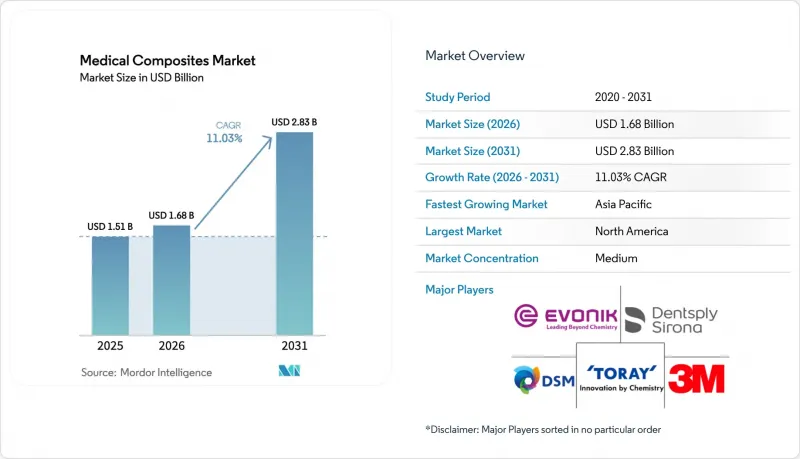
Mordor Intelligence에 의하면, 2026년 의료용 복합재료 시장 규모는 16억 8,000만 달러로 추정되고 있어 2025년 15억 1,000만 달러에서 확대해, 2031년에는 28억 3,000만 달러에 이를 것으로 예측됩니다.
2026년부터 2031년까지의 연평균 성장률(CAGR)은 11.03%를 나타낼 전망입니다.
본 보고서는 재료 유형(탄소섬유 강화 폴리머, 유리섬유 강화 폴리머 등), 폴리머 매트릭스(PEEK, 폴리프로필렌 등), 섬유 유형(탄소섬유 등), 용도(수술 기구 등), 지역(북미, 유럽,아시아태평양, 중동 및 아프리카, 남미)별로 분류되어 있습니다. 시장 전망은 금액(미 달러) 기준으로 제시되어 있습니다.
전 세계 의료용 복합재료 시장 동향 및 인사이트
만성 질환 부담의 급증과 고령화
정형외과 의사들은 탄소섬유의 피로 내성이 티타늄을 능가하여 고령 환자의 재수술률을 낮추기 때문에 복합재 임플란트를 점점 더 선호하고 있습니다. 인구 동향의 급격한 증가는 장기적인 수요 전망을 공고히 하며, 공급업체들이 생산 능력을 확대하고 더 폭넓은 적응증을 추구하도록 촉진하고 있습니다. 임상의들이 2차 제거 수술을 불필요하게 만드는 생체 흡수성 격자 구조를 채택함에 따라, 조직 공학용 스캐폴드도 혜택을 보고 있습니다. 이에 대응하여 복합재료 제조업체들은 골유착을 촉진하는 분해 프로파일과 표면 화학적 특성을 조정하고 있습니다. 재수술 비용 절감을 요구받는 보험 지급 기관들은 복합재료 솔루션의 유효성을 더욱 뒷받침하며, 실적이 입증되고 내구성이 뛰어난 재료를 중심으로 병원의 처방 목록을 좁혀가고 있습니다. 그 결과, 의료용 복합재료 시장은 경제 전반이 침체된 시기에도 안정적인 조달 실적을 유지하고 있습니다.
경량이며 MRI 호환이 가능한 기구에 대한 수요 증가
방사선 투과성 복합재료는 영상상의 아티팩트를 제거하여, 외과의가 형광 투시, CT, MRI 각 검사실에서 임플란트의 배치 상황을 실시간으로 모니터링할 수 있게 해줍니다. 기구의 경량화를 통해 수술 중 피로가 줄어들고, 수술 시간이 단축되며, 환자의 예후가 개선됩니다. 병원에서는 각종 영상 모달리티 간 균일한 품질을 보장하기 위해 복합 소재로 제작된 영상 촬영용 테이블과 포지셔닝 시스템을 표준화하고 있습니다. 로봇 공급업체는 정밀 구동 유닛의 허용 하중을 유지하면서 운동학적 정밀도를 높이기 위해 탄소섬유로 제작된 관절을 채택하고 있습니다. 보험 환급 모델이 효율성을 중시함에 따라 의료 서비스 제공업체들은 MRI 호환 복합 소재 세트를 점점 더 많이 지정하게 되었으며, 도입 대수가 증가함과 동시에 정기적인 교체 판매가 보장되고 있습니다.
높은 제조 비용과 제한된 공급망 깊이
의료용 탄소섬유는 ISO 13485의 문서화 요건 및 순도 기준을 충족하는 제조업체가 극소수에 불과하기 때문에 고가에 거래되고 있습니다. 오토클레이브 및 레이저 가공 설비에는 막대한 설비 투자가 필요하여, 신규 시장 진출기업에게는 진입 장벽이 높습니다. 전구체공급 차질은 임플란트 제품 라인 전체로 파급되고 있으며, 2024년 항공우주 수요의 급증에 따라 리드타임은 24주를 초과할 전망입니다. 각 OEM 업체들은 섬유 조달처를 2개사로 분산하거나 사내 프리프레그 생산 라인에 투자하는 등 대응하고 있지만, 비용 전가는 여전히 지속되고 있어 가격에 민감한 신흥 시장에서의 채택을 억제하고 있습니다.
부문 분석
2025년, CFRP는 의료용 복합재료 시장의 35.05%를 차지하며, 영상 진단용 테이블, 정형외과용 플레이트, 로봇 팔 부품의 핵심 소재로서의 입지를 확고히 했습니다. 이 부문은 타의 추종을 불허하는 높은 비강도를 지니고 있으며, 내하중성을 저해하지 않으면서도 두께를 얇게 만들 수 있다는 장점이 있습니다. 영상 진단 기기 OEM 업체들은 CFRP의 방사선 투과성을 활용하여 아티팩트가 없는 스캔을 실현하고, 의료 기관에서의 도입 범위를 확대되고 있습니다. 한편, 세라믹 매트릭스 복합재의 의료용 복합재료 시장 규모는 골 유착을 촉진하는 생체 활성에 힘입어 연평균 성장률(CAGR) 11.73%로 확대될 것으로 예측됩니다. 개발 프로그램에서는 하이드록시아파타이트를 배합한 세라믹과 흡수성 폴리머를 결합하여, 숙주 조직과 서서히 융합되는 하이브리드 구조체를 제공합니다. 무가압 소결 및 마이크로파 소결을 통해 사이클 타임이 단축됨에 따라 생산 비용 곡선은 하락 추세를 보이고 있습니다. 하이브리드 복합재료 및 바이오 복합재료는 여전히 초기 단계의 임상시험에 머물러 있지만, 항균 효과 등 특정 특성이 임상 현장에서 주목을 받고 있습니다.
CFRP 공급업체는 자동 섬유 배열 기술을 도입하여 불량률을 낮추는 동시에, 로트 간 기계적 성능의 균일성을 확보하고 있습니다. 병원 측은 CFRP의 화학적 비활성 특성으로 인한 감염 위험 감소를 높이 평가하고 있으며, 보험사 측은 수술 후 감사에서 재수술 발생률의 감소를 지적하고 있습니다. 세라믹 매트릭스 분야의 혁신 기업은 적층 가공 기술을 활용하여 환자별 결손 부위의 형상에 맞춘 격자 구조를 제작함으로써 수술 시간을 단축하고 있습니다. 외과용 로봇이 더욱 소형화되어 외래 수술에 대응 가능한 시스템으로 전환되는 가운데, 경량 세라믹-탄소 하이브리드 소재는 외과의사가 요구하는 강성을 제공합니다. 이처럼 끊임없이 진화하는 소재의 조합을 통해 의료용 복합재료 시장은 견실한 혁신 파이프라인을 유지하고 있습니다.
PEEK는 2025년에 41.22%의 점유율을 차지하며, 그 탄성 계수는 피질골과 유사하여 이식 후 스트레스 실드 현상을 완화합니다. 외과의들은 척추 고정술에서 PEEK 케이지를 선호하는데, 이는 수술 후 영상 진단에서 임플란트 주변의 뼈 성장을 명확하게 확인할 수 있기 때문입니다. PMMA 및 아크릴계 소재의 의료용 복합재료 시장 규모는 연평균 성장률(CAGR) 12.95%로 확대될 것으로 예상되며, 그 배경에는 저비용과 유동성 있는 경화가 중요한 치과 및 척추체 성형술 분야 수요가 있습니다. 은 이온을 함유한 항균성 PMMA 골 시멘트는 임상 적용 절차를 순차적으로 통과하며 감염 관리에 기여하고 있습니다. 폴리프로필렌은 저예산으로 내화학성이 요구되는 카테터 부품 분야에서 여전히 틈새 용도로 사용되고 있습니다.
압출 성형 기반의 3D 프린팅 기술 발전으로 PEEK 임플란트의 형태가 다양해졌으며, 조직 침투를 촉진하는 다공성 구조가 가능해졌습니다. 복합재료 매트릭스 개발자들은 현재 열전도율을 높이기 위해 PEEK에 탄소나노튜브를 혼합하고 있으며, 이를 통해 RF 절제 프로브의 제조가 촉진되고 있습니다. PMMA의 혁신적인 개발자들은 방사선 불투과성과 치료용 이온의 제어된 용출을 동시에 달성하기 위해 생체 활성 유리 마이크로스피어의 활용을 시도하고 있습니다. 규제 당국은 용출물에 대한 확실한 데이터를 요구하고 있으며, 이로 인해 폴리머 배합 제조업체들은 첨가제의 배합을 신중하고 정교하게 조정해야 하는 압박을 받고 있습니다. 이러한 경쟁의 결과, 의료용 복합재료 시장에서는 안전성을 저해하지 않으면서 매트릭스 제품의 다양화가 지속적으로 진행되고 있습니다.
지역별 분석
북미는 2025년 의료용 복합재료 시장의 41.10%를 차지했습니다. 이는 견고한 보험 환급 체계와 3M, 스트라이커와 같은 주요 기업들의 지속적인 연구개발 투자에 힘입은 결과입니다. 미국이 그 대부분을 차지하고 있으며, 기술의 조기 도입에 더해 복합재료로 제작된 기구 트레이를 표준화한 대규모 병원 네트워크가 맞물려 시장을 주도하고 있습니다. 캐나다는 단일 지불자 제도를 활용하여 대기 시간을 단축하기 위해 첨단 MRI 대응 테이블 조달에 자금을 투입하고 있습니다. 멕시코의 마킬라도라 회랑은 비용 최적화된 복합 소재 부품 생산을 추구하면서도 미국 규제 감독 기관과의 근접성을 유지하고자 하는 의료기기 OEM 제조업체들을 유치하고 있습니다. 정형외과 연구에 대한 연방 정부의 자금 지원이 파이프라인의 모멘텀을 유지하며 북미의 리더십을 공고히 하고 있습니다.
아시아태평양은 2031년까지 11.98%라는 가장 높은 연평균 성장률(CAGR)을 기록하고 있으며, 이는 의료 보험 적용 범위 확대, 급증하는 중산층 수요, 그리고 중국과 인도의 협력적인 산업 정책의 성과입니다. 중국의 복합재료 제조업체들은 전구체 수입 관세를 인하하는 국가의 우대 조치의 혜택을 받아 국내 공급 역량을 강화하고 있습니다. 일본은 수술용 로봇 수출에 복합 소재를 접목하여 해당 지역의 첨단 기술 이미지를 강화하고 있습니다. 인도의 ‘2025년 국가 의료기기 정책’은 수입 의존도 감소를 목표로 탄소섬유 임플란트의 현지 생산을 장려하고 있습니다. 동남아시아 국가들은 방사선 치료 센터에 투자하고 있으며, 각국이 탄소 에폭시 재질의 환자용 치료대를 지정함에 따라 의료용 복합재료 시장에서의 해당 지역 수요는 더욱 확대되고 있습니다.
유럽은 성숙기에 접어들었음에도 혁신적인 특성을 유지하고 있으며, 엄격한 MDR(의료기기 규정)에 따라 공급업체들은 추적성을 확보한 고품질 복합재료 제품 라인 개발로 이끌리고 있습니다. 독일은 응용 공학 분야에서 선두를 달리고 있으며, 수술 후 모니터링을 위해 척추 봉에 스마트 센서를 통합하고 있습니다. 영국의 ‘카타펄트(Catapult)’ 네트워크는 국민보건서비스(NHS)의 탄소 발자국 관련 요건에 따라 중소기업이 재활용 가능한 열가소성 복합재료를 시험할 수 있도록 지원하고 있습니다. 프랑스에서는 일회용 복합재료 의료기기를 대상으로 한 병원 내 회수 프로그램을 시범적으로 시행하며, 향후 규제 완화에 필수적인 수명 주기 데이터를 수집하고 있습니다. 이탈리아 롬바르디아 주의 클러스터는 오토클레이브 처리 능력을 확대하여 EU 전역으로 정형외과용 플레이트를 수출하고 있습니다. 이러한 협력적 노력을 통해, 성장세가 둔화되고 있음에도 불구하고 유럽은 기술 발전에서 여전히 필수적인 역할을 수행하고 있습니다.
기타 혜택:
- 엑셀 형식 시장 예측(ME) 시트
- 3개월간의 애널리스트 지원
자주 묻는 질문
목차
제1장 서론
제2장 조사 방법
제3장 개요
제4장 시장 구도
제5장 시장 규모와 성장 예측
제6장 경쟁 구도
제7장 시장 기회와 향후 전망
JHS 26.09.03According to Mordor Intelligence, medical composites market size in 2026 is estimated at USD 1.68 billion, growing from 2025 value of USD 1.51 billion with 2031 projections showing USD 2.83 billion, growing at 11.03% CAGR over 2026-2031.
This report is Segmented by Material Type (Carbon Fiber Reinforced Polymer, Glass Fiber Reinforced Polymer, and More), Polymer Matrix (PEEK, Polypropylene, and More), Fibre Type (Carbon Fibre, and More), Application (Surgical Instruments, and More), and Geography (North America, Europe, Asia-Pacific, Middle East & Africa, South America). The Market Forecasts are Provided in Terms of Value (USD).
Global Medical Composites Market Trends and Insights
Surging Chronic Disease Burden & Aging Population
Orthopedic surgeons increasingly prefer composite implants because carbon fiber's fatigue resistance outperforms titanium, lowering revision rates for elderly patients. The demographic surge strengthens long-term demand visibility, encouraging suppliers to scale capacity and pursue wider indications. Tissue engineering scaffolds benefit as clinicians adopt bio-resorbable lattices that obviate secondary removal surgeries. Composite producers respond by tailoring degradation profiles and surface chemistries that promote osteointegration. Insurance payors, under pressure to cut re-operation costs, further validate composite solutions, tightening hospital formularies around proven, durable materials. Consequently, the medical composites market registers steady procurement even during broader economic slowdowns.
Growing Demand for Lightweight, MRI-Compatible Tools
Radiolucent composites remove image artifacts, letting surgeons monitor implant placement in real time across fluoroscopy, CT, and MRI suites. Lower instrument weight reduces intra-operative fatigue, trimming procedure times and enhancing patient outcomes. Hospitals standardize composite imaging tables and positioning systems to guarantee uniform quality across modalities. Robotics vendors adopt carbon-fiber joints to sharpen kinematic accuracy while keeping payloads manageable for precision drive units. As reimbursement models reward efficiency, healthcare providers increasingly specify MRI-compatible composite sets, widening the installed base and locking in recurring replacement sales.
High Production Costs & Limited Supply Chain Depth
Medical-grade carbon fiber commands a premium because only a handful of producers meet ISO 13485 documentation and purity thresholds. Autoclave and laser-machining assets involve high capital outlays, raising entry barriers for new entrants. Disruptions in precursor supply ripple across implant lines, with lead times stretching past 24 weeks during 2024 aerospace demand spikes. OEMs mitigate by dual-sourcing fibers and investing in in-house prepreg lines, yet cost pass-throughs persist, restraining adoption in price-sensitive emerging markets.
Other drivers and restraints analyzed in the detailed report include:
- Advancements in Minimally Invasive & Robotic Surgery Devices
- Rapid Adoption of Robot-Assisted Composite Instruments
- Stringent Multi-Region Regulatory Approvals
For complete list of drivers and restraints, kindly check the Table Of Contents.
Segment Analysis
CFRP commanded 35.05% of the medical composites market in 2025, substantiating its role as the backbone of imaging tables, orthopedic plates, and robotic arm components. The segment benefits from unmatched strength-to-weight ratios that allow thinner profiles without sacrificing load tolerance. Imaging OEMs capitalize on CFRP's radiolucency to achieve artifact-free scans, widening its institutional footprint. Meanwhile, the medical composites market size for ceramic matrix composites is projected to advance at a 11.73% CAGR, propelled by bioactivity that accelerates osteointegration. Development programs pair hydroxyapatite-infused ceramics with resorbable polymers, offering hybrid constructs that knit gradually with host tissue. Production cost curves trend downward as pressureless sintering and microwave sintering reduce cycle times. Hybrid and bio-based composites linger in early-stage trials, yet targeted properties such as antimicrobial efficacy attract clinical attention.
CFRP suppliers deploy automated fiber placement to curtail scrap rates and drive consistent mechanical performance batch-to-batch. Hospitals value the reduced infection risk linked to CFRP's chemical inertness, while insurers flag lower re-operation incidence in postoperative audits. Ceramic matrix innovators leverage additive manufacturing to print lattice structures that match patient-specific defect geometries, shortening operating room time. As surgical robotics shifts toward smaller, outpatient-compatible systems, lightweight ceramic-carbon hybrids offer the stiffness surgeons expect. This evolving material mix ensures the medical composites market retains a robust innovation funnel.
PEEK held 41.22% share in 2025, its elastic modulus mirroring cortical bone and thereby mitigating stress-shielding after implantation. Surgeons prefer PEEK cages for spinal fusion because post-operative imaging clearly distinguishes bone growth around the implant. The medical composites market size expansion for PMMA & acrylics, set for 12.95% CAGR, rests on dental and vertebroplasty demand where low cost and flowable curing matter. Antimicrobial PMMA bone cements containing silver ions are clearing clinical pathways, aiding infection control. Polypropylene retains niche use in catheter components needing chemical resistance at low budgets.
Advances in extrusion-based 3D printing broaden PEEK implant geometries, supporting porous architectures that invite tissue in-growth. Composite matrix developers now blend PEEK with carbon nanotubes to elevate thermal conductivity, facilitating RF ablation probes. PMMA innovators experiment with bioactive glass microspheres to couple radiopacity with controlled elution of therapeutic ions. Regulatory bodies call for robust leachables data, pushing polymer formulators to refine additive packages carefully. The resulting competition ensures that the medical composites market continues to diversify matrix offerings without compromising safety.
Complete Report Scope:
- By Material Type
- Carbon Fiber Reinforced Polymer (CFRP)
- Glass Fiber Reinforced Polymer (GFRP)
- Ceramic Matrix Composites
- Other Materials
- By Polymer Matrix
- PEEK
- Polypropylene (PP)
- PMMA & Acrylics
- Others
- By Fibre Type
- Carbon Fibre
- Glass Fibre
- Aramid & Other High-Performance Fibres
- By Application
- Surgical Instruments
- Diagnostic Imaging Components
- Orthopedic Implants
- Dental Implants
- Tissue Engineering Scaffolds
- Other Applications
- By Geography
- North America
- United States
- Canada
- Mexico
- Europe
- Germany
- United Kingdom
- France
- Italy
- Spain
- Rest of Europe
- Asia-Pacific
- China
- Japan
- India
- Australia
- South Korea
- Rest of Asia-Pacific
- Middle East & Africa
- GCC
- South Africa
- Rest of Middle East & Africa
- South America
- Brazil
- Argentina
- Rest of South America
- North America
Geography Analysis
North America secured 41.10% of the medical composites market in 2025, underpinned by a robust reimbursement ecosystem and continuous R&D investments from players such as 3M and Stryker. The United States accounts for the lion's share, coupling early technology adoption with large-scale hospital networks that standardize composite instrument trays. Canada, leveraging its single-payer system, funds procurement of advanced MRI-compatible tables to cut wait times. Mexico's maquiladora corridor attracts device OEMs seeking cost-optimized composite component production while remaining proximate to US regulatory oversight. Federal funding for orthopedic research sustains pipeline momentum, preserving North American leadership.
Asia-Pacific registers the fastest 11.98% CAGR through 2031, a testament to expanded health insurance coverage, burgeoning middle-class demand, and concerted industrial policies in China and India. Chinese composite producers benefit from state incentives that lower precursor import tariffs, boosting domestic supply capacity. Japan integrates composites into surgical robotic exports, reinforcing the region's high-tech image. India's National Medical Devices Policy 2025 encourages local manufacture of carbon-fiber implants, targeting reduced import dependencies. Southeast Asian nations invest in radiotherapy centers, each specifying carbon-epoxy patient couches, further swelling regional uptake across the medical composites market.
Europe retains a mature yet innovative profile, with stringent MDR rules nudging suppliers toward traceable, high-quality composite lines. Germany spearheads application engineering, embedding smart sensors into spinal rods for postoperative monitoring. The United Kingdom's Catapult network supports SME trials of recyclable thermoplastic composites, aligning with National Health Service carbon-footprint mandates. France pilots hospital take-back programs for single-use composite devices, collecting lifecycle data critical to future regulatory relief. Italy's Lombardy cluster ramps autoclave capacity, exporting orthopedic plates across the EU. Such coordinated initiatives keep Europe integral to technological progress even as growth moderates.
- 3M
- Toray Industries
- Victrex plc (Invibio)
- DSM-Firmenich
- CeramTec GmbH
- SGL Carbon
- Evonik Industries
- Dentsply Sirona
- Solvay
- Kulzer
- Composiflex
- Mitsubishi Chemical Group (MCAM)
- Icotec AG
- Rochling Group
- Zeus Industrial Products
- Trelleborg AB
- Ensinger GmbH
- Hexcel Corporation
- Arkema SA
- Avient Corporation
- LANXESS AG
Additional Benefits:
- The market estimate (ME) sheet in Excel format
- 3 months of analyst support
TABLE OF CONTENTS
1 Introduction
- 1.1 Study Assumptions & Market Definition
- 1.2 Scope of the Study
2 Research Methodology
3 Executive Summary
4 Market Landscape
- 4.1 Market Overview
- 4.2 Market Drivers
- 4.2.1 Surging Chronic Disease Burden & Aging Population
- 4.2.2 Growing Demand for Lightweight, MRI-Compatible Tools
- 4.2.3 Advancements in Minimally-Invasive & Robotic Surgery Devices
- 4.2.4 Rapid Adoption of Robot-Assisted Composite Instruments
- 4.2.5 Regulatory Fast-Track for Carbon-Fiber PEEK Implants
- 4.2.6 Expansion of Diagnostic Imaging Infrastructure
- 4.3 Market Restraints
- 4.3.1 High Production Costs & Limited Supply Chain Depth
- 4.3.2 Stringent Multi-Region Regulatory Approvals
- 4.3.3 End-of-Life Recycling Challenges for Composite Devices
- 4.3.4 Machining & Sterilization Complexity
- 4.4 Porter's Five Forces Analysis
- 4.4.1 Threat of New Entrants
- 4.4.2 Bargaining Power of Buyers
- 4.4.3 Bargaining Power of Suppliers
- 4.4.4 Threat of Substitutes
- 4.4.5 Intensity of Competitive Rivalry
5 Market Size & Growth Forecasts (Value in USD)
- 5.1 By Material Type
- 5.1.1 Carbon Fiber Reinforced Polymer (CFRP)
- 5.1.2 Glass Fiber Reinforced Polymer (GFRP)
- 5.1.3 Ceramic Matrix Composites
- 5.1.4 Other Materials
- 5.2 By Polymer Matrix
- 5.2.1 PEEK
- 5.2.2 Polypropylene (PP)
- 5.2.3 PMMA & Acrylics
- 5.2.4 Others
- 5.3 By Fibre Type
- 5.3.1 Carbon Fibre
- 5.3.2 Glass Fibre
- 5.3.3 Aramid & Other High-Performance Fibres
- 5.4 By Application
- 5.4.1 Surgical Instruments
- 5.4.2 Diagnostic Imaging Components
- 5.4.3 Orthopedic Implants
- 5.4.4 Dental Implants
- 5.4.5 Tissue Engineering Scaffolds
- 5.4.6 Other Applications
- 5.5 By Geography
- 5.5.1 North America
- 5.5.1.1 United States
- 5.5.1.2 Canada
- 5.5.1.3 Mexico
- 5.5.2 Europe
- 5.5.2.1 Germany
- 5.5.2.2 United Kingdom
- 5.5.2.3 France
- 5.5.2.4 Italy
- 5.5.2.5 Spain
- 5.5.2.6 Rest of Europe
- 5.5.3 Asia-Pacific
- 5.5.3.1 China
- 5.5.3.2 Japan
- 5.5.3.3 India
- 5.5.3.4 Australia
- 5.5.3.5 South Korea
- 5.5.3.6 Rest of Asia-Pacific
- 5.5.4 Middle East & Africa
- 5.5.4.1 GCC
- 5.5.4.2 South Africa
- 5.5.4.3 Rest of Middle East & Africa
- 5.5.5 South America
- 5.5.5.1 Brazil
- 5.5.5.2 Argentina
- 5.5.5.3 Rest of South America
- 5.5.1 North America
6 Competitive Landscape
- 6.1 Market Concentration
- 6.2 Market Share Analysis
- 6.3 Company Profiles (includes Global level Overview, Market level overview, Core Segments, Financials as available, Strategic Information, Market Rank/Share for key companies, Products & Services, and Recent Developments)
- 6.3.1 3M
- 6.3.2 Toray Industries Inc.
- 6.3.3 Victrex plc (Invibio)
- 6.3.4 DSM-Firmenich
- 6.3.5 CeramTec GmbH
- 6.3.6 SGL Carbon
- 6.3.7 Evonik Industries AG
- 6.3.8 Dentsply Sirona
- 6.3.9 Solvay
- 6.3.10 Kulzer GmbH
- 6.3.11 Composiflex
- 6.3.12 Mitsubishi Chemical Group (MCAM)
- 6.3.13 Icotec AG
- 6.3.14 Rochling Group
- 6.3.15 Zeus Industrial Products
- 6.3.16 Trelleborg AB
- 6.3.17 Ensinger GmbH
- 6.3.18 Hexcel Corporation
- 6.3.19 Arkema SA
- 6.3.20 Avient Corporation
- 6.3.21 LANXESS AG
7 Market Opportunities & Future Outlook
- 7.1 White-space & Unmet-Need Assessment


