

|
시장보고서
상품코드
2119744
도매 음성 캐리어 시장 : 점유율 분석, 업계 동향과 통계, 성장 예측(2026-2031년)Wholesale Voice Carrier - Market Share Analysis, Industry Trends & Statistics, Growth Forecasts (2026 - 2031) |
||||||
 Mordor Intelligence
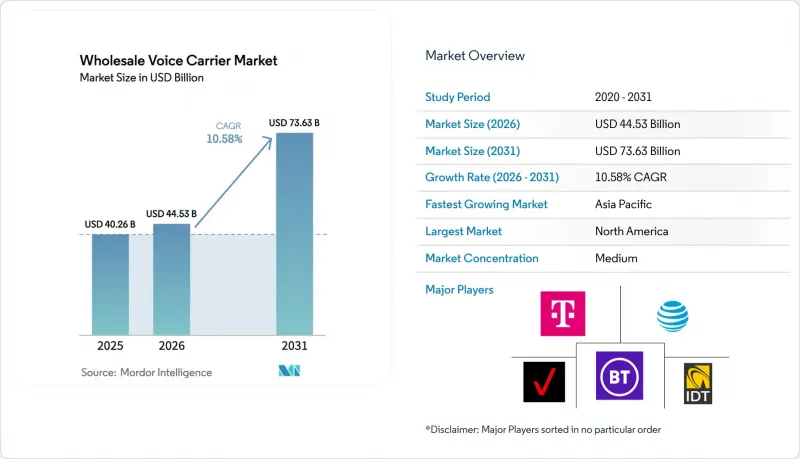
Mordor Intelligence에 의하면, 2026년 도매 음성 캐리어업자 시장 규모는 445억 3,000만 달러로 추정되고 있어 2025년 402억 6,000만 달러에서 확대해, 2031년에는 736억 3,000만 달러에 이를 것으로 예측됩니다.
2026년부터 2031년까지 연평균 성장률(CAGR) 10.58%로 성장할 것으로 전망됩니다.
본 보고서는 서비스별(음성 종단, 상호 접속 요금, 부정 관리), 기술별(VoIP 및 기존 교환 방식), 최종 사용자별(Tier-1 및 Tier-2 통신 사업자, OTT 및 CPaaS 제공업체 등), 지역별로 분류되어 있습니다.
세계 도매 음성 캐리어 시장 동향 및 인사이트
TDM에서 SIP 및 VoIP 트렁킹으로의 급속한 전환
영국 Ofcom이 정한 2027년 서비스 종료 일정 등 PSTN 네트워크의 단계적 폐지가 의무화됨에 따라, 통신 사업자들은 레거시 교환기를 폐지하고 IP 코어에 투자할 수밖에 없는 상황입니다. 이러한 전환을 통해 유지보수 비용이 절감되고 유연한 용량 확장이 가능해지며, 통신 사업자가 일시적으로 병렬 시스템을 운영하여 운영 비용(OPEX)이 증가하는 경우에도 기능 확장이 지원됩니다. 조기 도입 기업들은 지연 시간 개선 및 고급 코덱 지원을 활용하여 통화 품질로 차별화를 꾀하고 있는 반면, 도입이 지연되고 있는 사업자들은 규제 당국의 제재나 고객 이탈 위험 증가에 직면하고 있습니다.
클라우드 기반 통신(UCaaS/CPaaS)의 보급
기업들이 통합형 클라우드 플랫폼을 선호하는 경향에 따라, 도매 수요는 유선 회선에서 API 중심의 음성 서비스로 이동하고 있습니다. 화이트 라벨 CPaaS 서비스를 통해 프로그래밍 가능한 음성 기능, 녹음 기능, 분석 기능을 제공하는 통신 사업자는 트래픽량을 확보하면서 새로운 수익원을 창출하고 있습니다. IntelePeer의 1억 1,000만 달러 규모의 성장 투자와 같은 자금 조달의 이정표는 기존 종단 서비스와 클라우드 네이티브 오케스트레이션을 연결하는 제공업체로 자본 유입이 활발해지고 있음을 보여줍니다.
사기 증가(CLI 스푸핑, 로보콜)
2024년에 12억 달러의 손실을 초래한 격화되는 비싱(vishing) 공격은 소비자의 신뢰를 훼손하고, 더욱 엄격한 규정 준수 요건을 초래하고 있습니다. 도매 통신 사업자들은 분석 주도형 사기 감지에 막대한 투자를 하고 있지만, 보호 비용과 분당 발생하는 미미한 수익 간의 균형을 맞추어야 합니다. 연간 170억 달러로 추정되는 국제적인 부정 행위에는 ‘False Answer Supervision’이나 ‘Traffic Pumping’과 같은 수법이 포함되어 있으며, 이는 수익성을 저해할 뿐만 아니라 브랜드 평판에도 타격을 주고 있습니다.
부문 분석
2025년에는 음성 종단 서비스가 매출의 45.78%를 차지하며, 통신 사업자 간 거래에서 핵심적인 역할을 유지했습니다. 그러나 기업들이 발신자 신원 인증을 요구하고, 규제 당국이 로보콜 대책을 의무화하는 가운데, 부정 관리 분야는 2031년까지 연평균 성장률(CAGR) 13.55%라는 가장 빠른 성장세를 보이고 있습니다. 높은 수익률을 자랑하는 프리미엄 CLI 제품은 전송 보장 및 발신자 확인을 통해 상품화된 표준 베스트 에포트형 트래픽을 능가하는 실적을 올리고 있습니다. 상호 접속 과금 시장은 대형 기존 사업자가 선호하는 맞춤형 On-Premise형 모듈과, 운영 비용의 유연성을 추구하는 중소 사업자가 채택하는 SaaS 제품군으로 양분되어 있습니다. 수익 보장 플랫폼이 머신러닝을 통한 패턴 인식을 통합하여 비정상적인 트래픽의 급증을 예측하고 차단할 수 있게 되면, 도매 음성 캐리어 시장이 혜택을 볼 것입니다.
사기 관리의 기세는 북미의 STIR/SHAKEN과 같은 규제 프레임워크에서 비롯된 것으로, 통신 사업자는 착신 연결 전에 발신자 번호 인증을 수행해야 할 의무가 있습니다. 주요 벤더들은 시그널링 방화벽에 실시간 분석 대시보드를 통합하여 의심스러운 응답률을 표시하고 있습니다. 이러한 기능이 성숙해짐에 따라 소규모 솔루션 제공업체들은 진입 장벽에 직면하는 반면, 기존의 대형 기업들은 엔드투엔드 사기 방지 솔루션을 통해 시장 점유율을 확대되고 있습니다. 통신 사업자의 경우, 프리미엄 사기 방지 서비스 도입은 분당 평균 수익(ARPM) 향상으로 이어져, 광범위한 도매 음성 캐리어 시장에서 발생하는 단가 압박을 부분적으로 상쇄하고 있습니다.
지역별 분석
유럽은 2025년에도 27.95%의 매출 점유율을 유지하고 있으며, 그 배경에는 견고한 국경 간 상호 접속 규제와 광범위하게 구축된 광섬유 백본이 있습니다. 시장의 성숙에 따라 효율성과 부가가치 서비스로의 전환이 진행되고 있으며, 2024년 도이치 텔레콤의 매출 1,158억 유로 및 EBITDA 6.2% 증가는 이를 여실히 보여주고 있습니다. 오렌지(Orange)나 텔레포니카(Telefonica)와 같은 기존 대형 사업자들 간의 통합에 관한 협의는 하이퍼스케일 클라우드 경쟁사 및 OTT에 의한 시장 변혁에 대응하기 위한 전략적 필요성을 부각시키고 있습니다.
아시아태평양은 5G 가입자 수의 급증, 기업의 디지털화 진전, 그리고 지역 간 무역 흐름에 힘입어 2031년까지 연평균 성장률(CAGR)이 13.72%에 달하며, 지역별로는 가장 빠른 성장 궤도를 그리고 있습니다. GSMA는 2024년 모바일 경제의 기여액을 8,800억 달러로 평가하고 있으며, 중국만 해도 1조 7,400억 위안 규모의 통신 매출을 기록할 것으로 예상되고, 클라우드 및 빅데이터 서비스 부문에서는 두 자릿수 성장이 전망됩니다. 이러한 모멘텀에 힘입어 통신 사업자들이 새로운 상호 접속 및 로밍 프레임워크가 필요한 독립형 5G 코어를 도입함에 따라, 지역 전체의 도매 음성 캐리어 시장 규모가 확대되고 있습니다.
북미는 기술적 리더십을 발휘하고 있지만, 트래픽 증가세는 둔화되고 있습니다. 이 지역에서는 엄격한 STIR/SHAKEN 프레임워크가 시행되고 있어, 통신 사업자들은 통화 종료 전에 통화 인증에 투자할 수밖에 없습니다. 버라이즌이 프론티어 커뮤니케이션즈를 200억 달러에 인수함에 따라 25개 주에 걸친 광섬유 네트워크가 확장되고, 음성 및 광대역 자산의 통합이 진행되고 있습니다. 라틴아메리카에서는 전략에 차이가 보입니다. 텔레포니카는 규제 환경이 수익성을 뒷받침하는 지역에서는 선택적으로 사업을 유지하면서도, 더 높은 수익을 기대할 수 있는 유럽 시장에 자본을 재집중하기 위해 아르헨티나, 칠레, 멕시코에서의 사업 매각을 가속화하고 있습니다.
기타 혜택:
- 엑셀 형식 시장 예측(ME) 시트
- 3개월간의 애널리스트 지원
자주 묻는 질문
목차
제1장 서론
제2장 조사 방법
제3장 개요
제4장 시장 구도
제5장 시장 규모와 성장 예측
제6장 경쟁 구도
제7장 시장 기회와 향후 전망
JHS 26.09.03According to Mordor Intelligence, wholesale voice carrier market size in 2026 is estimated at USD 44.53 billion, growing from 2025 value of USD 40.26 billion with 2031 projections showing USD 73.63 billion, growing at 10.58% CAGR over 2026-2031.
This report is Segmented by Service (Voice Termination, Interconnect Billing, and Fraud Management), Technology (VoIP and Traditional Switching), End User (Tier-1 and Tier-2 Telcos, OTT and CPaaS Providers, and More), and Geography.
Global Wholesale Voice Carrier Market Trends and Insights
Rapid Migration from TDM to SIP and VoIP Trunking
Mandatory phase-outs of PSTN networks, such as the 2027 switch-off timetable set by Ofcom in the United Kingdom, compel operators to decommission legacy exchanges and invest in IP cores.The transition compresses maintenance costs, enables flexible capacity scaling, and supports feature expansion even as carriers temporarily operate parallel systems that elevate opex. Early adopters leverage improved latency and advanced codec support to differentiate on call quality, while lagging providers confront regulatory penalties and higher churn risk.
Cloud-based Communication (UCaaS / CPaaS) Uptake
Enterprise preference for unified cloud platforms shifts wholesale demand from fixed trunks to API-centric voice enablement. Operators that expose programmable voice, recording, and analytics capabilities through white-label CPaaS offerings gain new revenue while safeguarding traffic volumes. Funding milestones, such as IntelePeer's USD 110 million growth investment, signal heightened capital flow toward providers that bridge traditional termination with cloud-native orchestration.
Heightened Fraud (CLI Spoofing, Robocalls)
Escalating vishing attacks that generated USD 1.2 billion in losses during 2024 undermine consumer trust and trigger stricter compliance mandates. Wholesale carriers invest heavily in analytics-driven fraud detection, yet must balance protection costs against thin per-minute margins. International fraud, estimated at USD 17 billion annually, includes False Answer Supervision and Traffic Pumping schemes that erode profitability while damaging brand reputation.
Other drivers and restraints analyzed in the detailed report include:
- Emerging Voice-over-5G Roaming Agreements
- AI-enabled Dynamic Least-cost Routing Boosts Margins
- Declining Voice ARPU due to OTT Substitution
For complete list of drivers and restraints, kindly check the Table Of Contents.
Segment Analysis
Voice Termination accounted for 45.78% of revenue in 2025, maintaining its role as the cornerstone of inter-carrier exchange. However, Fraud Management delivers the swiftest expansion at 13.55% CAGR to 2031 as enterprises demand authenticated caller identities and regulators mandate robocall mitigation. Higher-margin Premium CLI products outperform commoditized Standard Best-Effort traffic thanks to guaranteed delivery and origin validation. Interconnect Billing splits between customizable on-premise modules preferred by large incumbents and SaaS suites adopted by smaller operators seeking opex flexibility. The wholesale voice carrier market benefits when revenue-assurance platforms integrate machine-learning pattern recognition, enabling predictive blocking of anomalous traffic bursts.
Fraud Management momentum stems from regulatory frameworks such as STIR/SHAKEN in North America, compelling carriers to certify calling party numbers before termination. Leading vendors package signaling firewalls with real-time analytics dashboards that flag suspicious answer-seizure ratios. As these capabilities mature, smaller solution providers encounter entry barriers while established players consolidate share through end-to-end fraud stacks. For carriers, premium anti-fraud service uptake supports average-revenue-per-minute lift that partially offsets unit price compression in the wider wholesale voice carrier market.
Complete Report Scope:
- By Service
- Voice Termination
- Premium (CLI Guaranteed)
- Standard (Best-Effort)
- Interconnect Billing
- On-premise Solutions
- SaaS-based Solutions
- Fraud Management
- Revenue-Assurance and Analytics
- Signalling-Based Firewalls
- Voice Termination
- By Technology
- VoIP
- SIP (IMS)
- H.323 and Other Protocols
- Traditional Switching (TDM)
- VoIP
- By End User
- Tier-1 and Tier-2 Telcos
- Mobile Virtual Network Operators (MVNO)
- OTT and CPaaS Providers
- Enterprises and BPOs
- By Geography
- North America
- United States
- Canada
- Mexico
- South America
- Brazil
- Argentina
- Rest of South America
- Europe
- Germany
- United Kingdom
- France
- Italy
- Spain
- Russia
- Rest of Europe
- Asia Pacific
- China
- Japan
- South Korea
- India
- Australia
- Rest of Asia Pacific
- Middle East and Africa
- Saudi Arabia
- United Arab Emirates
- South Africa
- Rest of Middle East and Africa
- North America
Geography Analysis
Europe maintained a 27.95% revenue share in 2025, underpinned by robust cross-border interconnection regulations and widespread fiber backbones. Market maturity prompts a pivot toward efficiency and value-added services, illustrated by Deutsche Telekom's EUR 115.8 billion revenue and 6.2% EBITDA uplift in 2024.Consolidation discussions between major incumbents such as Orange and Telefonica underline a strategic need to counter hyperscale cloud rivals and OTT disruptors.
Asia Pacific delivers the fastest regional trajectory at 13.72% CAGR through 2031, propelled by soaring 5G subscriptions, rising enterprise digitization, and inter-regional trade flows. The GSMA values the mobile economy contribution at USD 880 billion in 2024, with China alone recording RMB 1.74 trillion telecommunications revenue and double-digit growth in cloud and big-data services. Such momentum enlarges the wholesale voice carrier market size across the region as operators deploy standalone 5G cores that require new interconnect and roaming frameworks.
North America exhibits technological leadership but slower traffic growth. The region enforces stringent STIR/SHAKEN frameworks, compelling carriers to invest in call authentication before termination. Verizon's USD 20 billion purchase of Frontier Communications extends fiber reach across 25 states and consolidates voice and broadband assets. Latin America presents divergent strategies: Telefonica accelerates divestments in Argentina, Chile, and Mexico to refocus capital on higher-return European markets while maintaining selective presence where regulatory conditions support profitability.
- Verizon
- AT&T
- BT
- Deutsche Telekom
- Tata Communications
- Telefonica
- Lumen Technologies
- Orange
- Vodafone
- IDT Corporation
- BICS
- iBASIS
- Telia Carrier (Arelion)
- PCCW Global
- Sparkle
- China Telecom Global
- NTT Communications
- PLDT Global
- Telin
- Tofane Global
Additional Benefits:
- The market estimate (ME) sheet in Excel format
- 3 months of analyst support
TABLE OF CONTENTS
1 INTRODUCTION
- 1.1 Study Assumptions and Market Definition
- 1.2 Scope of the Study
2 RESEARCH METHODOLOGY
3 EXECUTIVE SUMMARY
4 MARKET LANDSCAPE
- 4.1 Market Overview
- 4.2 Market Drivers
- 4.2.1 Rapid migration from TDM to SIP and VoIP trunking
- 4.2.2 Cloud-based communication (UCaaS / CPaaS) uptake
- 4.2.3 Emerging voice-over-5G roaming agreements
- 4.2.4 AI-enabled dynamic least-cost routing boosts margins
- 4.2.5 Blockchain-based inter-carrier settlements reduce disputes
- 4.3 Market Restraints
- 4.3.1 Heightened fraud (CLI spoofing, robocalls)
- 4.3.2 Declining voice ARPU due to OTT substitution
- 4.3.3 STIR/SHAKEN compliance costs for carriers
- 4.3.4 eSIM driven fall in international roaming minutes
- 4.4 Value Chain Analysis
- 4.5 Regulatory Landscape
- 4.6 Technological Outlook
- 4.7 Porter's Five Forces Analysis
- 4.7.1 Threat of New Entrants
- 4.7.2 Bargaining Power of Buyers
- 4.7.3 Bargaining Power of Suppliers
- 4.7.4 Threat of Substitutes
- 4.7.5 Intensity of Competitive Rivalry
5 MARKET SIZE AND GROWTH FORECASTS (VALUE)
- 5.1 By Service
- 5.1.1 Voice Termination
- 5.1.1.1 Premium (CLI Guaranteed)
- 5.1.1.2 Standard (Best-Effort)
- 5.1.2 Interconnect Billing
- 5.1.2.1 On-premise Solutions
- 5.1.2.2 SaaS-based Solutions
- 5.1.3 Fraud Management
- 5.1.3.1 Revenue-Assurance and Analytics
- 5.1.3.2 Signalling-Based Firewalls
- 5.1.1 Voice Termination
- 5.2 By Technology
- 5.2.1 VoIP
- 5.2.1.1 SIP (IMS)
- 5.2.1.2 H.323 and Other Protocols
- 5.2.2 Traditional Switching (TDM)
- 5.2.1 VoIP
- 5.3 By End User
- 5.3.1 Tier-1 and Tier-2 Telcos
- 5.3.2 Mobile Virtual Network Operators (MVNO)
- 5.3.3 OTT and CPaaS Providers
- 5.3.4 Enterprises and BPOs
- 5.4 By Geography
- 5.4.1 North America
- 5.4.1.1 United States
- 5.4.1.2 Canada
- 5.4.1.3 Mexico
- 5.4.2 South America
- 5.4.2.1 Brazil
- 5.4.2.2 Argentina
- 5.4.2.3 Rest of South America
- 5.4.3 Europe
- 5.4.3.1 Germany
- 5.4.3.2 United Kingdom
- 5.4.3.3 France
- 5.4.3.4 Italy
- 5.4.3.5 Spain
- 5.4.3.6 Russia
- 5.4.3.7 Rest of Europe
- 5.4.4 Asia Pacific
- 5.4.4.1 China
- 5.4.4.2 Japan
- 5.4.4.3 South Korea
- 5.4.4.4 India
- 5.4.4.5 Australia
- 5.4.4.6 Rest of Asia Pacific
- 5.4.5 Middle East and Africa
- 5.4.5.1 Saudi Arabia
- 5.4.5.2 United Arab Emirates
- 5.4.5.3 South Africa
- 5.4.5.4 Rest of Middle East and Africa
- 5.4.1 North America
6 COMPETITIVE LANDSCAPE
- 6.1 Market Concentration
- 6.2 Strategic Moves
- 6.3 Market Share Analysis
- 6.4 Company Profiles (includes Global level Overview, Market level overview, Core Segments, Financials as available, Strategic Information, Market Rank/Share for key companies, Products and Services, and Recent Developments)
- 6.4.1 Verizon
- 6.4.2 AT&T
- 6.4.3 BT
- 6.4.4 Deutsche Telekom
- 6.4.5 Tata Communications
- 6.4.6 Telefonica
- 6.4.7 Lumen Technologies
- 6.4.8 Orange
- 6.4.9 Vodafone
- 6.4.10 IDT Corporation
- 6.4.11 BICS
- 6.4.12 iBASIS
- 6.4.13 Telia Carrier (Arelion)
- 6.4.14 PCCW Global
- 6.4.15 Sparkle
- 6.4.16 China Telecom Global
- 6.4.17 NTT Communications
- 6.4.18 PLDT Global
- 6.4.19 Telin
- 6.4.20 Tofane Global
7 MARKET OPPORTUNITIES AND FUTURE OUTLOOK
- 7.1 White-space and Unmet-need Assessment


