

|
시장보고서
상품코드
2119775
의료용 CDMO 시장 : 점유율 분석, 업계 동향과 통계, 성장 예측(2026-2031년)Healthcare CDMO - Market Share Analysis, Industry Trends & Statistics, Growth Forecasts (2026 - 2031) |
||||||
 Mordor Intelligence
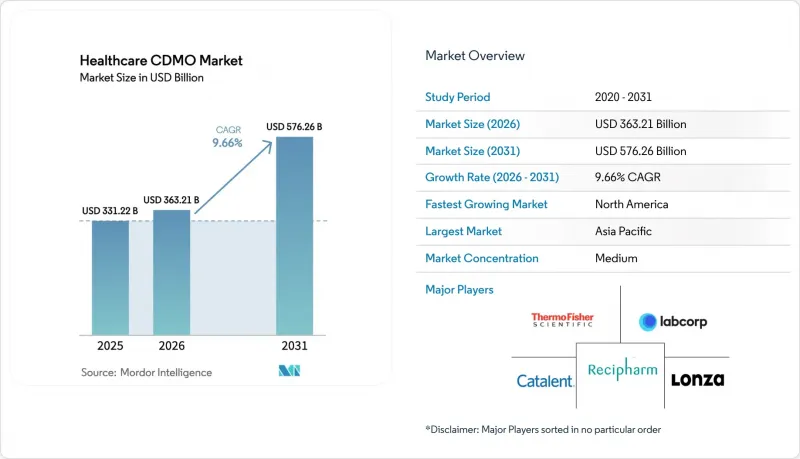
Mordor Intelligence에 의하면, 2026년 의료용 CDMO 시장 규모는 3,632억 1,000만 달러로 추정되고 있어 2025년 3,312억 2,000만 달러에서 확대해, 2031년에는 5,762억 6,000만 달러에 이를 것으로 예측됩니다.
2026년부터 2031년까지 연평균 성장률(CAGR) 9.66%를 기록하며 성장할 것으로 전망됩니다.
본 보고서는 서비스 유형(위탁 개발, 수탁 제조), 개발 단계(전임상, 제1상 등), 치료 분야(종양학, 순환기 등), 최종 사용자(대형 제약사 등), 지역(북미 등)별로 세분화되어 있습니다. 시장 전망은 금액(달러) 기준으로 제시되어 있습니다.
세계 의료용 CDMO 시장 동향 및 인사이트
핵심 경쟁력에 집중하기 위한 아웃소싱의 주류화
연구 개발의 격화와 사내 자원의 한계로 인해 신약 개발 기업의 86.9%가 적어도 하나의 제조 업무를 외부에 위탁하고 있습니다. 포트폴리오를 간소화함으로써 스폰서는 고정자산 리스크를 유능한 파트너에게 이전하는 동시에 자본을 신약 연구로 재분배할 수 있게 됩니다. 론자(Lonza)의 12억 달러 규모 바카빌(Vakaville) 인수와 캡슐 사업 부문 매각은 고부가가치 바이오의약품에 집중하겠다는 방향 전환을 상징하는 사례입니다. 대형 제약 기업들은 저분자 의약품 제조 거점을 매각하는 동시에, 퍼스트-인-클래스 바이오의약품 및 mRNA 플랫폼으로 집중력을 전환하고 있습니다. 각 CDMO 기업은 이용 계획의 기반이 되며, 분석, 규제 대응, 충전·포장 등의 부가 서비스에 대한 교차 판매를 가능하게 하는 다년간의 마스터 서비스 계약을 통해 혜택을 보고 있습니다.
바이오의약품 및 첨단 치료법의 성장
단일 클론 항체, 항체-약물 복합체(ADC), 세포 치료 및 유전자 치료에는 클린룸 설계, 격리 프로토콜, 공급망 조정이 필요하지만, 이를 사내에서 수행하는 것이 경제적이라고 생각하는 원료의약품 제조업체는 거의 없습니다. 2025년에 최종 확정된 FDA의 ‘첨단 제조 기술 지정 프로그램’은 새로운 생산 모델을 더욱 촉진하고, 혁신적인 설비를 도입하는 CDMO의 승인 위험을 줄여줍니다. 바이러스 벡터용 스위트 및 분리된 고활성 라인의 자본 집약성으로 인해, 스폰서는 더 이른 단계, 많은 경우 전임상 단계의 제제 개발 중에 제휴를 추진하게 되었습니다. CAR-T 및 유전자 편집 제품의 상업적 승인이 증가함에 따라, 세포 생존율을 유지하는 소량 저트인타임(just-in-time) 제조 및 종단간 물류 솔루션에 대한 수요도 높아지고 있습니다.
생산 능력의 제약과 CDMO의 긴 리드타임
적극적인 확장이 진행되고 있음에도 불구하고, 바이오의약품 아웃소싱 수요의 급증에는 완전히 대응하지 못하고 있습니다. 전문 ADC 제조 시설의 배정 기간은 24-36개월에 달하며, 스폰서는 1상 임상시험 결과가 나오기 전에 제조 슬롯을 확보해야 하는 상황입니다. 다이이치 산쿄의 10억 달러 규모 독일 ADC 공장이나 아스트라제네카의 15억 달러 규모 싱가포르 프로젝트는 2028년 이후에야 비로소 이러한 압박을 완화할 수 있을 것입니다. 이러한 수급 불일치로 인해 통합형 CDMO의 협상 우위가 높아지고 예약 수수료도 상승하고 있지만, 한편으로는 고객사가 일정을 확보하기 위해 듀얼 소싱을 추구하거나 파일럿 생산 능력을 유지하도록 촉구받고 있습니다.
부문 분석
2025년, 의료용 CDMO 시장에서 수탁 제조가 73.45%의 점유율을 차지했습니다. 이는 대형 제약사들이 기존에 대량 생산을 외부에 위탁하면서도 제제에 관한 전문 지식은 자사에서 보유해 왔기 때문입니다. 이 하위 부문에는 저분자 API, 1만 5,000리터를 초과하는 단일클론 항체, 그리고 무균 주사제가 포함되며, 각각 서로 다른 이익률 프로파일을 보입니다. 고효능 제제나 세포독성 제제에 대한 수요는 평균 판매 가격을 끌어올리며, 수년에 걸친 테이크-오어-페이(take-or-pay) 계약을 필요로 합니다. 대조적으로, 상품화된 경구용 고형 제제는 가격 압박을 받고 있지만, 여전히 생산 라인의 가동률을 지탱하고 있습니다.
위탁 개발(Contract Development)은 제형화 이전 단계, 공정 특성 평가 및 규제용 자료 작성에 있어 초기 단계부터 제3자가 관여하고 있음을 반영하여, 연평균 성장률(CAGR) 10.44%를 나타낼 것으로 예측됩니다. 스폰서 기업은 실험실 규모부터 상업적 규모에 이르기까지 일관된 지식 체계를 중시하고 있으며, 이를 통해 검증의 중복이 줄어들고 변경 관리 신청의 번거로움이 경감됩니다. 따라서 의료용 CDMO 시장에서는 개발 리테이너가 상업적 공급 옵션에 통합되는 하이브리드 계약이 나타나고 있으며, 신속한 기술 이전을 위한 인센티브가 조화를 이루고 있습니다. ADC, 벡터형 백신, 맞춤형 치료가 보급됨에 따라 공정 관련 지식은 후기 단계의 제조와 분리할 수 없게 되었으며, 개발 서비스와 생산 서비스 간의 기존 경계가 모호해지고 있습니다.
2025년 현재, 의료용 CDMO 시장 규모의 39.35%를 상용화 및 승인 후 프로그램이 차지하고 있으며, 이는 승인된 분자에 연계된 예측 가능한 수익원의 기반이 되고 있습니다. 제형 최적화나 새로운 용량 설정과 같은 라이프사이클 관리 활동을 통해 특허 만료 후에도 생산량은 유지되고 있습니다. 가격 상한선이 존재하지만, 높은 수익률을 보이는 바이오의약품이 상품화된 성숙 브랜드의 실적을 계속해서 상쇄하고 있습니다.
1상 임상시험 관련 업무는 새로운 치료법에 있어 특수한 독성 시험용 배치나 유연한 클린룸이 요구되기 때문에 2031년까지 연평균 성장률(CAGR) 10.78%로 확대될 것으로 예측됩니다. 스폰서 기업은 바이러스 벡터의 cGMP 및 mRNA 캡슐화와 관련된 사내 기술 부족을 보완하기 위해, 인간 대상 첫 투여 전에 CDMO와 계약을 체결합니다. 조기 계약 체결은 계약 기간의 장기화로 이어지며, 대부분의 경우 이후의 상업적 공급 단계에서도 동일한 파트너가 기용되므로, 제품의 수명 주기 전반에 걸쳐 의료용 CDMO의 잠재 시장 규모가 확대됩니다. 2상 및 3상 업무량은 꾸준히 증가하고 있지만, 임상시험의 성패에 따른 일정 변동에 직면해 있어, CDMO는 탈락 위험을 분산시키기 위해 고객 기반의 다각화를 도모하고 있습니다.
지역별 분석
북미는 FDA에 대한 숙련도, 확립된 콜드체인 물류, 그리고 후원 기업의 본사가 집중되어 있다는 점을 배경으로 2025년 매출의 41.75%를 차지했습니다. 시러큐스 및 켄튀르키예주에서 최근 발표된 생산 능력 확대는 고효능 제제 및 무균 주사제를 대상으로 하고 있으며, 이는 비용 중심의 API(원료의약품)에서 복잡한 바이오의약품으로의 해당 지역 전환을 반영하고 있습니다. 인건비 및 유틸리티 비용 상승에도 불구하고, 혁신 허브와의 근접성과 경험이 풍부한 규제 대응 인력의 존재로 인해, 첫 인체 투여 및 시판에 대비한 생산은 계속해서 국내에서 이루어지고 있습니다.
아시아태평양은 중국, 싱가포르, 한국의 규모 확대 보조금을 원동력으로 2031년까지 연평균 성장률(CAGR) 11.57%를 기록할 전망입니다. 정부의 인센티브로 인해 GMP 시설에 대한 자본적 장벽이 낮아지는 한편, 경쟁력 있는 임금 수준은 대서양을 사이에 둔 타 지역의 동종 업계 경쟁사들과의 비용 격차를 확대시키고 있습니다. 삼성바이오로직스는 제4공장 및 제5공장에서 36만 리터의 생산 능력을 확충했으며, 2025년 초에는 14억 달러 규모의 다품목 계약을 수주했습니다. 이 지역의 과제는 여전히 규제 조화이지만, 최근 ICH 지침 준수를 통해 스폰서의 신뢰는 높아지고 있습니다.
유럽은 엄격한 품질 문화와 매력적인 연구개발 세제를 겸비한 중간적 입장에 있습니다. 스위스, 아일랜드, 독일이 고부가가치 바이오의약품 분야를 주도하고 있으며, 비스프에서 론자의 ADC 사업 확장이 그 대표적인 예입니다. 동유럽 거점은 경쟁력 있는 비용으로 경구 제형 및 무균 포장을 처리하고 있습니다. 남미 및 중동 및 아프리카 시장 점유율은 여전히 한 자릿수에 머물러 있지만, 지정학적 분산화와 팬데믹 시기공급망 강건화 전략의 일환으로 투자를 유치하고 있습니다.
기타 혜택:
- 엑셀 형식 시장 예측(ME) 시트
- 3개월간의 애널리스트 지원
자주 묻는 질문
목차
제1장 서론
제2장 조사 방법
제3장 개요
제4장 시장 구도
제5장 시장 규모와 성장 예측
제6장 경쟁 구도
제7장 시장 기회와 향후 전망
JHS 26.09.03According to Mordor Intelligence, healthcare CDMO market size in 2026 is estimated at USD 363.21 billion, growing from 2025 value of USD 331.22 billion with 2031 projections showing USD 576.26 billion, growing at 9.66% CAGR over 2026-2031.
This report is Segmented by Service Type (Contract Development, Contract Manufacturing), Development Phase (Pre-Clinical, Phase I, and More), Therapeutic Area (Oncology, Cardiovascular, and More), End User (Big/Large Pharmaceutical Companies, and More), and Geography (North America, and More). The Market Forecasts are Provided in Terms of Value (USD).
Global Healthcare CDMO Market Trends and Insights
Mainstream Outsourcing to Focus on Core Competencies
Rising research intensity and finite internal resources have pushed 86.9% of originators to outsource at least one manufacturing activity. Portfolio simplification enables sponsors to redeploy capital toward discovery while transferring fixed-asset risk to capable partners. Lonza's USD 1.2 billion Vacaville acquisition, paired with the sale of its capsules unit, exemplifies the pivot toward high-value biologics focus. Large pharma is simultaneously divesting small-molecule plants, redirecting attention to first-in-class biologics and mRNA platforms. CDMOs benefit through multiyear master service agreements that underpin utilization planning and unlock cross-selling for analytical, regulatory, and fill-finish add-ons.
Growth in Biologics & Advanced Therapies
Monoclonal antibodies, antibody-drug conjugates (ADCs), cell, and gene therapies require cleanroom designs, containment protocols, and supply-chain orchestration few originators deem economical in-house. The FDA's Advanced Manufacturing Technologies Designation Program finalized in 2025 further encourages novel production models, reducing approval risk for CDMOs that deploy innovative equipment. Capital intensity for viral vector suites and segregated high-potency lines drives sponsors to partner earlier, often during pre-clinical formulation. As commercial approvals of CAR-T and gene-edited products climb, so does demand for small-lot, just-in-time manufacturing and end-to-end logistics solutions that preserve cell viability.
Capacity Constraints & Long CDMO Lead-Times
Even aggressive expansion has not fully met the surge in biologics outsourcing. Allocation windows for specialized ADC suites run 24-36 months, forcing sponsors to secure slots before Phase I readouts. Daiichi Sankyo's USD 1 billion German ADC plant and AstraZeneca's USD 1.5 billion project in Singapore will relieve pressure only from 2028 onward. The mismatch elevates negotiation leverage of integrated CDMOs and increases reservation fees, yet also spurs clients to pursue dual-sourcing or retain pilot capacity to protect timelines.
Other drivers and restraints analyzed in the detailed report include:
- Increasing Molecule Complexity Demanding End-to-End CDMOs
- AI-Driven Process Optimization Slashing Tech-Transfer Timelines
- Stringent Compliance / Audit Failures
For complete list of drivers and restraints, kindly check the Table Of Contents.
Segment Analysis
Contract Manufacturing held 73.45% of healthcare contract development and manufacturing organization market share in 2025 because large pharma historically retained formulation expertise while outsourcing volume production. The sub-segment spans small-molecule APIs, monoclonal antibody titers exceeding 15,000 L, and sterile injectables, each carrying distinct margin profiles. Demand for high-potency and cytotoxic suites pushes average selling price upward and commands multi-year take-or-pay agreements. In contrast, commoditized oral solids see price compression but still underpin line utilization.
Contract Development is forecast to post a 10.44% CAGR, reflecting earlier third-party involvement in pre-formulation, process characterization, and regulatory dossier assembly. Sponsors favor a single knowledge continuum from laboratory to commercial scale, which reduces validation repetition and eases change-control filings. The healthcare contract development and manufacturing organization market therefore sees hybrid contracts where a development retainer rolls into commercial supply options, aligning incentives for rapid technology transfer. As ADCs, vector-based vaccines, and personalized therapies proliferate, process knowledge becomes inseparable from late-stage manufacturing, blurring traditional boundaries between development and production services.
Commercial and Post-Approval programs represented 39.35% of healthcare contract development and manufacturing organization market size in 2025, anchoring predictable revenue streams tied to approved molecules. Lifecyle-management activities such as formulation optimization or new dosage strengths sustain volumes beyond patent expiry. Price ceilings exist, yet high-margin biologics continue to offset commoditized mature brands.
Phase I work is expected to climb at 10.78% CAGR to 2031 as emerging modalities require specialized toxicology batches and flexible cleanrooms. Sponsors engage CDMOs before first-in-human dosing to hedge internal skill gaps around viral vector cGMP or mRNA encapsulation. Earlier engagement yields longer total contract duration and often positions the same partner for later commercial supply, enlarging the addressable healthcare contract development and manufacturing organization market size over the product life cycle. Phase II and III volumes grow steadily but face scheduling volatility tied to clinical success, prompting CDMOs to diversify client rosters to balance attrition risk.
Complete Report Scope:
- By Service Type
- Contract Development
- Pre-formulation & Formulation Development
- Process Development & Optimisation
- Analytical, Stability & Release Testing
- Contract Manufacturing
- API Manufacturing
- Small-molecule APIs
- Monoclonal Antibodies
- Large-molecule / Biologic APIs
- Recombinant Proteins
- Small-molecule APIs
- Finished Dosage Formulation
- Vaccines
- Oral Solids (Tablets, Capsules)
- Cell & Gene Therapies
- Sterile Injectables / Fill-Finish
- Topicals & Semi-solids
- Other Dosage Forms
- Packaging & Serialization Services
- Medical Devices
- Class I
- Class II
- Class III
- API Manufacturing
- Contract Development
- By Therapeutic Area
- Oncology
- Cardiovascular
- Infectious Diseases
- Neurology / CNS
- Auto-immune & Inflammatory
- Metabolic Disorders (Diabetes, Obesity)
- Rare & Orphan Diseases
- Other Therapeutic Areas
- By Development Phase
- Pre-clinical
- Phase I
- Phase II
- Phase III
- Commercial / Post-Approval
- By End User
- Big / Large Pharmaceutical Companies
- Emerging & Virtual Biotech Firms
- Generic Drug Manufacturers
- Medical-Device & Combination-Product Firms
- Academic, Government & Non-Profit Sponsors
- By Geography
- North America
- United States
- Canada
- Mexico
- Europe
- Germany
- United Kingdom
- France
- Italy
- Spain
- Rest of Europe
- Asia-Pacific
- China
- India
- Japan
- South Korea
- Australia
- Rest of Asia-Pacific
- South America
- Brazil
- Argentina
- Rest of South America
- Middle East and Africa
- GCC
- South Africa
- Rest of Middle East and Africa
- North America
Geography Analysis
North America held 41.75% of 2025 revenue, anchored by FDA familiarity, established cold-chain logistics, and concentrated sponsor headquarters. Recent capacity announcements in Syracuse and Kentucky target high-potency and sterile injectables, reflecting the region's pivot to complex biologics rather than cost-sensitive APIs. Despite rising labor and utility costs, proximity to innovation hubs and seasoned regulatory talent keeps first-in-human and launch production onshore.
Asia-Pacific is set to post an 11.57% CAGR to 2031, driven by scale-up grants in China, Singapore, and South Korea. Government incentives lower capital hurdles for GMP suites, while competitive wages widen the cost differential with trans-Atlantic peers. Samsung Biologics added 360,000 L of capacity across Plants 4 and 5 and secured a USD 1.4 billion multi-product deal in early 2025. The region's challenge remains regulatory harmonization, yet recent alignment with ICH guidelines has improved sponsor confidence.
Europe occupies a middle ground, pairing stringent quality culture with attractive R&D tax frameworks. Switzerland, Ireland, and Germany dominate high-value biologics, exemplified by Lonza's ADC expansion in Visp. Eastern European sites cater to oral dose and sterile packaging at competitive rates. South America and Middle East & Africa still represent single-digit shares but win investment as part of geopolitical diversification and pandemic supply-chain resilience strategies.
- Catalent
- Lonza Group
- Thermo Fisher Scientific
- Samsung Biologics Co., Ltd.
- WuXi AppTec Co., Ltd.
- FUJIFILM
- Baxter
- Cambrex
- PCI Pharma Services (PCI Services LLC)
- Recipharm
- AGC Inc.
- Jubilant Pharmova Limited
- Piramal Pharma Limited
- Abbvie
- C.H. Boehringer Sohn AG & Co. KG (Boehringer Ingelheim)
- Vetter Pharma-Fertigung GmbH & Co. KG
- Delpharm SAS
- Fareva S.A.
- Siegfried Holding AG
Additional Benefits:
- The market estimate (ME) sheet in Excel format
- 3 months of analyst support
TABLE OF CONTENTS
1 Introduction
- 1.1 Study Assumptions & Market Definition
- 1.2 Scope of the Study
2 Research Methodology
3 Executive Summary
4 Market Landscape
- 4.1 Market Overview
- 4.2 Market Drivers
- 4.2.1 Mainstream outsourcing to focus on core competencies
- 4.2.2 Growth in biologics & advanced therapies
- 4.2.3 Increasing molecule complexity demanding end-to-end CDMOs
- 4.2.4 AI-driven process optimisation slashing tech-transfer timelines
- 4.2.5 Single-use & continuous manufacturing boosting agile mid-tier CDMOs
- 4.2.6 Government incentives for GMP capacity across emerging Asia
- 4.3 Market Restraints
- 4.3.1 Capacity constraints & long CDMO lead-times
- 4.3.2 Stringent compliance / audit failures
- 4.3.3 Sustainability mandates raising green-capex
- 4.3.4 Talent gaps in high-potency API engineering
- 4.4 Value / Supply-Chain Analysis
- 4.5 Regulatory Landscape
- 4.6 Technological Outlook
- 4.7 Porter's Five Forces
- 4.7.1 Threat of New Entrants
- 4.7.2 Bargaining Power of Suppliers
- 4.7.3 Bargaining Power of Buyers
- 4.7.4 Threat of Substitutes
- 4.7.5 Competitive Rivalry
5 Market Size & Growth Forecasts (Value, USD)
- 5.1 By Service Type
- 5.1.1 Contract Development
- 5.1.1.1 Pre-formulation & Formulation Development
- 5.1.1.2 Process Development & Optimisation
- 5.1.1.3 Analytical, Stability & Release Testing
- 5.1.2 Contract Manufacturing
- 5.1.2.1 API Manufacturing
- 5.1.2.1.1 Small-molecule APIs
- 5.1.2.1.1.1 Monoclonal Antibodies
- 5.1.2.1.2 Large-molecule / Biologic APIs
- 5.1.2.1.2.1 Recombinant Proteins
- 5.1.2.1.1 Small-molecule APIs
- 5.1.2.2 Finished Dosage Formulation
- 5.1.2.2.1 Vaccines
- 5.1.2.2.2 Oral Solids (Tablets, Capsules)
- 5.1.2.2.2.1 Cell & Gene Therapies
- 5.1.2.2.3 Sterile Injectables / Fill-Finish
- 5.1.2.2.4 Topicals & Semi-solids
- 5.1.2.2.5 Other Dosage Forms
- 5.1.2.3 Packaging & Serialization Services
- 5.1.2.4 Medical Devices
- 5.1.2.4.1 Class I
- 5.1.2.4.2 Class II
- 5.1.2.4.3 Class III
- 5.1.2.1 API Manufacturing
- 5.1.1 Contract Development
- 5.2 By Therapeutic Area
- 5.2.1 Oncology
- 5.2.2 Cardiovascular
- 5.2.3 Infectious Diseases
- 5.2.4 Neurology / CNS
- 5.2.5 Auto-immune & Inflammatory
- 5.2.6 Metabolic Disorders (Diabetes, Obesity)
- 5.2.7 Rare & Orphan Diseases
- 5.2.8 Other Therapeutic Areas
- 5.3 By Development Phase
- 5.3.1 Pre-clinical
- 5.3.2 Phase I
- 5.3.3 Phase II
- 5.3.4 Phase III
- 5.3.5 Commercial / Post-Approval
- 5.4 By End User
- 5.4.1 Big / Large Pharmaceutical Companies
- 5.4.2 Emerging & Virtual Biotech Firms
- 5.4.3 Generic Drug Manufacturers
- 5.4.4 Medical-Device & Combination-Product Firms
- 5.4.5 Academic, Government & Non-Profit Sponsors
- 5.5 By Geography
- 5.5.1 North America
- 5.5.1.1 United States
- 5.5.1.2 Canada
- 5.5.1.3 Mexico
- 5.5.2 Europe
- 5.5.2.1 Germany
- 5.5.2.2 United Kingdom
- 5.5.2.3 France
- 5.5.2.4 Italy
- 5.5.2.5 Spain
- 5.5.2.6 Rest of Europe
- 5.5.3 Asia-Pacific
- 5.5.3.1 China
- 5.5.3.2 India
- 5.5.3.3 Japan
- 5.5.3.4 South Korea
- 5.5.3.5 Australia
- 5.5.3.6 Rest of Asia-Pacific
- 5.5.4 South America
- 5.5.4.1 Brazil
- 5.5.4.2 Argentina
- 5.5.4.3 Rest of South America
- 5.5.5 Middle East and Africa
- 5.5.5.1 GCC
- 5.5.5.2 South Africa
- 5.5.5.3 Rest of Middle East and Africa
- 5.5.1 North America
6 Competitive Landscape
- 6.1 Market Concentration
- 6.2 Market Share Analysis
- 6.3 Company Profiles (includes Global level Overview, Market level overview, Core Segments, Financials as available, Strategic Information, Market Rank/Share for key companies, Products & Services, and Recent Developments)
- 6.3.1 Catalent, Inc.
- 6.3.2 Lonza Group AG
- 6.3.3 Thermo Fisher Scientific Inc.
- 6.3.4 Samsung Biologics Co., Ltd.
- 6.3.5 WuXi AppTec Co., Ltd.
- 6.3.6 FUJIFILM Holdings Corporation
- 6.3.7 Baxter International Inc.
- 6.3.8 Cambrex Corporation
- 6.3.9 PCI Pharma Services (PCI Services LLC)
- 6.3.10 Recipharm AB
- 6.3.11 AGC Inc.
- 6.3.12 Jubilant Pharmova Limited
- 6.3.13 Piramal Pharma Limited
- 6.3.14 AbbVie Inc.
- 6.3.15 C.H. Boehringer Sohn AG & Co. KG (Boehringer Ingelheim)
- 6.3.16 Vetter Pharma-Fertigung GmbH & Co. KG
- 6.3.17 Delpharm SAS
- 6.3.18 Fareva S.A.
- 6.3.19 Siegfried Holding AG
7 Market Opportunities & Future Outlook
- 7.1 White-Space & Unmet-Need Assessment


