|
시장보고서
상품코드
2119838
하이브리드 항공기 시장 : 점유율 분석, 업계 동향과 통계, 성장 예측(2026-2031년)Hybrid Aircraft - Market Share Analysis, Industry Trends & Statistics, Growth Forecasts (2026 - 2031) |
||||||
 Mordor Intelligence
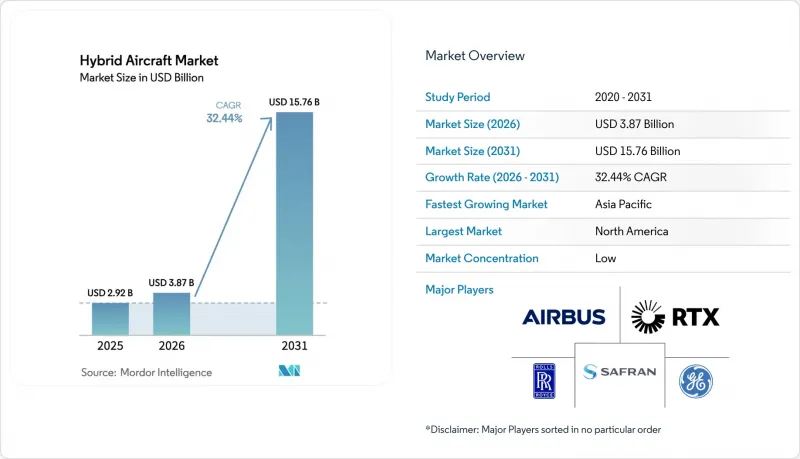
Mordor Intelligence에 의하면, 하이브리드 항공기 시장 규모는 2025년에 29억 2,000만 달러로 평가되었고 2026년 38억 7,000만 달러에서 2031년까지 157억 6,000만 달러에 이를 것으로 예측되며, 예측 기간(2026-2031년)에서 CAGR은 32.44%를 나타낼 전망입니다.
본 보고서는 항공기 유형(지역 수송기, 비즈니스 제트기 및 경항공기 등), 운항 모드(유인 및 자율형), 리프트 기술(기존 이착륙 등), 추진 아키텍처(시리즈 하이브리드, 병렬 하이브리드, 터보일렉트릭),및 지역(북미, 유럽 등)별로 분류되어 있습니다. 시장 예측은 금액(달러) 기준으로 제시되어 있습니다.
세계 하이브리드 항공기 시장 동향 및 인사이트
전 세계적인 배출 규제 강화
탄소 배출 감축 의무화로 인해 항공사의 기체 전략이 재편되면서 하이브리드 항공기 시장의 성장이 가속화되고 있습니다. 2024년 1월에 발효된 EU 택소노미 규정에서는 직접적인 CO2 배출량이 제로임을 입증한 항공기만이 그린 파이낸스의 대상이 된다고 명시되어, 자본이 하이브리드 및 전기 추진 프로그램으로 유입되고 있습니다. EASA는 2024년에 전기 추진에 관한 개정안을 제안하여 제조업체에 형식 인증 취득을 위한 명확한 로드맵을 제시했습니다. 다자간 차원에서는 ICAO(국제민간항공기구)의 ‘첨단 항공 모빌리티 연구 그룹’이 안전 요건을 조화시켜 국경을 초월한 도입을 원활하게 했습니다. 이러한 노력들이 합쳐져 정책 리스크가 완화되었고, 항공기 운영 사업자의 투자 회수 기간이 단축되었습니다.
배터리 및 전기 구동 에너지 밀도의 급속한 발전
배터리 및 전기 추진 기술의 발전으로 하이브리드 항공기 시장의 역량이 확대되고 있습니다. CATL은 500 Wh/kg의 에너지 밀도를 실현하는 고밀도 배터리 화학 조성을 발표하며, 8톤급 항공기에서 2,000-3,000 km의 항속 거리를 보장했습니다. 이로 인해 지역 노선의 설계 범위가 실질적으로 두 배로 늘어났습니다. NASA의 황·셀레늄계 고체 배터리 프로젝트는 동등한 에너지 밀도를 달성하면서 가연성 전해질을 배제함으로써 안전성을 향상시켰습니다. GE 에어로스페이스의 MW급 인버터는 실리콘 카바이드 전력 전자 장치를 발전시키고 NASA의 전력 밀도 목표를 달성함으로써 기내 중량을 줄였습니다. magniX사는 1,000회 사이클 시험을 거친 300 Wh/kg의 항공기용 배터리를 공급하여 이를 보완했습니다. 화학 기술, 인버터, 모터의 융합을 통해 준지역 노선에서 터보프롭 항공기를 능가하는 경제성을 갖춘 하이브리드 시스템이 실현되었습니다.
인증 체계의 미성숙
FAA는 2024년 3월 Joby사를 위한 특별 등급 기준을 발표했으나, 보다 광범위한 하이브리드 범주에 대해서는 여전히 통일된 규정이 부재하여 제조업체들은 여러 가지 방안을 모색할 수밖에 없었습니다. ASTM은 하이브리드 엔진 규격 제정을 시작했으나, 열 폭주 억제 및 고전압 전자기 간섭에 관해서는 여전히 미비한 점이 남아 있었습니다. EASA는 추가 조사 분야를 특정함에 따라, 완전한 규범적 프레임워크의 수립이 지연되었습니다. 이에 대응하여 각 OEM 업체들은 병행 인증 프로그램에 예산을 배정했으나, 그 결과 일정과 자금이 부족해지는 상황이 발생했습니다.
부문 분석
지역 수송용 플랫폼은 터보프롭 항공기를 기반으로 하여 개조 및 인증이 용이했기 때문에 하이브리드 전기 항공기 시장에서 41.82%의 점유율을 차지했습니다. 항공사들은 대규모 인프라 개보수 없이 1,500km 미만의 요건을 충족하기 위해 이를 우선적으로 선택했습니다. 도이체 에어크래프트(Deutsche Aircraft)는 2025년 2월, 첫 번째 D328eco 시험기 생산을 시작했으며, 기존 활주로 네트워크를 활용하는 40석 사양의 파생기 개발을 추진했습니다. 이 프로그램의 라이프치히에 위치한 최종 조립 라인을 통해 독일은 2026년부터 양산 납품을 지원할 수 있는 체제를 갖췄습니다. 이와 병행하여, 비즈니스 제트기 OEM 각사는 도심 공항에서의 착륙 시 소음을 줄이기 위해 전동 부스터를 후장착하는 한편, 경항공기 개발 각사는 비행 학교의 연료비를 절감하는 훈련기 모델을 판매했습니다.
어드밴스트 에어 모빌리티(eVTOL/에어 택시) 부문은 연평균 성장률(CAGR) 39.58%를 기록했습니다. 버티컬 에어로스페이스(Vertical Aerospace)는 2025년 1월, 9,000만 달러의 신규 투자를 확보하여 코츠월드 공항에서 VX4 기종의 인증 비행에 자금을 투입했습니다. 화물 운항 사업자는 미들마일 물류를 위해 ‘리프트 플러스 크루즈’ 구성을 평가하며, 여객 서비스에 앞서 자율 비행 실현을 목표로 했습니다. 한편, 하이브리드 무인항공기(UAV)는 항속 시간이 객실 용적보다 더 중요시되는 해상 순찰 분야에서 보급이 확대되었습니다.
유인 플랫폼은 하이브리드 전기 항공기 시장의 74.68%를 차지하고 있습니다. CAE사는 고전압 안전성과 다발 엔진 비상 훈련을 융합한 전용 형식 인증 커리큘럼을 시작했습니다. 에티하드 항공 훈련(Etihad Aviation Training)은 버티포트 도착 절차와 배터리 화재 대응을 포괄하는 eVTOL 모듈을 추가했습니다. 운항 사업자들은 미성숙한 기술이 성숙해질 때까지 승무원의 감독을 중시했습니다.
자율형 플랫폼은 규모는 작지만 연간 40.92%의 성장률을 보였습니다. 군용 ISR(정찰·감시·정찰) 계약에서는 조종사가 필요 없는 설계가 요구되었으며, 감지·회피 알고리즘의 비행 안전성이 입증되었습니다. ICAO(국제민간항공기구)가 2025년 3월에 제정한 원격 조종 항공기용 성능 기반 SARPs(권장 운영 기준)는 규제상의 주요 걸림돌을 제거했습니다. 화물 항공사들은 자산의 생산성을 높이는 동시에 사회적 수용성과 관련된 위험을 완화하기 위해 야간 운항 도입을 검토했습니다.
지역별 분석
북미는 매출의 40.12%를 차지하는 시장 점유율을 기록하고 있습니다. 이는 NASA의 ‘전동 파워트레인 비행 실증(Electrified Powertrain Flight Demonstration)’이 실물 규모의 추진 시스템 지상 시험 및 비행 시험기에 자금을 지원했기 때문입니다. 아메리칸 항공의 수소·전기 엔진 100기 조건부 구매는 주요 항공사들의 지지를 보여주는 사례였습니다. 유나이티드 항공은 JetZero사에 200대의 블렌드윙 하이브리드 항공기를 발주하고 네트워크 확대에 대한 의지를 강조함으로써 추가적인 추진력을 제공했습니다. 이와 병행하여 각 주의 지원이 공급망 확장을 촉진했습니다. 제트제로(JetZero)사는 2025년 6월, 노스캐롤라이나주 그린즈버러에 1만 4,500명의 일자리를 창출하는 공장을 건설하기로 결정했습니다.
아시아태평양은 중국의 2조 위안(2,790억 2,000만 달러) 규모의 저고도 경제 계획에 힘입어 35.72%라는 가장 높은 연평균 성장률(CAGR)을 기록했습니다. 중국 민용항공국은 연안 지역의 메가시티를 연결하는 eVTOL 노선을 우선시했으며, EHang사는 2024년에 자율형 여객기로서는 세계 최초로 형식 인증을 획득했습니다. CATL사는 국내 배터리 생산 규모를 활용해 2028년까지 8톤급 전기 항공기의 양산을 시작하겠다고 밝혔습니다. 호주 빅토리아주는 Dovetail Electric Aviation사에 보조금을 지급하여 태평양 시장을 겨냥한 지역 항공기 개조 사업을 확대했습니다.
유럽은 공공 자금 조달 수단을 통해 전략적 역할을 유지했습니다. 유럽투자이사회는 AURA Aero에 1,750만 유로(2,047만 달러)를 투자한 반면, 4,000만 유로(4,680만 달러) 규모의 HECATE 프로그램은 전력 배전 시스템 조사에 중점을 두었습니다. 에어버스, 다헤르, 사프란은 2024년 12월 ‘EcoPulse’ 비행 시험을 완료하고, 100시간의 비행 시간을 기록하며 6개의 모터로 구성된 분산형 추진 시스템의 유효성을 입증했습니다. 볼트 에어로(Volt Aero)는 그 한 달 전 누벨아키텐(Nouvelle-Aquitaine) 지역에 ‘카시오(Cassio)’ 시리즈의 최종 조립 공장을 개설하며, 유럽이 시제기에서 양산 체제로의 전환 준비를 마쳤음을 보여주었습니다.
기타 혜택:
- 엑셀 형식 시장 예측(ME) 시트
- 3개월간의 애널리스트 지원
자주 묻는 질문
목차
제1장 서론
제2장 조사 방법
제3장 개요
제4장 시장 구도
제5장 시장 규모와 성장 예측
제6장 경쟁 구도
제7장 시장 기회와 향후 전망
JHS 26.09.03According to Mordor Intelligence, the hybrid aircraft market size was valued at USD 2.92 billion in 2025 and estimated to grow from USD 3.87 billion in 2026 to reach USD 15.76 billion by 2031, at a CAGR of 32.44% during the forecast period (2026-2031).
This report is Segmented by Aircraft Type (Regional Transport Aircraft, Business Jets and Light Aircraft, and More), Mode of Operation (Piloted and Autonomous), Lift Technology (Conventional Take-Off and Landing, and More), Propulsion Architecture (Series Hybrid, Parallel Hybrid, and Turbo-Electric), and Geography (North America, Europe, and More). The Market Forecasts are Provided in Terms of Value (USD).
Global Hybrid Aircraft Market Trends and Insights
Stricter Global Emissions Regulations
Carbon-reduction mandates are reshaping airline fleet strategies and supporting growth in the Hybrid Aircraft Market. The EU Taxonomy Regulation, effective January 2024, specified that only aircraft demonstrating zero direct CO2 emissions qualify for green financing, steering capital toward hybrid and electric programs. EASA proposed amendments covering electric propulsion in 2024, giving manufacturers a known pathway for type certification. At the multilateral level, ICAO's Advanced Air Mobility Study Group harmonized safety requirements, smoothing cross-border deployment. Together, these actions reduced policy risk and shortened payback periods for fleet operators.
Rapid Advances in Battery and Electric-Drive Density
Technological advancements in batteries and electric propulsion are expanding the capabilities of the Hybrid Aircraft Market. CATL revealed a condensed-battery chemistry that delivered 500 Wh/kg and promised 2,000-3,000 km range for 8-ton aircraft, effectively doubling the design envelope for regional routes. NASA's sulfur-selenium solid-state project matched that energy density while removing flammable electrolytes, enhancing safety. GE Aerospace's MW-class inverter advanced silicon-carbide power electronics and met NASA power-density targets, reducing onboard weight. magniX supplemented the supply with 300 Wh/kg aviation-grade batteries tested for 1,000 cycles. The convergence of chemistry, inverters, and motors enabled hybrid systems that exceed the economics of turboprops on sub-regional stages.
Certification Framework Immaturity
The FAA issued special-class criteria for Joby in March 2024, yet broader hybrid categories still lacked harmonized rules, forcing manufacturers to pursue multiple paths. ASTM began drafting hybrid-engine standards, but gaps remained in thermal-runaway containment and high-voltage electromagnetic interference. EASA identified further research areas, delaying a fully prescriptive framework. In response, original-equipment manufacturers budgeted parallel certification programs that stretched timelines and capital.
Other drivers and restraints analyzed in the detailed report include:
- Surging Regional and Short-Haul Connectivity Demand
- Military Demand for Low-Acoustic ISR Platforms
- Hybrid Power-Train Weight Penalties
For complete list of drivers and restraints, kindly check the Table Of Contents.
Segment Analysis
Regional transport platforms represented a 41.82% hybrid electric aircraft market share because their turboprop baselines simplified conversion and certification. Airlines prioritized them to satisfy sub-1,500 km requirements without infrastructure overhauls. Deutsche Aircraft started constructing the first D328eco test airframe in February 2025, advancing a 40-seat derivative that leverages existing runway networks. The program's Leipzig final assembly line positioned Germany to support volume deliveries from 2026. In parallel, business-jet OEMs retrofitted electric boosters to reduce approach noise at urban airports, while light-aircraft developers marketed trainer models that cut fuel bills for flight schools.
The Advanced Air Mobility (eVTOL/Air Taxi) category clocked a 39.58% CAGR. Vertical Aerospace secured USD 90 million in fresh equity in January 2025, funding VX4 certification flights at Cotswold Airport. Cargo operators evaluated lift-plus-cruise configurations for middle-mile logistics, targeting autonomous entry before passenger service. Hybrid UAVs, meanwhile, gained traction in maritime patrol where endurance outweighed cabin volume.
Piloted platforms hold 74.68% of the hybrid electric aircraft market. CAE launched dedicated type-rating syllabi that blended high-voltage safety with multi-engine emergency drills. Etihad Aviation Training added eVTOL modules covering vertiport arrival procedures and battery-fire response. Operators valued crew oversight while unfamiliar technologies matured.
Autonomous platforms expanded 40.92% annually, albeit from a smaller base. Military ISR contracts demanded pilot-optional designs, demonstrating airworthiness for detect-and-avoid algorithms. ICAO's March 2025 performance-based SARPs for remotely piloted aircraft removed a key regulatory bottleneck. Cargo carriers considered night-time utilization to increase asset productivity while mitigating public acceptance risks.
Complete Report Scope:
- By Aircraft Type
- Regional Transport Aircraft
- Business Jets and Light Aircraft
- Advanced Air Mobility (eVTOL/Air Taxi)
- Hybrid UAV
- By Mode of Operation
- Piloted
- Autonomous
- By Lift Technology
- Conventional Take-off and Landing (CTOL)
- Short Take-off and Landing (STOL)
- Vertical Take-off and Landing (VTOL)
- By Propulsion Architecture
- Series Hybrid
- Parallel Hybrid
- Turbo-Electric
- By Geography
- North America
- United States
- Canada
- Mexico
- Europe
- United Kingdom
- Germany
- France
- Italy
- Rest of Europe
- Asia-Pacific
- China
- India
- Japan
- South Korea
- Rest of Asia-Pacific
- South America
- Brazil
- Rest of South America
- Middle East and Africa
- Middle East
- Saudi Arabia
- United Arab Emirates
- Rest of Middle East
- Africa
- South Africa
- Rest of Africa
- Middle East
- North America
Geography Analysis
North America holds the market share of 40.12% of revenue, because NASA's Electrified Powertrain Flight Demonstration funded full-scale propulsion ground tests and flight articles. American Airlines' conditional purchase of 100 hydrogen-electric engines signaled mainline-carrier endorsement. United Airlines added momentum by ordering 200 blended-wing hybrids from JetZero, underscoring network ambitions. Parallel state support attracted supply-chain expansion: JetZero chose Greensboro, North Carolina, for a 14,500-job factory in June 2025.
Asia-Pacific booked the fastest 35.72% CAGR, driven by China's CNY 2 trillion (USD 279.02 billion) low-altitude economy plan. The Civil Aviation Administration of China prioritized eVTOL routes linking coastal megacities, and EHang secured the world's first type certificate for an autonomous passenger aircraft in 2024. CATL pledged serial production of an 8-ton electric aircraft by 2028, leveraging domestic battery scale. Australia's Victoria allocated grants to Dovetail Electric Aviation, expanding regional-aircraft retrofits for the Pacific market.
Europe retained a strategic role through public finance instruments. The European Investment Council injected EUR 17.5 million (USD 20.47 million) into AURA Aero, while the EUR 40 million (USD 46.80 million) HECATE program focused on electric distribution system research. Airbus, Daher, and Safran completed the EcoPulse flight campaign in December 2024, logging 100 flight hours that validated six-motor distributed propulsion. VoltAero opened a final-assembly hall for the Cassio family in Nouvelle-Aquitaine a month earlier, signaling Europe's readiness to shift from prototypes to serial output.
- Airbus SE
- Embraer S.A.
- Safran SA
- General Electric Company
- Pratt & Whitney (RTX Corporation)
- Ampaire Inc.
- Rolls-Royce plc
- Heart Aerospace AB
- Faradair Aerospace Limited
- VoltAero
- AURA AERO
- Vertical Aerospace Group Ltd.
- magniX USA, Inc.
- XTI Aerospace, Inc.
- Ascendance Flight Technologies S.A.S.
- PLANA
- Electra.Aero
Additional Benefits:
- The market estimate (ME) sheet in Excel format
- 3 months of analyst support
TABLE OF CONTENTS
1 INTRODUCTION
- 1.1 Study Assumptions and Market Definition
- 1.2 Scope of the Study
2 RESEARCH METHODOLOGY
3 EXECUTIVE SUMMARY
4 MARKET LANDSCAPE
- 4.1 Market Overview
- 4.2 Market Drivers
- 4.2.1 Stricter global emissions regulations
- 4.2.2 Rapid advances in battery and electric-drive density
- 4.2.3 Surging regional and short-haul connectivity demand
- 4.2.4 Military demand for low-acoustic ISR platforms
- 4.2.5 Secondary-airport STOL/VTOL slot opportunities
- 4.2.6 ESG-linked finance lowering capital costs
- 4.3 Market Restraints
- 4.3.1 Certification framework immaturity
- 4.3.2 Hybrid powertrain weight penalties
- 4.3.3 Shortage of aerospace-grade HV wiring
- 4.3.4 Insurance-premium uncertainty
- 4.4 Value Chain Analysis
- 4.5 Regulatory Landscape
- 4.6 Technological Outlook
- 4.7 Porter's Five Forces Analysis
- 4.7.1 Bargaining Power of Buyers
- 4.7.2 Bargaining Power of Suppliers
- 4.7.3 Threat of New Entrants
- 4.7.4 Threat of Substitutes
- 4.7.5 Intensity of Competitive Rivalry
5 MARKET SIZE AND GROWTH FORECASTS (VALUE)
- 5.1 By Aircraft Type
- 5.1.1 Regional Transport Aircraft
- 5.1.2 Business Jets and Light Aircraft
- 5.1.3 Advanced Air Mobility (eVTOL/Air Taxi)
- 5.1.4 Hybrid UAV
- 5.2 By Mode of Operation
- 5.2.1 Piloted
- 5.2.2 Autonomous
- 5.3 By Lift Technology
- 5.3.1 Conventional Take-off and Landing (CTOL)
- 5.3.2 Short Take-off and Landing (STOL)
- 5.3.3 Vertical Take-off and Landing (VTOL)
- 5.4 By Propulsion Architecture
- 5.4.1 Series Hybrid
- 5.4.2 Parallel Hybrid
- 5.4.3 Turbo-Electric
- 5.5 By Geography
- 5.5.1 North America
- 5.5.1.1 United States
- 5.5.1.2 Canada
- 5.5.1.3 Mexico
- 5.5.2 Europe
- 5.5.2.1 United Kingdom
- 5.5.2.2 Germany
- 5.5.2.3 France
- 5.5.2.4 Italy
- 5.5.2.5 Rest of Europe
- 5.5.3 Asia-Pacific
- 5.5.3.1 China
- 5.5.3.2 India
- 5.5.3.3 Japan
- 5.5.3.4 South Korea
- 5.5.3.5 Rest of Asia-Pacific
- 5.5.4 South America
- 5.5.4.1 Brazil
- 5.5.4.2 Rest of South America
- 5.5.5 Middle East and Africa
- 5.5.5.1 Middle East
- 5.5.5.1.1 Saudi Arabia
- 5.5.5.1.2 United Arab Emirates
- 5.5.5.1.3 Rest of Middle East
- 5.5.5.2 Africa
- 5.5.5.2.1 South Africa
- 5.5.5.2.2 Rest of Africa
- 5.5.5.1 Middle East
- 5.5.1 North America
6 COMPETITIVE LANDSCAPE
- 6.1 Market Concentration
- 6.2 Strategic Moves
- 6.3 Market Share Analysis
- 6.4 Company Profiles (includes Global level Overview, Market level overview, Core Segments, Financials as available, Strategic Information, Market Rank/Share for key companies, Products and Services, and Recent Developments)
- 6.4.1 Airbus SE
- 6.4.2 Embraer S.A.
- 6.4.3 Safran SA
- 6.4.4 General Electric Company
- 6.4.5 Pratt & Whitney (RTX Corporation)
- 6.4.6 Ampaire Inc.
- 6.4.7 Rolls-Royce plc
- 6.4.8 Heart Aerospace AB
- 6.4.9 Faradair Aerospace Limited
- 6.4.10 VoltAero
- 6.4.11 AURA AERO
- 6.4.12 Vertical Aerospace Group Ltd.
- 6.4.13 magniX USA, Inc.
- 6.4.14 XTI Aerospace, Inc.
- 6.4.15 Ascendance Flight Technologies S.A.S.
- 6.4.16 PLANA
- 6.4.17 Electra.Aero
7 MARKET OPPORTUNITIES AND FUTURE OUTLOOK
- 7.1 White-space and Unmet-Need Assessment