

|
시장보고서
상품코드
2119899
홈보안 카메라 : 시장 점유율 분석, 업계 동향과 통계, 성장 예측(2026-2031년)Home Security Camera - Market Share Analysis, Industry Trends & Statistics, Growth Forecasts (2026 - 2031) |
||||||
 Mordor Intelligence
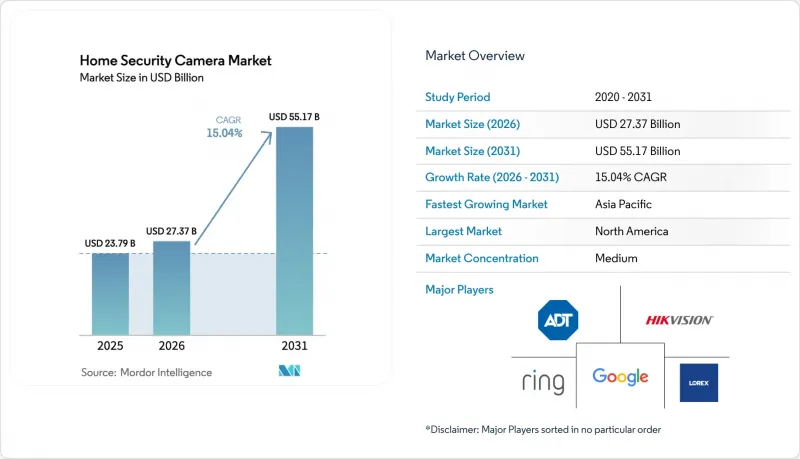
Mordor Intelligence에 따르면 홈보안 카메라 시장 규모는 2025년 237억 9,000만 달러에서 2026년에는 273억 7,000만 달러로 확대하며, 2026-2031년에 CAGR 15.04%로 추이하며, 2031년까지 551억 7,000만 달러에 달할 것으로 예측됩니다.
이 보고서는 제품 유형(배럿형, 돔형, PTZ형 등), 연결 방식(유선, 무선), 전원(AC 전원, 배터리/태양광발전), 해상도(HD(1080p 이하), 풀 HD 1080p 등),용도(실내, 실외, 도어벨) 및 지역(북미, 남미 등)별로 분류되어 있습니다. 시장 예측은 금액(달러) 기준으로 제시되어 있습니다.
글로벌 홈보안 카메라 시장의 동향 및 인사이트
스마트홈 생태계 및 음성 비서와의 통합
보안 카메라, 스마트 디스플레이, 음성 제어의 융합은 네트워크 효과를 창출하고, 소비자의 전환 비용을 높이며, 플랫폼에 대한 충성도를 공고히 합니다. 애플이 계획 중인 AI 홈 디스플레이는 주요 기술 기업이 감시 기능을 보다 광범위한 자동화 제품군의 중심에 통합하고 있음을 여실히 보여줍니다. 아마존의 링(Ring)은 실시간 동영상을 실질적인 인사이트으로 변환하는 AI 생성 동작 요약 기능을 통해 한계를 넓히고, 독자적인 클라우드 분석의 전략적 가치를 강화하고 있습니다. 생태계가 성숙해짐에 따라 하드웨어 이익률은 압박을 받는 반면, 정기 서비스 수익은 확대되어 홈보안 카메라 시장의 경쟁 역학을 재정의하고 있습니다.
중국 OEM 제조사의 과잉 생산 능력으로 인한 HD 및 4K IP 카메라의 평균 판매 가격(ASP) 하락
중국 OEM(Original Equipment Manufacturer)의 과잉 생산 능력은 가격 하락의 연쇄 반응을 일으켜 4K 해상도를 널리 보급시키는 한편, 유럽 및 미국의 공급업체들로 하여금 차별화된 소프트웨어와 개인정보 보호 기능으로의 전환을 촉구하고 있습니다. Hikvision의 2024년 가격표에 따르면 주류 4K 모델은 이전 HD 가격대를 밑도는 추세를 보이고 있으며, 고해상도 도입에 대한 진입 장벽을 낮추고 있습니다. 동시에, 규제 대상 공급업체를 대체하기 위한 미국의 프로그램으로 인해 2억 4,700만 달러가 국내 대체 제품에 투입되고 있으며, 가격에 민감한 가구는 중국 브랜드를 선호하는 반면, 보안을 중시하는 사용자는 비용이 비싸더라도 유럽 및 미국 공급업체를 선호하는 등 양극화된 시장 형성이 가속화되고 있습니다.
지속적인 클라우드 녹화를 제한하는 데이터 개인정보 보호 규정
유럽의 GDPR 규정은 데이터 보호 영향 평가를 의무화하고 상시 녹화를 제한하고 있으며, 제조사들은 ‘프라이버시 바이 디자인’ 아키텍처와 로컬 스토리지 옵션에 대한 투자를 할 수밖에 없는 상황입니다. 규정 준수를 위한 조치는 부품 원가를 상승시키고, 클라우드 저장에 따른 구독 수익을 제한하므로 프라이버시를 중시하는 소비자층에서의 보급 속도를 둔화시키고 있습니다.
부문 분석
2025년, 배럿형 카메라는 홈보안 카메라 시장에서 37.55%의 점유율을 유지했습니다. 이는 실내·실외를 불문하고 범용적으로 사용할 수 있다는 점과 높은 가성비에 힘입은 결과입니다. 도어벨형 카메라는 시장 규모는 작지만, 가구들이 택배 수령 확인 및 원활한 스마트홈 연동을 중시하는 경향이 있으며, 15.86%라는 가장 높은 연평균 성장률(CAGR)을 기록하고 있습니다. 돔형 및 PTZ 카메라는 안정적인 상업용 틈새 시장을 점유하고 있는 반면, 박스형 카메라는 여전히 특수 용도로만 사용되고 있습니다.
도어벨의 15.86%라는 성장률은 도시 지역에서 소포 도난이 증가하고, Ring사의 AI를 통한 동작 요약과 같은 생태계상의 인센티브가 얼리 어답터 이외의 층으로의 보급을 지원하고 있음을 반영합니다. 보험료 할인이 수요를 가속화하며, 홈보안 카메라 시장에서 ‘진입점의 가시화’라는 추세를 강화하고 있습니다.
무선 기기는 2025년에 홈보안 카메라 시장의 60.45% 점유율을 차지하며, 2031년까지 연평균 성장률(CAGR) 15.62%를 기록할 전망입니다. DIY에 적합한 설치 및 배치 변경의 유연성이 도입 곡선을 향상시키는 한편, Blink Sync Module XR과 같은 독자적인 장거리 허브를 통해 커버 범위는 400피트까지 확대되고 있습니다.
유선 시스템은 여전히 미션 크리티컬한 상업 환경에서 중요한 역할을 하고 있지만, 인건비와 배선 비용으로 인해 성장세가 둔화되고 있습니다. 배터리 지속 시간이 향상됨에 따라 2031년까지 무선 제품의 보급률은 홈보안 카메라 시장의 3분의 2를 넘어설 것으로 예상됩니다.
지역별 분석
2025년, 북미는 홈보안 카메라 시장의 37.60%를 차지했습니다. 높은 가처분 소득, 교외 주택의 밀집도, 그리고 보험사의 인센티브가 안정적인 연간 업그레이드를 지원하고 있습니다. 미국에서는 아마존(Amazon) 등의 기업을 통해 생태계에 대한 락인(lock-in)이 촉진되는 반면, 캐나다에서는 추운 기후로 인해 에너지 효율이 높은 모델에 대한 수요가 증가하고 있습니다.
아시아태평양은 2031년까지 16.34%라는 가장 높은 연평균 성장률(CAGR)을 기록할 것으로 전망됩니다. 싱가포르, 말레이시아, 태국 등 시장의 지역적 FTTH 확대와 스마트 시티에 대한 보조금이 클라우드 중심의 도입을 지원하고 있습니다. 중국은 대외 무역 제한에도 불구하고 내수와 지방자치단체의 안전 대책에 힘입어 여전히 큰 시장 규모를 유지하고 있습니다. 인도에서는 중산층 주택 소유자의 증가와 E-Commerce량 확대가 판매 대수의 점진적인 증가를 지원하고 있습니다. 일본과 한국은 프리미엄 4K 제품이나 개인정보 보호 기능을 강화한 솔루션에 중점을 두고 있는 반면, 호주와 뉴질랜드에서는 정부의 환급 제도를 바탕으로 한 하이엔드 제품이 채택되고 있습니다.
유럽에서는 꾸준한 성장이 나타나고 있지만, GDPR 준수에 따른 비용의 영향으로 그 속도는 완만합니다. 독일과 영국에서는 개인정보 보호 규정을 준수하는 하이브리드 스토리지 모델의 도입이 활발한 반면, 프랑스, 이탈리아, 스페인에서는 하드웨어 가격을 상쇄하는 지방자치단체의 보조금이 기여하고 있습니다. 데이터를 현지화하고 온프레미스 영상 처리 기능을 제공하는 제조사들은 해당 지역의 홈보안 카메라 시장에서 경쟁 우위를 확보하고 있습니다.
기타 혜택:
- 엑셀 형식의 시장 예측(ME) 시트
- 3개월간의 애널리스트 지원
자주 묻는 질문
목차
제1장 서론
제2장 조사 방법
제3장 개요
제4장 시장 구도
제5장 시장 규모와 성장 예측
제6장 경쟁 구도
제7장 시장 기회와 향후 전망
KSA 26.09.02According to Mordor Intelligence, the home security camera market size is expected to grow from USD 23.79 billion in 2025 to USD 27.37 billion in 2026 and is forecast to reach USD 55.17 billion by 2031 at 15.04% CAGR over 2026-2031.
This report is Segmented by Product Type (Bullet, Dome, PTZ, and More), Connectivity (Wired, and Wireless), Power Source (AC-Powered, and Battery/Solar-Powered), Resolution (HD <=1080p, Full-HD 1080p, and More), Application (Indoor, Outdoor, and Doorbell), and by Geography (North America, South America, and More). The Market Forecasts are Provided in Terms of Value (USD).
Global Home Security Camera Market Trends and Insights
Integration with Smart-Home Ecosystems and Voice Assistants
The convergence of security cameras, smart displays, and voice control creates a network effect that raises switching costs for consumers and cements platform loyalty. Apple's planned AI Home Display underscores how major tech firms embed surveillance at the center of broader automation suites. Amazon's Ring pushes the envelope with AI-generated motion summaries that transform raw video into actionable insights, reinforcing the strategic value of proprietary cloud analytics. As ecosystems mature, hardware margins compress while recurring service revenues expand, redefining competitive dynamics in the home security camera market.
Declining ASP of HD and 4K IP Cameras from Chinese OEM Overcapacity
Overcapacity among Chinese original-equipment manufacturers triggers a price deflation cycle that democratizes 4K resolution, yet forces Western suppliers to pivot toward differentiated software and privacy features. Hikvision's 2024 price list shows mainstream 4K models trending below prior HD price points, eroding the entry barrier for high-resolution adoption. Simultaneously, the US replacement program for restricted vendors channels USD 247 million into domestic alternatives, accelerating a bifurcated market where price-sensitive households gravitate to Chinese brands, while security-critical users favor Western vendors despite higher costs.
Data-Privacy Regulations Limiting Continuous Cloud Recording
European GDPR rules mandate data-protection impact assessments and curtail always-on recording, compelling manufacturers to invest in privacy-by-design architectures and local storage options. Compliance adds bill-of-materials cost and limits subscription revenue from cloud retention, dampening uptake among privacy-sensitive consumers.
Other drivers and restraints analyzed in the detailed report include:
- Insurance Premium Discounts for Homes with Verified Video Monitoring
- Rapid FTTH Roll-outs Enabling 24/7 Cloud Uploads in ASEAN
- CMOS Image-Sensor Supply Volatility Creating Price Spikes
For complete list of drivers and restraints, kindly check the Table Of Contents.
Segment Analysis
Bullet cameras retained 37.55% share of the home security camera market in 2025, a position anchored in versatile indoor-outdoor use and cost-effectiveness. Doorbell units, while smaller in base, post the fastest 15.86% CAGR as households prioritize package-delivery verification and seamless smart-home integration. Dome and PTZ cameras occupy stable commercial niches, whereas box cameras remain specialized.
The 15.86% growth rate in doorbells reflects rising urban parcel theft and ecosystem incentives such as AI motion summaries from Ring that push adoption beyond early adopters. Insurance discounts accelerate demand, reinforcing the home security camera market trend toward entry-point visibility.
Wireless devices captured 60.45% of the home security camera market share in 2025 and head toward a 15.62% CAGR to 2031. DIY-friendly installation and relocation agility improve the adoption curve, while proprietary long-range hubs such as Blink Sync Module XR extend coverage to 400 feet.
Wired systems maintain relevance for mission-critical commercial settings, yet slower growth reflects labor and cabling costs. As battery longevity improves, wireless penetration is expected to exceed two-thirds of the home security camera market by 2031.
Complete Report Scope:
- By Product Type
- Bullet Security Camera
- Dome Security Camera
- PTZ Security Camera
- Box Security Camera
- Doorbell (Video Doorbell) Camera
- By Connectivity
- Wired
- Wireless
- By Power Source
- AC-Powered
- Battery / Solar-Powered
- By Resolution
- HD (<=1080p)
- Full-HD (1080p)
- 2K QHD
- 4K UHD and Above
- By Application
- Indoor Camera
- Outdoor Camera
- Doorbell Camera
- By Geography
- North America
- United States
- Canada
- Mexico
- South America
- Brazil
- Argentina
- Rest of South America
- Europe
- United Kingdom
- Germany
- France
- Italy
- Spain
- Rest of Europe
- Asia Pacific
- China
- Japan
- India
- South Korea
- ASEAN
- Australia
- New Zealand
- Rest of Asia Pacific
- Middle East and Africa
- Middle East
- GCC
- Turkey
- Israel
- Rest of Middle East
- Africa
- South Africa
- Nigeria
- Egypt
- Rest of Africa
- Middle East
- North America
Geography Analysis
North America commanded 37.60% of the home security camera market in 2025. High disposable income, suburban housing density, and insurer incentives sustain stable annual upgrades. The United States champions ecosystem lock-in through companies such as Amazon, while Canada's colder climate elevates demand for energy-efficient models.
Asia Pacific posts the highest 16.34% CAGR through 2031. Regional FTTH expansion and smart-city grants in markets such as Singapore, Malaysia, and Thailand underpin cloud-centric adoption. China remains sizable despite external trade restrictions, driven by domestic demand and municipal safety initiatives. India's rise of middle-class homeowners and e-commerce volumes fuels incremental unit sales. Japan and South Korea emphasize premium 4K and privacy-enhanced solutions, whereas Australia and New Zealand adopt high-end offerings supported by government rebates.
Europe records steady growth but at a moderated pace due to GDPR compliance costs. Germany and the United Kingdom show strong uptake of privacy-compliant hybrid storage models, while France, Italy, and Spain benefit from municipal subsidies that offset hardware prices. Manufacturers that localize data and offer on-premises video processing gain a competitive edge in the regional home security camera market.
- Hangzhou Hikvision Digital Technology Co. Ltd
- Ring LLC (Amazon)
- Google LLC (Nest)
- ADT Inc.
- Lorex Technology Inc. (Flir)
- Arlo Technologies Inc.
- Wyze Labs Inc.
- Dahua Technology Co., Ltd.
- Blink LLC (Amazon)
- SimpliSafe Inc.
- Canary Connect Inc.
- Swann Communications
- Axis Communications AB
- Vivint Smart Home Inc.
- Eufy Security (Anker Innovations)
- Logitech International S.A.
- Swann Communications
- TP-Link Technologies Co., Ltd. (Tapo)
- Yi Technology
- Netatmo (SA Legrand)
- CP PLUS (Gunnebo Group)
- Xiaomi
Additional Benefits:
- The market estimate (ME) sheet in Excel format
- 3 months of analyst support
TABLE OF CONTENTS
1 INTRODUCTION
- 1.1 Study Assumptions and Market Definition
- 1.2 Scope of the Study
2 RESEARCH METHODOLOGY
3 EXECUTIVE SUMMARY
4 MARKET LANDSCAPE
- 4.1 Market Overview
- 4.2 Market Drivers
- 4.2.1 Integration with Smart-Home Ecosystems and Voice Assistants in North America and Europe
- 4.2.2 Declining ASP of HD and 4K IP Cameras due to Chinese OEM Overcapacity
- 4.2.3 Insurance Premium Discounts for Homes with Verified Video Monitoring
- 4.2.4 Rapid FTTH Roll-outs Enabling 24/7 Cloud Uploads in ASEAN
- 4.2.5 Urban Middle-Class Demand after Rise in Parcel Theft
- 4.2.6 Government Smart-City Safety Grants Subsidising Residential CCTV
- 4.3 Market Restraints
- 4.3.1 Data-Privacy Regulations Limiting Continuous Cloud Recording
- 4.3.2 Saturation of Early-Adopter Segments in Developed Markets
- 4.3.3 CMOS Image-Sensor Supply Volatility Creating Price Spikes
- 4.3.4 Rising Geopolitical Scrutiny on Chinese Brands
- 4.4 Value / Supply-Chain Analysis
- 4.5 Regulatory or Technological Outlook
- 4.6 Porter's Five Forces
- 4.6.1 Threat of New Entrants
- 4.6.2 Bargaining Power of Buyers
- 4.6.3 Bargaining Power of Suppliers
- 4.6.4 Threat of Substitutes
- 4.6.5 Intensity of Competitive Rivalry
5 MARKET SIZE AND GROWTH FORECASTS (VALUE)
- 5.1 By Product Type
- 5.1.1 Bullet Security Camera
- 5.1.2 Dome Security Camera
- 5.1.3 PTZ Security Camera
- 5.1.4 Box Security Camera
- 5.1.5 Doorbell (Video Doorbell) Camera
- 5.2 By Connectivity
- 5.2.1 Wired
- 5.2.2 Wireless
- 5.3 By Power Source
- 5.3.1 AC-Powered
- 5.3.2 Battery / Solar-Powered
- 5.4 By Resolution
- 5.4.1 HD (<=1080p)
- 5.4.2 Full-HD (1080p)
- 5.4.3 2K QHD
- 5.4.4 4K UHD and Above
- 5.5 By Application
- 5.5.1 Indoor Camera
- 5.5.2 Outdoor Camera
- 5.5.3 Doorbell Camera
- 5.6 By Geography
- 5.6.1 North America
- 5.6.1.1 United States
- 5.6.1.2 Canada
- 5.6.1.3 Mexico
- 5.6.2 South America
- 5.6.2.1 Brazil
- 5.6.2.2 Argentina
- 5.6.2.3 Rest of South America
- 5.6.3 Europe
- 5.6.3.1 United Kingdom
- 5.6.3.2 Germany
- 5.6.3.3 France
- 5.6.3.4 Italy
- 5.6.3.5 Spain
- 5.6.3.6 Rest of Europe
- 5.6.4 Asia Pacific
- 5.6.4.1 China
- 5.6.4.2 Japan
- 5.6.4.3 India
- 5.6.4.4 South Korea
- 5.6.4.5 ASEAN
- 5.6.4.6 Australia
- 5.6.4.7 New Zealand
- 5.6.4.8 Rest of Asia Pacific
- 5.6.5 Middle East and Africa
- 5.6.5.1 Middle East
- 5.6.5.1.1 GCC
- 5.6.5.1.2 Turkey
- 5.6.5.1.3 Israel
- 5.6.5.1.4 Rest of Middle East
- 5.6.5.2 Africa
- 5.6.5.2.1 South Africa
- 5.6.5.2.2 Nigeria
- 5.6.5.2.3 Egypt
- 5.6.5.2.4 Rest of Africa
- 5.6.5.1 Middle East
- 5.6.1 North America
6 COMPETITIVE LANDSCAPE
- 6.1 Market Concentration
- 6.2 Strategic Moves
- 6.3 Market Share Analysis
- 6.4 Company Profiles (includes Global level Overview, Market level overview, Core Segments, Financials as available, Strategic Information, Market Rank/Share for key companies, Products and Services, and Recent Developments)
- 6.4.1 Hangzhou Hikvision Digital Technology Co. Ltd
- 6.4.2 Ring LLC (Amazon)
- 6.4.3 Google LLC (Nest)
- 6.4.4 ADT Inc.
- 6.4.5 Lorex Technology Inc. (Flir)
- 6.4.6 Arlo Technologies Inc.
- 6.4.7 Wyze Labs Inc.
- 6.4.8 Dahua Technology Co., Ltd.
- 6.4.9 Blink LLC (Amazon)
- 6.4.10 SimpliSafe Inc.
- 6.4.11 Canary Connect Inc.
- 6.4.12 Swann Communications
- 6.4.13 Axis Communications AB
- 6.4.14 Vivint Smart Home Inc.
- 6.4.15 Eufy Security (Anker Innovations)
- 6.4.16 Logitech International S.A.
- 6.4.17 Swann Communications
- 6.4.18 TP-Link Technologies Co., Ltd. (Tapo)
- 6.4.19 Yi Technology
- 6.4.20 Netatmo (SA Legrand)
- 6.4.21 CP PLUS (Gunnebo Group)
- 6.4.22 Xiaomi
7 MARKET OPPORTUNITIES AND FUTURE OUTLOOK
- 7.1 White-Space and Unmet-Need Assessment


