

|
시장보고서
상품코드
2120256
시안화수소 시장 : 점유율 분석, 업계 동향과 통계, 성장 예측(2026-2031년)Hydrogen Cyanide - Market Share Analysis, Industry Trends & Statistics, Growth Forecasts (2026 - 2031) |
||||||
 Mordor Intelligence
Mordor Intelligence에 의하면, 시안화수소 시장 규모는 2026년에 241만 톤으로 추정되고 있어 예측 기간(2026-2031년)에서 CAGR 1.77%로 확대되어 2031년에는 263만 톤에 이를 전망입니다.
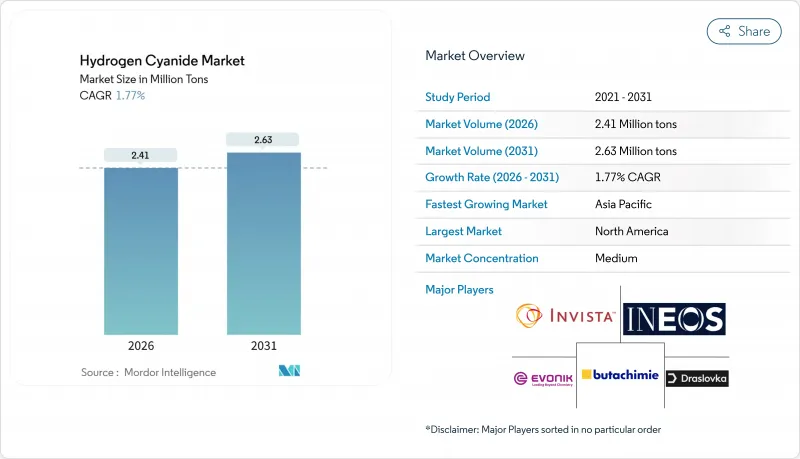
본 보고서는 형태별(시안화수소 액체 및 시안화수소 가스), 용도별(나트륨 시안화물 및 칼륨 시안화물, 아디포니트릴, 아세톤시아노히드린, 기타 용도), 지역별(아시아태평양, 북미, 유럽, 남미, 중동 및 아프리카)로 분류되어 있습니다. 시장 예측은 수량(톤) 기준으로 제시되어 있습니다.
전 세계 시안화수소 시장 동향 및 인사이트
NaCN 및 KCN 생산에 대한 호조세
금 생산자들은 시안화물 염 분야에서 전 세계 HCN 소비량의 대부분을 차지하고 있습니다. 2024년부터 2025년까지 금괴 가격이 상승함에 따라 저품위 광석의 처리가 현저히 증가했습니다. 주요 광업 기업들은 인증된 공급업체에 의존하게 되었으며, 2025년 말까지 국제 시안화물 관리 기구(ICMI)는 여러 국가에 걸쳐 있는 수많은 광산을 감사했습니다. 페루, 가나, 서호주에서는 힙 리치(heap leaching, 적재 침출) 프로젝트가 브리켓 출하량 증가를 견인하여 중기적인 인수 계약을 강화했습니다. 티오설페이트와 글리신을 시험적으로 도입하고 있는 파일럿 플랜트는 향후 전환 가능성을 시사하고 있지만, 이러한 대체 수단은 회수율과 시약 비용 양면에서 여전히 시안화물에 미치지 못하는 상황입니다. 그 결과, 대체 침출법이 비용 면에서 동등해지는 2028년 이후까지는 시안화 나트륨 및 시안화 칼륨의 출하량이 완만한 증가 추세를 유지할 전망입니다.
나일론 6,6용 아디포니트릴 수요 증가
나일론 업계의 선도 기업인 INVISTA는 커넥터, 배터리 모듈, 고온용 호스 등의 용도를 목표로 전 세계 나일론 6,6 사업의 확장을 위해 막대한 투자를 약속하고 있습니다. 중국 내 나일론 6,6 생산량이 증가함에 따라 아디포니트릴의 생산 능력도 확대되고 있습니다. 이러한 움직임으로 인해 새로운 원료의 병목 현상이 해소될 때까지 아시아태평양은 구조적인 공급 부족 상태가 지속될 것으로 확실시되고 있습니다. 전기차(EV) 설계에서는 차량 전체의 폴리머 사용량 감축을 목표로 하고 있지만, 내열 부품에 대한 수요가 이 감축분을 상쇄하고 있어 장기적인 수요 지속이 시사되고 있습니다. 또한, 유럽연합(EU) 및 미국의 자동차 경량화 규제로 인해 기존 금속에 비해 나일론 6,6이 선호되는 경향이 강해지고 있습니다. 업계가 2020년대 중반의 중요한 생산 능력 확대 시기를 맞이하는 가운데, 각 생산사는 과잉 생산을 피하기 위해 전기차(EV)의 판매 동향을 주시하고 있습니다.
매우 높은 독성과 규제 준수 비용
치사성으로 잘 알려진 시안화수소를 취급하기 위해서는 밀폐 루프 시스템, 지속적인 모니터링 및 전용 운송 수단이 필요합니다. OSHA(미국 직업안전보건청)는 8시간 평균 및 15분간의 피크값에 대해 작업장 내 노출 한계치를 특정 수준으로 설정하고 있습니다. 한편, REACH 부속서 XIV에서는 유럽의 사용자에게 특정 인가를 취득할 것을 의무화하고 있습니다. 스크러버, 가스 감지기, 비상 샤워기 등의 안전 대책으로 인해 플랜트 설치 비용은 대폭 증가합니다. 또한, 운송에 전용 철도 차량을 사용함으로써 표준 벌크 화학 물질에 비해 물류 비용이 높아집니다. 이러한 재정적 부담은 그린필드 프로젝트로의 신규 진입을 저해하고, 수직 통합형 기존 기업에 유리한 조건을 제공하게 됩니다. 현장에서 HCN을 사용하는 이러한 기존 기업들은 유럽이나 일본 등의 지역에서 무역 회사의 유동성을 제한하고 있습니다. 게다가 보험사는 이러한 위험에 대응하여 보험료를 인상하기 때문에 경험이 풍부한 생산자와 신규 시장 진출기업 간의 격차가 더욱 확대되고 있습니다.
부문 분석
2025년, 액체 HCN은 전 세계 총 출하량의 59.87%를 차지했습니다. 이러한 추세는 가압식 철도 차량과 ISO 탱크의 효율성에 크게 기인합니다. 이들은 한 번에 대량의 운송이 가능하여 대량 사용자에게 최저의 배송 비용을 보장합니다. 멕시코만 연안 및 동북아시아의 확립된 통합 생산 체제가 액체 시안화수소 시장에 막대한 영향을 미치고 있습니다. 이 지역에서는 아디포니트릴 및 시안화물 염을 생산하는 공장이 철도 부선 바로 옆에 전략적으로 위치해 있습니다. 반도체 팹에서 마이크로 앤더슨 발전기의 채택이 확대됨에 따라, 기상 시안화수소 수요는 2031년까지 연평균 성장률(CAGR) 2.01%로 확대될 것으로 예측됩니다. 이러한 발전기는 대량 저장 필요성을 없앨 뿐만 아니라, 엄격한 클린룸 기준도 준수하고 있습니다. 페루나 가나와 같은 광업 중심지에서는 액체 형태가 선호됩니다. 이 지역에서는 시안화물 브리켓 용해 장치를 통해 외딴 지역에 탱크로리로 운반된 원료가 침출액으로 전환됩니다. 반면 일본에서는 고정 저장 관련 엄격한 규제로 인해 특수 화학제품 제조업체들은 변동 비용이 높아지더라도 주문형 가스 기술을 채택할 수밖에 없습니다.
운송 비용 측면에서도 시장에서 액체 시안화수소의 우위는 확고합니다. 액체의 톤킬로당 비용은 가스통에 담긴 가스에 비해 대폭 낮습니다. 또한, 운송이 ICMI 운송 프로토콜을 준수한다면 보험료도 적정한 수준으로 억제될 수 있습니다. 그러나 아시아태평양의 전자 산업 집적지나 유럽의 웨이퍼 공장에서는 사용 현장에서 직접 생산하는 쪽으로 기울고 있습니다. 이러한 변화로 인해 세베소 III 규정에 따라 현장 재고 수준을 낮게 유지할 수 있게 됩니다. 이러한 동향을 반영하여 계약 형태에도 편차가 나타나고 있습니다. 나일론 업계나 광업 분야의 고객은 주로 장기 ‘테이크 오어 페이(Take-or-Pay)’ 방식의 액체 계약을 선택하는 반면, 가스 공급 계약은 기간이 짧은 경향이 있습니다. 미래를 내다보면, 마이크로 리액터에 대한 투자로 인해 액체 제품 시장 점유율은 축소될 전망이지만, 대규모 물류 네트워크와 자사 소유의 파생 제품 플랜트라는 강점을 바탕으로 예측 기간 동안 액체 제품은 주도적인 위치를 계속 유지할 것입니다.
지역별 분석
2025년에 북미가 시안화수소 시장에서 37.22%의 점유율을 차지하게 된 배경에는 셰일 유래의 천연가스 액체, 암모니아, 아크릴로니트릴, 아디포니트릴, 나일론 6,6을 동일한 거점에 집약한 수십 년에 걸친 걸프 코스트의 통합이 있습니다. 공동 생산을 통해 비용 효율성이 확보됨에 따라, 사업자는 일반 물류 비용을 부담하지 않고도 하류 수지 수요에 맞추어 HCN 생산량을 유연하게 조정할 수 있게 되었습니다. 자동차 OEM 각사는 열 사이클 내성이나 내액성 같은 특성이 비용 측면의 고려 사항을 상회하는 보닛 내부 부품에 대해 여전히 나일론 6,6을 지정하고 있습니다. 그러나 2022년 암모니아 가격 급등 이후 원료 헤지가 필수적이 되어, 질소 생산 업체와 장기 계약이 체결됨과 동시에 그린 암모니아 인수에 관한 초기 타당성 조사가 시작되었습니다.
아시아태평양은 2031년까지 연평균 성장률(CAGR) 1.98%로 확대될 것으로 예상되며, 그 원동력은 나일론 6,6의 자급자족을 목표로 하는 중국의 정책 추진, 인도의 단백질 소비 급증, 그리고 동남아시아의 전자 산업 확대입니다. 허베이 청신과 중국석유천연가스그룹(CNPC)은 2024년부터 2025년까지 전용 HCN 생산 능력을 확충하여 수입량을 줄이는 동시에 지역 내 가격 변동을 완화했습니다. 에보닉과 스미토모 화학은 장기 HCN 위탁 생산 계약에 따라 사우디아라비아와 싱가포르에서 메티오닌 복합체를 공급하고 있으며, 이는 중동 국가들이 동물 영양 밸류체인에 대한 참여를 강화하고 있음을 반영합니다. 일본과 한국은 에어 리퀴드(Air Liquide) 및 린데(Linde)로부터 라이선스를 취득한 현장 생산 기술을 통해 물류상의 제약을 완화함으로써, 벌크 저장에 관한 규제적 장벽을 회피하고 있습니다.
유럽 시장 점유율은 축소되었습니다. 이는 에너지 비용의 급등으로 인해 수입 대체품에 비해 HCN 전용 생산이 경제성이 떨어지게 되었기 때문입니다. 에보닉과 이네오스는 자체 사용용 MMA 및 특수 화학제품을 위해 자산을 재최적화했으나, 한편 일반 공급량은 원료 스프레드가 유리한 미국 및 중동에서공급이 점점 증가하고 있습니다. 남미 수요는 페루, 칠레, 브라질의 시안화물 소비에 집중되어 있으며, 사이안코와 도라스 로프카가 외딴 지역의 지형에도 대응 가능한 고체 연탄 형태의 물류를 통해 공급하고 있습니다. 중동에는 잠재적인 가능성이 숨겨져 있습니다. 사우디아라비아의 풍부한 가스와 암모니아는 수출 지향적인 플랜트를 뒷받침할 가능성이 있지만, 국내에서 파생되는 제품이 없기 때문에 이러한 프로젝트는 먼 시장에 진출하기 위해 자격 인증 및 운송 장벽을 극복해야 합니다. 아프리카는 여전히 광업을 중심으로 한 소비가 주를 이루고 있으며, 남아프리카공화국에서는 소규모 현지 생산이 이루어지고 있는 반면, 다른 지역에서는 수입에 대한 의존도가 높습니다.
기타 혜택:
- 엑셀 형식 시장 예측(ME) 시트
- 3개월간의 애널리스트 지원
자주 묻는 질문
목차
제1장 서론
제2장 조사 방법
제3장 개요
제4장 시장 구도
제5장 시장 규모와 성장 예측
제6장 경쟁 구도
제7장 시장 기회와 향후 전망
JHS 26.09.03According to Mordor Intelligence, the hydrogen cyanide market size is estimated at 2.41 million tons in 2026, and is expected to reach 2.63 million tons by 2031, at a CAGR of 1.77% during the forecast period (2026-2031).
This report is Segmented by Structure Type (Hydrogen Cyanide Liquid and Hydrogen Cyanide Gas), Application (Sodium Cyanide and Potassium Cyanide, Adiponitrile, Acetone Cyanohydrin, and Other Applications), and Geography (Asia-Pacific, North America, Europe, South America, and Middle-East and Africa). The Market Forecasts are Provided in Terms of Volume (Tons).
Global Hydrogen Cyanide Market Trends and Insights
Favorable Demand for NaCN and KCN Production
Gold producers account for a significant portion of global HCN consumption in cyanide salts. With bullion prices rising in 2024-2025, marginal-ore processing saw a notable uptick. Mining giants turned to certified suppliers, while by late 2025, the International Cyanide Management Institute had audited numerous sites across various countries . In Peru, Ghana, and Western Australia, heap-leach projects spurred increased briquette shipments, bolstering medium-term offtake commitments. Although pilot plants experimenting with thiosulfate and glycine signal a potential future shift, these alternatives still lag behind cyanide in both recovery rates and reagent costs. As a result, volumes of sodium and potassium cyanide are poised for a modest increase until post-2028, when alternative leaching methods achieve cost parity.
Increasing Adiponitrile Demand for Nylon 6,6
INVISTA, a major player in the nylon industry, has committed significant investments to expand its global nylon 6,6 operations, targeting applications in connectors, battery modules, and high-temperature hoses. China's production of nylon 6,6 has increased, leading to a boost in adiponitrile capacity. This move ensures that the Asia-Pacific region will remain in a structural deficit until new feedstock debottlenecks are introduced. While electric vehicle designs aim to reduce the overall polymer weight in cars, the demand for heat-resistant components balances this reduction, indicating a sustained long-term demand. Furthermore, automotive lightweighting regulations in both the European Union and the United States bolster the preference for nylon 6,6 over traditional metals. As the industry approaches a pivotal capacity expansion mid-decade, producers are keenly watching EV sales trends to sidestep potential overbuilding.
Extreme Toxicity and Regulatory Compliance Costs
Handling hydrogen cyanide, known for its lethality, requires a closed-loop system, continuous monitoring, and specialized transport. OSHA sets workplace exposure limits at specific levels over eight hours and for 15-minute spikes. Meanwhile, REACH Annex XIV mandates European users to secure specific authorizations. Safety measures, including scrubbers, gas detectors, and emergency showers, significantly increase the setup costs of a plant. Furthermore, using specialized railcars for transport raises logistics costs compared to standard bulk chemicals. Such financial burdens deter new entrants in greenfield projects and favor vertically integrated incumbents. These established players, who utilize HCN on-site, limit the liquidity of merchants in regions like Europe and Japan. Additionally, insurance underwriters respond to these risks by charging higher premiums, deepening the divide between seasoned producers and newcomers.
Other drivers and restraints analyzed in the detailed report include:
- Rising Methionine Demand in Animal Feed
- Integration of HCN with Acrylonitrile Complexes
- Raw-Material Price Volatility
For complete list of drivers and restraints, kindly check the Table Of Contents.
Segment Analysis
Liquid HCN retained 59.87% of global volume in 2025. This preference is largely due to the efficiency of pressurized railcars and ISO tanks, which transport significant volumes at a time, ensuring the lowest delivery costs for high-volume users. Established integrations along the Gulf Coast and Northeast Asia heavily influence the liquid hydrogen cyanide market. Here, plants producing adiponitrile and cyanide salts are strategically located next to rail sidings. Gas-phase demand is projected to expand at a 2.01% CAGR through 2031 as semiconductor fabs increasingly adopt micro-Andrussow generators. These generators not only eliminate the need for bulk storage but also adhere to stringent cleanroom standards. In mining hubs like Peru and Ghana, liquids are the preferred choice. Here, cyanide briquette dissolvers convert tank-truck deliveries into leach solutions at remote sites. Meanwhile, in Japan, strict regulations on stationary storage compel specialty-chemical producers to adopt on-demand gas technology, even at a higher variable cost.
Transport economics solidify the dominance of liquid hydrogen cyanide in the market. The cost per ton-kilometer for liquids is significantly lower than that of cylinderized gas. Furthermore, when shipments adhere to the ICMI Transport Protocol, insurance premiums remain reasonable. However, electronics clusters in the Asia-Pacific and wafer fabs in Europe are leaning towards point-of-use generation. This shift helps them maintain lower on-site inventory levels, in line with Seveso III regulations. Reflecting this trend, contract structures vary: nylon and mining clients predominantly opt for long-term, take-or-pay liquid contracts, while gas supply agreements tend to be shorter. Looking to the future, while investments in micro-reactors are poised to diminish the liquid's market share, the strength of bulk logistics networks and captive derivative plants will ensure liquids retain their leading position throughout the forecast period.
Complete Report Scope:
- By Structure Type
- Hydrogen Cyanide Liquid
- Hydrogen Cyanide Gas
- By Application
- Sodium Cyanide and Potassium Cyanide
- Adiponitrile
- Acetone Cyanohydrin
- Other Applications
- By Geography
- Asia-Pacific
- China
- India
- Japan
- South Korea
- ASEAN Countries
- Rest of Asia-Pacific
- North America
- United States
- Canada
- Mexico
- Europe
- Germany
- United Kingdom
- France
- Italy
- Spain
- Russia
- NORDICS Countries
- Rest of Europe
- South America
- Brazil
- Argentina
- Rest of South America
- Middle-East and Africa
- Saudi Arabia
- South Africa
- Rest of Middle-East and Africa
- Asia-Pacific
Geography Analysis
North America's 37.22% hydrogen cyanide market share in 2025 traces to decades-old Gulf Coast integration that co-locates shale-derived natural-gas liquids, ammonia, acrylonitrile, adiponitrile, and nylon 6,6. Co-production grants cost resilience, allowing operators to flex HCN output in sync with downstream resin demand without incurring merchant logistics. Automotive OEMs still specify nylon 6,6 for under-hood parts where thermal cycling and fluid resistance trump cost considerations. Nonetheless, feedstock hedging became essential after the 2022 ammonia spike, prompting long-term contracts with nitrogen producers and sparking early feasibility studies on green ammonia offtake.
Asia-Pacific expands at 1.98% CAGR through 2031, led by China's policy push for nylon 6,6 self-sufficiency, India's protein-consumption boom, and Southeast Asia's electronics build-out. Hebei Chengxin and CNPC added dedicated HCN capacity during 2024-2025, trimming imports and tempering regional price volatility. Evonik and Sumitomo Chemical supply methionine complexes in Saudi Arabia and Singapore under long-term HCN tolling, reflecting growing Middle Eastern participation in animal-nutrition value chains. Japan and South Korea mitigate logistics constraints via onsite generation technology licensed from Air Liquide and Linde, thereby sidestepping bulk-storage regulatory hurdles.
Europe's share contracted as energy costs rendered on-purpose HCN production uneconomic against imported alternatives. Evonik and INEOS re-optimized assets for captive MMA and specialty chemicals, while merchant volumes increasingly originate from the United States and the Middle East where feedstock spreads are favorable. South American demand clusters around cyanide consumption in Peru, Chile, and Brazil, served by Cyanco and Draslovka through solid briquette logistics that tolerate remote terrain. The Middle East holds latent potential: abundant gas and ammonia in Saudi Arabia could underpin export-oriented plants, yet, in the absence of domestic derivatives, such projects must clear qualification and shipping barriers to penetrate distant markets. Africa remains consumption-centered on mining, with modest local production in South Africa and import reliance elsewhere.
- Air Liquide
- Ascend Performance Materials
- Butachimie
- CNPC
- Cornerstone Chemical
- CSBP
- Cyanco International
- Dow
- Draslovka
- DuPont
- Evonik Industries AG
- Formosa Plastics
- Hebei Chengxin
- INEOS
- INVISTA
- Kuraray Co. Ltd
- Matheson Tri-Gas Inc.
- Mitsubishi Gas Chemical Co.
- Sumitomo Chemical Co. Ltd
- Taekwang Industrial Co. Ltd
Additional Benefits:
- The market estimate (ME) sheet in Excel format
- 3 months of analyst support
TABLE OF CONTENTS
1 Introduction
- 1.1 Study Assumptions and Market Definition
- 1.2 Scope of the Study
2 Research Methodology
3 Executive Summary
4 Market Landscape
- 4.1 Market Overview
- 4.2 Market Drivers
- 4.2.1 Favourable demand for NaCN and KCN production
- 4.2.2 Increasing adiponitrile demand for nylon 6,6
- 4.2.3 Rising methionine demand in animal feed
- 4.2.4 Integration of HCN with acrylonitrile complexes
- 4.2.5 ESG-driven shift to low-carbon H2/NH3 feedstocks
- 4.3 Market Restraints
- 4.3.1 Extreme toxicity and regulatory compliance costs
- 4.3.2 Raw-material (natural gas, NH3) price volatility
- 4.3.3 Shift to cyanide-free leaching in mining
- 4.4 Value Chain Analysis
- 4.5 Porter's Five Forces
- 4.5.1 Bargaining Power of Suppliers
- 4.5.2 Bargaining Power of Consumers
- 4.5.3 Threat of New Entrants
- 4.5.4 Threat of Substitutes
- 4.5.5 Degree of Competition
5 Market Size and Growth Forecasts (Volume)
- 5.1 By Structure Type
- 5.1.1 Hydrogen Cyanide Liquid
- 5.1.2 Hydrogen Cyanide Gas
- 5.2 By Application
- 5.2.1 Sodium Cyanide and Potassium Cyanide
- 5.2.2 Adiponitrile
- 5.2.3 Acetone Cyanohydrin
- 5.2.4 Other Applications
- 5.3 By Geography
- 5.3.1 Asia-Pacific
- 5.3.1.1 China
- 5.3.1.2 India
- 5.3.1.3 Japan
- 5.3.1.4 South Korea
- 5.3.1.5 ASEAN Countries
- 5.3.1.6 Rest of Asia-Pacific
- 5.3.2 North America
- 5.3.2.1 United States
- 5.3.2.2 Canada
- 5.3.2.3 Mexico
- 5.3.3 Europe
- 5.3.3.1 Germany
- 5.3.3.2 United Kingdom
- 5.3.3.3 France
- 5.3.3.4 Italy
- 5.3.3.5 Spain
- 5.3.3.6 Russia
- 5.3.3.7 NORDICS Countries
- 5.3.3.8 Rest of Europe
- 5.3.4 South America
- 5.3.4.1 Brazil
- 5.3.4.2 Argentina
- 5.3.4.3 Rest of South America
- 5.3.5 Middle-East and Africa
- 5.3.5.1 Saudi Arabia
- 5.3.5.2 South Africa
- 5.3.5.3 Rest of Middle-East and Africa
- 5.3.1 Asia-Pacific
6 Competitive Landscape
- 6.1 Market Concentration
- 6.2 Strategic Moves
- 6.3 Market Share/Ranking Analysis
- 6.4 Company Profiles (includes Global level Overview, Market level overview, Core Segments, Financials, Strategic Information, Market Rank/Share, Products and Services, Recent Developments)
- 6.4.1 Air Liquide
- 6.4.2 Ascend Performance Materials
- 6.4.3 Butachimie
- 6.4.4 CNPC
- 6.4.5 Cornerstone Chemical
- 6.4.6 CSBP
- 6.4.7 Cyanco International
- 6.4.8 Dow
- 6.4.9 Draslovka
- 6.4.10 DuPont
- 6.4.11 Evonik Industries AG
- 6.4.12 Formosa Plastics
- 6.4.13 Hebei Chengxin
- 6.4.14 INEOS
- 6.4.15 INVISTA
- 6.4.16 Kuraray Co. Ltd
- 6.4.17 Matheson Tri-Gas Inc.
- 6.4.18 Mitsubishi Gas Chemical Co.
- 6.4.19 Sumitomo Chemical Co. Ltd
- 6.4.20 Taekwang Industrial Co. Ltd
7 Market Opportunities and Future Outlook
- 7.1 White-space and Unmet-Need Assessment


