

|
시장보고서
상품코드
2120257
미국의 발포 폴리스티렌(EPS) : 시장 점유율 분석, 업계 동향과 통계, 성장 예측(2026-2031년)United States Expanded Polystyrene (EPS) - Market Share Analysis, Industry Trends & Statistics, Growth Forecasts (2026 - 2031) |
||||||
 Mordor Intelligence
Mordor Intelligence에 따르면 미국의 발포 폴리스티렌 시장 규모는 2025년에 387.75 킬로톤, 2026년에 397.13 킬로톤이 되어, 2031년까지 447.57 킬로톤에 달할 것으로 예측되고 있으며, 2026-2031년에 CAGR 2.42%로 성장할 것으로 전망되고 있습니다.
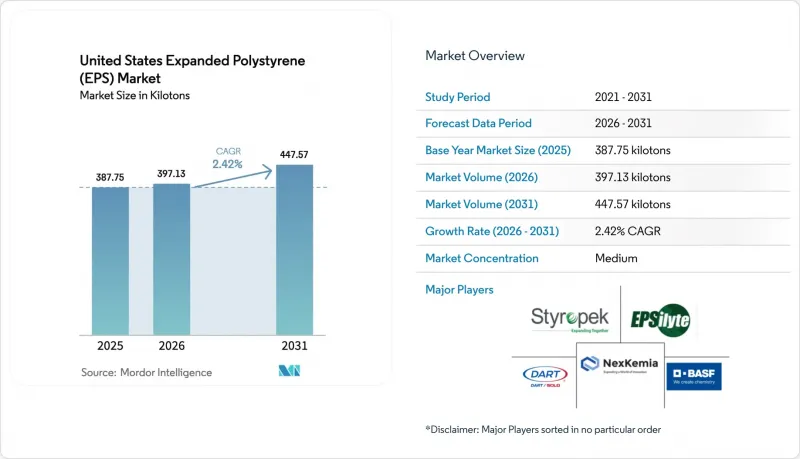
이 보고서는 유형별(화이트, 그레이, 실버(흑연 강화)) 및 최종사용자별(건축·건설, 포장, 자동차·운송, 가전·소비재)로 분류되어 있습니다. 시장 예측은 톤 단위로 표시되어 있습니다.
미국 발포 폴리스티렌(EPS) 시장의 동향 및 인사이트
건설 주도형 단열재 붐
2032년까지 가구당 최대 1,200달러 한도의 단열재에 대한 30% 연방 세액 공제로 인해 2000년 이전에 지어진 전체 주택 재고에서 다락방, 벽, 지하실의 개보수가 가속화되어 발포 폴리스티렌 시장에 새로운 수요가 창출되고 있습니다. ‘국제 에너지 절약 기준 2024’ 및 ‘ASHRAE 90.1-2022’에 따라철골 구조 벽의 U값 제한이 강화되어, EPS가 1인치당 R-4의 단열 성능을 발휘하고 설치 비용이 1보드피트당 0.50달러 미만인 경우, 연속적인 단열층의 채택이 사실상 의무화되었습니다. 2025년 주택 착공 건수는 전년 대비 6% 감소했으나, 반도체 및 데이터센터 메가 프로젝트로 인해 비주거용 건설의 총 건설비는 급증했습니다. 이러한 프로젝트에서는 연약 지반에서의 지반 침하를 억제하기 위해 모두 대량의 지오폼이 지정되고 있습니다. NREL의 추산에 따르면 2050년까지 주택의 바닥 면적은 38%, 상업 시설의 바닥 면적은 37% 증가할 것으로 예상되며, 경질 발포재 수요는 향후 수십년에 성장 여지가 확보되어 있습니다. 한랭 지역의 건설업체들은 R값을 20-30% 향상시키는 흑연 EPS로의 전환을 추진하고 있습니다. 이를 통해 패널 두께를 얇게 할 수 있으며, 목재 비용을 절감하고 실내 공간을 확보할 수 있습니다.
폭발적으로 증가하는 E-Commerce 콜드체인 수요
온도 관리형 물류 사업자들은 2℃-8℃를 최대 72시간 동안 유지할 수 있는 EPS제 배송 용기에 의존하고 있습니다. 이 용기의 배송 비용은 진공 단열 패널보다 40-60% 저렴하며, 이러한 큰 우위 덕분에 발포 폴리스티렌 시장내 포장재 수요가 지원되고 있습니다. FedEx의 ‘Temp-Assure’와 UPS의 ‘Temperature True’는 2025년까지 서비스 범위를 미국내 200개 이상의 대도시권으로 확대하고, 집하 허브에 쿨러 박스 회수 루프를 도입함으로써 집약화와 재사용을 추진하고 있습니다. 아마존의 식료품 부문은 전미에서 EPS 박스 도입을 계속하고 있지만, 캘리포니아주와 워싱턴주에서 종이 복합재 쿨러 박스를 시범 도입한 것은 금지 조치가 활발한 주에서 브랜드가 보여주는 배려를 나타냅니다. 폴리스티렌 재활용 연합(Polystyrene Recycling Alliance)은 2030년까지 가정에서 회수율을 인구의 32%에서 최대 66%까지 끌어올릴 계획이지만, 음식물 잔여물로 인한 오염 문제로 인해 대부분의 지자체 프로그램은 여전히 소극적인 태도를 보이고 있습니다. 이러한 장벽이 있음에도 불구하고 제약, 수산물, 밀키트 배송 업체들은 2026년 라스트 마일 배송에서 EPS가 비용 대비 성능이 뛰어난 최선의 선택이라고 생각합니다.
생분해성 및 종이 기반 대체재
현재 Dell의 노트북과 IKEA의 조립식 가구에는 섬유 성형 및 버섯 유래 포장재가 채택되고 있지만, 비용은 EPS의 2-3배에 달하며, 생물 성장 주기로 인해 리드타임이 2주까지 걸릴 수 있습니다. 풋프린트 인터내셔널과 후타마키는 EPS 사용 금지 조치가 시행되고 있는 주에서 사업을 운영하는 패스트푸드 체인을 염두에 두고, 섬유 트레이와 클램쉘 용기에 막대한 투자를 하고 있습니다. 시그마 올드리치(Sigma Aldrich)사의 종이·전분 소재 ‘Greener Cooler’는 1.5인치 두께의 EPS 벽면과 동등한 단열 성능을 내세우고 있지만, 현장 시험에서는 멕시코만 연안의 습도가 높은 환경에서 결로로 인한 결함이 확인되어, 가혹한 조건 하에서의 성능 격차가 드러났습니다. 내습성이나 압축 강도가 선정 기준의 핵심이 되는 건설 및 지오폼 용도에서는 2026년 시점에는 이러한 바이오 대체재에 의한 위협은 거의 없을 것입니다.
부문 분석
2025년, 화이트 등급은 발포 폴리스티렌 시장에서 71.25%의 점유율을 유지했습니다. 이는 1보드피트당 0.40-0.50달러 전후의 비용과 보호 포장, 지중 단열재, 지오폼에서의 높은 범용성이 지원하고 있습니다. 흑연 강화 유형은 1인치당 R-4.7-5의 단열 성능을 발휘하여 화이트 등급보다 20-30% 더 높은 성능을 보입니다. 이로 인해 구역 5-8의 건설업체는 더 얇은 벽으로도 건축 기준을 충족할 수 있게 되었으며, 이러한 이점은 10-20%의 가격 프리미엄을 상쇄해 줍니다. BASF사의 ‘Neopor’가 공급을 주도하고 있으며, 유럽의 신생 기업인 BEWI사는 자사의 그레이 라인이 화이트 등급보다 약 20% 높은 성능을 발휘한다고 보고하고 있습니다. 이 차이는 기온이 낮아질수록 더욱 확대됩니다.
흑연 배합 등급과 관련된 발포 폴리스티렌 시장 규모는 용도가 상업용 지붕에서 공동 주택의 벽 시스템으로 전환됨에 따라 2031년까지 연평균 성장률(CAGR) 3.71%로 확대될 것으로 예측됩니다. 백색 EPS는 R값보다 압축 강도, 내습성 및 납품 비용이 중시되는 지오폼 및 표준 포장재 분야에서 계속해서 주류 위치를 유지할 것입니다. 텍사스주 교통국(TxDOT)이 진행한 10번 주간고속도로 지오폼 교체 공사에서는 콘크리트에 비해 50% 이상의 비용 절감이 실현되었으며, 이는 많은 토목 공사에서 단열 성능이 중요하게 여겨지지 않는 이유를 지원합니다. 콜드 체인 포장 분야에서는 48-72시간의 보냉 시간을 충족하면서도 비용 면에서 여전히 흰색 쿨러가 흑연계 제품보다 우위를 점하고 있으며, 고부가가치 제품의 보급은 제한적입니다.
기타 혜택:
- 엑셀 형식의 시장 예측(ME) 시트
- 3개월간의 애널리스트 지원
자주 묻는 질문
목차
제1장 서론
제2장 조사 방법
제3장 개요
제4장 시장 구도
제5장 시장 규모와 성장 예측
제6장 경쟁 구도
제7장 시장 기회와 향후 전망
KSA 26.09.02According to Mordor Intelligence, the United States expanded polystyrene market size is projected to be 387.75 kilotons in 2025, 397.13 kilotons in 2026, and reach 447.57 kilotons by 2031, growing at a CAGR of 2.42% from 2026 to 2031.
This report is Segmented by Type (White, Grey, and Silver (Graphite-Enhanced)) and End-User (Building and Construction, Packaging, Automotive and Transportation, and Appliances and Consumer Goods). The Market Forecasts are Provided in Terms of Volume (Tons).
United States Expanded Polystyrene (EPS) Market Trends and Insights
Construction-Led Insulation Boom
A 30% federal tax credit on insulation, capped at USD 1,200 per household through 2032, has accelerated attic, wall, and basement retrofits across the pre-2000 housing stock, unlocking new tonnage for the expandable polystyrene market. The International Energy Conservation Code 2024 and ASHRAE 90.1-2022 tightened U-factor limits for steel-frame walls, effectively mandating continuous insulating layers where EPS delivers R-4 per inch at installed costs below USD 0.50 per board foot. Although 2025 housing starts dipped 6% year-over-year, nonresidential construction value surged on semiconductor and data-center megaprojects, each specifying high-volume geofoam to curb settlement on soft soils. NREL estimates residential floor area will climb 38% and commercial floor area 37% by 2050, securing a multi-decade runway for rigid-foam demand. Contractors in cold regions are shifting toward graphite EPS, which boosts R-value 20-30%, enabling thinner panels that cut lumber costs and free interior space.
Exploding E-Commerce Cold-Chain Demand
Temperature-controlled logistics providers rely on EPS shippers that maintain 2 °C-8 °C for up to 72 hours at landed costs 40-60% below vacuum-insulated panels, a sizable advantage that sustains packaging volumes in the expandable polystyrene market. FedEx Temp-Assure and UPS Temperature True extended coverage to more than 200 U.S. metros in 2025, embedding cooler take-back loops at consolidation hubs for densification and reuse. Amazon's grocery arm continues to deploy EPS boxes nationwide, although pilots of paper-composite coolers in California and Washington illustrate brand sensitivity in ban-active states. The Polystyrene Recycling Alliance plans to raise curbside access from 32% of the population to as high as 66% by 2030, yet contamination from food residues keeps most municipal programs on the sidelines. Even with these hurdles, pharmaceutical, seafood, and meal-kit shippers view EPS as the best cost-to-performance option for last-mile delivery in 2026.
Biodegradable and Paper-Based Substitutes
Fiber-molded and mushroom-based packaging now lines Dell laptops and IKEA flat-packs, but costs remain 2-3 times higher than EPS and lead times stretch to two weeks because of biological growing cycles. Footprint International and Huhtamaki have invested heavily in fiber trays and clamshells, eyeing fast-food chains operating in ban-active states. Sigma-Aldrich's paper-starch "Greener Cooler" claims identical thermal performance to 1.5-inch EPS walls, yet field trials found condensation failures in Gulf Coast humidity, highlighting performance gaps in extreme conditions. Construction and geofoam uses, where moisture resistance and compressive strength dominate selection criteria, face minimal threat from these bio-alternatives in 2026.
Other drivers and restraints analyzed in the detailed report include:
- Federal Energy-Efficiency Building Codes
- Growing Usage of Geofoam for Climate-Resilient Civil Works
- State Bans on Single-Use EPS Foodware
For complete list of drivers and restraints, kindly check the Table Of Contents.
Segment Analysis
White grades retained a 71.25% expandable polystyrene market share in 2025, anchored by costs near USD 0.40-0.50 per board foot and versatility in protective packaging, below-grade insulation, and geofoam. Graphite-enhanced versions deliver R-4.7-5 per inch, 20-30% higher than white, allowing builders in zones 5-8 to hit code with thinner walls - a benefit that offsets their 10-20% price premium. BASF's Neopor leads supply, and European entrant BEWI reports its grey line outperforms white by roughly 20%, a gap that widens as temperatures drop.
The expandable polystyrene market size tied to graphite grades is projected to rise 3.71% CAGR through 2031 as adoption moves from commercial roofs into multifamily wall systems. White EPS will remain dominant in geofoam and standard packaging where compressive strength, moisture resistance, and delivered cost matter more than R-value. TxDOT's Interstate 10 geofoam replacement saved over 50% versus concrete, underlining why thermal performance is irrelevant in many civil works. In cold-chain packaging, white coolers still beat graphite on cost even while meeting 48-72-hour hold times, limiting premium product penetration.
Complete Report Scope:
- By Type
- White
- Grey and Silver (Graphite-enhanced)
- By End-User
- Building and Construction
- Packaging
- Automotive and Transportation
- Appliances and Consumer Goods
List of Companies Covered in this Report:
- Alpek S.A.B. de C.V.
- BASF
- BEWI
- Cellofoam North America Inc.
- Dart Container Corp.
- Epsilyte LLC
- Alleguard
- Harbor Foam
- NexKemia Petrochemicals Inc.
- NOVA Chemicals Corporate
- Owens Corning
- Ravago
- SABIC
- Sealed Air
- Styrotech, Inc.
- TotalEnergies
Additional Benefits:
- The market estimate (ME) sheet in Excel format
- 3 months of analyst support
TABLE OF CONTENTS
1 Introduction
- 1.1 Study Assumptions and Market Definition
- 1.2 Scope of the Study
2 Research Methodology
3 Executive Summary
4 Market Landscape
- 4.1 Market Overview
- 4.2 Market Drivers
- 4.2.1 Construction-led insulation booming demand for EPS
- 4.2.2 Exploding e-commerce cold-chain demand
- 4.2.3 Federal energy-efficiency building codes
- 4.2.4 Growing usage of geofoam for climate-resilient civil works
- 4.2.5 Increasing empasis on 3-D printed graphite-EPS housing panels
- 4.3 Market Restraints
- 4.3.1 Biodegradable and paper-based substitutes
- 4.3.2 State bans on single-use EPS foodware
- 4.3.3 EPA pentane-emission fee escalation
- 4.4 Value Chain Analysis
- 4.5 Porter's Five Forces
- 4.5.1 Bargaining Power of Suppliers
- 4.5.2 Bargaining Power of Buyers
- 4.5.3 Threat of New Entrants
- 4.5.4 Threat of Substitutes
- 4.5.5 Degree of Competition
5 Market Size and Growth Forecasts (Volume)
- 5.1 By Type
- 5.1.1 White
- 5.1.2 Grey and Silver (Graphite-enhanced)
- 5.2 By End-User
- 5.2.1 Building and Construction
- 5.2.2 Packaging
- 5.2.3 Automotive and Transportation
- 5.2.4 Appliances and Consumer Goods
6 Competitive Landscape
- 6.1 Market Concentration
- 6.2 Strategic Moves
- 6.3 Market Share(%)/Ranking Analysis
- 6.4 Company Profiles {(includes Global level Overview, Market level overview, Core Segments, Financials as available, Strategic Information, Market Rank/Share for key companies, Products and Services, and Recent Developments)}
- 6.4.1 Alpek S.A.B. de C.V.
- 6.4.2 BASF
- 6.4.3 BEWI
- 6.4.4 Cellofoam North America Inc.
- 6.4.5 Dart Container Corp.
- 6.4.6 Epsilyte LLC
- 6.4.7 Alleguard
- 6.4.8 Harbor Foam
- 6.4.9 NexKemia Petrochemicals Inc.
- 6.4.10 NOVA Chemicals Corporate
- 6.4.11 Owens Corning
- 6.4.12 Ravago
- 6.4.13 SABIC
- 6.4.14 Sealed Air
- 6.4.15 Styrotech, Inc.
- 6.4.16 TotalEnergies
7 Market Opportunities and Future Outlook
- 7.1 White-space and Unmet-Need Assessment
- 7.2 Increasing Recycling in EPS industry


