

|
시장보고서
상품코드
2120271
CBRNe 방위 : 시장 점유율 분석, 업계 동향과 통계, 성장 예측(2026-2031년)CBRNe Defense - Market Share Analysis, Industry Trends & Statistics, Growth Forecasts (2026 - 2031) |
||||||
 Mordor Intelligence
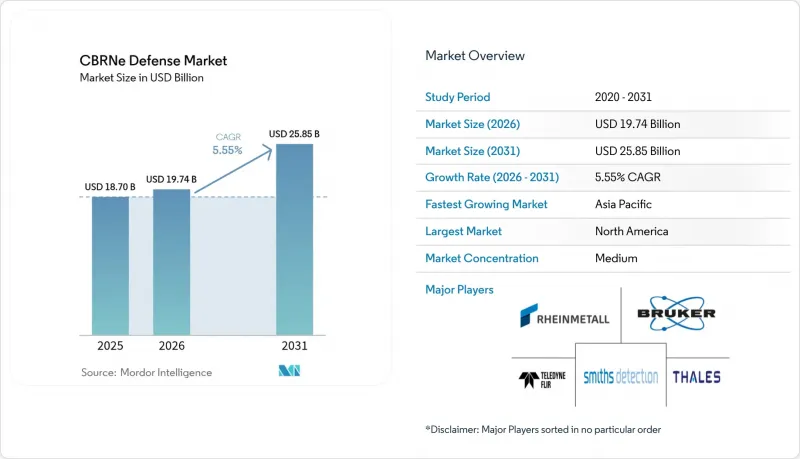
Mordor Intelligence에 따르면 2026년 CBRNe 방위 시장의 규모는 197억 4,000만 달러로 추정되고 있으며, 2025년 187억 달러에서 확대하며, 2031년에는 258억 5,000만 달러에 달할 것으로 예측됩니다.
2026-2031년까지의 연평균 성장률(CAGR)은 5.55%에 달할 것으로 전망됩니다.
이 보고서는 용도(탐지, 방호, 제염, 시뮬레이션 및 훈련), 최종사용자(군, 민간 및 법 집행 기관), 플랫폼(휴대용 및 웨어러블 시스템, 차량 탑재형 등), 유형(화학, 생물, 방사선, 핵 등), 지역(북미, 유럽, 아시아태평양 등)별로 분류되어 있습니다. 시장 전망은 금액(달러) 기준으로 제시되어 있습니다.
글로벌 CBRNe 방어 시장의 동향 및 인사이트
국방 예산의 현대화 및 전략적 우선순위 재설정
각국의 국방부는 다중 영역 억제 전략의 일환으로, 다년 계획 예산 중 더 큰 비중을 CBRNe 대응 능력 구축에 할당하고 있습니다. 미국의 ‘전략 관리 계획 2022-2026’에서는 CBRNe 대응 능력이 작전 행동의 자유를 유지하기 위해 필수적이라고 규정하고 있습니다. 유럽의 ‘ReArm Europe’ 구상과 같은 병행 노력에서는 보다 광범위한 방공 및 미사일 방어 네트워크와 통합 가능한 CBRNe 센서 스위트에 막대한 예산이 배정되고 있습니다. 현재 조달 우선순위는 확장 가능한 탐지 네트워크, 자율형 제염 자산, 그리고 통합 부대의 병참 체계와 호환되는 일체형 방호 장비에 중점을 두고 있습니다. 정부가 군사 및 민간 방호 임무에 예산을 효율적으로 배분하려는 가운데, 이중 용도(군사 및 민간용)의 가치를 입증할 수 있는 공급업체는 혜택을 볼 수 있는 입장에 있습니다.
비대칭 전쟁의 위협 증가와 비국가 주체의 능력
적층 제조 및 상용 드론을 비롯한 쉽게 입수할 수 있는 기술 덕분에 소규모 그룹도 유독성 화학 물질이나 생물제제를 무기화할 수 있게 되었으며, 우세한 기존형 전력에 대한 CBRNe 공격의 매력이 높아지고 있습니다. 정보 보고서는 기존의 경고 지표를 회피하는 전술이 진화하고 있음을 강조하고 있으며, 비정형적인 시그니처를 인식할 수 있는 적응형 센서가 요구되고 있습니다. 이러한 위험 프로필로 인해 CBRNe 방어 시장에서는 실시간 이상 현상을 감지하고, 방어 데이터베이스에 아직 등록되지 않은 물질을 식별하는 분석 기술의 도입이 가속화되고 있습니다.
높은 조달 비용과 수명 주기 총비용
첨단 CBRNe 장비에는 장기적인 투자가 필요하며, 훈련, 유지보수, 그리고 수명 주기 중반의 업그레이드가 더해지면 그 비용은 더욱 부풀어 오릅니다. 일반적으로 20년 기간 중 유지비는 초기 구매 가격의 3배에서 5배에 달할 수 있으며, 이로 인해 소규모 방위 기관은 조달 수량을 제한하거나 갱신 주기를 늦출 수밖에 없습니다. 공급업체들은 이러한 부담을 완화하기 위해 모듈식 업그레이드를 점점 더 많이 제안하고 있지만, 독자적인 생태계에 얽매이게 됨에 따라 단기적인 비용 절감 효과가 하류 공정에서의 고액 비용으로 상쇄되는 경향이 있으며, 예산 측면의 압박은 여전히 심각한 상황이 지속되고 있습니다.
부문 분석
2025년, 방호 시스템은 CBRNe 방어 시장 점유율의 35.22%를 차지하며, 모든 군종에서 개인 및 집단 방호가 여전히 중요함을 입증하고 있습니다. 그 범위는 차세대 호흡기부터 에어로졸화된 물질로부터 인원을 보호하는 과압 쉘터에 이르기까지 다양합니다. 이러한 수요는 전선 배치 부대에 대한 개인용 방호 장비의 최소 재고량을 규정하는 NATO 기준에 의해 지원되고 있습니다. 탐지 시스템은 이에 근소한 차이로 뒤를 잇고 있으며, 위협이 되는 구름이 탐지되었을 때 방호 조치를 발동시키는 트리거 역할을 하고 있습니다. 제염 자원은 플랫폼을 운용 가능한 상태로 복원하고 임무 수행 중 손실을 방지함으로써 이 세 가지 핵심 축을 완성합니다.
시뮬레이션 및 훈련 솔루션은 2031년까지 연평균 성장률(CAGR) 7.18%를 기록하며 가장 빠르게 성장하는 분야입니다. 방위 기관은 혼합 현실(MR) 시스템을 도입하여 유해 물질을 사용하지 않고 복잡한 방출 시나리오를 재현함으로써, 실탄을 사용하는 사격장 사용을 줄이고 훈련생 1인당 비용을 절감하고 있습니다. ForgeFX사의 HoloLens 기반 프로그램은 기술 습득을 촉진하면서 훈련 기간을 단축하는 몰입형 툴의 대표적인 예입니다. 디지털 트윈이 실제 탐지 장비를 재현하므로 지휘관은 안전한 가상 샌드박스 내에서 광역 대응 계획을 시뮬레이션하고 전술을 정교화할 수 있습니다. 이러한 학습 곡선의 효율화로 인해 군사 및 민간 각 분야에서의 도입이 확대되면서, 이 하위 부문의 견실한 전망이 확고해지고 있습니다.
2025년 CBRNe 방어 시장 규모 중 군사 최종사용자 부문이 69.35%를 차지하고 있으며, 이는 오염된 환경에서도 전투를 지속하고 전투 능력을 유지해야 하는 군대의 사명을 반영합니다. 넉넉한 예산을 바탕으로 내환경성이 뛰어난 센서 어레이, 견고한 지휘통제 노드, 그리고 대량의 방호복 비축에 대한 투자가 가능해졌습니다. 플랫폼 로드맵에서는 드론을 활용한 정찰과, 보다 광범위한 전장 네트워크와 통합된 AI를 활용한 위협 분석이 중점적으로 다루어지고 있습니다.
민간 및 법 집행 기관은 국내 사건에서 최초 대응자를 주요 이해관계자로 지정하는 국토안보 지침에 힘입어 연평균 성장률(CAGR) 7.02%로 성장하고 있습니다. 인도의 ‘CBRN 대비의 해’ 프로그램과 같은 구상을 통해 자금이 지방 자치 단체의 위험물 대응 팀에 투입되어 휴대용 탐지기 및 이동식 제염 장치의 조달이 촉진되고 있습니다. 군사급 기술과 민간 예산의 융합을 통해 공통 기준이 촉진되고 있으며, 대규모 비상사태 발생시 합동 임무 부대가 전개될 때의 상호 운용성이 향상되고 있습니다.
지역별 분석
2025년, 북미는 CBRNe 방어 시장에서 33.02%의 점유율을 차지하며 시장을 주도했습니다. 이는 탐지, 방어, 훈련을 아우르는 미국의 견고한 산업 기반과 안정적인 자금 공급에 힘입은 결과입니다. 에지우드, 애버딘 시험장 및 여러 국립 연구소에 걸쳐 있는 주요 연구개발 센터들이 기술의 성숙과 현장 부대 도입을 가속화하고 있습니다. 캐나다는 ‘합동 CBRN 방어 프로그램’을 통해 미국의 지출을 보완하고 있으며, 이 프로그램을 통해 NATO 작전을 위한 상호 운용 가능한 시스템이 배치되고 있습니다.
유럽은 집단 방어에 새로운 자금을 투입하는 ‘ReArm Europe’ 구상에 힘입어 2위를 차지하고 있습니다. 표준화 협정을 통해 국경을 초월한 장비의 호환성이 원활해지는 한편, EU의 시민 보호 기금은 공급업체들이 이중용도 제품을 맞춤형으로 제작하도록 장려하고 있습니다. 영국, 프랑스, 독일은 재편된 예산의 상당 부분을 구형 정찰 차량의 현대화에 할애하고 있으며, 영국의 ‘폭스(Fox)’ 차량 군 현대화 사업은 센서 및 통신 장비 개량에 대한 수요를 여실히 보여주고 있습니다.
아시아태평양은 연평균 성장률(CAGR) 7.41%로 가장 빠르게 성장하고 있는 지역입니다. 동아시아의 긴장 고조로 인해 2023년 군사 지출 총액은 4,110억 달러에 달했으며, CBRNe(화학·생물·방사능·핵·폭발물) 억제 수단에 대한 수요가 증가했습니다. 한국은 5km 거리에서 화학 물질을 탐지할 수 있는 성능을 강화한 K216 NBC 정찰차를 배치했으며, 호주는 폭발물 위험 대응을 위한 몰입형 훈련 키트 시험을 계속하고 있습니다. 인도의 국가재난대응부대는 전국 규모의 CBRN 훈련을 추진하고 있으며, 이는 탐지기 및 제염 장비에 대한 수요를 견인하고 있습니다. 일본 및 미국으로부터의 기술 이전을 포함한 지역적 산업 파트너십은 전개를 가속화하는 동시에 현지 지원 생태계를 구축하고 있습니다.
기타 혜택:
- 엑셀 형식의 시장 예측(ME) 시트
- 3개월간의 애널리스트 지원
자주 묻는 질문
목차
제1장 서론
제2장 조사 방법
제3장 개요
제4장 시장 구도
제5장 시장 규모와 성장 예측
제6장 경쟁 구도
제7장 시장 기회와 향후 전망
KSA 26.09.02According to Mordor Intelligence, the CBRNe defense market size in 2026 is estimated at USD 19.74 billion, growing from 2025 value of USD 18.70 billion with 2031 projections showing USD 25.85 billion, growing at 5.55% CAGR over 2026-2031.
This report is Segmented by Purpose (Detection, Protection, Decontamination, and Simulation and Training), End-User (Military, and Civil and Law Enforcement), Platform (Portable and Wearable Systems, Vehicle-Mounted, and More), Type (Chemical, Biological, Radiological, Nuclear, and More), and Geography (North America, Europe, Asia-Pacific, and More). The Market Forecasts are Provided in Terms of Value (USD).
Global CBRNe Defense Market Trends and Insights
Defense Budget Modernization and Strategic Reprioritization
Defense ministries are channeling larger shares of multi-year programs into CBRNe readiness as part of multi-domain deterrence strategies. The US Strategic Management Plan 2022-2026 frames CBRNe preparedness as essential to maintaining freedom of maneuver. Parallel efforts such as Europe's ReArm Europe initiative earmark sizeable sums for CBRNe sensor suites that integrate with broader air- and missile-defense networks. Procurement priorities now favor scalable detection grids, autonomous decontamination assets, and protective ensembles compatible with joint-force logistics. Vendors able to demonstrate dual-use value stand to benefit as governments look to stretch budgets across military and civil protection mandates.
Rising Threat of Asymmetric Warfare and Non-State Actor Capabilities
Accessible technologies, including additive manufacturing and commercial drones, enable small groups to weaponize toxic chemicals or biological agents, raising the attractiveness of CBRNe attacks against superior conventional forces. Intelligence reports underscore evolving tactics that bypass traditional warning indicators, demanding adaptive sensors that recognize atypical signatures. This risk profile accelerates the CBRNe defense market's adoption of analytics that spot real-time anomalies and identify materials previously unseen in defense databases.
High Procurement and Total Lifecycle Costs
Advanced CBRNe gear demands long-term investments that multiply once training, maintenance, and mid-life upgrades are added. Over a typical 20-year span, sustainment can run three to five times the original purchase price, pushing smaller defense establishments to limit quantities or delay refresh cycles. Vendors increasingly pitch modular upgrades to ease this burden, yet locked-in proprietary ecosystems often offset near-term savings with higher downstream fees, keeping budget pressure intense.
Other drivers and restraints analyzed in the detailed report include:
- Broader Civil Defense and Homeland Security Integration
- Emergence of AI-Driven Autonomous Detection Networks
- Stringent Export Regulations and Technology Transfer Restrictions
For complete list of drivers and restraints, kindly check the Table Of Contents.
Segment Analysis
Protection systems commanded 35.22% of the CBRNe defense market share in 2025, confirming the enduring importance of individual and collective protection across all services. They range from next-generation respirators to over-pressurized shelters that shield personnel from aerosolized agents. Demand is supported by NATO standards that prescribe minimum personal protective equipment inventories for forward-deployed units. Detection systems trail closely, serving as the trigger for activating protective measures once a threat cloud is sensed. Decontamination assets complete the triad by restoring platforms to service and preventing mission attrition.
Simulation and training solutions represent the fastest-growing slice at a 7.18% CAGR to 2031. Defense organizations deploy mixed-reality suites to replicate complex release scenarios without hazardous agents, reducing live-agent range usage and cutting per-trainee costs. ForgeFX's HoloLens-based program is emblematic of immersive tools that foster skills retention while shortening course timelines. As digital twins mirror actual detection gear, commanders can rehearse wide-area response plans and refine tactics in secure virtual sandboxes. This learning curve efficiency amplifies adoption across military and civil jurisdictions, cementing a robust outlook for this subsegment.
The military end-user segment accounted for 69.35% of the CBRNe defense market size in 2025, reflecting the armed forces' mandate to fight through contamination and preserve combat power. Large budgets allow investment in ruggedized sensor arrays, hardened command-and-control nodes, and extensive protective suit inventories. Platform roadmaps emphasize drone-based reconnaissance and AI-enabled threat analytics that integrate with broader battlefield networks.
Civil and law-enforcement agencies are growing at a 7.02% CAGR, spurred by homeland security directives designating first responders as primary stakeholders in domestic incidents. Initiatives like India's "Year of CBRN Preparedness" program funnel funds into municipal hazmat teams, boosting procurement of handheld detectors and mobile decontamination units. The convergence of military-grade technology with civil budgets promotes common standards, improving interoperability when joint task forces deploy during large-scale emergencies.
Complete Report Scope:
- By Purpose
- Detection
- Protection
- Decontamination
- Simulation and Training
- By End-User
- Military
- Civil and Law-Enforcement
- By Platform
- Portable and Wearable Systems
- Vehicle-mounted
- Fixed and Facility-Based Installations
- Drone-/UAV-based
- By Type
- Chemical
- Biological
- Radiological
- Nuclear
- Explosive
- By Geography
- North America
- United States
- Canada
- Mexico
- Europe
- United Kingdom
- France
- Germany
- Russia
- Rest of Europe
- Asia-Pacific
- China
- India
- Japan
- South Korea
- Rest of Asia-Pacific
- South America
- Brazil
- Rest of South America
- Middle East and Africa
- Middle East
- Saudi Arabia
- United Arab Emirates
- Rest of Middle East
- Africa
- South Africa
- Rest of Africa
- Middle East
- North America
Geography Analysis
North America led the CBRNe defense market with 33.02% share in 2025, anchored by the United States' deep industrial base and stable funding lines that cover detection, protection, and training. Significant R&D centers-spanning Edgewood, Aberdeen Proving Ground, and multiple national labs-accelerate technology maturation and transition to field units. Canada complements US spending with its Joint CBRN Defense Program, which fields interoperable systems for NATO operations.
Europe ranks second, bolstered by the ReArm Europe initiative that injects fresh capital into collective defense. Standardization agreements smooth cross-border equipment compatibility, while EU civil-protection funding invites suppliers to tailor dual-use products. The United Kingdom, France, and Germany allocate notable portions of recapped budgets toward upgrading legacy reconnaissance vehicle fleets, with the UK's Fox fleet overhaul illustrating demand for sensor and comms retrofits.
Asia-Pacific is the fastest-growing region at 7.41% CAGR. Heightened tensions in East Asia pushed combined military outlays to USD 411 billion in 2023 and fueled the appetite for CBRNe deterrence tools. South Korea fielded enhanced K216 NBC Recon Vehicles capable of chemical detection at 5-km standoff, and Australia continues to test immersive training kits for explosive hazard response. India's National Disaster Response Force presses with nationwide CBRN drills that create pull-through demand for detectors and decon gear. Regional industrial partnerships, including technology transfers from Japan and the United States, speed deployment while building indigenous support ecosystems.
- Teledyne FLIR LLC (Teledyne Technologies Incorporated)
- Smiths Detection (Smiths Group PLC)
- Bruker Corporation
- Rheinmetall AG
- Saab AB
- Leidos, Inc.
- Thales Group
- Karcher Futuretech GmbH
- Battelle
- QinetiQ Group
- Dragerwerk AG & Co. KGaA
- Argon Electronics (UK) Ltd.
- KNDS
- Avon Protection (Avon Technologies plc)
- Bertin Environics
- OSI Systems Inc.
Additional Benefits:
- The market estimate (ME) sheet in Excel format
- 3 months of analyst support
TABLE OF CONTENTS
1 INTRODUCTION
- 1.1 Study Assumptions and Market Definition
- 1.2 Scope of the Study
2 RESEARCH METHODOLOGY
3 EXECUTIVE SUMMARY
4 MARKET LANDSCAPE
- 4.1 Market Overview
- 4.2 Market Drivers
- 4.2.1 Defense budget modernization and strategic reprioritization
- 4.2.2 Rising threat of asymmetric warfare and non-state actor capabilities
- 4.2.3 Broader civil defense and homeland security integration
- 4.2.4 Emergence of AI-driven autonomous detection networks
- 4.2.5 Development of bio-digital pathogen analyzer chips
- 4.2.6 Mandates for dual-use decontamination infrastructure
- 4.3 Market Restraints
- 4.3.1 High procurement and total lifecycle costs
- 4.3.2 Stringent export regulations and technology transfer restrictions
- 4.3.3 Supply chain vulnerability in rare-earth and exotic sensor materials
- 4.3.4 Operator cognitive burden due to complex system interfaces
- 4.4 Value Chain Analysis
- 4.5 Regulatory Landscape
- 4.6 Technological Outlook
- 4.7 Porter's Five Forces Analysis
- 4.7.1 Bargaining Power of Buyers
- 4.7.2 Bargaining Power of Suppliers
- 4.7.3 Threat of New Entrants
- 4.7.4 Threat of Substitutes
- 4.7.5 Competitive Rivalry
5 MARKET SIZE AND GROWTH FORECASTS (VALUE)
- 5.1 By Purpose
- 5.1.1 Detection
- 5.1.2 Protection
- 5.1.3 Decontamination
- 5.1.4 Simulation and Training
- 5.2 By End-User
- 5.2.1 Military
- 5.2.2 Civil and Law-Enforcement
- 5.3 By Platform
- 5.3.1 Portable and Wearable Systems
- 5.3.2 Vehicle-mounted
- 5.3.3 Fixed and Facility-Based Installations
- 5.3.4 Drone-/UAV-based
- 5.4 By Type
- 5.4.1 Chemical
- 5.4.2 Biological
- 5.4.3 Radiological
- 5.4.4 Nuclear
- 5.4.5 Explosive
- 5.5 By Geography
- 5.5.1 North America
- 5.5.1.1 United States
- 5.5.1.2 Canada
- 5.5.1.3 Mexico
- 5.5.2 Europe
- 5.5.2.1 United Kingdom
- 5.5.2.2 France
- 5.5.2.3 Germany
- 5.5.2.4 Russia
- 5.5.2.5 Rest of Europe
- 5.5.3 Asia-Pacific
- 5.5.3.1 China
- 5.5.3.2 India
- 5.5.3.3 Japan
- 5.5.3.4 South Korea
- 5.5.3.5 Rest of Asia-Pacific
- 5.5.4 South America
- 5.5.4.1 Brazil
- 5.5.4.2 Rest of South America
- 5.5.5 Middle East and Africa
- 5.5.5.1 Middle East
- 5.5.5.1.1 Saudi Arabia
- 5.5.5.1.2 United Arab Emirates
- 5.5.5.1.3 Rest of Middle East
- 5.5.5.2 Africa
- 5.5.5.2.1 South Africa
- 5.5.5.2.2 Rest of Africa
- 5.5.5.1 Middle East
- 5.5.1 North America
6 COMPETITIVE LANDSCAPE
- 6.1 Market Concentration
- 6.2 Strategic Moves
- 6.3 Market Share Analysis
- 6.4 Company Profiles (includes Global level Overview, Market level overview, Core Segments, Financials as available, Strategic Information, Market Rank/Share for key companies, Products and Services, and Recent Developments)
- 6.4.1 Teledyne FLIR LLC (Teledyne Technologies Incorporated)
- 6.4.2 Smiths Detection (Smiths Group PLC)
- 6.4.3 Bruker Corporation
- 6.4.4 Rheinmetall AG
- 6.4.5 Saab AB
- 6.4.6 Leidos, Inc.
- 6.4.7 Thales Group
- 6.4.8 Karcher Futuretech GmbH
- 6.4.9 Battelle
- 6.4.10 QinetiQ Group
- 6.4.11 Dragerwerk AG & Co. KGaA
- 6.4.12 Argon Electronics (UK) Ltd.
- 6.4.13 KNDS
- 6.4.14 Avon Protection (Avon Technologies plc)
- 6.4.15 Bertin Environics
- 6.4.16 OSI Systems Inc.
7 MARKET OPPORTUNITIES AND FUTURE OUTLOOK
- 7.1 White-space and Unmet-need Assessment


