

|
시장보고서
상품코드
2120280
불소수지 필름 : 시장 점유율 분석, 업계 동향과 통계, 성장 예측(2026-2031년)Fluoropolymer Films - Market Share Analysis, Industry Trends & Statistics, Growth Forecasts (2026 - 2031) |
||||||
 Mordor Intelligence
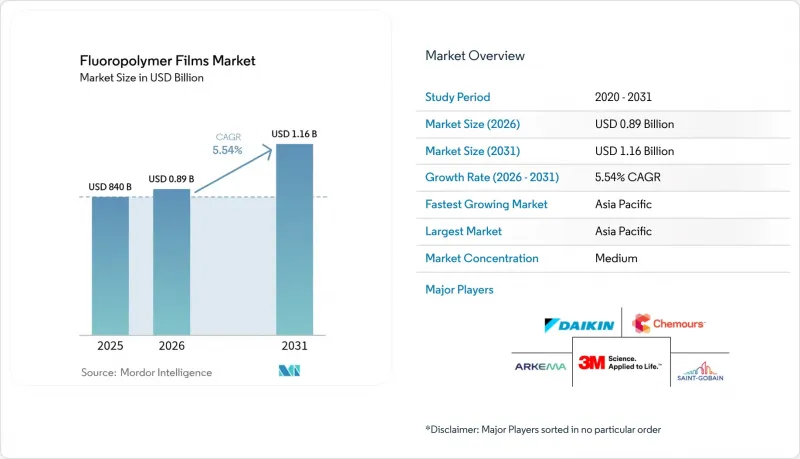
Mordor Intelligence에 따르면 불소수지 필름 시장 규모는 2025년 8억 4,000만 달러에서 2026년에는 8억 8,650만 달러로 확대하며, 2026-2031년에 CAGR 5.54%로 추이하며, 2031년에는 11억 6,000만 달러에 달할 것으로 예측됩니다.
이 보고서는 유형별(폴리테트라플루오로에틸렌(PTFE), 폴리비닐리덴플루오라이드(PVDF) 등),용도(배리어 필름, 박리 필름, 미세다공성 필름, 보안 필름), 최종사용자 산업(자동차·항공우주·방위, 건설, 포장, 산업용, 전자·반도체, 기타) 및 지역(아시아태평양, 북미, 유럽, 남미, 중동 및 아프리카)별로 분류되어 있습니다.
세계 불소수지 필름 시장의 동향 및 인사이트
태양광발전용 프론트 시트 및 백 시트 필름 수요 가속화
플렉서블 PV 설치에서는 무거운 유리를 대신하여 투명하고 내후성이 뛰어난 불소수지 라미네이트가 채택되고 있습니다. 수증기 투과율이 낮기 때문에 페로브스카이트 모듈은 2,000시간의 습열 시험 후에도 84%의 효율을 유지할 수 있으며, 모듈의 보증 기간을 25년으로 연장할 수 있습니다. 아시아태평양의 소비 점유율은 이 지역이 태양광발전 어셈블리 시장에서 차지하는 주도적인 위치를 반영하는 한편, 미국의 커뮤니티 태양광 정책이 수요의 정점을 지원하고 있습니다. 그 결과, 배리어 필름은 계속해서 불소 수지 필름 시장에서 가장 큰 응용 분야를 차지하고 있습니다.
의약품 및 의료용 포장 분야에서의 채택 확대
바이오의약품 및 맞춤형 치료에는 엄격한 수분 및 화학 물질에 대한 차단성이 요구됩니다. 켐어즈(Chemours)는 PTFE 및 PVDF 등급이 추출물이 적고 생체 적합성이 뛰어나기 때문에 프리필드 주사기 및 마이크로카테터 분야에서 여전히 필수적임을 확인하고 있습니다. 용기 및 밀폐 시스템의 무결성에 관한 미국 FDA 지침에 따라 제약사들은 민감한 유효 성분을 보호하기 위해 고순도 불소수지 라이너를 지정해야 하는 상황에 직면해 있습니다. EU 부속서 1 개정안의 유사한 동향 또한 의료용 등급 필름에 대한 수요를 지원하고 있습니다.
전 세계적인 PFAS 규제 강화
미국 환경보호청(EPA)은 자체 심사를 거치지 않고 329유형의 PFAS 제조를 금지했으며, PFOA 및 PFOS를 유해 물질로 지정했습니다. 미네소타주와 캘리포니아주에서는 2025년 1월부터 특정 소비재에 대한 PFAS 사용이 금지됩니다. 한편, EU의 REACH 규정 개정안에서는 임계 농도를 초과하는 10,000종 이상의 물질에 대한 사용 제한이 요구되고 있습니다. 규정 준수 비용과 대체 재료 도입에 따른 잠재적 위험으로 인해 불소수지 필름 시장의 예상 연평균 성장률(CAGR)은 총 1.4포인트 하락했습니다.
부문 분석
폴리테트라플루오로에틸렌(PTFE)은 46.10%의 점유율을 차지했습니다. 높은 용융 점도와 타의 추종을 불허하는 화학적 비활성 덕분에 반도체 제조용 챔버, 개스킷 시트, 고주파 케이블에 널리 사용되고 있습니다. 대만과 미국의 팹(제조 공장)이 지속적으로 확장되면서 수요가 견고하게 유지되고 있습니다. 또한 이 소재의 낮은 마찰 계수 덕분에 규제 심사가 임박했음에도 불구하고 PTFE는 외과용 기기 라이너로서 여전히 중요한 위치를 차지하고 있습니다.
불소화 에틸렌-프로필렌(FEP)은 5.93%의 연평균 성장률(CAGR)을 보이며, 2031년까지 가장 빠르게 성장하는 폴리머 계열이 될 전망입니다. 용융 온도가 낮기 때문에 용융 압출 성형을 통한 튜브, 색상 맞춤이 가능한 시트, 그리고 소비자용 전자기기 케이스용으로 점점 더 널리 보급되고 있는 3D 프린팅용 필라멘트의 제조가 가능합니다. 알케마(Arkema)사의 ‘FluorX’ 필라멘트 출시는 FEP가 적층 제조에서 PTFE의 채택을 제한하던 가공상의 제약을 어떻게 해결하고 있는지를 보여줍니다. 사용자들은 200°C의 연속 사용 온도와 투명성을 겸비한 특성을 높이 평가하고 있으며, 플렉서블 인쇄 회로에 대한 채택이 확대되고 있습니다.
지역별 분석
2025년, 아시아태평양은 전 세계 매출의 48.20%를 차지했으며, 불소 수지 필름 시장 규모는 이 지역에서 가장 높은 연평균 성장률(CAGR) 6.02%로 확대되었습니다. 중국의 통합형 태양광(PV) 공급망에서는 PVF 백시트와 ETFE 프론트 시트가 대량으로 소비되는 한편, 정부의 인센티브에 힘입어 옥상 태양광발전 설비의 개보수가 가속화되고 있습니다. 인도의 전자기기 제조 촉진 정책에 따라 고순도 PTFE 테이프의 국내 조달이 진행되며 기초 수요가 증가하고 있습니다. 일본의 자동차 플랫폼은 800V 아키텍처로 전환되고 있으며, 열 관리 향상을 위해 PEEK 및 PTFE 유전체 필름이 선호되고 있습니다.
북미에서는 반도체 분야의 견고한 설비 투자와 의료기기의 기술 혁신이 호재로 작용하고 있습니다. 미국 ‘CHIPS법’에 기반한 반도체 제조 공장에서는 클린룸 기준이 상향 조정되어, PTFE 및 FEP 재질의 소모품 수요를 견인하고 있습니다. 미시간주에서 조지아주에 이르는 전기자동차(EV) 플랫폼에서는 화이트 바디 패널용 복합재 박리 필름에 대한 수요가 증가하고 있습니다.
유럽에서는 규제 강화와 기후 정책에 따른 수요 견인 간의 균형이 이루어지고 있습니다. 독일과 스페인에서 진행 중인 그린 수소 전해조 시범 프로젝트에서는 불소수지 재질의 PEM(양성자 교환막)이 채택되고 있습니다. 독일과 프랑스의 자동차 제조사들은 경량화를 위해 ETFE 재질의 루프 스킨을 채택하고 있습니다. 그러나 EU 전역에 걸친 PFAS 규제안이 불확실성을 야기하고 있으며, 생산자들은 폐쇄형 회수 시스템 및 배기가스 처리 시설에 대한 투자를 강요받고 있습니다. 이러한 조치는 규정 준수 비용은 높아지겠지만, 공급 유지로 이어집니다.
기타 혜택:
- 엑셀 형식의 시장 예측(ME) 시트
- 3개월간의 애널리스트 지원
자주 묻는 질문
목차
제1장 서론
제2장 조사 방법
제3장 개요
제4장 시장 구도
제5장 시장 규모와 성장 예측
제6장 경쟁 구도
제7장 시장 기회와 향후 전망
KSA 26.09.02According to Mordor Intelligence, the fluoropolymer films market size is expected to grow from USD 840 million in 2025 to USD 886.5 million in 2026 and is forecast to reach USD 1.16 billion by 2031 at 5.54% CAGR over 2026-2031.
This report is Segmented by Type (Polytetrafluoroethylene (PTFE), Polyvinylidene Fluoride (PVDF), and More), Application (Barrier Films, Release Films, Microporous Films, and Security Films), End-User Industry (Automotive/Aerospace/Defense, Construction, Packaging, Industrial, Electronics/Semiconductor, and Others), and Geography (Asia-Pacific, North America, Europe, South America, and Middle-East and Africa).
Global Fluoropolymer Films Market Trends and Insights
Accelerating Demand for PV Solar Front-Sheet and Back-Sheet Films
Flexible PV installations rely on transparent and weather-resistant fluoropolymer laminates to displace heavier glass. Lower water-vapor-transmission rates help perovskite modules retain 84% efficiency after 2,000 hours of damp-heat testing, extending module warranties to 25 years. Asia Pacific's consumption share mirrors its photovoltaic assembly dominance, while U.S. community-solar policies reinforce demand peaks. Consequently, barrier films remain the largest application slice of the fluoropolymer films market.
Rising Pharmaceutical and Medical Packaging Adoption
Biologics and personalized therapies require stringent moisture and chemical barriers. Chemours confirms that PTFE and PVDF grades remain essential in pre-filled syringes and micro-catheters because of their low extractables and biocompatibility. U.S. FDA guidance on container-closure integrity pushes drug makers to specify high-purity fluoropolymer liners to protect sensitive actives. Matching trends in EU Annex 1 revisions strengthen demand for medical-grade films.
Global PFAS Regulatory Tightening
The U.S. EPA has barred production of 329 PFAS without agency review and designated PFOA and PFOS as hazardous substances. Minnesota and California ban PFAS in select consumer products from January 2025, while an EU REACH proposal seeks to restrict more than 10,000 substances above threshold concentrations. Compliance costs and potential substitution risks collectively shave 1.4 percentage points off the forecast CAGR for the fluoropolymer films market.
Other drivers and restraints analyzed in the detailed report include:
- EV-Led Uptake of Release Films for Lightweight Composites
- Fluoropolymer Proton-Exchange Membranes in Green-Hydrogen Electrolysers
- Volatile Feedstock Costs
For complete list of drivers and restraints, kindly check the Table Of Contents.
Segment Analysis
Polytetrafluoroethylene (PTFE) held a 46.10% share. High melt viscosity yet unmatched chemical inertness anchors its use in semiconductor fabrication chambers, gasket sheets, and high-frequency cables. Continued fab expansions in Taiwan and the United States support demand resilience. The material's low friction coefficient also keeps PTFE relevant in surgical device liners despite looming regulatory review.
Fluorinated Ethylene-Propylene's (FEP) 5.93% CAGR positions it as the fastest-growing polymer family through 2031. Lower melt temperature enables melt-extruded tubing, color-matchable sheets, and increasingly 3-D printed filaments for consumer electronics housings. Arkema's FluorX filament release illustrates how FEP addresses processing constraints that limit PTFE uptake in additive manufacturing. Users value optical clarity combined with 200 °C continuous-use temperature, broadening adoption in flexible printed circuits.
Complete Report Scope:
- By Type
- Polytetrafluoroethylene (PTFE)
- Polyvinylidene Fluoride (PVDF)
- Fluorinated Ethylene-Propylene (FEP)
- Ethylene Tetrafluoroethylene (ETFE)
- Perfluoroalkoxy Alkane (PFA)
- Polyvinyl Fluoride (PVF)
- Others
- By Application
- Barrier Films
- Release Films
- Microporous Films
- Security Films
- By End-User Industry
- Automotive, Aerospace and Defense
- Construction
- Packaging
- Industrial
- Electronics and Semiconductor
- Others (Textiles, Graphics)
- Geography
- Asia-Pacific
- China
- Japan
- India
- South Korea
- Rest of Asia-Pacific
- North America
- United States
- Canada
- Mexico
- Europe
- Germany
- United Kingdom
- France
- Italy
- Rest of Europe
- South America
- Brazil
- Argentina
- Rest of South America
- Middle-East and Africa
- Saudi Arabia
- South Africa
- Rest of Middle-East and Africa
- Asia-Pacific
Geography Analysis
Asia Pacific generated 48.20% of global sales in 2025, with the fluoropolymer films market size expanding at a region-leading 6.02% CAGR. China's integrated PV supply chain consumes vast volumes of PVF backsheets and ETFE frontsheets, while government incentives accelerate rooftop-solar retrofits. India's electronics manufacturing scheme promotes domestic sourcing of high-purity PTFE tapes, elevating baseline demand. Japan's automotive platforms shift to 800-V architectures, favouring PEEK and PTFE dielectric films for improved thermal management.
North America benefits from strong semiconductor capital expenditure and medical-device innovation. Chip fabs under the U.S. CHIPS Act upgrade clean-room standards, driving PTFE and FEP consumables. EV platforms from Michigan to Georgia require composite release films for body-in-white panels.
Europe balances regulatory stringency with climate-policy pull. Green-hydrogen electrolyser pilots in Germany and Spain incorporate fluoropolymer PEMs. Automotive OEMs in Germany and France integrate ETFE roof skins for weight savings. Yet proposed EU-wide PFAS restrictions inject uncertainty, prompting producers to invest in closed-loop recovery and waste-gas abatement. Such measures sustain supply, albeit at higher compliance cost.
- 3M
- AGC Inc.
- Arkema
- Daikin Industries Ltd.
- DuPont
- Fluortek AB
- Honeywell International Inc.
- Jiangsu Meilan Chemical Co. Ltd
- Nitto Denko Corporation
- Saint-Gobain
- Solvay
- The Chemours Company
- TORAY INDUSTRIES, INC.
- Zeus Industrial Products Inc.
Additional Benefits:
- The market estimate (ME) sheet in Excel format
- 3 months of analyst support
TABLE OF CONTENTS
1 Introduction
- 1.1 Study Assumptions and Market Definition
- 1.2 Scope of the Study
2 Research Methodology
3 Executive Summary
4 Market Landscape
- 4.1 Market Overview
- 4.2 Market Drivers
- 4.2.1 Accelerating Demand for PV Solar Front-Sheet and Back-Sheet Films
- 4.2.2 Rising Pharmaceutical and Medical Packaging Adoption
- 4.2.3 EV-Led Uptake of Release Films for Lightweight Composites
- 4.2.4 Fluoropolymer Proton-Exchange Membranes in Green-Hydrogen Electrolysers
- 4.2.5 Microporous PTFE Separators for Solid-State E-Aviation Batteries
- 4.3 Market Restraints
- 4.3.1 Global PFAS Regulatory Tightening
- 4.3.2 Volatile Feedstock Costs
- 4.3.3 Rise of Fluorine-Free High-Barrier Multilayer Films
- 4.4 Value Chain Analysis
- 4.5 Porter's Five Forces
- 4.5.1 Bargaining Power of Suppliers
- 4.5.2 Bargaining Power of Buyers
- 4.5.3 Threat of New Entrants
- 4.5.4 Threat of Substitutes
- 4.5.5 Degree of Competition
5 Market Size and Growth Forecasts (Value)
- 5.1 By Type
- 5.1.1 Polytetrafluoroethylene (PTFE)
- 5.1.2 Polyvinylidene Fluoride (PVDF)
- 5.1.3 Fluorinated Ethylene-Propylene (FEP)
- 5.1.4 Ethylene Tetrafluoroethylene (ETFE)
- 5.1.5 Perfluoroalkoxy Alkane (PFA)
- 5.1.6 Polyvinyl Fluoride (PVF)
- 5.1.7 Others
- 5.2 By Application
- 5.2.1 Barrier Films
- 5.2.2 Release Films
- 5.2.3 Microporous Films
- 5.2.4 Security Films
- 5.3 By End-User Industry
- 5.3.1 Automotive, Aerospace and Defense
- 5.3.2 Construction
- 5.3.3 Packaging
- 5.3.4 Industrial
- 5.3.5 Electronics and Semiconductor
- 5.3.6 Others (Textiles, Graphics)
- 5.4 Geography
- 5.4.1 Asia-Pacific
- 5.4.1.1 China
- 5.4.1.2 Japan
- 5.4.1.3 India
- 5.4.1.4 South Korea
- 5.4.1.5 Rest of Asia-Pacific
- 5.4.2 North America
- 5.4.2.1 United States
- 5.4.2.2 Canada
- 5.4.2.3 Mexico
- 5.4.3 Europe
- 5.4.3.1 Germany
- 5.4.3.2 United Kingdom
- 5.4.3.3 France
- 5.4.3.4 Italy
- 5.4.3.5 Rest of Europe
- 5.4.4 South America
- 5.4.4.1 Brazil
- 5.4.4.2 Argentina
- 5.4.4.3 Rest of South America
- 5.4.5 Middle-East and Africa
- 5.4.5.1 Saudi Arabia
- 5.4.5.2 South Africa
- 5.4.5.3 Rest of Middle-East and Africa
- 5.4.1 Asia-Pacific
6 Competitive Landscape
- 6.1 Market Concentration
- 6.2 Strategic Moves
- 6.3 Market Share Analysis
- 6.4 Company Profiles (includes Global level Overview, Market level overview, Core Segments, Financials as available, Strategic Information, Market Rank/Share, Products and Services, Recent Developments)
- 6.4.1 3M
- 6.4.2 AGC Inc.
- 6.4.3 Arkema
- 6.4.4 Daikin Industries Ltd.
- 6.4.5 DuPont
- 6.4.6 Fluortek AB
- 6.4.7 Honeywell International Inc.
- 6.4.8 Jiangsu Meilan Chemical Co. Ltd
- 6.4.9 Nitto Denko Corporation
- 6.4.10 Saint-Gobain
- 6.4.11 Solvay
- 6.4.12 The Chemours Company
- 6.4.13 TORAY INDUSTRIES, INC.
- 6.4.14 Zeus Industrial Products Inc.
7 Market Opportunities and Future Outlook
- 7.1 White-space and Unmet-Need Assessment


