

|
시장보고서
상품코드
2120291
입자 크기 분석 : 시장 점유율 분석, 업계 동향과 통계, 성장 예측(2026-2031년)Particle Size Analysis - Market Share Analysis, Industry Trends & Statistics, Growth Forecasts (2026 - 2031) |
||||||
 Mordor Intelligence
Mordor Intelligence에 따르면 입자 크기 분석 시장 규모는 2026년에 4억 8,926만 달러에 달하며, 2031년까지 6억 6,156만 달러로 확대할 것으로 예측되고 있으며, 예측 기간 동안 CAGR은 6.22%에 달할 전망입니다.
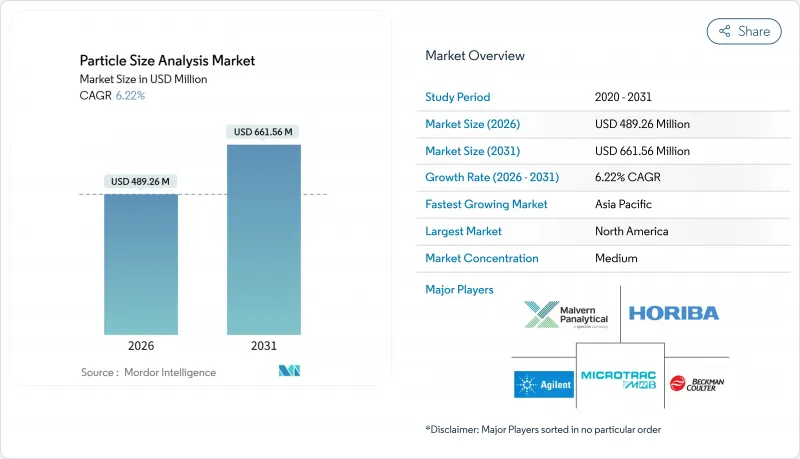
이 보고서는 기술별(레이저 회절법, 이미징 분석법 등), 분산 유형별(습식 입자 분석 장치, 건식 입자 분석 장치 등), 분석 모드별(오프라인/실험실용 시스템,온라인/앳라인용 시스템 등), 최종사용자 산업별(농림업, 환경·규제 관련 연구소 등) 및 지역별로 분류되어 있습니다. 시장 예측은 금액(달러) 기준으로 제시되어 있습니다.
전 세계 입자 크기 분석 시장의 동향 및 인사이트
나노테크놀러지 분야의 연구 활동 증가
제조된 나노 소재에 관한 통일 시험 지침에서는 입자 크기 분포가 자료 제출의 핵심 요소로 명시됨에 따라 50 nm 미만을 측정할 수 있는 기기에 대한 즉각적인 수요가 발생하고 있습니다. 대학 및 국립 연구소에서는 양자점, 지질 나노입자, 산화물 촉매의 검증에 나노입자 추적 분석 및 동적 광산란법이 도입되고 있습니다. 레이저 회절 장치 공급업체들은 더 미세한 측정 범위를 지원할 수 있도록 모듈을 개선하고 있지만, 입자 크기, 제타 전위, 농도를 단일 카트리지에 통합한 미세유체 장치와의 경쟁에 직면해 있습니다. 이러한 융합으로 인해 공급업체의 기반이 확대되는 동시에 혁신 주기가 가속화되어, 궁극적으로 입자 크기 분석 시장의 규모가 확대될 것입니다.
증가하는 제약 품질관리 수요
FDA가 2024년에 개정된 분석 검증 지침에서는 고형 제제 및 비경구 제제의 입자 크기 측정법에 대한 견고성 시험이 명시적으로 요구되고 있으며, 지금까지 선택 사항이었던 특성 평가가 법적 의무가 되었습니다. 이를 보완하는 ICH Q14 규정에서는 입자 크기 분석이 공정 검증 프레임워크에 통합되어 있으며, 제네릭 의약품, 바이오시밀러 및 위탁 제조업체는 스폰서의 감사를 통과하기 위해 중복성을 확보한 레이저 회절법 및 동적 광산란법 시스템을 도입해야 합니다. 나노입자 추적 분석 및 필드 플로우 분획법과 같은 직교 기법은 서브미크론 크기의 단백질 응집체 프로파일링 분야에서 주목을 받고 있습니다. 이러한 투자 열풍으로 인해 중형 장비에 대한 수요가 실질적으로 두 배로 증가하여 입자 크기 분석 시장을 더욱 공고히 하고 있습니다.
높은 설비 투자 및 유지 관리 비용
주력 레이저 회절 측정 시스템의 가격은 10만 달러 이상이며, 하드웨어 가격의 15-20%에 해당하는 연간 유지보수 계약이 필요하므로 수탁제조업체나 학술연구 기관의 예산에 부담이 되고 있습니다. 신흥 지역의 수입 관세 및 환율 변동으로 인해 도입 비용이 20-30% 증가할 가능성이 있으며, 구매자들은 리퍼브 제품에 대한 관심을 높이고 있습니다. 각 벤더는 리스나 ‘Instrument-as-a-Service(IaaS)’ 모델로 대응하고 있지만, 재고 리스크를 감수해야 하므로 이익률은 낮게 유지되고 투자 회수 기간이 장기화되어, 입자 크기 분석 시장의 단기적인 보급을 저해하고 있습니다.
부문 분석
레이저 회절법은 2025년 매출의 32.74%를 차지하며, 미세한 API부터 거친 클링커까지 대응 가능한 10 nm-3,500µm의 동적 범위 덕분에 입자 크기 분석 시장에서 최대 점유율을 유지하고 있습니다. ISO 13320에 기반한 검증 덕분에 시험소는 장시간의 측정법 타당성 검증 절차를 거치지 않고도 데이터를 제출할 수 있게 되었습니다. 또한 소프트웨어 플러그인을 통해 제타 전위 및 농도가 중첩 표시되므로 사용자는 단일 화면에서 고장의 근본 원인을 파악할 수 있게 되었습니다. 각 공급업체는 이미징 기능 애드온, 클라우드 라이브러리, CFR Part 11 감사 추적을 번들로 제공하여 사업 기반을 공고히 하고 있으며, 이를 통해 제약 업계 구매자의 설치 적합성 확인 절차가 단축되고 있습니다. 경쟁사들과의 경쟁 포인트는 해상도에 집중되어 있습니다. 각 벤더는 100 nm 미만의 감도를 내세우고 있지만, 입자가 레이저 파장에 가까워지면 회절의 물리적 원리에 의해 정확도가 제한되므로 구매자는 바이오의약품이나 고체 전지 관련 작업을 위해 다른 기법을 사용하는 툴 도입을 고려할 수밖에 없게 되었습니다.
2031년까지 연평균 성장률(CAGR) 7.69%로 확대될 것으로 예상되는 나노입자 추적 분석은 100 nm 이하의 단일 입자를 시각화함으로써 이러한 사각지대를 해소하여, 입자 크기 분석 시장에서 가장 빠르게 성장하는 분야가 되었습니다. 바이오의약품 제조업체는 이 기법을 사용하여 면역원성을 유발하는 단백질 응집체를 정량하고 있는 반면, 배터리 개발자는 수지상 결정 형성을 방지하기 위해 5µm 이하 수준에서 황화물 전해질의 균일성을 확인하고 있습니다. 동적 광산란법은 유체역학적 반경 연구 분야에서 여전히 학계에서 강력한 존재감을 보이고 있지만, 배치 모드라는 점과 희석에 따른 아티팩트가 산업 분야에서의 채택을 방해하고 있습니다. 이미징 분석 장치는 연마재나 금속 분말 등 형태에 민감한 틈새 시장을 채우고 있는 반면, 전기 임피던스법에서는 굴절률의 변동을 무시할 수 있으므로 흑연 슬러리 분야에서 콜터법이 다시 주목받고 있습니다. 매우 전문성이 높은 테일러 분산법이나 공명 질량분석 장치는 절대적인 정밀도가 처리 능력보다 중시되는 연구개발(R&D) 환경에서 고가 제품군으로 자리 잡고 있습니다.
습식 분산 장치는 광업, 세라믹, 의약품 현탁액 등 슬러리를 많이 사용하는 분야를 지원함으로써 2025년 매출의 53.89%를 차지했습니다. 이러한 분야에서는 인라인 밀도 조절이 신속한 피드백 루프에 의존하고 있습니다. 폐루프식 재순환 셀은 용매 사용량을 줄이고, 침강 방지 임펠러는 거대 입자의 영향으로 인한 D50 편차를 방지하므로, 이 기술은 입자 크기 분석 시장에서 확고한 점유율을 확보하고 있습니다. 건식 분석 장치는 시멘트, 토너, 금속 분말 분야에서는 여전히 주류를 이루고 있지만, 가연성 분진에 관한 기준으로 인해 불활성 가스 퍼지가 필요해져 운영 비용이 증가하고 있으므로 일부 사용자는 시험 후 증발하는 휘발성 용매를 사용하는 습식법을 채택하고 있습니다.
스프레이 분석 장치는 흡입기 및 비강 스프레이 신청 자료에 포함된 입자 크기 분포의 허용 한계가 엄격해진 데 따라 연평균 성장률(CAGR) 6.81%로 성장할 것으로 예측됩니다. 조제 부스에 내장된 광학 분광계는 액적의 중앙값이 캐스케이드 임팩터의 허용 범위를 초과할 경우 작업자에게 경고를 발령하여 재작업량을 대폭 줄이고 있습니다. 브라질과 아르헨티나의 농약 제제 제조업체들은 표적 외로 흩어지는 것을 억제하고 환경 규제치를 충족하기 위해 레이저식 스프레이 프로파일러를 도입하고 있으며, 입자 직경 분석 분야에 새로운 시장 기회가 생겨나고 있습니다. 다만, 여전히 장벽도 남아 있습니다. 스프레이 광학계를 기준용 임팩터에 맞춰 교정하려면 정밀한 위치 조정이 필요하며, 또한 폐쇄 루프식 용매 회수 시스템을 도입하면 설비 투자에 1만 5,000-2만 5,000달러가 추가로 소요되므로, 중견 제조업체에게는 장벽이 되고 있습니다.
지역별 분석
2025년 매출 중 북미가 37.79%를 차지했습니다. FDA의 철저한 감사 일정에 따라 입자 크기 검증은 신청 서류에서 필수 요소가 되었으며, 이 지역의 바이오의약품 클러스터가 시스템 업데이트 수요를 지속적으로 견인하고 있습니다. 중서부 및 남동부 지역의 배터리 기가팩토리에서는 양극 슬러리를 모니터링하기 위해 수십 개의 인라인 프로브가 통합되어 있는 반면, 캐나다의 칼륨 및 중요 광물 자산은 습식 분석 장비 매출을 견고하게 지원하고 있습니다. 도입 기반이 성숙기에 접어들면서 신규 프로젝트보다 갱신 프로젝트가 주류를 이루고 있으며, 각 벤더사는 서비스 계약 및 소프트웨어 업그레이드로 사업을 전환하고 있습니다.
아시아태평양은 리튬이온 기술 분야에서 중국의 우위와 국내 계측 기기에 대한 보조금에 힘입어 2031년까지 연평균 성장률(CAGR) 7.27%를 기록할 것으로 예측됩니다. 현지 제조사인 Bettersize Instruments와 Winner Particle은 중저가 시장에서 사업을 확장하며 수입 시스템의 시장 점유율을 잠식하고 있습니다. 품질을 중시하는 일본의 제약 및 세라믹 업계에서는 계속해서 고급 분석 장비가 구매되고 있으며, 한국의 디스플레이 및 반도체 팹에서는 CMP 슬러리의 적합성 확인을 위해 입자 직경 측정 기술이 도입되고 있습니다. 인도의 제네릭 의약품 업계에서는 미국 및 EU의 데이터 무결성 요건을 충족하기 위해 실험실 설비를 업그레이드하고 있는 반면, 호주에서는 광물 처리 과정에서 인라인 분석 장비가 활용되고 있습니다.
유럽에서는 성숙한 도입 현황과 지속가능한 제조에 관한 지침 간의 균형이 잡혀 있습니다. 독일의 화학 및 자동차 공장에서는 입자 크기 센서를 디지털 트윈 플랫폼에 통합하고 있으며, 영국에서는 이중 규제 상황으로 인해 국내 및 EU 당국의 요구 사항을 모두 충족하기 위해 이중 계측 장비가 도입되고 있습니다. 프랑스에서는 수십년에 걸친 추적성이 필수적인 핵연료 및 항공우주용 복합재료 분야에서 입자 크기 분석 장치가 도입되고 있습니다. 중동 및 아프리카에서는 광업 분야에서의 도입이 진행 중이며, 남미에서는 농업용 살포액 분석 분야에서 도입이 싹트기 시작하고 있으며, 브라질과 아르헨티나가 이를 주도하고 있습니다.
기타 혜택:
- 엑셀 형식의 시장 예측(ME) 시트
- 3개월간의 애널리스트 지원
자주 묻는 질문
목차
제1장 서론
제2장 조사 방법
제3장 개요
제4장 시장 구도
제5장 시장 규모와 성장 예측
제6장 경쟁 구도
제7장 시장 기회와 향후 전망
KSA 26.09.02According to Mordor Intelligence, the particle size analysis market size reached USD 489.26 million in 2026 and is projected to increase to USD 661.56 million by 2031, representing a 6.22% CAGR across the forecast period.
This report is Segmented by Technology (Laser Diffraction, Imaging Analysis, and More), Dispersion Type (Wet Particle Analyzers, Dry Particle Analyzers, and More), Mode of Analysis (Offline/Laboratory Systems, Online/At-Line Systems, and More), End-User Industry (Agriculture and Forestry, Environmental and Regulatory Labs, and More), and Geography. Market Forecasts are Provided in Terms of Value (USD).
Global Particle Size Analysis Market Trends and Insights
Rising Research Activity in Nanotechnology
Harmonized testing guidelines for manufactured nanomaterials now specify particle-size distribution as a core element of the dossier, creating an immediate demand for sub-50 nm instrumentation. Universities and national labs deploy nanoparticle tracking analysis and dynamic light scattering to validate quantum dots, lipid nanoparticles, and oxide catalysts. Laser-diffraction vendors retrofit modules for finer ranges, but face competition from microfluidic devices that consolidate size, zeta potential, and concentration in single cartridges. This convergence is widening the supplier base while accelerating innovation cycles, ultimately enlarging the particle size analysis market footprint.
Growing Pharmaceutical Quality-Control Needs
The FDA's 2024 revision of analytical validation guidance explicitly requires robustness studies for particle-size methods in solid and parenteral dosage forms, turning optional characterization into a legal mandate. Complementary ICH Q14 rules embed particle-size analysis within process-validation frameworks, prompting generics, biosimilars, and contract manufacturers to install redundant laser-diffraction and dynamic light-scattering systems to pass sponsor audits. Orthogonal techniques, such as nanoparticle tracking analysis or field-flow fractionation, gain traction in profiling sub-micron protein aggregates. The spending wave effectively doubles mid-tier equipment demand, reinforcing the particle size analysis market.
High Capital and Maintenance Costs
Flagship laser-diffraction systems list above USD 100,000 and require annual service contracts priced at 15-20% of hardware value, pressuring budgets at contract manufacturers and academic labs. Import tariffs and currency fluctuations in emerging regions can increase entry costs by 20-30%, steering buyers toward refurbished gear. Vendors respond with leasing and instrument-as-a-service models, but they must carry inventory risk, which keeps margins thin and lengthens payback, softening near-term uptake within the particle size analysis market.
Other drivers and restraints analyzed in the detailed report include:
- Shift Toward Online and Inline Real-Time Analysis
- AI-Enabled Multi-Technique Integration
- Shortage of Skilled Operators and Data Scientists
For complete list of drivers and restraints, kindly check the Table Of Contents.
Segment Analysis
Laser diffraction accounted for 32.74% of 2025 revenue, maintaining the largest particle size analysis market share due to a 10 nm-3,500 µm dynamic range that suits both fine APIs and coarse clinker. Validation against ISO 13320 enables laboratories to file data without lengthy method justification, and software plugins now overlay zeta potential and concentration, allowing users to diagnose root-cause failures on a single screen. Suppliers defend the franchise by bundling imaging add-ons, cloud libraries, and CFR Part 11 audit trails, which shorten the installation qualification process for pharmaceutical buyers. Competitive noise centers on resolution; vendors advertise sub-100 nm sensitivity, but diffraction physics limits precision once particles approach the laser wavelength, pushing buyers to consider orthogonal tools for biologics and solid-state battery tasks.
Nanoparticle tracking analysis, forecast to advance at a 7.69% CAGR to 2031, solves that blind spot with single-particle visualization below 100 nm, making it the fastest-moving slice of the particle size analysis market. Biologic drug makers use this method to quantify protein aggregates that trigger immunogenicity, while battery developers check sulfide electrolytes for uniformity at sub-5 µm levels that prevent dendrite formation. Dynamic light scattering maintains a strong presence in academia for hydrodynamic radius studies, but batch mode and dilution artifacts hinder industrial adoption. Imaging analyzers fill morphology-sensitive niches, such as abrasives and metal powders, whereas the Coulter principle is resurfacing in graphite slurries because electrical impedance can ignore refractive-index swings. Ultra-specialized Taylor dispersion and resonant mass instruments command premium prices in R&D environments where absolute precision outweighs throughput.
Wet dispersion instruments captured 53.89% of 2025 revenue by underpinning slurry-heavy verticals, such as mining, ceramics, and pharmaceutical suspensions, where inline density adjustments rely on rapid feedback loops. Closed-loop recirculation cells reduce solvent use, and anti-settling impellers prevent coarse tails from skewing the D50, thereby reinforcing the technology's hold on the particle size analysis market share. Dry analyzers remain staples for cement, toner, and metal powders; however, combustible-dust standards require inert-gas purges, which increase operating costs, prompting some users to adopt wet methods using volatile solvents that evaporate after testing.
Spray analyzers are projected to grow at a 6.81% CAGR, driven by stricter aerodynamic particle-size distribution limits in inhaler and nasal spray dossiers. Optical spectrometers built into formulation booths now alert operators when droplet medians drift beyond cascade-impactor guardrails, slashing rework. Pesticide formulators in Brazil and Argentina are adopting laser-based spray profilers to curb off-target drift and meet environmental caps, creating a new market opportunity within particle size analysis. Barriers remain: calibrating spray optics to reference impactors demands meticulous alignment, and closed-loop solvent capture can add USD 15,000-25,000 to capital outlay, a hurdle for mid-tier producers.
Complete Report Scope:
- By Technology
- Laser Diffraction
- Dynamic Light Scattering
- Nanoparticle Tracking Analysis
- Imaging Analysis
- Coulter Principle
- Taylor Dispersion Analysis
- Resonant Mass Measurement
- By Dispersion Type
- Wet Particle Analyzers
- Dry Particle Analyzers
- Spray Particle Analyzers
- By Mode of Analysis
- Offline / Laboratory Systems
- Online / At-Line Systems
- Inline / Real-Time Process Systems
- By End-User Industry
- Pharmaceuticals and Biopharmaceuticals
- Chemicals and Petrochemicals
- Food, Beverage and Nutrition
- Mining, Minerals and Cement
- Agriculture and Forestry
- Energy and Battery Materials
- Environmental and Regulatory Labs
- By Geography
- North America
- United States
- Canada
- Mexico
- Europe
- Germany
- United Kingdom
- France
- Russia
- Rest of Europe
- Asia-Pacific
- China
- Japan
- India
- South Korea
- Australia
- Rest of Asia-Pacific
- Middle East and Africa
- Middle East
- Saudi Arabia
- United Arab Emirates
- Rest of Middle East
- Africa
- South Africa
- Egypt
- Rest of Africa
- Middle East
- South America
- Brazil
- Argentina
- Rest of South America
- North America
Geography Analysis
North America accounted for 37.79% of the 2025 revenue. Intensive FDA inspection schedules have made particle-size validation a non-negotiable dossier element, and the region's biopharma clusters continue to drive demand for replacement systems. Midwest and Southeastern battery gigafactories integrate dozens of inline probes to monitor cathode slurries, while Canada's potash and critical-mineral assets sustain steady wet-analysis sales. Installed-base maturity means that replacement rather than greenfield projects dominate, so vendors pivot to service contracts and software upgrades.
Asia-Pacific is projected to post a 7.27% CAGR through 2031, led by China's dominance in lithium-ion technology and subsidies for domestic instrumentation. Local producers, Bettersize Instruments and Winner Particle, expand within mid-tier price bands, eroding market share from imported systems. Japan's quality-obsessed pharmaceutical and ceramics sectors continue to buy premium analyzers, and South Korea's display and semiconductor fabs deploy particle-size checks to qualify CMP slurries. India's generics industry upgrades its labs to meet US and EU data-integrity requirements, while Australia leverages inline analyzers in mineral processing.
Europe balances mature adoption with continuous manufacturing directives. German chemical and automotive plants embed particle-size sensors into digital twin platforms, and the United Kingdom's dual regulatory landscape drives duplicate instrumentation to satisfy both domestic and EU authorities. France deploys particle-size analyzers in nuclear fuel and aerospace composites where traceability over decades is essential. The Middle East and Africa are gaining traction through mining, and South America is showing a budding uptake in agricultural spray analysis, with Brazil and Argentina leading the adoption.
- Malvern Panalytical Ltd
- Horiba Ltd
- Beckman Coulter Inc.
- Agilent Technologies Inc.
- Microtrac MRB
- Micromeritics Instruments Corporation
- IZON Science Limited
- Sympatec GmbH
- Shimadzu Corporation
- Anton Paar GmbH
- Brookhaven Instruments Corporation
- Bettersize Instruments Ltd
- Particle Sizing Systems, LLC
- Jinan Winner Particle Instrument Stock Co., Ltd.
- Retsch GmbH
- Otsuka Electronics Co. Ltd
- LS Instruments AG
- CORDOUAN Technologies SAS
- Metso Outotec
Additional Benefits:
- The market estimate (ME) sheet in Excel format
- 3 months of analyst support
TABLE OF CONTENTS
1 INTRODUCTION
- 1.1 Study Assumptions and Market Definition
- 1.2 Scope of the Study
2 RESEARCH METHODOLOGY
3 EXECUTIVE SUMMARY
4 MARKET LANDSCAPE
- 4.1 Market Overview
- 4.2 Market Drivers
- 4.2.1 Rising Research Activity in Nanotechnology
- 4.2.2 Growing Pharmaceutical Quality-Control Needs
- 4.2.3 Shift Toward Online and Inline Real-Time Analysis
- 4.2.4 AI-Enabled Multi-Technique Integration
- 4.2.5 Soaring Demand for Battery and Energy-Storage Materials Testing
- 4.2.6 Expansion of Microfluidic Lab-on-Chip PSA Devices
- 4.3 Market Restraints
- 4.3.1 High Capital and Maintenance Costs
- 4.3.2 Shortage of Skilled Operators and Data Scientists
- 4.3.3 Sample Preparation Complexity for Agglomerated Particles
- 4.3.4 Competition from Alternative Characterisation Methods
- 4.4 Industry Value Chain Analysis
- 4.5 Regulatory Landscape
- 4.6 Technological Outlook
- 4.7 Porter's Five Forces Analysis
- 4.7.1 Bargaining Power of Suppliers
- 4.7.2 Bargaining Power of Buyers
- 4.7.3 Threat of New Entrants
- 4.7.4 Threat of Substitutes
- 4.7.5 Intensity of Competitive Rivalry
- 4.8 Impact of Macroeconomic Factors on the Market
5 MARKET SIZE AND GROWTH FORECASTS (VALUE)
- 5.1 By Technology
- 5.1.1 Laser Diffraction
- 5.1.2 Dynamic Light Scattering
- 5.1.3 Nanoparticle Tracking Analysis
- 5.1.4 Imaging Analysis
- 5.1.5 Coulter Principle
- 5.1.6 Taylor Dispersion Analysis
- 5.1.7 Resonant Mass Measurement
- 5.2 By Dispersion Type
- 5.2.1 Wet Particle Analyzers
- 5.2.2 Dry Particle Analyzers
- 5.2.3 Spray Particle Analyzers
- 5.3 By Mode of Analysis
- 5.3.1 Offline / Laboratory Systems
- 5.3.2 Online / At-Line Systems
- 5.3.3 Inline / Real-Time Process Systems
- 5.4 By End-User Industry
- 5.4.1 Pharmaceuticals and Biopharmaceuticals
- 5.4.2 Chemicals and Petrochemicals
- 5.4.3 Food, Beverage and Nutrition
- 5.4.4 Mining, Minerals and Cement
- 5.4.5 Agriculture and Forestry
- 5.4.6 Energy and Battery Materials
- 5.4.7 Environmental and Regulatory Labs
- 5.5 By Geography
- 5.5.1 North America
- 5.5.1.1 United States
- 5.5.1.2 Canada
- 5.5.1.3 Mexico
- 5.5.2 Europe
- 5.5.2.1 Germany
- 5.5.2.2 United Kingdom
- 5.5.2.3 France
- 5.5.2.4 Russia
- 5.5.2.5 Rest of Europe
- 5.5.3 Asia-Pacific
- 5.5.3.1 China
- 5.5.3.2 Japan
- 5.5.3.3 India
- 5.5.3.4 South Korea
- 5.5.3.5 Australia
- 5.5.3.6 Rest of Asia-Pacific
- 5.5.4 Middle East and Africa
- 5.5.4.1 Middle East
- 5.5.4.1.1 Saudi Arabia
- 5.5.4.1.2 United Arab Emirates
- 5.5.4.1.3 Rest of Middle East
- 5.5.4.2 Africa
- 5.5.4.2.1 South Africa
- 5.5.4.2.2 Egypt
- 5.5.4.2.3 Rest of Africa
- 5.5.4.1 Middle East
- 5.5.5 South America
- 5.5.5.1 Brazil
- 5.5.5.2 Argentina
- 5.5.5.3 Rest of South America
- 5.5.1 North America
6 COMPETITIVE LANDSCAPE
- 6.1 Market Concentration
- 6.2 Strategic Moves
- 6.3 Market Share Analysis
- 6.4 Company Profiles (includes Global Level Overview, Market Level Overview, Core Segments, Financials as available, Strategic Information, Market Rank/Share, Products and Services, and Recent Developments)
- 6.4.1 Malvern Panalytical Ltd
- 6.4.2 Horiba Ltd
- 6.4.3 Beckman Coulter Inc.
- 6.4.4 Agilent Technologies Inc.
- 6.4.5 Microtrac MRB
- 6.4.6 Micromeritics Instruments Corporation
- 6.4.7 IZON Science Limited
- 6.4.8 Sympatec GmbH
- 6.4.9 Shimadzu Corporation
- 6.4.10 Anton Paar GmbH
- 6.4.11 Brookhaven Instruments Corporation
- 6.4.12 Bettersize Instruments Ltd
- 6.4.13 Particle Sizing Systems, LLC
- 6.4.14 Jinan Winner Particle Instrument Stock Co., Ltd.
- 6.4.15 Retsch GmbH
- 6.4.16 Otsuka Electronics Co. Ltd
- 6.4.17 LS Instruments AG
- 6.4.18 CORDOUAN Technologies SAS
- 6.4.19 Metso Outotec
7 MARKET OPPORTUNITIES AND FUTURE OUTLOOK
- 7.1 White-Space and Unmet-Need Assessment


