

|
시장보고서
상품코드
2120296
자동차용 연료전지 : 시장 점유율 분석, 업계 동향과 통계, 성장 예측(2026-2031년)Automotive Fuel Cell - Market Share Analysis, Industry Trends & Statistics, Growth Forecasts (2026 - 2031) |
||||||
 Mordor Intelligence
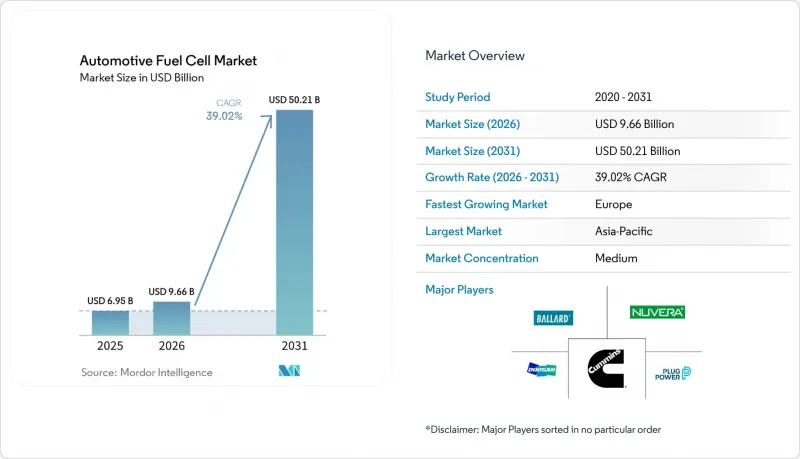
Mordor Intelligence에 따르면 자동차용 연료전지 시장 규모는 2025년에 69억 5,000만 달러로 평가되며, 2026년 96억 6,000만 달러에서 2031년까지 502억 1,000만 달러에 달할 것으로 추정되고 있으며, 예측 기간(2026-2031년)에 CAGR은 39.02%에 달할 전망입니다.
이 보고서는 차종별(승용차, 소형 상용차, 중형·대형 상용차, 버스·장거리 버스), 구동 방식별(전륜 구동, 후륜 구동, 사륜 구동),출력별(100kW 미만, 100-200kW, 200kW 이상), 추진 방식(FCEV, 하이브리드 FC) 및 지역별로 분류되어 있습니다. 시장 예측은 금액(달러) 기준으로 제시되어 있습니다.
세계 자동차용 연료전지 시장의 동향과 인사이트
CO₂ 배출 규제 및 ZEV 규제의 강화가 상용차 차량군의 연료전지 도입을 촉진
캘리포니아주의 ‘첨단 청정 차량 규정’ 및 EU의 대형 차량용 CO₂ 배출 기준에 따라 제조사와 차량 운용사는 2030년대 중반까지 제로 배출 트럭으로의 전환을 의무화하고 있으며, 이는 연료전지 구동 시스템의 수요를 지원하고 있습니다. 차량 관리자들은 배터리 1kg당 적재량에 따른 수익이 감소하므로 수소의 에너지 밀도를 중시하고 있습니다. 규제의 확실성으로 인해 특히 항만내 트럭 운송 및 장거리 운송 노선에서 조달 주기가 가속화되고 있습니다. 각 OEM 업체들은 현재 규제 준수에 필요한 대수를 기본 수요로 간주하여, 연료전지 공급업체와 다년간의 공급 계약을 체결하고 있습니다. 인프라 구축에 대한 추가 보조금 덕분에 디젤 차량과의 총 소유 비용(TCO) 격차는 더욱 좁혀지고 있습니다.
연료전지 스택의 비용 절감이 상용화 실현 가능성을 가속화
도요타의 최신 2세대 스택은 백금 사용량 감축과 막-전극 어셈블리의 자동화를 통해 2020년 이후 65%의 비용 절감을 실현하여, 1kW당 45달러가 되었습니다. 연간 5만 대를 넘는 생산량은 2027년까지 kW당 30달러를 목표로 하는 학습 곡선 효과를 지원하고 있습니다. 내구성은 현재 2만 5,000시간을 초과하여 리스 회사의 잔존 가치에 대한 우려를 완화하고 있습니다. 비용 평준화가 가까워짐에 따라 자동차용 연료전지 시장은 대형 차량 부문에서 두 자릿수의 보급률을 달성하기 위한 길이 더욱 명확해지고 있습니다.
높은 수소 생산 비용이 시장 확대의 걸림돌
녹색 수소의 평균 가격은 1kg당 4-6달러로, 장거리 트럭 운송에서 디젤 연료와의 비용 평등 달성 목표의 2배에 해당합니다. 블루 수소의 경제성은 여전히 지역적으로 제한된 탄소 포집 능력에 좌우됩니다. 파이프라인이 정비되지 않은 시장에서는 운송비로 인해 공급되는 수소 가격이 1kg당 1-2달러가 추가됩니다. 경쟁하는 산업용 구매자의 존재는 가격 변동성을 높이며, 차량 플릿의 예산 편성을 복잡하게 만들고 있습니다. 재생 가능 전력 가격이 하락하거나 전해 공정의 규모 확대가 이루어질 때까지는 자동차용 연료전지 시장은 이 격차를 메우기 위해 정책 수단에 의존할 수밖에 없습니다.
부문 분석
승용차는 2025년에 45.78%의 시장 점유율을 차지했으나, 중형·대형 상용차는 연평균 성장률(CAGR) 39.60%로 성장하고 있습니다. 상용차 사업자들은 고정 노선에서 수소가 제공하는 신속한 충전과 장거리 주행 능력을 높이 평가하고 있습니다. 총 소유 비용(TCO) 모델 분석에 따르면 수소 공급 가격이 1kg당 3달러로 가정할 경우, 캘리포니아주의 드라지(항만내 운송)에서 빠르면 2027년에는 디젤 차량과의 손익분기점에 도달할 전망입니다. 데포에서의 충전으로 소매 인프라 사각지대를 피하고 트럭의 가동 시간을 극대화할 수 있습니다. 아마존, DHL, UPS 등 글로벌 물류 기업은 수백 대의 연료전지 박스 트럭을 발주하고 있으며, 이는 공급업체에게 명확한 규모 확대 신호가 되고 있습니다.
승용차로의 도입은 브랜드 포지셔닝 측면에서는 여전히 전략적이지만, 판매 대수 측면에서는 부차적인 위치에 머물고 있습니다. 토요타와 현대는 내구성을 검증하고 정비사들이 익숙해질 수 있도록 한정 생산 세단을 활용하고 있지만, 투자의 초점은 현재 상용차 플랫폼으로 이동하고 있습니다. 지방자치단체의 교통 기관은 교통량이 많은 노선에 연료전지 버스를 도입하고 있으며, 자동차용 연료전지 시장을 더욱 확대시키고 있습니다. 예측 기간 중 상용차 차량군이 연료전지 스택 판매량을 지탱하는 중심이 될 것이며, 이는 공급망의 성숙을 촉진함으로써 궁극적으로 승용차 모델에도 혜택을 가져다줄 것으로 전망됩니다.
2025년에는 패키징의 단순성으로 비용을 절감할 수 있는 전륜 구동 모델이 56.30%의 점유율을 차지했습니다. 자동차 제조사들은 기존 플랫폼을 활용하여 스택을 Under-The-Hood에, 연료 탱크를 후면에 배치하고 있습니다. 한편, 프리미엄 브랜드들이 스포츠 유틸리티 차량 특유의 주행 성능을 약속하는 듀얼 모터 SUV를 잇달아 발표함에 따라 사륜구동(AWD) 시장은 연평균 26.40%의 성장률을 보일 것으로 전망됩니다. BMW의 수소 X5 프로토타입은 배터리 차량에 비해 뛰어난 저온 성능을 보여주고 있으며, 이는 AWD에 대한 관심을 부추기고 있습니다. 후륜 구동 트럭은 적재 공간 용량을 희생하지 않으면서 차체 하부 공간을 활용하여 더 큰 수소 실린더를 탑재하고 있습니다.
구동 방식의 다양화는 시장의 성숙을 나타냅니다. 초기 도입 기업은 규제 준수를 목표로 하는 틈새 시장을 노렸지만, 차세대 라인업에서는 수소를 ‘성능’이라는 가치로 포지셔닝하고 있습니다. 멀티 모터를 통한 토크 벡터링을 통해 산악 지대에서의 견인력이나 오프로드 주행 성능과 같은 마케팅 메시지를 전달할 수 있게 되었는데, 이는 고부하 조건에서 배터리 팩으로는 실현하기 어려운 부분입니다. 각 OEM 업체들이 연료전지 모듈을 스케이트보드형 EV 아키텍처로 전환함에 따라 구동계의 유연성은 더 이상 문제가 되지 않을 것이며, 자동차용 연료전지 시장은 더욱 확대될 것입니다.
지역별 분석
아시아태평양은 2030년까지 수소연료전지차 100만 대를 목표로 하는 중국의 ‘국가 수소 계획’을 배경으로, 2025년에는 전 세계 매출의 53.70%를 차지했습니다. 차량 가격의 40%를 충당하는 성(省) 차원의 보조금으로 자동차 제조사의 합작 투자가 유치된 한편, 국영 에너지 기업은 1,200곳의 공공 충전소 구축을 급속도로 추진했습니다. 일본의 ‘녹색 성장 전략’에서는 ‘미라이(Mirai)’ 세단을 택시 차량으로 도입하고, 2030년까지 900곳의 충전소 설치를 목표로 하고 있으며, 이는 국내 수소연료전지 스택 수요를 지원하고 있습니다. 한국은 수소 생산 로드맵과 현대자동차의 공급망 클러스터를 결합하여, 자국을 10,000psi 탱크의 수출 거점으로 자리매김하고 있습니다.
유럽에서는 브뤼셀의 ‘대체 연료 인프라 규정’에 따라 회원국들이 TEN-T 핵심 네트워크를 따라 200km마다 수소 충전소를 건설해야 할 의무가 부과됨에 따라 연평균 성장률(CAGR) 28.10%가 예상됩니다. 독일의 ‘국가 혁신 프로그램’은 버스와 장거리 트럭 모두에 자금을 지원하고 있으며, 프랑스는 수소 충전소와 재생 가능 에너지를 활용한 전기분해 능력을 연계하고 있습니다. 북유럽 국가들에서는 화물, 해운, 에너지의 탈탄소화를 통합한 수소 페리 및 대형 트럭의 실증 실험이 진행되고 있습니다. 기업의 ESG 목표가 야심찬 CO₂ 감축 경로와 부합하므로 상용차 분야의 수소 도입 진전은 승용차 도입을 앞지르고 있습니다.
북미는 충전소 밀도 면에서는 뒤처져 있지만, 연방 정부와 주 정부의 인센티브가 연계되면서 탄력을 받고 있습니다. 캘리포니아주만 해도 미국내 공공 충전소의 60%를 차지하고 있으며, ‘저탄소 연료 기준(LCFS)’을 활용하여 충전소에서 재생 가능 수소에 대한 보조금을 지급하고 있습니다. ‘인플레이션 억제법’에 따른 수소 생산 1kg당 3달러의 세액 공제는 텍사스주와 중서부 지역의 새로운 전해 프로젝트를 촉진하고 있습니다. 캐나다는 풍부한 수력발전을 활용하여, 밴쿠버에서 로스앤젤레스까지 이어지는 트럭 운송 노선을 목표로 미국 태평양 연안 북서부로의 수출 회랑을 계획하고 있습니다. 이러한 동향은 전반적으로 자동차용 연료전지 시장의 장기적인 성장을 지원할 정책 체계가 점차 정립되고 있음을 보여줍니다.
기타 혜택:
- 엑셀 형식의 시장 예측(ME) 시트
- 3개월간의 애널리스트 지원
자주 묻는 질문
목차
제1장 서론
제2장 조사 방법
제3장 개요
제4장 시장 역학
제5장 시장 세분화
제6장 경쟁 구도
제7장 시장 기회와 향후 동향
KSA 26.09.02According to Mordor Intelligence, the automotive fuel cell market size was valued at USD 6.95 billion in 2025 and estimated to grow from USD 9.66 billion in 2026 to reach USD 50.21 billion by 2031, at a CAGR of 39.02% during the forecast period (2026-2031).
This report is Segmented by Vehicle Type (Passenger Cars, Light Commercial Vehicles, Medium and Heavy Commercial Vehicles, Buses and Coaches), Drive Type (Front-Wheel Drive, Rear-Wheel Drive, All-Wheel Drive), Power Output (Below 100 KW, 100 To 200 KW, Above 200 KW), Propulsion (FCEV, Hybrid FC), and Geography. The Market Forecasts are Provided in Terms of Value (USD).
Global Automotive Fuel Cell Market Trends and Insights
Stricter CO2 and ZEV Mandates Drive Commercial Fleet Adoption
California's Advanced Clean Fleets rule and the EU's heavy-duty CO2 standards oblige manufacturers and fleets to shift toward zero-emission trucks by the mid-2030s, anchoring demand for fuel-cell drivetrains. Fleet managers value hydrogen's energy density because every kilogram of battery mass erodes payload revenue. Regulatory certainty accelerates procurement cycles, especially in port drayage and long-haul corridors. OEMs now treat compliance volumes as base demand, unlocking multi-year supply agreements with fuel-cell suppliers. Follow-on infrastructure grants further narrow the total-cost-of-ownership gap versus diesel.
Fuel-Cell Stack Cost Reduction Accelerates Commercial Viability
Toyota's latest Gen 2 stack lands at USD 45 per kW after a 65% cost slide since 2020, thanks to lower platinum loading and automated membrane-electrode assembly. Volumes above 50,000 units per year support learning-curve effects that target USD 30 per kW by 2027. Durability now exceeds 25,000 hours, easing residual-value concerns for leasing companies. As cost parity approaches, the automotive fuel cell market gains a clearer path to double-digit adoption in heavy-duty segments.
High Hydrogen Production Costs Constrain Market Expansion
Green hydrogen averages USD 4-6 per kg, double the cost target for diesel parity in long-haul trucking. Blue hydrogen's economics hinge on carbon-capture capacity that remains geographically limited. Transportation adds USD 1-2 per kg for delivered hydrogen in markets without pipeline access. Competing industrial offtakers raise price volatility, complicating fleet budgeting. Until renewable electricity prices fall or electrolysis scale improves, the automotive fuel cell market must rely on policy instruments to bridge the gap.
Other drivers and restraints analyzed in the detailed report include:
- Hydrogen Infrastructure Deployment Creates Network Effects
- Fleet Purchase Incentives Offset Initial Cost Premiums
- Infrastructure Gaps Limit Geographic Development
For complete list of drivers and restraints, kindly check the Table Of Contents.
Segment Analysis
Passenger cars held a 45.78% 2025 market share, while medium-and heavy-commercial vehicles are pacing at a 39.60% CAGR. Commercial operators prize the quick refueling and long range that hydrogen offers on fixed routes. Total-cost-of-ownership modeling shows break-even against diesel as early as 2027 in California drayage, assuming a delivered hydrogen price of USD 3 per kg. Depot refueling avoids retail infrastructure voids and maximizes truck uptime. Global logistics firms like Amazon, DHL, and UPS have ordered hundreds of fuel-cell box trucks, creating visible scale signals for suppliers.
Passenger-car adoption remains strategic for brand positioning but secondary in volume. Toyota and Hyundai use limited-production sedans to validate durability and familiarize technicians, yet investment focus now tilts to commercial platforms. Municipal transit agencies are rolling out fuel-cell buses on densely trafficked routes, further growing the automotive fuel cell market. Over the forecast window, commercial fleets are set to anchor stack volumes, driving supply-chain maturity that eventually benefits passenger models.
Front-wheel-drive models captured 56.30% share in 2025 because packaging simplicity keeps costs low. Automakers mount stacks under the hood and gas tanks aft, leveraging legacy platforms. All-wheel-drive, however, should grow 26.40% annually as premium brands unveil dual-motor SUVs that promise sports-utility dynamics. BMW's hydrogen X5 prototype demonstrates superior low-temperature performance versus battery peers, underpinning AWD interest. Rear-wheel-drive trucks exploit under-frame space to house larger hydrogen cylinders without compromising payload.
Drive-type diversity signals maturity: early adopters targeted compliance niches while next-generation line-ups position hydrogen as a performance proposition. Multi-motor torque vectoring enables marketing messages around mountain towing and off-road agility that battery packs struggle to match under high loads. As OEMs migrate fuel-cell modules into skateboard EV architectures, drivetrain flexibility will become a non-issue, further expanding the automotive fuel cell market.
Complete Report Scope:
- Electrolyte Type
- Polymer Electronic Membrane Fuel Cell
- Direct Methanol Fuel Cell
- Alkaline Fuel Cell
- Phosphoric Acid Fuel Cell
- Vehicle Type
- Passenger Cars
- Commercial Vehicles
- Fuel Type
- Hydrogen
- Methanol
- Power Output
- Below 100 KW
- 100 to 200 KW
- Above 200 KW
- Geography
- North America
- United States
- Canada
- Rest of North America
- Europe
- Germany
- United Kingdom
- France
- Russia
- Spain
- Rest of Europe
- Asia-Pacific
- India
- China
- Japan
- South Korea
- Rest of Asia-Pacific
- South America
- Brazil
- Argentina
- Rest of South America
- Middle-East and Africa
- United Arab Emirates
- Saudi Arabia
- Rest of Middle-East and Africa
- North America
Geography Analysis
Asia-Pacific generated 53.70% of global revenues in 2025 on the back of China's National Hydrogen Plan that targets 1 million fuel-cell vehicles by 2030. Provincial subsidies covering 40% of vehicle cost have pulled in OEM joint ventures, while state-owned energy firms fast-tracked 1,200 public stations. Japan's Green Growth Strategy keeps Mirai sedans in taxi fleets and aims for 900 stations by 2030, sustaining domestic stack demand. South Korea couples a hydrogen production roadmap with Hyundai's supply-chain cluster, positioning the country as an export hub for 10,000-psi tanks.
Europe is poised for a 28.10% CAGR as Brussels' Alternative Fuels Infrastructure Regulation obliges member states to build hydrogen stations every 200 km along the TEN-T core network. Germany's National Innovation Program funds both buses and long-haul trucks, while France links hydrogen refueling sites with renewable electrolysis capacity. Nordic countries pilot hydrogen ferries and heavy trucks that integrate freight, marine, and energy decarbonization. Commercial-vehicle uptake outruns passenger-car rollouts because corporate ESG targets align with ambitious CO2 reduction pathways.
North America lags in station density but gains momentum from synchronized federal and state incentives. California alone hosts 60% of U.S. public stations and uses the Low Carbon Fuel Standard to subsidize renewable hydrogen at the pump. The Inflation Reduction Act's USD 3 per kg hydrogen production credit is catalyzing new electrolysis projects in Texas and the Midwest. Canada leverages abundant hydropower to plan export corridors into the U.S. Pacific Northwest, targeting trucking lanes that stretch from Vancouver to Los Angeles. Collectively, these developments indicate converging policy frameworks that underwrite long-term growth for the automotive fuel cell market.
- BorgWarner Inc.
- Nuvera Fuel Cells LLC
- Ballard Power Systems Inc.
- Hydrogenics (Cummins Inc.)
- Nedstack Fuel Cell Technology BV
- Oorja Corporation
- Plug Power Inc.
- SFC Energy AG
- Watt Fuel Cell Corporation
- Doosan Fuel Cell Co. Ltd
Additional Benefits:
- The market estimate (ME) sheet in Excel format
- 3 months of analyst support
TABLE OF CONTENTS
1 INTRODUCTION
- 1.1 Study Assumptions
- 1.2 Scope of the Study
2 RESEARCH METHODOLOGY
3 EXECUTIVE SUMMARY
4 MARKET DYNAMICS
- 4.1 Market Drivers
- 4.1.1 Government Initiatives to Support The Market Growth
- 4.2 Market Restraints
- 4.2.1 Lack of Infrastructure poses a Challenge For The Growth of The Market
- 4.3 Industry Attractiveness - Porter's Five Forces Analysis
- 4.3.1 Threat of New Entrants
- 4.3.2 Bargaining Power of Buyers/Consumers
- 4.3.3 Bargaining Power of Suppliers
- 4.3.4 Threat of Substitute Products
- 4.3.5 Intensity of Competitive Rivalry
5 MARKET SEGMENTATION
- 5.1 Electrolyte Type
- 5.1.1 Polymer Electronic Membrane Fuel Cell
- 5.1.2 Direct Methanol Fuel Cell
- 5.1.3 Alkaline Fuel Cell
- 5.1.4 Phosphoric Acid Fuel Cell
- 5.2 Vehicle Type
- 5.2.1 Passenger Cars
- 5.2.2 Commercial Vehicles
- 5.3 Fuel Type
- 5.3.1 Hydrogen
- 5.3.2 Methanol
- 5.4 Power Output
- 5.4.1 Below 100 KW
- 5.4.2 100 to 200 KW
- 5.4.3 Above 200 KW
- 5.5 Geography
- 5.5.1 North America
- 5.5.1.1 United States
- 5.5.1.2 Canada
- 5.5.1.3 Rest of North America
- 5.5.2 Europe
- 5.5.2.1 Germany
- 5.5.2.2 United Kingdom
- 5.5.2.3 France
- 5.5.2.4 Russia
- 5.5.2.5 Spain
- 5.5.2.6 Rest of Europe
- 5.5.3 Asia-Pacific
- 5.5.3.1 India
- 5.5.3.2 China
- 5.5.3.3 Japan
- 5.5.3.4 South Korea
- 5.5.3.5 Rest of Asia-Pacific
- 5.5.4 South America
- 5.5.4.1 Brazil
- 5.5.4.2 Argentina
- 5.5.4.3 Rest of South America
- 5.5.5 Middle-East and Africa
- 5.5.5.1 United Arab Emirates
- 5.5.5.2 Saudi Arabia
- 5.5.5.3 Rest of Middle-East and Africa
- 5.5.1 North America
6 COMPETITIVE LANDSCAPE
- 6.1 Vendor Market Share
- 6.2 Company Profiles
- 6.2.1 BorgWarner Inc.
- 6.2.2 Nuvera Fuel Cells LLC
- 6.2.3 Ballard Power Systems Inc.
- 6.2.4 Hydrogenics (Cummins Inc.)
- 6.2.5 Nedstack Fuel Cell Technology BV
- 6.2.6 Oorja Corporation
- 6.2.7 Plug Power Inc.
- 6.2.8 SFC Energy AG
- 6.2.9 Watt Fuel Cell Corporation
- 6.2.10 Doosan Fuel Cell Co. Ltd
7 MARKET OPPORTUNITIES AND FUTURE TRENDS
- 7.1 Increasing Renewable Energy Integration


