

|
시장보고서
상품코드
2120321
광업용 화학제품 : 시장 점유율 분석, 업계 동향과 통계, 성장 예측(2026-2031년)Mining Chemicals - Market Share Analysis, Industry Trends & Statistics, Growth Forecasts (2026 - 2031) |
||||||
 Mordor Intelligence
Mordor Intelligence에 따르면 광업용 화학제품 시장 규모는 2025년 70억 2,000만 달러에서 2026년에는 73억 2,000만 달러로 확대하며, 2031년까지 90억 달러에 달할 것으로 예상되고 있으며, 2026-2031년에 CAGR 4.22%로 성장할 전망입니다.
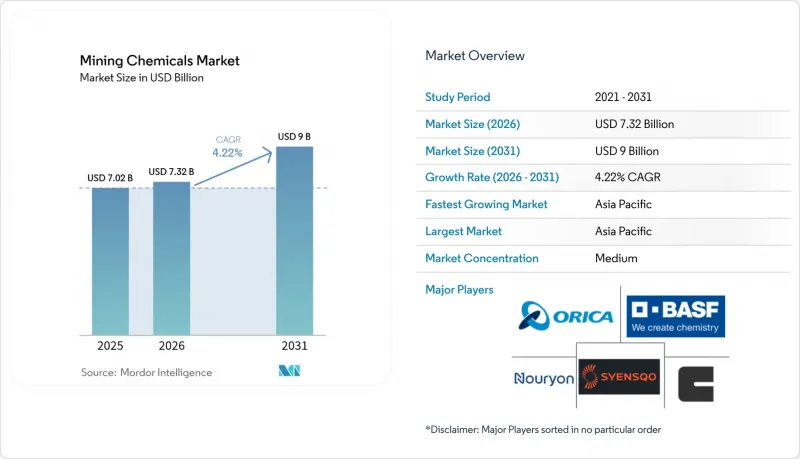
이 보고서는 기능별(부상 선별용 화학약품, 추출용 화학약품, 분쇄 보조제), 용도별(광물 처리 및 폐수 처리), 지역별(아시아태평양, 북미, 유럽, 남미, 중동 및 아프리카)로 분류되어 있습니다. 시장 전망은 금액(달러) 기준으로 제시되어 있습니다.
세계 광업용 화학제품 시장의 동향 및 인사이트
아시아태평양 및 북미의 광업 설비 투자(CAPEX) 증가
인도네시아의 니켈 HPAL(고압 산 침출) 라인 신규 건설 및 네바다주와 앨버타주의 리튬 DLE(직접 리튬 추출) 시범 사업으로 인해 황산, 트리부틸인산, 크라운 에테르계 추출제의 연간 수요가 증가하고 있습니다. 칠레의 아타카마 사막과 캐나다의 ‘불의 고리(Ring of Fire)’ 지역에서 진행 중인 구리 광산 확장으로 인해 집광제 및 발포제의 수요가 증가하고 있지만, 광석 선별 설비의 광범위한 개보수로 인해 시약 사용량은 억제되고 있습니다.
전기자동차 및 재생 가능 에너지 공급망에 따른 광물 수요의 급증
부상 선별 및 용매 추출을 통해 배터리용 금속은 중간 제품으로 정제됩니다. 중국에서는 인산철리튬 배터리가 코발트를 다량 사용하는 화학 조성의 배터리를 앞지르고 있습니다. 한편, 서호주에서는 스포듀멘의 부상 선별 과정에서 여전히 지방산계 집광제가 사용되고 있습니다. 2030년까지 구리 공급 부족이 예상됨에 따라 크산테이트계 및 디티오포스페이트계 집광제의 수요는 안정적인 양상을 보이고 있습니다.
유독 시약에 대한 전 세계적 규제 강화
2024년, ECHA는 에틸크산테이트 나트륨을 REACH 후보 리스트에 추가하고, 2026년을 기한으로 하는 승인 만료 절차를 시작했습니다. 한편, 미국 환경보호청(EPA)은 아밀크산테이트 칼륨을 면밀히 검토하고 있으며, 중국 환경보호부(MEE)는 현재 47종의 부양 시약에 대해 새로운 독성 데이터 파일 제출을 의무화하고 있습니다. 이러한 규제 준수 비용은 연구개발 예산을 압박하고 있으며, 특히 규제에 신중한 관할 구역에서는 새로운 포집제의 도입을 저해할 가능성이 있습니다.
부문별 분석
2025년에는 부유용 화학 약품이 광업용 화학 제품 시장의 매출의 55.33%를 차지할 것으로 예측됩니다. 집광제, 발포제, 억제제가 매출에서 주도적인 위치를 차지하고 있지만, 특히 산화구리 및 니켈 라테라이트 회로에서 하이드록시메이트계 및 바이오 기반 집광제의 채택이 현저히 증가하고 있습니다. 희석제 및 유기인계 추출제로 구성된 추출용 화학약품은 직접 리튬 추출(DLE)의 물결을 타고 연평균 성장률(CAGR) 4.33%로 성장하고 있으며, 기능별 카테고리에서 광업용 화학약품 시장 규모 분배에 미묘한 변화를 드러내고 있습니다. 아칸소주와 볼리비아의 DLE 프로젝트는 상당한 물 절약과 사이클 타임 단축을 입증하며, 크라운 에테르계 및 인산염계 추출제의 수요를 끌어올리고 있습니다. 동시에, 중국과 미국의 희토류 시설에서는 믹서-세틀러 내의 온도 프로파일을 안정화하기 위해 현재 대량의 C6-C12 계열 희석제가 사용되고 있습니다.
분쇄 보조제는 광업용 화학품 분야에서 가장 규모가 작은 부문이지만, 유망한 시험 결과가 나오고 있습니다. 칠레의 구리 제련소와 몽골의 금 제련소에서는 이러한 보조제를 통해 처리 능력이 현저히 향상되고 에너지 소비량이 감소하고 있습니다. 그러나 특히 광석의 경도가 서로 다른 경우, 보다 광범위한 도입을 위해서는 투자 대비 효과의 입증이 필수적입니다. 관련 동향으로, 공급업체들은 현재 시약과 함께 디지털 주입 밸브를 제공하고 있습니다. 이 전략은 과다 주입을 억제할 뿐만 아니라, 성능을 중시하는 구매로 향하는 업계 동향에도 부합합니다.
지역별 분석
아시아태평양은 2025년 매출의 54.13%를 차지하며 광업용 화학 제품 시장을 주도하고 있으며, 2031년까지 연평균 성장률(CAGR) 5.12%로 성장을 이어가고 있습니다. 인도네시아에서는 새로운 HPAL 라인이 도입되어 각 라인에서 연간 대량의 황산 및 추출제가 소비되고 있습니다. 중국 장시성 및 내몽골 자치구에서는 수입품보다 저렴한 국산 크산테이트를 활용하여 구리 광석의 처리 능력을 확대하고 있습니다. 호주에서는 수산화리튬 생산량을 확대하고 있으며, 스포쥬움 광석의 부양 공정에서는 광석의 입도가 미세해짐에 따라 지방산계 수집제에 대한 의존도가 높아지고 있습니다. 한편, 일본과 한국은 주요 블렌딩 거점으로서의 입지를 확고히 하고 있으며, 소나무유계 발포제를 수입하여 인도네시아의 니켈 제련소에 재공급하고 있습니다.
2025년 시장 매출 중 북미가 상당한 비중을 차지했습니다. 네바다주의 클레이턴 밸리와 앨버타주의 레덕층에서는 특수 이온교환수지 및 트리부틸인산염 희석제가 필요한 DLE 컬럼에 대한 시험이 파일럿 프로젝트로 진행되고 있습니다. 애리조나주 및 브리티시컬럼비아주의 구리 생산 확대와 서스캐처원주의 칼륨 생산 병목 현상 해소가 집전제에 대한 지속적인 수요를 견인하고 있습니다. 멕시코의 은·금 광대는 여전히 안정적인 수요원이고 있지만, 지역 사회의 반발로 인해 시안화물 기반 프로젝트가 연기됨에 따라 단기적인 시약 수주는 감소하고 있습니다.
광업용 화학물질 시장의 나머지 점유율은 유럽, 남미, 중동 및 아프리카이 차지하고 있습니다. 2025년, 칠레와 페루는 크산테이트와 디티오포스페이트를 공동 구매했습니다. 그러나 물 부족 문제가 심각해짐에 따라 음이온성 폴리아크릴아미드로 처리된 고처리 능력의 농축기로의 급속한 전환이 진행되고 있습니다. 남아프리카 부시벨드 지역의 광산 운영사는 현재 멜렌스키 광석과 UG2 광석 모두의 광물 조성에 적절히 대응하기 위해 복합 억제제 혼합물을 채택하고 있습니다. 또한 스칸디나비아의 광산에서는 특히 2026년 이후 REACH 규제가 더욱 엄격해질 것을 감안하여, 세계 표준이 될 잠재력을 지닌 바이오 컬렉터의 시험이 진행되고 있습니다.
기타 혜택:
- 엑셀 형식의 시장 예측(ME) 시트
- 3개월간의 애널리스트 지원
자주 묻는 질문
목차
제1장 서론
제2장 조사 방법
제3장 개요
제4장 시장 구도
제5장 시장 규모와 성장 예측
제6장 경쟁 구도
제7장 시장 기회와 향후 전망
KSA 26.09.02According to Mordor Intelligence, the mining chemicals market size is expected to increase from USD 7.02 billion in 2025 to USD 7.32 billion in 2026 and reach USD 9 billion by 2031, growing at a CAGR of 4.22% over 2026-2031.
This report is Segmented by Function (Flotation Chemicals, Extraction Chemicals, and Grinding Aids), Application (Mineral Processing and Wastewater Treatment), and Geography (Asia-Pacific, North America, Europe, South America, and Middle-East and Africa). The Market Forecasts are Provided in Terms of Value (USD).
Global Mining Chemicals Market Trends and Insights
Increasing Mining CAPEX in Asia-Pacific and North America
New nickel HPAL lines in Indonesia and lithium DLE pilots in Nevada and Alberta are lifting annual demand for sulfuric acid, tributyl phosphate, and crown-ether extractants. Copper expansions in Chile's Atacama Desert and Canada's Ring of Fire are adding collectors and frothers, although widespread ore-sorting retrofits are moderating reagent intensity.
Surging Mineral Demand from Electric Vehicle and Renewable-Energy Supply Chains
Through flotation or solvent extraction, battery metals are purified into intermediates. In China, lithium-iron-phosphate cells have surpassed cobalt-rich chemistries. Meanwhile, in Western Australia, spodumene flotation continues to use fatty-acid collectors. With projected copper deficits by 2030, the demand for xanthate and dithiophosphate collectors remains stable.
Tightening Global Regulations on Toxic Reagents
In 2024, ECHA added sodium ethyl xanthate to the REACH Candidate List, setting off an authorization sunset for 2026. Meanwhile, the U.S. EPA is scrutinizing potassium amyl xanthate, and China's MEE is now requiring fresh toxicity dossiers for 47 flotation reagents. These compliance costs are siphoning off research and development budgets, potentially hindering the adoption of new collectors, especially in jurisdictions that are cautious.
Other drivers and restraints analyzed in the detailed report include:
- Stricter Water-Recycling Norms in Large Mines
- Commodity-Price Rebound Sustaining Exploration Budgets
- Volatile Crude-Derived Raw-Material Costs
For complete list of drivers and restraints, kindly check the Table Of Contents.
Segment Analysis
In 2025, flotation chemicals are projected to account for 55.33% of the mining chemicals market revenue. While collectors, frothers, and depressants lead in value, there's a notable rise in the adoption of hydroxamate and bio-based collectors, especially in oxide-copper and nickel laterite circuits. Extraction chemicals, representing diluents and organophosphorus extractants, are riding the direct-lithium-extraction wave at a 4.33% CAGR, underscoring a subtle shift in the mining chemicals market size allocation across functional lines. DLE initiatives in Arkansas and Bolivia, showcasing substantial water savings and expedited cycle times, are driving up the demand for crown-ether and phosphate-based extractants. Concurrently, rare-earth facilities in China and the U.S. are now utilizing significant volumes of C6-C12 diluents to maintain stable mixer-settler temperature profiles.
Grinding aids, though the smallest segment in the mining chemicals arena, are witnessing promising trials. In Chilean copper and Mongolian gold concentrators, these aids have led to notable increases in throughput and reductions in energy consumption. However, broader adoption is contingent on demonstrating a return on investment, especially with varying ore hardness. In a related trend, suppliers are now offering digital dosage valves alongside reagents. This strategy not only curbs overdosing but also resonates with the industry's pivot towards performance-centric purchasing.
Complete Report Scope:
- By Function
- Flotation Chemicals
- Collectors
- Depressants
- Flocculants
- Frothers
- Dispersants
- Extraction Chemicals
- Diluents
- Extractants
- Grinding Aids
- Flotation Chemicals
- By Application
- Mineral Processing
- Wastewater Treatment
- By Geography
- Asia-Pacific
- China
- India
- Japan
- South Korea
- Indonesia
- Malaysia
- Australia and New Zealand
- Rest of Asia-Pacific
- North America
- United States
- Canada
- Mexico
- Europe
- Germany
- United Kingdom
- France
- Italy
- Russia
- Rest of Europe
- South America
- Brazil
- Argentina
- Rest of South America
- Middle-East and Africa
- Saudi Arabia
- South Africa
- Rest of Middle-East and Africa
- Asia-Pacific
Geography Analysis
Asia-Pacific dominated the mining chemicals market with 54.13% of 2025 revenue and is advancing at a 5.12% CAGR to 2031. Indonesia has rolled out new HPAL lines, each with significant annual consumption of sulfuric acid and extractants. In Jiangxi and Inner Mongolia, China has boosted its copper-ore processing capacity, utilizing domestically produced xanthates that are priced lower than their imported counterparts. Australia has ramped up its lithium hydroxide output, with spodumene flotation increasingly relying on fatty-acid collectors due to finer ore feeds. Meanwhile, Japan and South Korea have positioned themselves as key blending hubs, importing pine-oil frothers and redistributing them to nickel smelters in Indonesia.
North America accounted for a notable portion of the market's 2025 revenue. In Nevada's Clayton Valley and Alberta's Leduc Formation, pilot projects are testing DLE columns, which require specialty ion-exchange resins and tributyl phosphate diluents. Expansions in copper production in Arizona and British Columbia, along with potash debottlenecking in Saskatchewan, are driving sustained demand for collectors. While Mexico's silver and gold belts continue to be consistent consumers, community pushback has postponed cyanide-based projects, leading to a dip in short-term reagent orders.
Europe, South America, and the combined regions of the Middle East and Africa account for the remaining share of the mining chemicals market. In 2025, Chile and Peru made joint purchases of xanthates and dithiophosphates. However, due to escalating water scarcity issues, there's a swift shift towards high-throughput thickeners treated with anionic polyacrylamide. Operators in South Africa's Bushveld region are now opting for intricate depressant blends to adeptly handle both Merensky and UG2 mineralogy. Furthermore, Scandinavian mines are testing bio-collectors, which hold the potential to set global standards, especially with impending REACH restrictions tightening post-2026.
- 3M
- AECI
- Arkema
- BASF
- Betachem (Pty) Ltd
- Celanese Corporation
- Chevron Phillips Chemical Company LLC
- Clariant
- CTC (Tennant Consolidated Group)
- Ecolab
- FMC Corporation
- Indorama Ventures Public Limited
- Kemira
- NASACO
- Nouryon
- Orica Limited
- Qingdao Ruchang Mining Industry Co. Ltd
- Sasol
- SNF Group
- Syensqo
Additional Benefits:
- The market estimate (ME) sheet in Excel format
- 3 months of analyst support
TABLE OF CONTENTS
1 Introduction
- 1.1 Study Assumptions and Market Definition
- 1.2 Scope of the Study
2 Research Methodology
3 Executive Summary
4 Market Landscape
- 4.1 Market Overview
- 4.2 Market Drivers
- 4.2.1 Increasing Mining CAPEX in Asia-Pacific and North America
- 4.2.2 Surging Mineral Demand from Electric Vehicle And Renewable-Energy Supply Chains
- 4.2.3 Stricter Water-Recycling Norms in Large Mines
- 4.2.4 Commodity-Price Rebound Sustaining Exploration Budgets
- 4.2.5 Shift to Bio-Based Collectors for ESG Compliance
- 4.3 Market Restraints
- 4.3.1 Tightening Global Regulations on Toxic Reagents
- 4.3.2 Volatile Crude-Derived Raw-Material Costs
- 4.3.3 Emerging Dry-Processing Technologies that Bypass Wet Reagents
- 4.4 Value Chain Analysis
- 4.5 Porter's Five Forces
- 4.5.1 Bargaining Power of Suppliers
- 4.5.2 Bargaining Power of Buyers
- 4.5.3 Threat of New Entrants
- 4.5.4 Threat of Substitutes
- 4.5.5 Degree of Competition
5 Market Size and Growth Forecasts (Value)
- 5.1 By Function
- 5.1.1 Flotation Chemicals
- 5.1.1.1 Collectors
- 5.1.1.2 Depressants
- 5.1.1.3 Flocculants
- 5.1.1.4 Frothers
- 5.1.1.5 Dispersants
- 5.1.2 Extraction Chemicals
- 5.1.2.1 Diluents
- 5.1.2.2 Extractants
- 5.1.3 Grinding Aids
- 5.1.1 Flotation Chemicals
- 5.2 By Application
- 5.2.1 Mineral Processing
- 5.2.2 Wastewater Treatment
- 5.3 By Geography
- 5.3.1 Asia-Pacific
- 5.3.1.1 China
- 5.3.1.2 India
- 5.3.1.3 Japan
- 5.3.1.4 South Korea
- 5.3.1.5 Indonesia
- 5.3.1.6 Malaysia
- 5.3.1.7 Australia and New Zealand
- 5.3.1.8 Rest of Asia-Pacific
- 5.3.2 North America
- 5.3.2.1 United States
- 5.3.2.2 Canada
- 5.3.2.3 Mexico
- 5.3.3 Europe
- 5.3.3.1 Germany
- 5.3.3.2 United Kingdom
- 5.3.3.3 France
- 5.3.3.4 Italy
- 5.3.3.5 Russia
- 5.3.3.6 Rest of Europe
- 5.3.4 South America
- 5.3.4.1 Brazil
- 5.3.4.2 Argentina
- 5.3.4.3 Rest of South America
- 5.3.5 Middle-East and Africa
- 5.3.5.1 Saudi Arabia
- 5.3.5.2 South Africa
- 5.3.5.3 Rest of Middle-East and Africa
- 5.3.1 Asia-Pacific
6 Competitive Landscape
- 6.1 Market Concentration
- 6.2 Strategic Moves
- 6.3 Market Share(%)/Ranking Analysis
- 6.4 Company Profiles (includes Global Overview, Market Overview, Core Segments, Financials, Strategic Information, Products and Services, Recent Developments)
- 6.4.1 3M
- 6.4.2 AECI
- 6.4.3 Arkema
- 6.4.4 BASF
- 6.4.5 Betachem (Pty) Ltd
- 6.4.6 Celanese Corporation
- 6.4.7 Chevron Phillips Chemical Company LLC
- 6.4.8 Clariant
- 6.4.9 CTC (Tennant Consolidated Group)
- 6.4.10 Ecolab
- 6.4.11 FMC Corporation
- 6.4.12 Indorama Ventures Public Limited
- 6.4.13 Kemira
- 6.4.14 NASACO
- 6.4.15 Nouryon
- 6.4.16 Orica Limited
- 6.4.17 Qingdao Ruchang Mining Industry Co. Ltd
- 6.4.18 Sasol
- 6.4.19 SNF Group
- 6.4.20 Syensqo
7 Market Opportunities and Future Outlook
- 7.1 White-space and Unmet-need Assessment


