

|
시장보고서
상품코드
2120364
수성 접착제 : 시장 점유율 분석, 업계 동향과 통계, 성장 예측(2026-2031년)Water-borne Adhesives - Market Share Analysis, Industry Trends & Statistics, Growth Forecasts (2026 - 2031) |
||||||
 Mordor Intelligence
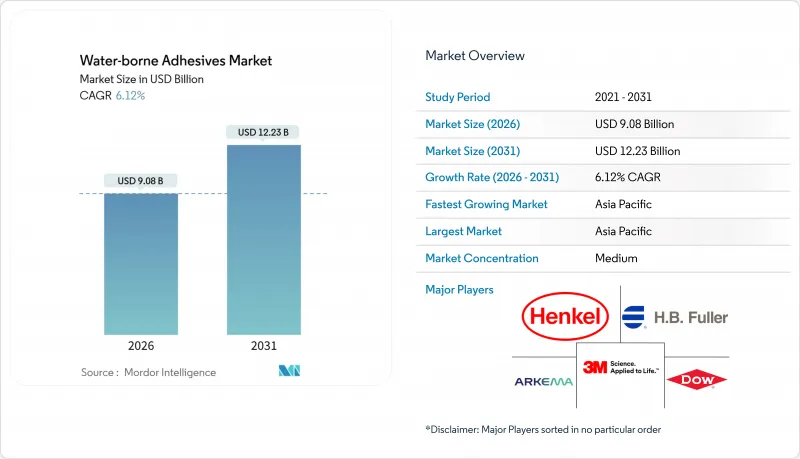
Mordor Intelligence에 따르면 수성 접착제 시장 규모는 2026년에 90억 8,000만 달러로 추정되고 있으며, 예측 기간(2026-2031년)에 CAGR 6.12%로 추이하며, 2031년에는 122억 3,000만 달러에 달할 것으로 전망되고 있습니다.
이 보고서는 수지 유형(아크릴계, 폴리비닐아세테이트(PVA) 에멀전 등), 용도(연포장, 테이프·라벨 등), 최종사용자 산업(건축·건설 등),기재(종이·판지, 플라스틱·필름 등) 및 지역(아시아태평양, 북미, 유럽 등)별로 분류되어 있습니다. 시장 예측은 금액(달러)으로 표시되어 있습니다.
세계 수성 접착제 시장의 동향 및 인사이트
E-Commerce 주도 하의 골판지 포장 급성장
2025년에 전 세계 온라인 매출은 6조 달러에 달하며, 이에 따라 물류 사업자들은 처리 속도 향상과 파손률 감소를 위해 2차 포장의 재설계를 추진하고 있습니다. 현재 골판지 가공업체들은 3초 이내에 경화되는 수성 전분계 및 PVA계 접착제를 채택하고 있으며, 핫멜트 시스템에서 볼 수 있는 화재 위험 없이 생산 라인을 분당 300미터 이상의 속도로 가동할 수 있게 되었습니다. 적정 크기의 상자에 대한 수요가 증가함에 따라 포장 중량 대 제품 중량 비율이 상승하여, 출하 건당 접착제 소비량이 증가하고 있습니다. 아마존 등 대형 E-Commerce 소매업체들은 2024년에 플라스틱 에어필로우를 폐지하고, 수성 접착제로 접착된 종이 완충재로 전환하는 속도를 가속화했습니다. 월마트와 알리바바의 유사한 조치들이 이러한 추세를 지원하고 있으며, 골판지 포장은 수성 접착제 시장에서 가장 큰 성장 분야가 되었습니다.
VOC 감축 규제가 용제형에서 수성형으로의 전환을 촉진
중국의 GB 33372-2020에서는 수성 제품의 VOC 상한선을 50 g/kg으로 정하고 있으며, 한편,유럽연합(EU)의 지침 2004/42/EC에서는 장식용 도료를 30 g/L, 접촉용 접착제를 50 g/L로 제한하고 있습니다. 미국에서는 환경보호청(EPA)의 ‘유해 대기 오염 물질에 관한 국가 배출 기준(NHS) P-95’에 따라 VOC 포집률 95% 또는 저배출 배합이 의무화되어 있습니다. 캘리포니아주 대기자원국(CARB)의 2단계 규제에서는 건축용 도료에 대해 더욱 엄격한 25 g/L의 상한선이 설정되어 있습니다. 이러한 규제가 맞물리면서 각 제조사들은 배합을 재검토할 수밖에 없게 되었고, 그 결과 수성 접착제 시장 전체의 수요가 증가하고 있습니다.
내열성 문제로 인해 고온 용도로의 진출이 제한되고 있습니다.
대부분의 수성 배합은 120°C를 초과하면 열화되므로, 주변 온도가 150°C를 넘는 엔진룸이나 260°C에 달하는 전자 기기의 리플로우 납땜 공정에서는 사용할 수 없습니다. 에폭시나 폴리이미드 계열은 200°C 환경에서도 수천 시간 동안 물성을 유지하지만, 수성 제품은 성막성을 희생하지 않는 한 이 성능 범위에 도저히 미치지 못합니다. 175°C에 대응하는 접착제가 필요한 실리콘 카바이드 인버터의 등장으로 인해 수성 화학 제품은 시장에서 더욱 밀려나고 있습니다. 또한 ASTM D5868 등의 항공우주 규격에서는 180°C에서 80%의 강도 유지가 요구되고 있으며, 사실상 수성 제품은 대상에서 제외되고 있습니다.
부문 분석
아크릴계는 10-15 N/25 mm의 박리 접착력만 있으면 충분한 점착 라벨 및 종이 가공 분야의 수요에 힘입어 2025년에는 매출의 38.12%를 차지했습니다. PU 분산액 수성 접착제 시장 규모는 자동차 제조사나 신발 브랜드가 아크릴계 접착제로는 실현할 수 없는 내마모성과 유연성을 요구하고 있으므로 2031년까지 연평균 성장률(CAGR) 6.71%로 확대될 것으로 예측됩니다. 코베스트로(Covestro)사의 ‘Dispercoll U’ 시리즈는 유리 이소시아네이트를 포함하지 않은 상태에서 800%의 신장률과 25 MPa의 인장 강도를 발휘하며, 공장 물류를 간소화하는 1액형 시스템에 적합합니다. PVA 에멀전은 투명한 접착선을 형성하고 다공성 기판에 침투하므로 여전히 목공 분야에서 주류를 이루고 있습니다. 한편, EVA 에멀전은 비용이 20% 더 비싸음에도 불구하고 카펫 안감이나 위생용 일회용 제품에서 여전히 선호되고 있습니다.
혁신을 통해 성능 격차는 점차 줄어들고 있습니다. 자가 가교형 아크릴 수지는 기존에 에폭시 수지가 우위를 점했던 알루미늄 표면에서 3 MPa의 중첩 전단 강도에 도달하게 되었습니다. 바이오 기반 수지의 시장 점유율은 여전히 5% 미만이지만, 헨켈(Henkel)과 바커(Wacker)가 리그닌 및 전분 유도체를 출시함에 따라 그 점유율은 상승 추세를 보이고 있습니다. EU의 REACH 규제로 인해 니트로소아민 전구체가 제한됨에 따라 클로로프렌 라텍스의 점유율은 계속해서 하락하고 있습니다. 전반적으로 고성능 PU 분산액으로의 전환에 따라 수성 접착제 시장 내의 가치 원천이 확대되고 있습니다.
2025년에는 각 브랜드사가 경질 포장재에서 재료 사용량을 30%-50% 절감할 수 있는 스탠드업 파우치로 전환한 결과, 연포장재의 시장 점유율이 40.44%를 차지했습니다. 라미네이트 및 필름 구조용 수성 접착제 시장 규모는 폴리에틸렌과 메탈라이즈드 폴리에스테르를 결합한 다층 배리어 필름에 힘입어 2031년까지 연평균 7.52%의 성장률을 보일 것으로 예측됩니다. FDA 규정을 준수하는 무용제 시스템은 현재 잔류량이 5 mg/m2 미만으로, 레토르트 파우치에 적용될 기회가 확대되고 있습니다.
테이프와 라벨은 E-Commerce 분야에서 위조 방지 수요의 혜택을 받고 있는 반면, LEED 인증을 획득한 바닥재용 접착제는 총 VOC 배출량이 50µg/m3 미만입니다. 제본 분야에서는 디지털화에 따른 대체가 진행되고 있지만, 중성 pH의 PVA에 의존하는 고급 하드커버는 여전히 수요가 있습니다. 부직포 위생용품 분야에서는 포름알데히드 무첨가 배합이 요구되고 있으며, 이에 따라 수성 분산액이 탄성 접착 및 습기 표시기와 같은 틈새 시장을 확보할 수 있게 되었습니다.
지역별 분석
아시아태평양은 2025년에 매출의 40.45%를 차지하며,접착제내 VOC를 50 g/kg으로 제한하는 중국의 GB 18582-2020 및 GB 30981-2020을 배경으로, 2031년까지 연평균 성장률(CAGR) 6.92%로 확대될 것으로 예상됩니다. 인도네시아의 4,120억 달러 규모 인프라 계획에서는 속경화형 PVA를 기반으로 한 모듈식 주택이 중시되고 있는 반면, 태국의 3조 바트 규모 ‘동부 경제 회랑’ 프로젝트는 저VOC 제품에 대한 수요를 견인하고 있습니다. 인도의 상품 및 서비스세(GST) 개혁으로 주간 운송 비용이 15% 절감되어, 구자라트주 및 타밀나두주에 대량 생산 거점을 구축할 수 있게 되었습니다. 일본에서는 2025년에 톨루엔의 작업장 노출 한계치가 10 ppm으로 하향 조정됨에 따라 배합 제조업체들은 수성 플랫폼으로의 전환을 요구받고 있습니다.
북미의 건설 및 자동차 시장은 정체 국면에 접어들었으나, E-Commerce 및 헬스케어 분야는 3%-4%의 성장세를 유지하고 있습니다. 미국의 NESHAP 규정에 따르면 수성 제품으로 전환함으로써 열산화 장치가 불필요해지기 때문에 컨버터에게 우대 조치가 제공되고 있습니다. 캐나다에서는 2024년에 포름알데히드 함유 상한선이 0.05 ppm으로 설정됨에 따라 캐비닛 업계에서 PVA(폴리비닐알코올)의 채택이 가속화되고 있습니다. 멕시코의 Tier 1 공급업체들은 현재 OEM의 지속가능성 평가 기준을 충족하기 위해 수성 구조용 접착제 사용을 지정하고 있습니다.
유럽은 규제 측면에서 계속해서 주도적인 역할을 하고 있습니다. 독일의 ‘TA Luft’는 VOC 배기가스 배출량을 20mg/m³로 제한하고 있는 반면, 프랑스의 ‘RE2020’은 바이오 기반 접착제를 우선시하는 수명 주기 탄소 감사를 의무화하고 있습니다. 브렉시트 이후 영국의 REACH는 발암성 물질에 관한 EU 규제를 유지하고 있으며, 무용제 배합으로의 전환 추세가 지속되고 있습니다. 북유럽의 순환형 프로그램은 분해를 전제로 한 설계를 주창하고 있으며, 재활용 가능한 가구를 위해 수성 접착제가 자리 잡고 있습니다.
남미에서는 일시적인 경기 침체를 겪은 후 다시 활기를 되찾고 있습니다. 브라질의 CONAMA 452는 VOC 상한치를 50 g/L로 통일하고 있으며, 건축용 도료로의 채택을 촉진하고 있습니다. 한편, 아르헨티나의 패널 제조업체들은 메르코수르(MERCOSUR)의 포름알데히드 0.1 ppm 제한을 준수하고 있으며, 요소-포름알데히드 에멀전에 대한 수요를 끌어올리고 있습니다. 중동 및 아프리카는 여전히 발전 단계에 있지만, 사우디아라비아의 메가 프로젝트와 남아프리카공화국의 재생에너지 사업으로 인해 태양광 라미네이트 및 터빈 블레이드용 저VOC 접착제에 대한 지역적 수요가 발생하고 있습니다.
기타 혜택:
- 엑셀 형식의 시장 예측(ME) 시트
- 3개월간의 애널리스트 지원
자주 묻는 질문
목차
제1장 서론
제2장 조사 방법
제3장 개요
제4장 시장 구도
제5장 시장 규모와 성장 예측
제6장 경쟁 구도
제7장 시장 기회와 향후 전망
KSA 26.09.02According to Mordor Intelligence, the water-borne adhesives market size is estimated at USD 9.08 billion in 2026 and is expected to reach USD 12.23 billion by 2031, at a CAGR of 6.12% during the forecast period (2026-2031).
This report is Segmented by Resin Type (Acrylics, Polyvinyl Acetate (PVA) Emulsion, and More), Application (Flexible Packaging, Tapes and Labels, and More), End-User Industry (Building and Construction, and More), Substrate (Paper and Paperboard, Plastics and Films, and More), and Geography (Asia-Pacific, North America, Europe, and More). The Market Forecasts are Provided in Terms of Value (USD).
Global Water-borne Adhesives Market Trends and Insights
E-commerce-Led Boom in Corrugated Packaging
Global online sales reached USD 6 trillion in 2025, prompting logistics operators to redesign secondary packaging for faster throughput and lower damage rates. Corrugated converters now use water-based starch and PVA adhesives that develop set speed within three seconds, enabling production lines to exceed 300 meters per minute without the fire hazards seen in hot-melt systems. Rising demand for right-sized boxes has increased the packaging-to-product weight ratio, which elevates adhesive consumption per shipment. Major e-retailers such as Amazon eliminated plastic air pillows in 2024, accelerating the switch to paper-based cushioning bonded with water-borne chemistries. Similar commitments by Walmart and Alibaba have reinforced this trajectory, making corrugated packaging the single-largest growth node in the water-borne adhesives market.
VOC-Reduction Mandates Driving Solvent-to-Water Switch
China's GB 33372-2020 caps VOCs in water-borne products at 50 g/kg, while the European Union's Directive 2004/42/EC restricts decorative coatings to 30 g/L and contact adhesives to 50 g/L. In the United States, the Environmental Protection Agency's National Emission Standards for Hazardous Air Pollutants require a 95% VOC capture rate or low-emitting formulations. California's Air Resources Board (CARB) Phase 2 regulation sets an even tighter 25 g/L ceiling for architectural coatings. Collectively, these rules have forced converters to reformulate, thereby boosting demand across the water-borne adhesives market.
Heat-Resistance Gap Limits Entry into High-Temperature Uses
Most aqueous formulations degrade above 120 °C, preventing deployment in engine compartments where ambient temperatures exceed 150 °C and in electronics reflow soldering peaks of 260 °C. Epoxy and polyimide systems retain integrity at 200 °C for thousands of hours, a performance envelope water-based products cannot match without sacrificing film formation. The rise of silicon-carbide inverters demanding 175 °C adhesives further sidelines water-borne chemistries, while aerospace specs such as ASTM D5868 require 80% strength retention at 180 °C, effectively excluding them.
Other drivers and restraints analyzed in the detailed report include:
- ASEAN Modular Construction Spurring Fast-Setting PVA Demand
- Lightweight Automotive Bonding Boosting PU Dispersions
- Limited Penetration in High-End Structural Bonding
For complete list of drivers and restraints, kindly check the Table Of Contents.
Segment Analysis
Acrylics held 38.12% of revenue in 2025, buoyed by pressure-sensitive labels and paper converting, where 10-15 N/25 mm peel adhesion suffices. The water-borne adhesives market size for PU dispersions is projected to increase at a 6.71% CAGR to 2031 as automakers and footwear brands demand abrasion resistance and flexibility unrivaled by acrylics. Covestro's Dispercoll U series posts 800% elongation and 25 MPa tensile strength without free isocyanate, positioning it for single-component systems that simplify plant logistics. PVA emulsions still dominate woodworking, forming transparent glue lines and penetrating porous substrates, while EVA emulsions remain preferred for carpet backing and hygiene disposables despite a 20% cost premium.
Innovation is narrowing the performance gap: self-crosslinking acrylics now reach 3 MPa lap-shear strength on aluminum, previously an epoxy stronghold. Bio-based resins remain below 5% but are rising as Henkel and Wacker launch lignin and starch derivatives. Chloroprene latex continues to lose share after the EU REACH restricted nitrosamine precursors. Collectively, the shift toward high-function PU dispersion broadens the value pool inside the water-borne adhesives market.
Flexible packaging represented 40.44% market share in 2025 as brands migrated from rigid formats to stand-up pouches that cut material use by 30%-50%. The water-borne adhesives market size for laminating and filmic structures is forecast to grow at 7.52% through 2031, fueled by multilayer barrier films combining polyethylene and metallized polyester. FDA-compliant solvent-free systems now leave <5 mg/m2 residuals, opening retort pouch opportunities.
Tapes and labels benefit from e-commerce tamper-evidence needs, while flooring adhesives certified under LEED emit <50 µg/m3 total VOCs. Bookbinding faces digital substitution yet retains premium hardcovers that rely on neutral-pH PVAs. Non-woven hygiene lines seek formaldehyde-free formulations, enabling water-borne dispersions to capture elastic attachment and wetness-indicator niches.
Complete Report Scope:
- By Resin Type
- Acrylics
- Polyvinyl Acetate (PVA) Emulsion
- Ethylene Vinyl Acetate (EVA) Emulsion
- Polyurethane Dispersions and CR (Chloroprene Rubber) Latex
- Other Resin Types
- By Application
- Flexible Packaging
- Tapes and Labels
- Paper Converting and Graphic Arts
- Laminating and Filmic Structures
- Flooring and Carpeting
- Bookbinding and Publishing
- Non-woven and Hygiene Products
- Others
- By End-user Industry
- Building and Construction
- Paper, Board, and Packaging
- Woodworking and Joinery
- Transportation
- Healthcare
- Electrical and Electronics
- Other End-user Industries
- By Substrate
- Paper and Paperboard
- Plastics and Films
- Wood and Composites
- Metals
- Glass and Ceramics
- Others
- By Geography
- Asia-Pacific
- China
- India
- Japan
- South Korea
- ASEAN
- Rest of Asia-Pacific
- North America
- United States
- Canada
- Mexico
- Europe
- Germany
- France
- United Kingdom
- Italy
- Spain
- NORDIC Countries
- Rest of Europe
- South America
- Brazil
- Argentina
- Rest of South America
- Middle East and Africa
- Saudi Arabia
- South Africa
- Rest of Middle East and Africa
- Asia-Pacific
Geography Analysis
Asia-Pacific controlled 40.45% of revenue in 2025 and is expected to compound at a 6.92% CAGR through 2031 on the back of China's GB 18582-2020 and GB 30981-2020, which cap VOCs in adhesives at 50 g/kg. Indonesia's USD 412 billion infrastructure plan favors modular housing that relies on fast-setting PVAs, while Thailand's THB 3 trillion Eastern Economic Corridor drives low-VOC demand. India's Goods and Services Tax reforms lowered interstate costs by 15%, enabling bulk production hubs in Gujarat and Tamil Nadu. Japan's 2025 workplace exposure limits of 10 ppm toluene push formulators toward aqueous platforms.
North America's construction and automotive markets have plateaued, yet e-commerce and healthcare sustain 3%-4% growth. The United States NESHAP rule rewards converters that switch to water-borne products by obviating thermal oxidizers. Canada's 2024 formaldehyde cap of 0.05 ppm accelerates PVA uptake in cabinetry. Mexico's tier-1 suppliers now specify aqueous structural adhesives to satisfy OEM sustainability scorecards.
Europe continues to lead on regulation: Germany's TA Luft limits VOC stack emissions to 20 mg/m3, while France's RE2020 enforces lifecycle carbon audits that favor bio-based adhesives. Post-Brexit UK REACH retained EU restrictions on carcinogens, maintaining momentum toward solvent-free formulations. Nordic circular programs advocate design-for-disassembly, positioning water-borne adhesives for recyclable furniture.
South America is regaining momentum after a short recession. Brazil's CONAMA 452 harmonizes with 50 g/L VOC caps, spurring adoption in architectural coatings, whereas Argentina's panel mills comply with MERCOSUR's 0.1 ppm formaldehyde limit, boosting urea-formaldehyde emulsions. The Middle East and Africa remain nascent; Saudi megaprojects and South African renewables create localized demand for low-VOC bonding in solar laminates and turbine blades.
- 3M
- Arkema
- Ashland
- Avery Dennison Corporation
- Benson Polymers Pvt Ltd.
- DIC CORPORATION
- Dow
- Dymax
- Evonik Industries AG
- H.B. Fuller Company
- HBK
- Henkel AG & Co. KGaA
- Jowat SE
- MAPEI S.p.A.
- Parker Hannifin Corp
- Pidilite Industries Ltd.
- PPG Industries, Inc.
- Sika AG
- Soudal Group
- Wacker Chemie AG
Additional Benefits:
- The market estimate (ME) sheet in Excel format
- 3 months of analyst support
TABLE OF CONTENTS
1 Introduction
- 1.1 Study Assumptions and Market Definition
- 1.2 Scope of the Study
2 Research Methodology
3 Executive Summary
4 Market Landscape
- 4.1 Market Overview
- 4.2 Market Drivers
- 4.2.1 E-commerce-led boom in corrugated packaging
- 4.2.2 VOC-reduction mandates driving solvent-to-water switch
- 4.2.3 ASEAN modular construction spurring fast-setting PVA demand
- 4.2.4 Light-weight automotive bonding boosting PU dispersions
- 4.2.5 Bio-based resin breakthroughs enabling food-contact compliance
- 4.3 Market Restraints
- 4.3.1 Heat-resistance gap limits entry into high-temperature uses
- 4.3.2 Limited penetration in high-end structural bonding
- 4.3.3 Higher capex for water-borne production lines
- 4.4 Value Chain Analysis
- 4.5 Porter's Five Forces
- 4.5.1 Bargaining Power of Suppliers
- 4.5.2 Bargaining Power of Buyers
- 4.5.3 Threat of New Entrants
- 4.5.4 Threat of Substitutes
- 4.5.5 Competitive Rivalry
5 Market Size and Growth Forecasts (Value)
- 5.1 By Resin Type
- 5.1.1 Acrylics
- 5.1.2 Polyvinyl Acetate (PVA) Emulsion
- 5.1.3 Ethylene Vinyl Acetate (EVA) Emulsion
- 5.1.4 Polyurethane Dispersions and CR (Chloroprene Rubber) Latex
- 5.1.5 Other Resin Types
- 5.2 By Application
- 5.2.1 Flexible Packaging
- 5.2.2 Tapes and Labels
- 5.2.3 Paper Converting and Graphic Arts
- 5.2.4 Laminating and Filmic Structures
- 5.2.5 Flooring and Carpeting
- 5.2.6 Bookbinding and Publishing
- 5.2.7 Non-woven and Hygiene Products
- 5.2.8 Others
- 5.3 By End-user Industry
- 5.3.1 Building and Construction
- 5.3.2 Paper, Board, and Packaging
- 5.3.3 Woodworking and Joinery
- 5.3.4 Transportation
- 5.3.5 Healthcare
- 5.3.6 Electrical and Electronics
- 5.3.7 Other End-user Industries
- 5.4 By Substrate
- 5.4.1 Paper and Paperboard
- 5.4.2 Plastics and Films
- 5.4.3 Wood and Composites
- 5.4.4 Metals
- 5.4.5 Glass and Ceramics
- 5.4.6 Others
- 5.5 By Geography
- 5.5.1 Asia-Pacific
- 5.5.1.1 China
- 5.5.1.2 India
- 5.5.1.3 Japan
- 5.5.1.4 South Korea
- 5.5.1.5 ASEAN
- 5.5.1.6 Rest of Asia-Pacific
- 5.5.2 North America
- 5.5.2.1 United States
- 5.5.2.2 Canada
- 5.5.2.3 Mexico
- 5.5.3 Europe
- 5.5.3.1 Germany
- 5.5.3.2 France
- 5.5.3.3 United Kingdom
- 5.5.3.4 Italy
- 5.5.3.5 Spain
- 5.5.3.6 NORDIC Countries
- 5.5.3.7 Rest of Europe
- 5.5.4 South America
- 5.5.4.1 Brazil
- 5.5.4.2 Argentina
- 5.5.4.3 Rest of South America
- 5.5.5 Middle East and Africa
- 5.5.5.1 Saudi Arabia
- 5.5.5.2 South Africa
- 5.5.5.3 Rest of Middle East and Africa
- 5.5.1 Asia-Pacific
6 Competitive Landscape
- 6.1 Market Concentration
- 6.2 Strategic Moves (Mergers and Acquisitions, JVs, Expansions)
- 6.3 Market Share(%)/Ranking Analysis
- 6.4 Company Profiles {(includes Global level Overview, Market level overview, Core Segments, Financials as available, Strategic Information, Market Rank/Share for key companies, Products and Services, and Recent Developments)}
- 6.4.1 3M
- 6.4.2 Arkema
- 6.4.3 Ashland
- 6.4.4 Avery Dennison Corporation
- 6.4.5 Benson Polymers Pvt Ltd.
- 6.4.6 DIC CORPORATION
- 6.4.7 Dow
- 6.4.8 Dymax
- 6.4.9 Evonik Industries AG
- 6.4.10 H.B. Fuller Company
- 6.4.11 HBK
- 6.4.12 Henkel AG & Co. KGaA
- 6.4.13 Jowat SE
- 6.4.14 MAPEI S.p.A.
- 6.4.15 Parker Hannifin Corp
- 6.4.16 Pidilite Industries Ltd.
- 6.4.17 PPG Industries, Inc.
- 6.4.18 Sika AG
- 6.4.19 Soudal Group
- 6.4.20 Wacker Chemie AG
7 Market Opportunities and Future Outlook
- 7.1 White-space and Unmet-Need Assessment
- 7.2 Rising Demand for Sustainable and Eco-Friendly Products


