

|
시장보고서
상품코드
2120372
자동차용 커넥터 : 시장 점유율 분석, 업계 동향과 통계, 성장 예측(2026-2031년)Automotive Connector - Market Share Analysis, Industry Trends & Statistics, Growth Forecasts (2026 - 2031) |
||||||
 Mordor Intelligence
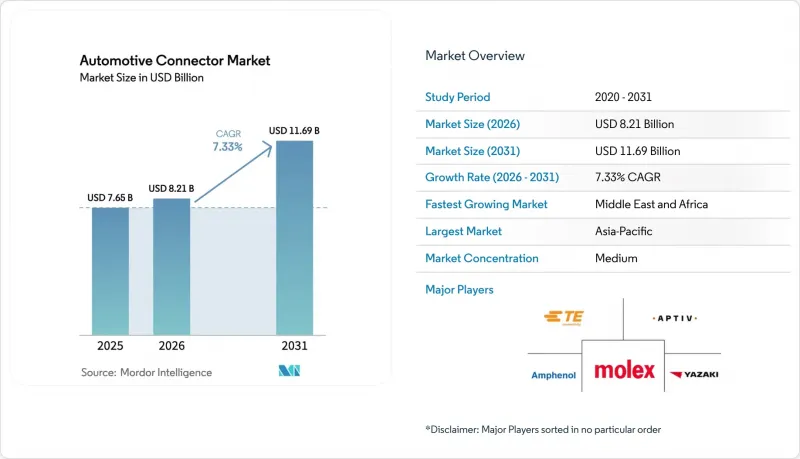
Mordor Intelligence에 따르면 자동차용 커넥터 시장 규모는 2025년 76억 5,000만 달러에서 2026년에는 82억 1,000만 달러로 확대하며, 2026-2031년에 CAGR 7.33%로 추이하며, 2031년에는 116억 9,000만 달러에 달할 것으로 예측됩니다.
이 보고서는 용도별(파워트레인, 안전·보안, 기타), 차종별(승용차, 소형 상용차, 기타), 추진 방식별(내연기관 차량, 하이브리드 전기자동차, 기타),커넥터 유형별(와이어 간 연결, 기타), 연결부 밀봉 방식별(밀폐형, 비밀폐형) 및 지역별로 분류되어 있습니다. 시장 예측은 금액(달러) 및 수량(대)으로 제시되어 있습니다.
전 세계 자동차용 커넥터 시장의 동향 및 인사이트
가속화되는 전동화 및 고전압 E-파워트레인
고에너지 아키텍처는 400볼트에서 800볼트 배터리 팩으로 전환되고 있으며, 커넥터에는 낮은 접촉 저항으로 훨씬 더 높은 수준의 연속 전류를 견딜 수 있는 성능이 요구되고 있습니다. 2024년에 완공된 CharIN 메가와트 충전 시스템에서는 상용 트럭에 최대 3.75 MW를 공급하는 인터페이스가 승인되어, 단자 형상 및 액체 냉각 채널의 재설계가 불가피하게 되었습니다. 리튬이온 배터리의 열폭주에 대한 우려로 인해 각 OEM 업체들은 UL 94 V-0를 준수하는 난연성 하우징을 채택해야만 하며, 이로 인해 수지 선택의 폭이 좁아져 비용 상승으로 이어지고 있습니다. 중복화된 고전압 인터록 핀으로 인해 커넥터당 2-4개의 핀 위치가 추가되어 핀 밀도가 높아지고 공차 범위가 엄격해졌습니다. 이러한 요구 사항들이 합쳐지면서 공급망의 우선 순위가 재검토되고, 고전압 시험실 및 자동 실링 라인에 대한 투자가 촉진되고 있습니다.
존형 E/E 아키텍처로의 전환이 고밀도 커넥터 시장을 촉진
구역별 전략에서는 전자제어 장치(ECU)의 측정값을 지역별 연산 노드로 집약함으로써 배선량을 최대 30%까지 줄이는 동시에, 물리적 인터페이스 수를 줄여 데이터 트래픽을 일원화합니다. 이러한 노드에 탑재되는 커넥터는 일반적으로 50핀 이상이며, 단일 결합 불량으로 인한 영향이 확대되므로 각 OEM 업체들은 세컨더리 잠금 기능이나 키가 있는 컬러 코딩을 요구하고 있습니다. 공급업체는 재고 관리의 복잡성을 줄이기 위해 전압이나 신호 유형에 관계없이 하우징을 표준화하고 있으며, 이러한 선택은 전 세계적인 플랫폼 확장의 가속화로도 이어지고 있습니다. 이러한 통합으로 고유 부품 번호는 줄어들지만, 성능에 대한 기대는 높아지고 있으며, 치수를 변경하지 않고도 저전력 센서 링크부터 대전류 전원 트렁크까지 대응 가능한 커넥터 제품군이 선호되고 있습니다.
구리 및 금속 원자재 가격 변동
2025년에도 구리는 커넥터 생산에 여전히 필수적인 소재였습니다. 주요 지역의 공급 차질과 투기적 거래가 맞물려 가격이 크게 변동했습니다. Tier 1 공급업체들은 헤지 조치를 취하고 있었지만, 프리미엄 변동에 따른 위험에 여전히 직면해 있었으며, 이로 인해 이익률이 압박을 받았습니다. 고신뢰성 도금에 필수적인 팔라듐은 구리와 유사한 추이를 보였으며, 연초에 정점을 찍은 후 자동차 생산량 감소에 따라 하락했습니다. 이에 대응하여 대형 제조사들은 도금층 수를 줄이고 선택적 도금 기술을 도입함으로써 귀금속 소비량을 줄였습니다. 반면, 헤지 전략이 없는 중소기업은 특히 가격 조정 여지를 제한하는 장기 계약에 묶여 있는 경우, 이익률이 크게 압박받는 상황에 직면했습니다.
부문별 분석
파워트레인용 커넥터는 2025년에 34.01%라는 압도적인 점유율을 차지하고 있으며, 이는 엔진 제어, 배기가스 관리 및 구동계의 효율화를 가능하게 하는 데 있으며, 커넥터가 수행하는 기초적인 역할을 반영합니다. 이러한 우위는 도로를 주행하는 내연기관차 및 하이브리드차의 막대한 대수에 의해 지원되고 있으며, 가혹한 열적·기계적 환경 하에서도 견고한 커넥터 시스템이 신뢰성 높은 신호 전송을 보장하고 있습니다. 자동차 제조사들은 계속해서 파워트레인의 신뢰성을 최우선으로 하고 있으며, 이는 진동, 습기, 온도 변동에 견디는 고내구성 커넥터에 대한 수요를 지원하고 있습니다. 동시에, OEM의 현대화 및 지능형 파워트레인 아키텍처로의 전환으로 인해 전동화가 가속화되는 상황에서도 이 부문은 구조적으로 중요한 위치를 계속 차지하고 있습니다.
한편, ADAS(첨단 운전자 지원 시스템) 및 자율주행 시스템은 2031년까지 연평균 성장률(CAGR)이 17.76%에 달할 것으로 예상되는 가장 빠르게 성장하는 응용 분야입니다. 센서, 레이더, 라이더,카메라, 도메인 컨트롤러의 활용 확대에 따라 신속하고 신뢰성 높은 데이터 전송을 가능하게 하는 고속·고밀도 커넥터에 대한 수요가 증가하고 있습니다. 이러한 동향은 레벨 2+나 레벨 3과 같은 보다 고도화된 자율주행 단계로 자동차 업계가 전환되고 있음을 반영하며, 이를 위해서는 정교한 데이터 경로와 신뢰성 높은 연결 시스템이 요구됩니다.
2025년에는 승용차가 54.87%로 가장 큰 점유율을 차지하고 있으며, 이는 세계 자동차 생산에서 승용차가 차지하는 우위와 이에 탑재되는 전자 시스템의 다양성을 여실히 보여줍니다. 주류 모델에서 편의성, 안전성, 커넥티비티 기능이 보급됨에 따라 차량당 커넥터 수는 계속해서 급증하고 있습니다. 자동차 제조업체들은 첨단 인포테인먼트, ADAS(첨단 운전자 지원 시스템) 및 에너지 효율이 높은 배전 시스템을 점점 더 많이 탑재하고 있으며, 이 모든 것은 커넥터의 밀도와 신뢰성에 크게 의존하고 있습니다. 이 대중 시장 부문에서 다양한 기능이 확대됨에 따라 성숙 시장과 신흥 시장을 막론하고 승용차용 커넥터에 대한 지속적인 수요가 지원되고 있습니다.
대조적으로, 이륜차는 아시아의 급속한 전기화와 커넥티드 이륜차의 보급 확대에 힘입어 연평균 성장률(CAGR) 11.48%로 가장 빠르게 성장하고 있는 부문입니다. 스쿠터와 오토바이에 텔레매틱스, 배터리 관리 시스템, LED 조명이 탑재됨에 따라 커넥터의 고도화와 1대당 탑재 수가 꾸준히 증가하고 있으며, 기존에는 전자 부품 탑재가 적었던 이 부문을 고성장 기회로 끌어올리고 있습니다.
지역별 분석
아시아태평양은 2025년에 전 세계 매출의 39.07%를 차지하여 선두가 되며, 중국이 듀얼 크레딧 정책 하에서 배터리 전기자동차(BEV)의 보급을 확대하고 있으며, 견고한 성장세를 유지하고 있습니다. Luxshare Precision과 같은 현지 공급업체들은 주요 EV 공장 옆에 공장을 설립하여 물류 발자국을 축소하는 동시에 적시 납품에 대응하고 있습니다. 인도에서는 ‘FAME II’ 인센티브를 통해 이륜차의 전기화가 가속화되고 있으며, 열대 기후에 적합하고 가성비가 뛰어나면서도 내구성이 높은 커넥터에 대한 수요가 증가하고 있습니다. 일본은 수십년에 걸친 마이크로 커넥터 관련 전문 지식을 활용하여, 초기 단계의 자율주행 프로토타입을 위한 고신뢰성 연결 솔루션을 제공하고 있습니다. 한편, 한국은 배터리 셀 생산 능력 확대에 발맞춰 고전압 검증 연구소에 자금을 지원하고 있습니다. 인도네시아와 베트남을 포함한 동남아시아 국가들은 중국 이외의 지역으로 다각화를 모색하는 글로벌 OEM으로부터 조립 프로그램 수주를 확보하고 있으며, 이에 따라 커넥터 제조사들은 지역 기술 센터 확충을 추진하고 있습니다.
북미에서는 IRA(인플레이션 억제법)의 국내 조달 요건에 따라 국내 전기자동차 생산이 확대되고 있으며, 이에 따라 여러 대형 커넥터 기업이 연방 세액 공제 적용 자격을 확보하기 위해 미국내 조립 라인을 확장하고 있습니다. 멕시코의 바히오 회랑은 니어쇼어링 거점으로서의 위상을 강화하고 있으며, 지역적 근접성과 자유무역의 혜택으로 인해 미국 공장으로의 리드타임이 단축되고 있습니다. 유럽에서는 독일이 800V 시스템과 소프트웨어 정의 플랫폼을 추진함으로써 기술적 리더십을 유지하고 있으며, 파워트레인 및 차체 분야에서 저인덕턴스 및 고속 커넥터가 요구되고 있습니다. 영국에서는 초저지연 통신 링크를 필요로 하는 자율주행 시범 프로젝트가 계속해서 활발히 진행되고 있지만, 브렉시트 이후의 규제 차이로 인해 인증 절차가 더욱 복잡해지고 있습니다. 프랑스, 이탈리아, 스페인에서는 플랫폼의 전동화에 따라 커넥터 수요가 안정적인 반면, 러시아에서는 제재로 인해 수입이 제한되고 있으며, 지역내 대체품으로의 조달 전환이 진행되고 있습니다.
남미에서는 브라질이 팬데믹으로 인한 혼란에서 회복됨에 따라 생산량이 회복되고 있습니다. 각 OEM 업체들이 서브시스템의 현지화를 추진함에 따라 현지 커넥터 채택률은 완만하지만 꾸준히 증가하고 있습니다. 중동 및 아프리카는 2031년까지의 연평균 성장률(CAGR)이 15.17%로 지역내 가장 높은 성장세를 보이고 있으며, 그 원동력은 사우디아라비아의 전기자동차(EV) 제조 추진(공공투자기금의 지원 포함)과이집트의 무역 협정에 힘입은 조립 활동입니다. 아랍에미리트(UAE)는 물류 측면의 강점을 살려, 지역 유통 허브로서의 위상을 확립해 가고 있습니다. 터키는 수출 지향형 자동차 프로그램을 중심으로 2차 공급망을 강화하고 있는 반면, 남아프리카공화국은 해안 지역의 제조 클러스터에서 하이브리드차 및 배터리식 전동화로의 전환을 추진하고 있습니다. 나이지리아와 케냐를 포함한 사하라 이남 시장에서는 전동 이륜차의 도입이 초기 단계에 있으며, 현지 수리 인프라에 적합한 견고하고 유지보수가 용이한 커넥터가 요구되고 있습니다.
기타 혜택:
- 엑셀 형식의 시장 예측(ME) 시트
- 3개월간의 애널리스트 지원
자주 묻는 질문
목차
제1장 서론
제2장 조사 방법
제3장 개요
제4장 시장 구도
제5장 시장 규모와 성장 예측
제6장 경쟁 구도
제7장 시장 기회와 향후 전망
KSA 26.09.02According to Mordor Intelligence, the automotive connector market size is expected to grow from USD 7.65 billion in 2025 to USD 8.21 billion in 2026 and is forecast to reach USD 11.69 billion by 2031 at a 7.33% CAGR over 2026-2031.
This report is Segmented by Application (Powertrain, Safety and Security, and More), Vehicle Type (Passenger Cars, Light Commercial Vehicles, and More), Propulsion Type (ICE Vehicles, Hybrid Electric Vehicles, and More), Connector Type (Wire-To-Wire and More), Connection Sealing (Sealed and Unsealed), and Geography. The Market Forecasts are Provided in Terms of Value (USD) and Volume (Units).
Global Automotive Connector Market Trends and Insights
Accelerating Electrification and Higher-Voltage E-Powertrains
High-energy architectures are shifting from 400-volt to 800-volt packs, compelling connectors to sustain a significantly higher level of continuous current with low contact resistance . The CharIN Megawatt Charging System, completed in 2024, ratified interfaces that deliver up to 3.75 MW to commercial trucks, forcing redesigns of terminal geometries and liquid-cooling channels . Lithium-ion thermal-runaway concerns push OEMs toward flame-retardant housings compliant with UL 94 V-0, narrowing resin options and nudging costs higher. Redundant high-voltage interlock pins add two to four positions per connector, increasing pin density and tightening tolerance envelopes. Collectively, these demands are rewriting supply-chain priorities and steering capital toward high-voltage test labs and automated sealing lines.
Shift to Zonal E/E Architectures Driving High-Density Connectors
Zonal strategies aggregate scores from electronic control units into regional compute nodes, reducing wiring mass by up to 30% while centralizing data traffic through fewer physical interfaces. Connectors in these nodes routinely exceed 50 positions, enlarging the consequence of a single mating fault and prompting OEMs to require secondary-lock features and keyed color coding. Suppliers are standardizing housings across voltage and signal types to curb inventory complexity, a choice that also accelerates global platform rollouts. The consolidation cuts unique part numbers but elevates performance expectations, favoring connector families that scale from low-power sensor links to high-current power trunks without dimensional changes.
Volatile Copper and Metal Commodity Prices
In 2025, copper remained a critical component in connector production. Supply disruptions in key regions, combined with speculative trading, led to significant price fluctuations. While tier-one suppliers hedged, they still faced risks from varying premiums, which squeezed their margins. Palladium, vital for high-reliability plating, followed a similar trajectory as copper, peaking early in the year and then declining alongside a dip in auto output. In response, major manufacturers reduced the number of plating layers and implemented selective deposition techniques, thereby cutting their precious metal consumption. Conversely, smaller firms lacking hedging strategies felt significant margin pressures, especially when bound by long-term contracts that limited their ability to adjust prices.
Other drivers and restraints analyzed in the detailed report include:
- Rapid ADAS and Autonomous Functionality Penetration
- Software-Defined Vehicles Requiring High-Speed Data Links
- Shortage of High-Performance Resins (PPS, LCP)
For complete list of drivers and restraints, kindly check the Table Of Contents.
Segment Analysis
Powertrain connectors hold a commanding 34.01% share in 2025, reflecting their foundational role in enabling engine control, emissions management, and drivetrain efficiency. This dominance is driven by the sheer volume of ICE and hybrid vehicles on the road, where robust connector systems ensure reliable signal transmission in harsh thermal and mechanical environments. Automakers continue to prioritize powertrain reliability, which reinforces demand for high-durability connectors that withstand vibration, moisture, and temperature fluctuations. At the same time, OEM modernization and the shift toward intelligent powertrain architectures keep this segment structurally significant even as electrification accelerates.
On the other hand, ADAS and autonomous systems are the fastest-growing application areas, with a projected CAGR of 17.76% through 2031. The increasing use of sensors, radars, lidars, cameras, and domain controllers is driving demand for high-speed, high-density connectors that enable quick, reliable data transmission. This trend reflects the automotive industry's move toward higher levels of autonomy, such as Level 2+ and Level 3, which require advanced data pathways and highly reliable connectivity systems.
Passenger cars account for the largest share at 54.87% in 2025, underscoring their dominance in global vehicle production and the diversity of electronic systems they incorporate. As comfort, safety, and connectivity features proliferate in mainstream models, the number of connectors per vehicle continues to rise sharply. Automotive OEMs are increasingly embedding advanced infotainment, ADAS, and energy-efficient power distribution systems, all of which depend heavily on connector density and reliability. This broad feature expansion in mass-market segments anchors the sustained demand for connectors in passenger cars across mature and emerging markets.
In contrast, two-wheelers are the fastest-growing segment, with an 11.48% CAGR, driven by rapid electrification in Asia and the rising adoption of connected two-wheelers. As scooters and motorcycles integrate telematics, battery management systems, and LED lighting, connector sophistication and unit count per vehicle are steadily increasing, elevating this traditionally low-electronics segment into a high-growth opportunity.
Complete Report Scope:
- By Application
- Powertrain
- Safety and Security
- Body Wiring and Power Distribution
- Comfort, Convenience and Entertainment
- Navigation and Instrumentation
- ADAS and Autonomous Systems
- Charging and Energy Management (EV)
- By Vehicle Type
- Passenger Cars
- Light Commercial Vehicles
- Medium and Heavy Commercial Vehicles
- Two-Wheelers
- Bus and Coach
- By Propulsion Type
- Internal Combustion Engine (ICE) Vehicles
- Hybrid Electric Vehicles (HEV)
- Plug-in Hybrid Electric Vehicles (PHEV)
- Battery Electric Vehicles (BEV)
- Fuel-Cell Electric Vehicles (FCEV)
- By Connector Type
- Wire-to-Wire
- Wire-to-Board
- Board-to-Board
- I/O and Circular
- FFC/FPC and Micro
- High-Speed / High-Voltage
- By Connection Sealing
- Sealed
- Unsealed
- By Geography
- North America
- United States
- Canada
- Rest of North America
- South America
- Brazil
- Argentina
- Rest of South America
- Europe
- Germany
- United Kingdom
- France
- Italy
- Spain
- Russia
- Rest of Europe
- Asia-Pacific
- China
- Japan
- India
- South Korea
- Indonesia
- Vietnam
- Philippines
- Australia
- New Zealand
- Rest of Asia-Pacific
- Middle East and Africa
- Saudi Arabia
- United Arab Emirates
- Turkey
- South Africa
- Egypt
- Nigeria
- Rest of Middle East and Africa
- North America
Geography Analysis
Asia-Pacific led with 39.07% of global revenue in 2025 and maintains robust momentum as China increases battery electric vehicle adoption under its dual-credit policy. Local suppliers such as Luxshare Precision situate factories next to major EV plants, shrinking logistics footprints and meeting just-in-time schedules. India accelerates two-wheeler electrification through the FAME II incentive, uplifting demand for cost-sensitive yet durable connectors suited to tropical climates. Japan leans on decades of micro-connector expertise to deliver high-reliability links for early autonomous prototypes, while South Korea funds high-voltage validation labs aligned with its battery-cell capacity build-out. Southeast Asian countries, including Indonesia and Vietnam, gain assembly program commitments from global OEMs seeking diversification beyond China, encouraging connector makers to add regional technical centers.
North America advances as domestic EV production scales under IRA domestic-content rules, prompting several large connector companies to expand U.S. assembly lines to secure eligibility for federal tax credits. Mexico's Bajio corridor reinforces its standing as a near-shoring nexus, where proximity and free-trade benefits lower lead times for United States plants. Europe sustains technology leadership through Germany's push for 800-V systems and software-defined platforms, demanding low-inductance, high-speed connectors across powertrain and body domains. The United Kingdom remains active in autonomous pilot projects seeking ultra-low-latency links, although regulatory divergence post-Brexit heightens certification complexity. France, Italy, and Spain steady their connector demand amid platform electrification, while Russia sees constrained imports due to sanctions, prompting sourcing shifts toward regional alternatives.
South America revives production volumes as Brazil recovers from pandemic disruptions; local connector content grows slowly yet steadily as OEMs localize more subsystems. The Middle East and Africa post the fastest regional CAGR of 15.17% through 2031, anchored by Saudi Arabia's EV manufacturing drive, supported by the Public Investment Fund, and by Egypt's trade-agreement-catalyzed assembly activity. The United Arab Emirates leverages its logistics strengths to become a regional distribution hub. Turkey consolidates its tier-two supply chains around export-oriented vehicle programs, while South Africa progresses toward hybrid and battery-electrification in its coastal manufacturing clusters. Sub-Saharan markets, including Nigeria and Kenya, see initial uptake of electric two-wheelers, which demand rugged, easily serviceable connectors well suited to local repair infrastructure.
- TE Connectivity Ltd
- Yazaki Corporation
- Aptiv PLC
- Molex Inc. (Koch Industries)
- Sumitomo Wiring Systems Ltd
- Luxshare Precision Industry Co., Ltd
- Hirose Electric Co., Ltd
- J.S.T. Mfg Co., Ltd
- Amphenol Corporation
- Furukawa Electric Co., Ltd
- Rosenberger Hochfrequenztechnik GmbH
- Leoni AG
Additional Benefits:
- The market estimate (ME) sheet in Excel format
- 3 months of analyst support
TABLE OF CONTENTS
1 Introduction
- 1.1 Study Assumptions and Market Definition
- 1.2 Scope of the Study
2 Research Methodology
3 Executive Summary
4 Market Landscape
- 4.1 Market Overview
- 4.2 Market Drivers
- 4.2.1 Accelerating Electrification and Higher-Voltage E-Powertrains
- 4.2.2 Shift to Zonal E/E Architectures Driving High-Density Connectors
- 4.2.3 Rapid ADAS and Autonomous Functionality Penetration
- 4.2.4 Software-Defined Vehicles Requiring High-Speed Data Links
- 4.2.5 Surge in In-Vehicle Infotainment and Connectivity Units
- 4.2.6 Stricter Global Safety and Emission Mandates
- 4.3 Market Restraints
- 4.3.1 Volatile Copper and Metal Commodity Prices
- 4.3.2 Shortage of High-Performance Resins (PPS, LCP)
- 4.3.3 Reliability Challenges in Harsh Automotive Environments
- 4.3.4 EMI Compliance Hurdles at More than 10 Gbps Signal Speeds
- 4.4 Value / Supply-Chain Analysis
- 4.5 Porter's Five Forces Analysis
- 4.5.1 Threat of New Entrants
- 4.5.2 Bargaining Power of Buyers
- 4.5.3 Bargaining Power of Suppliers
- 4.5.4 Threat of Substitutes
- 4.5.5 Intensity of Competitive Rivalry
5 Market Size and Growth Forecasts (Value (USD) and Volume (Units))
- 5.1 By Application
- 5.1.1 Powertrain
- 5.1.2 Safety and Security
- 5.1.3 Body Wiring and Power Distribution
- 5.1.4 Comfort, Convenience and Entertainment
- 5.1.5 Navigation and Instrumentation
- 5.1.6 ADAS and Autonomous Systems
- 5.1.7 Charging and Energy Management (EV)
- 5.2 By Vehicle Type
- 5.2.1 Passenger Cars
- 5.2.2 Light Commercial Vehicles
- 5.2.3 Medium and Heavy Commercial Vehicles
- 5.2.4 Two-Wheelers
- 5.2.5 Bus and Coach
- 5.3 By Propulsion Type
- 5.3.1 Internal Combustion Engine (ICE) Vehicles
- 5.3.2 Hybrid Electric Vehicles (HEV)
- 5.3.3 Plug-in Hybrid Electric Vehicles (PHEV)
- 5.3.4 Battery Electric Vehicles (BEV)
- 5.3.5 Fuel-Cell Electric Vehicles (FCEV)
- 5.4 By Connector Type
- 5.4.1 Wire-to-Wire
- 5.4.2 Wire-to-Board
- 5.4.3 Board-to-Board
- 5.4.4 I/O and Circular
- 5.4.5 FFC/FPC and Micro
- 5.4.6 High-Speed / High-Voltage
- 5.5 By Connection Sealing
- 5.5.1 Sealed
- 5.5.2 Unsealed
- 5.6 By Geography
- 5.6.1 North America
- 5.6.1.1 United States
- 5.6.1.2 Canada
- 5.6.1.3 Rest of North America
- 5.6.2 South America
- 5.6.2.1 Brazil
- 5.6.2.2 Argentina
- 5.6.2.3 Rest of South America
- 5.6.3 Europe
- 5.6.3.1 Germany
- 5.6.3.2 United Kingdom
- 5.6.3.3 France
- 5.6.3.4 Italy
- 5.6.3.5 Spain
- 5.6.3.6 Russia
- 5.6.3.7 Rest of Europe
- 5.6.4 Asia-Pacific
- 5.6.4.1 China
- 5.6.4.2 Japan
- 5.6.4.3 India
- 5.6.4.4 South Korea
- 5.6.4.5 Indonesia
- 5.6.4.6 Vietnam
- 5.6.4.7 Philippines
- 5.6.4.8 Australia
- 5.6.4.9 New Zealand
- 5.6.4.10 Rest of Asia-Pacific
- 5.6.5 Middle East and Africa
- 5.6.5.1 Saudi Arabia
- 5.6.5.2 United Arab Emirates
- 5.6.5.3 Turkey
- 5.6.5.4 South Africa
- 5.6.5.5 Egypt
- 5.6.5.6 Nigeria
- 5.6.5.7 Rest of Middle East and Africa
- 5.6.1 North America
6 Competitive Landscape
- 6.1 Market Concentration
- 6.2 Strategic Moves
- 6.3 Market Share Analysis
- 6.4 Company Profiles (includes Global Level Overview, Market Level Overview, Core Segments, Financials as Available, Strategic Information, Market Rank/Share for Key Companies, Products and Services, SWOT Analysis, and Recent Developments)
- 6.4.1 TE Connectivity Ltd
- 6.4.2 Yazaki Corporation
- 6.4.3 Aptiv PLC
- 6.4.4 Molex Inc. (Koch Industries)
- 6.4.5 Sumitomo Wiring Systems Ltd
- 6.4.6 Luxshare Precision Industry Co., Ltd
- 6.4.7 Hirose Electric Co., Ltd
- 6.4.8 J.S.T. Mfg Co., Ltd
- 6.4.9 Amphenol Corporation
- 6.4.10 Furukawa Electric Co., Ltd
- 6.4.11 Rosenberger Hochfrequenztechnik GmbH
- 6.4.12 Leoni AG
7 Market Opportunities and Future Outlook
- 7.1 White-space and Unmet-Need Assessment


