

|
시장보고서
상품코드
2120405
보호 포장 : 시장 점유율 분석, 업계 동향 및 통계, 성장 예측(2026-2031년)Protective Packaging - Market Share Analysis, Industry Trends & Statistics, Growth Forecasts (2026 - 2031) |
||||||
 Mordor Intelligence
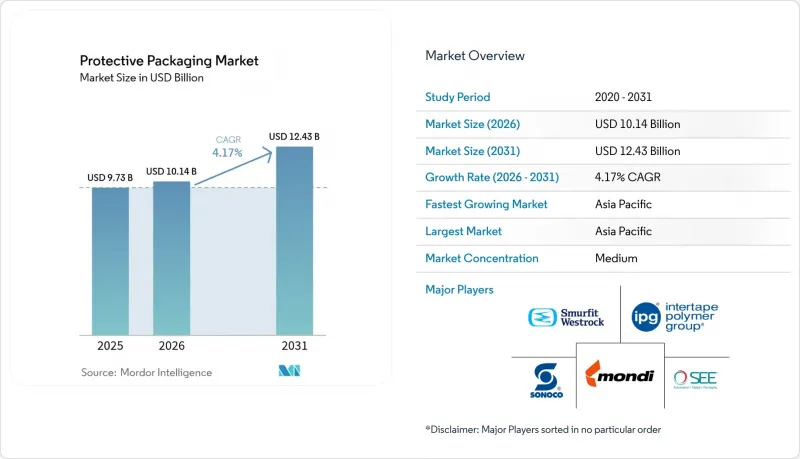
Mordor Intelligence에 의하면, 보호 포장 시장 규모는 2025년 97억 3,000만 달러로 평가되었습니다. 2026년에는 101억 4,000만 달러로 확대되어 2026년부터 2031년에 걸쳐 CAGR 4.17%로 성장을 지속하여, 2031년에는 124억 3,000만 달러에 이를 것으로 예측됩니다.
본 보고서는 제품 유형(경질, 연질, 발포), 소재(종이, 플라스틱, 발포 폴리머, 생분해성),기능(충격 흡수, 틈새 채움, 포장, 기타), 최종 사용자 산업(식품 및 음료, 전자, 제약, 전자상거래), 지역(북미, 유럽, 아시아태평양, 중동 및 아프리카, 남미)별로 분류되어 있습니다. 시장 예측은 금액(달러)으로 표시되어 있습니다.
세계의 보호 포장 시장 동향 및 인사이트
급증하는 전자상거래 배송량
소포의 급격한 증가로 인해 보호 포장 시장의 물류 구조가 재정의되면서, 각 브랜드는 포장 부피를 축소하고 운송사의 부피 중량 기준을 충족하는 섬유 소재로 전환할 수밖에 없게 되었습니다. HP는 올인원 PC 포장을 재설계하여 발포 폴리에틸렌 사용량을 98% 줄이고 부피를 최대 67% 감소시켰을 뿐만 아니라, 27인치 모델의 팔레트 적재 밀도를 향상시켜 운송 비용과 이산화탄소 배출량을 줄였습니다. 로지텍은 2025년까지 전체 제품 라인업에서 종이로의 전환을 완료하여, 연간 660톤의 플라스틱과 6,000톤의 CO2를 감축했습니다. 또한, 조사 대상 구매자의 61%가 재활용 가능한 포장재를 지지하고 있습니다. 이처럼 각 브랜드는 보호 포장재 시장을 단순한 비용 항목이 아닌, ‘도어스텝 경제’에서 고객 유지를 위한 수단으로도 인식하고 있습니다.
제품 안전 및 파손 감소를 위한 규제 추진
새로운 법규는 재활용 가능성뿐만 아니라 포장을 소비자 안전에 필수적인 요소로 다루고 있습니다. 유럽의 ‘일반 제품 안전 규정’에서는 제조업체가 포장의 무결성이 오염이나 변조를 방지한다는 사실을 검증할 것을 의무화하고 있습니다. 서모피셔(Thermo Fisher)사의 골판지 상자에는 변조 방지 기능이 내장되어 있으며, -80°C의 저온에도 견디고, 접착제를 사용하지 않으며, 바이알 크기에 맞추어 크기를 조절할 수 있습니다. 미국에서는 일련번호 부여 관련 법률에 따라 추적 코드와 완충재가 연동되게 되어, 스마트 라벨에 대한 수요가 증가하고 있습니다. 규정 준수 일정에 따라 제조업체는 시행 몇년전부터 보호 포장 시장에 대응할 준비를 갖추어야 합니다.
플라스틱 및 EPS에 대한 엄격한 환경 규제
유럽에서는 2040년까지 재사용률을 15%로 높일 것을 의무화하고, 특정 PFAS를 금지하고 있어, 이로 인해 즉각적인 소재 대체가 진행되고 있으며, 확대 생산자 책임(EPR)에 따른 비용 부담이 증가하여 가공업체의 이익률을 압박하고 있습니다. 영국에서는 2025년 10월 EPR(확대 생산자 책임) 도입으로 폐기 비용 전액이 브랜드 측에 전가되는 한편, 캘리포니아주에서는 가정 쓰레기로 수거된다는 것이 입증되지 않는 한 재활용 마크 사용이 제한되고 있습니다. 이러한 움직임으로 인해 규정 준수 비용이 증가하여 발포재 설비의 투자 회수 기간이 장기화되고 있으며, 이는 보호 포장 시장의 성장 곡선을 둔화시키고 있습니다.
부문 분석
보호 포장 시장에서 2025년 매출의 64.88%는 유연형 포장이 차지했으며, 이는 최소한의 부피와 낮은 운송비로 대량의 소포를 처리할 수 있는 능력을 반영합니다. 발포체 카테고리는 규모는 작지만, 전자 기기 및 바이오 의약품이 정전기 방전(ESD) 방지 기능을 갖춘 맞춤형 금형에 의존하고 있기 때문에 2031년까지 연평균 성장률(CAGR) 6.52%로 성장을 가속화하고 있습니다. 발포재 보호 포장 시장 규모는 콜드체인의 확대에 따라 성장할 것으로 예상되며, 이에 따라 발포재 제조업체는 높은 차단 성능에 걸맞은 프리미엄 가격 책정이 가능해질 전망입니다.
쉴드 에어(Shield Air)사의 ‘KORRVU’ 서스펜션 방식은 종이 및 골판지가 폼의 탄력성을 재현할 수 있음을 보여주고 있으며, 가정에서 재활용이 가능하고 평평한 상태로 출하할 수 있어 반입 시 운송 비용을 절감할 수 있습니다. 한편, 경질 골판지는 적재 강도가 중요한 대형 가전제품 및 기계 분야에서 여전히 중요한 역할을 하고 있습니다. 제품 구성에는 명확한 양극화가 나타나고 있습니다. 플렉서블 제품은 전자상거래 분야의 비용 절감 요구를 충족시키는 반면, 기술형 폼은 정밀한 완충성 및 단열성이 가격 프리미엄을 가져다주는 분야에서 우위를 점하고 있습니다.
플라스틱은 여전히 2025년 총 취급량의 57.70%를 차지했지만, 발포 폴리머는 7.06%라는 가장 높은 연평균 성장률(CAGR)을 기록하며, 고부가가치 전자기기 및 생명과학 분야의 성장과 연동되고 있습니다. 보리 유래 바이오플라스틱과 재생 폴리에틸렌 필름은 파일럿 라인에서 생산 규모를 확대하고 있으며, 대량 채택을 위한 실현 가능성을 입증하고 있습니다. 바이오 복합재의 보호 포장 시장 점유율은 여전히 소규모이지만, 식품 및 의약품 구매자들이 퇴비화 가능하거나 바이오 유래의 밀봉재를 요구함에 따라 확대되고 있습니다.
종이 및 판지 가공업체들은 섬유 포장재가 습기와 기름기를 차단할 수 있도록 배리어 코팅을 개선하고 있습니다. 버지니아 공과대학의 저압 셀룰로오스 처리 기술은 투명성을 유지하면서 종이의 강도를 높임으로써, 신선 식품의 ‘매장 진열 적합성’이라는 매력을 끌어내고 있습니다. 제조업체들은 이러한 기술 발전과 탄소 발자국 공개를 결합함으로써, 보호 포장 시장에서 소재 혁신을 조달상의 이점으로 연결하고 있습니다.
지역별 분석
아시아태평양은 2025년에 매출의 40.05%를 차지했으며, 제조업의 집적, 모바일 단말기의 급속한 보급, 그리고 지원적이면서도 점차 엄격해지고 있는 정책에 힘입어 연평균 성장률(CAGR) 7.41%를 나타낼 것으로 전망됩니다. 중국은 전 세계 플라스틱 생산량의 절반을 차지하며, 가공업체에 유리한 현지 조달 가능한 수지 공급원을 제공하는 한편, 일본은 고급 전자기기 수출업체를 만족시킬 수 있는 발포지 연구를 진행하고 있습니다. 각국에서는 자동 포장 라인에 대한 정부 보조금의 시범 도입이 진행되고 있으며, 보호 포장 시장이 크로스보더 전자상거래의 급증에 뒤처지지 않도록 보장되고 있습니다.
북미에서는 프리미엄화 추세가 이어지고 있습니다. HP나 Amazon과 같은 미국 브랜드들이 ‘플라스틱 제로’를 시범적으로 시행하고 있으며, 이러한 움직임은 향후 전 세계로 확산되어 해당 지역을 동향의 선도자로 자리매김하고 있습니다. 캘리포니아주의 SB 343 법안을 시작으로 주 차원의 ‘확대 생산자 책임(EPR)’ 규정이 도입되어, 2026년까지 재활용 가능성 표기가 의무화되며, 보호 포장 시장에서 이를 조기에 도입한 기업에는 우대 조치가 제공됩니다. 캐나다는 폐쇄형 순환 방식의 종이 재활용을 추진하고 있는 반면, 멕시코는 니어쇼어링을 활용하여 가전·전자제품 수출을 확대하고 있어, 공장 내 완충재에 대한 수요가 증가하고 있습니다.
유럽은 규제 제정을 주도하고 있습니다. ‘포장 및 포장 폐기물 규정’은 재활용률과 재사용률 할당량을 규정하고 있으며, 이는 전 세계 조달 정책의 벤치마크가 되고 있습니다. 독일의 보증금 제도와 영국의 플라스틱세는 섬유 소재 채택을 가속화하고 있습니다. 시장에 진출한 기업들은 폴리머별로 상이한 복잡한 환경 조정 요금에 대응해야 하므로, 다국적 기업들은 미래를 내다보는 배합을 실현하기 위해 이 지역에 연구개발 거점을 집중시키고 있습니다. 따라서 규정 준수를 철저히 이행하는 것이 보호 포장 시장 전체에서 경쟁 우위를 확보하는 열쇠가 됩니다.
기타 혜택 :
- 엑셀 형식 시장 예측(ME) 시트
- 3개월간의 애널리스트 지원
자주 묻는 질문
목차
제1장 서론
제2장 조사 방법
제3장 주요 요약
제4장 시장 구도
제5장 시장 규모 및 성장 예측
제6장 경쟁 구도
제7장 시장 기회 및 향후 전망
KTH 26.09.10According to Mordor Intelligence, the protective packaging market size is expected to grow from USD 9.73 billion in 2025 to USD 10.14 billion in 2026 and is forecast to reach USD 12.43 billion by 2031 at 4.17% CAGR over 2026-2031.
This report is Segmented by Product Type (Rigid, Flexible, Foam), Materials (Paper, Plastics, Foam Polymers, Biodegradable), Function (Cushioning, Void Fill, Wrapping, Others), End-User Industry (Food & Beverage, Electronics, Pharmaceuticals, E-Commerce), and Geography (North America, Europe, Asia-Pacific, MEA, South America). Market Forecasts are in Value (USD).
Global Protective Packaging Market Trends and Insights
Surging E-commerce Shipping Volumes
Exponential parcel growth is redefining protective packaging market logistics, compelling brands to shrink cube sizes and pivot toward fiber formats that meet carrier dimensional weight thresholds. HP's redesign of its All-in-One PC packaging eliminated 98% of expanded polyethylene, reduced volume by up to 67%, and raised pallet density for the 27-inch model, trimming freight spend and carbon load. Logitech completed a portfolio-wide switch to paper in 2025, removing 660 tons of plastic and 6,000 tons of CO2 each year, while 61% of surveyed buyers favored recyclable packs . Brands thus regard the protective packaging market not only as a cost line but as a retention lever in a doorstep economy.
Regulatory Push for Product Safety and Damage Reduction
New statutes go beyond recyclability to treat packaging as intrinsic to consumer safety. Europe's General Product Safety Regulation obliges manufacturers to validate that pack integrity prevents contamination or tampering.Thermo Fisher's carton with built-in tamper evidence withstands -80 °C, discards glue, and scales across vial sizes. In the United States, serialization laws link tracking codes with cushioning layers, catalyzing smart-label demand. Compliance timetables push producers to confirm protective packaging market readiness years ahead of enforcement.
Stringent Environmental Rules on Plastics and EPS
Europe mandates reusable targets climbing to 15% by 2040 and bans certain PFAS, triggering immediate material substitutions and extended-producer fees that squeeze converters' margins. The United Kingdom's October 2025 EPR rollout shifts full disposal costs onto brands, while California restricts the recycling symbol unless curbside acceptance is documented. These moves inflate compliance costs and lengthen payback periods for foam installations, dragging on the protective packaging market growth curve.
Other drivers and restraints analyzed in the detailed report include:
- Growing Consumer Electronics Demand
- Preference for Lightweight Flexible Protective Formats
- Raw-material Price Volatility
For complete list of drivers and restraints, kindly check the Table Of Contents.
Segment Analysis
Flexible formats generated 64.88% of 2025 sales within the protective packaging market, reflecting their ability to serve high-volume parcels with minimal cube and lower freight spend. Foam categories, though smaller, are accelerating at 6.52% CAGR toward 2031 as electronics and biologics rely on custom molds with electrostatic discharge yields. The protective packaging market size for foam is projected to widen in tandem with cold-chain expansion, positioning foam makers for premium pricing aligned with higher barrier performance.
Sealed Air's KORRVU suspension format illustrates how paper and corrugate can mimic foam resilience, offering curbside recyclability and shipping flat to cut inbound freight. Rigid corrugated, meanwhile, remains relevant for large white-goods and machinery where stacking strength matters. The product mix signals a divide: flexibles satisfy cost-down mandates in e-commerce, whereas technical foams win where precision cushioning and thermal insulation command a price premium.
Plastics still supplied 57.70% of 2025 tonnage, yet foam polymers log the quickest 7.06% CAGR, tracking growth in high-value electronics and life sciences. Barley-based bioplastics and recycled polyethylene films are scaling pilot lines, proving viability for mass adoption. Protective packaging market share for biocomposites remains modest but expands as food and pharma buyers seek compostable or bio-based seals.
Paper and board converters upgrade barrier coatings so that fiber wraps repel moisture and grease. Virginia Tech's low-pressure cellulose treatment strengthens paper while preserving transparency, unlocking shelf-ready appeal for perishables. Producers bundle such advances with carbon footprint disclosures, translating material innovation into procurement gains within the protective packaging market.
Complete Report Scope:
- By Product Type
- Rigid
- Corrugated Paperboard Protectors
- Molded Pulp
- Insulated Shipping Containers
- Other Rigid Types
- Flexible
- Protective Mailers
- Bubble Wrap
- Air Pillows / Air Bags
- Paper Fill
- Other Flexible Types (Foil Pouches, Stretch and Shrink Films)
- Foam
- Molded Foam
- Foam-in-Place (FIP)
- Loose Fill
- Foam Rolls / Sheets
- Other Foam Types (Corner Blocks etc.)
- Rigid
- By Materials
- Paper and Paperboard
- Plastics
- Polyethylene (PE)
- Polypropylene (PP)
- Polyethylene Terephthalate (PET)
- Foam Polymers
- Expanded Polystyrene (EPS)
- Expanded Polyethylene (EPE)
- Expanded Polypropylene (EPP)
- Biodegradable and Compostable
- Molded Fiber
- Starch-based
- Polylactic Acid (PLA)
- Other Materials
- By Function
- Cushioning
- Blocking and Bracing
- Void Fill
- Insulation and Temperature Control
- Wrapping
- Dunnage and Others
- By End-user Industry
- Food and Beverage
- Industrial Goods
- Pharmaceuticals and Life Sciences
- Consumer Electronics
- Beauty and Home Care
- Automotive and Aerospace
- E-commerce and Retail Fulfilment
- Other End-user Industry
- By Geography
- North America
- United States
- Canada
- Mexico
- Europe
- Germany
- United Kingdom
- France
- Italy
- Spain
- Russia
- Rest of Europe
- Asia-Pacific
- China
- Japan
- India
- South Korea
- Australia and New Zealand
- Rest of Asia-Pacific
- Middle East and Africa
- Middle East
- Saudi Arabia
- United Arab Emirates
- Turkey
- Rest of Middle East
- Africa
- South Africa
- Egypt
- Nigeria
- Rest of Africa
- Middle East
- South America
- Brazil
- Argentina
- Chile
- Rest of South America
- North America
Geography Analysis
Asia-Pacific controlled 40.05% revenue in 2025 and is set for 7.41% CAGR, underpinned by dense manufacturing, rapid mobile penetration, and supportive yet tightening policy. China funnels half of global plastic output, offering localized resin access that favors converters, while Japan advances foamed paper research that can satisfy premium electronics exporters. Countries pilot government subsidies for automated packing lines, ensuring the protective packaging market keeps pace with cross-border e-commerce surges.
North America follows through premiumization. United States brands like HP and Amazon test zero-plastic pilots that later migrate worldwide, positioning the region as a trend bellwether. State-level Extended Producer Responsibility rules, beginning with California SB 343, compel recyclability declarations by 2026, rewarding early adopters in the protective packaging market. Canada promotes closed-loop paper recycling, whereas Mexico leverages near-shoring to grow appliance and electronics exports, widening demand for in-plant cushioning.
Europe leads rulemaking. The Packaging and Packaging Waste Regulation locks in recyclability and reuse quotas that benchmark global sourcing policies. Germany's deposit systems and the UK's plastic tax accelerate fiber uptake. Market entrants must navigate complex eco-modulation fees that vary by polymer, so multinationals cluster R&D hubs in the region to future-proof formulations. Compliance mastery therefore becomes a commercial edge across the protective packaging market.
- Sealed Air Corporation
- Pregis LLC
- Intertape Polymer Group Inc.
- Sonoco Products Company
- Smurfit Westrock
- Mondi Group
- International Paper Company
- Storopack Hans Reichenecker GmbH
- Ranpak Holdings Corp.
- Huhtamaki Oyj
- Signode Industrial Group LLC
- Crown Holdings Inc.
- Amcor plc
- Pro-Pac Packaging Ltd.
- ProAmpac Holdings Inc.
- Reflex Packaging LLC
- Pactiv Evergreen Inc.
- AirPack Systems Ltd.
- Polyair Inter Pack Inc.
Additional Benefits:
- The market estimate (ME) sheet in Excel format
- 3 months of analyst support
TABLE OF CONTENTS
1 INTRODUCTION
- 1.1 Study Assumptions and Market Definition
- 1.2 Scope of the Study
2 RESEARCH METHODOLOGY
3 EXECUTIVE SUMMARY
4 MARKET LANDSCAPE
- 4.1 Market Overview
- 4.2 Market Drivers
- 4.2.1 Surging e-commerce shipping volumes
- 4.2.2 Regulatory push for product safety and damage reduction
- 4.2.3 Growing consumer electronics demand
- 4.2.4 Preference for lightweight flexible protective formats
- 4.2.5 Adoption of on-demand packaging automation
- 4.2.6 Expansion of cold-chain biologics and vaccines
- 4.3 Market Restraints
- 4.3.1 Stringent environmental rules on plastics and EPS
- 4.3.2 Raw-material price volatility
- 4.3.3 Space constraints at urban last-mile hubs
- 4.3.4 Product redesign minimising protective-packaging need
- 4.4 Supply-Chain Analysis
- 4.5 Regulatory Landscape
- 4.6 Technological Outlook
- 4.7 Porter's Five Forces Analysis
- 4.7.1 Bargaining Power of Suppliers
- 4.7.2 Bargaining Power of Buyers
- 4.7.3 Threat of New Entrants
- 4.7.4 Threat of Substitute Products
- 4.7.5 Intensity of Competitive Rivalry
5 MARKET SIZE AND GROWTH FORECASTS (VALUE)
- 5.1 By Product Type
- 5.1.1 Rigid
- 5.1.1.1 Corrugated Paperboard Protectors
- 5.1.1.2 Molded Pulp
- 5.1.1.3 Insulated Shipping Containers
- 5.1.1.4 Other Rigid Types
- 5.1.2 Flexible
- 5.1.2.1 Protective Mailers
- 5.1.2.2 Bubble Wrap
- 5.1.2.3 Air Pillows / Air Bags
- 5.1.2.4 Paper Fill
- 5.1.2.5 Other Flexible Types (Foil Pouches, Stretch and Shrink Films)
- 5.1.3 Foam
- 5.1.3.1 Molded Foam
- 5.1.3.2 Foam-in-Place (FIP)
- 5.1.3.3 Loose Fill
- 5.1.3.4 Foam Rolls / Sheets
- 5.1.3.5 Other Foam Types (Corner Blocks etc.)
- 5.1.1 Rigid
- 5.2 By Materials
- 5.2.1 Paper and Paperboard
- 5.2.2 Plastics
- 5.2.2.1 Polyethylene (PE)
- 5.2.2.2 Polypropylene (PP)
- 5.2.2.3 Polyethylene Terephthalate (PET)
- 5.2.3 Foam Polymers
- 5.2.3.1 Expanded Polystyrene (EPS)
- 5.2.3.2 Expanded Polyethylene (EPE)
- 5.2.3.3 Expanded Polypropylene (EPP)
- 5.2.4 Biodegradable and Compostable
- 5.2.4.1 Molded Fiber
- 5.2.4.2 Starch-based
- 5.2.4.3 Polylactic Acid (PLA)
- 5.2.5 Other Materials
- 5.3 By Function
- 5.3.1 Cushioning
- 5.3.2 Blocking and Bracing
- 5.3.3 Void Fill
- 5.3.4 Insulation and Temperature Control
- 5.3.5 Wrapping
- 5.3.6 Dunnage and Others
- 5.4 By End-user Industry
- 5.4.1 Food and Beverage
- 5.4.2 Industrial Goods
- 5.4.3 Pharmaceuticals and Life Sciences
- 5.4.4 Consumer Electronics
- 5.4.5 Beauty and Home Care
- 5.4.6 Automotive and Aerospace
- 5.4.7 E-commerce and Retail Fulfilment
- 5.4.8 Other End-user Industry
- 5.5 By Geography
- 5.5.1 North America
- 5.5.1.1 United States
- 5.5.1.2 Canada
- 5.5.1.3 Mexico
- 5.5.2 Europe
- 5.5.2.1 Germany
- 5.5.2.2 United Kingdom
- 5.5.2.3 France
- 5.5.2.4 Italy
- 5.5.2.5 Spain
- 5.5.2.6 Russia
- 5.5.2.7 Rest of Europe
- 5.5.3 Asia-Pacific
- 5.5.3.1 China
- 5.5.3.2 Japan
- 5.5.3.3 India
- 5.5.3.4 South Korea
- 5.5.3.5 Australia and New Zealand
- 5.5.3.6 Rest of Asia-Pacific
- 5.5.4 Middle East and Africa
- 5.5.4.1 Middle East
- 5.5.4.1.1 Saudi Arabia
- 5.5.4.1.2 United Arab Emirates
- 5.5.4.1.3 Turkey
- 5.5.4.1.4 Rest of Middle East
- 5.5.4.2 Africa
- 5.5.4.2.1 South Africa
- 5.5.4.2.2 Egypt
- 5.5.4.2.3 Nigeria
- 5.5.4.2.4 Rest of Africa
- 5.5.4.1 Middle East
- 5.5.5 South America
- 5.5.5.1 Brazil
- 5.5.5.2 Argentina
- 5.5.5.3 Chile
- 5.5.5.4 Rest of South America
- 5.5.1 North America
6 COMPETITIVE LANDSCAPE
- 6.1 Market Concentration
- 6.2 Strategic Moves
- 6.3 Market Share Analysis
- 6.4 Company Profiles (includes Global level Overview, Market level overview, Core Segments, Financials as available, Strategic Information, Market Rank/Share for key companies, Products and Services, and Recent Developments)
- 6.4.1 Sealed Air Corporation
- 6.4.2 Pregis LLC
- 6.4.3 Intertape Polymer Group Inc.
- 6.4.4 Sonoco Products Company
- 6.4.5 Smurfit Westrock
- 6.4.6 Mondi Group
- 6.4.7 International Paper Company
- 6.4.8 Storopack Hans Reichenecker GmbH
- 6.4.9 Ranpak Holdings Corp.
- 6.4.10 Huhtamaki Oyj
- 6.4.11 Signode Industrial Group LLC
- 6.4.12 Crown Holdings Inc.
- 6.4.13 Amcor plc
- 6.4.14 Pro-Pac Packaging Ltd.
- 6.4.15 ProAmpac Holdings Inc.
- 6.4.16 Reflex Packaging LLC
- 6.4.17 Pactiv Evergreen Inc.
- 6.4.18 AirPack Systems Ltd.
- 6.4.19 Polyair Inter Pack Inc.
7 MARKET OPPORTUNITIES AND FUTURE OUTLOOK
- 7.1 White-space and Unmet-need Assessment


