

|
시장보고서
상품코드
2120413
생물학적 안전성 시험 : 시장 점유율 분석, 업계 동향과 통계, 성장 예측(2026-2031년)Biological Safety Testing - Market Share Analysis, Industry Trends & Statistics, Growth Forecasts (2026 - 2031) |
||||||
 Mordor Intelligence
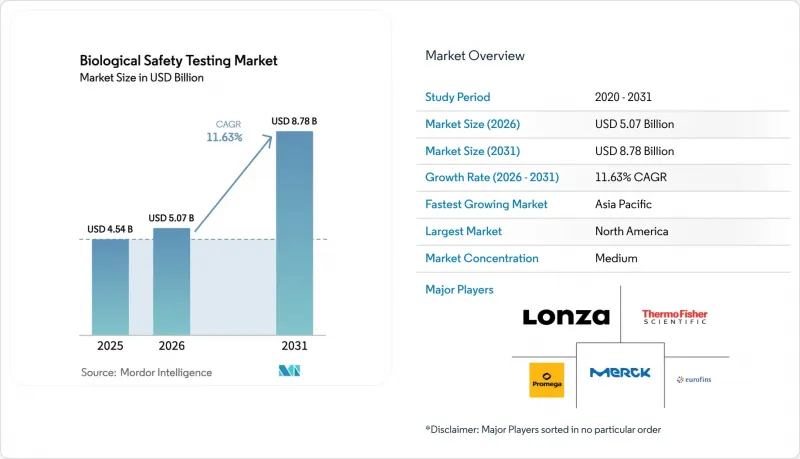
Mordor Intelligence에 따르면 생물학적 안전성 시험 시장 규모는 2025년 45억 4,000만 달러에서 2026년에는 50억 7,000만 달러로 확대되어, 2026년부터 2031년까지 CAGR 11.63%를 기록하며 2031년까지 87억 8,000만 달러에 달할 것으로 예측됩니다.
본 보고서는 제품·서비스(제품 및 서비스), 시험 유형(무균 시험, 바이오버든 시험 등), 용도(재조합 단백질/단일클론 항체 등), 최종사용자(바이오의약품·바이오기술 기업, CDMO 등), 및 지역(북미, 유럽, 아시아태평양, 중동 및 아프리카, 남미)별로 분류되어 있습니다. 시장 예측은 금액(달러) 기준으로 제시되어 있습니다.
세계 생물학적 안전성 시험 시장의 동향 및 인사이트
세계 바이오의약품 연구개발 및 벤처 자금 조달의 확대
2024년, 벤처 투자자들은 바이오의약품 분야에 230억 달러를 투자했으며, 그 자본의 42%를 임상시험용 신약 신청(IND) 전에 광범위한 안전성 시험이 필요한 면역학 및 유전자 편집 플랫폼에 배분했습니다. 유럽의약품청(EMA)의 데이터에 따르면, 2025년 상반기 생물학적 제제 신청 건수는 19% 증가했으며, 각 신청에는 무균성, 내독소, 마이코플라스마 검사 패널이 필수로 요구되고 있습니다. 시리즈 B 단계의 후원 기업들은 2024년부터 2025년까지 예상되는 8-12%의 시약 가격 상승을 헤지하기 위해 3년간의 마스터 서비스 계약을 체결하고 있으며, 지출은 세계 상위 5대 검사 기관에 집중되고 있습니다. 화이자는 mRNA 백신 포트폴리오 확장에 따라 2025년 품질 관리 업무의 외주 비용이 14% 증가했다고 보고하며, 이러한 추세의 지속성을 뒷받침하고 있습니다. 이러한 동향들이 맞물려 검사 기준량이 증가함에 따라 벤처 자금이 예측 가능한 서비스 수익으로 전환되고 있습니다.
세포·유전자 치료의 상용화 가속화
미국 식품의약국(FDA)은 2024년에 8개의 세포·유전자 치료 제품을 승인하여, 2017년 이후 누적 승인 건수는 37건에 달했습니다. 자가 유래 치료제가 출시될 때마다 로트를 통합할 수 없기 때문에 안전성 시험 수요가 두 배로 증가합니다. 노바티스는 2024년 자사의 CAR-T 네트워크를 위해 1만 2,000건 이상의 무균성 시험을 실시하며, ‘환자 1명당 1로트’라는 패러다임을 여실히 보여주었습니다. 2025년에 발표된 유럽의약품청(EMA)의 지침에서는 렌티바이러스 벡터에 대한 바이러스 검사를 체외(in vitro) 및 생체 내(in vivo) 분석 모두 의무화함으로써 검사 건수를 두 배로 늘렸습니다. 한편, 일본에서는 무균 유지 기간을 28일에서 7일로 단축하여 아시아태평양 전체에 걸쳐 신속한 검사법의 도입을 촉진했습니다. 블루버드 바이오(Bluebird Bio)는 시애틀 거점에 마이코플라스마 자동 검출 시스템을 도입한 결과, 출시 주기 시간을 30% 단축했습니다. 이는 처리 능력이 높은 경우, 사내 신속 플랫폼이 단기간에 투자를 회수할 수 있음을 입증하는 것입니다. 현재 각 지역에서는 자체 생산 제품을 48시간 콜드체인 기간 내에 맞추기 위해 제조와 검사를 동일한 거점에 집약하는 움직임이 진행되고 있습니다.
신규 신속 미생물 검사법의 검증 기간 장기화
신속 무균 검사 플랫폼은 약전 기준인 14일 대비 3일 이내에 결과를 제공한다고 약속하고 있습니다. 그러나 2024년에 발행된 미국 FDA 지침에서는 최소 30개의 제조 배치에 걸친 병행 동등성 시험을 요구하고 있으며, 이로 인해 소량 생산되는 생물학적 제제의 경우 검증 기간이 18-24개월로 연장되었습니다. 찰스 리버 래버러토리즈(Charles River Laboratories)는 이러한 부담으로 인해 자사의 ‘Celsis’ 시스템 도입이 예상보다 저조했다고 지적하고 있습니다. 또한, 유럽 약전(European Pharmacopoeia)의 2025년 프레임워크에서는 10콜로니 형성 단위(CFU) 미만을 검출하는 기술에 대해서만 완전한 동등성이 인정되지만, 많은 ATP법 및 세포계측 플랫폼은 이 기준치를 충족하지 못하고 있습니다. 수탁 시험 기관은 단일 제품의 검증 비용을 여러 고객사 간에 분담할 수 없기 때문에 중견 기업의 투자 의욕이 위축되고 있습니다. 그 결과, 2025년 중반 시점에서 론자의 바이오의약품 고객 중 신속 무균 시험으로 전환한 기업은 12% 미만에 그쳤습니다. 따라서 2028년 이전에 광범위한 도입이 이루어질 가능성은 낮으며, 중기적으로는 사이클 타임 단축에 따른 이점이 제한될 것입니다.
부문 분석
2025년에는 제품이 생물학적 안전성 시험 시장의 62.45%를 차지했으나, 서비스 분야는 2031년까지 연평균 성장률(CAGR) 13.54%로 확대되고 있습니다. 자동화 미생물학 플랫폼의 초기 도입 비용이 고가(대부분의 경우 1대당 50만 달러 이상)이기 때문에 초기 단계의 스폰서는 변동비 기반의 아웃소싱을 선택할 수밖에 없습니다. 시약 공급업체는 라이세이트 부족을 완화하기 위해 LAL 키트와 rFC 대체품을 세트로 판매하고 있는 반면, 일회용 용기의 경우 ISO 13485:2024에 따라 추출물 및 용출물 시험이 의무화되어 있습니다. 유로핀스는 고객이 사내 검증에 소요되는 12-18개월의 리드타임을 피할 수 있게 함으로써, 2024년 바이오의약품 서비스 매출을 전년 대비 16% 증가시켰습니다.
CDMO는 여러 고객에게 자본 비용을 분산시키고 더 빠른 납기를 제공할 수 있기 때문에 이러한 구조적 변화는 서비스 사업에 유리하게 작용하고 있습니다. Pacific BioLabs와 같은 검사 기관은 시차 배양을 도입하여 무균 시험 주기를 10일로 단축한 반면, 제품 공급업체는 시험별 가격 경쟁으로 인해 이익률 압박에 직면해 있습니다. 또한, 서비스 부문은 BSL-2 또는 BSL-3 시설을 보유하지 않은 많은 스폰서가 사내에서 대응할 수 없는 새로운 바이러스 안전성 요건에서도 가치를 창출하고 있습니다. 그 결과, 복잡성과 규제 당국의 기대가 높아짐에 따라 아웃소싱의 추세는 계속해서 강해지고 있습니다.
2025년에는 무균 시험이 매출의 28.54%를 차지했으나, 자동 액체 핸들러 도입으로 인건비가 절감됨에 따라 상품화 압력에 직면하고 있습니다. 외인성 바이러스 검출은 유전자 치료 분야에서 복제 능력을 가진 렌티바이러스에 대한 우려를 배경으로 연평균 성장률(CAGR) 13.76%를 기록하며 가장 빠르게 성장하는 부문입니다. 엔도톡신 분석은 시약 부족으로 인해 가격이 상승하고 있어 여전히 높은 수익률을 유지하고 있지만, rFC의 광범위한 승인으로 인해 3년 이내에 비용이 20% 절감될 가능성이 있습니다. 마이코플라스마 검출은 4시간 내에 결과를 얻을 수 있으며, 유럽 약전 제2.6.7장에 부합하는 PCR 기반 키트로 전환되고 있습니다.
각 부문의 동향은 규제상의 인센티브에 좌우됩니다. 찰스 리버(Charles River)사의 경우, 전임상시험과 시판 후 시험을 모두 요구하는 고객이 증가함에 따라 2024년에 바이러스 안전성 관련 매출이 21% 증가했습니다. 기술의 급속한 도입 현황에는 편차가 보입니다. 바이오메리유(BioMerieux)는 한 번의 측정으로 8종의 마이코플라스마를 검출하는 멀티플렉스 분석법을 출시했으나, 한편 미국약전(USP) 제71호의 개정에 따라 후원사는 멸균 필터의 재검증을 수행해야 했으며, 이로 인해 일시적으로 위탁 검사 기관에 대한 수요가 증가했습니다. 동종 요법의 보급에 따라 마스터 셀 뱅크 검사가 업스트림 공정으로 이동함에 따라, 외래 바이러스 패널에 관한 생물학적 안전성 시험의 시장 규모는 확대될 전망입니다.
지역별 분석
2025년, 북미는 매출의 41.67%를 차지했습니다. 이는 벤처 캐피탈의 지원을 받은 생명공학 클러스터와, 환경 모니터링 및 배치 출하를 연계하는 개정된 무균성 규정을 FDA가 시행한 것이 주요 요인입니다. 서모피셔는 록빌에서 1억 5,000만 달러를 투자한 확장 공사를 완료하여 2,000건의 생체 내 바이러스 분석 능력을 강화했습니다. 한편, 캐나다는 마이코플라스마 PCR 요건을 USP(63)와 일치시켰습니다. 멕시코의 Grupo PiSA는 FDA로부터 해외 시험 시설로 인증을 받아, 미국 스폰서의 배치 출시까지 소요되는 기간을 단축했습니다.
유럽에서는 EMA의 통합 심사 절차의 혜택을 받고 있으며, 생물학적 안전성 시험의 시장 점유율은 독일, 스위스, 아일랜드에 집중되어 있습니다. 론자의 EU 연구소는 2024년 하반기 87%의 가동률을 기록했습니다. 유럽 약전(European Pharmacopoeia)에 대체 방법에 관한 장이 수록됨에 따라 신속 분석법에 대한 관심이 높아지고 있습니다. 그러나 영국의 바이러스 안전성 관련 규정이 다른 국가와 다르기 때문에 유럽 전역에서 제품을 출시하려면 이중 시험이 필요합니다. 프랑스와 이탈리아에서는 민관 파트너십을 통해 CAR-T 시험을 확대하고 있어, 지역의 처리 능력이 향상되고 있습니다.
아시아태평양은 중국 국가의약품감독관리국(NMPA)의 ICH 기준 준수 및 CDMO에 대한 투자 확대를 배경으로, 2026년부터 2031년까지 연평균 성장률(CAGR) 12.54%로 가장 빠른 성장을 기록할 것으로 예상됩니다. 우시(WuXi)의 상하이 조사소는 유럽의약품청(EMA)의 릴리스 사이트로 인증을 획득했으며, 일본에서는 무균성 검사를 통한 보류 기간이 7일로 단축됨에 따라 신속한 검사법의 도입이 촉진되고 있습니다. 삼성바이오로직스의 인천에 위치한 3개의 품질 관리(QC) 시설은 소규모 지역 CDMO가 감당할 수 없는 자본 집약성을 보여주고 있습니다. 인도의 바이오콘(Biocon)은 벵갈루루 연구소에 대해 EMA의 승인을 획득한 반면, 호주는 임상시험 심사 기간을 30일로 단축하여 초기 단계의 스폰서를 유치하고 있습니다.
남미와 중동 등 신흥 지역에서는 WHO의 사전 인증 기준을 충족하기 위해 생산능력을 확대하고 있습니다. 브라질에서는 현재 세포 배양 제품에 대해 마이코플라스마 PCR 검사가 의무화되어 있으며, UAE는 두바이 사이언스 파크에 2,500만 달러 규모의 검사 센터를 건설 중입니다. 남아프리카공화국은 SGS와 제휴하여 검체 운송 지연을 줄이고 있으며, 이는 지역 차원의 자립성이 더욱 높아지고 있음을 보여줍니다.
기타 혜택:
- 엑셀 형식의 시장 예측(ME) 시트
- 3개월간의 애널리스트 지원
자주 묻는 질문
목차
제1장 소개
제2장 조사 방법
제3장 주요 요약
제4장 시장 구도
제5장 시장 규모와 성장 예측
제6장 경쟁 구도
제7장 시장 기회와 향후 전망
KSM 26.09.02According to Mordor Intelligence, the biological safety testing market size is expected to grow from USD 4.54 billion in 2025 to USD 5.07 billion in 2026 and is forecast to reach USD 8.78 billion by 2031 at 11.63% CAGR over 2026-2031.
This report is Segmented by Product & Service (Products and Services), Test Type (Sterility Tests, Bioburden Tests, and More), Application (Recombinant Protein/Monoclonal Antibodies, and More), End User (Biopharma & Biotech Companies, Cdmos, and More), and Geography (North America, Europe, Asia-Pacific, Middle East and Africa, and South America). Market Forecasts are Provided in Terms of Value (USD).
Global Biological Safety Testing Market Trends and Insights
Expansion of Global Biopharma R&D and Venture Financing
Venture investors deployed USD 23 billion into biopharma in 2024, channeling 42% of capital toward immunology and gene-editing platforms that require extensive safety testing before investigational new drug filings. European Medicines Agency data show a 19% increase in biologics submissions during the first half of 2025, with each submission requiring sterility, endotoxin, and mycoplasma panels. Series B-stage sponsors are locking in three-year master service agreements that hedge reagent inflation of 8-12% seen in 2024-2025, concentrating spend among the five largest global laboratories. Pfizer reported a 14% increase in outsourced quality-control spending in 2025, as its mRNA vaccine portfolio expanded, underscoring the trend's durability. These trends collectively raise baseline testing volumes and translate venture funding into predictable service revenues.
Accelerated Commercialization of Cell & Gene Therapies
The U.S. FDA approved eight cell and gene therapy products in 2024, bringing the cumulative number of authorizations to 37 since 2017. Each autologous launch multiplies safety-testing demand, as batches cannot be pooled. Novartis processed more than 12,000 sterility tests in 2024 for its CAR-T network, illustrating the one-patient-one-batch paradigm. The EMA guidance issued in 2025 doubled viral testing for lentiviral vectors by mandating both in vitro and in vivo assays, while Japan shortened sterility holds from 28 days to seven, spurring the uptake of rapid methods across the Asia-Pacific region. Bluebird Bio reduced its release cycle time by 30% after installing automated mycoplasma detection at its Seattle site, confirming that in-house rapid platforms can quickly pay back when throughput is high. Geographic clusters are now co-locating manufacturing and testing to keep autologous products within a 48-hour cold-chain window.
Prolonged Validation Timelines for Novel Rapid Microbiology Methods
Rapid sterility platforms promise three-day results versus the 14-day compendial benchmark; however, U.S. FDA guidance issued in 2024 requires side-by-side equivalence studies over at least 30 production batches, which pushes validation timelines to 18-24 months for low-volume biologics. Charles River Laboratories noted a sub-forecast adoption of its Celsis system due to this burden, and the European Pharmacopoeia's 2025 framework grants full equivalence only to technologies detecting under 10 colony-forming units, a threshold that many ATP and cytometry platforms miss. Contract labs cannot amortize single-product validations across clients, choking mid-tier investment appetite. Consequently, fewer than 12% of Lonza's biologics customers had migrated to rapid sterility testing by mid-2025. Widespread adoption is therefore unlikely before 2028, which will limit the benefits of cycle-time compression in the intermediate term.
Other drivers and restraints analyzed in the detailed report include:
- Stringent Global Regulatory Standards for Contamination Control
- Growing Outsourcing of Quality Control to Cost-Efficient CDMOs
- Volatile Supply of Horseshoe Crab Lysate and Alternate Reagent Uncertainty
For complete list of drivers and restraints, kindly check the Table Of Contents.
Segment Analysis
Services are rising at a 13.54% CAGR through 2031, even though products commanded 62.45% of the biological safety testing market in 2025. The high upfront price of automated microbiology platforms-often above USD 500,000 per unit-pushes early-stage sponsors toward variable-cost outsourcing. Suppliers of reagents are bundling LAL kits with rFC alternatives to mitigate lysate shortages, while single-use containers now require extractables- and leachables assays under ISO 13485:2024. Eurofins grew biopharma services revenue 16% year-over-year in 2024 as clients avoided 12- to 18-month in-house validation lead times.
Structural shifts favor services because CDMOs can amortize capital across multiple clients and offer faster turnaround times. Laboratories, such as Pacific BioLabs, have trimmed sterility cycles to 10 days by implementing staggered incubation, whereas product vendors face margin pressure due to competitive pricing per test. The services segment also captures value from new viral-safety requirements that many sponsors cannot support internally without BSL-2 or BSL-3 facilities. Consequently, outsourcing continues to gain momentum as complexity and regulatory expectations escalate.
Sterility tests held 28.54% of revenue in 2025, but face commoditization as automated liquid handlers cut labor input. Adventitious virus detection is the fastest-growing segment, with a 13.76% CAGR, driven by concerns about replication-competent lentivirus in gene therapy. Endotoxin assays remain high-margin because reagent scarcity inflates prices, yet widespread rFC approval could trim costs by 20% within three years. Mycoplasma detection is pivoting to PCR-based kits that provide four-hour results and comply with European Pharmacopoeia chapter 2.6.7.
Segment dynamism hinges on regulatory incentives. Charles River saw viral-safety revenue increase by 21% in 2024, as more clients required both pre-clinical and commercial testing. Rapid technology adoption is uneven; BioMerieux launched a multiplex assay that detects eight Mycoplasma species in a single run, while USP (71) revisions forced sponsors to revalidate sterility filters, temporarily boosting demand for contract labs. The biological safety testing market size for adventitious virus panels is set to expand as allogeneic therapies push master-cell-bank testing upstream.
Complete Report Scope:
- By Product & Service
- Products
- Reagents & Kits
- Instruments
- Single-Use Consumables
- Services
- Sterility Testing Services
- Endotoxin & Pyrogen Testing Services
- Cell Line Authentication & Characterisation
- Products
- By Test Type
- Sterility Tests
- Bioburden Tests
- Endotoxin/LAL Tests
- Mycoplasma Detection
- Adventitious Virus Detection
- By Application
- Recombinant Protein / Monoclonal Antibodies
- Vaccine And Therapeutics
- Cellular And Gene Therapy
- Blood And Blood-Based Therapy
- Other Application
- By End User
- Biopharma & Biotech Companies
- Contract Development & Manufacturing Organisations
- Academic & Research Institutes
- Medical Device Manufacturers
- Geography
- North America
- United States
- Canada
- Mexico
- Europe
- Germany
- United Kingdom
- France
- Italy
- Spain
- Rest Of Europe
- Asia-Pacific
- China
- Japan
- India
- Australia
- South Korea
- Rest Of Asia-Pacific
- Middle East And Africa
- GCC
- South Africa
- Rest Of Middle East And Africa
- South America
- Brazil
- Argentina
- Rest Of South America
- North America
Geography Analysis
North America contributed a 41.67% revenue share in 2025, anchored by venture-backed biotech clusters and the FDA's enforcement of revised sterility rules that link environmental monitoring with batch release. Thermo Fisher completed a USD 150 million expansion in Rockville to add capacity for 2,000 in vivo viral assays, while Canada harmonized mycoplasma PCR requirements with USP (63). Mexico's Grupo PiSA gained FDA recognition as a foreign testing site, shortening batch-release timelines for U.S. sponsors.
Europe benefits from a centralized EMA pathway, concentrating the biological safety testing market share in Germany, Switzerland, and Ireland. Lonza's EU labs operated at 87% utilization during the second half of 2024. Rapid-method interest is rising following the European Pharmacopoeia's alternative methods chapter; however, the U.K.'s divergent viral-safety rules require dual testing for pan-European launches. France and Italy are scaling CAR-T testing through public-private partnerships, boosting regional capacity.
The Asia-Pacific region is expected to post the fastest growth at a 12.54% CAGR from 2026 to 2031, following the NMPA's alignment with ICH standards and rising CDMO investment. WuXi's Shanghai lab secured EMA release-site status, and Japan reduced sterility holds to seven days, facilitating rapid method adoption. Samsung Biologics' three QC suites in Incheon illustrate capital intensity that smaller regional CDMOs cannot match. India's Biocon won EMA approval for its Bengaluru lab, while Australia reduced the review time for investigational testing to 30 days, attracting early-phase sponsors.
Emerging regions, such as South America and the Middle East, are adding capacity to meet WHO prequalification standards. Brazil now mandates Mycoplasma PCR for cell-culture products, and the UAE is building a USD 25 million testing center in Dubai Science Park. South Africa partnered with SGS to reduce sample shipping delays, signaling a greater level of regional self-sufficiency.
- Alcami
- Avance Biosciences
- bioMerieux
- Charles River
- Creative BioLabs
- Cytovance Biologics
- Eurofins
- Lonza Group
- Merck KGaA (MilliporeSigma)
- Microbac Laboratories
- Nelson Labs
- Pall Corporation (Danaher)
- Pacific BioLabs
- Promega
- Sartorius
- SGS
- STERIS
- Thermo Fisher Scientific
- Toxikon (Labcorp)
- WuXi App Tec
Additional Benefits:
- The market estimate (ME) sheet in Excel format
- 3 months of analyst support
TABLE OF CONTENTS
1 Introduction
- 1.1 Study Assumptions & Market Definition
- 1.2 Scope Of The Study
2 Research Methodology
3 Executive Summary
4 Market Landscape
- 4.1 Market Overview
- 4.2 Market Drivers
- 4.2.1 Expansion of Global Biopharma R&D and Venture Financing
- 4.2.2 Accelerated Commercialization of Cell & Gene Therapies
- 4.2.3 Stringent Global Regulatory Standards for Contamination Control
- 4.2.4 Growing Outsourcing of Quality Control to Cost-Efficient CDMOs
- 4.2.5 Adoption of Digital Twins and Predictive Analytics for Batch Release
- 4.2.6 Government Biodefense Stockpile Initiatives Boosting Validation Demand
- 4.3 Market Restraints
- 4.3.1 Prolonged Validation Timelines for Novel Rapid Microbiology Methods
- 4.3.2 Limited Skilled Workforce and Rising Training Expenditure
- 4.3.3 Margin Compression from Vendor Consolidation in Testing Supply Chain
- 4.3.4 Volatile Supply of Horseshoe Crab Lysate and Alternate Reagent Uncertainty
- 4.4 Value / Supply-Chain Analysis
- 4.5 Regulatory Landscape
- 4.6 Technological Outlook
- 4.7 Porter's Five Forces Analysis
- 4.7.1 Threat Of New Entrants
- 4.7.2 Bargaining Power Of Buyers
- 4.7.3 Bargaining Power Of Suppliers
- 4.7.4 Threat Of Substitutes
- 4.7.5 Competitive Rivalry
5 Market Size & Growth Forecasts (Value, USD)
- 5.1 By Product & Service
- 5.1.1 Products
- 5.1.1.1 Reagents & Kits
- 5.1.1.2 Instruments
- 5.1.1.3 Single-Use Consumables
- 5.1.2 Services
- 5.1.2.1 Sterility Testing Services
- 5.1.2.2 Endotoxin & Pyrogen Testing Services
- 5.1.2.3 Cell Line Authentication & Characterisation
- 5.1.1 Products
- 5.2 By Test Type
- 5.2.1 Sterility Tests
- 5.2.2 Bioburden Tests
- 5.2.3 Endotoxin/LAL Tests
- 5.2.4 Mycoplasma Detection
- 5.2.5 Adventitious Virus Detection
- 5.3 By Application
- 5.3.1 Recombinant Protein / Monoclonal Antibodies
- 5.3.2 Vaccine And Therapeutics
- 5.3.3 Cellular And Gene Therapy
- 5.3.4 Blood And Blood-Based Therapy
- 5.3.5 Other Application
- 5.4 By End User
- 5.4.1 Biopharma & Biotech Companies
- 5.4.2 Contract Development & Manufacturing Organisations
- 5.4.3 Academic & Research Institutes
- 5.4.4 Medical Device Manufacturers
- 5.5 Geography
- 5.5.1 North America
- 5.5.1.1 United States
- 5.5.1.2 Canada
- 5.5.1.3 Mexico
- 5.5.2 Europe
- 5.5.2.1 Germany
- 5.5.2.2 United Kingdom
- 5.5.2.3 France
- 5.5.2.4 Italy
- 5.5.2.5 Spain
- 5.5.2.6 Rest Of Europe
- 5.5.3 Asia-Pacific
- 5.5.3.1 China
- 5.5.3.2 Japan
- 5.5.3.3 India
- 5.5.3.4 Australia
- 5.5.3.5 South Korea
- 5.5.3.6 Rest Of Asia-Pacific
- 5.5.4 Middle East And Africa
- 5.5.4.1 GCC
- 5.5.4.2 South Africa
- 5.5.4.3 Rest Of Middle East And Africa
- 5.5.5 South America
- 5.5.5.1 Brazil
- 5.5.5.2 Argentina
- 5.5.5.3 Rest Of South America
- 5.5.1 North America
6 Competitive Landscape
- 6.1 Market Concentration
- 6.2 Market Share Analysis
- 6.3 Company Profiles {(Includes Global Level Overview, Market Level Overview, Core Segments, Financials as Available, Strategic Information, Market Rank/Share for Key Companies, Products & Services, and Recent Developments)}
- 6.3.1 Alcami Corporation
- 6.3.2 Avance Biosciences
- 6.3.3 BioMerieux SA
- 6.3.4 Charles River Laboratories
- 6.3.5 Creative BioLabs
- 6.3.6 Cytovance Biologics
- 6.3.7 Eurofins Scientific
- 6.3.8 Lonza Group
- 6.3.9 Merck KGaA (MilliporeSigma)
- 6.3.10 Microbac Laboratories
- 6.3.11 Nelson Labs
- 6.3.12 Pall Corporation (Danaher)
- 6.3.13 Pacific BioLabs
- 6.3.14 Promega Corporation
- 6.3.15 Sartorius AG
- 6.3.16 SGS SA
- 6.3.17 Steris PLC
- 6.3.18 Thermo Fisher Scientific
- 6.3.19 Toxikon (Labcorp)
- 6.3.20 WuXi AppTec
7 Market Opportunities & Future Outlook
- 7.1 White-Space & Unmet-Need Assessment


