

|
시장보고서
상품코드
2120435
HCS(High Throughput Screening) : 시장 점유율 분석, 업계 동향 및 통계, 성장 예측(2026-2031년)High-throughput Screening - Market Share Analysis, Industry Trends & Statistics, Growth Forecasts (2026 - 2031) |
||||||
 Mordor Intelligence
Mordor Intelligence에 의하면, 2026년 HCS(High Throughput Screening) 시장 규모는 282억 3,000만 달러로 추정되고 2025년 257억 1,000만 달러에서 확대해, 2031년에는 450억 7,000만 달러에 이를 것으로 예측됩니다.
2026년부터 2031년까지의 연평균 성장률(CAGR)은 9.81%가 될 것으로 전망됩니다.
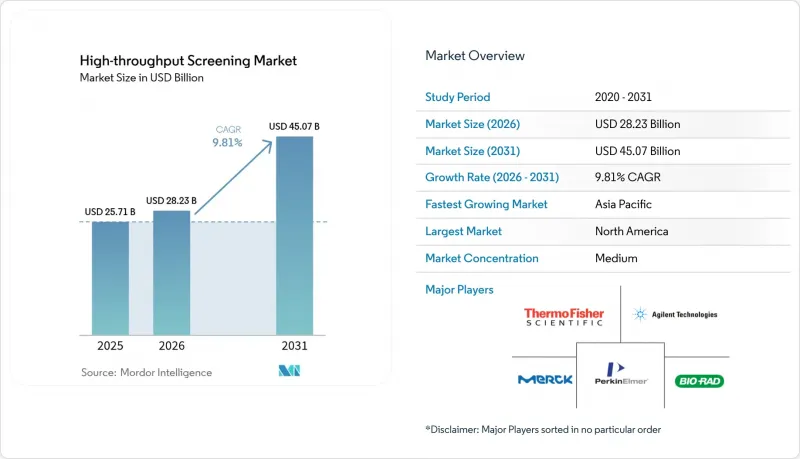
본 보고서에서는 업계를 기술별(초고처리량 스크리닝, 세포 기반 분석 등), 용도별(표적 동정 등), 제품 및 서비스별(장비 등), 최종 사용자별(제약·바이오기술 기업 등), 지역별(북미, 유럽, 아시아태평양 등)로 분류하고 있습니다. 시장 전망은 금액(달러) 기준으로 제시되어 있습니다.
세계의 HCS(High Throughput Screening) 시장 동향 및 인사이트
로봇을 활용한 액체 처리 및 이미징 시스템의 발전
적응형 로봇 공학의 비약적인 발전으로 인해, 하이 스루풋 스크리닝 시장 전반에 걸쳐 처리 능력과 재현성이 향상되고 있습니다. 현재 컴퓨터 비전 모듈이 피펫팅의 정확도를 실시간으로 제어하여, 수동 워크플로우에 비해 실험의 편차를 85% 줄이고 있습니다. 통합된 AI 감지 알고리즘은 시간당 80장 이상의 슬라이드를 처리하여, 하이컨텐츠 이미징의 처리 능력 상한선을 높이고 있습니다. 듀얼 인터페이스 프로그래밍을 통해 화학자들은 전문적인 코딩 지식 없이도 복잡한 워크플로우를 구성할 수 있게 되어, 사용자의 접근 범위가 확대되고 있습니다. 워크셀당 200만 달러를 초과하는 설비 투자는 연간 10만 개 이상의 화합물을 처리할 때 투자 수익률(ROI)이 향상되므로 여전히 정당화됩니다. 그 결과, 플랫폼 업그레이드가 서로를 강화하는 선순환이 형성되어, HCS(High Throughput Screening) 시장을 더욱 확대하고, 속도를 높이며, 데이터 품질을 향상시키는 방향으로 추진하고 있습니다.
제약 및 생명공학 업계의 연구개발비 증가와 파이프라인 확대
정밀 의학에 할당되는 연구개발 예산의 확대에 따라, 계산 생물학과 자동화된 실험을 통합한 스크리닝 플랫폼으로 자본이 유입되고 있습니다. AI를 활용한 신약 개발로 인해 후보 화합물 선별에 소요되는 기간이 6년에서 18개월 미만으로 단축되었으며, 2025년 초 AI를 통해 발견된 2종의 항암제를 임상시험 단계로 진행한 Recursion Pharmaceuticals와 같은 기업에 벤처 캐피탈 자금이 유입되고 있습니다. 예산 증가와 알고리즘 효율성의 시너지 효과로 인해, 초기 단계 스크리닝은 리스크 경감과 개발 기간 단축을 도모하기 위한 전략적 수단으로서의 위상을 강화하고 있습니다. 특히 암이나 희귀질환 파이프라인에서는 화합물의 신속한 선별이 병용 요법의 탐색과 맞춤형 치료의 확립을 뒷받침하고 있어 그 혜택을 크게 누리고 있습니다.
완전 자동화된 HTS 워크셀에 필요한 고액의 설비 투자
소프트웨어, 검증, 교육을 포함한 초기 투자액이 500만 달러에 달하기 때문에 소규모 기업에게는 자금 면에서 장벽이 되고 있습니다. 연간 유지비와 라이선스 비용으로 인해 운영 예산은 15-20% 증가합니다. 총 소유 비용 측면에서는 대량 사용자에게 유리하지만, 높은 자본 집약성으로 인해 자금 조달에 제약이 있는 조직의 도입이 지연되면서 아웃소싱 서비스에 대한 수요를 뒷받침하고 있습니다. 장비 리스나 시설 공유 모델을 통해 이러한 장벽은 부분적으로 완화되지만, 기술의 노후화 속도는 여전히 빠른 시장 침투에 있어 뿌리 깊은 걸림돌로 남아 있습니다.
부문 분석
2025년, 세포 기반 분석법은 HCS(High Throughput Screening) 시장에서 44.63%의 점유율을 차지했습니다. 이는 생화학적 대체 기법보다 복잡한 신호 전달 경로를 모델링하고, 인간에서의 유효성을 더 정확하게 예측할 수 있는 능력을 반영한 것입니다. 이 부문은 미세한 표현형 변화를 포착하는 형광 리포터, 3차원 배양 스캐폴드, 그리고 라벨이 필요 없는 임피던스 기술 분야의 지속적인 발전의 혜택을 받고 있습니다. 랩온어칩 및 마이크로플루이딕스 플랫폼과 관련된 HCS(High Throughput Screening) 시장 규모는 연평균 성장률(CAGR) 10.54%의 성장에 힘입어 시약 비용 절감과 분석 민감도 향상이 실현됨에 따라 급속히 확대될 전망입니다. 대규모 의약품 라이브러리에서는 초고처리량 플랫폼에 대한 수요가 견조하게 유지되고 있는 반면, 라벨 프리 접근법은 분석에 대한 간섭을 최소화하고자 하는 안전성 및 독성학 워크플로우에서 주목을 받고 있습니다.
하이컨텐츠 이미징과 AI 기반 분석의 융합을 통해 1회 스크리닝당 데이터 심도가 증가하여, 예상치 못한 작용기전을 규명하는 표현형 발견이 가능해집니다. 오가노이드를 활용한 스크리닝은 조직의 미세 구조별로 화합물의 반응을 더욱 상세하게 구분하여, 종양 미세환경의 충실한 재현이 요구되는 종양학 프로그램을 지원합니다. 이러한 혁신들이 결합되어 세포 기반 부문에서 매출 1위 자리를 공고히 하는 동시에, HCS(High Throughput Screening) 시장의 장기적인 확장을 뒷받침할 차세대 시스템 파이프라인을 촉진하고 있습니다.
2025년에는 1차 및 2차 스크리닝 용도가 HCS(High Throughput Screening) 시장 규모의 52.98%를 차지하여, 히트 화합물 식별에 있어 그 기초적인 역할이 부각되었습니다. 애세이 자동화 및 소형화, 그리고 AI를 통한 분류로 인해 시료 처리 능력이 향상되어, 신속한 리드 화합물 선정을 원하는 신약 개발 팀의 요구를 충족시키고 있습니다. 대조적으로, 전 세계 규제 당국이 비동물 안전성 데이터 제출을 강력히 요구함에 따라, 독성학 및 ADME 워크플로는 2031년까지 연평균 성장률(CAGR) 13.41%로 성장할 전망입니다. 이러한 변화는 초기 안전성 평가를 통해 후기 단계에서의 탈락 비용을 최소화하려는 경제적 판단을 반영한 것으로, 촉박한 일정에 따라 운영되는 벤처 기업의 프로그램에게 있어 이는 가장 중요한 고려 사항이 되고 있습니다.
현재 in vitro 독성학 플랫폼에는 인간 유래 세포주, 장기-온-칩(organ-on-chip) 장치, 예측 AI 모델이 통합되어 있어, 후보 화합물의 우선순위 결정에 도움이 되는 360도 안전성 프로파일링을 제공합니다. CRISPR를 활용한 표적 검증을 통해 질병과 유전자의 관련성에 대한 연구가 가속화되는 한편, 다중 바이오마커 측정을 통해 중개 의학적 관련성이 더욱 높아지고 있습니다. 이러한 동향들이 결합되어, 기존의 HCS(High Throughput Screening)과 고가 책정이 가능한 안전성 중심 분석법 간의 균형을 맞추면서 수익원이 다각화되고, HCS(High Throughput Screening) 시장 전체의 안정성이 강화되고 있습니다.
지역별 분석
북미는 2025년에 매출의 39.22%를 차지했으며, 성숙한 제약 생태계, AI를 활용한 자동화 보급률의 높음, 그리고 견조한 벤처 캐피탈의 진입에 힘입고 있습니다. 광범위한 화합물 라이브러리와 유리한 보험 환급 환경이 플랫폼 업그레이드를 가속화하여 지역 전체 수요를 뒷받침하고 있습니다. 미국의 HCS(High Throughput Screening) 시장 규모는 학계와 산업계의 중개 연구 파트너십을 촉진하는 미국 국립보건원(NIH)의 전략적 보조금의 혜택을 받고 있습니다.
유럽에서는 엄격한 품질 기준과 3차원 세포 배양 도입을 촉진하는 지원적인 규제 프레임워크 덕분에 꾸준한 성장을 유지하고 있습니다. 독일, 네덜란드, 스칸디나비아 국가들의 클러스터는 지속 가능한 실험실 이니셔티브를 주도하며, 유럽 전체의 환경 목표와 부합하는 재사용 가능한 마이크로플루이딕스 카트리지에 대한 투자를 촉진하고 있습니다. 또한, 이 지역 시장은 차세대 독성학에 할당된 ‘호라이즌 유럽(Horizon Europe)’ 자금도 유치하고 있습니다.
아시아태평양은 중국의 생명공학 분야에서 새로운 자본 유입과 지원적인 정책 조치가 예상에 따라, 서유럽 국가들을 웃도는 연평균 성장률(CAGR) 13.74%로 확대될 것으로 전망됩니다. 2025년 바이오테크 주식은 60% 상승하여 AI 부문 지수를 능가하는 성과를 보였으며, 투자자들의 신뢰를 신약 개발 인프라로 이끌었습니다. 서유럽 주요 기업과 아시아 바이오테크 기업 간의 라이선싱 계약을 통해, 국제적인 규정 준수 기준을 지키면서도 경쟁력 있는 운영 비용을 활용한 스크리닝 거점이 확립되고 있습니다. ‘장기 온 칩(Organ-on-a-chip)’ 및 마이크로플루이딕스 기술의 급속한 보급으로 아시아는 기존 방식을 뛰어넘는 입지에 서 있으며, HCS(High Throughput Screening) 시장의 지리적 다양성을 확대되고 있습니다.
남미, 중동 및 아프리카의 신흥 시장은 미개척 잠재력을 지니고 있습니다. 브라질과 아랍에미리트는 바이오테크놀러지 파크 내에 공동 이용형 HTS 시설에 자금을 지원하는 국가 혁신 계획을 주도하고 있습니다. 인프라 제약과 규제 차이로 인해 현재 도입률은 제한적이지만, 이러한 지역으로의 세계 CDMO 진출은 기술 이전과 현지 역량 구축의 토대를 마련하여, 향후 전 세계의 HCS(High Throughput Screening) 시장의 확산을 촉진할 것입니다.
기타 혜택 :
- 엑셀 형식 시장 예측(ME) 시트
- 3개월간의 애널리스트 지원
자주 묻는 질문
목차
제1장 서론
제2장 조사 방법
제3장 주요 요약
제4장 시장 구도
제5장 시장 규모 및 성장 예측
제6장 경쟁 구도
제7장 시장 기회 및 향후 전망
KTH 26.09.10According to Mordor Intelligence, high-throughput screening market size in 2026 is estimated at USD 28.23 billion, growing from 2025 value of USD 25.71 billion with 2031 projections showing USD 45.07 billion, growing at 9.81% CAGR over 2026-2031.
This report Segments the Industry Into by Technology (Ultra-High-Throughput Screening, Cell-Based Assays, and More), Application (Target Identification, and More), Product and Service (Instruments, and More), End User (Pharmaceutical and Biotechnology Firms, and More), and Geography (North America, Europe, Asia-Pacific, and More). The Market Forecasts are Provided in Terms of Value (USD).
Global High-throughput Screening Market Trends and Insights
Advances in Robotic Liquid-Handling & Imaging Systems
Breakthroughs in adaptive robotics are elevating throughput and reproducibility across the high throughput screening market. Computer-vision modules now guide pipetting accuracy in real time, cutting experimental variability by 85% compared with manual workflows. Integrated AI detection algorithms process more than 80 slides per hour, lifting the ceiling for high-content imaging throughput. Dual-interface programming lets chemists configure complex workflows without specialist coding, broadening user access. Capital investments exceeding USD 2 million per workcell remain justified as return-on-investment profiles improve with volumes above 100,000 compounds annually. The result is a self-reinforcing cycle of platform upgrades that propels the high throughput screening market toward greater scale, speed, and data quality.
Rising Pharma/Biotech R&D Spending & Pipeline Growth
Expanded R&D budgets dedicated to precision medicine funnel capital into screening platforms that integrate computational biology with automated experimentation. AI-powered discovery has shortened candidate identification from six years to under 18 months, attracting venture flows to companies such as Recursion Pharmaceuticals, which progressed two AI-discovered oncology drugs to clinical trials in early 2025. The multiplier effect between rising budgets and algorithmic efficiency positions early-stage screening as a strategic lever for risk mitigation and timeline compression. Oncology and rare-disease pipelines especially benefit, as rapid compound triage supports combination-therapy exploration and personalized regimens.
High Capital Expenditure for Fully Automated HTS Workcells
Initial outlays near USD 5 million, including software, validation, and training, create financial friction for smaller firms. Annual maintenance and licensing inflate operating budgets by 15-20%. Although total cost of ownership favors high-volume users, capital intensity delays adoption in cash-constrained organizations and sustains demand for outsourced services. Equipment-leasing and shared-facility models partially offset the barrier, yet the pace of technology obsolescence remains an enduring hurdle to rapid market penetration.
Other drivers and restraints analyzed in the detailed report include:
- Adoption of Physiologically Relevant Cell-Based & 3-D Assays
- AI/ML In-Silico Triage Shrinking Wet-Lab Library Size
- Shortage of Skilled Assay-Automation Specialists
For complete list of drivers and restraints, kindly check the Table Of Contents.
Segment Analysis
Cell-based assays held 44.63% high throughput screening market share in 2025, reflecting their capability to model complex signaling pathways and predict human efficacy more accurately than biochemical alternatives. The segment benefits from continual advances in fluorescent reporters, 3-D culture scaffolds, and label-free impedance technologies that capture subtle phenotypic shifts. The high throughput screening market size associated with lab-on-a-chip and microfluidic platforms is set to expand rapidly as 10.54% CAGR growth unlocks reagent savings and heightens assay sensitivity. Demand for ultra-high-throughput platforms remains steady among large pharmaceutical libraries, whereas label-free approaches attract safety-toxicology workflows seeking minimal assay interference.
The fusion of high-content imaging with AI-driven analytics magnifies data depth per screen, enabling phenotypic discovery that surfaces unexpected mechanisms of action. Organoid-based screening further differentiates compound responses by tissue microarchitecture, aiding oncology programs that require tumor-microenvironment fidelity. Together, these innovations fortify the cell-based segment's leading revenue position and catalyze a pipeline of next-generation systems that sustain the high throughput screening market's long-term expansion.
Primary and secondary screening applications contributed 52.98% of the high throughput screening market size in 2025, underscoring their foundational role in hit identification. Automated assay miniaturization and AI triage have accelerated sample throughput, aligning with discovery teams' need for rapid lead selection. In contrast, toxicology and ADME workflows are poised for 13.41% CAGR through 2031 as global regulators press for non-animal safety data. The shift reflects an economic calculus wherein early safety interrogation minimizes late-stage attrition costs, a prime consideration for venture-backed programs operating on compressed timelines.
In vitro toxicology platforms now incorporate human-derived cell lines, organ-on-chip devices, and predictive AI models, offering 360-degree safety profiling that informs candidate prioritization. CRISPR-enabled target validation accelerates disease-gene linkage studies, while multiplexed biomarker readouts sharpen translational relevance. Collectively, these dynamics diversify revenue streams by balancing legacy high-volume screens with safety-centric assays that draw premium pricing, reinforcing stability across the high throughput screening market.
Complete Report Scope:
- By Technology
- Ultra-high-throughput Screening (uHTS)
- Cell-based Assays
- Lab-on-a-chip / Microfluidics
- Label-free Technologies
- High-content Screening
- By Application
- Target Identification / Validation
- Primary & Secondary Screening
- Toxicology & ADME
- By Product & Service
- Instruments
- Reagents, Kits & Consumables
- Software & Informatics
- Services
- By End-user
- Pharma & Biotech Firms
- Contract Research / CDMOs
- Academic & Research Institutes
- By Geography
- North America
- United States
- Canada
- Mexico
- Europe
- Germany
- United Kingdom
- France
- Italy
- Spain
- Rest of Europe
- Asia-Pacific
- China
- Japan
- India
- Australia
- South Korea
- Rest of Asia-Pacific
- Middle East & Africa
- GCC
- South Africa
- Rest of Middle East & Africa
- South America
- Brazil
- Argentina
- Rest of South America
- North America
Geography Analysis
North America generated 39.22% revenue in 2025, sustained by mature pharmaceutical ecosystems, high adoption of AI-enabled automation, and robust venture capital participation. Expansive compound libraries and favorable reimbursement landscapes accelerate platform upgrades, anchoring region-wide demand. The high throughput screening market size in the United States benefits from strategic National Institutes of Health (NIH) grants that incentivize translational research partnerships between academia and industry.
Europe maintains steady growth through stringent quality standards and supportive regulatory frameworks that encourage 3-D cell culture adoption. Clusters in Germany, the Netherlands, and the Scandinavian countries champion sustainable laboratory initiatives, spurring investments in reusable microfluidic cartridges that dovetail with continental environmental goals. The regional market also attracts Horizon-Europe funding earmarked for next-generation toxicology.
Asia-Pacific is forecast to advance at a 13.74% CAGR, outpacing Western counterparts as China's biotech sector experiences renewed capital inflows and supportive policy measures. A 60% biotech stock rally in 2025 outperformed AI sector indices, channeling investor confidence toward drug-discovery infrastructure. Licensing deals between Western majors and Asian biotech firms establish screening hubs that leverage competitive operating costs while adhering to international compliance standards. Rapid adoption of organ-on-chip and microfluidic technologies positions Asia to leapfrog legacy modalities, expanding the high throughput screening market's geographic diversification.
Emerging markets in South America and the Middle East & Africa exhibit untapped potential. Brazil and the United Arab Emirates spearhead national innovation agendas that fund shared HTS facilities within biotechnology parks. Infrastructure limitations and regulatory variability presently temper adoption rates, yet global CDMO expansion into these regions sets the stage for technology transfer and local capacity building, offering a future lift to worldwide high throughput screening market penetration.
- Thermo Fisher Scientific
- PerkinElmer (Revvity)
- Danaher (Molecular Devices)
- Agilent Technologies
- Merck
- Beckman Coulter (Life Sciences)
- Tecan Group
- GE Healthcare (Cytiva)
- Axxam
- Bio-Rad Laboratories
- Hamilton Company
- Promega
- Corning Life Sciences
- HighRes Biosolutions
- Charles River Labs
- Eurofins
- Evotec
- Abcam
- DiscoverX (Crownbio)
- Labcyte (Echo) - Beckman
Additional Benefits:
- The market estimate (ME) sheet in Excel format
- 3 months of analyst support
TABLE OF CONTENTS
1 Introduction
- 1.1 Study Assumptions & Market Definition
- 1.2 Scope of the Study
2 Research Methodology
3 Executive Summary
4 Market Landscape
- 4.1 Market Overview
- 4.2 Market Drivers
- 4.2.1 Advances in Robotic Liquid-Handling & Imaging Systems
- 4.2.2 Rising Pharma/Biotech R&D Spending & Pipeline Growth
- 4.2.3 Adoption of Physiologically Relevant Cell-Based & 3-D Assays
- 4.2.4 AI/ML In-Silico Triage Shrinking Wet-Lab Library Size
- 4.2.5 Venture-Backed Microfluidic uHTS Platforms
- 4.2.6 Rising CDMOs Bundling HTS In Integrated Discovery Contracts
- 4.3 Market Restraints
- 4.3.1 High Capital Expenditure for Fully Automated HTS Workcells
- 4.3.2 Shortage of Skilled Assay-Automation Specialists
- 4.3.3 Data-Quality & Reproducibility Issues Across Labs
- 4.3.4 Sustainability Push Against Single-Use 1536-Well Plastics
- 4.4 Porter's Five Forces Analysis
- 4.4.1 Threat of New Entrants
- 4.4.2 Bargaining Power of Buyers
- 4.4.3 Bargaining Power of Suppliers
- 4.4.4 Threat of Substitutes
- 4.4.5 Intensity of Competitive Rivalry
5 Market Size & Growth Forecasts (Value in USD)
- 5.1 By Technology
- 5.1.1 Ultra-high-throughput Screening (uHTS)
- 5.1.2 Cell-based Assays
- 5.1.3 Lab-on-a-chip / Microfluidics
- 5.1.4 Label-free Technologies
- 5.1.5 High-content Screening
- 5.2 By Application
- 5.2.1 Target Identification / Validation
- 5.2.2 Primary & Secondary Screening
- 5.2.3 Toxicology & ADME
- 5.3 By Product & Service
- 5.3.1 Instruments
- 5.3.2 Reagents, Kits & Consumables
- 5.3.3 Software & Informatics
- 5.3.4 Services
- 5.4 By End-user
- 5.4.1 Pharma & Biotech Firms
- 5.4.2 Contract Research / CDMOs
- 5.4.3 Academic & Research Institutes
- 5.5 By Geography
- 5.5.1 North America
- 5.5.1.1 United States
- 5.5.1.2 Canada
- 5.5.1.3 Mexico
- 5.5.2 Europe
- 5.5.2.1 Germany
- 5.5.2.2 United Kingdom
- 5.5.2.3 France
- 5.5.2.4 Italy
- 5.5.2.5 Spain
- 5.5.2.6 Rest of Europe
- 5.5.3 Asia-Pacific
- 5.5.3.1 China
- 5.5.3.2 Japan
- 5.5.3.3 India
- 5.5.3.4 Australia
- 5.5.3.5 South Korea
- 5.5.3.6 Rest of Asia-Pacific
- 5.5.4 Middle East & Africa
- 5.5.4.1 GCC
- 5.5.4.2 South Africa
- 5.5.4.3 Rest of Middle East & Africa
- 5.5.5 South America
- 5.5.5.1 Brazil
- 5.5.5.2 Argentina
- 5.5.5.3 Rest of South America
- 5.5.1 North America
6 Competitive Landscape
- 6.1 Market Concentration
- 6.2 Market Share Analysis
- 6.3 Company Profiles (includes Global level Overview, Market level overview, Core Segments, Financials as available, Strategic Information, Market Rank/Share for key companies, Products & Services, and Recent Developments)
- 6.3.1 Thermo Fisher Scientific
- 6.3.2 PerkinElmer (Revvity)
- 6.3.3 Danaher (Molecular Devices)
- 6.3.4 Agilent Technologies
- 6.3.5 Merck KGaA (Sigma-Aldrich)
- 6.3.6 Beckman Coulter (Life Sciences)
- 6.3.7 Tecan Group
- 6.3.8 GE Healthcare (Cytiva)
- 6.3.9 Axxam SpA
- 6.3.10 Bio-Rad Laboratories
- 6.3.11 Hamilton Company
- 6.3.12 Promega Corporation
- 6.3.13 Corning Life Sciences
- 6.3.14 HighRes Biosolutions
- 6.3.15 Charles River Labs
- 6.3.16 Eurofins Discovery
- 6.3.17 Evotec SE
- 6.3.18 Abcam plc
- 6.3.19 DiscoverX (Crownbio)
- 6.3.20 Labcyte (Echo) - Beckman
7 Market Opportunities & Future Outlook
- 7.1 White-space & Unmet-need Assessment


