

|
시장보고서
상품코드
2120491
벤조산 : 시장 점유율 분석, 업계 동향 및 통계, 성장 예측(2026-2031년)Benzoic Acid - Market Share Analysis, Industry Trends & Statistics, Growth Forecasts (2026 - 2031) |
||||||
 Mordor Intelligence
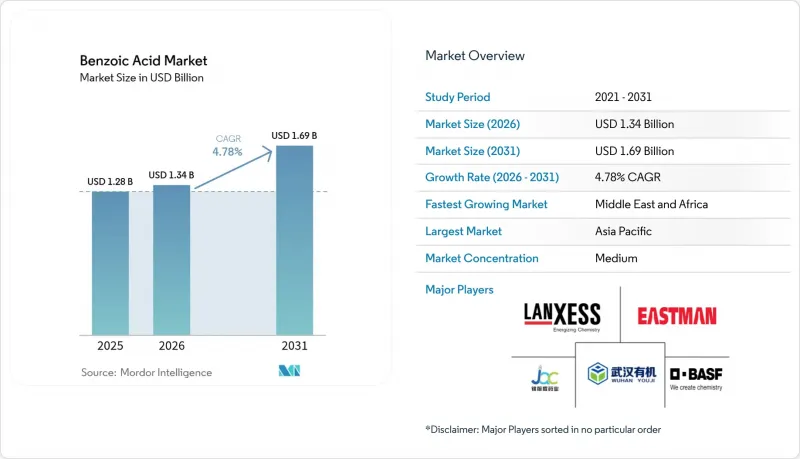
Mordor Intelligence에 의하면, 벤조산 시장 규모는 2025년 12억 8,000만 달러로 평가되었습니다. 2026년에는 13억 4,000만 달러로 확대되어 2026-2031년에 걸쳐 CAGR 4.78%로 성장을 지속하여, 2031년에는 16억 9,000만 달러에 이를 것으로 예측됩니다.
본 보고서는 형태별(액체, 무수, 기타), 순도 등급별(99.0-99.5%, 99.5-99.9%, 기타), 유도체별(벤조산 나트륨, 벤조산 칼륨, 기타), 용도별(식음료, 의약품, 화학제품, 기타), 지역별(북미, 유럽, 아시아태평양, 남미, 중동 및 아프리카)로 분류되어 있습니다. 시장 예측은 금액(미 달러) 기준으로 제시되어 있습니다.
세계의 벤조산 시장 동향 및 인사이트
신흥국에서의 장기 보존 의약품에 대한 규제적 추진
신흥 시장의 의약품 규제 당국은 더욱 엄격한 유통 기한 요건을 도입하고 있으며, 이에 따라 벤조산 수요가 증가하고 있습니다. 제품의 안정성 향상에 대한 노력은 액상 제제에서 특히 중요하며, 벤조산은 미생물의 증식을 방지하고 세균 및 곰팡이에 의한 오염을 억제함으로써 유통 기한을 연장합니다. 이러한 규제 동향은 의약품 부문의 꾸준한 수요 성장을 주도하고 있으며, 특히 중국, 인도, 브라질 등 의료 규제가 엄격해지고 있는 국가에서 두드러집니다. 아시아태평양 시장 전반에 걸친 규제 조화를 통해 벤조산은 주요 방부제로서의 입지를 확고히 하고 있습니다. 특히, 유효 성분과의 호환성이 요구되는 경구 제제 및 비경구 제제에서 그 중요성이 더욱 커지고 있습니다. 이러한 제제에는 내복액, 현탁액, 주사제 및 기타 액상 의약품이 포함됩니다. 신생아용 용도에서의 안전성 요건 강화로 인해 고순도 등급에 대한 수요가 증가하고 있으며, 순도에 관한 규격이 정해져 있어 초고순도 부문의 성장을 뒷받침하고 있습니다. 이러한 수요는 소아용 의약품에 대한 관심이 높아지고 있는 점, 민감한 의약품 용도에서 오염이 없는 방부제에 대한 필요성, 새로운 약물 전달 시스템에서 벤조산의 채택 확대에 의해 더욱 뒷받침되고 있습니다. 제약 산업에서 품질 관리 및 규정 준수를 중시함에 따라, 벤조산이 이러한 엄격한 요건을 충족하도록 보장하기 위해 고도의 정제 기술 및 검사 방법에 대한 투자가 증가하고 있습니다.
농약 합성에서 벤조일 클로라이드의 이용 확대
벤조산 유도체인 벤조일 클로라이드는 제초제 및 살균제, 특히 내성 잡초를 방제하고 작물 수확량을 향상시키는 클로람벤 계열 화합물의 제조에 있어 중요한 성분입니다. 이 화합물의 특성 덕분에 제조업체는 작물의 안전성을 유지하면서 해충의 내성에 대처하는 특정 제제를 개발할 수 있습니다. 인도의 제제 제조업체와 중국의 수탁 제조업체는 특정 불순물 프로파일을 갖춘 제품에 대한 세계 농약 기업의 요구 사항을 충족하기 위해 공정 관리 및 품질 시스템 개선을 실시함으로써 생산 능력을 확대되고 있습니다. 이러한 제조 측면의 강화에는 더 우수한 여과 시스템, 자동 모니터링, 종합적인 품질 검사 프로토콜이 포함됩니다. 농업 부문에서 지속가능성에 대한 관심이 높아짐에 따라, 아미드기를 가진 설폰산 유도체에 대한 연구가 증가하고 있습니다. 실험실 연구에 따르면, 이러한 유도체는 기존 유효 성분에 비해 표적 생물에 대한 치사 농도에서 효과가 더 뛰어나며, 해충 방제 효율을 유지하면서 살포량을 줄일 가능성이 있습니다. 시장의 성장은 환경 규제 및 안전 요건을 충족하면서 비용 효율성을 실현하고, 농약 공급망에서 벤조산에 대한 안정적인 수요를 유지할 수 있는지에 달려 있습니다. 업계에서는 새로운 작물 보호 제품을 개발하기 위해 벤조일클로라이드를 기반으로 한 솔루션에 대한 투자를 계속하고 있습니다.
클린 라벨 방부제로의 전환에 따른 합성 벤조산염 사용 제한
천연 성분을 선호하는 소비자 경향이 강해짐에 따라, 식품 제조업체들은 벤조산나트륨을 포함한 합성 방부제의 대체재를 모색할 수밖에 없게 되었습니다. 유럽 시장 데이터에 따르면, 원료 조달 및 제조 공정의 투명성을 확보한 ‘클린 라벨’ 제품에 대한 수요가 증가하고 있으며, 소비자들은 제품 라벨을 점점 더 면밀히 검토하며 천연 유래 대체품을 찾고 있습니다. 식물 추출물, 에센셜 오일, 미생물 대사 산물 등의 천연 항균 화합물이 합성 방부제의 대체 후보로 떠오르고 있습니다. 이러한 천연 화합물은 식중독 원인균을 억제하는 데 효과적일 뿐만 아니라, 클린 라벨 제품을 찾는 소비자의 기호에도 부합합니다. 육류 산업은 천연 방부제에 큰 관심을 보이고 있으며, 합성 화학 물질의 대체재로 박테리오파지, 박테리오신, 항균 펩타이드 등의 다양한 선택지를 폭넓게 검토하고 있습니다. 이러한 대체재들은 실험실 및 상업적 환경에서 유망한 결과를 보여주고 있습니다. 그러나 천연 유래 대체제의 보급에는 표준화 문제, 높은 생산 비용, 식품 용도별 항균 효과의 편차와 같은 제약이 있습니다. 규제 환경, 특히 EU에서는 합성 방부제에 대한 보다 엄격한 지침과 승인 절차를 통해 천연 성분을 우선시하는 방향으로 변화하고 있으며, 이는 벤조산 제조업체에게 시장 적응 및 제품 개발 측면에서 기회인 동시에 과제도 안겨주고 있습니다.
부문별 분석
무수 등급의 벤조산 시장은 광범위한 산업 부문에서의 용도에 힘입어 2025년에는 52.74%라는 압도적인 시장 점유율을 차지했습니다. 무수 분말은 흡습성이 낮아 대량 보관에 적합하기 때문에 드라이 믹스 식품, 폴리머용 촉매, 입상 동물사료 혼합에 선호되는 선택지가 되고 있습니다. 이러한 특성은 보관 기간 동안 제품의 안정성과 품질을 유지하는 데 도움이 됩니다. 액체 형태 부문은 가공 효율과 운영상의 이점에 힘입어 연평균 성장률(CAGR) 6.09%로 성장하고 있습니다. 의약품 시럽 제조업체는 액체 벤조산 용액을 사용함으로써 현장에서의 용해 공정을 생략하고, 정확한 정량 허용 범위를 유지하여 제조 공정을 합리화하고 있습니다. 이를 통해 배치 간 편차가 줄어들고 제품의 균일성이 향상됩니다. 산업 용도료 제조업체는 고전단 반응기에서 액체를 사용함으로써 더 빠른 균질화를 실현하여 생산 시간 단축과 효율 향상을 도모하고 있습니다.
공정의 집약화를 통해 제조 공정에서 액체의 활용 능력이 대폭 향상되었습니다. 종합적인 실험실 테스트에 따르면, 액상 벤조산은 알키드 수지에서 사슬 종결제로 더 효과적으로 기능하며, 그 결과 광택 유지력과 표면 마감 품질이 향상되는 것으로 나타났습니다. 이러한 대폭적인 성능 향상과 더불어 취급 및 가공 시 분진 배출량 감소가 더해져, 이 부문은 벤조산 시장 전체와 비교하여 더욱 강력한 성장 궤도를 그리고 있습니다. 액체 형태에 따른 효율 향상은 처리 시간 단축 및 다양한 산업용도로의 통합성 향상으로도 이어져, 시장 내 입지를 더욱 공고히 하고 있습니다.
2025년에는 순도 99.5-99.9%의 부문이 시장 점유율의 62.21%를 차지하며 시장을 주도했습니다. 이는 주로 중요한 제조 공정에서 광범위하게 사용되기 때문입니다. 순도 99.9%를 초과하는 초고순도 등급은 엄격한 품질 사양이 요구되는 특수 코팅 및 의약품 용도 수요 증가에 힘입어 2031년까지 연평균 성장률(CAGR) 6.88%로 성장하고 있습니다. 제약 산업에서는 특히 환자의 안전과 규제 준수를 위해 엄격한 약전 기준을 충족해야 하는 비경구 제제에서 더 높은 순도의 등급이 요구되고 있습니다. 바이오 생산 방법에 관한 연구에서는 막 분리 및 크로마토그래피 기술과 같은 고도 정제 기술을 바탕으로, 비용 효율성을 유지하면서 초고순도 수준을 실현하는 혁신적인 공정이 개발되고 있습니다.
순도 99.0-99.5% 등급은 식품 보존 및 기본적인 산업용도에서 필수 요건을 충족하며, 경쟁력 있는 가격대에서 신뢰할 수 있는 성능을 제공합니다. 이 등급은 초고순도가 필수적이지 않은 일반적인 제조 공정에서 널리 사용되고 있습니다. 각 제조업체는 고급 분석 기법과 종합적인 품질 관리 시스템을 도입하여 더 높은 순도 사양을 안정적으로 달성함으로써, 프리미엄 부문의 성장을 뒷받침하는 동시에 업무 효율과 생산 수율을 최적화하고 있습니다.
지역별 분석
2025년, 아시아태평양은 세계 시장의 41.87%를 차지했습니다. 절강 석유화학(Zhejiang Petroleum &Chemical)의 1,180만 톤 규모 시설을 포함한 중국의 대규모 방향족 복합 시설이 톨루엔 원료를 대량으로 공급하고 있습니다. 이 지역의 가공 업체들은 수출 지향적인 규제와 통합된 물류 네트워크를 활용하여 유통 채널을 최적화하는 동시에 운영 비용을 절감하고 있습니다. 인도에서는 계속 확장되고 있는 제약 및 식품 가공 부문이 방부제나 중간체 등 다양한 용도를 통해 수요를 끌어올리고 있습니다. 한편, 일본에서는 높은 기술력을 바탕으로 전자코팅 및 특수 산업용 고품질 등급 제품의 생산이 가능해졌습니다. 아세안(ASEAN)은 관세 면제 무역 협정을 활용하여 유럽 및 북미로의 수출 거점이 될 유통 센터를 설립하고 있으며, 벤조산 시장을 지역 밸류체인에 통합함과 동시에 현지 제조업체를 위한 부가가치 창출 기회를 마련하고 있습니다.
중동 및 아프리카는 연평균 성장률(CAGR) 6.49%로 가장 높은 성장률을 보이고 있으며, 이는 도시화 진전에 따른 보존 식품, 음료, 퍼스널케어 제품 수요 증가에 더해, 세제 혜택 및 인프라 확충을 통해 폴리머 제조업체를 유치하려는 정부의 이니셔티브이 뒷받침되고 있기 때문입니다. 사우디아라비아의 검사 시설에서는 PVC 케이블 절연체 제조용 벤조산 에스테르계 가소제의 평가가 이루어지고 있으며, 이는 국내 제조 요건을 충족할 뿐만 아니라 수입 의존도 감소에도 기여하고 있습니다.
북미에서는 FDA(미국 식품의약국)의 규제 체계에 더해, 식품, 음료, 소비재 각 부문에서 제조업체들이 프탈레이트를 사용하지 않는 포장 솔루션을 선호하는 경향이 호재로 작용하고 있습니다. 유럽 시장에서는 비스페놀류 제한에 관한 규정(EU) 2024/3190에 대한 대응이 진행되고 있으며, 포장 제조업체들은 식품 접촉 재료 및 소비자용 포장에 벤조산 에스테르계 대체재의 채택을 촉진하고 있습니다. 한편, 재활용 요건은 비용 측면의 검토 및 소재 선정 과정에 영향을 미치고 있습니다.
기타 혜택
- 엑셀 형식 시장 예측(ME) 시트
- 3개월간의 애널리스트 지원
자주 묻는 질문
목차
제1장 서론
제2장 조사 방법
제3장 주요 요약
제4장 시장 구도
제5장 시장 규모 및 성장 예측
제6장 경쟁 구도
제7장 시장 기회 및 향후 전망
KTH 26.09.04According to Mordor Intelligence, the benzoic acid market size is expected to grow from USD 1.28 billion in 2025 to USD 1.34 billion in 2026 and is forecast to reach USD 1.69 billion by 2031 at 4.78% CAGR over 2026-2031.
This report is Segmented by Form (Liquid, Anhydrous, and More), Purity Grade (99. 0-99. 5%, 99. 5-99. 9%, and More), Derivative (Sodium Benzoate, Potassium Benzoate, and More), Application (Food and Beverage, Pharmaceuticals, Chemicals, and More), and Geography (North America, Europe, Asia-Pacific, South America, and Middle East and Africa). The Market Forecasts are Provided in Terms of Value (USD).
Global Benzoic Acid Market Trends and Insights
Regulatory push for longer shelf-life pharmaceuticals in emerging economies
Pharmaceutical regulators in emerging markets are implementing stricter shelf-life requirements, increasing the demand for benzoic acid. The focus on extended product stability is significant in liquid formulations, where benzoic acid prevents microbial growth and extends shelf life by inhibiting bacterial and fungal contamination. This regulatory trend drives consistent demand growth in the pharmaceutical sector, particularly in countries like China, India, and Brazil, where healthcare regulations are becoming more stringent. The alignment of regulations across Asia-Pacific markets positions benzoic acid as a key preservative, particularly in oral and parenteral formulations that require compatibility with active pharmaceutical ingredients. These formulations include oral solutions, suspensions, injectable medications, and other liquid pharmaceutical products. The safety requirements for neonatal applications are increasing demand for higher purity grades, with specifications of purity, supporting growth in ultra-high purity segments. This demand is further driven by the growing focus on pediatric medications, the need for contamination-free preservatives in sensitive pharmaceutical applications, and the increasing adoption of benzoic acid in novel drug delivery systems. The pharmaceutical industry's emphasis on quality control and regulatory compliance has led to increased investment in advanced purification technologies and testing methods to ensure benzoic acid meets these stringent requirements.
Expansion of benzoyl chloride usage in agrochemical synthesis
Benzoyl chloride, a benzoic acid derivative, is a key component in manufacturing herbicides and fungicides, particularly chloramben analogs that control resistant weeds and improve crop yields. The compound's properties allow manufacturers to develop specific formulations that address pest resistance while maintaining crop safety. Indian formulators and Chinese contract manufacturers are expanding their production capabilities by implementing improved process controls and quality systems to meet global agrochemical companies' requirements for products with specific impurity profiles. These manufacturing enhancements include better filtration systems, automated monitoring, and comprehensive quality testing protocols. Research into amide-bearing sulfonate derivatives has increased due to the agricultural sector's sustainability focus. Laboratory studies show these derivatives achieve higher lethal-concentration effectiveness against target organisms compared to conventional active ingredients, potentially reducing application rates while maintaining pest control efficiency. The market growth depends on achieving cost-effectiveness while meeting environmental regulations and safety requirements, and maintaining consistent demand for benzoic acid in the agricultural chemical supply chain. The industry continues to invest in benzoyl chloride-based solutions for developing new crop protection products.
Shift towards clean-label preservatives limiting synthetic benzoate adoption
The growing consumer preference for natural ingredients is compelling food manufacturers to seek alternatives to synthetic preservatives, including sodium benzoate. European market data indicates rising demand for clean-label products that offer transparency in ingredient sourcing and manufacturing processes, with consumers increasingly scrutinizing product labels and demanding natural alternatives. Natural antimicrobial compounds, including plant extracts, essential oils, and microbial metabolites, have emerged as potential replacements for synthetic preservatives. These natural compounds demonstrate effectiveness in controlling foodborne pathogens while aligning with consumer preferences for clean-label products. The meat industry has shown significant interest in natural preservatives, extensively exploring options such as bacteriophages, bacteriocins, and antimicrobial peptides as substitutes for synthetic chemicals. These alternatives have demonstrated promising results in laboratory and commercial settings. However, the widespread adoption of natural alternatives faces limitations due to standardization challenges, higher production costs, and varying antimicrobial efficacy across different food applications. The regulatory environment, particularly in the EU, is shifting toward favoring natural ingredients through stricter guidelines and approval processes for synthetic preservatives, which presents both opportunities and challenges for benzoic acid manufacturers in terms of market adaptation and product development.
Other drivers and restraints analyzed in the detailed report include:
- Substitution of phthalate plasticizers with benzoate-based alternatives
- Growing demand for high-purity benzoic acid for specialty coatings
- Price volatility of raw materials
For complete list of drivers and restraints, kindly check the Table Of Contents.
Segment Analysis
The benzoic acid market for anhydrous grades held a dominant 52.74% market share in 2025, supported by its extensive applications across industries. Anhydrous powders serve as the preferred choice for dry-mix foods, polymer catalysts, and granular animal-feed blends, owing to their low moisture absorption and efficient bulk storage properties. These characteristics help maintain product stability and quality during storage periods. The liquid forms segment is growing at a 6.09% CAGR, driven by processing efficiency and operational benefits. Pharmaceutical syrup manufacturers use liquid benzoic acid solutions to streamline production processes by eliminating on-site dissolution steps and maintaining precise assay tolerances, which reduces batch variations and improves product consistency. Industrial coating manufacturers achieve faster homogenization by using liquids in high-shear reactors, reducing production time and improving efficiency.
Process intensification has significantly improved liquid uptake capabilities in manufacturing processes. Comprehensive laboratory tests indicate that liquid benzoic acid functions more effectively as a chain-stop agent in alkyd resins, resulting in enhanced gloss retention and surface finish quality. These substantial performance improvements, combined with reduced dust emissions during handling and processing, support the segment's stronger growth trajectory compared to the overall benzoic acid market. The improved efficiency in liquid form has also led to reduced processing times and better integration in various industrial applications, further strengthening its market position.
The 99.5-99.9% purity segment dominates with 62.21% market share in 2025, primarily due to its widespread use in critical manufacturing processes. Ultra-high purity grades above 99.9% are growing at 6.88% CAGR through 2031, driven by increasing demand from specialty coating and pharmaceutical applications requiring stringent quality specifications. The pharmaceutical industry requires higher purity grades, especially for parenteral formulations that must meet strict pharmacopeial standards for patient safety and regulatory compliance. Research into bio-based production methods is developing innovative processes for ultra-high purity levels while maintaining cost efficiency, supported by advanced purification technologies including membrane separation and chromatographic techniques.
The 99.0-99.5% purity grade meets essential requirements for food preservation and basic industrial applications, offering reliable performance at competitive price points. This grade finds extensive use in general manufacturing processes where ultra-high purity is not critical. Manufacturers are implementing sophisticated analytical methods and comprehensive quality control systems to achieve higher purity specifications consistently, supporting premium segment growth while optimizing operational efficiency and production yields.
Complete Report Scope:
- By Form
- Liquid
- Anhydrous
- Powder/Crystal
- By Purity Grade
- 99.0-99.5%
- 99.5-99.9%
- Above 99.9%
- By Derivative
- Sodium Benzoate
- Potassium Benzoate
- Benzyl Benzoate
- Benzoyl Chloride
- Benzoate Plasticizers
- Other Derivatives
- By Application
- Food and Beverage
- Bakery
- Confectionery
- Dairy
- Beverage
- Sauces and Dressings
- Others
- Pharmaceuticals
- Chemicals
- Personal Care and Cosmetics
- Animal Feed
- Others
- Food and Beverage
- By Geography
- North America
- United States
- Canada
- Mexico
- Rest of North America
- Europe
- United Kingdom
- Germany
- France
- Russia
- Italy
- Spain
- Rest of Europe
- Asia-Pacific
- India
- China
- Japan
- Australia
- Rest of Asia-Pacific
- South America
- Brazil
- Argentina
- Rest of South America
- Middle-East and Africa
- South Africa
- Saudi Arabia
- Rest of Middle-East and Africa
- North America
Geography Analysis
Asia-Pacific held 41.87% of the global market in 2025, with China's large-scale aromatic complexes, including Zhejiang Petroleum & Chemical's 11.8 million-ton facility, providing substantial toluene feedstock supply. The region's processors utilize export-oriented regulations and integrated logistics networks to optimize distribution channels and reduce operational costs. India's expanding pharmaceutical and food-processing sectors increase demand through multiple applications, including preservatives and intermediates, while Japan's technological capabilities enable the production of high-quality grades for electronic coatings and specialized industrial applications. ASEAN countries utilize duty-free trade agreements to establish distribution centers for exports to Europe and North America, integrating the benzoic acid market into regional supply chains and creating value-added opportunities for local manufacturers.
The Middle East and Africa region exhibits the highest growth rate at 6.49% CAGR, supported by increasing urbanization driving demand for preserved food products, beverages, and personal care items, alongside government initiatives attracting polymer manufacturers through tax incentives and infrastructure development. Saudi Arabia's test facilities assess benzoate plasticizers for PVC cable insulation production, supporting domestic manufacturing requirements and reducing import dependency.
North America benefits from FDA regulatory framework and manufacturer preferences for phthalate-free packaging solutions across food, beverage, and consumer goods sectors. Europe's market adapts to Regulation (EU) 2024/3190 on bisphenol limitations, encouraging packaging manufacturers to adopt benzoate alternatives in food contact materials and consumer packaging, while recycling requirements affect cost considerations and material selection processes.
- Lanxess AG
- Eastman Chemical Company
- Wuhan Youji Industry Co., Ltd.
- JQC(Huayin) Pharmaceutical Co., Ltd.
- BASF SE
- I G Petrochemicals Ltd.
- Chemcrux Enterprises Ltd.
- Ganesh Benzoplast Ltd.
- FUSHIMI Pharmaceutical Co., Ltd.
- Jiangsu Sanmu Group Co., Ltd.
- Thermo Fisher Scientific Inc.
- The Merck Group
- Smart Chemicals Group Co., Ltd.
- San Fu Chemical Co., Ltd.
- Mitsui Bussan Chemicals Co., Ltd.
- Spectrum Laboratory Products, Inc.
- Tokyo Chemical Industry Co., Ltd
- Sisco Research Laboratories Pvt Ltd
- Central Drug House (P) Ltd
- Otto Chemie Pvt. Ltd.
Additional Benefits:
- The market estimate (ME) sheet in Excel format
- 3 months of analyst support
TABLE OF CONTENTS
1 INTRODUCTION
- 1.1 Study Assumptions and Market Definition
- 1.2 Scope of the Study
2 RESEARCH METHODOLOGY
3 EXECUTIVE SUMMARY
4 MARKET LANDSCAPE
- 4.1 Market Overview
- 4.2 Market Drivers
- 4.2.1 Regulatory push for longer shelf-life pharmaceuticals in emerging economies
- 4.2.2 Expansion of benzoyl chloride usage in agrochemical synthesis
- 4.2.3 Substitution of phthalate plasticizers with benzoate-based alternatives
- 4.2.4 Growing demand for high-purity benzoic acid for specialty coatings
- 4.2.5 Rise in demand for packaged and convenience foods
- 4.2.6 Technological advancements in production
- 4.3 Market Restraints
- 4.3.1 Shift towards clean-label preservatives limiting synthetic benzoate adoption
- 4.3.2 Price volatality of raw materials
- 4.3.3 Healh and safetu concerns
- 4.3.4 Competition from natural preservatives
- 4.4 Supply Chain Analysis
- 4.5 Regulatory Outlook
- 4.6 Porter's Five Forces
- 4.6.1 Threat of New Entrants
- 4.6.2 Bargaining Power of Buyers
- 4.6.3 Bargaining Power of Suppliers
- 4.6.4 Threat of Substitute Products
- 4.6.5 Intensity of Competitive Rivalry
5 MARKET SIZE AND GROWTH FORECASTS (VALUE)
- 5.1 By Form
- 5.1.1 Liquid
- 5.1.2 Anhydrous
- 5.1.3 Powder/Crystal
- 5.2 By Purity Grade
- 5.2.1 99.0-99.5%
- 5.2.2 99.5-99.9%
- 5.2.3 Above 99.9%
- 5.3 By Derivative
- 5.3.1 Sodium Benzoate
- 5.3.2 Potassium Benzoate
- 5.3.3 Benzyl Benzoate
- 5.3.4 Benzoyl Chloride
- 5.3.5 Benzoate Plasticizers
- 5.3.6 Other Derivatives
- 5.4 By Application
- 5.4.1 Food and Beverage
- 5.4.1.1 Bakery
- 5.4.1.2 Confectionery
- 5.4.1.3 Dairy
- 5.4.1.4 Beverage
- 5.4.1.5 Sauces and Dressings
- 5.4.1.6 Others
- 5.4.2 Pharmaceuticals
- 5.4.3 Chemicals
- 5.4.4 Personal Care and Cosmetics
- 5.4.5 Animal Feed
- 5.4.6 Others
- 5.4.1 Food and Beverage
- 5.5 By Geography
- 5.5.1 North America
- 5.5.1.1 United States
- 5.5.1.2 Canada
- 5.5.1.3 Mexico
- 5.5.1.4 Rest of North America
- 5.5.2 Europe
- 5.5.2.1 United Kingdom
- 5.5.2.2 Germany
- 5.5.2.3 France
- 5.5.2.4 Russia
- 5.5.2.5 Italy
- 5.5.2.6 Spain
- 5.5.2.7 Rest of Europe
- 5.5.3 Asia-Pacific
- 5.5.3.1 India
- 5.5.3.2 China
- 5.5.3.3 Japan
- 5.5.3.4 Australia
- 5.5.3.5 Rest of Asia-Pacific
- 5.5.4 South America
- 5.5.4.1 Brazil
- 5.5.4.2 Argentina
- 5.5.4.3 Rest of South America
- 5.5.5 Middle-East and Africa
- 5.5.5.1 South Africa
- 5.5.5.2 Saudi Arabia
- 5.5.5.3 Rest of Middle-East and Africa
- 5.5.1 North America
6 COMPETITIVE LANDSCAPE
- 6.1 Market Concentration
- 6.2 Strategic Moves
- 6.3 Market Ranking Analysis
- 6.4 Company Profiles (includes Global level Overview, Market level overview, Core Segments, Financials (if available), Strategic Information, Market Rank/Share for key companies, Products and Services, and Recent Developments)
- 6.4.1 Lanxess AG
- 6.4.2 Eastman Chemical Company
- 6.4.3 Wuhan Youji Industry Co., Ltd.
- 6.4.4 JQC(Huayin) Pharmaceutical Co., Ltd.
- 6.4.5 BASF SE
- 6.4.6 I G Petrochemicals Ltd.
- 6.4.7 Chemcrux Enterprises Ltd.
- 6.4.8 Ganesh Benzoplast Ltd.
- 6.4.9 FUSHIMI Pharmaceutical Co., Ltd.
- 6.4.10 Jiangsu Sanmu Group Co., Ltd.
- 6.4.11 Thermo Fisher Scientific Inc.
- 6.4.12 The Merck Group
- 6.4.13 Smart Chemicals Group Co., Ltd.
- 6.4.14 San Fu Chemical Co., Ltd.
- 6.4.15 Mitsui Bussan Chemicals Co., Ltd.
- 6.4.16 Spectrum Laboratory Products, Inc.
- 6.4.17 Tokyo Chemical Industry Co., Ltd
- 6.4.18 Sisco Research Laboratories Pvt Ltd
- 6.4.19 Central Drug House (P) Ltd
- 6.4.20 Otto Chemie Pvt. Ltd.


