

|
시장보고서
상품코드
2120528
의료기기 포장 : 시장 점유율 분석, 업계 동향 및 통계, 성장 예측(2026-2031년)Medical Devices Packaging - Market Share Analysis, Industry Trends & Statistics, Growth Forecasts (2026 - 2031) |
||||||
 Mordor Intelligence
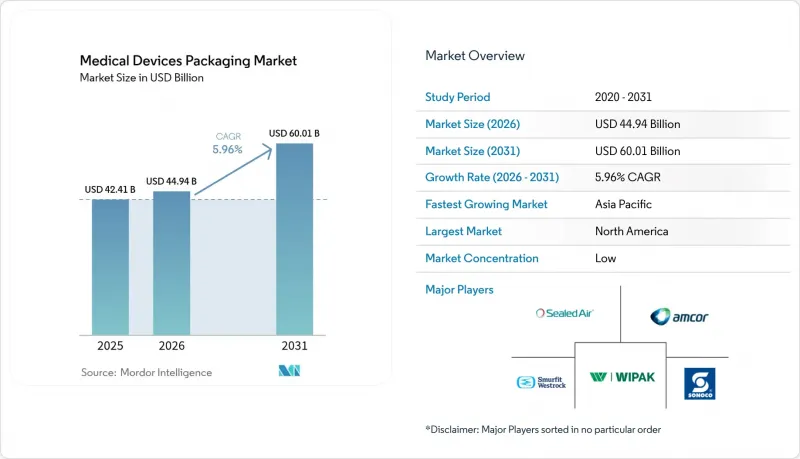
Mordor Intelligence에 의하면, 의료기기 포장 시장 규모는 2025년 424억 1,000만 달러로 평가되었습니다. 2026년에는 449억 4,000만 달러로 확대되어 2026-2031년에 걸쳐 CAGR 5.96%로 성장을 지속하여, 2031년에는 600억 1,000만 달러에 이를 것으로 예측됩니다.
본 보고서는 소재별(플라스틱, 종이 및 판지, 기타), 제품 유형별(파우치·백, 기타),용도별(멸균 포장, 비멸균 포장, 액티브·스마트 포장), 최종 사용자별(병원 및 클리닉, 진단·영상 센터, 기타), 포장 단계별(1차 포장, 2차 포장, 3차 포장), 지역별로 분류되어 있습니다. 시장 예측은 금액(미 달러) 기준으로 제시되어 있습니다.
세계의 의료기기 포장 시장 동향 및 인사이트
장기 보존 가능한 형태에 대한 수요 증가
팬데믹 대비 및 지방 지역으로의 의료 서비스 확대에 따라 재고 보충 주기가 장기화됨에 따라, 의료 종사자들은 5년에서 7년 동안 사용 가능한 의료기기를 요구하고 있습니다. 에틸렌 비닐 알코올(EVA)이나 메탈라이즈드 폴리에스터를 배합한 배리어 필름은 현재 이러한 장기 보존성을 실현하고 있으며,듀폰(DuPont)사가 2025년 코스타리카에서 시행할 확장 계획(무균 타이벡 팩 전용으로 1만 6,000제곱피트의 생산 공간 추가)은 우수한 차단 성능을 추구하는 전 세계적인 추세를 뒷받침합니다. 가속 열화 시험 및 실시간 안정성 시험이 표준화되고 있어, 구매 가격은 높아지더라도 소재 선택은 고품질 폴리머로 전환되고 있습니다.
저침습 기기 및 웨어러블 기기의 성장
새로운 복강경 기구와 커넥티드 웨어러블 기기는 복잡한 형태와 고감도 전자 부품을 갖추고 있어, 부드럽으면서도 무균 상태를 유지하는 보관 용기가 요구되고 있습니다. 소형 외과용 세트의 경우 맞춤형 형태의 캐비티를 갖춘 열성형 트레이가 주류를 이루고 있지만, 가정용을 염두에 둔 스마트 패치에는 온도 감응성 잉크가 내장된 유연한 파우치가 적합합니다. 또한, 포장 전문가들은 웨어러블 센서의 피부 안전성을 확보하기 위해 접착제 이동을 억제하는 노력을 기울이고 있으며, 이는 아시아태평양의 의료 기관에서 인터뷰에 응한 디바이스 통합 업체들이 지적한 과제이기도 합니다.
규제 준수에 따른 비용 부담
EU의 MDR(의료기기 규정)에 따라 각 포장 구성 요소가 생체 적합성, 가속 노화 시험, 유통 시뮬레이션 시험을 통과해야 하기 때문에 검증에 드는 비용이 25-30% 증가하고 있습니다. 소규모 컨버터 기업들은 검사 중복을 줄이기 위해 플랫폼 통합을 추진하고 있으나, 이로 인해 용도 적합성이 저하될 가능성이 있습니다. 이러한 복잡성으로 인해 고액의 보수를 받고 신청 서류 작성을 지원하는 틈새 컨설팅 부문이 호황을 누리고 있습니다.
부문별 분석
2025년, 플라스틱은 의료기기 포장 시장의 54.78%를 차지했으며, 이 부문은 2031년까지 연평균 성장률(CAGR) 7.88%로 성장을 주도하고 있습니다. 환상 올레핀 공중합체(COC)와 같은 첨단 고분자는 뒤틀림 없이 증기나 플라즈마를 이용한 멸균을 가능하게 하는 반면, 액정 고분자는 스마트 회로 내장 기능을 지원합니다. 그 결과, 의료기기 포장 시장에서는 1차 포장에서 기존 유리나 금속을 점차 대체하는 추세가 나타나고 있습니다. 판지는 차단 성능보다 비용 효율성이 우선시되는 2차 포장의 역할을 계속해서 담당하고 있습니다. 바이오 플라스틱은 수량 기준 5% 이하에 그치지만, 병원의 지속가능성 평가 기준과 아시아태평양이 바이오 폴리머의 거점으로 부상하고 있는 것을 배경으로 두 자릿수 성장을 기록하고 있습니다.
감마선 및 전자선 멸균을 견딜 수 있는 다층 필름에 대한 수요 증가가 미국과 말레이시아 전역에서 공압출 라인에 대한 설비 투자를 촉진하고 있습니다. 폴리머 공급업체들은 수직 통합을 활용하여 의료용 등급 수지의 순도를 보장하고, 검증된 배리어 시스템 분야에서 신뢰할 수 있는 파트너로서의 입지를 확고히 하고 있습니다. 이러한 추세에 따라 예측 기간 동안 의료기기 포장 시장에서 플라스틱의 압도적인 점유율이 유지될 것으로 예측됩니다.
파우치와 백은 일회용 제품 및 전자 카테터 등 폭넓은 용도에 대응할 수 있는 범용성 덕분에 2025년 매출의 35.88%를 차지했습니다. 그러나 정형외과 및 심혈관 치료용 키트의 복잡성이 증가함에 따라 경질 박스 및 카톤에 대한 수요가 높아지고 있으며, 이러한 형태 시장은 연평균 성장률(CAGR) 8.95%로 확대되고 있습니다. 그 결과, 외부의 강성과 내부의 무균성을 동시에 확보해야 하는 부문에서는 타이벡(Tyvek)으로 안감이 처리된 다층 카톤의 점유율이 확대되고 있습니다. 트레이는 섬세한 내시경에 여전히 필수적이며, 한편 열성형 블리스터는 진단 스트립 등 소형 제품을 확실하게 고정합니다.
외부 멸균 업체들 사이에서는 수술실로의 반입을 신속하게 할 수 있는 최적의 박리성을 갖춘 플랫 파우치에 대한 수요가 점점 더 높아지고 있습니다. 이와 병행하여, 카톤 공급업체들은 의료진이 밀봉을 뜯지 않고도 기구 세트를 확인할 수 있도록 투명 창을 적용하고 있습니다. 이러한 사용 편의성 개선은 의료기기 포장 시장에서 제품 유형의 다양화를 촉진하고 있습니다.
지역별 분석
2025년에는 미국의 견고한 의료기기 혁신 기반과 FDA의 명확한 검증 프로세스에 힘입어 북미가 35.11%의 점유율로 1위를 차지했습니다. 캐나다의 병원 현대화 프로그램은 비용 효율이 뛰어난 포장에 대한 수요를 끌어올리고 있는 반면, 멕시코의 마킬라도라 클러스터에서는 FDA와 COFEPRIS의 기준을 모두 충족하는 국경 간 포장 라인이 통합되어 있습니다. 자재 재활용 목표를 배경으로, 미국의 여러 병원 시스템에서 재활용 가능한 고밀도 폴리에틸렌 필름의 검사 운영이 진행되고 있으며, 이러한 노력은 Amcor사의 확대되는 폐쇄형 순환 프로젝트에 의해 지원되고 있습니다.
아시아태평양은 중국, 일본, 인도를 주축으로 연평균 성장률(CAGR) 10.31%를 기록하며 성장하고 있습니다. 중국의 의료기기 시장은 2,100억 달러에 달할 것으로 예측되며, 라벨 현지화 및 UDI 준수 인쇄에 대한 투자가 촉진됨에 따라 각 컨버터 기업들이 쑤저우 등 지방 거점으로 진출하고 있습니다. 일본의 인구 고령화에 따라 장기 보관이 가능한 파우치에 포장된 재택용 키트 수요가 확대되고 있습니다. 한편, 인도의 ‘메이크 인 인디아(Make in India)’ 정책에 따른 우대 조치로 인해 아메다바드 근교에 압출 성형 및 다이컷 생산 능력을 구축하는 합작 사업이 유치되고 있습니다.
유럽은 여전히 성숙한 시장이지만, 혁신이 원동력이 되고 있습니다. EU의 MDR(의료기기 규정)에 따라 다국어 표기 및 재활용 가능성 증명이 의무화되어 있으며, 독일의 정형외과 클러스터는 포장 연구소와 제휴하여 단일 소재 멸균 시스템의 시제품 개발을 진행하고 있습니다. 브렉시트 이후 시장 분화로 인해 EU 시장과 영국 시장을 모두 대상으로 하는 수출업체에게는 이중 인증이 요구되고 있습니다. 중동 및 아프리카에서는 걸프 국가들이 잇달아 신규 병원 건설을 발주함에 따라 꾸준한 성장을 보이고 있는 반면, 남미의 성장은 현재 현지 가공업체로부터 타이벡(Tyvek) 트레이를 조달하고 있는 브라질의 국내 심장박동기 제품 라인에 기인하고 있습니다.
기타 혜택
- 엑셀 형식 시장 예측(ME) 시트
- 3개월간의 애널리스트 지원
자주 묻는 질문
목차
제1장 서론
제2장 조사 방법
제3장 주요 요약
제4장 시장 구도
제5장 시장 규모 및 성장 예측
제6장 경쟁 구도
제7장 시장 기회 및 향후 전망
KTH 26.09.04According to Mordor Intelligence, the medical device packaging market size is expected to grow from USD 42.41 billion in 2025 to USD 44.94 billion in 2026 and is forecast to reach USD 60.01 billion by 2031 at 5.96% CAGR over 2026-2031.

This report is Segmented by Material (Plastics, Paper and Paperboard, and More), Product Type (Pouches and Bags, and More), Application (Sterile Packaging, Non-Sterile Packaging, Active/Smart Packaging), End User (Hospitals and Clinics, Diagnostic and Imaging Centers, and More ), Packaging Level (Primary, Secondary, Tertiary), and Geography. The Market Forecasts are Provided in Terms of Value (USD).
Global Medical Devices Packaging Market Trends and Insights
Rising Demand for Extended-Shelf-Life Formats
Healthcare providers want devices that remain usable for five to seven years because pandemic preparedness and rural outreach stretch replenishment cycles. Barrier films incorporating ethylene vinyl alcohol and metallized polyester now deliver that longevity, and DuPont's 2025 Costa Rica expansion-adding 16,000 ft2 solely for sterile Tyvek packs-underscores the global push for superior barriers. Accelerated-aging and real-time stability protocols are becoming routine, shifting material choice toward premium polymers despite higher purchase prices.
Growth in Minimally-Invasive and Wearable Devices
New laparoscopic tools and connected wearables feature complex geometries and sensitive electronics that require gentle yet sterile containment. Thermoformed trays with custom cavities dominate for small surgical sets, whereas flexible pouches embedded with temperature-sensitive inks suit smart patches destined for home use. Packaging scientists are also mitigating adhesive migration to ensure skin safety for wearable sensors, a challenge cited by device integrators interviewed across APAC clinics.
Regulatory Compliance Cost Burden
Validation outlays have risen 25-30% under the EU MDR because each pack configuration must pass biocompatibility, accelerated-aging, and distribution-simulation batteries. Smaller converters are consolidating platforms to curb test repetition, yet this can compromise application fit. The complexity fuels a niche consulting segment that guides dossier compilation at premium fees.
Other drivers and restraints analyzed in the detailed report include:
- Stricter Global Sterility Regulations
- Integration of RFID/UDI Smart-Label Traceability
- Volatile Medical-Grade Polymer Prices
For complete list of drivers and restraints, kindly check the Table Of Contents.
Segment Analysis
Plastics retained 54.78% of the medical device packaging market in 2025, and the segment leads growth with an 7.88% CAGR through 2031. Advanced polymers such as cyclic olefin copolymers enable steam and plasma sterilization without warping, whereas liquid-crystal polymers support smart circuitry embedment. As a result, the medical device packaging market records steady migration away from legacy glass and metal for primary packs. Paperboard continues in secondary roles where cost efficiency trumps barrier performance. Bio-based plastics, though under 5% of volume, post double-digit expansion riding on hospital sustainability scorecards and Asia-Pacific's emergence as a biopolymer hub.
Rising demand for multi-layer films that withstand gamma and e-beam sterilization fuels capital investment in co-extrusion lines across the United States and Malaysia. Polymer suppliers leverage vertical integration to guarantee medical-grade resin purity, positioning themselves as assured partners for validated barrier systems. These dynamics are expected to uphold plastics' commanding share of the medical device packaging market through the forecast horizon.
Pouches and bags delivered 35.88% of 2025 revenues owing to their versatility across single-use disposables and electronic catheters. However, kit complexity in orthopedic and cardiovascular interventions lifts demand for rigid boxes and cartons, causing this format to pace at a 8.95% CAGR. Consequently, multilayer cartons lined with Tyvek are gaining share where outer rigidity and inner sterility must coexist. Trays remain indispensable for delicate scopes, while thermoformed blisters secure small items such as diagnostic strips.
Third-party sterilizers increasingly request flat pouches equipped with optimized peelability that speeds operating-room presentation. In parallel, carton suppliers integrate transparent apertures so clinicians can verify instrument sets without breaking seals. These usability tweaks reinforce product-type diversification within the medical device packaging market.
Complete Report Scope:
- By Material
- Plastics
- Paper and Paperboard
- Metals and Foils
- Glass
- Bio-based Plastics
- By Product Type
- Pouches and Bags
- Trays
- Boxes and Cartons
- Blister Packs
- Other Product Types
- By Application
- Sterile Packaging
- Non-sterile Packaging
- Active / Smart Packaging
- By End User
- Hospitals and Clinics
- Diagnostic and Imaging Centers
- Home Healthcare
- Contract Manufacturing and Sterilization Orgs
- By Packaging Level
- Primary
- Secondary
- Tertiary
- By Geography
- North America
- United States
- Canada
- Mexico
- Europe
- Germany
- United Kingdom
- France
- Italy
- Spain
- Russia
- Rest of Europe
- Asia-Pacific
- China
- India
- Japan
- South Korea
- Australia and New Zealand
- Rest of Asia-Pacific
- Middle East and Africa
- Middle East
- United Arab Emirates
- Saudi Arabia
- Turkey
- Rest of Middle East
- Africa
- South Africa
- Nigeria
- Egypt
- Rest of Africa
- Middle East
- South America
- Brazil
- Argentina
- Rest of South America
- North America
Geography Analysis
North America led with 35.11% share in 2025, propelled by the United States' robust device innovation base and FDA's clear validation pathways. Canadian hospital-modernization programs boost demand for cost-effective packs, while Mexico's maquiladora clusters integrate cross-border packaging lines that meet both FDA and COFEPRIS standards. Material circularity targets drive trial runs of recyclable high-density polyethylene film across several US hospital systems, initiatives supported by Amcor's expanded closed-loop projects.
Asia-Pacific advances at a 10.31% CAGR, anchored by China, Japan, and India. China's forecast USD 210 billion device market prompts label-localization investments and UDI-compliant printing, drawing converters into provincial hubs such as Suzhou. Japan's ageing demographic multiplies the need for home-use kits preserved in long-life pouches, while India's Make-in-India incentives attract joint ventures that erect extrusion and die-cutting capacity near Ahmedabad.
Europe remains mature yet innovation-driven. The EU MDR compels multi-language labeling and proof of recyclability, and Germany's orthopedic cluster partners with packaging labs to prototype mono-material sterility systems. Post-Brexit divergence obliges dual certification for exporters targeting both EU and UK markets. The Middle East and Africa record steady gains as Gulf states commission new hospitals, whereas South America's growth stems from Brazil's domestic pacemaker lines that now source Tyvek trays from local converters.
- Amcor plc
- DuPont de Nemours Inc.
- Smurfit WestRock
- Mitsubishi Chemical Group
- Sonoco Products Company
- Technipaq Inc.
- SteriPack Group
- Riverside Medical Packaging
- Wipak Group
- 3M Company
- Sealed Air Corporation
- Constantia Flexibles
- Klockner Pentaplast Group
- Placon Corporation
- West Pharmaceutical Services
- Nelipak Healthcare Packaging
- Oliver Healthcare Packaging
- Tekni-Plex
- Multivac Group
Additional Benefits:
- The market estimate (ME) sheet in Excel format
- 3 months of analyst support
TABLE OF CONTENTS
1 INTRODUCTION
- 1.1 Study Assumptions and Market Definition
- 1.2 Scope of the Study
2 RESEARCH METHODOLOGY
3 EXECUTIVE SUMMARY
4 MARKET LANDSCAPE
- 4.1 Market Overview
- 4.2 Market Drivers
- 4.2.1 Rising demand for extended-shelf-life formats
- 4.2.2 Growth in minimally-invasive and wearable devices
- 4.2.3 Stricter global sterility regulations (ISO 11607, EU MDR, FDA)
- 4.2.4 Integration of RFID/UDI smart-label traceability
- 4.2.5 Carbon-footprint disclosure pushing mono-materials
- 4.2.6 Expansion of outsourced contract sterilization networks
- 4.3 Market Restraints
- 4.3.1 Regulatory compliance cost burden
- 4.3.2 Volatile medical-grade polymer prices
- 4.3.3 Scarcity of bio-based and PCR resins
- 4.3.4 Cold-chain e-commerce seal-failure recalls
- 4.4 Supply-Chain Analysis
- 4.5 Regulatory Landscape
- 4.6 Technological Outlook
- 4.7 Sustainability Trends and LCA Impact
- 4.8 Porter's Five Forces Analysis
- 4.8.1 Bargaining Power of Suppliers
- 4.8.2 Bargaining Power of Buyers
- 4.8.3 Threat of New Entrants
- 4.8.4 Threat of Substitutes
- 4.8.5 Competitive Rivalry
5 MARKET SIZE AND GROWTH FORECASTS (VALUE)
- 5.1 By Material
- 5.1.1 Plastics
- 5.1.2 Paper and Paperboard
- 5.1.3 Metals and Foils
- 5.1.4 Glass
- 5.1.5 Bio-based Plastics
- 5.2 By Product Type
- 5.2.1 Pouches and Bags
- 5.2.2 Trays
- 5.2.3 Boxes and Cartons
- 5.2.4 Blister Packs
- 5.2.5 Other Product Types
- 5.3 By Application
- 5.3.1 Sterile Packaging
- 5.3.2 Non-sterile Packaging
- 5.3.3 Active / Smart Packaging
- 5.4 By End User
- 5.4.1 Hospitals and Clinics
- 5.4.2 Diagnostic and Imaging Centers
- 5.4.3 Home Healthcare
- 5.4.4 Contract Manufacturing and Sterilization Orgs
- 5.5 By Packaging Level
- 5.5.1 Primary
- 5.5.2 Secondary
- 5.5.3 Tertiary
- 5.6 By Geography
- 5.6.1 North America
- 5.6.1.1 United States
- 5.6.1.2 Canada
- 5.6.1.3 Mexico
- 5.6.2 Europe
- 5.6.2.1 Germany
- 5.6.2.2 United Kingdom
- 5.6.2.3 France
- 5.6.2.4 Italy
- 5.6.2.5 Spain
- 5.6.2.6 Russia
- 5.6.2.7 Rest of Europe
- 5.6.3 Asia-Pacific
- 5.6.3.1 China
- 5.6.3.2 India
- 5.6.3.3 Japan
- 5.6.3.4 South Korea
- 5.6.3.5 Australia and New Zealand
- 5.6.3.6 Rest of Asia-Pacific
- 5.6.4 Middle East and Africa
- 5.6.4.1 Middle East
- 5.6.4.1.1 United Arab Emirates
- 5.6.4.1.2 Saudi Arabia
- 5.6.4.1.3 Turkey
- 5.6.4.1.4 Rest of Middle East
- 5.6.4.2 Africa
- 5.6.4.2.1 South Africa
- 5.6.4.2.2 Nigeria
- 5.6.4.2.3 Egypt
- 5.6.4.2.4 Rest of Africa
- 5.6.4.1 Middle East
- 5.6.5 South America
- 5.6.5.1 Brazil
- 5.6.5.2 Argentina
- 5.6.5.3 Rest of South America
- 5.6.1 North America
6 COMPETITIVE LANDSCAPE
- 6.1 Market Concentration
- 6.2 Strategic Moves
- 6.3 Market Share Analysis
- 6.4 Company Profiles (includes Global level Overview, Market level overview, Core Segments, Financials as available, Strategic Information, Market Rank/Share, Products and Services, Recent Developments)
- 6.4.1 Amcor plc
- 6.4.2 DuPont de Nemours Inc.
- 6.4.3 Smurfit WestRock
- 6.4.4 Mitsubishi Chemical Group
- 6.4.5 Sonoco Products Company
- 6.4.6 Technipaq Inc.
- 6.4.7 SteriPack Group
- 6.4.8 Riverside Medical Packaging
- 6.4.9 Wipak Group
- 6.4.10 3M Company
- 6.4.11 Sealed Air Corporation
- 6.4.12 Constantia Flexibles
- 6.4.13 Klockner Pentaplast Group
- 6.4.14 Placon Corporation
- 6.4.15 West Pharmaceutical Services
- 6.4.16 Nelipak Healthcare Packaging
- 6.4.17 Oliver Healthcare Packaging
- 6.4.18 Tekni-Plex
- 6.4.19 Multivac Group
7 MARKET OPPORTUNITIES AND FUTURE OUTLOOK
- 7.1 White-space and Unmet-need Assessment


