

|
시장보고서
상품코드
2120532
의약품 막 여과 : 시장 점유율 분석, 업계 동향 및 통계, 성장 예측(2026-2031년)Pharmaceutical Membrane Filtration - Market Share Analysis, Industry Trends & Statistics, Growth Forecasts (2026 - 2031) |
||||||
 Mordor Intelligence
Mordor Intelligence에 의하면, 의약품 막 여과 시장 규모는 2025년 124억 1,000만 달러로 평가되었습니다. 2026년에는 135억 8,000만 달러로 확대되어 2026년부터 2031년에 걸쳐 CAGR 9.43%로 성장을 지속하여, 2031년에는 213억 1,000만 달러에 이를 것으로 예측됩니다.
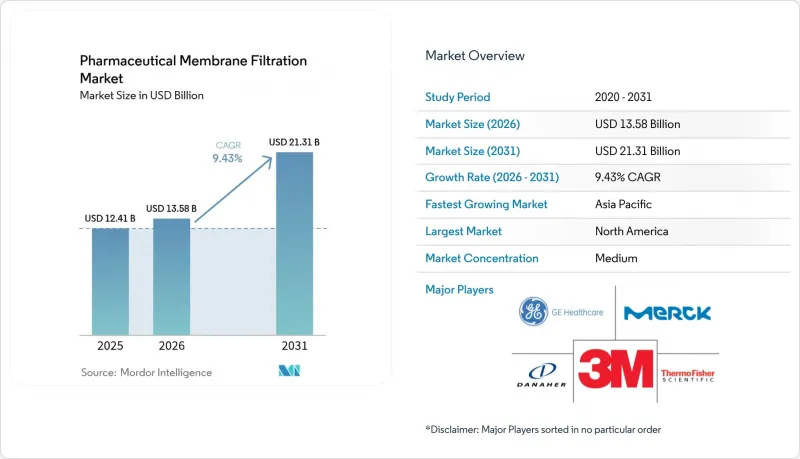
본 보고서는 소재(폴리에테르설폰, 폴리비닐리덴플루오라이드 등), 기술(정밀 여과 등), 공정 단계(최종 제품의 무균 여과 등), 규모(실험실 규모 등), 지역(북미, 유럽, 아시아태평양, 중동 및 아프리카, 남미)별로 분류되어 있습니다. 시장 전망은 금액(미 달러) 기준으로 제시되어 있습니다.
세계의 의약품 막 여과 시장 동향 및 인사이트
일회용 기술의 채택 확대
일회용 여과 어셈블리는 교체 시간을 최대 50% 단축하고 세척 검증 절차를 불필요하게 만들기 때문에 현대 바이오의약품 제조 시설의 핵심을 이루고 있습니다. 중공사 탄젠셜 플로우 설계와의 호환성 덕분에 제조업체는 기존 라인을 신속하게 개조할 수 있습니다. 유연한 백형 시스템을 통해 맞춤형 치료를 위한 병렬 생산이 가능해지는 한편, 내장 센서는 FDA가 요구하는 지속적인 모니터링 요건을 충족하는 중요한 품질 데이터를 전송합니다. 유틸리티 및 인건비 절감에 더해, 경량 구조 재료의 채택으로 폐기물량도 감소하므로 비용 측면의 이점이 커지고 있습니다. 유전자 치료제 생산량이 확대되는 가운데, 엔도톡신을 99.999% 이상 제거할 수 있는 일회용 카트리지를 통해 제품 간 교차 오염 위험 없이 배치의 신속한 전환이 가능해집니다. 이 모델은 현장에서의 신속한 전개와 급증하는 수요에 대응할 수 있는 능력이 요구되는 팬데믹 대응 전략에도 부합합니다.
생물학적 제제 및 유전자 치료 파이프라인의 확대
세계 바이오의약품 파이프라인은 1만 건 이상의 진행 중인 프로그램을 넘어섰으며, 각각 6 log10 이상의 감축 요건을 충족하는 견고한 바이러스 여과가 필요합니다. 플라스미드 DNA와 바이러스 벡터는 고점도 부하를 유발하므로, 전단에 의한 분해를 방지하기 위해 최적화된 기공 형상을 가진 막에 대한 수요가 증가하고 있습니다. 아사히카세이의 ‘Planova FG1’은 7배 높은 투과율을 실현하여, 보유 성능을 저하시키지 않으면서 공정 시간을 단축합니다. 개정된 Q5A(R2) 지침은 위험 기반 검증(risk-based validation)을 권장하고 있으며, 신속한 상용화를 지원하는 용도 특화형 필터 개발을 촉진하고 있습니다. 이러한 추세는 mRNA 백신 분야로도 확대되고 있으며, 취약한 지질 나노입자를 보호하기 위해 저결합 조건에서 정제 및 멸균을 수행해야 합니다.
막대한 설비 투자
스키드, 분석 장비, 검증 비용을 포함하면 상업 규모의 여과 설비 비용은 1,000만 달러 이상에 달하며, 이는 중소기업 및 CDMO에게 장벽이 되고 있습니다. PAT 센서 통합으로 인해 데이터 히스토리언 및 사이버 보안 계층의 인증이 필요해짐에 따라 지출은 더욱 증가합니다. 신흥 시장의 제조업체들은 자금 확보를 위해 보조금이나 파트너십에 의존하는 경우가 많으며, 환율 변동으로 인해 예산이 압박받을 가능성이 있습니다. 서모피셔(Thermo Fisher)가 Solventum사를 41억 달러에 인수한 것은 정제 기술 분야에서 경쟁력을 유지하기 위해 필요한 투자 규모가 얼마나 큰지를 보여줍니다. 다국적 기업들은 지역별로 시험 프로토콜을 중복하여 구축해야 하므로, 중복된 설비에 묶여 있는 자본이 급증하고 있습니다.
부문 분석
2025년, 의약품 막 여과 시장에서 PES는 32.35%를 차지했으며, 그 높은 내약성 및 낮은 단백질 결합성이 높이 평가받고 있습니다. 그 친수성 덕분에 211 mL/분의 유속에 대응하면서도 단백질 흡착률을 1% 미만으로 억제할 수 있어, mAb 정제에서 안정적인 수율을 실현합니다. 표면 설폰화 및 PEG 그래프트화를 통해 친수성이 더욱 높아지고, 수명이 연장되며, 파울링이 억제됩니다.
PVDF는 PFAS에 대한 엄격한 감시가 있음에도 불구하고 추출물이 적고 최종 충전 라인에 적합하기 때문에 연평균 성장률(CAGR) 9.73%를 나타낼 것으로 예측됩니다. 규제상의 불확실성으로 인해 공급업체들은 PFAS가 포함되지 않은 제품을 개발하도록 촉구받고 있지만, 사용자들은 SIP(Steam-in-Place) 사이클에서 PVDF의 열적 안정성을 중요하게 여기고 있습니다. 혼합 셀룰로오스 에스테르, 나일론 및 폴리프로필렌으로 만들어진 멤브레인은 극도로 높은 견고성이 필수적이지 않은 틈새 실험실용도나 비용 효율을 중시하는 작업에 적합합니다. 비교 연구에 따르면, PES는 높은 고형분 부하에서도 투과성을 유지하는 반면, PVDF는 흡착성이 낮은 무균 여과에 탁월합니다. 각 제조업체는 점점 더 엄격해지는 용출물 기준을 충족하고, 보관 기간 동안 제품의 순도를 유지하는 초순도 등급 개발에 주력하고 있습니다.
미세여과는 세포 회수 및 바이오버든 저감 분야에서 확고한 용도로 자리 잡으며, 2025년에는 매출 점유율의 43.75%를 차지했습니다. 직렬 저항 모델을 통해 정확한 스케일업이 가능해져, 파일럿 데이터가 제조 공정에 확실하게 반영됩니다. 연속 미세여과와 교대 접선 유동을 결합함으로써, 강화된 피드 배치 배양에서 수확 수치가 향상됩니다. 나노여과는 높은 유량 조건에서 바이러스 제거가 필요한 백신 및 유전자 치료 파이프라인을 배경으로, 연평균 성장률(CAGR) 12.45%로 성장할 전망입니다.
2차원 소재를 이용한 코팅은 20 nm의 기공 크기로 인한 배제 성능을 저해하지 않으면서 투수성을 높여, 6 log10 이상의 바이러스 제거를 가능하게 합니다. 스케일다운 장치는 최적의 pH 및 전도도 범위를 파악하는 데 도움이 되며, 매개변수를 조정함으로써 처리량을 900% 향상시킵니다. 한외여과는 완충액 교환 및 단백질 농축에 여전히 필수적인 반면, 역삼투는 주사용 제제 시스템의 수처리를 담당하고 있습니다.
지역별 분석
북미는 2025년 의약품 막 여과 시장에서 36.10%의 점유율을 유지했습니다. 이는 바이오의약품 제조 시설의 밀집된 네트워크와 명확한 지침을 바탕으로 첨단 제조를 장려하는 FDA의 존재에 힘입은 결과입니다. 팬데믹 대응을 위한 연방 정부의 인센티브로 인해 대용량 일회용 시스템 및 연속 생산 라인에 대한 투자가 지속되고 있습니다. 유럽은 이에 근소한 차이로 뒤를 잇고 있습니다. 이는 제조업체에 PUPSIT 및 자동화된 무결성 검사의 도입을 의무화하는 부속서 1의 개정이 원동력이 되고 있습니다. 각 기업은 엄격한 감사 요건에 대응하기 위해 바이러스 필터 및 데이터 수집 기능이 뛰어난 스키드에 대한 투자를 추진하고 있습니다.
아시아태평양은 각국 정부가 생명공학 허브에 자금을 투입하고 있어, 2031년까지 연평균 성장률(CAGR) 11.23%로 성장할 전망입니다. Cytiva사의 1억 5,000만 달러 규모의 한국 거점과 MilliporeSigma사의 대전 소재 3억 유로 규모의 공장은 이 지역의 부상을 보여주는 사례이며, 무균 필터 및 일회용 키트의 현지 공급을 통해 물류 체인을 단축하고 있습니다. 중국과 인도에서는 GMP 준수가 강화되고 있으며, 중국 바이오 매니저의 90% 가까이, 인도 바이오 매니저의 100%가 세계 시장 진출을 목표로 하고 있습니다. 라틴아메리카와 중동에서는 경제 다각화를 도모하기 위해 CDMO를 적극적으로 유치하고 있는 브라질과 사우디아라비아를 필두로 꾸준한 진전이 보이고 있습니다. ICH 가이드라인의 조화를 통해 기술 이전이 원활해짐에 따라, 세계 기업들은 여러 대륙에 동일한 여과 라인을 도입할 수 있게 되었습니다.
기타 혜택 :
- 엑셀 형식 시장 예측(ME) 시트
- 3개월간의 애널리스트 지원
자주 묻는 질문
목차
제1장 서론
제2장 조사 방법
제3장 주요 요약
제4장 시장 구도
제5장 시장 규모 및 성장 예측
제6장 경쟁 구도
제7장 시장 기회 및 향후 전망
KTH 26.09.10According to Mordor Intelligence, the pharmaceutical membrane filtration market size is expected to grow from USD 12.41 billion in 2025 to USD 13.58 billion in 2026 and is forecast to reach USD 21.31 billion by 2031 at 9.43% CAGR over 2026-2031.
This report is Segmented by Material (Polyethersulfone, Polyvinylidene Difluoride, and More), Technique (Microfiltration, and More), Process Stage (Final Product Sterile-Filtration, and More), Scale (Laboratory, and More), and Geography (North America, Europe, Asia-Pacific, Middle East and Africa, South America). The Market Forecasts are Provided in Terms of Value (USD).
Global Pharmaceutical Membrane Filtration Market Trends and Insights
Increasing Adoption of Single-Use Technologies
Single-use filtration assemblies shorten change-over times by up to 50% and remove cleaning validation, making them a central pillar of modern biologics facilities. Compatibility with hollow-fiber tangential-flow designs lets producers retrofit legacy lines quickly. Flexible bag-based systems permit parallel campaigns for personalized therapies, while built-in sensors transmit critical quality data that satisfy FDA expectations for continuous monitoring. Cost advantages rise as utilities and labor shrink, and waste volumes decline thanks to lighter construction materials. As gene therapy volumes scale, single-use cartridges rated to >99.999% endotoxin removal enable rapid batch turnaround without risking cross-product carryover. The model aligns with pandemic-preparedness strategies that require fast site deployment and surge capacity.
Expansion of Biologics & Gene Therapy Pipelines
The global biologics pipeline surpasses 10,000 active programs, each requiring robust virus filtration that meets >6 log10 reduction mandates. Plasmid DNA and viral vectors impose high-viscosity loads that spur demand for membranes with optimized pore geometry to avoid shear-induced degradation.Asahi Kasei's Planova FG1 delivers seven-fold higher flux, cutting process time without compromising retention. Updated Q5A(R2) guidance promotes risk-based validation, encouraging application-specific filter development that supports rapid commercialization. The trend extends to mRNA vaccines, where clarification and sterilization must proceed under low binding conditions to protect fragile lipid nanoparticles.
High Capital Investment
Commercial-scale filtration suites cost upward of USD 10 million once skids, analytics, and validation are included, a hurdle for small firms and CDMOs. Integration of PAT sensors raises spending further because data historians and cybersecurity layers must be certified. Emerging-market manufacturers often rely on subsidies or partnerships to secure funding, and currency fluctuations can erode budgets. Thermo Fisher's USD 4.1 billion Solventum purchase shows the size of bets required to stay competitive in purification technology. Multinational companies must duplicate test protocols across regions, swelling capital tied up in duplicate equipment.
Other drivers and restraints analyzed in the detailed report include:
- Stringent Regulatory Requirements
- Advancements in Nanofiltration Technology
- Membrane Fouling Issues & Reduced Lifecycle
For complete list of drivers and restraints, kindly check the Table Of Contents.
Segment Analysis
PES accounted for 32.35% of the pharmaceutical membrane filtration market in 2025, favored for high chemical resistance and low protein binding. Its hydrophilic nature supports 211 mL/min flow rates with protein adsorption below 1%, enabling consistent yields in mAb purification. Surface sulfonation and PEG grafting deepen hydrophilicity, stretch lifespan, and limit fouling.
PVDF is projected to grow at 9.73% CAGR despite PFAS scrutiny, owing to its low extractables and suitability for final fill lines. Regulatory uncertainty encourages suppliers to devise PFAS-free variants, but users value PVDF's thermal stability for steam-in-place cycles. Mixed cellulose ester, nylon, and polypropylene membranes satisfy niche lab or cost-sensitive tasks where extreme robustness is not essential. Comparative studies find PES retains permeability under high solids loads while PVDF excels in low-binding sterile filtration. Manufacturers target ultraclean grades that meet ever tighter leachables limits, preserving product purity throughout storage.
Microfiltration held 43.75% revenue share in 2025 due to entrenched use for cell harvesting and bioburden reduction. Resistance-in-series models allow accurate scale-up, ensuring pilot data translate to manufacturing. Continuous microfiltration combined with alternating tangential flow lifts harvest titers for intensified fed-batch cultures. Nanofiltration is set to rise at 12.45% CAGR on the back of vaccine and gene therapy pipelines demanding virus removal under high flux.
Two-dimensional material coatings raise water permeability without sacrificing 20 nm pore exclusion, facilitating >6 log10 virus clearance. Scale-down rigs help define optimal pH and conductivity windows, driving 900% throughput gains when parameters are tuned. Ultrafiltration remains vital for buffer exchange and protein concentration, whereas reverse osmosis handles water treatment for injection systems.
Complete Report Scope:
- By Material
- Polyethersulfone (PES)
- Polyvinylidene Difluoride (PVDF)
- Mixed Cellulose Ester & Cellulose Acetate (MCE & CA)
- Nylon
- Polypropylene & Others
- By Technique
- Microfiltration
- Ultrafiltration
- Nanofiltration
- Reverse-Osmosis & Others
- By Process Stage
- Final Product Sterile-filtration
- Bulk Drug Substance Clarification
- Cell Separation & Harvesting
- Water & Utility Filtration
- Air/Gas Filtration
- By Scale
- Laboratory
- Pilot
- Commercial Production
- By Geography
- North America
- United States
- Canada
- Mexico
- Europe
- Germany
- United Kingdom
- France
- Italy
- Spain
- Rest of Europe
- Asia-Pacific
- China
- Japan
- India
- Australia
- South Korea
- Rest of Asia-Pacific
- Middle East & Africa
- GCC
- South Africa
- Rest of Middle East & Africa
- South America
- Brazil
- Argentina
- Rest of South America
- North America
Geography Analysis
North America retained 36.10% share of the pharmaceutical membrane filtration market in 2025, powered by a dense network of biologics plants and an FDA that endorses advanced manufacturing with clear guidance. Federal incentives for pandemic preparedness sustain spending on high-capacity single-use systems and continuous lines. Europe follows closely, driven by Annex 1 revisions that compel producers to adopt PUPSIT and automated integrity checks. Firms invest in virus filters and data-rich skids to navigate stringent audit expectations.
Asia-Pacific is set to grow at 11.23% CAGR through 2031 as governments pour funds into biotech hubs. Cytiva's USD 150 million Korean site and MilliporeSigma's EUR 300 million plant in Daejeon signal the region's ascent, offering local supply of sterile filters and single-use kits that shorten logistics chains. China and India increase GMP adherence, with close to 90% of Chinese and 100% of Indian biomanagers targeting global market entry. Latin America and the Middle East make incremental progress, led by Brazil and Saudi Arabia, which court CDMOs to diversify their economies. Harmonization of ICH guidelines eases technology transfer, enabling global firms to deploy identical filtration trains across multiple continents.
- 3M
- Danaher
- Merck
- Sartorius
- Thermo Fisher Scientific
- Parker Hannifin
- Repligen
- GEA Group
- Graver Technologies
- GE Healthcare
- Meissner Filtration
- Alfa Laval
- Cobetter Filtration
- Amazon Filters
- Porvair Filtration Group
- Novasep
- Donaldson Company
- Asahi Kasei
- Tami Industries
- Cole-Parmer
Additional Benefits:
- The market estimate (ME) sheet in Excel format
- 3 months of analyst support
TABLE OF CONTENTS
1 Introduction
- 1.1 Study Assumptions & Market Definition
- 1.2 Scope of the Study
2 Research Methodology
3 Executive Summary
4 Market Landscape
- 4.1 Market Overview
- 4.2 Market Drivers
- 4.2.1 Increasing Adoption of Single-Use Technologies
- 4.2.2 Expansion of Biologics & Gene Therapy Pipelines
- 4.2.3 Stringent Regulatory Requirements
- 4.2.4 Advancements in Nanofiltration Technology
- 4.2.5 Rising R&D Investments
- 4.2.6 Expanding Pharmaceutical Manufacturing in Emerging Markets
- 4.3 Market Restraints
- 4.3.1 High Capital Investment
- 4.3.2 Membrane Fouling Issues & Reduced Lifecycle
- 4.3.3 Complexity in Integration
- 4.3.4 Limited Awareness in Developing Regions
- 4.4 Porter's Five Forces Analysis
- 4.4.1 Threat of New Entrants
- 4.4.2 Bargaining Power of Buyers
- 4.4.3 Bargaining Power of Suppliers
- 4.4.4 Threat of Substitutes
- 4.4.5 Intensity of Competitive Rivalry
5 Market Size & Growth Forecasts (Value in USD)
- 5.1 By Material
- 5.1.1 Polyethersulfone (PES)
- 5.1.2 Polyvinylidene Difluoride (PVDF)
- 5.1.3 Mixed Cellulose Ester & Cellulose Acetate (MCE & CA)
- 5.1.4 Nylon
- 5.1.5 Polypropylene & Others
- 5.2 By Technique
- 5.2.1 Microfiltration
- 5.2.2 Ultrafiltration
- 5.2.3 Nanofiltration
- 5.2.4 Reverse-Osmosis & Others
- 5.3 By Process Stage
- 5.3.1 Final Product Sterile-filtration
- 5.3.2 Bulk Drug Substance Clarification
- 5.3.3 Cell Separation & Harvesting
- 5.3.4 Water & Utility Filtration
- 5.3.5 Air/Gas Filtration
- 5.4 By Scale
- 5.4.1 Laboratory
- 5.4.2 Pilot
- 5.4.3 Commercial Production
- 5.5 By Geography
- 5.5.1 North America
- 5.5.1.1 United States
- 5.5.1.2 Canada
- 5.5.1.3 Mexico
- 5.5.2 Europe
- 5.5.2.1 Germany
- 5.5.2.2 United Kingdom
- 5.5.2.3 France
- 5.5.2.4 Italy
- 5.5.2.5 Spain
- 5.5.2.6 Rest of Europe
- 5.5.3 Asia-Pacific
- 5.5.3.1 China
- 5.5.3.2 Japan
- 5.5.3.3 India
- 5.5.3.4 Australia
- 5.5.3.5 South Korea
- 5.5.3.6 Rest of Asia-Pacific
- 5.5.4 Middle East & Africa
- 5.5.4.1 GCC
- 5.5.4.2 South Africa
- 5.5.4.3 Rest of Middle East & Africa
- 5.5.5 South America
- 5.5.5.1 Brazil
- 5.5.5.2 Argentina
- 5.5.5.3 Rest of South America
- 5.5.1 North America
6 Competitive Landscape
- 6.1 Market Concentration
- 6.2 Market Share Analysis
- 6.3 Company Profiles (includes Global level Overview, Market level overview, Core Segments, Financials as available, Strategic Information, Market Rank/Share for key companies, Products & Services, and Recent Developments)
- 6.3.1 3M Company
- 6.3.2 Danaher
- 6.3.3 Merck KGaA
- 6.3.4 Sartorius Stedim Biotech
- 6.3.5 Thermo Fisher Scientific
- 6.3.6 Parker Hannifin
- 6.3.7 Repligen Corporation
- 6.3.8 GEA Group
- 6.3.9 Graver Technologies
- 6.3.10 GE Healthcare
- 6.3.11 Meissner Filtration
- 6.3.12 Alfa Laval
- 6.3.13 Cobetter Filtration
- 6.3.14 Amazon Filters
- 6.3.15 Porvair Filtration Group
- 6.3.16 Novasep
- 6.3.17 Donaldson Company
- 6.3.18 Asahi Kasei
- 6.3.19 Tami Industries
- 6.3.20 Cole-Parmer
7 Market Opportunities & Future Outlook
- 7.1 White-Space & Unmet-Need Assessment


