

|
시장보고서
상품코드
2120583
분산형 발전 : 시장 점유율 분석, 업계 동향 및 통계, 성장 예측(2026-2031년)Distributed Power Generation - Market Share Analysis, Industry Trends & Statistics, Growth Forecasts (2026 - 2031) |
||||||
 Mordor Intelligence
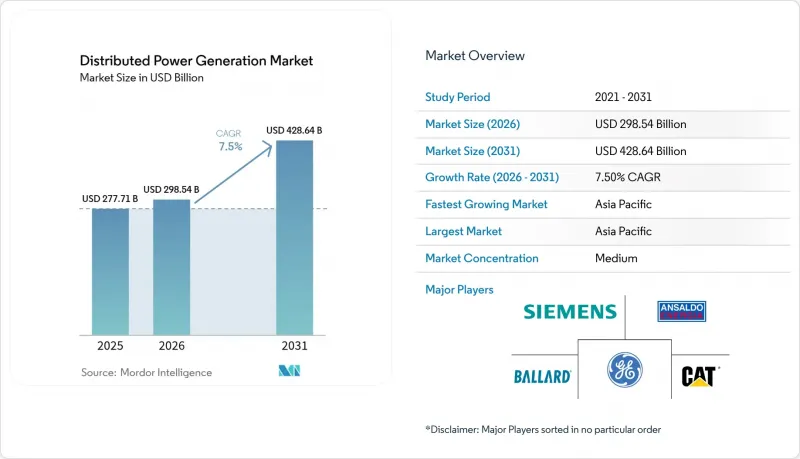
Mordor Intelligence에 의하면, 분산형 발전 시장 규모는 2025년 2,777억 1,000만 달러로 평가되었습니다. 2026년에는 2,985억 4,000만 달러로 확대되어 2026-2031년에 걸쳐 CAGR 7.5%로 성장을 지속하여, 2031년에는 4,286억 4,000만 달러에 이를 것으로 예측됩니다.
본 보고서는 기술별(태양광 발전, 풍력 터빈, 가스 터빈, 디젤 발전기, 연료전지, 기타), 정격 출력별(0-100kW, 101-1,000kW, 1,000kW 이상), 연료 유형별(재생 가능, 비재생 가능), 연결 방식별(온그리드, Off-grid·원격지), 최종 사용자별(주택, 통신·데이터센터, 기타), 지역별(북미, 유럽, 아시아태평양, 남미, 중동 및 아프리카)로 분류되어 있습니다.
세계의 분산형 발전 시장 동향 및 인사이트
아시아 소규모 태양광 발전의 LCOE 급격한 하락
2024년, 중국의 TOPCon 모듈 가격은 1와트당 0.16달러까지 하락했으며, 이로 인해 지역 전체의 균등화 발전 원가(LCOE)가 낮아지면서 분산형 발전의 경제성이 재구축되었습니다. 설치 작업의 표준화, 저비용 인버터, 우대 금융이 이러한 효과를 더욱 증폭시켜, 아시아태평양은 소규모 태양광 발전의 세계적 벤치마크로서의 위상을 확립하고 있습니다. 각국 정부는 인허가 절차와 계통 연계 규정을 합리화하여 프로젝트 주기를 더욱 단축하고 있습니다. 이러한 가격 압박으로 인해 다른 지역공급업체들은 효율성이나 용도에 특화된 설계를 통해 차별화를 꾀할 수밖에 없게 되었습니다.
유럽 내 상업 및 산업(C·I)용 계량기 후방 설치의 급속한 확대
유럽 기업들은 변동이 심한 도매 가격에 대한 헤지 및 기업의 탈탄소화 공약 달성을 위해 현장 발전을 가속화하고 있습니다. 독일에서는 2026년부터 신축 상업용 건물에 태양광 발전 설비 설치를 의무화하는 EU 규정에 따라 옥상 설치 건수가 사상 최고치를 기록하고 있으며, 2028년까지는 기존 건물의 개보수 대상도 확대될 예정입니다. 태양광 발전과 결합된 배터리 저장 시스템을 통해 부하 평준화 및 부가 서비스 수익 창출이 가능해지면서, 분산형 자산은 경제적·환경적 도구로 자리 잡고 있습니다. 북미 기업들도 연방 정부의 세제 혜택 및 각 주의 청정 에너지 의무화 정책에 힘입어 이러한 모델을 따르고 있습니다.
신흥국 내 배전망 상호 연결의 장벽
세계 계통 연계 대기 목록에 있는 재생에너지 용량은 3,000GW를 초과하며, 신청 건의 80%는 비용 급등이나 장기간에 걸친 조사를 이유로 철회되고 있습니다. 신흥국의 송전망에는 최신 기준이나 인력이 부족하기 때문에 소규모 프로젝트는 불균형할 정도로 큰 지연에 직면하고 있습니다. “준비가 된 순서대로 우선순위를 부여한다”는 개혁이 추진되고 있지만, 선진 시장 이외의 지역에서는 진전이 여전히 더뎌 단기적인 도입을 제약하고 있습니다.
부문별 분석
태양광 발전 부문은 간소화된 설치 키트와 인버터 키트를 활용하는 주택 및 소규모 상업용 옥상 설치를 주축으로, 2025년 매출의 34.62%를 차지했습니다. 2025년 분산형 발전 시장 규모에서 태양광 발전이 차지한 점유율은 961억 3,000만 달러였습니다. 현재 규모는 작지만, 연료전지는 11.25%라는 가장 높은 CAGR을 기록하고 있으며, 이는 디젤 연료에 의존하지 않는 가동 시간을 요구하는 데이터센터 캠퍼스 내 프로젝트가 주도하고 있습니다. 캐터필러는 와이오밍주의 하이퍼스케일 시설을 위해 99.999%라는 서비스 수준 목표를 달성한 1.5MW 수소 연료전지 백업 시스템의 검증을 성공적으로 마쳤습니다. 풍력 마이크로터빈과 왕복동식 가스 엔진도 구성 요소 중 하나이며, 토지 이용 효율과 열전병급 능력을 중시하는 틈새 시설에 도입되고 있습니다. 현재 경쟁의 초점은 단일 발전 하드웨어 자체가 아니라, 에너지 저장 시스템 및 전력 전자 장치의 통합에 있습니다.
0-100kW 범위에 속하는 가정용 및 소규모 사업용 시스템은 2025년 수요의 46.28%를 차지하며, 키트 형태의 조달 및 턴키 설치 모델이 반영되었습니다. 이 부문은 대수 기준으로 분산형 발전 시장에서 가장 큰 점유율을 차지했습니다. 이와 대조적으로 1,000kW를 초과하는 솔루션은 산업단지가 송전망의 제약을 피하기 위해 현장 발전을 선택함에 따라 2031년까지 연평균 성장률(CAGR) 9.85%를 기록할 전망입니다. 각 벤더사는 디지털 트윈 및 O&M(운영·유지보수) 분석을 활용하여 전력 회사의 요금 체계에 맞추어 발전 최적화를 수행함으로써 차별화를 꾀하고 있습니다. 중규모인 101-1,000kW 패키지는 병원이나 대학 캠퍼스용으로 제공되며, 표준화된 스키드와 제한적인 맞춤형 설계의 균형을 맞추고 있습니다.
지역별 분석
아시아태평양은 2025년에 매출 점유율 43.55%를 차지하며 분산형 발전 시장을 주도했으며, 2031년까지 연평균 성장률(CAGR) 10.7%라는 가장 높은 성장률을 지속적으로 유지하고 있습니다. 이 지역의 주도적 지위는 대량 생산된 태양광 모듈, 광범위한 정책 인센티브, 급증하는 전력 수요에 의해 뒷받침되고 있습니다. 2024년에는 중국의 옥상 태양광 발전 프로그램만으로도 50GW가 넘는 신규 발전 용량이 실현된 반면, 인도의 배전 사업자들은 옥상 설비를 통합하여 가상 발전소를 구축하고 있습니다. 동남아시아의 일부 정부는 순계량제(net metering) 제도를 공식적으로 도입하여 계량기 뒤편 투자를 촉진하고 있습니다.
북미는 절대값 기준으로 2위를 차지하고 있으며, 풍부한 천연가스 공급과 유리한 세액 공제 혜택을 모두 갖추고 있습니다. 미시간주에서 아메리칸 머니시펄 파워(American Municipal Power)가 운영하는 20MW 규모의 ‘계량기 뒤편’ 프로그램은 지방 자치단체 전력 사업자가 피크 부하 완화를 위해 지역 발전을 활용하는 전형적인 사례입니다. 30개 주에서 제정된 재생에너지 포트폴리오 기준이 학교 및 공공시설에서의 태양광 발전과 에너지 저장 시스템의 결합을 촉진하고 있습니다. 버지니아주, 텍사스주, 앨버타주의 데이터센터 집적지에서는 듀얼 연료 엔진 및 수소 대응 엔진의 조기 도입이 진행되고 있어, 해당 지역 수요 동향을 더욱 끌어올리고 있습니다.
유럽의 분산형 전략은 지정학적 요인으로 인한 가스 공급 혼란에 대응하여 에너지 안보 요구와 부합하고 있습니다. ‘EU 태양광 기준’은 2026년 이후 신축 상업용 건물에 태양광 발전 설비 설치를 의무화하여, 개발업자들이 분산형 설계를 추진하도록 유도하고 있습니다. 프랑스에서는 1,500m²를 초과하는 주차장의 경우 태양광 발전 시설로 덮는 면적을 50% 이상으로할 것을 의무화하고 있으며, 위반 시 최대 4만 유로의 벌금이 부과되므로 상업용 부동산의 개보수 작업이 가속화되고 있습니다. 독일에서는 800W까지의 ‘발코니 발전소’ 등록 절차가 간소화되어 일반 가정의 참여가 확대되고 있습니다. 한편, 역사적 건축물에 대한 규제와 시 차원의 허가 취득에 시간이 오래 걸리는 점이 역사적인 도심 지역의 성장을 저해하고 있습니다.
기타 혜택
- 엑셀 형식 시장 예측(ME) 시트
- 3개월간의 애널리스트 지원
자주 묻는 질문
목차
제1장 서론
제2장 조사 방법
제3장 주요 요약
제4장 시장 구도
제5장 시장 규모 및 성장 예측
제6장 경쟁 구도
제7장 시장 기회 및 향후 전망
KTH 26.09.04According to Mordor Intelligence, the distributed power generation market size is expected to grow from USD 277.71 billion in 2025 to USD 298.54 billion in 2026 and is forecast to reach USD 428.64 billion by 2031 at 7.5% CAGR over 2026-2031.
This report is Segmented by Technology (Solar, Wind Turbines, Gas Turbines, Diesel Gensets, Fuel Cells, and More), by Rating (0 To 100 KW, 101 To 1, 000 KW, and More), Fuel Type (Renewable and Non-Renewable), Connectivity (On-Grid and Off-Grid), End-User (Residential, Telecom and Data Centers, and More), and Geography (North America, Europe, Asia-Pacific, South America, and Middle East and Africa).
Global Distributed Power Generation Market Trends and Insights
Rapid Decline in Small-Scale Solar-PV LCOE
Chinese TOPCon module prices fell to USD 0.16 per watt in 2024, driving a region-wide drop in levelized electricity costs and reshaping distributed economics. Installation labor standardization, low-cost inverters, and concessional finance amplify the effect, positioning Asia-Pacific as the global benchmark for small-scale PV. Governments streamline permitting and grid-code rules, further shortening project cycles. The price pressure forces suppliers elsewhere to differentiate on efficiency and application-specific design.
Booming Commercial & Industrial Behind-the-Meter Installations
European firms accelerate on-site generation to hedge volatile wholesale prices and meet corporate decarbonization pledges. Record rooftop additions in Germany follow EU rules that require solar on new commercial buildings from 2026, broadening to retrofits by 2028. Battery systems paired with PV allow load shifting and ancillary service income, making distributed assets a financial and environmental tool. North American businesses replicate the model, spurred by federal tax incentives and state clean-energy mandates.
Distribution-Network Interconnection Barriers in Emerging Economies
Renewables waiting in global interconnection queues exceed 3,000 GW, and 80% of applications are withdrawn due to escalating costs or long studies. Emerging grids lack modern standards and workforce capacity, so small projects face disproportionate delays. Although a "first-ready, first-served" reform is underway, progress outside advanced markets remains slow, restraining near-term deployment.
Other drivers and restraints analyzed in the detailed report include:
- Microgrid Adoption for Telecom Towers across Africa & Islands
- Natural-Gas Price Volatility Shifting Demand toward Biogas Gensets
- Capital-Intensive Energy-Storage Pairing for Intermittent DG
For complete list of drivers and restraints, kindly check the Table Of Contents.
Segment Analysis
The solar segment commanded 34.62% of 2025 revenues, anchored by residential and light-commercial rooftops that capitalize on simplified mounting and inverter kits. Solar's share of the distributed power generation market size for 2025 stood at USD 96.13 billion. Though smaller today, fuel cells deliver the highest 11.25% CAGR, led by projects at data-center campuses where operators seek diesel-free uptime. Caterpillar validated a 1.5 MW hydrogen fuel-cell backup system that met a 99.999% service-level target for a hyperscale facility in Wyoming. Wind micro-turbines and reciprocating gas engines round out the mix, serving niche sites that value either land-use efficiency or combined heat-and-power capability. Competitive dynamics now center on integrating storage and power electronics rather than standalone generation hardware.
Household and small-business systems in the 0-100 kW bracket captured 46.28% of 2025 demand, reflecting kit-based procurement and turnkey installation models. The segment accounted for the largest distributed power generation market share in unit terms. At the other extreme, Above 1,000 kW solutions will record a 9.85% CAGR through 2031 as industrial campuses opt for on-site generation to bypass grid constraints. Vendors differentiate through digital twins and O&M analytics that fine-tune dispatch against utility tariffs. Mid-range 101-1,000 kW packages serve hospitals and university estates, balancing standardized skids with limited custom engineering.
Complete Report Scope:
- By Technology
- Solar Photovoltaic (Rooftop & Ground-Mounted <=5 MW)
- Wind Turbines (<=5 MW)
- Microturbines
- Gas Turbines (<=50 MW)
- Fuel Cells (PEMFC, SOFC, Others)
- Diesel Gensets
- Natural-Gas Gensets
- Hydrokinetic and Small Hydro (<=10 MW)
- Others (Biomass CHP, Stirling Engines)
- By Power Rating
- 0 to 100 kW
- 101 to 1,000 kW
- Above 1,000 kW
- By Fuel Type
- Renewable
- Non-Renewable
- By Connectivity
- On-Grid
- Off-Grid and Remote
- By End-user
- Residential
- Commercial and Institutional
- Industrial and Manufacturing
- Utility and IPP Peaking/Reserve
- Telecom and Data Centers
- By Geography
- North America
- United States
- Canada
- Mexico
- Europe
- United Kingdom
- Germany
- France
- Spain
- Nordic Countries
- Russia
- Rest of Europe
- Asia-Pacific
- China
- India
- Japan
- South Korea
- Malaysia
- Thailand
- Indonesia
- Vietnam
- Australia
- Rest of Asia-Pacific
- South America
- Brazil
- Argentina
- Colombia
- Rest of South America
- Middle East and Africa
- United Arab Emirates
- Saudi Arabia
- South Africa
- Egypt
- Rest of Middle East and Africa
- North America
Geography Analysis
Asia-Pacific dominated the distributed power generation market with a 43.55% revenue share in 2025 and continues to post the fastest 10.7% CAGR to 2031. Regional leadership rests on mass-manufactured PV modules, extensive policy incentives, and surging electricity demand. China's rooftop program alone realized more than 50 GW of new capacity in 2024, while India's distribution utilities aggregate rooftop installations into virtual power plants. Several Southeast Asian governments are formalizing net-billing regimes, unlocking behind-the-meter investment.
North America ranks second in absolute value and combines an abundant natural gas supply with favorable tax credits. American Municipal Power's 20 MW behind-the-meter program in Michigan typifies how municipal utilities leverage local generation for peak shaving. Thirty state-level renewable portfolio standards catalyze solar-plus-storage at schools and municipal facilities. Data-center clusters in Virginia, Texas, and Alberta drive early adoption of dual-fuel or hydrogen-ready engines, further lifting the region's demand profile.
Europe's distributed strategy aligns with energy-security imperatives following geopolitical gas disruptions. The EU Solar Standard obliges new commercial buildings to integrate PV from 2026, pushing developers toward distributed layouts. France mandates 50% solar coverage on parking lots over 1 500 m2, with fines up to EUR 40 000 for non-compliance, accelerating commercial-real-estate retrofits. Germany simplified the registration of "balcony power plants" up to 800 W, broadening household participation. Heritage-site constraints and lengthy city-level permitting temper growth in historic urban cores.
- Caterpillar Inc.
- Cummins Inc.
- Siemens AG
- General Electric Co.
- Schneider Electric SE
- Ansaldo Energia SpA
- Ballard Power Systems Inc.
- Bloom Energy Corp.
- Capstone Turbine Corp.
- FuelCell Energy Inc.
- Rolls-Royce plc (mtu Onsite Energy)
- Aggreko Ltd.
- Yanmar Holdings Co., Ltd.
- Wartsila Corp.
- Kohler Co.
- Canadian Solar Inc.
- Sunverge Energy Inc.
- MTU Aero Engines AG Microgrid Solutions
- Generac Power Systems Inc.
- Plug Power Inc.
Additional Benefits:
- The market estimate (ME) sheet in Excel format
- 3 months of analyst support
TABLE OF CONTENTS
1 Introduction
- 1.1 Study Assumptions & Market Definition
- 1.2 Scope of the Study
2 Research Methodology
3 Executive Summary
4 Market Landscape
- 4.1 Market Overview
- 4.2 Market Drivers
- 4.2.1 Rapid Decline in Small-Scale Solar-PV LCOE in Asia
- 4.2.2 Booming Commercial & Industrial (C&I) Behind-the-Meter Installations in Europe
- 4.2.3 Microgrid Adoption for Telecom Towers across Africa & Islands
- 4.2.4 Natural-Gas Price Volatility Shifting Demand toward Biogas Gensets in North America
- 4.2.5 Mandated Renewable Portfolio Standards (RPS) in U.S. Municipal Utilities
- 4.2.6 Hydrogen-Ready Fuel-Cell Pilots in Middle-East Data Centers
- 4.3 Market Restraints
- 4.3.1 Distribution-Network Interconnection Barriers in Emerging Economies
- 4.3.2 Capital-Intensive Energy-Storage Pairing for Intermittent DG
- 4.3.3 Stringent NOx/PM Limits Curtailing Diesel Genset Sales in EU Urban Areas
- 4.3.4 Complex Permitting for Rooftop PV in Historic City Centers
- 4.4 Supply-Chain Analysis
- 4.5 Regulatory Outlook
- 4.6 Technological Outlook
- 4.7 Porters Five Forces
- 4.7.1 Bargaining Power of Suppliers
- 4.7.2 Bargaining Power of Consumers
- 4.7.3 Threat of New Entrants
- 4.7.4 Threat of Substitute Products & Services
- 4.7.5 Intensity of Competitive Rivalry
5 Market Size & Growth Forecasts
- 5.1 By Technology
- 5.1.1 Solar Photovoltaic (Rooftop & Ground-Mounted <=5 MW)
- 5.1.2 Wind Turbines (<=5 MW)
- 5.1.3 Microturbines
- 5.1.4 Gas Turbines (<=50 MW)
- 5.1.5 Fuel Cells (PEMFC, SOFC, Others)
- 5.1.6 Diesel Gensets
- 5.1.7 Natural-Gas Gensets
- 5.1.8 Hydrokinetic and Small Hydro (<=10 MW)
- 5.1.9 Others (Biomass CHP, Stirling Engines)
- 5.2 By Power Rating
- 5.2.1 0 to 100 kW
- 5.2.2 101 to 1,000 kW
- 5.2.3 Above 1,000 kW
- 5.3 By Fuel Type
- 5.3.1 Renewable
- 5.3.2 Non-Renewable
- 5.4 By Connectivity
- 5.4.1 On-Grid
- 5.4.2 Off-Grid and Remote
- 5.5 By End-user
- 5.5.1 Residential
- 5.5.2 Commercial and Institutional
- 5.5.3 Industrial and Manufacturing
- 5.5.4 Utility and IPP Peaking/Reserve
- 5.5.5 Telecom and Data Centers
- 5.6 By Geography
- 5.6.1 North America
- 5.6.1.1 United States
- 5.6.1.2 Canada
- 5.6.1.3 Mexico
- 5.6.2 Europe
- 5.6.2.1 United Kingdom
- 5.6.2.2 Germany
- 5.6.2.3 France
- 5.6.2.4 Spain
- 5.6.2.5 Nordic Countries
- 5.6.2.6 Russia
- 5.6.2.7 Rest of Europe
- 5.6.3 Asia-Pacific
- 5.6.3.1 China
- 5.6.3.2 India
- 5.6.3.3 Japan
- 5.6.3.4 South Korea
- 5.6.3.5 Malaysia
- 5.6.3.6 Thailand
- 5.6.3.7 Indonesia
- 5.6.3.8 Vietnam
- 5.6.3.9 Australia
- 5.6.3.10 Rest of Asia-Pacific
- 5.6.4 South America
- 5.6.4.1 Brazil
- 5.6.4.2 Argentina
- 5.6.4.3 Colombia
- 5.6.4.4 Rest of South America
- 5.6.5 Middle East and Africa
- 5.6.5.1 United Arab Emirates
- 5.6.5.2 Saudi Arabia
- 5.6.5.3 South Africa
- 5.6.5.4 Egypt
- 5.6.5.5 Rest of Middle East and Africa
- 5.6.1 North America
6 Competitive Landscape
- 6.1 Market Concentration
- 6.2 Strategic Moves (M&A, Partnerships, PPAs)
- 6.3 Market Share Analysis (Market Rank/Share for key companies)
- 6.4 Company Profiles (includes Global level Overview, Market level overview, Core Segments, Financials as available, Strategic Information, Products & Services, and Recent Developments)
- 6.4.1 Caterpillar Inc.
- 6.4.2 Cummins Inc.
- 6.4.3 Siemens AG
- 6.4.4 General Electric Co.
- 6.4.5 Schneider Electric SE
- 6.4.6 Ansaldo Energia SpA
- 6.4.7 Ballard Power Systems Inc.
- 6.4.8 Bloom Energy Corp.
- 6.4.9 Capstone Turbine Corp.
- 6.4.10 FuelCell Energy Inc.
- 6.4.11 Rolls-Royce plc (mtu Onsite Energy)
- 6.4.12 Aggreko Ltd.
- 6.4.13 Yanmar Holdings Co., Ltd.
- 6.4.14 Wartsila Corp.
- 6.4.15 Kohler Co.
- 6.4.16 Canadian Solar Inc.
- 6.4.17 Sunverge Energy Inc.
- 6.4.18 MTU Aero Engines AG Microgrid Solutions
- 6.4.19 Generac Power Systems Inc.
- 6.4.20 Plug Power Inc.
7 Market Opportunities & Future Outlook
- 7.1 White-space & Unmet-Need Assessment


