

|
시장보고서
상품코드
2120587
터보 익스팬더 : 시장 점유율 분석, 업계 동향 및 통계, 성장 예측(2026-2031년)Turboexpander - Market Share Analysis, Industry Trends & Statistics, Growth Forecasts (2026 - 2031) |
||||||
 Mordor Intelligence
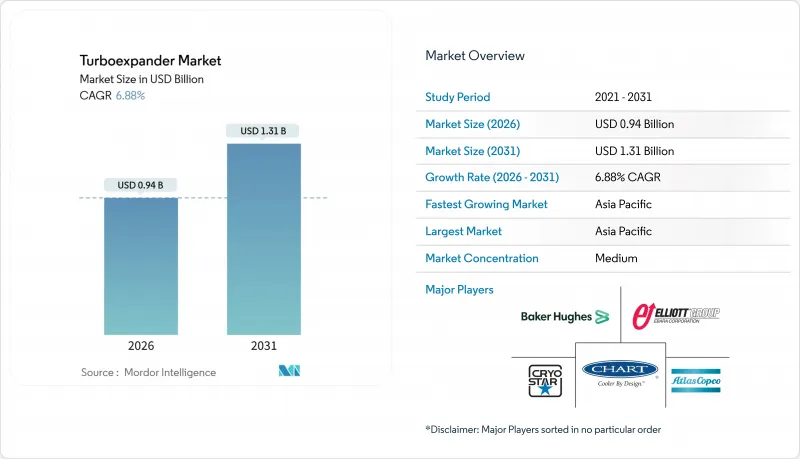
Mordor Intelligence에 의하면, 터보 익스팬더 시장 규모는 2026년에 9억 4,000만 달러로 평가되었습니다. 예측 기간(2026-2031년) CAGR 6.88%로 성장을 지속하여, 2031년에는 13억 1,000만 달러에 이를 전망입니다.
본 보고서는 제품 유형별(방사형, 축류형, 하이브리드 구성), 부하 장치별(압축기 결합형, 발전기 연동형, 유압·오일 브레이크형), 전력 용량별(10MW 이하, 40MW 초과, 기타),용도별(천연가스 처리·NGL 회수, 수소·헬륨 액화, 기타), 최종 사용자 산업별(석유 및 가스, 청정 에너지 개발 사업자, 기타), 지역별(북미, 아시아태평양, 기타)
세계의 터보 익스팬더 시장 동향 및 인사이트
LNG 설비 확충에 따른 극저온 터보 익스팬더 수요 증가
2026년 중반 가동을 목표로 하는 카타르의 노스 필드 이스트 확장 프로젝트에서는 혼합 냉매 사이클에 대응하기 위해, 각각 30-40MW의 정격 출력을 가진 극저온 터보 익스팬더 트레인 16기가 도입될 예정입니다. 아부다비의 LNG 생산 능력은 2035년까지 연간 25mtpa에 달할 전망이며, 이에 따라 약 40기의 추가 수주가 예상됩니다. 공급업체는 액화 설비 총 예산의 8-10%를 차지하고 있으며, 이는 수십억 달러 규모의 잠재적 시장 규모에 해당합니다. 베이커 휴즈가 수주한 10억 달러 규모의 리오 그란데 LNG 패키지는 차세대 플랜트 레이아웃에서 터보 익스팬더가 필수적임을 입증하고 있습니다. 2026-2027년에 걸친 까다로운 납기 일정으로 인해 첨단 자기 베어링(AMB) 공급망에는 이미 부담이 가중되고 있습니다.
파이프라인 감압에 따른 에너지 회수 프로젝트
미국에서는 2024년에 17.8bcf/d의 수송 능력이 추가되었습니다. 600psi를 초과하는 압력 차이로 인해, 2-5MW의 발전기 연동형 팽창기가 낭비되던 에너지를 수익화할 수 있게 되었습니다. 에너지 트랜스퍼(Energy Transfer)사의 보고에 따르면, 각 개조 공사를 통해 사이트당 1만 5,000tCO2e의 배출을 감축할 수 있으며, 현재의 전력 가격과 탄소 가격 수준에서는 3년 이내에 투자 회수가 가능하다고 합니다. EU의 에너지 효율 지침에 따라 독일과 네덜란드의 게이트 스테이션에서도 유사한 전환이 진행되고 있습니다.
변동이 심한 석유 및 가스 설비 투자 사이클
2024년 미국 업스트림 부문의 현금 흐름은 2022년 정점 대비 15% 감소하여, 터보 익스팬더를 도입한 가스 처리 시설의 확장이 지연되었습니다. 2024년 해상 가스 프로젝트에 대한 최종 투자 결정(FID)은 20% 감소했으며, 수주 잔고가 장기화되고 있습니다. 회복 여부는 2026년 말까지 견조한 회복세가 예상되는 LNG 판매 계약에 달려 있습니다.
부문별 분석
레이디얼형 유닛은 10-40MW급 LNG 및 ASU의 듀티 포인트에 힘입어 2025년 터보 익스팬더 시장 점유율의 63.1%를 차지했습니다. 레이디얼-축방향 하이브리드 설계는 2031년까지 연평균 7.9%의 성장이 예상되며, 부분 부하 조건에서도 효율을 유지합니다. 베이커 휴즈의 차트(Chart) 사 인수로 L.A. 터빈의 AMB 레이디얼 터빈과 베이커 휴즈의 압축기가 융합되어, 현장 통합 공사 기간을 단축하는 턴키 방식의 플랜트가 실현되었습니다. 50MW를 초과하는 카타르 및 호주의 메가 트레인에서는 축류식 모델이 여전히 필수적입니다.
10MW 이하의 소형 스키드 장착형 레이디얼 압축기는 분산형 LNG 및 수소 허브에서 수요가 증가하고 있으며, 공장 출하 시 검사 완료된 포장을 통해 현장 작업을 최소화하고 있습니다. 지열 ORC 개발 사업자들은 30-70%의 부하 변동 범위에서 성능을 유지하기 위해 하이브리드 아키텍처를 채택하고 있으며, 이로 인해 25MW 이하 부문에서 지속적인 수요가 뒷받침되고 있습니다.
압축기 결합형 팽창기는 2025년 출하 대수의 56.5%를 차지했으며, 이는 LNG 및 ASU 플로우시트에서 이 방식이 갖는 우위를 반영합니다. 한편, 발전기 결합형 유닛은 파이프라인 및 산업용 가스 사업자들이 압력 손실을 수익화하고 전력을 수출하게 됨에 따라 2031년까지 연평균 성장률(CAGR) 7.6%를 기록할 전망입니다. 텍사스주의 단일 감압 개조 공사를 통해 2024년 전력 비용을 3,000만 달러 절감할 수 있었습니다.
유럽과 일본의 수소 로드맵에서는 기생 부하를 줄이기 위해 계통 연계형 발전기의 도입이 요구되고 있습니다. 파워 일렉트로닉스를 통합한 턴키 스키드는 현재 40주 이내에 납품이 가능하며, 사내에 전기 공학 전문 지식이 없는 소유주에게 엔지니어링에 드는 간접비를 절감해 주고 있습니다.
지역별 분석
아시아태평양은 2025년 매출의 36.6%를 차지했으며, 중국이 새로운 공기 분리 장치(ASU)를 가동하고, 인도가 그린 수소에 보조금을 지급하며, 일본이 액화 허브를 확대함에 따라 연평균 성장률(CAGR) 7.3%를 유지할 전망입니다. 인도네시아와 필리핀에서는 15-25MW의 익스팬더를 이용한 지열 ORC 설비가 추가될 예정입니다.
북미는 셰일가스 처리, LNG 수출 터미널, 감압 시 에너지 회수를 주축으로 2025년 수요의 약 30%를 차지했습니다. 베이커 휴즈(Baker Hughes)의 10억 달러 규모 리오 그란데(Rio Grande) LNG 수주와 에너지 트랜스퍼(Energy Transfer)의 50MW 발전기 연계형 개조는 이 부문의 지속적인 성장세를 보여주고 있습니다.
유럽과 중동을 합치면 전체의 약 30%를 차지합니다. ADNOC과 카타르 에너지의 메가트레인이 고출력 설비 조달을 주도하는 한편, EU 사업자들은 에너지 효율화 의무에 따라 파이프라인 개조를 진행하고 있습니다. 남미와 아프리카에서는 해양 가스 및 지열 부문에서 제한적인 도입이 진행되고 있으나, 여전히 자금 조달 비용의 제약을 겪고 있습니다.
기타 혜택
- 엑셀 형식 시장 예측(ME) 시트
- 3개월간의 애널리스트 지원
자주 묻는 질문
목차
제1장 서론
제2장 조사 방법
제3장 주요 요약
제4장 시장 구도
제5장 시장 규모 및 성장 예측
제6장 경쟁 구도
제7장 시장 기회 및 향후 전망
KTH 26.09.04According to Mordor Intelligence, the turboexpander market size is estimated at USD 0.94 billion in 2026, and is expected to reach USD 1.31 billion by 2031, at a CAGR of 6.88% during the forecast period (2026-2031).
This report is Segmented by Product Type (Radial, Axial, and Hybrid), Loading Device (Compressor-Coupled, Generator-Coupled, and Hydraulic/Oil-Brake), Power Capacity (Up To 10 MW, Above 40 MW, and More), Application (Natural Gas Processing and NGL Recovery, Hydrogen and Helium Liquefaction, and More), End-User (Oil and Gas, Clean Energy Developers, and More), and Geography (North America, Asia-Pacific, and More)
Global Turboexpander Market Trends and Insights
LNG Capacity Build-Out Drives Cryogenic Turboexpander Demand
Qatar's North Field East expansion, targeting mid-2026 start-up, will install 16 cryogenic turboexpander trains rated 30-40 MW each to handle mixed-refrigerant cycles. Abu Dhabi LNG capacity is slated to reach 25 mtpa by 2035, implying orders for roughly 40 additional units. Suppliers capture 8-10% of total liquefaction equipment budgets, translating into a multi-billion-dollar addressable spend. Baker Hughes' USD 1 billion Rio Grande LNG package validates turboexpanders' indispensability in next-generation layouts. Tight delivery windows in 2026-2027 are already stretching advanced magnetic-bearing (AMB) supply chains.
Pipeline Pressure-Letdown Energy-Recovery Projects
The United States added 17.8 bcf/d of takeaway capacity in 2024; pressure differentials exceeding 600 psi allow 2-5 MW generator-coupled expanders to monetize wasted energy. Energy Transfer reports each retrofit displaces 15,000 tCO2e per site and yields payback in under three years at prevailing power and carbon prices. The EU's Energy Efficiency Directive is pushing similar conversions at German and Dutch gate stations.
Volatile Oil-and-Gas CAPEX Cycles
U.S. upstream cash flow in 2024 was 15% below 2022 peaks, delaying gas-processing expansions that employ turboexpanders. FIDs on offshore gas projects declined 20% in 2024, elongating order books. Recovery depends on LNG offtake contracts expected to firm by late 2026.
Other drivers and restraints analyzed in the detailed report include:
- APAC Air-Separation Plant Construction Boom
- Hydrogen Liquefaction Needs Ultra-Cold Oil-Free Expanders
- High Upfront Cost versus J-T Valves
For complete list of drivers and restraints, kindly check the Table Of Contents.
Segment Analysis
Radial units captured 63.1% of the 2025 Turboexpander market share, driven by 10-40 MW LNG and ASU duty points. Hybrid radial-axial designs will grow 7.9% annually by 2031, preserving efficiency under part-load conditions. Baker Hughes' Chart acquisition blends L.A. Turbine AMB radials with Baker Hughes compressors, enabling turnkey trains that shorten site integration. Axial models remain indispensable above 50 MW for Qatar and Australia mega-trains.
Smaller, skid-mounted radials below 10 MW are rising in distributed LNG and hydrogen hubs, where factory-tested packages minimize site work. Geothermal ORC developers adopt hybrid architectures to maintain performance across 30-70% load swings, reinforcing sustained demand in the sub-25 MW bracket.
Compressor-coupled expanders held 56.5% of 2025 shipments, reflecting their dominance in LNG and ASU flowsheets. Generator-coupled units, however, will post a 7.6% CAGR to 2031 as pipeline and industrial-gas operators monetize pressure losses and export power. A single Texas pressure-letdown retrofit saved USD 30 million in 2024 power costs.
European and Japanese hydrogen roadmaps call for grid-synchronized generators to reduce parasitic loads. Turnkey skids integrating power electronics now ship in under 40 weeks, lowering engineering overheads for owners without in-house electrical expertise.
Complete Report Scope:
- By Product Type
- Radial Turboexpanders
- Axial Turboexpanders
- Hybrid Configurations
- By Loading Device
- Compressor-Coupled Expanders
- Generator-Coupled Expanders
- Hydraulic/Oil-Brake (Dyno) Units
- By Power Capacity
- Up to 10 MW
- 10 to 20 MW
- 20 to 40 MW
- Above 40 MW
- By Application
- Natural Gas Processing and NGL Recovery
- LNG Liquefaction and Pretreatment
- Air Separation and Industrial Gases
- Pressure-Letdown Energy Recovery
- Geothermal and Waste-Heat ORC
- Hydrogen and Helium Liquefaction
- By End-User Industry
- Oil and Gas
- Chemical and Petrochemicals
- Power Generation
- Industrial Manufacturing
- Clean Energy Developers
- By Geography
- North America
- United States
- Canada
- Mexico
- Europe
- Germany
- France
- United Kingdom
- Italy
- Spain
- NORDIC Countries
- Russia
- Rest of Europe
- Asia-Pacific
- China
- India
- Japan
- South Korea
- ASEAN Countries
- Australia and New Zealand
- Rest of Asia-Pacific
- South America
- Brazil
- Argentina
- Chile
- Rest of South America
- Middle East and Africa
- Saudi Arabia
- United Arab Emirates
- South Africa
- Egypt
- Rest of Middle East and Africa
- North America
Geography Analysis
Asia-Pacific, holding 36.6% of 2025 sales, will maintain a 7.3% CAGR as China commissions new ASUs, India subsidizes green hydrogen, and Japan scales liquefaction hubs. Indonesia and the Philippines add geothermal ORC capacity using 15-25 MW expanders.
North America delivered roughly 30% of 2025 demand, anchored by shale-gas processing, LNG export terminals, and pressure-letdown energy recovery. Baker Hughes' USD 1 billion Rio Grande LNG order and Energy Transfer's 50 MW of generator-coupled retrofits highlight enduring momentum.
Europe and the Middle East together contribute about 30% of the total. ADNOC and QatarEnergy mega-trains dominate high-power procurements, while EU operators retrofit pipelines under energy-efficiency mandates. South America and Africa register selective uptake in offshore gas and geothermal, but remain constrained by financing costs.
- Atlas Copco AB
- Baker Hughes Co.
- Cryostar SAS
- Chart Industries (L.A. Turbine)
- Air Products & Chemicals Inc. (Rotoflow)
- Elliott Group
- Nikkiso ACD
- PBS Group
- Sapphire Technologies (Calnetix)
- Siemens Energy
- MAN Energy Solutions
- Barber-Nichols
- R&D Dynamics
- Simms Machinery
- Turbomachinery Solutions
- Howden Group
- Atlas Copco Rental (Expanders)
- Calnetix Technologies
- Rotoflow Aftermarket Services
- Concept NREC
Additional Benefits:
- The market estimate (ME) sheet in Excel format
- 3 months of analyst support
TABLE OF CONTENTS
1 Introduction
- 1.1 Study Assumptions & Market Definition
- 1.2 Scope of the Study
2 Research Methodology
3 Executive Summary
4 Market Landscape
- 4.1 Market Overview
- 4.2 Market Drivers
- 4.2.1 LNG capacity build-out drives cryogenic turboexpander demand
- 4.2.2 Pipeline pressure-letdown energy-recovery projects
- 4.2.3 APAC air-separation plant construction boom
- 4.2.4 Hydrogen liquefaction needs ultra-cold oil-free expanders
- 4.2.5 Wellhead micro-turboexpanders electrify pad equipment
- 4.2.6 Geothermal & ORC waste-heat projects adopt expander-generators
- 4.3 Market Restraints
- 4.3.1 Volatile oil-&-gas CAPEX cycles
- 4.3.2 High upfront cost vs J-T valves
- 4.3.3 AMB component supply bottlenecks
- 4.3.4 Unproven reliability in >20 % H2 service
- 4.4 Supply-Chain Analysis
- 4.5 Regulatory Landscape
- 4.6 Technological Outlook
- 4.7 Porter's Five Forces
- 4.7.1 Threat of New Entrants
- 4.7.2 Bargaining Power of Suppliers
- 4.7.3 Bargaining Power of Buyers
- 4.7.4 Threat of Substitutes
- 4.7.5 Competitive Rivalry
5 Market Size & Growth Forecasts
- 5.1 By Product Type
- 5.1.1 Radial Turboexpanders
- 5.1.2 Axial Turboexpanders
- 5.1.3 Hybrid Configurations
- 5.2 By Loading Device
- 5.2.1 Compressor-Coupled Expanders
- 5.2.2 Generator-Coupled Expanders
- 5.2.3 Hydraulic/Oil-Brake (Dyno) Units
- 5.3 By Power Capacity
- 5.3.1 Up to 10 MW
- 5.3.2 10 to 20 MW
- 5.3.3 20 to 40 MW
- 5.3.4 Above 40 MW
- 5.4 By Application
- 5.4.1 Natural Gas Processing and NGL Recovery
- 5.4.2 LNG Liquefaction and Pretreatment
- 5.4.3 Air Separation and Industrial Gases
- 5.4.4 Pressure-Letdown Energy Recovery
- 5.4.5 Geothermal and Waste-Heat ORC
- 5.4.6 Hydrogen and Helium Liquefaction
- 5.5 By End-User Industry
- 5.5.1 Oil and Gas
- 5.5.2 Chemical and Petrochemicals
- 5.5.3 Power Generation
- 5.5.4 Industrial Manufacturing
- 5.5.5 Clean Energy Developers
- 5.6 By Geography
- 5.6.1 North America
- 5.6.1.1 United States
- 5.6.1.2 Canada
- 5.6.1.3 Mexico
- 5.6.2 Europe
- 5.6.2.1 Germany
- 5.6.2.2 France
- 5.6.2.3 United Kingdom
- 5.6.2.4 Italy
- 5.6.2.5 Spain
- 5.6.2.6 NORDIC Countries
- 5.6.2.7 Russia
- 5.6.2.8 Rest of Europe
- 5.6.3 Asia-Pacific
- 5.6.3.1 China
- 5.6.3.2 India
- 5.6.3.3 Japan
- 5.6.3.4 South Korea
- 5.6.3.5 ASEAN Countries
- 5.6.3.6 Australia and New Zealand
- 5.6.3.7 Rest of Asia-Pacific
- 5.6.4 South America
- 5.6.4.1 Brazil
- 5.6.4.2 Argentina
- 5.6.4.3 Chile
- 5.6.4.4 Rest of South America
- 5.6.5 Middle East and Africa
- 5.6.5.1 Saudi Arabia
- 5.6.5.2 United Arab Emirates
- 5.6.5.3 South Africa
- 5.6.5.4 Egypt
- 5.6.5.5 Rest of Middle East and Africa
- 5.6.1 North America
6 Competitive Landscape
- 6.1 Market Concentration
- 6.2 Strategic Moves (M&A, Partnerships, PPAs)
- 6.3 Market Share Analysis (Market Rank/Share for key companies)
- 6.4 Company Profiles (includes Global level Overview, Market level overview, Core Segments, Financials as available, Strategic Information, Products & Services, and Recent Developments)
- 6.4.1 Atlas Copco AB
- 6.4.2 Baker Hughes Co.
- 6.4.3 Cryostar SAS
- 6.4.4 Chart Industries (L.A. Turbine)
- 6.4.5 Air Products & Chemicals Inc. (Rotoflow)
- 6.4.6 Elliott Group
- 6.4.7 Nikkiso ACD
- 6.4.8 PBS Group
- 6.4.9 Sapphire Technologies (Calnetix)
- 6.4.10 Siemens Energy
- 6.4.11 MAN Energy Solutions
- 6.4.12 Barber-Nichols
- 6.4.13 R&D Dynamics
- 6.4.14 Simms Machinery
- 6.4.15 Turbomachinery Solutions
- 6.4.16 Howden Group
- 6.4.17 Atlas Copco Rental (Expanders)
- 6.4.18 Calnetix Technologies
- 6.4.19 Rotoflow Aftermarket Services
- 6.4.20 Concept NREC
7 Market Opportunities & Future Outlook
- 7.1 White-Space & Unmet-Need Assessment


