

|
시장보고서
상품코드
2120722
임상시험 : 시장 점유율 분석, 업계 동향과 통계, 성장 예측(2026-2031년)Clinical Trials - Market Share Analysis, Industry Trends & Statistics, Growth Forecasts (2026 - 2031) |
||||||
 Mordor Intelligence
임상시험 시장 규모는 2025년에 904억 4,000만 달러로 평가되며, 2026년 959억 7,000만 달러에서 2031년까지 1,315억 5,000만 달러에 달할 것으로 예측되며, 예측 기간(2026-2031년) 동안 CAGR은 6.51%가 될 전망입니다.
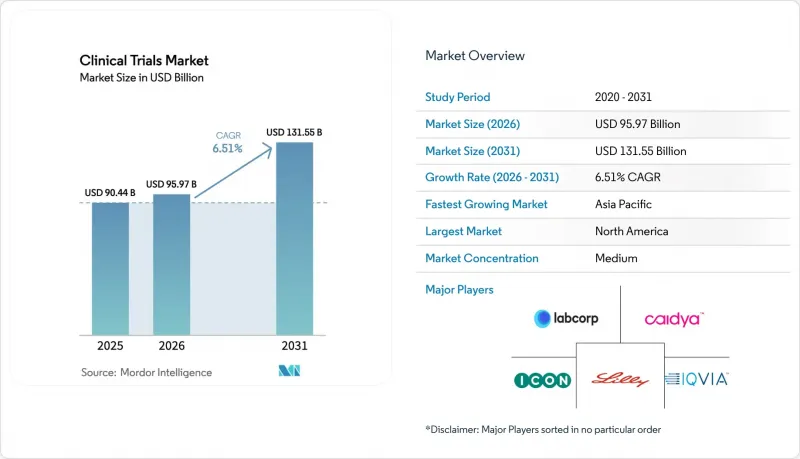
본 보고서는 단계(제1상 등), 시험 설계(중재·치료 시험 등), 서비스 유형(프로토콜 설계·실현 가능성 평가 등), 치료 분야(종양학 등), 후원사 유형(제약·바이오의약품 기업 등), 및 지역(북미, 유럽, 아시아 등)별로 분류되어 있습니다. 시장 전망은 금액(달러) 기준으로 제시되어 있습니다.
세계 임상시험 시장의 동향 및 인사이트
대규모 임상시험이 필요한 복잡한 생물학적 제제 및 정밀 의학의 증가
2025년에는 생물학적 제제 및 정밀 의학이 전체 임상시험 자산의 38%를 차지하여 5년 전의 29%에서 증가했으며, 이로 인해 기간이 길고 데이터 집약적인 임상시험에 대한 수요가 높아지고 있습니다[1]. 2025년, 미국의 세포·유전자 치료 프로그램에는 1,847건의 유효한 IND(신약 임상시험 신청)가 필요했으나, 바이러스 벡터의 생산능력 제약으로 인해 계획된 프로토콜 중 실제로 예정대로 시작된 것은 고작 64%에 그쳤습니다. 각 CRO 기업들은 이러한 지연을 완화하기 위해 제조 자산 인수를 시작했으며, 서모피셔(Thermo Fisher)는 4억 2,000만 달러를 투자하여 2027년까지 벡터 생산능력을 두 배로 늘릴 계획입니다. 2025년 단일클론 항체의 3상 임상시험 평균 기간은 52개월이었던 반면, 저분자 화합물의 경우 38개월이었기 때문에 시험 1건당 4-6테라바이트의 유전체 데이터 및 영상 데이터를 관리할 수 있는 플랫폼에 대한 수요가 증가하고 있습니다.
비용과 속도의 이점을 추구하며 풀서비스형 CRO로의 아웃소싱이 확대
2025년, 제약사 스폰서는 임상 예산의 73%를 CRO에 위탁하여, 자체 수행 프로그램에 비해 3상 임상시험의 피험자 등록을 5.3개월 더 빨리 완료했습니다. IQVIA는 294억 달러의 수주 잔고를 기록했으며, 이는 2.1년 치 매출 전망에 해당합니다. 한편, Medpace는 각 임상시험 기관에 암 전문 간호사를 배치함으로써 데이터베이스 잠금을 기한 내에 달성하는 비율을 94%로 높였습니다. 아시아의 CRO는 여전히 3대 1의 비용 우위를 제공하고 있지만, 2025년에는 인도의 14개 임상시험 기관이 GCP 위반으로 FDA로부터 경고장을 받았으며, 이는 품질 관리의 중요성이 여전히 높음을 보여줍니다.
종양학 및 중추신경계(CNS) 임상시험의 높은 중도 탈락률이 비용 리스크를 높이고 있습니다
2025년 종양학 프로토콜의 3상 임상시험 실패율은 52%에 달했습니다. 이는 종양의 이질성 외에도 전체 생존 기간(OS) 데이터에 대한 보험사의 엄격한 요구가 원인으로 작용했습니다. 알츠하이머병 프로그램의 상황은 더욱 심각하여, 실패율은 68%에 달했으며, 실패한 각 임상시험마다 1억 8,000만-2억 4,000만 달러의 매몰 비용이 발생했습니다. 적응형 설계는 위험 완화에 도움이 됩니다. 로슈의 2025년 바스켓 임상시험에서는 시험 도중 성과가 기대되지 않는 코호트를 제외함으로써 피험자 등록 수를 34% 줄이고, 6,200만 달러의 비용 절감을 실현했습니다. 독일의 IQWiG는 2025년 종양학 분야 신청의 41%를 기각했으며, 이로 인해 후원사는 보다 엄격한 평가 지표에 집중하게 되었습니다[2].
부문 분석
2상 임상시험은 2031년까지 연평균 성장률(CAGR) 6.80%로 확대될 것으로 예상되며, 적응형 연구 기법을 통해 단일 프로토콜 내에서 용량 설정과 유효성 확인이 최적화됨에 따라 관심이 높아지고 있습니다. 노바티스는 2025년, 베이즈 방식에 따른 무작위 배정을 통해 성적이 좋은 군으로 피험자 배정을 전환함으로써 총 피험자 수를 28% 감축했습니다. 2025년 현재 3상 임상시험이 임상시험 시장의 55%를 차지하고 있지만, 그 기간이 길고 중도 탈락률이 높기 때문에 각 후원사는 일정을 9-12개월 단축할 가능성이 있는 원활한 2/3상 연계 경로에 대한 조기 투자를 추진하고 있습니다. 제1상 프로그램에서는 마이크로 도징과 48시간 이내에 약동학(PK) 데이터를 제공하는 신속한 질량 분석법이 활용되고 있는 반면, 제4상 임상시험에서는 주요 임상시험에 편승하여 시설 비용을 분산시키고 있습니다.
2025년 수익의 72.30%를 중재 임상시험이 차지했지만, 실세계 증거(REW)를 생성하기 위해서는 실용적인 접근 방식과 관찰 연구도 필수적입니다. EMA 지침에 따르면, 성향 점수로 조정된 최소 1,200명의 피험자로 구성된 관찰 데이터세트로 뒷받침되는 적응증 확대가 인정됩니다[3]. 확대 접근 프로그램은 전체 활동의 4%를 차지했으며, 제품 출시 전에 의사의 이해를 높이는 데 도움이 되었습니다. NIH는 2025년에 전자건강기록을 이용한 무작위 배정을 통해 비용을 3분의 2로 절감한 11건의 실용적인 대규모 임상시험에 자금을 지원했습니다.
지역별 분석
2025년, 북미는 전 세계 매출의 49.20%를 차지했습니다. 이는 FDA의 인센티브, 높은 임상시험 기관 밀도, 그리고 기관당월 1.2명의 환자 등록률(유럽보다 40% 높은 수치)에 힘입은 결과입니다. 캐나다는 미국과의 프로토콜 일관성이라는 이점을 바탕으로 해당 지역 내 연구의 6%를 차지했습니다. 한편, 멕시코는 ICON의 2025년 사업 거점으로서 30%의 비용 절감을 목표로 삼음으로써 입지를 강화했습니다.
아시아태평양은 2025년 중국에서 62건의 IND 승인이 이루어진 점과 인도에서 환자 1인당 비용이 30-40% 더 저렴하다는 점에 힘입어, 2031년까지 연평균 성장률(CAGR)이 7.90%로 모든 지역을 상회하는 성장률을 보였습니다. 일본의 재생의학 조건부 승인 및 호주의 43.5% 연구개발 세액 환급 제도가 해당 지역의 매력을 한층 더 높였습니다. 한국은 국민건강보험 데이터베이스를 활용하여 단일군 비교 임상시험의 종양학 연구에서 실세계 데이터에 기반한 비교 대상을 제공했습니다.
유럽에서는 임상시험 규정에 따라 평균 승인 기간이 10개월로 단축되고, 여러 국가에서 동시에 임상시험을 시작할 수 있게 됨에 따라 2025년에 28%의 시장 점유율을 확보했습니다. 영국의 롤링 리뷰(Rolling Review) 방식을 통해 2025년에는 14건의 희귀질환 관련 임상시험 계획이 유치되었습니다. GCC 국가들은 의료 경제의 다각화를 도모하기 위해 획기적인 당뇨병 및 종양학 연구에 자금을 지원했습니다. 한편, 브라질과 아르헨티나는 통화 및 수입 관련 병목 현상이 있었음에도 불구하고, 합쳐서 전 세계 임상시험 건수의 4%를 차지했습니다.
기타 혜택:
- 엑셀 형식의 시장 예측(ME) 시트
- 3개월간의 애널리스트 지원
자주 묻는 질문
목차
제1장 소개
제2장 조사 방법
제3장 주요 요약
제4장 시장 구도
제5장 시장 규모와 성장 예측
제6장 경쟁 구도
제7장 시장 기회와 향후 전망
KSM 26.09.02According to Mordor Intelligence, the clinical trials market size was valued at USD 90.44 billion in 2025 and is estimated to grow from USD 95.97 billion in 2026 to reach USD 131.55 billion by 2031, at a CAGR of 6.51% during the forecast period (2026-2031).
This report is Segmented by Phase (Phase I, and More), Study Design (Interventional/Treatment Studies, and More), Service Type (Protocol Design & Feasibility, and More), Therapeutic Area (Oncology, and More), Sponsor Type (Pharmaceutical & Biopharmaceutical Companies, and More), and Geography (North America, Europe, Asia, and More). The Market Forecasts are Provided in Terms of Value (USD).
Global Clinical Trials Market Trends and Insights
Growing Volume of Complex Biologics and Precision Medicines Requiring Extensive Trials
Biologics and precision medicines represented 38% of all investigational assets in 2025, up from 29% five years earlier, driving increased demand for longer and data-intensive studies[1]. Cell-and-gene therapy programs needed 1,847 active INDs in the United States during 2025, yet viral-vector capacity constraints meant just 64% of planned protocols actually initiated on schedule. CROs have started acquiring manufacturing assets to mitigate these delays; Thermo Fisher invested USD 420 million to double vector capacity by 2027. Monoclonal-antibody Phase III studies averaged 52 months in 2025, compared to 38 months for small molecules, thereby elevating demand for platforms that manage four to six terabytes of genomic and imaging data per trial.
Expanded Outsourcing to Full-Service CROs for Cost and Speed Advantages
Pharmaceutical sponsors outsourced 73% of their clinical budgets to CROs in 2025 and secured Phase III enrollment 5.3 months faster than in-house programs. IQVIA posted USD 29.4 billion in backlog, equal to 2.1 years of revenue visibility, while Medpace hit a 94% on-time database-lock rate by embedding oncology nurses at sites. Asian CROs still offer a three-to-one cost edge, although 14 Indian sites received FDA warning letters in 2025 for GCP lapses, signaling that quality oversight remains critical.
High Attrition Rates in Oncology and CNS Trials Increasing Cost Risk
Oncology protocols posted a 52% Phase III failure rate in 2025, driven by tumor heterogeneity and stringent payer demands for overall survival data. Alzheimer's programs fared worse, with a 68% failure rate, causing each unsuccessful study to absorb USD 180-240 million in sunk costs. Adaptive designs help mitigate risk; Roche's 2025 basket trial trimmed enrollment by 34% and saved USD 62 million by dropping weak cohorts mid-stream. Germany's IQWiG rejected 41% of oncology submissions in 2025, prompting sponsors to focus on more rigorous endpoints[2].
Other drivers and restraints analyzed in the detailed report include:
- Regulatory Reforms Accelerating Approval Pathways
- Pandemic-Induced Digital Transformation Driving eClinical Adoption
- Stringent Data-Privacy Legislations Limiting Cross-Border Data Flows
For complete list of drivers and restraints, kindly check the Table Of Contents.
Segment Analysis
Phase II studies are projected to grow at a 6.80% CAGR through 2031 and captured rising interest as adaptive methodologies optimize dose-finding and efficacy confirmation inside a single protocol. Novartis used Bayesian randomization in 2025 to shift enrollment toward high-performing arms, trimming total exposure by 28%. Despite Phase III's 55% clinical trials market share in 2025, its duration and attrition rates spur sponsors to invest earlier in seamless Phase II/III pathways that may condense timelines by 9-12 months. Phase I programs benefit from micro-dosing and rapid mass-spectrometry assays that deliver PK data within 48 hours, while Phase IV studies piggyback on pivotal trials to amortize site costs.
Interventional trials accounted for 72.30% of 2025 revenue, yet pragmatic and observational approaches are also essential for generating real-world evidence. EMA guidance allows label expansions supported by observational datasets of at least 1,200 subjects adjusted by propensity scores[3]. Expanded-access programs accounted for 4% of total activity and helped build physician familiarity ahead of launches. The NIH funded 11 pragmatic megatrials in 2025 that utilized electronic health-record randomization to reduce costs by two-thirds.
Complete Report Scope:
- By Phase
- Phase I
- Phase II
- Phase III
- Phase IV
- By Study Design
- Interventional / Treatment Studies
- Observational Studies
- Expanded Access Studies
- By Service Type
- Protocol Design & Feasibility
- Site Identification & Start-Up
- Regulatory Submission & Approval
- Clinical Trial Monitoring
- Data Management & Biostatistics
- Medical Writing
- Other Service Types
- By Therapeutic Area
- Oncology
- Cardiovascular
- Neurology
- Infectious Diseases
- Metabolic Disorders (Diabetes, Obesity)
- Immunology / Autoimmune
- Other Therapeutic Areas
- By Sponsor Type
- Pharmaceutical & Biopharmaceutical Companies
- Medical Device Companies
- Academic & Research Institutes
- Government & Non-Profit Organizations
- Geography
- North America
- United States
- Canada
- Mexico
- Europe
- Germany
- United Kingdom
- France
- Italy
- Spain
- Rest Of Europe
- Asia-Pacific
- China
- Japan
- India
- South Korea
- Australia
- Rest Of Asia-Pacific
- Middle-East And Africa
- GCC
- South Africa
- Rest Of Middle East And Africa
- South America
- Brazil
- Argentina
- Rest Of South America
- North America
Geography Analysis
North America controlled 49.20% of global revenue in 2025, stoked by FDA incentives, a high site density, and enrollment rates of 1.2 patients per site each month, 40% above Europe. Canada added 6% of regional studies, benefiting from protocol alignment with the United States, while Mexico gained prominence as ICON's 2025 operations hub targeted 30% cost savings.
Asia-Pacific outpaced all regions at 7.90% CAGR through 2031, powered by China's 62 IND clearances in 2025 and India's 30-40% per-patient cost advantages. Conditional approvals for regenerative medicines in Japan and a 43.5% R&D tax refund in Australia further widened the region's appeal. South Korea leveraged its national insurance database to supply real-world comparators for single-arm oncology designs.
Europe captured 28% market share in 2025 after the Clinical Trials Regulation slashed average approval time to 10 months and enabled simultaneous multi-country site activation. The UK's rolling-review model enticed 14 rare-disease protocols in 2025. GCC nations funded landmark diabetes and oncology studies to diversify health economies, while Brazil and Argentina together made up 4% of global volume despite currency and import bottlenecks.
- ACM Global Laboratories
- Aragen Life Sciences Ltd.
- Caidya
- Charles River
- ClinChoice
- ICON
- IQVIA
- KCR S.A.
- Laboratory Corporation Of America Holdings (Labcorp)
- Lilly (Lilly Clinical Innovation)
- MedPace
- Novotech
- Parexel International Corp.
- Pfizer
- Pharmaron Inc.
- Syneos Health
- Thermo Fisher Scientific Inc. (PPD)
- Wuxi AppTec Co. Ltd.
Additional Benefits:
- The market estimate (ME) sheet in Excel format
- 3 months of analyst support
TABLE OF CONTENTS
1 Introduction
- 1.1 Study Assumptions & Market Definition
- 1.2 Scope of the Study
2 Research Methodology
3 Executive Summary
4 Market Landscape
- 4.1 Market Overview
- 4.2 Market Drivers
- 4.2.1 Growing Volume of Complex Biologics & Precision Medicines Requiring Extensive Trials
- 4.2.2 Expanded Outsourcing to Full-Service CROs for Cost & Speed Advantages
- 4.2.3 Regulatory Reforms Accelerating Approval Pathways (E.G., FDA Fast Track, EMA PRIME)
- 4.2.4 Pandemic-Induced Digital Transformation Driving Eclinical Adoption
- 4.2.5 Rise of Patient-Owned Health Data Wallets Facilitating Remote Monitoring
- 4.2.6 Blockchain-Based Consent Management Enhancing Auditability & Compliance
- 4.3 Market Restraints
- 4.3.1 High Attrition Rates in Oncology and CNS Trials Increasing Cost Risk
- 4.3.2 Stringent Data-Privacy Legislations Limiting Cross-Border Data Flows
- 4.3.3 Scarcity of GMP-Compliant Viral Vector Manufacturing Capacity for Gene Therapy Trials
- 4.3.4 Rising Carbon-Footprint Accountability Pressures on Multisite Trials
- 4.4 Regulatory Outlook
- 4.5 Porter's Five Forces Analysis
- 4.5.1 Threat Of New Entrants
- 4.5.2 Bargaining Power Of Buyers
- 4.5.3 Bargaining Power Of Suppliers
- 4.5.4 Threat Of Substitutes
- 4.5.5 Intensity Of Competitive Rivalry
5 Market Size & Growth Forecasts (Value, USD)
- 5.1 By Phase
- 5.1.1 Phase I
- 5.1.2 Phase II
- 5.1.3 Phase III
- 5.1.4 Phase IV
- 5.2 By Study Design
- 5.2.1 Interventional / Treatment Studies
- 5.2.2 Observational Studies
- 5.2.3 Expanded Access Studies
- 5.3 By Service Type
- 5.3.1 Protocol Design & Feasibility
- 5.3.2 Site Identification & Start-Up
- 5.3.3 Regulatory Submission & Approval
- 5.3.4 Clinical Trial Monitoring
- 5.3.5 Data Management & Biostatistics
- 5.3.6 Medical Writing
- 5.3.7 Other Service Types
- 5.4 By Therapeutic Area
- 5.4.1 Oncology
- 5.4.2 Cardiovascular
- 5.4.3 Neurology
- 5.4.4 Infectious Diseases
- 5.4.5 Metabolic Disorders (Diabetes, Obesity)
- 5.4.6 Immunology / Autoimmune
- 5.4.7 Other Therapeutic Areas
- 5.5 By Sponsor Type
- 5.5.1 Pharmaceutical & Biopharmaceutical Companies
- 5.5.2 Medical Device Companies
- 5.5.3 Academic & Research Institutes
- 5.5.4 Government & Non-Profit Organizations
- 5.6 Geography
- 5.6.1 North America
- 5.6.1.1 United States
- 5.6.1.2 Canada
- 5.6.1.3 Mexico
- 5.6.2 Europe
- 5.6.2.1 Germany
- 5.6.2.2 United Kingdom
- 5.6.2.3 France
- 5.6.2.4 Italy
- 5.6.2.5 Spain
- 5.6.2.6 Rest Of Europe
- 5.6.3 Asia-Pacific
- 5.6.3.1 China
- 5.6.3.2 Japan
- 5.6.3.3 India
- 5.6.3.4 South Korea
- 5.6.3.5 Australia
- 5.6.3.6 Rest Of Asia-Pacific
- 5.6.4 Middle-East And Africa
- 5.6.4.1 GCC
- 5.6.4.2 South Africa
- 5.6.4.3 Rest Of Middle East And Africa
- 5.6.5 South America
- 5.6.5.1 Brazil
- 5.6.5.2 Argentina
- 5.6.5.3 Rest Of South America
- 5.6.1 North America
6 Competitive Landscape
- 6.1 Market Concentration
- 6.2 Market Share Analysis
- 6.3 Company Profiles (Includes Global Level Overview, Market Level Overview, Core Business Segments, Financials, Headcount, Key Information, Market Rank, Market Share, Products And Services, And Analysis Of Recent Developments)
- 6.3.1 ACM Global Laboratories
- 6.3.2 Aragen Life Sciences Ltd.
- 6.3.3 Caidya
- 6.3.4 Charles River Laboratories International Inc.
- 6.3.5 ClinChoice
- 6.3.6 ICON Plc
- 6.3.7 IQVIA Holdings Inc.
- 6.3.8 KCR S.A.
- 6.3.9 Laboratory Corporation Of America Holdings (Labcorp)
- 6.3.10 Lilly (Lilly Clinical Innovation)
- 6.3.11 Medpace Holdings Inc.
- 6.3.12 Novotech
- 6.3.13 Parexel International Corp.
- 6.3.14 Pfizer Inc.
- 6.3.15 Pharmaron Inc.
- 6.3.16 Syneos Health
- 6.3.17 Thermo Fisher Scientific Inc. (PPD)
- 6.3.18 Wuxi AppTec Co. Ltd.
7 Market Opportunities & Future Outlook
- 7.1 White-Space & Unmet-Need Assessment


