
|
시장보고서
상품코드
2120723
인간 증강 : 시장 점유율 분석, 업계 동향과 통계, 성장 예측(2026-2031년)Human Enhancement - Market Share Analysis, Industry Trends & Statistics, Growth Forecasts (2026 - 2031) |
||||||
 Mordor Intelligence
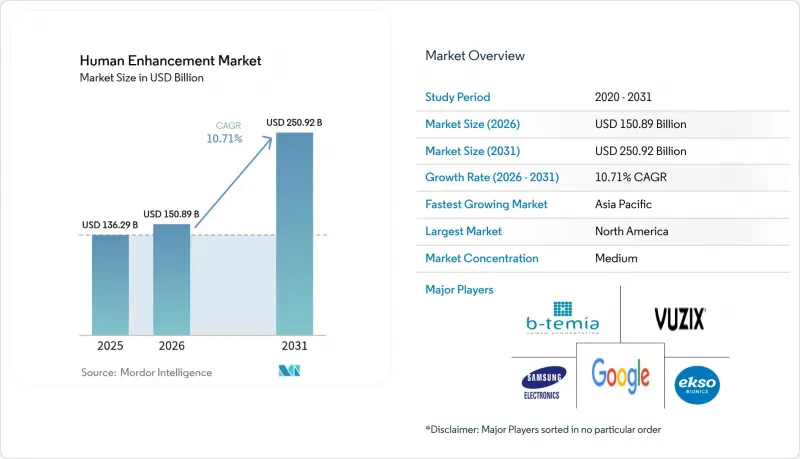
인간 증강 시장 규모는 2025년에 1,362억 9,000만 달러로 평가되며, 2026년 1,508억 9,000만 달러에서 2031년까지 2,509억 2,000만 달러에 달할 것으로 추정되며, 예측 기간(2026-2031년) 동안 CAGR은 10.71%가 될 전망입니다.
본 보고서는 제품 유형(스마트워치, 헤드 마운트 디스플레이 등), 용도(의료·재활 등), 최종사용자(개인·소비자, 의료 종사자 등), 기술(웨어러블 전자기기, 외골격 로봇, 뇌-컴퓨터 인터페이스 등), 및 지역별로 분류되어 있습니다. 시장 전망은 금액(달러) 기준으로 제시되어 있습니다.
세계 인간 증강 시장의 동향 및 인사이트
웨어러블 센서의 소형화 및 배터리 수명 향상
현재 5그램 미만의 센서 스택에는 가속도계, 마이크로컨트롤러 및 고체 배터리가 결합되어 있어 충전 없이도 며칠 동안 작동할 수 있습니다. MIT 연구진은 32비트 마이크로컨트롤러와 충전식 배터리를 단일 탄성 섬유에 내장하여, 의류가 95%의 정확도로 분산 추론을 수행할 수 있음을 입증했습니다. 애플의 수면무호흡증 진단 기능 승인도 이러한 추세에 부합하며, 엣지 알고리즘이 손목의 움직임을 로컬에서 분석함으로써 클라우드에 의한 지연을 해소하고 있습니다. 에너지 밀도의 향상과 더불어 체열이나 운동 에너지를 회수하는 프로토타입의 등장으로, 매일 충전할 필요가 없을 정도의 작동 시간이 기대되고 있습니다. 하드웨어의 장벽이 해소됨에 따라 인간 증강 시장에서는 센서가 의류, 신발, 헬멧에 내장되어 적용 가능한 사용 사례가 확대되고 있습니다. 전력 효율과 신호 무결성을 동시에 최적화하는 부품 공급업체들은 현재 소비자용 및 의료용 시장 모두에서 설계 채택을 통해 프리미엄을 확보하고 있습니다.
만성 질환 유병률 상승이 보조 기기 수요를 끌어올리고 있습니다
비전염성 질환으로 인해 매년 4,100만 명이 목숨을 잃고 있는 상황에서, 보험사와 고용주는 고액의 입원 비용을 피하기 위해 지속적인 모니터링 기기에 대한 지원을 확대하고 있습니다. 애보트(Abbott)사의 ‘FreeStyle Libre 3 Plus’는 14일간의 혈당 데이터와 스마트폰 알림 기능을 제공하여, 당뇨병 관리를 예측적 개입으로 전환시키고 있습니다. 광용적맥파측정(PPG) 및 심전도 센서를 탑재한 스마트워치는 심방세동을 감지하여, 뇌졸중이 발생하기 전에 검사를 받도록 사용자에게 권장합니다. FDA 디지털 헬스 센터 오브 엑설런스(Digital Health Center of Excellence)와 같은 규제 샌드박스는 웰니스와 의료를 융합한 하이브리드 제품의 심사 주기를 단축하고 있으며, 견고한 규정 준수 체계를 갖춘 기업에 유리하게 작용하고 있습니다. 건강보험사의 경제 모델 분석에 따르면, 원격 모니터링은 재입원으로 인한 불이익을 줄이는 것으로 나타났으며, 이는 기업의 일괄 구매를 촉진하여 인간 증강 시장의 판매량을 끌어올리고 있습니다.
고급 능력 향상 기기의 고액 초기 비용
전동 외골격 장치의 가격은 4만-10만 달러 범위이며, 그 도입은 국방 관련 구매자나 보험 적용을 받는 재활 센터로 제한되어 있습니다. ‘Robotics-as-a-Service(서비스형 로봇)’는 월정액 요금으로 비용을 분산시키지만, 수명주기 비용을 상승시키고 벤더 종속을 초래합니다. 피트니스용 웨어러블 기기는 정반대의 압박에 직면해 있습니다. 샤오미가 50달러 미만의 가격으로 트래커를 판매하고 있어 중견 브랜드의 이익률이 압박받고 있습니다. 메디케어는 지속 혈당 모니터 비용을 부담하지만, 웰니스 기기는 대상에서 제외되어 있어 환급 격차가 발생하고, 이는 보급을 저해하고 있습니다. 신흥 시장에서는 의료비 본인 부담금에 상한선이 있어 수요가 제한되고 있으며, 고급 기기는 가격을 인하하거나 수년 단위로 투자 회수가 가능함을 입증해야 합니다.
부문 분석
스마트워치는 2025년 매출의 52.88%를 차지하며, 인간 증강 시장 점유율에서 핵심적인 관문으로서의 역할을 강화하고 있습니다. 외골격의 매출은 절대액으로는 낮지만 11.39%의 성장 궤도에 있으며, 2031년까지 제품 구성을 크게 바꿀 가능성이 있습니다. 헤드 마운트 디스플레이는 외과 수술의 시각화 및 산업용 유지보수에 활용되고 있으나, 착용 시의 편안함과 배터리 한계라는 과제에 직면해 있습니다. 스마트 의류의 프로토타입은 부피가 큰 배터리 팩 없이 센서에 전력을 공급하는 전도성 섬유를 통해 미래성을 보여주고 있으나, 아직 양산 단계에는 이르지 못했습니다. 귀 착용형 기기는 보청 기능과 실시간 통역을 결합하여 고령층과 국경을 넘어 일하는 근로자들에게 어필하고 있습니다. 법집행기관의 보조금으로 자금을 지원받는 바디 카메라는 인간의 능력 향상이 건강 영역을 넘어 책임성 분야까지 확장되고 있음을 보여줍니다. 신경 인터페이스 기기는 아직 상용화 전 단계이지만, FDA의 획기적인 승인 절차를 확보하고 있어 향후 더 광범위한 제품 포트폴리오에 통합될 것임을 시사합니다.
제품 시장은 50달러 미만의 기본형 트래커와 같은 소비자용 가격대부터 6자리 수의 가격대를 형성하는 치료용 로봇에 이르기까지의 연속체를 반영하고 있습니다. 고급 스마트워치가 FDA 승인 기능을 탑재함에 따라 의료기기와의 경계가 모호해지고 있으며, 진단 관련 수익이 소비자 채널로 유입되고 있습니다. 외골격은 실험적인 시제품 단계에서 공장 현장에서 팔레트를 들어 올리는 주력 장비로 전환되고 있으며, 여기서 부상 감소가 구체적인 투자 수익률(ROI)을 가져오고 있습니다. 스마트웨어는 내구성과 세탁성 문제가 해결된다면 웨어러블 기기(손목 착용형)를 추월할 가능성이 있습니다. 귀에 착용하는 기기는 ‘오디오 퍼스트(Audio First)’ 트렌드에 발맞춰 음성 비서 및 인지 기능 확장 기능을 통합하고 있습니다. 전반적으로 이러한 동향으로 인해 인간 증강 시장은 대체가 아닌 중복이 성장을 주도하는 다제품 시장으로서의 기반을 공고히 하고 있습니다.
의료 및 재활 용도는 2025년 지출의 41.96%를 차지하며, 임상 용도에서 인간 증강 시장 규모에 미치는 근본적인 영향력을 여실히 보여주고 있습니다. 군·방위 분야는 가장 빠르게 성장하고 있으며, 각국 정부가 병사의 짐 운반 및 전술적 상황 인식을 위한 엑소슈트를 인증함에 따라 연평균 성장률(CAGR) 12.43%로 확대될 전망입니다. 산업 안전 분야에서의 도입은 창고업 및 건설업에서 확대되고 있으며, 이곳에서는 외골격 임대 모델을 통해 투자 회수 기간이 12개월 미만으로 단축되고 있습니다. 소비자용 피트니스 기기는 수면, 스트레스,회복 점수를 통합한 종합적인 웰니스 플랫폼으로 성숙해 가고 있으나, 선진국 시장의 포화로 인해 각 브랜드는 신흥 시장으로의 확장을 모색하고 있습니다. 인지 기능 강화 응용 분야는 여전히 초기 단계이지만, 뉴럴 게이밍의 시범 프로젝트가 사고 제어 인터페이스를 입증함에 따라 벤처 자금을 유치하고 있습니다.
용도별 내역을 살펴보면, 의료 분야와 비의료 분야의 융합이 진행되고 있습니다. 병원에서는 병상 여유를 확보하기 위해 재택 관리용 연속 혈당 모니터를 도입하고 있는 반면, 국방연구소에서 스핀오프된 기술이 이후 스포츠 기억력 향상 코치에 채택되고 있습니다. 산업 분야의 구매 담당자들은 지원용 로봇 도입과 산재 보상 및 인재 유지를 위한 비용을 저울질하며, 데이터에 기반한 조달 기준을 수립하고 있습니다. 소비자용 기기에 승인된 진단 기능이 통합됨에 따라 피트니스와 의료의 경계가 모호해지며, 의료비 환급이 가능해질 가능성이 있습니다. 방위 프로젝트에서 수립된 내환경성 기준은 산업용 엑소스켈레톤 제조업체에 의해 재사용되어 상용 제품의 신뢰성 향상을 가속화하고 있습니다.
지역별 분석
북미는 FDA의 조기 승인, 높은 의료비 지출, 그리고 견고한 국방 분야 연구개발 파이프라인 덕분에 2025년 인체 기능 강화 시장 점유율의 48.36%를 차지했습니다. 아시아태평양은 중국이 제조 분야의 규모의 경제를 활용하고, 일본이 초고령 사회를 대비해 이동 지원 기기에 대한 보조금을 지급하고 있는 점에 힘입어 2031년까지 연평균 성장률(CAGR) 12.64%를 기록할 것으로 예측됩니다. 유럽은 국민건강보험에 따른 환급 제도의 혜택을 받고 있지만, GDPR 준수 및 다국어 표시 요건으로 인해 제품 출시 지연과 비용 증가로 이어지고 있습니다. 중동에서는 스마트 시티 및 국경 경비 프로젝트의 일환으로 외골격 시범 사업에 자금이 투입되고 있는 반면, 아프리카에서는 높은 스마트폰 보급률을 활용한 모바일 헬스와의 통합이 추진되고 있습니다.
미국은 DARPA의 보조금 지원 하에 뇌-컴퓨터 인터페이스(BCI) 연구를 주도하고 있으며, 이를 통해 민간 스타트업 기업에 인재를 공급하는 통로가 마련되고 있습니다. 캐나다에서는 지속 혈당 모니터링에 대한 보험 급여로 인해 대상 당뇨병 환자층이 확대되고 있습니다. 중국은 선전과 광둥성의 수탁 제조업체를 통해 전 세계 스마트워치 출하대수의 60% 이상을 공급하고 있습니다. 일본이 2025년 1월 사이버다인사의 소형 HAL을 승인함에 따라 재활 로봇 분야에서의 리더십이 확고해졌습니다. 인도의 ‘아유슈만 바라트 디지털 미션’은 웨어러블 기기에서 수집된 데이터를 국민 건강 기록에 통합하기 위한 기반을 마련하고 있으나, 농촌 지역의 대역폭 격차로 인해 실시간 데이터 업로드가 지연되고 있습니다.
유럽의 의료기기 규정(MDR)은 시판 후 조사를 의무화하고 있어, 규정 준수 비용은 상승하고 있지만 환자 안전성은 향상되고 있습니다. 독일과 이탈리아는 높은 요양 의존율에 직면해 있어, 재택 간호용 외골격 대여에 보조금을 지급하고 있습니다. 사우디아라비아와 아랍에미리트는 ‘비전 2030’ 예산을 원격의료 및 외골격 공급망에 투입하고 있습니다. 남아프리카공화국은 광산 안전을 위한 스마트 의류 키트의 시범 운영을 진행 중이며, 도입에 산업적 측면을 더하고 있습니다. 이러한 다양한 지역별 우선순위로 인해 수익원이 다각화되고, 집중 위험이 완화되며, 인간 증강 시장의 세계 성장이 지속되고 있습니다.
기타 혜택:
- 엑셀 형식의 시장 예측(ME) 시트
- 3개월간의 애널리스트 지원
자주 묻는 질문
목차
제1장 소개
제2장 조사 방법
제3장 주요 요약
제4장 시장 구도
제5장 시장 규모와 성장 예측
제6장 경쟁 구도
제7장 시장 기회와 향후 전망
KSM 26.09.02According to Mordor Intelligence, the human enhancement market size was valued at USD 136.29 billion in 2025 and estimated to grow from USD 150.89 billion in 2026 to reach USD 250.92 billion by 2031, at a CAGR of 10.71% during the forecast period (2026-2031).
This report is Segmented by Product Type (Smartwatch, Head-Mounted Display, and More), Application (Healthcare and Rehabilitation, and More), End-User (Individuals and Consumers, Healthcare Providers, and More), Technology (Wearable Electronics, Exoskeleton Robotics, Brain-Computer Interfaces, and More), and Geography. The Market Forecasts are Provided in Terms of Value (USD).
Global Human Enhancement Market Trends and Insights
Advancements in Wearable Sensor Miniaturization and Battery Life
Sub-5-gram sensor stacks now combine accelerometers, microcontrollers, and solid-state batteries, allowing multi-day operation without recharging. MIT researchers embedded a 32-bit microcontroller and rechargeable cell into a single elastic fiber, proving garments can perform distributed inference at 95% accuracy. Apple's sleep-apnea approval rides on the same trend, with edge algorithms parsing wrist motion locally to eliminate cloud latency. Higher energy densities, plus body-heat or kinetic energy harvesting prototypes, promise runtimes that make daily charging obsolete. As hardware friction dissolves, the human enhancement market integrates sensors into textiles, shoes, and helmets, extending addressable use cases. Component suppliers that co-optimize power and signal integrity now capture design-win premiums across consumer and clinical buyers.
Rising Prevalence of Chronic Diseases Boosting Demand for Assistive Devices
Noncommunicable ailments kill 41 million people each year, spurring payers and employers to subsidize continuous monitors that avert costly hospitalizations. Abbott's FreeStyle Libre 3 Plus delivers 14-day glucose streams and smartphone alerts, shifting diabetes care toward predictive intervention. Smartwatches with photoplethysmography and electrocardiogram sensors detect atrial fibrillation, nudging users to seek evaluation before stroke occurs. Regulatory sandboxes, such as the FDA Digital Health Center of Excellence, shorten review cycles for hybrid wellness-medical products, favouring firms with robust compliance teams. Economic modelling by health insurers shows remote monitoring lowers readmission penalties, fuelling enterprise bulk purchases that swell unit volumes in the human enhancement market.
High Upfront Costs of Advanced Enhancement Devices
Powered exoskeletons list between USD 40,000 and USD 100,000, restricting adoption to defense buyers and reimbursed rehab centers. Robotics-as-a-Service spreads cost over monthly fees but raises lifetime expenses and embeds vendor lock-in. Fitness wearables face opposite pressures: Xiaomi retails trackers below USD 50, eroding margins for mid-tier brands. Medicare funds continuous glucose monitors but not wellness devices, creating reimbursement gaps that slow uptake. In emerging markets, out-of-pocket healthcare spending caps demand, meaning premium devices must either drop price or prove multi-year payback.
Other drivers and restraints analyzed in the detailed report include:
- Growing Aging Population Requiring Mobility and Cognitive Support
- Integration of On-Device Edge AI Enabling Real-Time Personalized Assistance
- Data Privacy and Security Concerns Around Biometric and Neural Data
For complete list of drivers and restraints, kindly check the Table Of Contents.
Segment Analysis
Smartwatches anchored 52.88% of 2025 revenue, reinforcing their role as the core gateway to the human enhancement market share. Exoskeleton revenue, although lower in absolute terms, is on an 11.39% growth trajectory that could materially shift the product mix by 2031. Head-mounted displays cater to surgical visualization and industrial maintenance but battle user comfort and battery limits. Smart clothing prototypes show promise through conductive fibers that power sensors without bulky packs, yet mass production remains elusive. Ear-worn devices combine hearing assistance and real-time translation, appealing to aging and cross-border workforces. Body-worn cameras, funded by law-enforcement grants, illustrate that enhancement extends beyond health to accountability. Neural interface devices are pre-commercial but have secured breakthrough FDA pathways, signalling future inclusion in the broader product portfolio.
The product landscape reflects a continuum from consumer price points under USD 50 for basic trackers to six-figure therapeutic robots. As premium smartwatches fold in FDA-cleared features, they blur lines with medical-grade equipment and pull diagnostic revenues into the consumer channel. Exoskeletons shift from experimental prototypes to pallet-lifting workhorses on factory floors, where injury reduction delivers tangible return on investment. Smart clothing could leapfrog wrist devices once durability and washability challenges drop. Ear-worn form factors ride an audio-first trend, integrating voice assistants and potential cognitive augmentation. In aggregate, these dynamics anchor the human enhancement market as a multiproduct arena in which overlap rather than substitution drives growth.
Healthcare and rehabilitation applications commanded 41.96% of 2025 spending, underlining their foundational influence on the human enhancement market size for clinical use. Military and defense are the fastest climbers, set to expand at 12.43% CAGR as governments validate exosuits for soldier load carriage and tactical awareness. Industrial safety deployments scale in warehousing and construction, where exoskeleton leasing models compress payback periods to under 12 months. Consumer fitness devices mature into holistic wellness platforms that integrate sleep, stress, and recovery scores, but saturation in developed economies pushes brands toward emerging-market expansion. Cognitive enhancement applications remain nascent yet attract venture funding as neural-gaming pilots showcase thought-controlled interfaces.
The application breakout shows convergence between medical and non-medical domains. Hospitals deploy continuous glucose monitors for at-home management to free bed capacity, while defense labs spin off tech later adopted by sports-memory coaches. Industrial buyers weigh assistive robotics against workers' compensation and retention costs, creating data-driven procurement criteria. As consumer devices integrate approved diagnostics, the line between fitness and medical narrows, potentially unlocking reimbursement. Defense projects generate ruggedization standards that industrial exoskeleton manufacturers reuse, accelerating commercial reliability.
Complete Report Scope:
- By Product Type
- Smartwatch
- Head-Mounted Display
- Smart Clothing
- Ear-Worn Devices
- Fitness Tracker
- Body-Worn Camera
- Exoskeleton
- Neural Interface Device
- Medical Enhancement Device
- By Application
- Healthcare and Rehabilitation
- Industrial and Workplace Safety
- Consumer Fitness and Wellness
- Military and Defense
- Cognitive Enhancement and Neuro-Gaming
- By End-User
- Individuals and Consumers
- Healthcare Providers
- Industrial Enterprises
- Defense Organizations
- Research and Academia
- By Technology
- Wearable Electronics
- Exoskeleton Robotics
- Brain-Computer Interfaces
- Gene Editing and Cell Therapy
- Implantable Devices
- By Geography
- North America
- United States
- Canada
- Mexico
- South America
- Brazil
- Argentina
- Rest of South America
- Europe
- Germany
- France
- United Kingdom
- Italy
- Spain
- Russia
- Asia Pacific
- China
- Japan
- India
- South Korea
- Australia
- Middle East
- Turkey
- Saudi Arabia
- United Arab Emirates
- Africa
- South Africa
- Nigeria
- Egypt
- North America
Geography Analysis
North America held 48.36% of 2025 human enhancement market share due to early FDA approvals, high healthcare spend, and robust defense R and D pipelines. Asia-Pacific is forecast to post a 12.64% CAGR to 2031 as China leverages manufacturing economies of scale and Japan subsidizes mobility aids for its super-aged society. Europe benefits from universal healthcare reimbursements, yet GDPR compliance and multilingual labelling prolong launches and increase costs. The Middle East funds exoskeleton pilots within smart-city and border-security projects, while Africa adopts mobile health integrations that piggyback on high smartphone penetration.
The United States leads brain-computer interface research under DARPA grants, creating a spillover talent pool for private startups. Canada's reimbursement for continuous glucose monitoring broadens addressable diabetic populations. China delivers over 60% of global smartwatch shipments through contract manufacturers in Shenzhen and Guangdong. Japan's January 2025 clearance of Cyberdyne's small-size HAL cements its rehabilitation robotics leadership. India's Ayushman Bharat Digital Mission lays groundwork for integrating wearable feeds into national health records, yet rural bandwidth gaps slow real-time uploads.
Europe's Medical Device Regulation demands post-market surveillance, raising compliance costs but improving patient safety. Germany and Italy, facing high dependency ratios, subsidize homecare exoskeleton rentals. Saudi Arabia and the United Arab Emirates funnel Vision 2030 budgets into telehealth and exoskeleton supply chains. South Africa pilots smart-clothing kits for mining safety, adding an industrial dimension to adoption. These varied regional priorities diversify revenue streams, reducing concentration risk and sustaining global growth in the human enhancement market.
- Apple Inc.
- Samsung Electronics Co. Ltd.
- Google LLC
- Garmin Ltd.
- Huawei Technologies Co. Ltd.
- Xiaomi Corporation
- Abbott Laboratories
- Cochlear Limited
- Ekso Bionics Holdings Inc.
- ReWalk Robotics Ltd.
- Cyberdyne Inc.
- Magic Leap Inc.
- Vuzix Corporation
- Neuralink Corporation
- Intellia Therapeutics Inc.
- CRISPR Therapeutics AG
- B-Temia Inc.
- Second Sight Medical Products Inc.
- RTX Corporation
- BrainGate Company
Additional Benefits:
- The market estimate (ME) sheet in Excel format
- 3 months of analyst support
TABLE OF CONTENTS
1 INTRODUCTION
- 1.1 Study Assumptions and Market Definition
- 1.2 Scope of the Study
2 RESEARCH METHODOLOGY
3 EXECUTIVE SUMMARY
4 MARKET LANDSCAPE
- 4.1 Market Overview
- 4.2 Impact of Macroeconomic Factors on the Market
- 4.3 Market Drivers
- 4.3.1 Advancements in Wearable Sensor Miniaturization and Battery Life
- 4.3.2 Rising Prevalence of Chronic Diseases Boosting Demand for Assistive Devices
- 4.3.3 Increasing Consumer Health and Fitness Awareness
- 4.3.4 Growing Aging Population Requiring Mobility and Cognitive Support
- 4.3.5 Integration of On-Device Edge AI Enabling Real-Time Personalized Assistance
- 4.3.6 Government Defense Programs Funding Soldier Augmentation Pilots
- 4.4 Market Restraints
- 4.4.1 High Upfront Costs of Advanced Enhancement Devices
- 4.4.2 Data Privacy and Security Concerns Around Biometric and Neural Data
- 4.4.3 Regulatory Uncertainty for Hybrid Wellness-Medical Devices
- 4.4.4 Supply Chain Constraints for High-Performance Flexible Electronics Materials
- 4.5 Value-Chain Analysis
- 4.6 Regulatory Landscape
- 4.7 Technological Outlook
- 4.8 Porter's Five Forces Analysis
- 4.8.1 Bargaining Power of Suppliers
- 4.8.2 Bargaining Power of Buyers
- 4.8.3 Threat of New Entrants
- 4.8.4 Threat of Substitutes
- 4.8.5 Intensity of Competitive Rivalry
5 MARKET SIZE AND GROWTH FORECASTS (VALUE)
- 5.1 By Product Type
- 5.1.1 Smartwatch
- 5.1.2 Head-Mounted Display
- 5.1.3 Smart Clothing
- 5.1.4 Ear-Worn Devices
- 5.1.5 Fitness Tracker
- 5.1.6 Body-Worn Camera
- 5.1.7 Exoskeleton
- 5.1.8 Neural Interface Device
- 5.1.9 Medical Enhancement Device
- 5.2 By Application
- 5.2.1 Healthcare and Rehabilitation
- 5.2.2 Industrial and Workplace Safety
- 5.2.3 Consumer Fitness and Wellness
- 5.2.4 Military and Defense
- 5.2.5 Cognitive Enhancement and Neuro-Gaming
- 5.3 By End-User
- 5.3.1 Individuals and Consumers
- 5.3.2 Healthcare Providers
- 5.3.3 Industrial Enterprises
- 5.3.4 Defense Organizations
- 5.3.5 Research and Academia
- 5.4 By Technology
- 5.4.1 Wearable Electronics
- 5.4.2 Exoskeleton Robotics
- 5.4.3 Brain-Computer Interfaces
- 5.4.4 Gene Editing and Cell Therapy
- 5.4.5 Implantable Devices
- 5.5 By Geography
- 5.5.1 North America
- 5.5.1.1 United States
- 5.5.1.2 Canada
- 5.5.1.3 Mexico
- 5.5.2 South America
- 5.5.2.1 Brazil
- 5.5.2.2 Argentina
- 5.5.2.3 Rest of South America
- 5.5.3 Europe
- 5.5.3.1 Germany
- 5.5.3.2 France
- 5.5.3.3 United Kingdom
- 5.5.3.4 Italy
- 5.5.3.5 Spain
- 5.5.3.6 Russia
- 5.5.4 Asia Pacific
- 5.5.4.1 China
- 5.5.4.2 Japan
- 5.5.4.3 India
- 5.5.4.4 South Korea
- 5.5.4.5 Australia
- 5.5.5 Middle East
- 5.5.5.1 Turkey
- 5.5.5.2 Saudi Arabia
- 5.5.5.3 United Arab Emirates
- 5.5.6 Africa
- 5.5.6.1 South Africa
- 5.5.6.2 Nigeria
- 5.5.6.3 Egypt
- 5.5.1 North America
6 COMPETITIVE LANDSCAPE
- 6.1 Market Concentration
- 6.2 Strategic Moves
- 6.3 Market Share Analysis
- 6.4 Company Profiles (includes Global level Overview, Market level overview, Core Segments, Financials as available, Strategic Information, Market Rank/Share for key companies, Products and Services, and Recent Developments)
- 6.4.1 Apple Inc.
- 6.4.2 Samsung Electronics Co. Ltd.
- 6.4.3 Google LLC
- 6.4.4 Garmin Ltd.
- 6.4.5 Huawei Technologies Co. Ltd.
- 6.4.6 Xiaomi Corporation
- 6.4.7 Abbott Laboratories
- 6.4.8 Cochlear Limited
- 6.4.9 Ekso Bionics Holdings Inc.
- 6.4.10 ReWalk Robotics Ltd.
- 6.4.11 Cyberdyne Inc.
- 6.4.12 Magic Leap Inc.
- 6.4.13 Vuzix Corporation
- 6.4.14 Neuralink Corporation
- 6.4.15 Intellia Therapeutics Inc.
- 6.4.16 CRISPR Therapeutics AG
- 6.4.17 B-Temia Inc.
- 6.4.18 Second Sight Medical Products Inc.
- 6.4.19 RTX Corporation
- 6.4.20 BrainGate Company
7 MARKET OPPORTUNITIES AND FUTURE OUTLOOK
- 7.1 White-Space and Unmet-Need Assessment