

|
시장보고서
상품코드
2120740
바이오계면활성제 : 시장 점유율 분석, 업계 동향과 통계, 성장 예측(2026-2031년)Biosurfactants - Market Share Analysis, Industry Trends & Statistics, Growth Forecasts (2026 - 2031) |
||||||
 Mordor Intelligence
Mordor Intelligence에 따르면 바이오계면활성제 시장 규모는 2025년 30억 1,000만 달러에서 2026년에는 31억 8,000만 달러로 확대되어 2031년까지 41억 6,000만 달러에 달할 것으로 예상되며, 2026년부터 2031년까지 CAGR 5.52%로 성장할 것으로 전망됩니다.
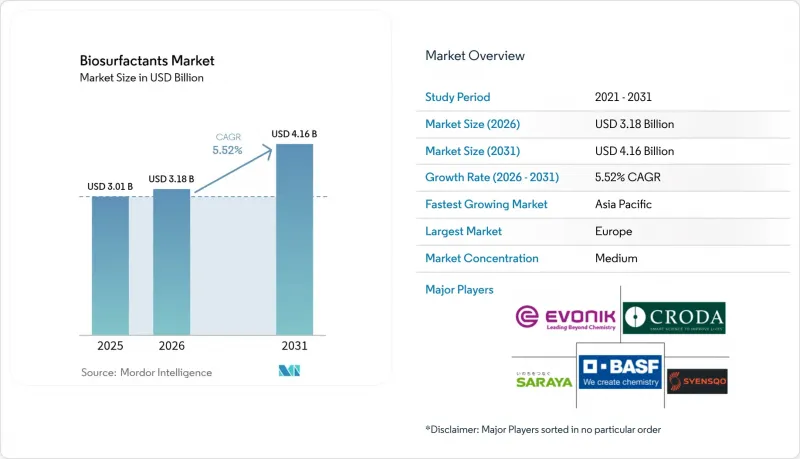
본 보고서는 제품 유형(글리코지질, 인지질, 서팩틴, 리케니신, 고분자 바이오계면활성제, 기타), 원료(식물유, 산업 폐기물 유래 글리세롤,농업 잔여물, 기타), 용도(세제 및 산업용 세정제 등), 지역(아시아태평양, 북미 등)별로 분류되어 있습니다. 시장 전망은 금액(달러) 기준으로 제시되어 있습니다.
세계 바이오계면활성제 시장의 동향 및 인사이트
아시아태평양의 퍼스널케어 및 화장품 수요 확대
2025년, 중국의 화장품 지출은 급증하여 상당한 수준에 도달했습니다. ‘클린 뷰티’ 기준을 충족하는 데 열심인 국내 브랜드들은 소포롤리피드를 사용하여 세안제 처방을 변경하기 시작했습니다. 한편, 인도에서는 2025년 10월 출시 후 불과 90일 만에 시장 점유율을 확대한 힌두스탄 유니레버의 글리콜리피드 함유 핸드워시의 호조에 힘입어 퍼스널케어 제품 매출이 증가했습니다. 한국 규제 당국은 2025년 2월, 씻어내지 않는 타입의 화장품에 라므노리피드의 사용을 승인했습니다. 이러한 움직임은 높은 이익률을 자랑하는 프리미엄 K-뷰티용 세럼 시장의 개척으로 이어졌습니다. 일본의 수출업체들은 아세안(ASEAN) 국가들의 수요 증가를 활용해 바이오계면활성제가 함유된 제품을 수출했습니다. 이러한 수출 증가세가 2025년 해당 지역의 세면용품 매출을 끌어올렸습니다. 전략적 조치로, 쿠로다(Kuroda)사는 2025년 11월 상하이에서 합작 회사를 설립하여, 이 급성장하는 소비자 시장에 대응하기 위한 글리콜리피드 생산능력을 확보했습니다.
생분해성 계면활성제에 대한 규제 추진(EU, 미국)
REACH 부속서 XVII의 규정에 따라, 가정용 제품은 28일 이내에 60%의 생분해성을 달성해야 합니다. 람노리피드는 이 요건을 충족하지만, 많은 에톡실레이트계 계면활성제는 충족하지 못합니다. 2025년 3월, 미국 환경보호청(EPA)은 람노리피드와 소포롤리피드를 ‘세이퍼 초이스(Safer Choice)’ 성분 목록에 추가했습니다. 이 인증을 통해 세제 제품은 포장 표시상 우위를 확보할 수 있어 구매 의욕을 높일 것으로 기대됩니다. 2025년 1월부터 캘리포니아주의 ‘세정 제품 정보 공개법(Cleaning Product Right to Know Act)’에 따라 브랜드는 성분을 완전히 공개해야 하며, 보다 명확하고 식물 유래의 명칭으로의 전환이 촉진됩니다. 한편, PFAS를 단계적으로 폐지하려는 유럽의 제안에 따라 배합 개발자들은 바이오 기반 계면활성제를 더욱 적극적으로 채택하고 있습니다. 이러한 노력들이 맞물려 경기 침체기에도 수요를 지탱하고 있습니다.
높은 제조 비용과 석유계 계면활성제와의 비교
람노리피드는 여전히 LAS에 비해 가격이 비쌉니다. 다운스트림 공정에서의 정제가 현금 비용의 대부분을 차지하고 있으며, 크로마토그래피와 분무건조도 비용을 상승시키고 있습니다. 특히 글리세롤이나 잔여물이 부족한 경우, 원료 가격의 급등으로 인해 이익률이 압박받습니다. 잠재력은 있지만, 규모의 경제를 실현하기는 어려우며, 최대 규모의 바이오계면활성제 플랜트조차도 석유화학 플랜트와는 상당한 격차가 있습니다.
부문 분석
2025년에는 글리코리피드가 매출의 68.91%를 차지하며, 2031년까지 연평균 성장률(CAGR) 5.81%로 성장을 이어갈 전망입니다. 람노리피드가 임계 미셀 농도에 도달함에 따라 바이오계면활성제 시장 내 점유율은 확대될 것으로 보입니다. 소포롤리피드는 유럽의 액체 세탁 세제 수요에 힘입어 글리코리피드 부문에서 두드러진 시장 점유율을 차지했습니다. 한편, 서팍틴은 열적 안정성을 활용하여 유전 및 시추 유체 용도에서 시장 점유율을 확보했습니다.
규제 당국의 승인이 채택 확대를 뒷받침하고 있습니다. 2025년 3월, 일본 PMDA는 일반용 스킨케어 제품에 소포롤리피드의 사용을 승인했습니다. 또한 ECHA는 2024년 사전 등록에 따라 라무노리피드의 등록 절차를 신속히 처리했습니다. 카네카는 화장품용 세럼에 사용되는 고순도 등급 제품을 출시했습니다. 이 제품들은 상당한 가격 프리미엄이 붙어 있어, 프리미엄화 추세를 뒷받침하고 있습니다.
지역별 분석
2025년, 유럽은 매출의 51.75%를 차지했습니다. 이는 REACH 규정의 조화, PFAS 단계적 폐지를 위한 제안, 그리고 친환경 라벨이 부착된 세제에 대한 소비자의 선호도 증가가 요인으로 작용했습니다. 독일, 영국, 프랑스가 해당 지역의 소비 대부분을 차지하고 있으며, 주로 에보닉(Evonik)과 BASF의 멀티모달 허브에서 조달되고 있습니다. 또한, ‘기업 지속가능성 보고 지침(CSRD)’에서 의무화한 탄소 집약도 공개로 인해 소매업체들은 바이오계면활성제를 기반으로 한 자사 브랜드 상품의 취급을 확대해야 하는 상황에 직면해 있습니다.
매출에 크게 기여하고 있는 북미에서는 EPA(미국 환경보호청)의 ‘Safer Choice’ 인증이 매장 내 눈에 띄는 표시를 촉진하는 형태로 호재가 되었습니다. 프록터 앤 갬블(P&G)의 재생 가능 계면활성제 시장으로의 신속한 진출에 더해, 콜게이트-팔모리브가 미국 및 멕시코에서 소포롤리피드를 도입함에 따라 조달 수요가 증가했습니다. 또한, 캐나다의 ‘EcoLogo’ 인증은 상업용 청소용품 부문에서 틈새 시장 계약 확보로 이어졌습니다.
아시아태평양은 2031년까지 연평균 6.04%라는 가장 높은 성장률을 기록할 전망입니다. 이러한 급속한 성장은 중국의 화장품에 대한 폭발적인 수요와 인도 퍼스널케어 시장의 견조한 성장에 힘입은 것입니다. 일본에서는 프리미엄 노리세정 제품군에 람노리피드의 채택이 인정받고 있으며, 한국에서는 아세안 시장으로의 수출 경로가 활성화되면서 해당 지역의 소비가 촉진되고 있습니다. 공급 안정화를 위한 노력의 일환으로, 쿠로다와 상하이의 합작 회사가 2027년에 가동을 시작할 예정이며, 그 생산능력은 매우 클 것으로 예상됩니다.
남미 및 중동 및 아프리카의 합산 점유율은 미미한 수준입니다. 가격 민감성으로 인해 성장이 억제되고 있지만, 특히 원시 글리세롤이 풍부하고 유전 용도가 널리 보급된 지역에서는 성장세가 가속화되고 있습니다. 브라질의 바이오디젤 촉진 정책에 따라 연간 막대한 양의 글리세롤이 생산되고 있습니다. 이러한 풍부한 공급은 국내 생산자들에게 경제적인 발효 원료가 되고 있습니다. 한편, 사우디 아람코는 ‘비전 2030’의 목표에 따라 바이오계면활성제를 이용한 시추 유체 시험을 진행하고 있습니다.
기타 혜택:
- 엑셀 형식의 시장 예측(ME) 시트
- 3개월간의 애널리스트 지원
자주 묻는 질문
목차
제1장 소개
제2장 조사 방법
제3장 주요 요약
제4장 시장 구도
제5장 시장 규모와 성장 예측
제6장 경쟁 구도
제7장 시장 기회와 향후 전망
KSM 26.09.02According to Mordor Intelligence, the biosurfactants market size is expected to increase from USD 3.01 billion in 2025 to USD 3.18 billion in 2026 and reach USD 4.16 billion by 2031, growing at a CAGR of 5.52% over 2026-2031.
This report is Segmented by Product Type (Glycolipids, Phospholipids, Surfactin, Lichenysin, Polymeric Bio-Surfactants, and Other Product Types), Feedstock (Vegetable Oils, Industrial Waste Glycerol, Agricultural Residues, and Others), Application (Detergents and Industrial Cleaners, and More), and Geography (Asia-Pacific, North America, and More). The Market Forecasts are Provided in Terms of Value (USD).
Global Biosurfactants Market Trends and Insights
Expansion of Personal-Care and Cosmetics Demand in Asia-Pacific
In 2025, China's cosmetics expenditure surged, reaching significant levels. Domestic brands, keen on meeting "clean beauty" standards, began reformulating their cleansers with sophorolipids. Meanwhile, in India, personal-care sales saw an uptick, bolstered by Hindustan Unilever's glycolipid handwash, which gained market share just 90 days post its October 2025 launch. South Korea's regulatory body greenlit rhamnolipids for leave-on cosmetics in February 2025. This move paved the way for premium K-beauty serums, which boast high margins. Japanese exporters capitalized on rising demand from ASEAN, dispatching biosurfactant-infused products. This boost in exports propelled regional toiletries sales in 2025. In a strategic move, Croda inaugurated a joint venture in Shanghai in November 2025, establishing a glycolipid capacity to cater to this burgeoning consumer market.
Regulatory Push for Biodegradable Surfactants (EU, US)
Household products must now achieve 60% biodegradation within 28 days, as mandated by REACH Annex XVII. While rhamnolipids meet this requirement, many ethoxylates do not. In March 2025, the U.S. EPA included rhamnolipids and sophorolipids in its Safer Choice ingredient list. This endorsement provides detergents with a shelf-labeling advantage, which can boost purchase intent. Starting January 2025, California's Cleaning Product Right to Know Act will require brands to fully disclose ingredients, nudging them towards clearer, plant-based names. Meanwhile, European proposals to phase out PFAS are steering formulators more towards bio-based surfactants. Together, these initiatives bolster demand, even during economic downturns.
High Production Cost vs. Petro-Surfactants
Rhamnolipids still carry a surcharge over LAS. Downstream purification consumes a significant portion of the cash cost, with chromatography and spray-drying adding to the expenses. Margins face pressure from feedstock spikes, especially when glycerol or residues are in short supply. Despite the potential, achieving economies of scale proves challenging; the largest biosurfactant plants trail petrochemical units by a considerable factor.
Other drivers and restraints analyzed in the detailed report include:
- Brand-Level Sustainability Commitments by FMCG Majors
- Synthetic-Biology-Enabled Designer Biosurfactants
- Tight Purity Specs for Food and Pharma Grades
For complete list of drivers and restraints, kindly check the Table Of Contents.
Segment Analysis
In 2025, glycolipids accounted for 68.91% of the revenue and are also advancing at a 5.81% CAGR through 2031. Their share of the biosurfactants market is poised to increase, thanks to rhamnolipids achieving critical micelle concentrations. Sophorolipids, bolstered by laundry liquids in Europe, commanded a notable portion of the glycolipid segment. Meanwhile, surfactin, capitalizing on its thermal stability, secured a share for oilfield and drilling fluid applications.
Regulatory approvals are driving increased adoption: In March 2025, Japan's PMDA approved sophorolipids for over-the-counter skincare, and the ECHA expedited the registration process for rhamnolipids following their pre-registration in 2024. Kaneka introduced high-purity grades for cosmetic serums, which command significant price premiums, underscoring a trend towards premiumization.
Complete Report Scope:
- By Product Type
- Glycolipids
- Phospholipids
- Surfactin
- Lichenysin
- Polymeric Bio-surfactants
- Other Product Types
- By Feedstock
- Vegetable Oils (soy, palm, rapeseed)
- Industrial Waste Glycerol
- Agricultural Residues (molasses, whey)
- Others (Animal Fat, Synthesised Sugars)
- By Application
- Detergents and Industrial Cleaners
- Cosmetics (Personal Care)
- Food Processing
- Oilfield Chemicals
- Agricultural Chemicals
- Textiles
- Other Applications
- By Geography
- Asia-Pacific
- China
- India
- Japan
- South Korea
- ASEAN
- Rest of Asia-Pacific
- North America
- United States
- Canada
- Mexico
- Europe
- Germany
- United Kingdom
- France
- Italy
- Spain
- Russia
- Rest of Europe
- South America
- Brazil
- Argentina
- Rest of South America
- Middle-East and Africa
- Saudi Arabia
- South Africa
- Rest of Middle-East and Africa
- Asia-Pacific
Geography Analysis
Europe held 51.75% revenue in 2025 as REACH, driven by the convergence of REACH regulations, proposals for phasing out PFAS, and a growing consumer preference for ecolabeled detergents. Germany, the United Kingdom, and France collectively accounted for the region's consumption, primarily sourcing from the multi-modal hubs of Evonik and BASF. Additionally, carbon-intensity disclosures mandated by the Corporate Sustainability Reporting Directive are pushing retailers to increasingly stock private labels based on biosurfactants.
North America, contributing significantly to the turnover, benefited from EPA's Safer Choice designations, which facilitate prominent shelf-edge callouts. Procter & Gamble's swift expansion into renewable surfactants, coupled with Colgate-Palmolive's introduction of sophorolipids in the U.S. and Mexico, heightened the demand for sourcing. Furthermore, Canada's EcoLogo endorsement has carved out niche contracts within the institutional cleaning supplies sector.
Asia-Pacific will post the fastest 6.04% run-rate to 2031. This surge is fueled by China's staggering appetite for cosmetics and India's robust growth in personal care. Japan's endorsement of rhamnolipids for premium leave-on products, alongside Korea's flourishing export channel to ASEAN markets, bolsters regional consumption. Addressing supply security, a Croda-Shanghai joint venture is poised to commence operations in 2027, boasting a significant capacity.
South America and the combined regions of the Middle East and Africa hold a modest share. Their growth is tempered by price sensitivity, yet they are gaining traction, especially in areas abundant with crude glycerol and where oilfield applications are prevalent. Brazil's biodiesel initiative churns out an impressive amount of glycerol annually. This bounty serves as an economical fermentation feed for domestic producers. Meanwhile, in alignment with its Vision 2030 objectives, Saudi Aramco is experimenting with biosurfactant drilling fluids.
- AGAE Technologies, LLC
- AmphiStar Biosurfactants
- BASF
- Biotensidon GmbH
- Croda International Plc
- Dispersa Inc.
- Ecover
- Evonik Industries AG
- Givaudan
- GlycoSurf
- Jeneil Biotech
- Kaneka Corporation
- Saraya.Co.Ltd
- Stepan Company
- Syensqo
- TeeGene Biotech
- TensioGreen
- WHEATOLEO
Additional Benefits:
- The market estimate (ME) sheet in Excel format
- 3 months of analyst support
TABLE OF CONTENTS
1 Introduction
- 1.1 Study Assumptions and Market Definition
- 1.2 Scope of the Study
2 Research Methodology
3 Executive Summary
4 Market Landscape
- 4.1 Market Overview
- 4.2 Market Drivers
- 4.2.1 Expansion of Personal-Care and Cosmetics Demand in Asia-Pacific
- 4.2.2 Regulatory Push for Biodegradable Surfactants (EU, US)
- 4.2.3 Brand-Level Sustainability Commitments by FMCG Majors
- 4.2.4 Fermentation Scale-Up Lowering Cost Curves
- 4.2.5 Synthetic-Biology-Enabled "Designer" Biosurfactants
- 4.3 Market Restraints
- 4.3.1 High Production Cost vs. Petro-Surfactants
- 4.3.2 Tight Purity Specs for Food and Pharma Grades
- 4.3.3 Patent Thickets around Production Strains
- 4.4 Value Chain Analysis
- 4.5 Porter's Five Forces
- 4.5.1 Bargaining Power of Suppliers
- 4.5.2 Bargaining Power of Buyers
- 4.5.3 Threat of New Entrants
- 4.5.4 Threat of Substitutes
- 4.5.5 Competitive Rivalry
5 Market Size and Growth Forecasts (Value)
- 5.1 By Product Type
- 5.1.1 Glycolipids
- 5.1.2 Phospholipids
- 5.1.3 Surfactin
- 5.1.4 Lichenysin
- 5.1.5 Polymeric Bio-surfactants
- 5.1.6 Other Product Types
- 5.2 By Feedstock
- 5.2.1 Vegetable Oils (soy, palm, rapeseed)
- 5.2.2 Industrial Waste Glycerol
- 5.2.3 Agricultural Residues (molasses, whey)
- 5.2.4 Others (Animal Fat, Synthesised Sugars)
- 5.3 By Application
- 5.3.1 Detergents and Industrial Cleaners
- 5.3.2 Cosmetics (Personal Care)
- 5.3.3 Food Processing
- 5.3.4 Oilfield Chemicals
- 5.3.5 Agricultural Chemicals
- 5.3.6 Textiles
- 5.3.7 Other Applications
- 5.4 By Geography
- 5.4.1 Asia-Pacific
- 5.4.1.1 China
- 5.4.1.2 India
- 5.4.1.3 Japan
- 5.4.1.4 South Korea
- 5.4.1.5 ASEAN
- 5.4.1.6 Rest of Asia-Pacific
- 5.4.2 North America
- 5.4.2.1 United States
- 5.4.2.2 Canada
- 5.4.2.3 Mexico
- 5.4.3 Europe
- 5.4.3.1 Germany
- 5.4.3.2 United Kingdom
- 5.4.3.3 France
- 5.4.3.4 Italy
- 5.4.3.5 Spain
- 5.4.3.6 Russia
- 5.4.3.7 Rest of Europe
- 5.4.4 South America
- 5.4.4.1 Brazil
- 5.4.4.2 Argentina
- 5.4.4.3 Rest of South America
- 5.4.5 Middle-East and Africa
- 5.4.5.1 Saudi Arabia
- 5.4.5.2 South Africa
- 5.4.5.3 Rest of Middle-East and Africa
- 5.4.1 Asia-Pacific
6 Competitive Landscape
- 6.1 Market Concentration
- 6.2 Strategic Moves
- 6.3 Market Share(%)/Ranking Analysis
- 6.4 Company Profiles (includes Global Overview, Market Overview, Core Segments, Financials, Strategic Information, Products and Services, Recent Developments)
- 6.4.1 AGAE Technologies, LLC
- 6.4.2 AmphiStar Biosurfactants
- 6.4.3 BASF
- 6.4.4 Biotensidon GmbH
- 6.4.5 Croda International Plc
- 6.4.6 Dispersa Inc.
- 6.4.7 Ecover
- 6.4.8 Evonik Industries AG
- 6.4.9 Givaudan
- 6.4.10 GlycoSurf
- 6.4.11 Jeneil Biotech
- 6.4.12 Kaneka Corporation
- 6.4.13 Saraya.Co.Ltd
- 6.4.14 Stepan Company
- 6.4.15 Syensqo
- 6.4.16 TeeGene Biotech
- 6.4.17 TensioGreen
- 6.4.18 WHEATOLEO
7 Market Opportunities and Future Outlook
- 7.1 White-space and Unmet-Need Assessment


