

|
시장보고서
상품코드
2120749
재택의료 소프트웨어 : 시장 점유율 분석, 업계 동향과 통계, 성장 예측(2026-2031년)Home Healthcare Software - Market Share Analysis, Industry Trends & Statistics, Growth Forecasts (2026 - 2031) |
||||||
 Mordor Intelligence
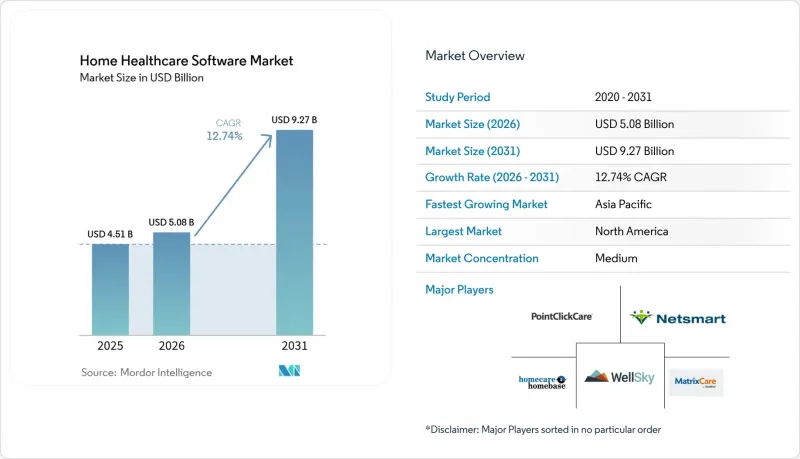
Mordor Intelligence에 따르면 재택의료 소프트웨어 시장 규모는 2025년 45억 1,000만 달러에서 2026년에는 50억 8,000만 달러로 확대되어, 2026년부터 2031년까지 CAGR 12.74%를 기록하며 2031년에는 92억 7,000만 달러에 달할 것으로 예측됩니다.
본 보고서는 소프트웨어 유형(재택의료 기관 관리 솔루션, 임상 관리 시스템 등), 서비스(재활, 정맥 주사 요법 등), 제공 형태(클라우드 기반 등), 최종사용자(재택의료 기관 등), 및 지역(북미, 유럽, 아시아태평양 등)별로 분류되어 있습니다. 시장 예측은 금액(달러)으로 제시되어 있습니다.
세계 재택의료 소프트웨어 시장의 동향 및 인사이트
가치 중심의 의료로의 전환이 소프트웨어 요구 사항을 변화시키고 있습니다
지급 기관은 종량제 보상에서 측정 가능한 성과에 대해 보상이 지급되는 모델로 계속해서 전환하고 있습니다. 유나이티드헬스그룹(UnitedHealth Group)의 보고에 따르면, 연계된 재택 간호를 통해 만성 질환 환자의 입원을 최대 25%까지 줄일 수 있다고 합니다. 현재 의료 제공자들은 품질 지표, 위험 점수, 임상 경로 등을 추적하는 분석 기능이 내장된 플랫폼을 도입하고 있습니다. ‘재택의료 가치 기반 구매(Home Health Value-Based Purchasing)’ 프레임워크를 시범 도입하고 있는 주에서는 소프트웨어가 시기적절하고 정확한 성과 보고서를 제공할 경우, 사업자가 보너스 형태의 보상을 받을 수 있습니다. 각 벤더사는 환자가 재입원 임계치에 근접했을 때 직원에게 경고를 보내는 예측 알고리즘을 통합하여, 이를 통해 정액 계약에서의 이익률을 유지하고 있습니다. 성과 연계형 보상이 확대됨에 따라 재택의료 소프트웨어 시장은 단순한 선택적 도구가 아닌, 업무에 필수적인 인프라로 변화하고 있습니다.
전자 방문 검증(EVV) 의무화로 디지털 도입 가속화
‘21세기 치료법(21st Century Cures Act)’에 따라 메디케이드 환급 시 전자 방문 검증(EVV)이 의무화되었습니다. 펜실베이니아주와 뉴욕주 등에서는 2025년까지 각각 85% 및 90%의 EVV 준수율을 의무화하고 있으며, 이를 준수하지 못할 경우 지급이 거부됩니다. EVV 플랫폼은 서비스 유형, 수급자, 날짜, 장소, 제공자, 시간 등 6가지 데이터 포인트를 대부분 GPS 지원 모바일 앱이나 고정 단말기를 통해 검증해야 합니다. 과거 종이 기반 프로세스에 의존하던 소규모 기관들도 현재는 면허를 유지하기 위해 디지털 방문 기록 도입을 추진하고 있습니다. 각 벤더사는 EVV 모듈을 보다 광범위한 제품군에 통합하여, 일정 관리, 청구, 임상 문서 작성 등의 부가 서비스 판매로 이어질 수 있는 기회를 창출하고 있습니다. 이러한 의무화로 인해 도입 일정이 단축되면서, 재택의료 소프트웨어 시장의 잠재 수요에 급격한 변화를 가져오고 있습니다.
데이터 보안에 대한 우려가 도입의 장벽이 되고 있다
의료 분야는 여전히 사이버 범죄의 주요 표적이 되고 있습니다. 2024년에 랜섬웨어 공격이 급증함에 따라 각 기관은 위험 허용 한도를 재평가할 수밖에 없게 되었습니다. 특히, HIPAA 위반에 따른 벌금이 건당 100달러에서 5만 달러에 달한다는 점을 고려할 때, 그 필요성은 더욱 커지고 있습니다. 소규모 의료 제공업체는 전담 보안 담당자가 부족하여 새로운 플랫폼 도입 결정이 지연되고 있습니다. 벤더들은 종단 간 암호화, 세분화된 역할 기반 권한 설정, 감사 추적 기능을 추가하고 있지만, 고객들은 여전히 정기적인 침투 테스트 및 규정 준수 감사 비용을 감당해야 하는 상황에 직면해 있습니다. 유럽에서는 GDPR에 따라 엄격한 정보 유출 통지 기간이 정해져 있어, 잠재적인 벌금 및 평판 하락 위험이 높아지고 있습니다. 이러한 요인으로 인해 디지털 도구에 대한 업무상의 필요성이 끝없이 증가하고 있음에도 불구하고, 재택의료 소프트웨어 시장의 판매 주기는 장기화되고 있습니다.
부문 분석
2025년에는 에이전시 관리 솔루션이 총 매출의 34.62%를 차지하며, 대다수 사업자에게 업무의 기반으로서 역할을 하고 있음을 알 수 있습니다. 이러한 플랫폼은 일정 관리, 급여 계산, 규정 준수 보고를 통합하여 소규모 에이전시라도 분산된 직원을 효율적으로 조정할 수 있게 해줍니다. ‘Homecare Homebase’나 ‘MatrixCare’와 같은 주요 소프트웨어 제품군은 신뢰할 수 있는 가동률과 분기별 상세한 규제 업데이트를 결합하여 장기 계약을 확보하고 있습니다. 재택의료 소프트웨어 시장은 보다 광범위한 디지털 전환의 관문으로서 이러한 핵심 시스템에 의존하고 있습니다.
성장의 모멘텀은 ‘기타 소프트웨어’ 부문으로 이동하고 있습니다. 이 부문에는 원격의료, 원격 모니터링, AI를 활용한 임상 의사결정 지원 등이 포함됩니다. 해당 부문은 2031년까지 연평균 성장률(CAGR) 14.97%를 기록하며, 재택의료 소프트웨어 시장 전체를 상회하는 속도로 성장하고 있습니다. 원격 진료 플랫폼의 이용률은 팬데믹 이전 수준을 훨씬 상회하는 상태를 유지하고 있으며, AI 스크라이브는 현재 화상 통화를 통해 직접 진료 기록을 작성하고 있습니다. 각 벤더사는 이러한 틈새 모듈을 각 기관의 핵심 시스템에 긴밀하게 통합하여 원활한 데이터 흐름과 더욱 풍부한 분석 기능을 실현하고 있습니다. 보험사가 원격 서비스를 대면 진료와 동등한 수준으로 보상함에 따라, 전문적인 솔루션은 각 제공업체에서 점유율을 확대하고 있습니다.
2025년 매출액 중 숙련 간호 분야가 41.28%를 차지하고 있어, 재택 급성기 후 관리 분야에서 이 분야의 선도적 지위가 입증되고 있습니다. 병원들은 복잡한 증례 환자를 조기에 퇴원시키고, 품질 점수에 영향을 미치는 30일 이내 재입원을 방지하기 위해 요양 서비스 제공업체와 제휴하고 있습니다. 전문 간호용 소프트웨어에서는 상처 관리 템플릿, 투약 조정, 그리고 다직종 협력을 통한 케어 플랜 조정이 우선시되고 있습니다. 간호 방문 시 방대한 양의 기록 작성이 발생하기 때문에 자연어 처리 도구가 임상 의사의 기록 작성 속도를 높여 재택의료 소프트웨어 시장에서 방문 대응 능력을 유지하고 있습니다.
정맥 주사 요법은 현재 규모는 작지만 연평균 성장률(CAGR) 13.72%로 확대되고 있으며, 가장 빠르게 성장하는 서비스 분야가 되었습니다. 과거에는 입원 환자 전용이었던 고가의 생물학적 제제나 전문 의약품이 현재는 재택으로 전환되면서 투여 비용이 대폭 절감되고 있습니다. 각 플랫폼에는 재고 관리 기능이 내장되어 있어, 주사백의 로트 번호를 추적하고 소모품을 자동으로 재주문함으로써 낭비를 최소화하고 있습니다. 텔레파마시 기능을 통해 임상의는 환자의 생체 신호를 바탕으로 투여량을 실시간으로 조정할 수 있어 안전성이 향상됩니다. 이 부문의 호황은 치료에 특화된 워크플로우를 목표로 하는 벤더들에게, 서비스 다각화가 재택의료 소프트웨어 시장의 규모를 얼마나 확대하고 있는지를 보여줍니다.
지역별 분석
북미는 2025년에도 선진적인 환급 모델과 메디케이드 방문 시마다 소프트웨어 사용을 의무화하는 엄격한 EVV(전자 방문 검증) 시행에 힘입어 전 세계 매출의 41.55%를 계속 차지할 것으로 보입니다. 미국만으로도 전체 지역 지출의 5분의 4 이상을 차지하고 있는 반면, 캐나다의 단일 지불자 제도는 주 전역에 걸친 플랫폼 조달을 뒷받침하고 있습니다. 스노우버드(겨울철에 따뜻한 지역으로 이동하는 사람들)에게 서비스를 제공하는 기관들이 여러 주의 메디케이드 시스템과 데이터를 교환해야 하기 때문에 국경을 초월한 상호 운용성은 여전히 과제로 남아 있습니다.
아시아태평양은 연평균 성장률(CAGR) 13.66%로 가장 빠른 성장을 기록하고 있습니다. 인도, 중국, 인도네시아 정부는 클라우드 시범 사업 및 원격의료 네트워크에 자금을 지원하는 디지털 헬스 이니셔티브를 추진하고 있습니다. 대형 민간 병원 체인들은 퇴원 후 수익을 확보하고 입원 환자 과밀을 완화하기 위해 재택의료 부문을 출범시키고 있습니다. 스마트폰의 급속한 보급으로 막대한 하드웨어 투자 없이도 의료진의 모바일 업무 흐름이 가능해졌으며, 신규 진입 기업들이 기존의 도입 체계를 뛰어넘을 수 있게 되었습니다. 이러한 동향으로 인해 현지 언어 지원 및 데이터 상주 요건을 준수할 수 있는 국제적인 벤더들에게 재택의료 소프트웨어 시장의 규모가 확대되고 있습니다.
유럽은 매출액 기준 2위를 차지하고 있으며, 수요는 독일, 영국, 프랑스에 집중되어 있습니다. 규제 당국은 ‘Interoperable Europe Act’ 등의 법률을 통해 국경을 초월한 데이터 이관성을 추진하고 있으며, 표준 규격에 기반한 플랫폼에 대한 투자를 장려하고 있습니다. 또한 각 기관은 GDPR 준수를 요구받고 있어, 암호화 및 동의 관리에 대한 관심이 높아지고 있습니다. 이 지역의 민간 보험사들은 미국의 가치 기반 지불 체계를 모방한 성과 기반 계약을 시범적으로 도입하고 있어, 재택의료 소프트웨어 시장에서 고급 분석의 중요성이 커지고 있습니다. 중동 및 아프리카, 남미와 같은 신흥 지역은 기반이 작고 기존 인프라가 부족하기 때문에 클라우드 솔루션을 신속하게 도입하고 있습니다.
기타 혜택:
- 엑셀 형식의 시장 예측(ME) 시트
- 3개월간의 애널리스트 지원
자주 묻는 질문
목차
제1장 소개
제2장 조사 방법
제3장 주요 요약
제4장 시장 구도
제5장 시장 규모와 성장 예측
제6장 경쟁 구도
제7장 시장 기회와 향후 전망
KSM 26.09.02According to Mordor Intelligence, the home healthcare software market size is expected to grow from USD 4.51 billion in 2025 to USD 5.08 billion in 2026 and is forecast to reach USD 9.27 billion by 2031 at 12.74% CAGR over 2026-2031.
This report is Segmented by Software Type (Air Agency Management Solutions, Clinical Management Systems, and More), Service (Rehabilitation, Infusion Therapy, and More), Mode of Delivery (Cloud-Based, and More), End-User (Home Health Agencies, and More), and Geography (North America, Europe, Asia-Pacific, and More). The Market Forecasts are Provided in Terms of Value (USD).
Global Home Healthcare Software Market Trends and Insights
Shift to Value-Based Care Transforming Software Requirements
Payers continue to pivot away from fee-for-service toward models that reward measurable outcomes. UnitedHealth Group reports that coordinated home care can lower hospital admissions by as much as 25% for chronically ill patients. Providers now purchase platforms with embedded analytics that track quality metrics, risk scores, and clinical pathways. In states piloting the Home Health Value-Based Purchasing framework, agencies see reimbursement bonuses when software supplies timely, accurate outcome reports. Vendors integrate predictive algorithms to alert staff when patients approach thresholds for readmission, thereby protecting margins in capitated contracts. As pay-for-performance expands, the home healthcare software market becomes mission-critical infrastructure rather than an optional tool.
Electronic Visit Verification Mandates Accelerating Digital Adoption
The 21st Century Cures Act locks EVV into Medicaid reimbursement. States such as Pennsylvania and New York require 85% and 90% EVV compliance respectively by 2025, with payment denials for failures. EVV platforms must verify six data points-service type, recipient, date, location, provider, and time-often through GPS-enabled mobile apps or fixed devices. Smaller agencies that once relied on paper processes are now adopting digital visit capture to stay licensed. Vendors bundle EVV modules into broader suites, creating a gateway to upsell scheduling, billing, and clinical documentation. These mandates compress adoption timelines, producing a step-change in addressable demand for the home healthcare software market.
Data Security Concerns Creating Implementation Barriers
Healthcare remains a prime cyber-crime target. A surge in ransomware hits during 2024 forced agencies to reassess risk tolerance, especially when HIPAA fines span USD 100 to USD 50,000 per incident. Smaller providers lack dedicated security staff, slowing decisions on new platforms. Vendors add end-to-end encryption, granular role-based permissions, and audit trails, yet clients still face recurring penetration-testing and compliance audit costs. In Europe, GDPR stipulates strict breach notification windows, raising potential penalties and reputational damage. These factors lengthen sales cycles in the home healthcare software market even as the operational need for digital tools grows unchecked.
Other drivers and restraints analyzed in the detailed report include:
- Cloud-Based Solutions Dominating Market Growth
- Chronic Disease Management Driving Specialized Software Demand
- Reimbursement Complexity Hampering Software ROI
For complete list of drivers and restraints, kindly check the Table Of Contents.
Segment Analysis
Agency Management Solutions accounted for 34.62% of total revenue in 2025, reflecting their role as the operational backbone for most providers. These platforms consolidate scheduling, payroll, and compliance reporting, enabling even small agencies to coordinate distributed workforces efficiently. Leading suites such as Homecare Homebase and MatrixCare secure long-term contracts by pairing reliable uptime with deep regulatory updates every quarter. The home healthcare software market relies on these core systems as entry points for broader digital transformation.
Growth momentum is shifting toward the Other Software segment, which combines telehealth, remote monitoring, and AI-assisted clinical decision support. That segment is posting a 14.97% CAGR through 2031, outpacing the overall home healthcare software market. Virtual visit platforms maintain usage levels far above pre-pandemic norms, and AI scribes now draft encounter notes directly from video calls. Vendors tightly integrate these niche modules into core agency systems, creating seamless data flows and richer analytics. As payers reimburse remote services at parity with in-person care, specialized solutions carve out growing wallet share across providers.
Skilled Nursing commands 41.28% of 2025 revenues, confirming its primacy in home-based post-acute care. Hospitals discharge complex cases earlier, and they partner with agencies to prevent readmissions during the 30-day window that affects quality scores. Software for Skilled Nursing prioritizes wound care templates, medication reconciliation, and interdisciplinary care plan coordination. Because nursing visits generate high documentation volume, natural-language processing utilities help clinicians complete notes faster, preserving visit capacity in the home healthcare software market.
Infusion Therapy, though smaller today, advances at a 13.72% CAGR and is the fastest-growing service line. Expensive biologics and specialty drugs once confined to inpatient settings now move to the home, where administration costs drop sharply. Platforms embed inventory management to track bag lot numbers and auto-reorder supplies, minimizing waste. Telepharmacy links let clinicians adjust doses in real-time based on patient vitals, improving safety. The segment's dynamism illustrates how service diversification broadens the home healthcare software market size for vendors targeting therapy-specific workflows.
Complete Report Scope:
- By Software Type
- Agency Management Solutions
- Clinical Management Systems
- Hospice & Palliative Care Software
- Other Software
- By Service
- Rehabilitation
- Infusion Therapy
- Respiratory Therapy
- Pregnancy & Post-partum Care
- Skilled Nursing
- Other Services
- By Mode of Delivery
- Cloud-Based
- On-Premises
- Hybrid
- By End-User
- Home Health Agencies
- Hospice Agencies
- Other End-Users
- Geography
- North America
- United States
- Canada
- Mexico
- Europe
- Germany
- United Kingdom
- France
- Italy
- Spain
- Rest of Europe
- Asia-Pacific
- China
- Japan
- India
- Australia
- South Korea
- Rest of Asia-Pacific
- Middle East & Africa
- GCC
- South Africa
- Rest of Middle East & Africa
- South America
- Brazil
- Argentina
- Rest of South America
- North America
Geography Analysis
North America retains 41.55% of global revenue in 2025, propelled by advanced reimbursement models and stringent EVV enforcement that mandates software for every Medicaid visit. The United States alone contributes more than four-fifths of regional spending, while Canada's single-payer structure supports province-wide platform procurements. Cross-border interoperability remains an agenda item, as agencies serving snowbird populations require data exchange with multiple state Medicaid systems.
Asia-Pacific records the briskest expansion at 13.66% CAGR. Governments in India, China, and Indonesia sponsor digital health missions that fund cloud pilots and telehealth networks. Large private hospital chains open home health divisions to capture post-discharge revenue and reduce inpatient congestion. Rapid smartphone penetration enables mobile clinician workflows without heavy hardware investment, allowing new entrants to leapfrog legacy deployments. These trends enlarge the home healthcare software market size for international vendors capable of local language support and data residency compliance.
Europe ranks second by revenue, with demand concentrated in Germany, the United Kingdom, and France. Regulators promote cross-border data portability through laws such as the Interoperable Europe Act, creating incentives to invest in standards-based platforms. Agencies must also align with GDPR, reinforcing focus on encryption and consent management. Private insurers in the region pilot outcome-based contracts that mirror U.S. value-based payment schemes, strengthening the case for advanced analytics within the home healthcare software market. Emerging regions in the Middle East, Africa, and South America grow from a smaller base but adopt cloud solutions quickly due to scarce legacy infrastructure.
- WellSky Corp.
- Netsmart Technologies
- MatrixCare (Brightree & ResMed)
- Homecare Homebase LLC
- PointClickCare Technologies
- Axxess Technology Solutions
- AlayaCare Inc.
- Delta Health Technologies
- Allscripts
- Meditech
- Oracle Health (Cerner)
- Mckesson
- CARECENTA
- AxisCare LLC
- Thornberry Ltd.
- Kinnser Software
- ClearCare (WellSky Personal Care)
- HealthCare Provider Solutions Inc.
- Epic Systems (Home Health module)
- GE Healthcare Digital
- Teladoc Health
Additional Benefits:
- The market estimate (ME) sheet in Excel format
- 3 months of analyst support
TABLE OF CONTENTS
1 Introduction
- 1.1 Study Assumptions & Market Definition
- 1.2 Scope of the Study
2 Research Methodology
3 Executive Summary
4 Market Landscape
- 4.1 Market Overview
- 4.2 Market Drivers
- 4.2.1 Shift to Value-Based & Home-Centric Care Models
- 4.2.2 Government Mandates for Electronic Visit Verification & Outcome Reporting
- 4.2.3 Rapid Cloud- and Mobile-First Health-IT Adoption by Care Providers
- 4.2.4 Aging Population & Chronic?Disease Burden Expanding Home-Care Demand
- 4.2.5 Interoperability Push Across Acute, Post-Acute, and Payer Systems
- 4.2.6 Venture Funding & M&A Accelerating Digital Home-Care Innovation
- 4.3 Market Restraints
- 4.3.1 Data-Security & HIPAA / GDPR Compliance Concerns
- 4.3.2 Fragmented Reimbursement & Billing Regulations Across Payers
- 4.3.3 Limited IT Budgets & Change-Management Barriers in Small Agencies
- 4.3.4 Integration Complexity with Legacy EHRs and Medical Devices
- 4.4 Value / Supply-Chain Analysis
- 4.5 Regulatory Outlook
- 4.6 Porter's Five Forces Analysis
- 4.6.1 Threat of New Entrants
- 4.6.2 Bargaining Power of Buyers/Consumers
- 4.6.3 Bargaining Power of Suppliers
- 4.6.4 Threat of Substitute Products
- 4.6.5 Intensity of Competitive Rivalry
5 Market Size & Growth Forecasts (Value, USD)
- 5.1 By Software Type
- 5.1.1 Agency Management Solutions
- 5.1.2 Clinical Management Systems
- 5.1.3 Hospice & Palliative Care Software
- 5.1.4 Other Software
- 5.2 By Service
- 5.2.1 Rehabilitation
- 5.2.2 Infusion Therapy
- 5.2.3 Respiratory Therapy
- 5.2.4 Pregnancy & Post-partum Care
- 5.2.5 Skilled Nursing
- 5.2.6 Other Services
- 5.3 By Mode of Delivery
- 5.3.1 Cloud-Based
- 5.3.2 On-Premises
- 5.3.3 Hybrid
- 5.4 By End-User
- 5.4.1 Home Health Agencies
- 5.4.2 Hospice Agencies
- 5.4.3 Other End-Users
- 5.5 Geography
- 5.5.1 North America
- 5.5.1.1 United States
- 5.5.1.2 Canada
- 5.5.1.3 Mexico
- 5.5.2 Europe
- 5.5.2.1 Germany
- 5.5.2.2 United Kingdom
- 5.5.2.3 France
- 5.5.2.4 Italy
- 5.5.2.5 Spain
- 5.5.2.6 Rest of Europe
- 5.5.3 Asia-Pacific
- 5.5.3.1 China
- 5.5.3.2 Japan
- 5.5.3.3 India
- 5.5.3.4 Australia
- 5.5.3.5 South Korea
- 5.5.3.6 Rest of Asia-Pacific
- 5.5.4 Middle East & Africa
- 5.5.4.1 GCC
- 5.5.4.2 South Africa
- 5.5.4.3 Rest of Middle East & Africa
- 5.5.5 South America
- 5.5.5.1 Brazil
- 5.5.5.2 Argentina
- 5.5.5.3 Rest of South America
- 5.5.1 North America
6 Competitive Landscape
- 6.1 Market Concentration
- 6.2 Strategic Moves
- 6.3 Market Share Analysis
- 6.4 Company Profiles (includes Global level Overview, Market level overview, Core Business Segments, Financials, Headcount, Key Information, Market Rank, Market Share, Products and Services, and analysis of Recent Developments)
- 6.4.1 WellSky Corp.
- 6.4.2 NetSmart Technologies
- 6.4.3 MatrixCare (Brightree & ResMed)
- 6.4.4 Homecare Homebase LLC
- 6.4.5 PointClickCare Technologies
- 6.4.6 Axxess Technology Solutions
- 6.4.7 AlayaCare Inc.
- 6.4.8 Delta Health Technologies
- 6.4.9 Allscripts Healthcare Solutions Inc.
- 6.4.10 MEDITECH
- 6.4.11 Oracle Health (Cerner)
- 6.4.12 McKesson Corporation
- 6.4.13 CARECENTA, INC.
- 6.4.14 AxisCare LLC
- 6.4.15 Thornberry Ltd.
- 6.4.16 Kinnser Software Inc.
- 6.4.17 ClearCare (WellSky Personal Care)
- 6.4.18 HealthCare Provider Solutions Inc.
- 6.4.19 Epic Systems (Home Health module)
- 6.4.20 GE Healthcare Digital
- 6.4.21 Teladoc Health
7 Market Opportunities & Future Outlook
- 7.1 White-space & Unmet-Need Assessment


