
|
시장보고서
상품코드
2120778
내시경 기기 : 시장 점유율 분석, 업계 동향과 통계, 성장 예측(2026-2031년)Endoscopy Devices - Market Share Analysis, Industry Trends & Statistics, Growth Forecasts (2026 - 2031) |
||||||
 Mordor Intelligence
Mordor Intelligence에 따르면 내시경 기기 시장 규모는 2025년 401억 달러, 2026년 427억 3,000만 달러에서 2031년까지 587억 1,000만 달러로 확대되어, 2026년부터 2031년까지 CAGR은 6.56%가 될 전망입니다.
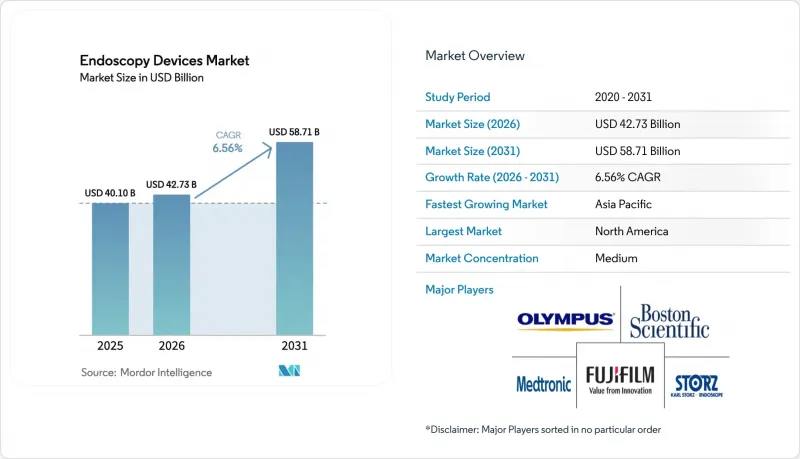
본 보고서는 기기 유형(내시경[경성 내시경 등], 내시경 수술용 기기[접근 기기 등] 등), 용도(소화기계, 기타), 사용 형태(재처리된/재사용 가능한 기기, 기타), 최종사용자(병원, 대학 부속 병원, 기타), 및 지역(북미, 유럽, 기타)에 따라 분류되어 있습니다. 시장 예측은 금액(달러)으로 표시되어 있습니다.
세계 내시경 기기 시장의 동향 및 인사이트
세계 소화기암 및 대장암 발병률 상승이 선별 검사 수요를 견인
미국 내 20-49세 성인의 대장암 사례 수는 2020년부터 2024년 사이에 9% 증가할 것으로 예상되며, 이에 따라 보험사들은 선별 검사 대상 연령대를 젊은 층으로 확대하도록 촉구하고 있습니다. 그 결과, 내시경 기기의 교체 주기가 더욱 단축되어야 할 필요성이 대두되고 있으며, 검사 건수가 많은 의료기관에서는 간격 암의 30%를 차지하는 평탄하거나 함몰된 병변을 보다 선명하게 시각화할 수 있는 고해상도(HD) 대장내시경을 도입하고 있습니다. 일본과 한국은 의무화된 검진의 효과를 여실히 보여주고 있습니다. 1인당 내시경 이용률은 서유럽 의료 시스템에 비해 3-4배 높으며, 중국과 인도에서 새롭게 도입되고 있는 검진 프로그램이 가져올 검사 건수 증가를 예견하게 합니다. 세계보건기구(WHO)의 2024년판 암 전망에 따르면, 2040년까지 전 세계 암 발병률이 47% 증가할 것으로 예측되며, 그중에서도 소화기 계통의 암이 절대 수에서 가장 큰 증가세를 보일 것으로 지적되고 있습니다. 규제 당국도 품질 기준을 강화하고 있으며, 개정된 ISO 13485 감사에서는 의료기기의 성능이 문서화된 암 검출률과 직접 연계되도록 되어 신규 공급업체의 진입 장벽이 높아지고 있습니다.
각 외과 전문 분야에서의 최소침습 수술로의 광범위한 전환
현재 미국에서 시행되는 선택적 복부 수술의 72%가 최소침습 수술 방식으로 이루어지고 있으며, 이는 2020년의 64%에서 증가한 수치입니다. 2024년에는 GLP-1 작용제 공급 부족으로 인해 환자들이 약물 요법에서 수술을 통한 체중 관리로 전환함에 따라, 내시경 슬리브 위절제술 시행 건수가 38% 급증했습니다. 정형외과 관절경 검사도 유사한 경향을 보였으며, 2024년에는 미국 내 반월상 연골 봉합술의 85%가 관절경 하에 시행되었습니다. 2024년에 승인된 인튜이티브 서지컬(Intuitive Surgical)의 ‘Ion’과 같은 로봇 기관지경 플랫폼은 2cm 미만의 폐 결절에서 89%의 진단 정확도를 달성하며, 유연 내시경 기술과 로봇 기술이 점점 더 융합되고 있음을 여실히 보여주었습니다. 이러한 광범위한 시술의 전환으로 인해 내시경 기기 시장은 소화기내과의 범위를 훨씬 넘어 확장되고 있으며, 경성 내시경의 정밀도와 연성 내시경의 도달 범위를 융합한 하이브리드 시각화 시스템에 미개척 시장 기회가 열리고 있습니다.
첨단 내시경 시스템의 높은 초기 투자 비용 및 수명주기 유지 비용
AI 소프트웨어가 탑재된 완전 통합형 4K 타워는 18만-25만 달러로, 표준 해상도 장비보다 약 60% 더 비싸며, 이익률이 낮은 지역 병원이나 외래 수술 센터(ASC)에게는 장벽이 되고 있습니다. FDA 및 CDC 프로토콜에서 의무화하고 있는 자동 내시경 재처리 장치(AER)는 1대당 40,000-75,000달러의 비용이 들며, 고수준 소독제 사용에는 내시경 1회 처리 주당 12-18달러의 추가 비용이 발생합니다. 유지보수, 점검, 재처리 비용을 포함한 재사용형 대장내시경의 연간 총 소유 비용은 평균 2,800달러입니다. 일회용 내시경은 재처리 비용을 절감할 수 있지만, 1건당 200-400달러의 비용이 발생하기 때문에 그 도입은 검사 건수가 적은 시설이나 감염 위험이 높은 환경으로 제한됩니다. 신흥 시장에서는 예산이 여전히 빠듯한 상황이며, 인도의 일반 공립 병원에서는 내시경 기기에 연간 2만 5,000달러를 배정하고 있지만, 이는 중급 수준의 유연 내시경 1대 분량밖에 충당할 수 없습니다. 자본비, 유지보수비, 소모품비를 1회당 검사 비용에 포함시킨 리스 모델은 유럽에서 증가 추세에 있지만, 이미 도입된 시스템의 5% 미만을 차지하고 있습니다.
부문 분석
영상 진단 기기 시장은 2026년부터 2031년까지 연평균 성장률(CAGR) 8.25%로 확대되어, 모든 의료기기 카테고리 중 가장 높은 성장률을 보였습니다. 이 부문의 성장세는 올림푸스의 ‘EVIS X1’이나 후지필름의 ‘ELUXEO 8000’과 같은 4K 및 AI 지원 타워형 시스템에 대한 병원의 수요를 반영한 것입니다. 이 제품들은 모두 2024년에 승인되었으며, 선종의 누락률을 최대 14퍼센트 포인트까지 낮춥니다. 내시경은 2025년 매출의 38.55%를 차지하며, 소화기과 및 호흡기과에서는 유연 내시경이 주류를 이루고 있습니다. 메드트로닉사의 ‘PillCam’을 필두로 한 캡슐 내시경은 소장 영상 진단 및 크론병의 경과 관찰 분야에서 독보적인 입지를 확립했습니다. 인튜이티브(Intuitive)사의 ‘Ion’ 기관지경으로 대표되는 로봇 호환형 시각화 시스템은 유연한 도달 범위와 로봇 특유의 정밀도를 융합하여 말초 폐 생검에서 89%의 진단률을 뒷받침하고 있습니다.
스네어나 집게 등의 수동 기구는 아시아 공급업체들의 가격 압박으로 인해 상품화가 진행되고 있지만, 높은 이익률을 보이는 디지털 영상 진단 시스템이 그 압박을 상쇄하고 있습니다. 칼 슈톨츠(Karl Storz)사의 ‘IMAGE1 S 4K’ 시스템은 신경 보존 전립선 전적출술을 지원하며, 초고해상도를 통한 임상적 효과를 입증하고 있습니다. 그 결과, 내시경 기기 시장에서 시각화 기술이 증분 수익의 가장 큰 비중을 차지했습니다. 하이브리드형 4K/HD 제품 포트폴리오는 프리미엄 하드웨어에 대한 투자 회수가 여전히 미흡한, 예산에 민감한 지역을 공략하여 교체 수요 확대를 뒷받침하고 있습니다.
2025년에는 미국에서만 연간 1,900만 건 이상의 대장내시경 검사가 시행됨에 따라, 소화기 내시경 시장이 55.53%라는 압도적인 점유율을 차지했습니다. 그러나 로봇 플랫폼이 외과의사의 피로를 줄이고 단일 구멍 맹장 절제술 및 담낭 절제술을 가능하게함에 따라, 복강경 검사는 2031년까지 연평균 성장률(CAGR) 8.85%라는 가장 빠른 성장세를 기록했습니다. 2024년에 경구 적용이 승인된 인튜이티브 서지컬(Intuitive Surgical)사의 ‘다빈치 SP(da Vinci SP)’는 로봇 기술이라는 틀 아래에서 경성 내시경과 연성 내시경의 융합이 진행되고 있음을 보여줍니다. 호흡기 분야도 가속화되고 있습니다. 미국 예방의료서비스작업반(USPSTF)의 2024년 지침에 따라 폐암 검진 대상 범위가 확대되어 640만 명의 대상자가 추가됨에 따라, 로봇 기관지경 시스템의 도입이 촉진되고 있습니다.
이비인후과, 비뇨기과, 산부인과 수술에서는 고해상도(HD) 영상 기술의 향상으로 인한 혜택을 지속적으로 누리고 있는 반면, 신경내시경 분야에서는 단일 천공법을 통한 뇌수종 치료가 주목받고 있습니다. 정형외과 분야는 성숙한 시장이지만, 인대 재건을 안내하는 증강현실(AR) 오버레이 기술을 통해 혁신이 진행되고 있으며, 이 기능은 스미스 앤 네퓨(Smith & Nephew)사가 2024년에 4K 관절경 수술 시스템으로 상용화한 것입니다. 광범위한 임상 적용 범위는 궁극적으로 내시경 기기 시장의 총 잠재 규모를 확대하고, 특정 전문 분야의 수요 둔화로부터 수익원을 보호하는 데 기여할 것입니다.
기타 혜택:
- 엑셀 형식의 시장 예측(ME) 시트
- 3개월간의 애널리스트 지원
자주 묻는 질문
목차
제1장 소개
제2장 조사 방법
제3장 주요 요약
제4장 시장 구도
제5장 시장 규모와 성장 예측
제6장 경쟁 구도
제7장 시장 기회와 향후 전망
KSM 26.09.02According to Mordor Intelligence, the endoscopy devices market size is projected to expand from USD 40.10 billion in 2025 and USD 42.73 billion in 2026 to USD 58.71 billion by 2031, registering a CAGR of 6.56% between 2026 to 2031.
This report is Segmented by Device Type (Endoscopes [Rigid Endoscopes, and More], Endoscopic Operative Devices [Access Devices, and More], and More), Application (Gastrointestinal, and More), Usability (Reprocessed / Reusable Devices, and More), End-User (Hospitals, Academic Medical Centers, and More) and Geography (North America, Europe, and More). The Market Forecasts are Provided in Terms of Value (USD).
Global Endoscopy Devices Market Trends and Insights
Rising Global Incidence of Gastrointestinal & Colorectal Cancers Driving Screening Demand
Colorectal cancer cases among U.S. adults aged 20-49 increased 9% between 2020 and 2024, prompting payers to broaden screening eligibility to younger cohorts. Endoscopy fleets therefore require faster refresh cycles, with high-volume centers acquiring high-definition (HD) colonoscopes that better visualize flat or depressed lesions responsible for 30% of interval cancers. Japan and South Korea illustrate the effect of mandatory screening: per-capita endoscope utilization runs three to four times higher than in Western systems, demonstrating the procedure volume that emerging Chinese and Indian programs could unleash. The World Health Organization's 2024 cancer outlook projects a 47% rise in global cancer incidence by 2040, spotlighting gastrointestinal malignancies as the largest absolute increase. Regulators are also tightening quality standards; updated ISO 13485 audits link device performance directly to documented cancer-detection rates, raising the entry hurdle for new vendors.
Widespread Shift Toward Minimally Invasive Procedures Across Surgical Specialties
Minimally invasive techniques now represent 72% of elective abdominal surgeries in the United States, up from 64% in 2020. Bariatric endoscopic sleeve gastroplasty volumes jumped 38% in 2024 as shortages of GLP-1 agonists steered patients from pharmacotherapy to procedural weight management. Orthopedic arthroscopy follows a similar trajectory, with 85% of U.S. meniscus repairs completed arthroscopically in 2024. Robotic bronchoscopy platforms such as Intuitive Surgical's Ion, cleared in 2024, reached an 89% diagnostic yield for sub-2 cm lung nodules, underscoring how flexible-scope technology increasingly merges with robotics. This broad procedural pivot expands the endoscopy devices market well beyond gastroenterology, opening white-space opportunities for hybrid visualization systems that blend rigid-scope precision with flexible-scope reach.
High Capital & Lifecycle Maintenance Costs of Advanced Endoscopic Systems
A fully integrated 4K tower with AI software lists between USD 180,000 and USD 250,000, about 60% higher than standard-definition rigs-a hurdle for community hospitals and ASCs with thin margins. Automated endoscope reprocessors (AERs), mandated by FDA and CDC protocols, cost USD 40,000-75,000 apiece, while high-level disinfectants add USD 12-18 per scope cycle. Total annual ownership of a reusable colonoscope averages USD 2,800 when maintenance, servicing, and reprocessing are included. Disposable scopes eliminate reprocessing costs but introduce a USD 200-400 per-case expense, limiting viability to low-volume or high-infection-risk settings. Emerging-market budgets remain tight; typical Indian public hospitals earmark USD 25,000 per year for endoscopy equipment, adequate for only a single mid-tier flexible scope. Leasing models that bundle capital, maintenance, and consumables into per-procedure fees are growing in Europe but still cover less than 5% of installed systems.
Other drivers and restraints analyzed in the detailed report include:
- Continuous Innovation in Endoscopy Visualization Enhancing Clinical Outcomes
- Expansion of Ambulatory Surgical Centers Boosting Outpatient Endoscopy Volumes
- Persistent Infection-Control Challenges and Heightened Regulatory Scrutiny
For complete list of drivers and restraints, kindly check the Table Of Contents.
Segment Analysis
Visualization equipment expanded at an 8.25% CAGR between 2026 and 2031, the fastest among all device categories. The segment's momentum reflects hospital demand for 4K and AI-ready towers like Olympus's EVIS X1 and Fujifilm's ELUXEO 8000, both cleared in 2024, which cut adenoma miss rates by up to 14 percentage points. Endoscopes retained 38.55% of 2025 revenue, with flexible variants dominating gastroenterology and pulmonology. Capsule endoscopes, led by Medtronic's PillCam, carved a niche in small-bowel imaging and Crohn's disease surveillance. Robotic-compatible visualization, exemplified by Intuitive's Ion bronchoscope, blends flexible reach with robotic precision, underpinning 89% diagnostic yields in peripheral lung biopsies.
Manual instruments such as snares and forceps are commoditizing as Asian suppliers exert price pressure, yet high-margin digital visualization suites offset the squeeze. Karl Storz's IMAGE1 S 4K system supports nerve-sparing prostatectomy, demonstrating the clinical lift associated with ultra-high resolution. As a result, visualization commanded the largest slice of incremental revenue in the endoscopy devices market. Hybrid 4K/HD portfolios cater to budget-sensitive geographies where reimbursement remains inadequate for premium hardware, extending the replacement opportunity curve.
Gastrointestinal endoscopy held a commanding 55.53% share in 2025, driven by more than 19 million annual colonoscopies in the United States alone. Yet laparoscopy clocked the swiftest growth at an 8.85% CAGR through 2031 as robotic platforms reduced surgeon fatigue and enabled single-port appendectomies and cholecystectomies. Intuitive Surgical's da Vinci SP, cleared for transoral applications in 2024, illustrates the convergence of rigid and flexible modalities under a robotic umbrella. Pulmonology accelerates too: the U.S. Preventive Services Task Force's 2024 guidelines expanded lung-cancer screening eligibility, adding 6.4 million candidates and fueling adoption of robotic bronchoscopy systems.
ENT, urology, and gynecology procedures continue to benefit from HD imaging upgrades, while neurology endoscopy gains attention for hydrocephalus management via single-burr-hole techniques. Orthopedics remains mature but innovates through augmented-reality overlays that guide ligament reconstruction, a feature Smith & Nephew commercialized in its 4K arthroscopy suite in 2024. The breadth of clinical indications ultimately broadens the total addressable endoscopy devices market, insulating revenue streams from single-specialty slowdowns.
Complete Report Scope:
- By Device Type
- Endoscopes
- Rigid Endoscopes
- Flexible Endoscopes
- Capsule Endoscopes
- Robotic-assisted Endoscopes
- Endoscopic Operative Devices
- Irrigation / Suction Systems
- Access Devices
- Wound Protectors
- Insufflation Devices
- Manual Instruments
- Visualization Equipment
- Endoscopic Cameras
- SD Visualization Systems
- HD / 4K Visualization Systems
- Endoscopes
- By Application
- Gastrointestinal Endoscopy
- Laparoscopy
- Pulmonology / Bronchoscopy
- ENT / Otolaryngology
- Urology
- Gynecology
- Cardiology
- Neurology
- Orthopedics / Arthroscopy
- By Usability
- Reprocessed / Reusable Devices
- Single-use / Disposable Devices
- By End-User
- Hospitals & Academic Medical Centers
- Ambulatory Surgical Centers
- Specialty Clinics
- Geography
- North America
- United States
- Canada
- Mexico
- Europe
- Germany
- United Kingdom
- France
- Italy
- Spain
- Rest of Europe
- Asia-Pacific
- China
- Japan
- India
- Australia
- South Korea
- Rest of Asia-Pacific
- Middle East and Africa
- GCC
- South Africa
- Rest of Middle East and Africa
- South America
- Brazil
- Argentina
- Rest of South America
- North America
List of Companies Covered in this Report:
- Olympus
- Boston Scientific
- Medtronic
- FUJIFILM
- Karl Storz
- Stryker
- Johnson & Johnson (Ethicon Endo-Surgery)
- HOYA
- Conmed
- Richard Wolf
- Cook Group
- Smiths Group
- Intuitive Surgical
- Ambu
- Arthrex
- B. Braun
- Ackermann Instrumente
- STERIS
- Interscope Inc.
Additional Benefits:
- The market estimate (ME) sheet in Excel format
- 3 months of analyst support
TABLE OF CONTENTS
1 Introduction
- 1.1 Study Assumptions & Market Definition
- 1.2 Scope of the Study
2 Research Methodology
3 Executive Summary
4 Market Landscape
- 4.1 Market Overview
- 4.2 Market Drivers
- 4.2.1 Rising Global Incidence of Gastrointestinal & Colorectal Cancers Driving Screening Demand
- 4.2.2 Widespread Shift Toward Minimally Invasive Procedures Across Surgical Specialties
- 4.2.3 Continuous Innovation in Endoscopy Visualization Enhancing Clinical Outcomes
- 4.2.4 Favorable Reimbursement & Public-Health Programs Supporting Preventive Endoscopy
- 4.2.5 Aging Population with Multiple Chronic Conditions Requiring Diagnostic Interventions
- 4.2.6 Expansion of Ambulatory Surgical Centers Boosting Outpatient Endoscopy Volumes
- 4.3 Market Restraints
- 4.3.1 Persistent Infection-Control Challenges and Heightened Regulatory Scrutiny
- 4.3.2 Global Shortage of Trained Endoscopists and Support Staff
- 4.3.3 Lengthy, Stringent Regulatory Approval Processes Slowing Product Launches
- 4.3.4 High Capital & Lifecycle Maintenance Costs of Advanced Endoscopic Systems
- 4.4 Supply-Chain Analysis
- 4.5 Technological Outlook
- 4.6 Porter's Five Forces
- 4.6.1 Threat of New Entrants
- 4.6.2 Bargaining Power of Buyers
- 4.6.3 Bargaining Power of Suppliers
- 4.6.4 Threat of Substitutes
- 4.6.5 Intensity of Competitive Rivalry
5 Market Size & Growth Forecasts (Value, USD)
- 5.1 By Device Type
- 5.1.1 Endoscopes
- 5.1.1.1 Rigid Endoscopes
- 5.1.1.2 Flexible Endoscopes
- 5.1.1.3 Capsule Endoscopes
- 5.1.1.4 Robotic-assisted Endoscopes
- 5.1.2 Endoscopic Operative Devices
- 5.1.2.1 Irrigation / Suction Systems
- 5.1.2.2 Access Devices
- 5.1.2.3 Wound Protectors
- 5.1.2.4 Insufflation Devices
- 5.1.2.5 Manual Instruments
- 5.1.3 Visualization Equipment
- 5.1.3.1 Endoscopic Cameras
- 5.1.3.2 SD Visualization Systems
- 5.1.3.3 HD / 4K Visualization Systems
- 5.1.1 Endoscopes
- 5.2 By Application
- 5.2.1 Gastrointestinal Endoscopy
- 5.2.2 Laparoscopy
- 5.2.3 Pulmonology / Bronchoscopy
- 5.2.4 ENT / Otolaryngology
- 5.2.5 Urology
- 5.2.6 Gynecology
- 5.2.7 Cardiology
- 5.2.8 Neurology
- 5.2.9 Orthopedics / Arthroscopy
- 5.3 By Usability
- 5.3.1 Reprocessed / Reusable Devices
- 5.3.2 Single-use / Disposable Devices
- 5.4 By End-User
- 5.4.1 Hospitals & Academic Medical Centers
- 5.4.2 Ambulatory Surgical Centers
- 5.4.3 Specialty Clinics
- 5.5 Geography
- 5.5.1 North America
- 5.5.1.1 United States
- 5.5.1.2 Canada
- 5.5.1.3 Mexico
- 5.5.2 Europe
- 5.5.2.1 Germany
- 5.5.2.2 United Kingdom
- 5.5.2.3 France
- 5.5.2.4 Italy
- 5.5.2.5 Spain
- 5.5.2.6 Rest of Europe
- 5.5.3 Asia-Pacific
- 5.5.3.1 China
- 5.5.3.2 Japan
- 5.5.3.3 India
- 5.5.3.4 Australia
- 5.5.3.5 South Korea
- 5.5.3.6 Rest of Asia-Pacific
- 5.5.4 Middle East and Africa
- 5.5.4.1 GCC
- 5.5.4.2 South Africa
- 5.5.4.3 Rest of Middle East and Africa
- 5.5.5 South America
- 5.5.5.1 Brazil
- 5.5.5.2 Argentina
- 5.5.5.3 Rest of South America
- 5.5.1 North America
6 Competitive Landscape
- 6.1 Market Concentration
- 6.2 Market Share Analysis
- 6.3 Company profiles (includes Global level Overview, Market level overview, Core Segments, Financials as available, Strategic Information, Market Rank/Share for key companies, Products & Services, and Recent Developments)
- 6.3.1 Olympus Corporation
- 6.3.2 Boston Scientific Corporation
- 6.3.3 Medtronic PLC
- 6.3.4 Fujifilm Holdings Corporation
- 6.3.5 Karl Storz SE & Co. KG
- 6.3.6 Stryker Corporation
- 6.3.7 Johnson & Johnson (Ethicon Endo-Surgery)
- 6.3.8 Hoya Corporation (Pentax Medical)
- 6.3.9 CONMED Corporation
- 6.3.10 Richard Wolf GmbH
- 6.3.11 Cook Group Incorporated
- 6.3.12 Smith & Nephew PLC
- 6.3.13 Intuitive Surgical Inc.
- 6.3.14 Ambu A/S
- 6.3.15 Arthrex Inc.
- 6.3.16 B. Braun Melsungen AG
- 6.3.17 Ackermann Instrumente GmbH
- 6.3.18 Steris PLC
- 6.3.19 Interscope Inc.
7 Market Opportunities & Future Outlook
- 7.1 White-space & Unmet-need Assessment