

|
시장보고서
상품코드
2120800
북미의 연포장 : 시장 점유율 분석, 업계 동향과 통계, 성장 예측(2026-2031년)North America Flexible Packaging - Market Share Analysis, Industry Trends & Statistics, Growth Forecasts (2026 - 2031) |
||||||
 Mordor Intelligence
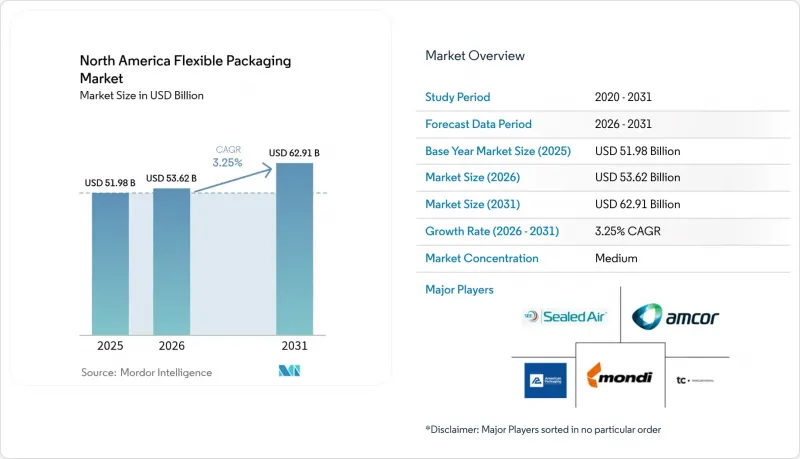
Mordor Intelligence에 따르면 북미의 연포장 시장 규모는 2025년 519억 8,000만 달러, 2026년 536억 2,000만 달러에서 2031년에는 629억 1,000만 달러로 확대되어, 2026년부터 2031년까지 CAGR 3.25%를 기록할 것으로 예측됩니다.
본 보고서는 소재 유형(플라스틱, 종이 등), 제품 유형(파우치, 백 및 소포장, 필름 및 랩 등), 최종사용자 산업(식품, 음료, 의약품·의료, 가정용품·퍼스널케어 등), 유통 채널(B2B 직접 판매, E-Commerce 및 풀필먼트, 소매), 및 지역별로 분류되어 있습니다. 시장 전망은 금액(달러) 기준으로 제시되어 있습니다.
북미 연포장 시장의 동향 및 인사이트
외출 시 간편하게 즐길 수 있는 스낵 제품의 수요 급증
2025년 ‘외출 시 식품 소비’는 1,486억 달러에 달했으며, 2027년까지 39% 증가할 전망입니다. 이에 따라 각 브랜드는 배낭이나 차량 컵 홀더에 들어갈 수 있는 스탠드업 파우치로 경질 용기에서 전환을 추진하고 있습니다. 소비자들이 섭취량 관리를 추구하는 가운데, 2025년에는 짭짤한 스낵 신제품 출시 중 28-56그램의 1회분 팩이 42%를 차지하여, 2024년의 31%에서 증가했습니다. 유연한 구조 덕분에 포장 무게가 60% 감소하여 장거리 운송 시 케이스당 0.12달러의 비용 절감으로 이어지고 있습니다. 2025년에는 새로 출시된 스낵 SKU의 68%에 재밀봉 가능한 지퍼가 채택되어 유통기한이 14일 연장되었을 뿐만 아니라, 단위당 0.08-0.12달러의 추가 수익을 창출했습니다. 치포틀레(Chipotle)나 파넬라(Panera)와 같은 퀵 서비스 체인점들은 유연한 트레이에 담긴 ‘그랩 앤 고(Grab-and-Go)’ 방식의 식사 키트를 도입하여, 경질 포장재의 판매량을 잠식했습니다.
브랜드 소유주의 재활용 가능한 단일 소재 구조로의 전환
제너럴 밀즈(General Mills)는 2025년 말까지 북미의 스낵 제품 포트폴리오 전체를 100% 폴리에틸렌 파우치로 전환하겠다고 약속하며, 매장 내 재활용을 방해하는 알루미늄 포일 및 나일론 층을 제거했습니다. 암코(Amco)사의 ‘AmLite’ 전 PE 시리즈는 금속 코팅을 하지 않고도 산소 투과율을 5 cc/m²/일 미만으로 억제하여 과자류의 유통 기한을 유지하면서 ‘How2Recycle’ 라벨을 표시하고 있습니다. Kind Snacks사는 종이 기반 포장을 채택하여 플라스틱 사용량을 90% 줄이고, ‘Climate Pledge Friendly’ 인증을 획득했습니다. 이를 통해 아마존에서 지속가능성 관점에서 검색 결과를 필터링하는 소비자층을 성공적으로 확보했습니다. 캘리포니아주의 SB 54 법에 따르면, 2032년까지 플라스틱 포장재 재활용률을 65%로 달성해야 하며, 위반 시 톤당 최대 500달러의 벌금이 부과됩니다. 이에 따라 전국 규모의 브랜드들은 단일 소재 설계로 표준화할 수밖에 없게 되었습니다. 7-9층 공압출 라인을 보유한 컨버터만이 재활용이 불가능한 라미네이트 소재로 회귀하지 않으면서도 차단 성능 목표를 달성할 수 있습니다.
다층 필름의 가정별 수거는 제한적
미국 지자체 중 가정 쓰레기로 유연한 필름을 수거하는 곳은 불과 8%에 불과하며, 2025년에는 판매량의 9% 미만이 매장 수거 프로그램을 통해 회수될 전망입니다. 필름은 광학 선별기의 작동을 방해하기 때문에 혼입률이 25%를 초과하면 많은 자원 회수 시설이 베일째 매립 처분할 수밖에 없습니다. 11개 주에서 시행된 PFAS 금지 조치로 인해 내유성 코팅이 배제되면서 퇴비화 가능한 대안이 줄어들었습니다. APR 지침에서는 두께 2.5밀 이상이고 금속층을 포함하지 않는 PE 필름을 권장하고 있지만, 2025년에 출시된 파우치의 63%는 산화알루미늄 배리어를 사용하고 있어 기준을 충족하지 못하고 있습니다. 2025년 맥킨지 조사에 따르면, 쇼핑객의 47%가 필름 재활용에 의구심을 가지고 있어 소비자들의 회의적인 시각이 커지고 있습니다.
부문 분석
2025년 북미 연포장 시장에서 폴리에틸렌, 이축 연신 폴리프로필렌, 캐스트 폴리프로필렌, 폴리염화비닐 및 에틸렌-비닐 알코올이 시장의 67.91%를 차지했습니다. 소매업체들이 가정 쓰레기로 재활용 가능한 형태를 장려함에 따라, 종이 기반 대체재는 연평균 성장률(CAGR) 3.66%를 기록하며 소재 중 가장 빠른 성장이 예상됩니다. 폴리에틸렌은 FDA 승인을 받았으며 열 밀봉성이 신뢰할 수 있어 식품 접촉 용도에서 압도적인 점유율을 차지하고 있습니다. 한편, 이축 연신 폴리프로필렌은 강성과 투명성이 요구되는 스낵류에 사용되고 있습니다. 캐스트 폴리프로필렌은 121°C의 살균 처리를 받아도 박리되지 않고 견딜 수 있는 레토르트 파우치에 널리 채택되고 있습니다. 에틸렌-비닐알코올 층은 0.5 cc/m²/일 미만의 산소 투과율을 실현하여, 생고기나 커피 포장에 필수적입니다.
2025년에 도입된 몬디(Mondi)사의 ‘PerFORMing’ 종이 파우치는 수프나 소스 믹스를 건조한 상태로 유지하면서 섬유 재활용을 가능하게 하여, 네슬레(Nestle) 및 유니레버(Unilever)와 계약을 체결했습니다. 런팩(Lunpak)사의 골판지 우편 봉투는 2025년에 E-Commerce 채널 전체에서 1,800만 개의 기포 완충재가 들어간 봉투를 대체했습니다. 알루미늄 포일은 커피 및 반려동물 사료 분야에 집중하여 6%의 점유율을 유지했으나, 지속가능성 노력으로 인해 향후 판매량은 위협받고 있습니다. 생분해성 PLA 및 셀룰로오스 필름의 점유율은 퇴비화 시설 부족으로 인해 여전히 3% 미만에 머물러 있습니다. 아마존의 ‘Climate Pledge Friendly’와 같은 소매 프로그램에서는 2025년에 종이 함량이 70%를 초과하는 2,400개의 SKU가 등록되어, 2024년 대비 3배에 달했습니다.
북미 연포장 시장에서 2025년 매출의 45.72%를 파우치가 차지했습니다. 이는 반려동물 사료의 프리미엄화 및 스낵류의 포장 용도로의 적용이 뒷받침한 결과입니다. 필름 및 랩은 E-Commerce용 우편 봉투와 신선식품용 플로우랩에 힘입어 2031년까지 연평균 성장률(CAGR) 3.42%로 성장할 것으로 예측됩니다. 백과 사셰는 미국 약전(USP) 기준을 충족하는 어린이 안전 지퍼가 필요한 벌크 식품 및 의약품에 있어 여전히 필수적인 존재입니다. 수축 슬리브와 라벨은 360도 브랜딩이 가능하지만, 각 주의 규정에 따라 병 재활용을 용이하게 하기 위해 미싱선이 있는 찢어내기 스트립을 채택해야 합니다.
아마존과 월마트는 2025년까지 340곳의 자동 주문 처리 센터를 운영할 예정이며, 각 센터에서는 ISTA 6-아마존 낙하 테스트를 대규모로 통과할 수 있는 2밀 미만의 초박형 우편용 포장재가 요구됩니다. 농산물용 플로우 랩은 2025년에 11% 증가했으며, 가스 치환 포장용 필름 덕분에 유통 기한이 5-7일 연장되었습니다. Printpack사의 1.8밀 두께 메일러는 기존의 3.0밀 두께 제품에 비해 무게가 40% 가벼워, 개당 0.04달러의 비용 절감을 실현하고 있습니다. 파우치는 계속해서 해당 카테고리의 선두를 유지할 전망이지만, 온라인 소매 매출 비중이 2025년 16%에서 2031년 22%로 상승함에 따라 필름과 랩이 그 격차를 좁혀가고 있습니다.
기타 혜택:
- 엑셀 형식의 시장 예측(ME) 시트
- 3개월간의 애널리스트 지원
자주 묻는 질문
목차
제1장 소개
제2장 조사 방법
제3장 주요 요약
제4장 시장 구도
제5장 시장 규모와 성장 예측
제6장 경쟁 구도
제7장 시장 기회와 향후 전망
KSM 26.09.02According to Mordor Intelligence, the North America flexible packaging market size is projected to expand from USD 51.98 billion in 2025 and USD 53.62 billion in 2026 to USD 62.91 billion by 2031, registering a CAGR of 3.25% between 2026 to 2031.
This report is Segmented by Material Type (Plastics, Paper, and More), Product Type (Pouches, Bags and Sachets, Films and Wraps, Sand More), End-User Industry (Food, Beverage, Pharmaceutical and Medical, Household and Personal Care, and More), Distribution Channel (Direct B2B, E-Commerce and Fulfilment, Retail), and Geography. The Market Forecasts are Provided in Terms of Value (USD).
North America Flexible Packaging Market Trends and Insights
Surge in Demand for Convenient On-the-Go Snacking Formats
Away-from-home food spending reached USD 148.6 billion in 2025 and is on track to climb 39% by 2027, pushing brands to replace rigid canisters with stand-up pouches that fit backpacks and car cup holders. Single-serve packs of 28-56 grams represented 42% of salty-snack launches in 2025, up from 31% in 2024, as consumers seek portion control. Flexible structures cut package weight by 60%, saving USD 0.12 per case on cross-country lanes. Resealable zippers appeared on 68% of new snack SKUs in 2025, extending shelf life by 14 days and fetching an extra USD 0.08-0.12 per unit. Quick-service chains such as Chipotle and Panera introduced grab-and-go meal kits in flexible trays, siphoning volumes from rigid formats.
Brand-Owner Shift Toward Recyclable Mono-Material Structures
General Mills pledged to convert its entire North American snack portfolio to all-polyethylene pouches by year-end 2025, eliminating foil and nylon layers that block Store Drop-Off recyclability.Amcor's AmLite all-PE range achieved sub-5 cc/m2/day oxygen transmission without metallization, preserving confectionery shelf life while carrying How2Recycle labels. Kind Snacks cut plastic content by 90% with a paper-based wrapper and earned Climate Pledge Friendly status, tapping consumers who filter Amazon searches by sustainability. California's SB 54 requires 65% recyclability for plastic packaging by 2032 and fines noncompliance up to USD 500 per ton, compelling national brands to standardize on mono-material designs. Only converters wielding 7- to 9-layer co-extrusion lines can meet barrier targets without reverting to non-recyclable laminates.
Limited Curb-Side Collection for Multilayer Films
Just 8% of U.S. municipalities accept flexible films curbside, leaving Store Drop-Off programs to capture under 9% of sold volume in 2025. Films snarl optical sorters, prompting many material recovery facilities to landfill entire bales when contamination tops 25%. PFAS bans in 11 states eliminated grease-resistant coatings, narrowing compostable options. Although APR guides endorse PE films thicker than 2.5 mil and free of metal layers, 63% of 2025 pouch launches used aluminum-oxide barriers, rendering them ineligible. Consumer skepticism is rising as 47% of shoppers doubt films get recycled, according to a 2025 McKinsey survey.
Other drivers and restraints analyzed in the detailed report include:
- Premiumisation in Pet-Food Flexibles
- State-Level PCR Mandates Triggering Long-Term Resin Off-Take Contracts
- Polymer-Price Volatility After Geopolitical Shocks
For complete list of drivers and restraints, kindly check the Table Of Contents.
Segment Analysis
Polyethylene, biaxially-oriented polypropylene, cast polypropylene, polyvinyl chloride, and ethylene-vinyl alcohol accounted for 67.91% of the North America flexible packaging market in 2025. Paper-based alternatives are forecast to post a 3.66% CAGR, the quickest growth among materials, as retailers promote curbside-recyclable formats. Polyethylene's FDA-approved status and heat-seal reliability make it dominant in food contact, whereas biaxially oriented polypropylene serves snacks that need stiffness and clarity. Cast polypropylene thrives in retort pouches that survive 121 °C sterilization with no delamination. Ethylene-vinyl alcohol layers deliver oxygen barriers below 0.5 cc/m2/day, critical for fresh meat and coffee packaging.
Mondi's PerFORMing paper pouch, introduced in 2025, allows fiber recycling while keeping soups and sauce mixes dry, winning Nestle and Unilever contracts. Ranpak's corrugated mailers replaced 18 million bubble mailers across e-commerce channels in 2025. Aluminum foil retained a 6% share, concentrated in coffee and pet food, although sustainability pledges threaten future volume. Biodegradable PLA and cellulose films remain below 3% share, hindered by a lack of composting sites. Retail programs such as Amazon's Climate Pledge Friendly listed 2,400 SKUs with paper content above 70% in 2025, triple 2024's tally.
Pouches secured 45.72% of 2025 revenue in the North America flexible packaging market, fueled by pet-food premiumization and snack convertibility. Films and wraps are projected to grow at a 3.42% CAGR to 2031, powered by e-commerce mailers and fresh-produce flow-wrap. Bags and sachets remain vital for bulk foods and pharma products that require child-resistant zippers that meet U.S. Pharmacopeia standards. Shrink sleeves and labels offer 360-degree branding but must adopt perforated tear strips to aid bottle recycling under state rules.
Amazon and Walmart ran 340 automated fulfillment centers by 2025, each demanding ultra-thin mailers below 2 mil that survive ISTA 6-Amazon drop tests at scale. Flow-wrap for produce advanced 11% in 2025 as modified-atmosphere films extended shelf life 5-7 days. Printpack's 1.8-mil mailer cut weight is 40% lower than 3.0-mil incumbents, saving USD 0.04 per unit. Pouches will stay category leader, but films and wraps are closing the gap as online retail climbs from 16% of sales in 2025 to 22% by 2031.
Complete Report Scope:
- By Material Type
- Plastics
- Polyethylene (PE)
- Biaxially-Oriented Polypropylene (BOPP)
- Cast Polypropylene (CPP)
- Polyvinyl Chloride (PVC)
- Ethylene-Vinyl Alcohol (EVOH)
- Paper
- Aluminum Foil
- Plastics
- By Product Type
- Pouches
- Bags and Sachets
- Films and Wraps
- Shrink Sleeves and Labels
- Other Product Types
- By End-user Industry
- Food
- Frozen Food
- Dairy Products
- Fruits and Vegetables
- Meat, Poultry and Seafood
- Baked Goods and Snacks
- Confectionery
- Other Food
- Beverage
- Pharmaceutical and Medical
- Household and Personal Care
- Industrial and Chemical
- Other End-User Industries
- Food
- By Distribution Channel
- Direct B2B
- E-commerce & Fulfilment
- Retail
- By Country
- United States
- Canada
- Mexico
List of Companies Covered in this Report:
- Amcor plc
- Sealed Air Corporation
- Mondi plc
- ProAmpac LLC
- Transcontinental Inc.
- American Packaging Corporation
- Sonoco Products Company
- Printpack Inc.
- Sigma Plastics Group
- Novolex Holdings Inc.
- Constantia Flexibles
- PPC Flexible Packaging
- Charter Next Generation
- Glenroy Inc.
- CCL Industries
- WestRock Company
- Berry Global Inc.
- Winpak Ltd.
- Coveris Holdings SA
Additional Benefits:
- The market estimate (ME) sheet in Excel format
- 3 months of analyst support
TABLE OF CONTENTS
1 INTRODUCTION
- 1.1 Study Assumptions and Market Definition
- 1.2 Scope of the Study
2 RESEARCH METHODOLOGY
3 EXECUTIVE SUMMARY
4 MARKET LANDSCAPE
- 4.1 Market Overview
- 4.2 Market Drivers
- 4.2.1 Surge in Demand For Convenient On-the-go Snacking Formats
- 4.2.2 Brand-owner Shift Toward Recyclable Mono-material Structures
- 4.2.3 Premiumisation in Pet-food Flexibles
- 4.2.4 State-level PCR Mandates Triggering Long-term Resin off-take Contracts
- 4.2.5 Automation in Micro-fulfilment Hubs Favouring Ultra-thin Mailer Films
- 4.2.6 Retailers Shift to Automated Micro-fulfilment Hubs Spurring Demand for Ultra-thin Mailers
- 4.3 Market Restraints
- 4.3.1 Limited Curb-side Collection for Multilayer Films
- 4.3.2 Polymer-price Volatility after Geopolitical Shocks
- 4.3.3 Scarcity of FDA-grade rPE Feedstock
- 4.3.4 Extended Producer Responsibility Laws Impose New Fees and Reporting Burdens
- 4.4 Value Chain Analysis
- 4.5 Regulatory Landscape
- 4.6 Porter's Five Forces
- 4.6.1 Threat of New Entrants
- 4.6.2 Bargaining Power of Buyers
- 4.6.3 Bargaining Power of Suppliers
- 4.6.4 Threat of Substitutes
- 4.6.5 Intensity of Competitive Rivalry
5 MARKET SIZE AND GROWTH FORECASTS (VALUE)
- 5.1 By Material Type
- 5.1.1 Plastics
- 5.1.1.1 Polyethylene (PE)
- 5.1.1.2 Biaxially-Oriented Polypropylene (BOPP)
- 5.1.1.3 Cast Polypropylene (CPP)
- 5.1.1.4 Polyvinyl Chloride (PVC)
- 5.1.1.5 Ethylene-Vinyl Alcohol (EVOH)
- 5.1.2 Paper
- 5.1.3 Aluminum Foil
- 5.1.1 Plastics
- 5.2 By Product Type
- 5.2.1 Pouches
- 5.2.2 Bags and Sachets
- 5.2.3 Films and Wraps
- 5.2.4 Shrink Sleeves and Labels
- 5.2.5 Other Product Types
- 5.3 By End-user Industry
- 5.3.1 Food
- 5.3.1.1 Frozen Food
- 5.3.1.2 Dairy Products
- 5.3.1.3 Fruits and Vegetables
- 5.3.1.4 Meat, Poultry and Seafood
- 5.3.1.5 Baked Goods and Snacks
- 5.3.1.6 Confectionery
- 5.3.1.7 Other Food
- 5.3.2 Beverage
- 5.3.3 Pharmaceutical and Medical
- 5.3.4 Household and Personal Care
- 5.3.5 Industrial and Chemical
- 5.3.6 Other End-User Industries
- 5.3.1 Food
- 5.4 By Distribution Channel
- 5.4.1 Direct B2B
- 5.4.2 E-commerce & Fulfilment
- 5.4.3 Retail
- 5.5 By Country
- 5.5.1 United States
- 5.5.2 Canada
- 5.5.3 Mexico
6 COMPETITIVE LANDSCAPE
- 6.1 Market Concentration
- 6.2 Strategic Moves
- 6.3 Market Share Analysis
- 6.4 Company Profiles (includes Global level Overview, Market level overview, Core Segments, Financials as available, Strategic Information, Market Rank/Share for key companies, Products & Services, and Recent Developments)
- 6.4.1 Amcor plc
- 6.4.2 Sealed Air Corporation
- 6.4.3 Mondi plc
- 6.4.4 ProAmpac LLC
- 6.4.5 Transcontinental Inc.
- 6.4.6 American Packaging Corporation
- 6.4.7 Sonoco Products Company
- 6.4.8 Printpack Inc.
- 6.4.9 Sigma Plastics Group
- 6.4.10 Novolex Holdings Inc.
- 6.4.11 Constantia Flexibles
- 6.4.12 PPC Flexible Packaging
- 6.4.13 Charter Next Generation
- 6.4.14 Glenroy Inc.
- 6.4.15 CCL Industries
- 6.4.16 WestRock Company
- 6.4.17 Berry Global Inc.
- 6.4.18 Winpak Ltd.
- 6.4.19 Coveris Holdings SA
7 MARKET OPPORTUNITIES AND FUTURE OUTLOOK
- 7.1 White-space & Unmet-need Assessment


