

|
시장보고서
상품코드
2120805
스마트 라벨 : 시장 점유율 분석, 업계 동향과 통계, 성장 예측(2026-2031년)Smart Label - Market Share Analysis, Industry Trends & Statistics, Growth Forecasts (2026 - 2031) |
||||||
 Mordor Intelligence
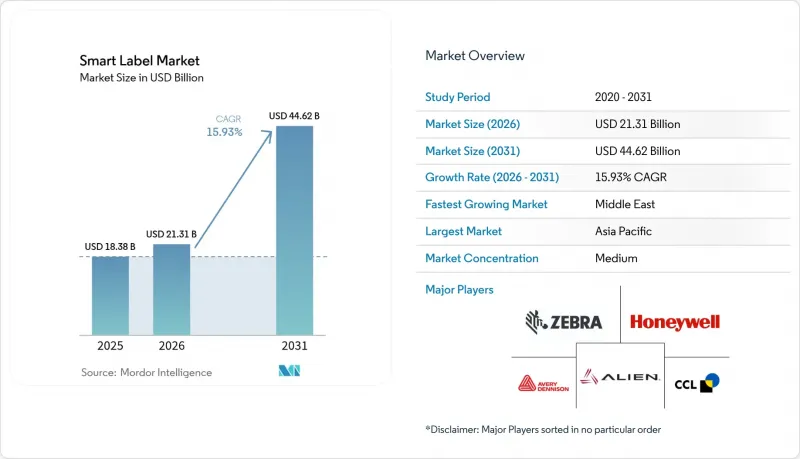
Mordor Intelligence에 따르면 스마트 라벨 시장 규모는 2025년에 183억 8,000만 달러로 평가되며, 2026년 213억 1,000만 달러에서 2031년까지 446억 2,000만 달러에 달할 것으로 예측되며, 예측 기간(2026-2031년) 동안 CAGR은 15.93%가 될 전망입니다.
본 보고서는 기술별(RFID, 센싱 라벨 등), 최종사용자 산업별(소매, 식품·음료 등), 구성요소별(마이크로컨트롤러/IC, 센서 등), 용도(도난 방지·보안, 콜드체인 모니터링 등), 라벨 형태(행택, 인몰드 라벨, 섬유·의류용 라벨 등), 및 지역별로 분류되어 있습니다. 시장 예측은 금액(달러) 기준으로 제시되어 있습니다.
세계 스마트 라벨 시장의 동향 및 인사이트
재고 가시화를 위한 RFID 도입 확대
품목 단위 RFID를 통해 재고 실사 정확도는 65% 미만에서 약 98%로 향상되며, 품절 현상을 최대 절반까지 줄일 수 있습니다. 월마트는 2025년, 공급업체에 대한 요구 사항을 가정용품 및 전자제품으로 확대하고, 인코딩을 제조 현장으로 앞당기는 동시에 실시간 게이트 데이터를 자동 보충의 트리거로 활용하는 노력을 추진했습니다. 리더기 출하대수는 급증했으며, 제브라 테크놀러지스는 2025년 상반기 고정형 포털 출하대수가 전년 동기 대비 40% 증가했다고 보고했습니다. 최신 GS1 EPCIS 업데이트에서는 256비트 사용자 메모리가 지원되게 되어, 브랜드는 로트 번호나 지속가능성 인증서를 단일 인레이에 기록할 수 있게 되었습니다.
제약 공급망 내 위조 방지 대책에 대한 수요 증가
미국 및 EU 법률에 따른 단위별 일련번호 부여 의무화로 인해, 변조 방지 기능을 갖춘 스마트 라벨은 제약 제조업체에게 필수 품목이 되었습니다. 에이버리 데니슨(Avery Dennison)은 2025년, 약국 카운터에서 3요소 인증을 구현하는 홀로그램,RFID, NFC 지원 라벨을 출시했습니다. WHO는 현재 시판 후 조사에서 주요 증거로 RFID 이벤트 로그를 승인하고 있으며, 이는 위탁 제조업체에게 종이 기반 기록에서 전환할 수 있는 추가적인 동기가 되고 있습니다. 인도의 규제 당국은 고가 생물학적 제제를 대상으로 블록체인과 연동된 RFID의 시범 운영을 진행 중이며, 이는 암 치료제 위조품에 대한 지역적 대응이 더욱 확대되고 있음을 시사합니다.
소규모 소매업체의 경우 초기 하드웨어 및 통합 비용이 높다는 점
단일 매장을 운영하는 소매업자의 경우, 대량 생산으로 인해 인레이 비용이 0.05달러까지 낮아졌다고는 하지만, 리더기, 인코더, 미들웨어 도입에는 여전히 5만-15만 달러의 비용이 듭니다. 하네웰(Honeywell)이나 사토(Sato)의 리스 프로그램을 통해 도입 비용은월 약 800달러까지 낮출 수 있지만, 3% 미만의 낮은 순이익률로 인해 많은 독립 소매업체들은 도입을 보류하고 있습니다. 인코딩 작업에는 단위당 추가로 0.03-0.06달러의 비용이 들기 때문에 바코드에 비해 수익성이 떨어집니다. 클라우드 기반 SaaS는 유용하지만, 지방 시장의 불안정한 광대역 환경이 보급을 저해하고 있습니다.
부문 분석
2025년, 무선 주파수 식별(RFID)은 스마트 라벨 시장의 67.33% 점유율을 차지하며, 3-10미터의 판독 범위가 자동 게이트 스캔을 가능하게 하는 대량 재고 추적 분야에서 이 기술이 확고한 입지를 다지고 있음을 보여줍니다. Impinj사의 M800(30미터 통신 범위)과 같은 장거리 대응 패시브 칩의 등장으로 실외 자산 추적 활용 사례가 확대되고 있으며, 스마트 라벨 시장에서 RFID의 우위가 확고해지고 있습니다.
근거리 무선 통신(NFC)은 탭하여 읽는 기능을 갖춘 스마트폰이 연간 14억 대 이상 출하됨에 따라 소비자 참여에 있어 하드웨어 장벽을 낮추고 있으며, 2031년까지 연평균 성장률(CAGR) 17.19%로 성장하고 있습니다. 현재 NFC 지원 전자 가격표는 한 번의 탭으로 영양 정보나 로열티 혜택을 제공할 수 있게 되었으며, 이 기술은 단순한 인증 수단에서 마케팅 매체로 변모하고 있습니다. 이러한 진화는 스마트 라벨 시장 규모 내에서 가장 빠르게 성장하는 분야를 개척하고 있습니다.
2025년에는 소매 업계가 전 세계 매출의 34.83%를 차지했습니다. 이는 의류 체인점들이 재고 손실 억제, 재고 정확도 향상, 커브사이드 픽업의 원활화를 목적으로 상품 단위 태그 부착을 도입한 것이 원인입니다. 이러한 도입으로 업무 효율이 향상되었을 뿐만 아니라, 더 신속하고 정확한 주문 처리가 가능해져 고객 만족도 향상으로도 이어졌습니다. 월마트가 2025년에 도입한 공급업체 대상 요건에 따라 인코딩이 물류 센터로 이관됨에 따라, 스마트 라벨 시장에서 RFID의 역할은 더욱 확고해졌으며, 다른 소매업체들이 따라야 할 벤치마크가 확립되었습니다.
의료·제약 업계는 2027년까지 미국 DSCSA 및 EU FMD 규정에 따른 일련번호 부여 마감 기한을 앞두고 있으며, 의약품 1개 단위당 안전한 디지털 ID가 의무화됨에 따라 전체 부문 중 가장 높은 연평균 성장률(CAGR) 17.14%를 기록할 것으로 전망됩니다. 이러한 성장은 환자 안전 확보 및 규제 준수를 위해 공급망 내 추적성과 투명성에 대한 수요가 증가하고 있는 점에 힘입고 있습니다. 한편, 온도 데이터를 지속적으로 모니터링하는 배터리 불필요 센서 라벨은 규제 대상인 콜드체인에서 규정 준수를 강화하고, 스마트 라벨 시장의 확대에 기여하고 있습니다. 이러한 라벨은 백신이나 생물학적 제제 등 온도에 민감한 제품의 전체 공급망에 걸쳐 품질을 유지하는 데 특히 중요합니다.
지역별 분석
2025년, 아시아태평양은 전 세계 매출의 38.29%를 차지했습니다. 이는 중국의 주요 도시에서 판매되는 고급 의류 및 전자기기에 대해 정부가 품목별 태그 부착을 의무화하고 있음을 반영합니다. 중국의 규제는 국내 공급망 전반으로 파급되는 대규모 도입의 기반이 되고 있습니다. 일본의 편의점 업체들은 2025년에 5,000만 장 이상의 전자 가격표를 도입하여 매일 가격 변경에 소요되는 노동 시간을 대폭 줄였습니다. 인도의 의약품 규제 당국은 항암제를 대상으로 한 RFID 일련번호 부여 시범 프로젝트를 시작하여, 위탁 제조업체들 사이에서 초기 수요를 견인하고 있습니다. 한국에서는 소매업체들이 NFC 행거 태그를 탭하는 동작을 로열티 프로그램과 연동하여 재구매율을 약 30% 향상시켰습니다.
유럽의 성장은 ‘포장 및 포장 폐기물 규정’에 달려 있습니다. 이 규정에 따르면 2028년 이후 판매되는 모든 소비재에 디지털 제품 여권을 첨부해야 합니다. 독일의 자동차 부품 공급업체는 재사용 가능한 토트백에 RFID를 내장하여 하역장의 체류 시간을 최대 30분 단축하고 있습니다. 영국 국민보건서비스(NHS)는 RFID가 탑재된 의약품 캐비닛을 시범 운영 중이며, 초기 시험에서 규제 약품의 재고 불일치를 40% 줄였습니다. 프랑스의 까르푸 체인은 15분마다 가격을 갱신하고 옴니채널 주문 처리 전략을 지원하는 전자 가격표를 1,200개 매장에 도입을 완료했습니다.
북미는 여전히 보급률이 높은 지역이지만, DSCSA에 따른 의료 분야의 일련번호 부여 기한으로 인해 투자 수준은 높은 상태를 유지하고 있습니다. 월마트는 2025년에 인코딩 작업을 물류 센터 측으로 이관하여, 매장 직원을 고객 응대 업무에 투입할 수 있도록 했습니다. 캐나다 대마초 업계에서는 RFID를 활용하여 ‘종자에서 판매까지’의 규제 요건을 충족하고 있으며, 이 체계는 현재 영양 보조 식품 수출업체에도 채택되고 있습니다. 중동 지역은 ‘사우디 비전 2030’에 따른 물류 회랑 구축과 아랍에미리트(UAE)의 콜드체인 디지털화를 배경으로, 지역별 가장 높은 연평균 성장률(CAGR) 16.91%를 기록할 것으로 예측됩니다. 브라질 소매업계의 초기 시범 사업과 아르헨티나의 의약품 콜드체인 추적 프로그램은 남미에서의 도입 첫 물결을 시사하고 있습니다. 이러한 지역적 동향이 맞물려 규정 준수를 중시하는 새로운 구매자들을 생태계로 끌어들이며, 스마트 라벨 시장 전체를 확대시키고 있습니다.
기타 혜택:
- 엑셀 형식의 시장 예측(ME) 시트
- 3개월간의 애널리스트 지원
자주 묻는 질문
목차
제1장 소개
제2장 조사 방법
제3장 주요 요약
제4장 시장 구도
제5장 시장 규모와 성장 예측
제6장 경쟁 구도
제7장 시장 기회와 향후 전망
KSM 26.09.02According to Mordor Intelligence, the smart label market size was valued at USD 18.38 billion in 2025 and estimated to grow from USD 21.31 billion in 2026 to reach USD 44.62 billion by 2031, at a CAGR of 15.93% during the forecast period (2026-2031).
This report is Segmented by Technology (RFID, Sensing Labels, and More), End-User Industry (Retail, Food and Beverage, and More), Component (Micro-Controllers/ICs, Sensors, and More), Application (Anti-Theft and Security, Cold-Chain Monitoring, and More), Label Form Factor (Hang Tags, In-Mold Labels, Textile and Apparel Labels, and More), and Geography. The Market Forecasts are Provided in Terms of Value (USD).
Global Smart Label Market Trends and Insights
Growing RFID Adoption for Inventory Visibility
Item-level RFID lifts stock-count accuracy from below 65% to about 98%, trimming out-of-stock events by as much as half. Walmart broadened its supplier mandate in 2025 to cover home goods and electronics, pushing encoding upstream into manufacturing sites and turning real-time portal data into automated replenishment triggers. Reader shipments rose sharply, with Zebra Technologies reporting 40% year-on-year growth in fixed portals during the first half of 2025. The latest GS1 EPCIS update now supports 256-bit user memory, letting brands write batch numbers and sustainability certificates into a single inlay.
Rising Demand for Anti-Counterfeiting in Pharma Supply Chains
Mandatory unit-level serialization under U.S. and EU laws has turned tamper-evident smart labels into a non-discretionary line item for drug makers. Avery Dennison launched a hologram, RFID, and NFC label in 2025 to deliver three-factor authentication at pharmacy counters. The WHO now accepts RFID event logs as primary evidence in post-market inspections, giving contract manufacturers another incentive to migrate from paper trails. India's regulator is piloting blockchain-anchored RFID for high-value biologics, signaling a broader regional push against fake oncology drugs.
High Initial Hardware and Integration Costs for Small Retailers
A single-site retailer still faces a USD 50,000-150,000 price tag for readers, encoders, and middleware, even though inlay costs have fallen to USD 0.05 in high volumes. Leasing programs from Honeywell and SATO drop entry costs to roughly USD 800 a month, yet thin net margins under 3% keep many independents on the sidelines. Encoding labor adds another USD 0.03-0.06 per unit, eroding the business case versus barcodes. Cloud-based SaaS helps, but patchy broadband in rural markets limits adoption.
Other drivers and restraints analyzed in the detailed report include:
- Expansion of Omnichannel Retail Requiring Real-Time Pricing
- Increasing Penetration of IoT-Enabled Logistics
- Lack of Universal Interoperability Standards
For complete list of drivers and restraints, kindly check the Table Of Contents.
Segment Analysis
Radio-frequency identification captured 67.33% of smart label market share in 2025, underscoring the technology's entrenched role in high-volume inventory tracking, where 3-10 meter read ranges support automated portal scanning. The launch of extended-range passive chips, such as Impinj's M800 with 30-meter coverage, is expanding outdoor asset-tracking use cases and solidifying RFID's dominance in the smart label market.
Near-field communication is advancing at a 17.19% CAGR through 2031 as over 1.4 billion smartphones ship annually with tap-to-read capability, lowering hardware friction for consumer engagement. NFC-enabled electronic shelf labels now deliver nutrition data and loyalty rewards in one tap, transforming the technology from simple authentication to a marketing conduit, an evolution that is carving out the fastest-growing slice of the smart label market size.
In 2025, retail claimed 34.83% of global revenue, driven by apparel chains adopting item-level tagging to curb shrinkage, improve inventory accuracy, and facilitate curbside pickups. This adoption not only enhanced operational efficiency but also improved customer satisfaction by enabling faster and more accurate order fulfillment. Walmart's 2025 supplier mandate, which shifted encoding to distribution centers, further solidified RFID's role in the smart label market, setting a benchmark for other retailers to follow.
Healthcare and pharmaceuticals, facing serialization deadlines under U.S. DSCSA and EU FMD rules by 2027, are set to grow at a 17.14% CAGR, the fastest among all sectors, as each drug unit mandates a secure digital identity. This growth is further supported by the increasing need for traceability and transparency in the supply chain to ensure patient safety and regulatory compliance. Meanwhile, battery-free sensor labels, which consistently monitor temperature data, are enhancing compliance and broadening the smart label market within regulated cold chains. These labels are particularly critical for maintaining the integrity of temperature-sensitive products, such as vaccines and biologics, throughout the supply chain.
Complete Report Scope:
- By Technology
- RFID
- Electronic Article Surveillance
- Near Field Communication
- Sensing Labels
- Electronic Shelf Label
- Other Technologies
- By End-User Industry
- Retail
- Healthcare and Pharmaceuticals
- Logistics and Transportation
- Manufacturing and Industrial
- Food and Beverage
- Other End-User Industries
- By Component
- Micro-Controllers / ICs
- Batteries and Power Units
- Antennas and Transceivers
- Sensors
- Software and Middleware
- Substrate and Protective Materials
- By Application
- Asset and Inventory Tracking
- Anti-Theft and Security
- Cold-Chain Monitoring
- Dynamic Pricing and Promotion
- Brand Authentication and Consumer Engagement
- Work-in-Process Management
- By Label Form Factor
- Wet-Inlay / Sticker Labels
- Hang Tags
- In-Mold Labels
- Textile and Apparel Labels
- Printable Flexible Sensor Labels
- By Geography
- North America
- United States
- Canada
- Mexico
- South America
- Brazil
- Argentina
- Rest of South America
- Europe
- United Kingdom
- Germany
- France
- Italy
- Rest of Europe
- Asia Pacific
- China
- Japan
- India
- South Korea
- Rest of Asia Pacific
- Middle East and Africa
- Middle East
- United Arab Emirates
- Saudi Arabia
- Rest of Middle East
- Africa
- South Africa
- Egypt
- Rest of Africa
- Middle East
- North America
Geography Analysis
Asia-Pacific accounted for 38.29% of global revenue in 2025, reflecting government mandates requiring item-level tagging for premium apparel and electronics sold across tier-1 Chinese cities. China's regulations anchor large deployments that ripple through domestic supply chains. Japanese convenience-store brands installed more than 50 million electronic shelf labels in 2025, sharply reducing labor hours spent on daily price changes. India's drug regulator began an RFID serialization pilot for oncology products, driving early demand among contract manufacturers. In South Korea, retailers tie NFC hang-tag taps to loyalty programs, lifting repeat-purchase rates by roughly 30%.
Europe's growth hinges on the Packaging and Packaging Waste Regulation, which requires a digital product passport for every consumer good sold after 2028. Automotive suppliers in Germany embed RFID in reusable totes to shave dock-door dwell times by up to 30 minutes. The United Kingdom's National Health Service is piloting RFID medicine cabinets that have cut controlled-substance discrepancies by 40% in early trials. France's Carrefour chain completed a 1,200-store rollout of electronic shelf labels that update prices every 15 minutes and support omnichannel fulfillment strategies.
North America remains a high-penetration territory, yet healthcare serialization deadlines under the DSCSA keep investment levels elevated. Walmart moved encoding upstream to distribution centers in 2025, freeing store labor for customer engagement tasks. Canada's cannabis sector uses RFID to satisfy seed-to-sale regulations, a framework now adopted by nutraceutical exporters. The Middle East is projected to register the fastest regional CAGR of 16.91% thanks to Saudi Vision 2030's logistics corridors and the United Arab Emirates' cold-chain digitization. Early pilots in Brazil's retail sector and Argentina's pharmaceutical cold-chain traceability programs signal the first wave of South American adoption. Together, these regional dynamics expand the overall smart label market by attracting new compliance-led buyers into the ecosystem.
- Avery Dennison Corporation
- CCL Industries Inc.
- Zebra Technologies Corp.
- Honeywell International Inc.
- SATO Holdings Corp.
- William Frick & Company
- Invengo Information Technology Co. Ltd.
- Scanbuy Inc.
- Alien Technology LLC
- Roambee Corporation
- SES-imagotag SA
- Pricer AB
- Thinfilm Electronics ASA
- Digimarc Corporation
- Tapwow LLC
- Stora Enso Oyj
- Identiv Inc.
- Impinj Inc.
- Checkpoint Systems Inc.
- Confidex Ltd.
- NXP Semiconductors N.V.
Additional Benefits:
- The market estimate (ME) sheet in Excel format
- 3 months of analyst support
TABLE OF CONTENTS
1 INTRODUCTION
- 1.1 Study Assumptions and Market Definition
- 1.2 Scope of the Study
2 RESEARCH METHODOLOGY
3 EXECUTIVE SUMMARY
4 MARKET LANDSCAPE
- 4.1 Market Overview
- 4.2 Market Drivers
- 4.2.1 Growing RFID Adoption for Inventory Visibility
- 4.2.2 Rising Demand for Anti-Counterfeiting in Pharma Supply Chains
- 4.2.3 Expansion of Omnichannel Retail Requiring Real-Time Pricing
- 4.2.4 Increasing Penetration of IoT-Enabled Logistics
- 4.2.5 Emergence of Printed Battery-Free Sensor Labels for Cold-Chain Integrity
- 4.2.6 EU ESG Packaging Mandates (PPWR 2026) Accelerating Smart-Label Integration
- 4.3 Market Restraints
- 4.3.1 High Initial Hardware and Integration Costs for Small Retailers
- 4.3.2 Lack of Universal Interoperability Standards
- 4.3.3 Semiconductor Supply Constraints Delaying UHF RFID IC Availability
- 4.3.4 Data-Privacy Regulations Limiting NFC Consumer-Engagement Analytics
- 4.4 Industry Value Chain Analysis
- 4.5 Regulatory Landscape
- 4.6 Technological Outlook
- 4.7 Impact of Macroeconomic Factors on the Market
- 4.8 Porter's Five Forces Analysis
- 4.8.1 Bargaining Power of Suppliers
- 4.8.2 Bargaining Power of Buyers/Consumers
- 4.8.3 Threat of New Entrants
- 4.8.4 Intensity of Competitive Rivalry
- 4.8.5 Threat of Substitutes
5 MARKET SIZE AND GROWTH FORECASTS (VALUE)
- 5.1 By Technology
- 5.1.1 RFID
- 5.1.2 Electronic Article Surveillance
- 5.1.3 Near Field Communication
- 5.1.4 Sensing Labels
- 5.1.5 Electronic Shelf Label
- 5.1.6 Other Technologies
- 5.2 By End-User Industry
- 5.2.1 Retail
- 5.2.2 Healthcare and Pharmaceuticals
- 5.2.3 Logistics and Transportation
- 5.2.4 Manufacturing and Industrial
- 5.2.5 Food and Beverage
- 5.2.6 Other End-User Industries
- 5.3 By Component
- 5.3.1 Micro-Controllers / ICs
- 5.3.2 Batteries and Power Units
- 5.3.3 Antennas and Transceivers
- 5.3.4 Sensors
- 5.3.5 Software and Middleware
- 5.3.6 Substrate and Protective Materials
- 5.4 By Application
- 5.4.1 Asset and Inventory Tracking
- 5.4.2 Anti-Theft and Security
- 5.4.3 Cold-Chain Monitoring
- 5.4.4 Dynamic Pricing and Promotion
- 5.4.5 Brand Authentication and Consumer Engagement
- 5.4.6 Work-in-Process Management
- 5.5 By Label Form Factor
- 5.5.1 Wet-Inlay / Sticker Labels
- 5.5.2 Hang Tags
- 5.5.3 In-Mold Labels
- 5.5.4 Textile and Apparel Labels
- 5.5.5 Printable Flexible Sensor Labels
- 5.6 By Geography
- 5.6.1 North America
- 5.6.1.1 United States
- 5.6.1.2 Canada
- 5.6.1.3 Mexico
- 5.6.2 South America
- 5.6.2.1 Brazil
- 5.6.2.2 Argentina
- 5.6.2.3 Rest of South America
- 5.6.3 Europe
- 5.6.3.1 United Kingdom
- 5.6.3.2 Germany
- 5.6.3.3 France
- 5.6.3.4 Italy
- 5.6.3.5 Rest of Europe
- 5.6.4 Asia Pacific
- 5.6.4.1 China
- 5.6.4.2 Japan
- 5.6.4.3 India
- 5.6.4.4 South Korea
- 5.6.4.5 Rest of Asia Pacific
- 5.6.5 Middle East and Africa
- 5.6.5.1 Middle East
- 5.6.5.1.1 United Arab Emirates
- 5.6.5.1.2 Saudi Arabia
- 5.6.5.1.3 Rest of Middle East
- 5.6.5.2 Africa
- 5.6.5.2.1 South Africa
- 5.6.5.2.2 Egypt
- 5.6.5.2.3 Rest of Africa
- 5.6.5.1 Middle East
- 5.6.1 North America
6 COMPETITIVE LANDSCAPE
- 6.1 Market Concentration
- 6.2 Strategic Moves
- 6.3 Market Share Analysis
- 6.4 Company Profiles (includes Global Level Overview, Market Level Overview, Core Segments, Financials as available, Strategic Information, Market Rank/Share, Products and Services, Recent Developments)
- 6.4.1 Avery Dennison Corporation
- 6.4.2 CCL Industries Inc.
- 6.4.3 Zebra Technologies Corp.
- 6.4.4 Honeywell International Inc.
- 6.4.5 SATO Holdings Corp.
- 6.4.6 William Frick & Company
- 6.4.7 Invengo Information Technology Co. Ltd.
- 6.4.8 Scanbuy Inc.
- 6.4.9 Alien Technology LLC
- 6.4.10 Roambee Corporation
- 6.4.11 SES-imagotag SA
- 6.4.12 Pricer AB
- 6.4.13 Thinfilm Electronics ASA
- 6.4.14 Digimarc Corporation
- 6.4.15 Tapwow LLC
- 6.4.16 Stora Enso Oyj
- 6.4.17 Identiv Inc.
- 6.4.18 Impinj Inc.
- 6.4.19 Checkpoint Systems Inc.
- 6.4.20 Confidex Ltd.
- 6.4.21 NXP Semiconductors N.V.
7 MARKET OPPORTUNITIES AND FUTURE OUTLOOK
- 7.1 White-Space and Unmet-Need Assessment


