

|
시장보고서
상품코드
2121229
바이오인포매틱스 : 시장 점유율 분석, 업계 동향과 통계, 성장 예측(2026-2031년)Bioinformatics - Market Share Analysis, Industry Trends & Statistics, Growth Forecasts (2026 - 2031) |
||||||
 Mordor Intelligence
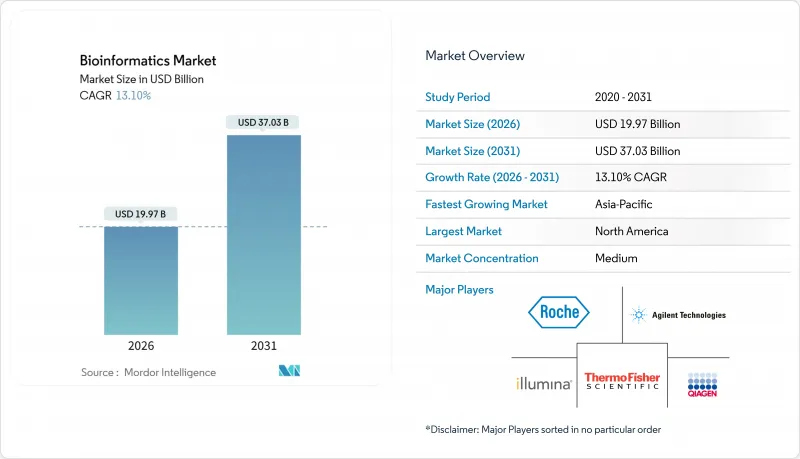
Mordor Intelligence에 의하면, 바이오인포매틱스 시장 규모는 2026년에 199억 7,000만 달러로 추정되며, 예측 기간(2026-2031년)에 CAGR13.10%로 확대되어 2031년에는 370억 3,000만 달러에 이를 전망입니다.
본 보고서는 제품 및 서비스별(지식 관리 도구, 생물정보학 플랫폼, 생물정보학 서비스),용도별(유전체학·전사체학, 단백체학·대사체학 등), 최종 사용자별(제약·생명공학 기업, 학술·연구 기관 등), 지역별(북미, 유럽, 아시아태평양 등)로 분류되어 있습니다. 시장 예측은 금액(미 달러)으로 표시되어 있습니다.
전 세계 바이오정보학 시장 동향 및 인사이트
멀티오믹스 데이터량의 폭발적 증가
시퀀싱 처리량은 장치 1대당 연간 20페타베이스를 넘어섰으나, 스토리지 및 컴퓨팅 인프라는 수요를 따라가지 못해 바이오정보학 플랫폼이 해결해야 할 병목 현상이 발생하고 있습니다. 인간 유전체 시퀀싱 비용은 2024년에 200달러 미만으로 떨어졌지만, 다운스트림 분석 비용은 그 3배에서 5배에 달하여 데이터를 현장에서 처리하는 압축 알고리즘 및 연합 학습(federated learning)에 대한 투자를 촉진하고 있습니다. 제약 기업들은 동일한 환자 코호트의 유전체, 전사체, 단백질체, 대사체 데이터 세트를 통합하는 사례가 증가하고 있으며, 이러한 워크플로우에는 페타바이트 규모의 워크로드에 최적화된 GPU 클러스터와 오브젝트 스토리지가 필수적입니다. AWS, Google Cloud, Microsoft Azure와 같은 클라우드 제공업체들은 변이 감지 및 주석 달기를 가속화하는 관리형 파이프라인을 제공함으로써 이에 대응하고 있습니다. 시퀀서에 내장된 엣지 어플라이언스는 염기 호출 및 1차 분석을 로컬에서 처리함으로써 데이터 전송 비용을 더욱 최소화합니다. 이러한 추세들이 맞물리면서, 샘플당 시퀀싱 비용은 감소하고 있음에도 불구하고 탄력적 컴퓨팅에 대한 지출은 두 자릿수 성장세를 유지하고 있습니다.
정밀 의학 및 동반 진단 도입
2025년에는 임상 수준의 정확도로 복잡한 유전체 변이를 감지하는 파이프라인에 대한 필요성이 높아짐에 따라, 동반 진단에 대한 규제 당국의 승인 건수가 2024년에 비해 증가했습니다. NTRK 융합이나 MSI-high 시그니처를 표적으로 하는 종양 비특이적 치료법에는 300개 이상의 유전자를 분석하는 패널이 필요하며, 이로 인해 수요는 단일 유전자 분석에서 종합적인 프로파일링으로 이동하고 있습니다. 유럽의약품청(EMA)은 2024년, 다양한 민족 코호트를 대상으로 한 분석적 타당성 검증을 의무화하는 지침을 최종 확정했으며, 이를 통해 참조 데이터셋 및 민족성을 고려한 알고리즘의 확충이 촉진되었습니다. 일본에서는 2025년에 액체 생검 모니터링에 대한 보험 적용 코드가 추가되어, 순환 종양 DNA의 동태를 추적하는 도구의 보급이 촉진되었습니다. 이러한 정책들은 전반적으로 종양학 분야에서의 바이오정보학 지출을 견인하는 한편, 지불 기관이 계층화 치료의 약제경제적 가치를 인식함에 따라 순환기학 및 희귀질환 분야로도 파급되고 있습니다.
숙련된 바이오인포마티션 인력 부족
2025년, 학술 프로그램에서는 약 8,500명의 계산 생물학자가 배출되었으나, 산업계의 신규 채용 수요는 1만 5,000명을 초과하여 인력 부족이 확대되는 한편, 중견 전문가의 연봉은 15만 달러를 넘는 수준까지 상승하고 있습니다. 기업들은 분자생물학자를 대상으로 Python 및 R 기술 향상을 위한 사내 교육을 시작하는 한편, 플랫폼 벤더들은 사용 편의성을 높이기 위해 노코드 인터페이스를 도입하고 있습니다. 인도 및 동유럽의 해외 인력 풀이 일부 인력 부족을 완화하고 있지만, 시차 및 데이터 주권에 관한 제약으로 인해 보호 대상인 건강 정보(PHI)의 워크플로우에는 제한이 발생하고 있습니다.
부문 분석
2025년, 바이오정보학 시장의 48.1%를 플랫폼이 차지할 것으로 예상되며, 이는 일루미나(Illumina)나 옥스포드 나노포어(Oxford Nanopore)의 장비와 긴밀하게 연동된 염기서열 분석 워크플로우가 주도하고 있습니다. 이 부문에서는 연구소들이 감가상각이 진행 중인 On-Premise 클러스터에서 점차 전환함에 따라, 종량제 클라우드 도입의 점유율이 확대되고 있습니다. 서비스 부문은 설비 투자를 변동성 있는 운영비로 전환하고, CLIA 및 CE-IVDR 요건을 충족하는 규정 준수 프레임워크를 묶음 상품으로 제공함으로써 2031년까지 연평균 성장률(CAGR) 14.1%로 성장하고 있습니다. 시퀀싱 분석은 여전히 핵심을 이루고 있지만, 멀티오믹스 통합 및 지식 관리 모듈에는 수동 큐레이션보다 신속하게 경로에 대한 인사이트력을 추출하는 그래프 데이터베이스와 텍스트 마이닝 엔진이 통합되고 있습니다. 클라우드와 엣지 모두의 코드베이스를 제공하지 못하는 플랫폼 공급업체는 최근 중견 기업들 간의 합병에서 드러나듯이, 업계 재편에 대한 압박에 직면해 있습니다.
바이오정보학 서비스는 사내에 계산 처리 팀을 보유하지 않은 소규모 생명공학 기업이나 학술 연구소로부터 확대되는 지출 점유율을 확보하고 있습니다. 각 하이퍼스케일러 기업들은 유전체학 툴킷(AWS HealthOmics, Google Cloud Life Sciences API 등)을 보다 광범위한 클라우드 서비스에 통합함으로써 이러한 추세를 더욱 가속화하고 있습니다. 많은 경우, 스토리지 및 컴퓨팅 이용을 촉진하기 위해 원가보다 낮은 가격 책정이 이루어지고 있습니다. 그 결과, 총 지출은 증가하고 있음에도 불구하고 독립형 소프트웨어 라이선스에 기인하는 바이오인포매틱스 시장 규모는 축소되고 있습니다. 구독료나 샘플당 이용료가 하드웨어의 일시적인 수익을 대체하면서, 벤더의 인센티브와 고객의 데이터 양을 연동시키고 있습니다. 지식 관리 도구는 여전히 데이터 큐레이션의 품질에 따라 수익이 창출되지만, 오픈 액세스 리소스가 가격 결정력을 잠식함에 따라 전자연구노트(ELN)나 실험실 정보 시스템과 통합되는 독자적인 알고리즘으로 중점이 이동하고 있습니다.
지역별 분석
북미는 제약 기업 본사, 학술 기관, 벤처 자금이 밀집해 있는 점을 배경으로 2025년 바이오정보학 시장의 39.4%를 차지했습니다. 2024년에 발표된 FDA 지침에 따라 차세대 염기서열 분석 검사의 임상 타당성 기준이 엄격해지고 개발 주기가 장기화된 반면, 데이터 분석의 전반적인 복잡성은 증가했습니다. 캐나다의 정밀 종양학 네트워크에서는 각 주의 개인정보 보호법을 준수하는 연합형 플랫폼이 도입되었으며, 멕시코의 바이오시밀러 제조업체들도 비교 가능성 프로토콜을 위해 바이오정보학 도구를 채택하고 있어 지역별 수요가 다양화되고 있습니다.
아시아태평양은 2031년까지 연평균 성장률(CAGR) 14.89%를 나타낼 것으로 예측됩니다. 그 배경에는 중국의 국가 지원 유전체학 생태계가 시퀀싱 역량을 확대하고,분석 플랫폼을 수직 통합하고 있다는 점, 인도가 남아시아의 하플로유형에 맞춘 파이프라인을 현지화하는 스타트업을 육성하고 있다는 점, 그리고 일본이 500개 이상의 유전자로 구성된 패널에 대한 보험 적용 범위를 확대하고 병원에서 임상 등급 소프트웨어의 도입을 촉진하고 있다는 점이 그 배경으로 꼽힙니다. 호주와 한국은 클라우드 컴퓨팅과 자국의 데이터센터를 결합한 국가 차원의 정밀의료 프로그램에 투자하고 있으며, 국내 사이버 보안 관련 법규 준수를 확보하고 있습니다.
2024년부터 시행되는 유럽의 체외진단용 의료기기 규정(IVDR)에 따라, 진단에 사용되는 소프트웨어는 CE-IVDR 인증을 의무적으로 취득해야 하며, 이에 따라 공급업체의 규정 준수 비용이 증가할 것입니다. 독일의 국립 유전체 센터는 희귀질환의 워크플로우를 일원화하고 있는 반면, 영국은 전체 유전체 시퀀싱을 국민건강서비스(NHS)에 통합하여 14일 이내에 결과를 보고하도록 의무화하고 있습니다. 남미 시장은 브라질의 약리유전체학 관련 시범 사업과 아르헨티나의 작물 유전체학 프로그램이 중심을 이루고 있습니다. 반면, 중동 및 아프리카은 여전히 발전 단계에 있으며, 아랍에미리트와 사우디아라비아는 경제 다각화 정책의 일환으로 대규모 시퀀싱에 자금을 지원하고 있습니다.
기타 혜택:
- 엑셀 형식 시장 예측(ME) 시트
- 3개월간의 애널리스트 지원
자주 묻는 질문
목차
제1장 서론
제2장 조사 방법
제3장 주요 요약
제4장 시장 구도
제5장 시장 규모와 성장 예측
제6장 경쟁 구도
제7장 시장 기회와 향후 전망
LSH 26.09.08According to Mordor Intelligence, the bioinformatics market size is estimated at USD 19.97 billion in 2026, and is expected to reach USD 37.03 billion by 2031, at a CAGR of 13.10% during the forecast period (2026-2031).
This report is Segmented by Products and Services (Knowledge Management Tools, Bioinformatics Platforms, Bioinformatics Services), Application (Genomics & Transcriptomics, Proteomics & Metabolomics, and More), End-User (Pharmaceutical & Biotechnology Companies, Academic & Research Institutes, and More), and Geography (North America, Europe, Asia-Pacific, and More). Market Forecasts are in Value (USD).
Global Bioinformatics Market Trends and Insights
Explosion of Multi-Omics Data Volumes
Sequencing throughput has surpassed 20 petabases per instrument per year, yet storage and compute infrastructure trail demand, creating bottlenecks that bioinformatics platforms must resolve. The cost to sequence a human genome fell below USD 200 in 2024, but downstream analysis now costs three to five times that amount, driving investment in compression algorithms and federated learning that process data in situ. Pharmaceutical sponsors increasingly integrate genomic, transcriptomic, proteomic, and metabolomic datasets from identical patient cohorts, a workflow that depends on GPU clusters and object storage optimized for petabyte-scale workloads. Cloud providers such as AWS, Google Cloud, and Microsoft Azure are responding with managed pipelines that accelerate variant calling and annotation. Edge appliances embedded inside sequencers further minimize data-transfer fees by handling base-calling and primary analysis locally. Together, these dynamics sustain double-digit spending on elastic compute even as per-sample sequencing costs decline.
Precision Medicine and Companion Diagnostics Adoption
Regulatory approvals for companion diagnostics rose in 2025 as compared to 2024, owing to reinforcing the need for pipelines that detect complex genomic alterations with clinical-grade accuracy. Tumor-agnostic therapies targeting NTRK fusions and MSI-high signatures require panels interrogating more than 300 genes, shifting demand from single-gene assays toward comprehensive profiling. The European Medicines Agency finalized guidance in 2024 that obligates analytical validation across diverse ethnic cohorts, prompting expansion of reference datasets and ethnicity-aware algorithms. Japan added reimbursement codes for liquid biopsy monitoring in 2025, catalyzing the uptake of tools that track circulating tumor-DNA dynamics. Collectively, these policies anchor bioinformatics spending in oncology, yet spill into cardiology and rare disease as payers recognize the pharmacoeconomic value of stratified therapeutics.
Shortage of Skilled Bioinformaticians
Academic programs graduated roughly 8,500 computational biologists in 2025, versus industrial demand for more than 15,000 new hires, widening a talent gap that inflates salaries past USD 150,000 for mid-career professionals . Companies launch in-house training to upskill molecular biologists in Python and R, while platform vendors embed no-code interfaces to widen usability. Offshore talent pools in India and Eastern Europe offer partial relief, though time-zone and data-sovereignty constraints restrict protected-health-information workflows.
Other drivers and restraints analyzed in the detailed report include:
- Pharma-Biotech Shift Toward Data-Centric R&D
- Government-Funded Genomic Initiatives
- Cybersecurity and Genomic-Data Privacy Risks
For complete list of drivers and restraints, kindly check the Table Of Contents.
Segment Analysis
Platforms accounted for 48.1% of the bioinformatics market in 2025, driven by tightly coupled sequence analysis workflows with Illumina and Oxford Nanopore instruments. Within this category, consumption-based cloud deployment is winning share as laboratories migrate away from depreciating on-premise clusters. Services grow at a 14.1% CAGR through 2031 by translating capital expenditure into variable operating expense and bundling compliance frameworks that satisfy CLIA and CE-IVDR requirements. Sequence analysis remains core, yet multi-omics integration and knowledge-management modules now bundle graph databases and text-mining engines that surface pathway insights faster than manual curation. Platform vendors that cannot deliver both cloud and edge codebases face consolidation pressure, as evidenced by recent mid-tier mergers.
Bioinformatics services capture expanding wallet share from small biotech and academic labs that lack internal computational teams. Hyperscalers amplify this trend by embedding genomics toolkits-AWS HealthOmics, Google Cloud Life Sciences API-into broader cloud offerings, often priced below cost to drive storage and compute consumption. As a result, the bioinformatics market size attributable to standalone software licenses is declining even though overall spend rises. Subscription and per-sample fees replace one-time hardware revenue, aligning vendor incentives with customer data volumes. Knowledge-management tools still monetize curation quality, yet open-access resources erode their pricing power, shifting emphasis toward proprietary algorithms that integrate with electronic lab notebooks and laboratory-information systems.
Complete Report Scope:
- By Products & Services
- Knowledge Management Tools
- Bioinformatics Platforms
- Sequence Analysis Platforms
- Sequence Alignment Platforms
- Sequence Manipulation Platforms
- Structural & Functional Analysis Platforms
- Multi-omics Integration Platforms
- Bioinformatics Services
- Sequencing & Data-Generation Services
- Database Construction & Management
- Data Analysis & Interpretation Services
- Cloud-native Bioinformatics-as-a-Service
- By Application
- Genomics & Transcriptomics
- Proteomics & Metabolomics
- Drug Discovery & Development
- Microbial Genomics (Metagenomics & AMR)
- Precision & Personalized Medicine
- Other Applications
- By End-user
- Pharmaceutical & Biotechnology Companies
- Academic & Research Institutes
- Clinical & Diagnostic Laboratories
- Contract Research Organizations (CROs)
- Other End-Users
- Geography
- North America
- United States
- Canada
- Mexico
- Europe
- Germany
- United Kingdom
- France
- Italy
- Spain
- Rest of Europe
- Asia-Pacific
- China
- Japan
- India
- South Korea
- Australia
- Rest of Asia-Pacific
- Middle East and Africa
- GCC
- South Africa
- Rest of Middle East and Africa
- South America
- Brazil
- Argentina
- Rest of South America
- North America
Geography Analysis
North America commanded 39.4% of the bioinformatics market in 2025, backed by a dense cluster of pharmaceutical headquarters, academic centers, and venture funding. FDA guidance published in 2024 tightened clinical validity standards for next-generation sequencing tests, extending development cycles yet raising overall data-analysis complexity. Canada's precision-oncology networks deploy federated platforms that comply with provincial privacy acts, and Mexico's biosimilar producers adopt bioinformatics tools for comparability protocols, diversifying regional demand.
The Asia-Pacific region is forecast to expand at a 14.89% CAGR through 2031 as China's state-sponsored genomics ecosystem scales sequencing capacity and vertically integrates analytics platform India incubates start-ups that localize pipelines for South-Asian haplotypes, and Japan broadens reimbursement for 500-plus-gene panels, pushing hospital adoption of clinical-grade software. Australia and South Korea invest in national precision-medicine programs that couple cloud computing with sovereign data centers, ensuring compliance with domestic cybersecurity statutes.
Europe's In Vitro Diagnostic Regulation, enforceable from 2024, obliges software used in diagnostics to obtain CE-IVDR certification, increasing vendor compliance costs. Germany's National Genome Center centralizes rare-disease workflows, while the United Kingdom integrates whole-genome sequencing into the National Health Service, mandating turnaround times of less than 14 days. South America's market centers on Brazil's pharmacogenomics pilots and Argentina's crop genomics programs, whereas the Middle East and Africa remain nascent, with the United Arab Emirates and Saudi Arabia funding large-scale sequencing as part of their economic diversification agendas.
- 3rd Millennium
- Agilent Technologies
- BGI Genomics Co. Ltd.
- Dassault Systemes SE (BIOVIA)
- Data4Cure Inc.
- DNAnexus Inc.
- Eagle Genomics Ltd.
- Roche
- Gene42 Inc.
- Genedata
- Geneious (Biomatters)
- Illumina
- Ontoforce NV
- Oracle Corporation (Oracle Healthcare)
- Partek Inc.
- PerkinElmer
- QIAGEN
- Seven Bridges Genomics Inc.
- SoftGenetics LLC
- Thermo Fisher Scientific
- WuXi NextCODE Genomics
Additional Benefits:
- The market estimate (ME) sheet in Excel format
- 3 months of analyst support
TABLE OF CONTENTS
1 Introduction
- 1.1 Study Assumptions & Market Definition
- 1.2 Scope of the Study
2 Research Methodology
3 Executive Summary
4 Market Landscape
- 4.1 Market Overview
- 4.2 Market Drivers
- 4.2.1 Explosion Of Multi-Omics Data Volumes
- 4.2.2 Precision Medicine & Companion Diagnostics Adoption
- 4.2.3 Pharma-Biotech Shift Toward Data-Centric R&D
- 4.2.4 Government-Funded Genomic Initiatives
- 4.2.5 Edge/Near-Instrument Bioinformatics Processing
- 4.2.6 AI Model-Marketplaces Enabling Plug-And-Play Analytics
- 4.3 Market Restraints
- 4.3.1 Shortage of Skilled Bioinformaticians
- 4.3.2 Fragmented Data Standards
- 4.3.3 Cyber-Security & Genomic-Data Privacy Risks
- 4.3.4 Rising Cloud Egress & Long-Term Storage Costs
- 4.4 Value Chain Analysis
- 4.5 Regulatory Landscape
- 4.6 Technological Outlook
- 4.7 Porter's Five Forces
- 4.7.1 Threat of New Entrants
- 4.7.2 Bargaining Power of Buyers
- 4.7.3 Bargaining Power of Suppliers
- 4.7.4 Threat of Substitutes
- 4.7.5 Competitive Rivalry
5 Market Size & Growth Forecasts (Value, USD)
- 5.1 By Products & Services
- 5.1.1 Knowledge Management Tools
- 5.1.2 Bioinformatics Platforms
- 5.1.2.1 Sequence Analysis Platforms
- 5.1.2.2 Sequence Alignment Platforms
- 5.1.2.3 Sequence Manipulation Platforms
- 5.1.2.4 Structural & Functional Analysis Platforms
- 5.1.2.5 Multi-omics Integration Platforms
- 5.1.3 Bioinformatics Services
- 5.1.3.1 Sequencing & Data-Generation Services
- 5.1.3.2 Database Construction & Management
- 5.1.3.3 Data Analysis & Interpretation Services
- 5.1.3.4 Cloud-native Bioinformatics-as-a-Service
- 5.2 By Application
- 5.2.1 Genomics & Transcriptomics
- 5.2.2 Proteomics & Metabolomics
- 5.2.3 Drug Discovery & Development
- 5.2.4 Microbial Genomics (Metagenomics & AMR)
- 5.2.5 Precision & Personalized Medicine
- 5.2.6 Other Applications
- 5.3 By End-user
- 5.3.1 Pharmaceutical & Biotechnology Companies
- 5.3.2 Academic & Research Institutes
- 5.3.3 Clinical & Diagnostic Laboratories
- 5.3.4 Contract Research Organizations (CROs)
- 5.3.5 Other End-Users
- 5.4 Geography
- 5.4.1 North America
- 5.4.1.1 United States
- 5.4.1.2 Canada
- 5.4.1.3 Mexico
- 5.4.2 Europe
- 5.4.2.1 Germany
- 5.4.2.2 United Kingdom
- 5.4.2.3 France
- 5.4.2.4 Italy
- 5.4.2.5 Spain
- 5.4.2.6 Rest of Europe
- 5.4.3 Asia-Pacific
- 5.4.3.1 China
- 5.4.3.2 Japan
- 5.4.3.3 India
- 5.4.3.4 South Korea
- 5.4.3.5 Australia
- 5.4.3.6 Rest of Asia-Pacific
- 5.4.4 Middle East and Africa
- 5.4.4.1 GCC
- 5.4.4.2 South Africa
- 5.4.4.3 Rest of Middle East and Africa
- 5.4.5 South America
- 5.4.5.1 Brazil
- 5.4.5.2 Argentina
- 5.4.5.3 Rest of South America
- 5.4.1 North America
6 Competitive Landscape
- 6.1 Market Concentration
- 6.2 Market Share Analysis
- 6.3 Company Profiles (includes Global level Overview, Market level overview, Core Segments, Financials as available, Strategic Information, Market Rank/Share for key companies, Products & Services, and Recent Developments)
- 6.3.1 3rd Millennium Inc.
- 6.3.2 Agilent Technologies Inc.
- 6.3.3 BGI Genomics Co. Ltd.
- 6.3.4 Dassault Systemes SE (BIOVIA)
- 6.3.5 Data4Cure Inc.
- 6.3.6 DNAnexus Inc.
- 6.3.7 Eagle Genomics Ltd.
- 6.3.8 F. Hoffmann-La Roche Ltd.
- 6.3.9 Gene42 Inc.
- 6.3.10 Genedata AG
- 6.3.11 Geneious (Biomatters)
- 6.3.12 Illumina Inc.
- 6.3.13 Ontoforce NV
- 6.3.14 Oracle Corporation (Oracle Healthcare)
- 6.3.15 Partek Inc.
- 6.3.16 PerkinElmer Inc.
- 6.3.17 Qiagen N.V.
- 6.3.18 Seven Bridges Genomics Inc.
- 6.3.19 SoftGenetics LLC
- 6.3.20 Thermo Fisher Scientific Inc.
- 6.3.21 WuXi NextCODE Genomics
7 Market Opportunities & Future Outlook
- 7.1 White-space & Unmet-need Assessment


