

|
시장보고서
상품코드
2121268
농업용 효소 : 시장 점유율 분석, 업계 동향과 통계, 성장 예측(2026-2031년)Agricultural Enzymes - Market Share Analysis, Industry Trends & Statistics, Growth Forecasts (2026 - 2031) |
||||||
 Mordor Intelligence
Mordor Intelligence에 따르면 농업용 효소 시장 규모는 2025년에 6억 달러로 평가되며, 2026년 6억 4,872만 달러에서 2031년까지 9억 5,815만 달러에 달할 것으로 예측되며, 예측 기간(2026-2031년) 동안 CAGR은 8.12%가 될 전망입니다.
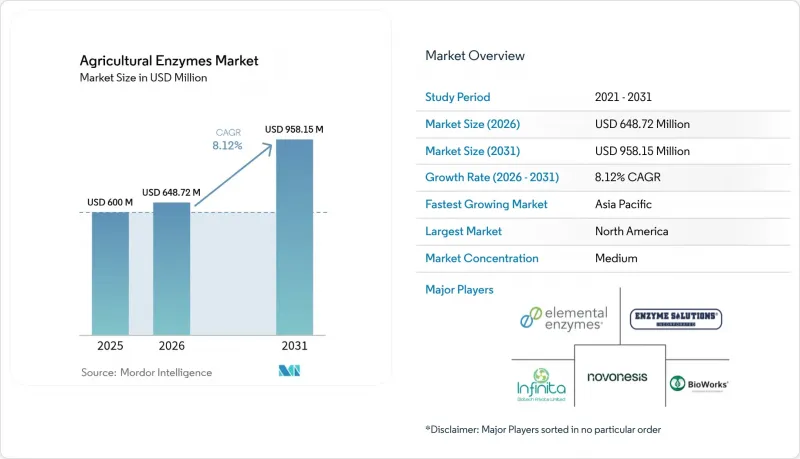
본 보고서는 효소 유형(포스파타제, 기타), 제형별(액체, 기타), 용도별(작물 보호, 기타), 시용 방법별(종자 처리, 기타), 작물 유형별(곡류·곡물, 유지종자·콩류, 기타), 지역별(북미, 유럽, 기타)로 분류되어 있습니다. 시장 예측은 금액(달러) 기준으로 제시되어 있습니다.
세계 농업용 효소 시장의 동향 및 인사이트
유기농 식품 및 잔류 농약이 없는 식품에 대한 수요
소매업체들이 잔류 기준을 강화하고, EU의 ‘팜 투 포크(Farm to Fork) 전략’이 2030년까지 화학 농약 사용량을 50% 감축할 것을 의무화하고 있는 만큼, 전 세계적으로 유기농 농산물에 대한 지출이 증가하고 있습니다. 농업 종사자들은 인증받은 유기농 농산물 유통 채널에서 20-30%의 가격 프리미엄을 얻을 수 있어, 화학 잔류물을 남기지 않고 영양분을 동원하는 효소를 도입하기 위한 전환 비용을 상쇄하고 있습니다. 효소를 접목한 프로그램은 인과 질소의 이용 효율을 높이고, 식물의 방어 체계를 강화하며, 토양 미생물 군집의 균형을 개선함으로써 유기 농업 시스템의 수확량 격차 해소에도 기여하고 있습니다. 스페인의 상업용 과수원 경영자는 2024년에 인산 비료에서 포스파타제와 우레아제를 배합한 입상 비료로 전환한 결과, 수확량이 9% 향상되었다고 보고하여 명확한 경제적 이익이 입증되었습니다. 이와 유사한 성과가 현재 캐나다 전역의 온실 채소 재배에 도입되는 데 박차를 가하고 있으며, 그곳에서는 액체 셀룰라아제 배합제가 윤작 기간 동안 바이오매스 분해를 촉진함으로써 재배 주기를 단축시키고 있습니다.
생물 유래 자재의 도입 급증
브라질에서는 경작지의 상당 부분에서 생물학적 작물 보호 솔루션이 도입되어 있으며, 그 보급률은 유럽연합(EU)이나 미국을 웃돌고 있습니다. 합성 제초제 및 살균제에 대한 내성이 높아짐에 따라 새로운 작용기전의 탐색이 가속화되고 있으며, 농업용 효소는 생물학적 방제 미생물과 시너지 효과를 내는 파트너로서의 입지를 확립해 가고 있습니다. 마트그로소주의 밭작물 농업 종사자들은 리파아제와 만나나아제 효소를 포함한 종자 처리용 혼합제를 도입한 결과, 2024/25 시즌에 옥수수 연작에서 4.6%의 수확량 증가를 기록했습니다. 인도에서도 유사한 추세가 나타나고 있으며, 주 차원의 보조금 프로그램을 통해 효소 투입 비용의 최대 30%가 지원됨에 따라 소규모 농업 종사자들의 도입이 촉진되어 시장 성장률이 두 자릿수에 달하고 있습니다.
규제 당국의 승인 기준 차이
생물 유래 자재 개발 기업들은 여전히 지역마다 다른 승인 일정을 헤쳐나가야 합니다. EU에서는 제품 분류에 따라 여러 건의 신청 서류 제출이 요구됩니다. 미국에서는 새로 개설된 ‘생명공학 규제 통합 웹사이트’를 통해 국내 투명성이 향상되었지만, 전 세계 규제의 조화에는 아직 한참 모자란 상황입니다. 승인 지연으로 인해 평균 상품화 주기가 18-24개월 연장되고, 규정 준수 비용이 증가함에 따라 일부 기업은 진출 시장을 좁혀 고부가가치 시장을 우선시하고 있습니다. 소규모 혁신 기업들은 특히 어려움을 겪고 있으며, 규제 대응 지원을 받기 위해 대형 농약 기업과 제휴하는 경우가 많지만, 이로 인해 독립적인 시장 진입 전략이 제한될 가능성이 있습니다.
부문 분석
포스파타제는 시비된 비료의 80%에 달하는 고정된 토양 내 인을 방출함으로써 2025년 농업용 효소 시장에서 36.42%의 점유율을 차지했습니다. 비료 가격 변동이 지속되는 가운데, 곡물 및 유지종자 전반에 걸쳐 인 동원 솔루션에 대한 수요는 견조한 추세를 보이고 있습니다. 따라서 포스파타제의 농업용 효소 시장 규모는 2031년까지 매출 측면에서 지배적인 위치를 유지할 것으로 전망됩니다. 셀룰라제는 CelOCE 및 관련 혁신에 힘입어 연평균 성장률(CAGR) 13.05%로 성장률 순위 1위를 차지하고 있습니다. 이러한 효소는 작물 잔여물을 분해하여 유익한 미생물의 영양원이 되는 당을 방출하는 동시에 토양 구조를 개선합니다. 우레아제, 리아제, 프로테아제가 제품 라인업을 구성하고 있으며, 복잡한 밭 조건에 대응하기 위해 서로 보완적인 작용을 하는 효소를 조합한 혼합 제품이 점점 늘어나고 있습니다.
다중 효소 혼합으로의 전환은 고부가가치 원예 부문에서 두드러지며, 생산자들은 한 번의 시비로 정확한 영양소 동원 및 스트레스 대응 능력 향상을 요구하고 있습니다. 신생 기업들은 생산자가 신선한 셀룰라아제가 풍부하게 포함된 혼합액을 자체적으로 조제할 수 있는 농장용 발효 키트를 개발하고 있으며, 이를 통해 보존 기간에 대한 우려를 해소하고 비용을 절감하고 있습니다. 대기업들은 논에서 질소 이용 효율을 높이고 휘발을 억제하기 위해 포스파타제와 우레아제의 시너지 효과를 통합하고 있으며, 이는 농업용 효소 시장에서 솔루션의 폭이 넓어지고 있음을 반영합니다.
2025년 기준, 액상 제품은 농업용 효소 시장 규모의 45.55%를 차지하고 있으며, 이는 주로 기존 살포 장비와의 호환성 및 엽면을 통한 효율적인 흡수 덕분입니다. 그러나 물류 비용과 콜드체인에 대한 의존도가 높기 때문에 제품 담당자들은 내열성이 더 뛰어난 기술로 관심을 돌리고 있습니다. 연평균 성장률(CAGR) 11.72%로 성장하고 있는 과립형 제품은 현재 ‘입자 내 바이오리액터’라는 구조를 채택하고 있어, 효소를 최대 24개월 동안 안정화시키는 동시에 토양과 접촉한 후 시간 차 방출을 가능하게 합니다.
분말 제제는 비용 효율성이 뛰어난 중간적인 위치를 차지하고 있지만, 전용 혼합 장치가 필요합니다. 하이브리드 수분산성 과립은 이러한 경계를 모호하게 하여, 액체와 같은 편의성과 과립의 내구성을 양립시키고 있습니다. 특히 콜드체인 인프라가 미비한 아시아태평양 및 아프리카의 열대 지역에서 성장을 목표로 하는 기업의 경우, 제제의 범용성이 경쟁상의 차별화 요소가 될 것으로 예상됩니다.
지역별 분석
2025년에 농업용 효소 시장의 약 34.62%를 차지할 북미는 견고한 유통 인프라와 생물 유래 자재에 대한 신속한 규제 승인의 혜택을 받고 있습니다. 캐나다의 농업 종사자들은 지난 시즌 1,180만 헥타르의 유전자 변형 작물을 재배했으며, 이를 보완하는 효소 프로그램에 유리한 환경이 조성되어 있습니다. 미국의 바이오 자극제 부문도 마찬가지로 호조를 보이고 있으며, 효소가 함유된 엽면 살포제가 아몬드 및 토마토 생산자들 사이에서 점차 보급되고 있습니다.
아시아태평양은 가장 두드러진 성장을 보이고 있으며, 2031년까지 연평균 성장률(CAGR) 9.56%를 기록할 전망입니다. 인도의 바이오농업 부문은 2023년에 124억 달러에 달했으며, 현재 주 정부 보조금이 효소 비용의 최대 30%를 충당하고 있어 소규모 농업 종사자들의 도입이 가속화되고 있습니다. 콜드체인의 부족은 여전히 큰 장벽으로 남아 있으며, 인도의 유제품 부문에서는 필요한 용량의 80%가 여전히 부족하기 때문에 제조업체들은 과립형 제품 공급에 주력하고 있습니다. 중국의 토지 양도 개혁은 대규모 농업 경영을 촉진하고 있으며, 대규모로 적용 가능한 효소 기술의 비즈니스 타당성을 높이고 있습니다.
유럽에서는 ‘그린 딜(Green Deal)’에 따른 엄격한 농약 감축 목표 덕분에 여전히 견고한 기반을 유지하고 있습니다. 생물학적 방제용 유효 성분은 2011년 120종에서 2022년에는 220종 가까이 증가했으며, 같은 기간 매출액은 2배인 15억 4,900만 유로(17억 8,400만)에 달했습니다. 브라질이 선구적으로 생물 농약 채택률 60%를 달성한 것을 필두로 하는 남미는, 특히 대두와 옥수수를 대상으로 한 효소 강화 종자 처리 부문에서 성숙기를 맞이하면서도 계속해서 성장하는 시장으로 남아 있습니다. 중동 및 아프리카는 새로운 가능성을 보여주고 있지만, 성장은 규제 명확화와 콜드체인에 대한 투자에 달려 있으며, 남아프리카와 걸프 국가들이 조기 도입을 주도하고 있습니다.
기타 혜택
- 엑셀 형식의 시장 예측(ME) 시트
- 3개월간의 애널리스트 지원
자주 묻는 질문
목차
제1장 소개
제2장 조사 방법
제3장 주요 요약
제4장 시장 구도
제5장 시장 규모와 성장 예측
제6장 경쟁 구도
제7장 시장 기회와 향후 전망
KSM 26.09.03According to Mordor Intelligence, the agricultural enzymes market size was valued at USD 600 million in 2025 and estimated to grow from USD 648.72 million in 2026 to reach USD 958.15 million by 2031, at a CAGR of 8.12% during the forecast period (2026-2031).
This report is Segmented by Enzyme Type (Phosphatases and More), by Formulation (Liquid and More), by Application (Crop Protection and More), by Mode of Application (Seed Treatment and More), by Crop Type (Cereals and Grains, Oil Seeds and Pulses, and More), and by Geography (North America, Europe, and More). The Market Forecasts are Provided in Terms of Value (USD).
Global Agricultural Enzymes Market Trends and Insights
Organic and Residue-free Food Demand
Global spending on organic produce is climbing as retailers tighten residue thresholds, and the EU Farm to Fork Strategy mandates a 50% cut in chemical pesticide use by 2030. Farmers gain 20-30% price premiums in certified organic channels, offsetting the transition costs of adopting enzymes that mobilize nutrients without chemical residues. Enzyme-embedded programs help close yield gaps in organic systems by enhancing phosphorus and nitrogen availability, fortifying plant defense pathways, and improving soil microbiome balance. Commercial orchard operators in Spain reported a 9% yield uplift after switching from phosphate fertilizers to a blended phosphatase-urease granule in 2024, demonstrating clear economic returns. Similar outcomes are now driving uptake in greenhouse vegetables across Canada, where liquid cellulase blends shorten crop cycles by improving biomass breakdown between rotations.
Biological Input Adoption Surge
Brazil has adopted biological crop-protection solutions on a significant portion of its cultivated land, surpassing adoption rates in the European Union and the United States. Mounting resistance to synthetic herbicides and fungicides is accelerating the search for new modes of action, positioning agricultural enzymes as synergistic companions to biocontrol microbes. Row-crop growers in Mato Grosso logged a 4.6% corn-on-corn yield gain in the 2024/25 season after integrating a seed-treatment cocktail containing lipase and mannanase enzymes. Similar momentum is unfolding in India, where state-level subsidy programs cover up to 30% of enzyme input costs, catalyzing smallholder adoption and fueling double-digit market growth.
Fragmented Regulatory Approvals
Biological input developers still navigate divergent approval timelines, with the EU requiring multiple dossiers depending on product classification. The new United States Unified Website for Biotechnology Regulation improves domestic transparency, yet global harmonization remains distant.Delays add 18-24 months to average commercialization cycles, inflating compliance costs and prompting some firms to prioritize fewer, high-value markets. Smaller innovators struggle most, often partnering with larger agrochemical companies for regulatory support, which can limit independent go-to-market strategies.
Other drivers and restraints analyzed in the detailed report include:
- Intensified Research and Development, and Product Innovation
- Seed-coating Micro-dose Delivery
- Cold-chain Gaps in Tropical Regions
For complete list of drivers and restraints, kindly check the Table Of Contents.
Segment Analysis
Phosphatases captured 36.42% of the agricultural enzymes market in 2025 by unlocking immobilized soil phosphorus that otherwise reaches 80% of applied fertilizer. As fertilizer prices remain volatile, demand for phosphorus-mobilizing solutions stays strong across cereals and oilseeds. The agricultural enzymes market size for phosphatases is, therefore, set to maintain a dominant revenue position through 2031. Cellulases, propelled by CelOCE and related innovations, top the growth chart at a 13.05% CAGR. These enzymes deconstruct crop residues, releasing sugars that fuel beneficial microbes and improve soil structure. Ureases, lyases, and proteases round out the portfolio, with cocktail products increasingly combining complementary activities to match complex field conditions.
The shift toward multi-enzyme blends is pronounced in high-value horticulture, where growers demand precise nutrient mobilization and stress-response enhancement in one pass. Start-ups are developing on-farm fermentation kits that allow growers to brew fresh cellulase-rich mixes, avoiding shelf-life concerns and reducing costs. Larger players integrate phosphatase-urease synergies to improve nitrogen use efficiency and mitigate volatilization in paddy fields, reflecting a broadening solution set within the agricultural enzymes market.
Liquid products retained 45.55% of the agricultural enzymes market size in 2025, primarily due to their compatibility with existing spraying equipment and efficient foliar absorption. Yet logistics costs and cold-chain dependency are steering product managers toward more temperature-tolerant technologies. Granular products, advancing at 11.72% CAGR, now embed "bioreactor-in-a-granule" architectures that stabilize enzymes for up to 24 months while enabling timed release after soil contact.
Powder formulations occupy a cost-efficient middle ground, but require dedicated mixing equipment. Hybrid water-dispersible granules blur these lines, providing liquid-like convenience with granular durability. Expect competitive differentiation to hinge on formulation versatility, particularly for companies pursuing growth in the Asia-Pacific and African tropics where cold-chain gaps persist.
Complete Report Scope:
- By Enzyme Type
- Phosphatases
- Dehydrogenases
- Ureases
- Proteases
- Lyases
- Cellulases
- Other Enzyme Types
- By Formulation
- Liquid
- Powder
- Granular
- By Application
- Crop Protection
- Fertility Enhancement
- Plant Growth Regulation
- By Mode of Application
- Seed Treatment
- Foliar Spray
- Soil Treatment
- By Crop Type
- Cereals and Grains
- Oilseeds and Pulses
- Fruits and Vegetables
- Turf and Ornamentals
- Other Crops
- By Geography
- North America
- United States
- Canada
- Mexico
- Rest of North America
- Europe
- Germany
- United Kingdom
- France
- Italy
- Spain
- Russia
- Rest of Europe
- Asia-Pacific
- China
- Japan
- India
- Australia
- Rest of Asia-Pacific
- South America
- Brazil
- Argentina
- Rest of South America
- Middle East
- Saudi Arabia
- United Arab Emirates
- Turkey
- Rest of Middle East
- Africa
- South Africa
- Kenya
- Rest of Africa
- North America
Geography Analysis
North America, holding about 34.62% of the agricultural enzymes market in 2025, benefits from robust distribution infrastructure and rapid regulatory clearance for biological inputs. Canadian growers planted 11.8 million hectare of genetically engineered crops last season, creating a receptive environment for complementary enzyme programs. The United States biostimulant segment is equally vibrant, with enzyme-infused foliar sprays gaining traction among almond and tomato producers.
Asia-Pacific is the fastest-growing region, on track for a 9.56% CAGR through 2031. India's BioAgri segment reached USD 12.4 billion in 2023, and state subsidies now cover up to 30% of enzyme costs, accelerating adoption among smallholders. Cold-chain gaps remain a material hurdle, 80% of the required capacity is still absent across India's dairy sector, prompting manufacturers to emphasize granular products. China's land-transfer reforms encourage larger farm units, improving the business case for enzyme technologies that can be applied at scale.
Europe retains a strong foothold due to stringent pesticide-reduction goals under the Green Deal. Biocontrol active substances climbed from 120 in 2011 to almost 220 in 2022, doubling revenue to EUR 1.549 billion (1.784 billion) in that period. South America, led by Brazil's trail-blazing 60% biological adoption, remains a mature yet expanding arena, particularly for enzyme-enhanced seed treatments in soy and corn. The Middle East and Africa show emerging promise, though growth hinges on regulatory clarity and cold-chain investment, with South Africa and the Gulf states spearheading early adoption.
- Novenesis Group
- Elemental Enzymes
- Enzyme Solutions Inc.
- Bioworks Inc.
- Infinita Biotech Pvt. Ltd.
- Biocatalysts Ltd
- Enzyme Development Corporation
- American Vanguard Corp.
- DSM-Firmenich AG
- Orffa
- GreenLight Biosciences
Additional Benefits:
- The market estimate (ME) sheet in Excel format
- 3 months of analyst support
TABLE OF CONTENTS
1 Introduction
- 1.1 Study Assumptions and Market Definition
- 1.2 Scope of the Study
2 Research Methodology
3 Executive Summary
4 Market Landscape
- 4.1 Market Overview
- 4.2 Market Drivers
- 4.2.1 Organic and Residue-free Food Demand
- 4.2.2 Biological Input Adoption Surge
- 4.2.3 Intensified Research and Development, and Product Innovation
- 4.2.4 Seed-coating Micro-dose Delivery
- 4.2.5 Regenerative-Ag Carbon-Credit Programs
- 4.2.6 On-farm Enzyme Fermentation Units
- 4.3 Market Restraints
- 4.3.1 Fragmented Regulatory Approvals
- 4.3.2 Soil and Climate based Performance Variability
- 4.3.3 Cold-chain Gaps in Tropical Regions
- 4.3.4 Invisible short-term Return on Investment vs chemicals
- 4.4 Regulatory Landscape
- 4.5 Technological Outlook
- 4.6 Porters Five Forces
- 4.6.1 Bargaining Power of Suppliers
- 4.6.2 Bargaining Power of Buyers
- 4.6.3 Threat of New Entrants
- 4.6.4 Threat of Substitutes
- 4.6.5 Intensity of Competitive Rivalry
5 Market Size and Growth Forecasts (Value)
- 5.1 By Enzyme Type
- 5.1.1 Phosphatases
- 5.1.2 Dehydrogenases
- 5.1.3 Ureases
- 5.1.4 Proteases
- 5.1.5 Lyases
- 5.1.6 Cellulases
- 5.1.7 Other Enzyme Types
- 5.2 By Formulation
- 5.2.1 Liquid
- 5.2.2 Powder
- 5.2.3 Granular
- 5.3 By Application
- 5.3.1 Crop Protection
- 5.3.2 Fertility Enhancement
- 5.3.3 Plant Growth Regulation
- 5.4 By Mode of Application
- 5.4.1 Seed Treatment
- 5.4.2 Foliar Spray
- 5.4.3 Soil Treatment
- 5.5 By Crop Type
- 5.5.1 Cereals and Grains
- 5.5.2 Oilseeds and Pulses
- 5.5.3 Fruits and Vegetables
- 5.5.4 Turf and Ornamentals
- 5.5.5 Other Crops
- 5.6 By Geography
- 5.6.1 North America
- 5.6.1.1 United States
- 5.6.1.2 Canada
- 5.6.1.3 Mexico
- 5.6.1.4 Rest of North America
- 5.6.2 Europe
- 5.6.2.1 Germany
- 5.6.2.2 United Kingdom
- 5.6.2.3 France
- 5.6.2.4 Italy
- 5.6.2.5 Spain
- 5.6.2.6 Russia
- 5.6.2.7 Rest of Europe
- 5.6.3 Asia-Pacific
- 5.6.3.1 China
- 5.6.3.2 Japan
- 5.6.3.3 India
- 5.6.3.4 Australia
- 5.6.3.5 Rest of Asia-Pacific
- 5.6.4 South America
- 5.6.4.1 Brazil
- 5.6.4.2 Argentina
- 5.6.4.3 Rest of South America
- 5.6.5 Middle East
- 5.6.5.1 Saudi Arabia
- 5.6.5.2 United Arab Emirates
- 5.6.5.3 Turkey
- 5.6.5.4 Rest of Middle East
- 5.6.6 Africa
- 5.6.6.1 South Africa
- 5.6.6.2 Kenya
- 5.6.6.3 Rest of Africa
- 5.6.1 North America
6 Competitive Landscape
- 6.1 Market Concentration
- 6.2 Strategic Moves
- 6.3 Market Share Analysis
- 6.4 Company Profiles (Includes Global Level Overview, Market Level Overview, Core Segments, Financials as Available, Strategic Information, Market Rank/Share, Products and Services, Recent Developments)
- 6.4.1 Novenesis Group
- 6.4.2 Elemental Enzymes
- 6.4.3 Enzyme Solutions Inc.
- 6.4.4 Bioworks Inc.
- 6.4.5 Infinita Biotech Pvt. Ltd.
- 6.4.6 Biocatalysts Ltd
- 6.4.7 Enzyme Development Corporation
- 6.4.8 American Vanguard Corp.
- 6.4.9 DSM-Firmenich AG
- 6.4.10 Orffa
- 6.4.11 GreenLight Biosciences


