

|
시장보고서
상품코드
2121290
영국의 영상 진단 장비 : 시장 점유율 분석, 업계 동향과 통계, 성장 예측(2026-2031년)United Kingdom Diagnostic Imaging Equipment - Market Share Analysis, Industry Trends & Statistics, Growth Forecasts (2026 - 2031) |
||||||
 Mordor Intelligence
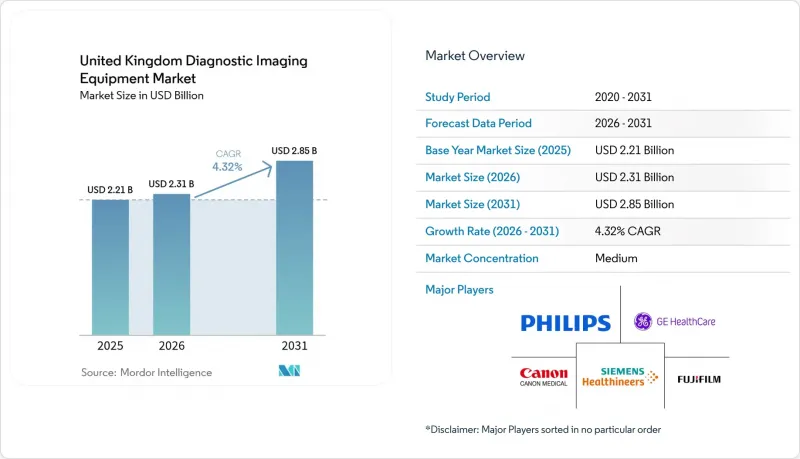
Mordor Intelligence에 따르면 영국의 영상 진단 장비 시장 규모는 2025년 22억 1,000만 달러에서 2026년에는 23억 1,000만 달러로 확대되고, 2026년부터 2031년까지 CAGR 4.32%를 기록하며 2031년까지 28억 5,000만 달러에 달할 것으로 예측됩니다.
본 보고서는 모달리티(MRI, 컴퓨터 단층촬영(CT), 초음파, X선, 핵의학 영상, 투시 검사, 유방촬영술), 휴대성(고정형 시스템, 모바일·핸드헬드 시스템), 용도(순환기과, 종양학, 신경학,정형외과, 기타), 최종사용자(병원, 영상 센터, 기타 최종사용자)별로 분류되어 있습니다. 시장 예측은 금액(달러) 기준으로 제시되어 있습니다.
영국 영상 진단 장비 시장의 동향 및 인사이트
만성 질환 유병률 증가
심혈관질환, 종양 질환, 대사성 질환의 증가가 다중 모달리티 영상 진단에 대한 수요를 견인하고 있으며, 2025년에 예상되는 4,700만 건의 NHS 스캔 중 만성 질환이 가장 빠르게 점유율을 확대하고 있습니다. 암 검진의 확대에 따라 진단, 병기 분류, 경과 관찰의 각 단계에서 영상 검사의 실시 빈도가 높아지면서 스캐너 이용률이 더욱 증가하고 있습니다. 당뇨병 관련 혈관 평가 및 고령 근로자층의 근골격계 퇴행성 질환 또한 모달리티를 불문하고 검사 건수 증가에 기여하고 있습니다. NICE(영국 국립의료기술평가기구)의 지침에서는 침습적 시술보다 영상 검사가 점점 더 권장되고 있어, CT 혈관조영술 및 MRI 관절조영술에 대한 의존도가 높아지고 있습니다. 이러한 누적적인 효과로 인해 환자 1인당 평생 스캔 건수가 증가하고 있으며, 모달리티에 관계없이 지속적인 수익 기반이 확립되고 있습니다.
첨단 영상 기술의 도입 확대
교육 병원은 검사 시간을 단축하고 재검사를 대폭 줄임으로써 제한된 인력 자원을 확보할 수 있는, AI를 활용한 CT, MRI, X선 시스템의 도입을 주도하고 있습니다. NICE는 2024년에 4가지 AI 골절 감지 도구를 승인하여 규제 당국의 수용을 시사하는 한편, 병원 내 내장형 분석 기능에 대한 조달 요건을 가속화하고 있습니다. 디지털 유방 토모신테시스는 암 검출률 측면에서 2D 유방촬영술을 능가하고 있어, 전국적인 업그레이드 계획이 추진되고 있습니다. MAGNETOM Flow와 같은 저헬륨 1.5T MRI 플랫폼은 운영 비용을 최대 30% 절감하여 예산 및 지속가능성 측면의 요구 사항을 모두 충족합니다. 합성 CT 알고리즘은 영상의 충실도를 유지하면서 방사선 피폭량을 줄여, 의료 기관이 IR(ME)R 2024의 기준치 및 규정을 충족하는 데 도움을 주고 있습니다.
높은 장비 및 검사 비용
차폐 및 공조 설비 업그레이드를 포함하면 MRI실 정비 비용은 200만 파운드를 초과하며, 이 금액은 많은 지역 병원의 연간 자본 예산을 웃돌게 됩니다. 서비스 계약에 따라 매년 구매 가격의 10%가 추가 비용으로 발생하므로, 의료 기관은 운영 기간 전체에 걸쳐 고액의 간접비를 부담할 수밖에 없습니다. 첨단 검사법에 대한 보험 급여 단가는 실제 비용을 따라가지 못하고 있어, 임상적 이점이 있음에도 불구하고 조기 도입에 대한 의욕을 꺾고 있습니다. 설비의 노후화(현재 CT 스캐너의 57%가 도입 후 5년 이상 경과함)로 인해 유지보수 비용이 증가하고, 예기치 못한 가동 중단이 발생하여 처리 능력과 수익이 저하되고 있습니다. 이러한 비용 압박이 복합적으로 작용하여 소규모 의료기관이 현대화 프로그램에 참여하는 속도를 늦추고 있습니다.
부문 분석
X선은 소유 비용이 낮고, 임상 적용 범위가 넓으며, 시설 요구 사항이 최소화되어 있어 2025년 영국 영상 기기 시장에서 33.84%의 점유율을 유지했습니다. 이 부문은 응급실, 외래 진료소, 지역 진단 센터에서 거의 보편적으로 도입되어 있습니다. 디지털 X선 촬영으로의 업그레이드를 통해 노후된 CR 시스템이 교체되고, 검출기의 감도가 향상되어 방사선 피폭량을 최대 40%까지 줄이고 있습니다. 이동식 DR 장치는 병상 옆에서 영상 촬영을 가능하게 하여 감염 관리 프로토콜을 지원할 뿐만 아니라 환자 이송 시간을 단축시킵니다. 그러나 성장 전망이 정체된 것은 시장 포화와 보험 환급 한도 때문입니다.
MRI는 5.63%라는 가장 높은 연평균 성장률(CAGR)을 보이며, 전립선 다중 매개변수 스캔, 간 철분 정량, 태아 영상 촬영 등의 사용 사례를 확대함으로써 영국 영상 진단 장비 시장을 주도하고 있습니다. 고자기장 3T 및 신흥 7T 플랫폼은 고해상도 연조직 콘트라스트가 필요한 신경학 및 정형외과 하위 전문 분야를 포괄하고 있습니다. 헬륨을 소량만 사용하는 ‘MAGNETOM Flow’와 GE Healthcare의 새로운 초프리미엄 1.5T 그라디언트 시스템은 운영 비용을 절감하고 대상 구매자층을 확대하고 있습니다. 하이브리드 PET-MR은 종양학 연구 센터에서 틈새 수요가 있지만, 학계와 산업계의 공동 자금 지원의 혜택을 받고 있습니다. CT, 초음파, 핵의학, 투시 검사, 유방촬영술은 여전히 중요하지만, 신규 도입보다는 주로 교체 수요에 기인하여 한 자릿수 중반의 성장에 그치고 있습니다.
2025년, 영국 영상 진단 장비 시장 규모의 80.12%를 고정실형 장비가 차지했으며, 이는 고처리량 CT, MRI, 중재실에 대한 병원의 꾸준한 수요를 반영합니다. 대규모 교육 병원은 공유 제어 영역과 통합형 RIS/PACS를 갖춘 멀티룸 스위트에 투자하고 있으며, 85% 이상의 가동률을 달성하고 있습니다. 차폐 벙커 및 간트리의 중량 제한으로 인해, 이러한 시스템은 시설 내에 고정된 상태로 유지되고 있습니다. 보증 기간 연장 및 모듈식 업그레이드로 자산 수명은 연장되고 있지만, MES 계약 하에서는 장비 교체 주기가 단축되고 있습니다.
한편, 모바일 및 핸드헬드형 플랫폼은 진단을 환자에게 더 가깝게 가져다주는 분산화 추세에 힘입어 연평균 성장률(CAGR) 5.78%를 기록하고 있습니다. 지역 진단 센터에서는 트레일러형 CT 및 MRI 장비를 활용하여 농촌 관할 구역을 순회하고 있으며, 고정 시설에 대한 투자 없이 하루 40회 스캔 분량의 처리 능력을 제공하고 있습니다. Butterfly Network의 1,699파운드짜리 핸드헬드 초음파 장치는 기존 5만 달러짜리 카트를 스마트폰 크기의 프로브로 집약하여, 21개 트러스트에서 POC(Point-of-Care)(point-of-care) 도입을 가능하게 하고 있습니다. 휴대용 C-암 및 미니 투시 시스템은 당일 수술 센터(day-case surgical hubs)를 지원하며, 영상 진단 능력을 더욱 분산시키고 있습니다. 성장의 핵심은 임상의 교육 및 보험 급여의 일관성에 있으며, 이 두 가지 모두 NHS의 디지털 인증 절차를 통해 진전되고 있습니다.
기타 혜택
- 엑셀 형식의 시장 예측(ME) 시트
- 3개월간의 애널리스트 지원
자주 묻는 질문
목차
제1장 소개
제2장 조사 방법
제3장 주요 요약
제4장 시장 구도
제5장 시장 규모와 성장 예측
제6장 경쟁 구도
제7장 시장 기회와 향후 전망
KSM 26.09.03According to Mordor Intelligence, the United Kingdom diagnostic imaging equipment market size is expected to grow from USD 2.21 billion in 2025 to USD 2.31 billion in 2026 and is forecast to reach USD 2.85 billion by 2031 at 4.32% CAGR over 2026-2031.
This report is Segmented by Modality (MRI, Computed Tomography, Ultrasound, X-Ray, Nuclear Imaging, Fluoroscopy, Mammography), Portability (Fixed Systems, Mobile and Hand-Held Systems), Application (Cardiology, Oncology, Neurology, Orthopedics, and More), and End-User (Hospitals, Diagnostic Imaging Centres, Other End-Users). The Market Forecasts are Provided in Terms of Value (USD).
United Kingdom Diagnostic Imaging Equipment Market Trends and Insights
Rising Prevalence of Chronic Diseases
Escalating cardiovascular, oncologic, and metabolic disorders fuel multi-modality imaging demand, with chronic cases now accounting for the fastest-growing share of the 47 million NHS scans projected for 2025. Cancer screening expansions extend imaging intensity across diagnosis, staging, and surveillance stages, further tightening scanner utilization. Diabetes-related vascular assessments and musculoskeletal degeneration in an older workforce add to modality-agnostic volume growth. NICE guidelines increasingly favor imaging over invasive procedures, reinforcing reliance on CT angiography and MRI arthrography. The cumulative effect is a higher lifetime scan count per patient, anchoring durable revenue across modalities.
Growing Adoption of Advanced Imaging Technologies
Teaching hospitals spearhead procurement of AI-augmented CT, MRI, and X-ray systems that compress exam times and slash repeats, thereby freeing scarce staff capacity. NICE approved four AI fracture-detection tools in 2024, signposting regulatory acceptance and accelerating hospital tender requirements for embedded analytics. Digital breast tomosynthesis outperforms 2-D mammography in cancer pick-up rates, prompting nationwide upgrade roadmaps. Low-helium 1.5 T MRI platforms, such as MAGNETOM Flow, cut running costs by up to 30%, satisfying both budgetary and sustainability mandates. Synthetic-CT algorithms reduce radiation dose while safeguarding image fidelity, helping providers meet IR(ME)R 2024 thresholds and regulations.
High Equipment & Procedure Costs
MRI suite build-outs exceed GBP 2 million once shielding and HVAC upgrades are counted, a figure that eclipses annual capital envelopes for many community hospitals. Service contracts add another 10% of purchase price each year, locking trusts into steep overheads for the full operational life. Reimbursement tariffs lag real costs for advanced modalities, disincentivizing early adoption despite clinical gains. Aging assets-57% of CT scanners are now older than five years-raise maintenance outlays and unplanned downtime, dampening throughput and revenue. Collectively, these cost pressures slow the pace at which smaller facilities can join modernization programs.
Other drivers and restraints analyzed in the detailed report include:
- Government Capital Funding to Modernise NHS Imaging Fleet
- Managed-Equipment-Service (MES) Model Shortening Replacement Cycles
- Radiographer Shortages Limiting Scanner Throughput
For complete list of drivers and restraints, kindly check the Table Of Contents.
Segment Analysis
X-ray retained 33.84% of United Kingdom diagnostic imaging equipment market share in 2025, owing to low ownership costs, ubiquitous clinical indications, and minimal facility prerequisites. The segment enjoys near-universal deployment across emergency rooms, outpatient clinics, and community diagnostic centres. Digital radiography upgrades replace aging CR suites, boosting detector sensitivity and cutting radiation by up to 40%. Mobile DR units enable bedside imaging, supporting infection-control protocols and reducing patient transport time. Nevertheless, flat growth expectations reflect saturation and reimbursement ceilings.
MRI exhibits the fastest 5.63% CAGR, extending the United Kingdom diagnostic imaging equipment market by expanding use cases such as prostate multiparametric scans, liver iron quantification, and fetal imaging. High-field 3 T and emerging 7 T platforms capture neurology and orthopaedics subspecialties that demand high-resolution soft-tissue contrast. The helium-light MAGNETOM Flow and GE HealthCare's new ultra-premium 1.5 T gradient system limit operational expense, widening the addressable buyer base. Hybrid PET-MR holds niche appeal for oncology research centres but benefits from pooled academic-industry funding. CT, ultrasound, nuclear imaging, fluoroscopy, and mammography remain critical but record mid-single-digit growth, largely tied to replacement rather than net-new installs.
Fixed rooms delivered 80.12% of the United Kingdom diagnostic imaging equipment market size in 2025, reflecting entrenched hospital demand for high-throughput CT, MRI, and interventional labs. Large teaching hospitals invest in multi-room suites with shared control areas and integrated RIS/PACS, achieving capacity utilisation above 85%. Shielded bunkers and gantry weight constraints keep these systems firmly site-bound. Warranty extensions and modular upgrades prolong asset life, yet fleet renewal cycles shorten under MES arrangements.
Conversely, mobile and hand-held platforms record a 5.78% CAGR, riding the decentralisation wave that places diagnostics closer to patients. Community Diagnostic Centres rely on trailer-based CT and MRI units that rotate through rural catchment areas, delivering 40-scan daily capacity without bricks-and-mortar spend. Butterfly Network's GBP 1,699 handheld ultrasound compresses a traditional USD 50,000 cart into a smartphone-sized probe, unlocking point-of-care adoption across 21 trusts. Portable C-arms and mini-fluoroscopy systems support day-case surgical hubs, further dispersing imaging capacity. Growth hinges on clinician training and reimbursement alignment, both advancing via NHS digital accreditation pathways.
Complete Report Scope:
- By Modality
- MRI
- High-field (>1.5 T)
- Low-field (<=1.5 T)
- Computed Tomography
- High-slice (>64)
- Mid-slice (16-64)
- Low-slice (<16)
- Cone-Beam CT
- Ultrasound
- Diagnostic (2D)
- Diagnostic (3D/4D)
- Hand-held/Portable
- X-Ray
- Digital Radiography
- Analog Radiography
- Mobile DR
- Nuclear Imaging
- PET
- SPECT
- Hybrid (PET-CT / PET-MR)
- Fluoroscopy
- Fixed C-arm
- Mobile C-arm
- Mammography
- Digital 2D
- 3D Tomosynthesis
- MRI
- By Portability
- Fixed Systems
- Mobile and Hand-held Systems
- By Application
- Cardiology
- Oncology
- Neurology
- Orthopedics
- Gastroenterology
- Gynecology
- Other Applications
- By End-User
- Hospitals
- Diagnostic Imaging Centres
- Other End-users
List of Companies Covered in this Report:
- Siemens Healthineers
- GE Healthcare
- Koninklijke Philips
- Canon
- Fujifilm Holdings Corp.
- Carestream Health
- Hologic
- Shimadzu
- Esaote
- MR Solutions
- Samsung Medison Co. Ltd.
- United Imaging Healthcare Co. Ltd.
- Mindray Medical Intl. Ltd.
- Butterfly Network Inc.
- Medray Imaging Systems Ltd.
- Xograph Healthcare Ltd.
- Intelligent Ultrasound Group plc
- Agfa-Gevaert
- Ziehm Imaging
Additional Benefits:
- The market estimate (ME) sheet in Excel format
- 3 months of analyst support
TABLE OF CONTENTS
1 Introduction
- 1.1 Study Assumptions & Market Definition
- 1.2 Scope of the Study
2 Research Methodology
3 Executive Summary
4 Market Landscape
- 4.1 Market Overview
- 4.2 Market Drivers
- 4.2.1 Rising Prevalence of Chronic Diseases
- 4.2.2 Growing Adoption of Advanced Imaging Technologies
- 4.2.3 Government Capital Funding to Modernise NHS Imaging Fleet
- 4.2.4 Managed-Equipment-Service (MES) Model Shortening Replacement Cycles
- 4.2.5 AI-Enabled Workflow Tools Boosting Utilisation Rates
- 4.2.6 Hand-Held Ultrasound Uptake in Primary/Community Settings
- 4.3 Market Restraints
- 4.3.1 High Equipment & Procedure Costs
- 4.3.2 Radiation-Dose Compliance and Image-Quality Regulations
- 4.3.3 Brexit-Linked Installation & Spare-Parts Delays
- 4.3.4 Shortage of Radiographers Limiting Scanner Throughput
- 4.4 Supply-Chain Analysis
- 4.5 Regulatory Landscape
- 4.6 Technological Outlook
- 4.7 Porter's Five Forces Analysis
- 4.7.1 Threat of New Entrants
- 4.7.2 Bargaining Power of Buyers
- 4.7.3 Bargaining Power of Suppliers
- 4.7.4 Threat of Substitutes
- 4.7.5 Intensity of Competitive Rivalry
5 Market Size & Growth Forecasts (Value)
- 5.1 By Modality
- 5.1.1 MRI
- 5.1.1.1 High-field (>1.5 T)
- 5.1.1.2 Low-field (<=1.5 T)
- 5.1.2 Computed Tomography
- 5.1.2.1 High-slice (>64)
- 5.1.2.2 Mid-slice (16-64)
- 5.1.2.3 Low-slice (<16)
- 5.1.2.4 Cone-Beam CT
- 5.1.3 Ultrasound
- 5.1.3.1 Diagnostic (2D)
- 5.1.3.2 Diagnostic (3D/4D)
- 5.1.3.3 Hand-held/Portable
- 5.1.4 X-Ray
- 5.1.4.1 Digital Radiography
- 5.1.4.2 Analog Radiography
- 5.1.4.3 Mobile DR
- 5.1.5 Nuclear Imaging
- 5.1.5.1 PET
- 5.1.5.2 SPECT
- 5.1.5.3 Hybrid (PET-CT / PET-MR)
- 5.1.6 Fluoroscopy
- 5.1.6.1 Fixed C-arm
- 5.1.6.2 Mobile C-arm
- 5.1.7 Mammography
- 5.1.7.1 Digital 2D
- 5.1.7.2 3D Tomosynthesis
- 5.1.1 MRI
- 5.2 By Portability
- 5.2.1 Fixed Systems
- 5.2.2 Mobile and Hand-held Systems
- 5.3 By Application
- 5.3.1 Cardiology
- 5.3.2 Oncology
- 5.3.3 Neurology
- 5.3.4 Orthopedics
- 5.3.5 Gastroenterology
- 5.3.6 Gynecology
- 5.3.7 Other Applications
- 5.4 By End-User
- 5.4.1 Hospitals
- 5.4.2 Diagnostic Imaging Centres
- 5.4.3 Other End-users
6 Competitive Landscape
- 6.1 Market Concentration
- 6.2 Market Share Analysis
- 6.3 Company Profiles (includes Global level Overview, Market level overview, Core Segments, Financials as available, Strategic Information, Market Rank/Share for key companies, Products & Services, and Recent Developments)
- 6.3.1 Siemens Healthineers
- 6.3.2 GE Healthcare
- 6.3.3 Koninklijke Philips N.V.
- 6.3.4 Canon Medical Systems Corporation
- 6.3.5 Fujifilm Holdings Corp.
- 6.3.6 Carestream Health Inc.
- 6.3.7 Hologic Inc.
- 6.3.8 Shimadzu Corp.
- 6.3.9 Esaote SpA
- 6.3.10 MR Solutions Ltd.
- 6.3.11 Samsung Medison Co. Ltd.
- 6.3.12 United Imaging Healthcare Co. Ltd.
- 6.3.13 Mindray Medical Intl. Ltd.
- 6.3.14 Butterfly Network Inc.
- 6.3.15 Medray Imaging Systems Ltd.
- 6.3.16 Xograph Healthcare Ltd.
- 6.3.17 Intelligent Ultrasound Group plc
- 6.3.18 Agfa-Gevaert NV
- 6.3.19 Ziehm Imaging GmbH
7 Market Opportunities & Future Outlook
- 7.1 White-space & Unmet-Need Assessment


