

|
시장보고서
상품코드
2121405
방수 투습성 텍스타일 시장 : 시장 점유율 분석, 업계 동향 및 통계, 성장 예측(2026-2031년)Waterproof Breathable Textiles - Market Share Analysis, Industry Trends & Statistics, Growth Forecasts (2026 - 2031) |
||||||
 Mordor Intelligence
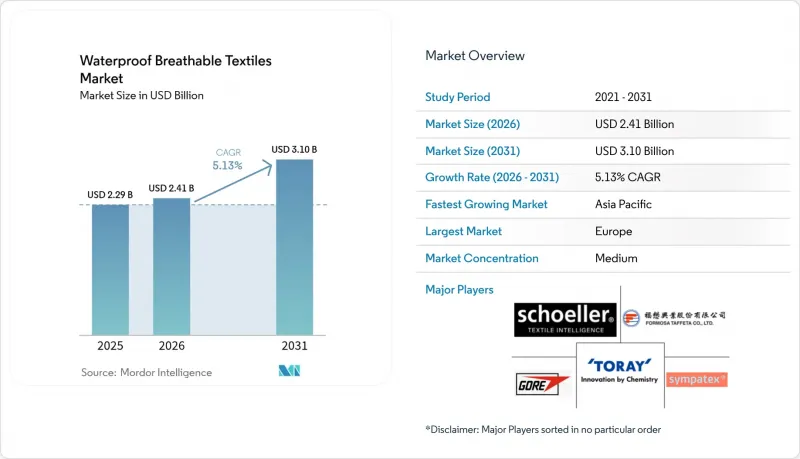
Mordor Intelligence에 의하면, 방수 투습성 텍스타일 시장 규모는 2025년 22억 9,000만 달러로 평가되었고, 2026년에는 24억 1,000만 달러로 추정되고, 2026-2031년 CAGR 5.13%로 성장을 지속할 전망이며, 2031년까지 31억 달러에 이를 것으로 예측됩니다.
본 보고서는 원자재별(PTFE, 폴리에스터, 폴리우레탄(PU), 기타), 섬유별(고밀도 직물, 막 기반, 코팅), 용도별(스포츠웨어·액티브웨어, 보호·군용, 일반 의류·홈 텍스타일, 기타), 지역별(아시아태평양, 북미 등)로 분류되어 있습니다. 시장 전망은 금액(달러) 기준으로 제시되어 있습니다.
세계 방수 투습성 텍스타일 시장 동향 및 인사이트
스포츠·아웃도어 의류 분야 수요 증가
2024년에는 아웃도어 활동 참여가 급증하면서, 기존의 면 혼방 소재보다 통기성이 뛰어난 쉘 소재를 선호하는 미국 소비자가 증가했습니다. 도시 지역의 트레일 네트워크가 장비 구매의 큰 비중을 차지하고 있으며, 방수 재킷이 일상복으로 자리 잡고 있습니다. 컬럼비아(Columbia)의 ‘OutDry Extreme Eco III’는 멤브레인을 사용하지 않는 접착 기술을 채택하여, 사무실 근무와 트레일에서의 모험을 병행하려는 통근자들의 부담을 덜어주고 있습니다. 파타고니아는 H2No 3층 시스템에서 높은 내수압 성능을 유지하는 데 성공했으며, PFAS 처리를 배제함으로써 불소 무첨가 제품의 실현 가능성을 입증했습니다. 프랑스가 2026년에 PFAS 금지 조치를 시행하고, 덴마크가 2025년에 규제를 도입할 예정인 만큼, 제품 개량이 늦어지고 있는 기업은 매장 내 진열 공간 확보에 어려움을 겪을 가능성이 있습니다. 신속하게 적응한 브랜드는 EU 소매 시장에서 입지를 확보할 뿐만 아니라, 전문 소매점에서 프리미엄 가격을 책정할 수도 있게 됩니다.
기술 보호 작업복의 확대와 군사 입찰
2025년, NATO 및 인도-태평양 지역의 현대화 노력에 따라 조달 수요가 급증했습니다. 특히 주목할 점은 영국이 VIRTUS 방탄 장비 갱신에 있어 ISO 343 레벨 3을 준수하는 통기성 아우터 착용 의무화를 도입했다는 것입니다. 산업 규격은 군사적 요구에 맞추어 진화하고 있으며, 예를 들어 EN 343 클래스 3에서는 현재 최소 15 g/m²/h의 수분 투과성이 의무화되어, 기존의 PVC 코팅 나일론 소재는 더 이상 채택되지 않고 있습니다. 또한, 습도가 높은 해상 석유 시추 시설을 위해 개정된 ANSI/ISEA 지침에 따라 멕시코만과 북해 분지에서 시장 가능성이 열렸습니다. 마찬가지로, 말레이시아가 2025년에 시행한 산업안전법 개정에 따라 건설 현장에서 통기성 있는 레인웨어 착용이 의무화되어 아세안 전역에 파급 효과를 가져오고 있습니다.
PFAS 화학물질 규제에 따른 단계적 폐지
2026년 4월, ECHA는 DWR 처리에 영향을 미치는 널리 사용되는 단쇄 PFAS의 일종인 PFHxA에 대해 규제를 부과했습니다. 프랑스에서는 25 ppm이라는 임계값이 설정되어 있어, 이에 따른 시험 비용 발생 및 리드타임 연장이 요구되고 있습니다. 캘리포니아주의 AB-1817 법안은 여러 지역에서 사업을 전개하는 브랜드에게 추가적인 복잡성을 야기하고 있습니다. 실리콘계 DWR은 추가 중량이 필요하기 때문에 여분의 비용이 발생합니다. 고어(Gore)사는 ePE 막 생산 라인을 도입하기 위해 엘크턴-푸츠브룬 공장에 대한 대규모 개보수에 막대한 투자를 단행했으나, 이는 소규모 경쟁사들에게는 감당하기 어려운 대업입니다.
부문 분석
폴리우레탄은 2025년에 원자재 수요의 44.92%를 차지했으며, 연평균 성장률(CAGR) 5.80%를 기록할 전망이며, 비용 중시 및 친환경 라벨 부문에서 방수 투습성 텍스타일 시장 규모 확대를 뒷받침하고 있습니다. 수성 분산액 및 피마자유 유래 폴리올과의 호환성을 통해 VOC(휘발성 유기 화합물) 및 탄소 집약도를 낮추고 있습니다. 폴리에스터는 코팅된 원단의 기재 대부분을 공급하고 있으며, 재활용 소재 함유율 목표 설정의 혜택을 받고 있습니다. PTFE는 원자재 가격 변동과 규제 당국의 감시에도 불구하고, 알파인 및 방위 산업과 같은 틈새 시장에서 여전히 중요한 위치를 차지하고 있습니다.
‘기타 원자재’ 범주(폴리아미드, 폴리프로필렌, 산화 그래핀 코팅 등)는 규모는 작지만 전략적으로 중요한 위치를 차지하고 있습니다. 테이진의 ‘Nanofront’ 700nm 섬유는 직조 밀도만으로 방수성을 실현하여 소재 비용을 20-25% 절감하고 있습니다. 고어(Gore)사의 ePE 분야에서 이룬 획기적인 진전은 비불소계 수지가 성능을 저하시키지 않으면서 PTFE를 대체할 수 있음을 보여주고 있지만, 양산화에는 여전히 막대한 자본 투자가 필요합니다. 바이오 유래 폴리올에 관한 장기 계약을 체결한 브랜드는 석유화학제품의 가격 변동으로부터 이익률을 보호할 수 있습니다. 파타고니아가 코베스트로와 체결한 CO₂ 유래 PU에 관한 2025년 계약이 그 대표적인 예입니다.
지역별 분석
유럽은 확고한 레크리에이션 습관과 PFAS 없는 혁신을 추진하는 엄격한 화학 물질 규제의 뒷받침을 받아 2025년 매출의 32.39%를 차지했습니다. 독일의 기계 제조업체인 몬포르츠(Monforts)와 브루크너(Bruckner)는 화학 기술의 급속한 전환을 촉진하여 EU 방적 공장에 선구자로서의 우위를 안겨주었습니다. 2026년 프랑스의 PFAS 금지 조치는 각 브랜드의 대응 일정을 앞당기게 했으며, Sympatex와 같은 경쟁 기업들이 대응이 늦어진 라이벌 기업들이 상황이 명확해질 때까지 기다리는 동안 매장 공간을 확보할 수 있게 했습니다. 브렉시트 이후, 영국 브랜드들은 2025년에 국내 생산량이 감소했음에도 불구하고 캐나다·호주 시장으로 중심을 옮기고, 제조 거점을 포르투갈과 튀르키예로 이전했습니다.
아시아태평양은 수출과 내수 수요를 모두 충족하기 위해 인도, 베트남, 방글라데시의 막 적층 투자에 힘입어 연평균 성장률(CAGR) 5.55%로 확대되고 있습니다. 도레이가 오디샤 주에서 MAS 홀딩스와 제휴한 것은 PLI(생산 연계 인센티브) 제도의 뒷받침을 받은 인도의 기능성 원단 분야에 대한 야망을 여실히 드러내고 있습니다. 중국은 전 세계 PTFE 멤브레인 생산 능력에서 큰 비중을 차지하고 있지만, 각 브랜드가 조달처 다각화를 추진함에 따라 2025년에는 방수 섬유 수출이 감소했습니다. 동남아시아의 방적 공장은 EU 수입 기준을 충족하는 PFAS 무함유 코팅 원단을 생산함으로써 성장세를 보이고 있습니다.
북미의 섬유 및 방호복 시장 전망은 이 분야에 예산의 일부를 배정하고 있는 2026년도 국방 예산 및 미국의 아웃도어·레크리에이션 경제와 밀접하게 연관되어 있습니다. 2025년, 멕시코는 5일이라는 짧은 납기 수요에 대응하기 위한 니어쇼어 코팅 라인에 초점을 맞추어 섬유 분야에서 막대한 투자를 유치했습니다. 남미·중동 및 아프리카은 여전히 비교적 소규모 시장이지만, 때때로 급격한 성장이 관찰됩니다. 예를 들어, 2024년 홍수 이후 브라질의 조달이나 ‘사우디 비전 2030’에 기반한 통기성 작업복 계약 등은 기후 변화와 건설 수요로 인한 이러한 수요 급증을 여실히 보여줍니다. 이 지역에서는 온화한 기후 조건에서 비용 대비 효율이 높고 유지보수가 용이하다는 점 때문에 코팅 원단이 선호되고 있습니다.
기타 혜택 :
- 엑셀 형식 시장 예측(ME) 시트
- 3개월간의 애널리스트 지원
자주 묻는 질문
목차
제1장 서론
제2장 조사 방법
제3장 주요 요약
제4장 시장 구도
제5장 시장 규모 및 성장 예측
제6장 경쟁 구도
제7장 시장 기회 및 향후 전망
AJY 26.09.09According to Mordor Intelligence, the waterproof breathable textiles market size is expected to grow from USD 2.29 billion in 2025 to USD 2.41 billion in 2026 and is forecast to reach USD 3.10 billion by 2031 at 5.13% CAGR over 2026-2031.
This report is Segmented by Raw Material (PTFE, Polyester, Polyurethane, and Other Raw Materials), Textile (Densely Woven, Membrane-Based, and Coated), Application (Sportswear and Activewear, Protective and Military, General Clothing and Home Textile, and Other Applications), and Geography (Asia-Pacific, North America, and More). The Market Forecasts are Provided in Terms of Value (USD).
Global Waterproof Breathable Textiles Market Trends and Insights
Rising Demand From Sports and Outdoor Apparel
In 2024, outdoor participation surged, welcoming U.S. consumers who now prefer breathable shells over traditional cotton blends. Urban trail networks have claimed a significant share of gear purchases, integrating waterproof jackets into daily wear. Columbia's OutDry Extreme Eco III showcases a membrane-free bonding technique, lightening the load for commuters balancing office hours and trailhead adventures. Patagonia has successfully maintained a high hydrostatic-head rating in its H2No 3-layer system, eliminating PFAS treatments and demonstrating the feasibility of fluorine-free products. With France set to enforce a PFAS ban in 2026 and Denmark imposing restrictions in 2025, late reformulators face potential shelf-space challenges. Brands that adapt swiftly not only ensure their presence in EU retail but also command premium prices in specialty outlets.
Expansion of Technical Protective Workwear and Military Tenders
In 2025, NATO and Indo-Pacific modernization efforts led to a procurement surge. Notably, the U.K. mandated an ISO 343 Level 3 breathable outer for its VIRTUS armor refresh. Industrial standards are evolving in tandem with military needs; for instance, EN 343 Class 3 now mandates a moisture transfer of at least 15 g/m2/h, sidelining older PVC-coated nylons. Furthermore, updated ANSI/ISEA guidelines tailored for humid offshore rigs have unlocked a market potential in the Gulf of Mexico and North Sea basins. In a similar vein, Malaysia's 2025 amendments to occupational safety laws now mandate breathable rain gear on construction sites, creating a ripple effect of opportunities across ASEAN.
Regulatory Phase-Out of PFAS Chemistries
In April 2026, ECHA imposed a restriction on PFHxA, a prevalent short-chain PFAS, impacting DWR treatments. France's 25 ppm threshold mandates testing costs, extending lead times. California's AB-1817 adds layers of complexity for brands operating across multiple regions. Silicone DWRs, needing an additional weight, incur extra costs. Gore invested significantly to retrofit its Elkton and Putzbrunn plants for ePE membrane lines, a feat beyond the reach of smaller competitors.
Other drivers and restraints analyzed in the detailed report include:
- Climate-Resilient Infrastructure Boosting Rain-Gear Sales
- Advancements in Bio-Based Polyurethane and Solvent-Free Lamination Technologies
- High Processing and Capital Costs Versus Conventional Fabrics
For complete list of drivers and restraints, kindly check the Table Of Contents.
Segment Analysis
Polyurethane accounted for 44.92% of raw-material demand in 2025 and is on course for a 5.80% CAGR, underpinning the waterproof breathable textiles market size gains in cost-sensitive and green-label segments. Its compatibility with waterborne dispersions and castor-oil polyols reduces VOCs and carbon intensity. Polyester supplies most coated-fabric substrates and is benefiting from recycled-content targets. PTFE retains relevance in alpine and defense niches despite feedstock volatility and regulatory scrutiny.
The "Other Raw Materials" bucket-polyamide, polypropylene, graphene-oxide coatings-remains small yet strategically important. Teijin's Nanofront 700-nm fibers create waterproofness via weave density alone, lowering material costs by 20 to 25 percent. Gore's ePE breakthrough illustrates how non-fluorinated resins can replace PTFE without losing performance, but scale-up remains capital-intensive. Brands locking long-term contracts for bio-based polyols secure margin insulation against petrochemical swings, as seen in Patagonia's 2025 agreement with Covestro for CO2-based PU.
Complete Report Scope:
- By Raw Material
- PTFE
- Polyester
- Polyurethane (PU)
- Other Raw Materials
- By Textile
- Densely Woven
- Membrane-based
- Coated
- By Application
- Sportswear and Activewear
- Protective and Military
- General Clothing and Home Textile
- Other Applications
- By Geography
- Asia-Pacific
- China
- Japan
- India
- South Korea
- ASEAN Countries
- North America
- United States
- Canada
- Mexico
- Europe
- Germany
- United Kingdom
- France
- Italy
- Russia
- Rest of Europe
- South America
- Brazil
- Argentina
- Rest of South America
- Middle-East and Africa
- Saudi Arabia
- South Africa
- Rest of Middle-East and Africa
- Asia-Pacific
Geography Analysis
Europe retained 32.39% of 2025 revenue, buoyed by mature recreation habits and stringent chemical laws that pull PFAS-free innovation forward. German machinery makers, Monforts and Bruckner, facilitated rapid chemistry pivots, granting EU mills a first-mover advantage. France's 2026 PFAS ban hastened brand timelines, allowing contenders like Sympatex to seize shelf space while slower rivals awaited clarity. Following Brexit, U.K. brands, despite a domestic output dip in 2025, pivoted to Canadian and Australian markets, relocating fabrication to Portugal and Turkey.
Asia-Pacific is expanding at a 5.55% CAGR, driven by investments in membrane-lamination from India, Vietnam, and Bangladesh to cater to both export and domestic demands. Toray's collaboration with MAS Holdings in Odisha underscores India's ambitions in technical fabrics, bolstered by the PLI scheme. While China commands a significant share of the global PTFE membrane capacity, it experienced a decline in waterproof-textile exports in 2025, as brands began diversifying their sourcing. Mills in Southeast Asia are gaining momentum by producing PFAS-free coated fabrics that meet EU import standards.
North America's textile and protective gear outlook is closely linked to the FY 2026 defense budget, which allocates a portion to these sectors, and the nation's outdoor-recreation economy. In 2025, Mexico drew in substantial textile investments, focusing on near-shore coating lines to meet a swift 5-day lead-time demand. While South America and the Middle East-Africa regions remain relatively small players, they occasionally surge; for instance, Brazil's procurement post-2024 floods and Saudi Vision 2030's contracts for breathable workwear highlight these climate- and construction-driven spikes. Coated fabrics are favored in these regions, attributed to their cost-effectiveness and ease of maintenance in warmer climates.
- Columbia Sportswear India
- eVent Fabrics (Clarus Corp.)
- FORMOSA TAFFETA CO., LTD.
- HeiQ Materials AG
- Helly Hansen
- Henderson Textiles
- Huntsman Textile Effects
- Jack Wolfskin - Ausrustung For Draussen Gmbh & Co. Kgaa
- Marmot Mountain LLC
- Nisshinbo Textile Inc.
- Patagonia Inc.
- Pertex (Mitsui & Co.)
- Polartec
- Polartec (Milliken & Company)
- schoeller Switzerland
- Stotz & Co. AG (Ventile)
- Sympatex
- Teijin Limited
- The North Face, A VF Company
- TORAY INDUSTRIES, INC.
- W. L. Gore & Associates Inc.
Additional Benefits:
- The market estimate (ME) sheet in Excel format
- 3 months of analyst support
TABLE OF CONTENTS
1 Introduction
- 1.1 Study Assumptions and Market Definition
- 1.2 Scope of the Study
2 Research Methodology
3 Executive Summary
4 Market Landscape
- 4.1 Market Overview
- 4.2 Market Drivers
- 4.2.1 Rising demand from sports and outdoor apparel
- 4.2.2 Expansion of technical protective workwear and military tenders
- 4.2.3 Climate-resilient infrastructure boosting rain-gear sales in emerging economies
- 4.2.4 Advancements in bio-based Polyurethane and solvent-free lamination technologies
- 4.2.5 Micro-adventure urban outdoor trend spurring casual waterproof fashion
- 4.3 Market Restraints
- 4.3.1 Regulatory phase-out of PFAS chemistries
- 4.3.2 High processing and capital costs versus conventional fabrics
- 4.3.3 PTFE feedstock supply-chain disruptions amid geo-political tensions
- 4.4 Value Chain Analysis
- 4.5 Porter's Five Forces
- 4.5.1 Bargaining Power of Suppliers
- 4.5.2 Bargaining Power of Buyers
- 4.5.3 Threat of New Entrants
- 4.5.4 Threat of Substitutes
- 4.5.5 Intensity of Competitive Rivalry
5 Market Size and Growth Forecasts
- 5.1 By Raw Material
- 5.1.1 PTFE
- 5.1.2 Polyester
- 5.1.3 Polyurethane (PU)
- 5.1.4 Other Raw Materials
- 5.2 By Textile
- 5.2.1 Densely Woven
- 5.2.2 Membrane-based
- 5.2.3 Coated
- 5.3 By Application
- 5.3.1 Sportswear and Activewear
- 5.3.2 Protective and Military
- 5.3.3 General Clothing and Home Textile
- 5.3.4 Other Applications
- 5.4 By Geography
- 5.4.1 Asia-Pacific
- 5.4.1.1 China
- 5.4.1.2 Japan
- 5.4.1.3 India
- 5.4.1.4 South Korea
- 5.4.1.5 ASEAN Countries
- 5.4.2 North America
- 5.4.2.1 United States
- 5.4.2.2 Canada
- 5.4.2.3 Mexico
- 5.4.3 Europe
- 5.4.3.1 Germany
- 5.4.3.2 United Kingdom
- 5.4.3.3 France
- 5.4.3.4 Italy
- 5.4.3.5 Russia
- 5.4.3.6 Rest of Europe
- 5.4.4 South America
- 5.4.4.1 Brazil
- 5.4.4.2 Argentina
- 5.4.4.3 Rest of South America
- 5.4.5 Middle-East and Africa
- 5.4.5.1 Saudi Arabia
- 5.4.5.2 South Africa
- 5.4.5.3 Rest of Middle-East and Africa
- 5.4.1 Asia-Pacific
6 Competitive Landscape
- 6.1 Market Concentration
- 6.2 Strategic Moves
- 6.3 Market Share (%)/Ranking Analysis
- 6.4 Company Profiles {(includes Global level Overview, Market level overview, Core Segments, Financials as available, Strategic Information, Products and Services, and Recent Developments)}
- 6.4.1 Columbia Sportswear India
- 6.4.2 eVent Fabrics (Clarus Corp.)
- 6.4.3 FORMOSA TAFFETA CO., LTD.
- 6.4.4 HeiQ Materials AG
- 6.4.5 Helly Hansen
- 6.4.6 Henderson Textiles
- 6.4.7 Huntsman Textile Effects
- 6.4.8 Jack Wolfskin - Ausrustung For Draussen Gmbh & Co. Kgaa
- 6.4.9 Marmot Mountain LLC
- 6.4.10 Nisshinbo Textile Inc.
- 6.4.11 Patagonia Inc.
- 6.4.12 Pertex (Mitsui & Co.)
- 6.4.13 Polartec
- 6.4.14 Polartec (Milliken & Company)
- 6.4.15 schoeller Switzerland
- 6.4.16 Stotz & Co. AG (Ventile)
- 6.4.17 Sympatex
- 6.4.18 Teijin Limited
- 6.4.19 The North Face, A VF Company
- 6.4.20 TORAY INDUSTRIES, INC.
- 6.4.21 W. L. Gore & Associates Inc.
7 Market Opportunities and Future Outlook
- 7.1 White-space and Unmet-need Assessment


