

|
시장보고서
상품코드
2121459
의료용 생체인식 : 시장 점유율 분석, 업계 동향과 통계, 성장 예측(2026-2031년)Healthcare Biometrics - Market Share Analysis, Industry Trends & Statistics, Growth Forecasts (2026 - 2031) |
||||||
 Mordor Intelligence
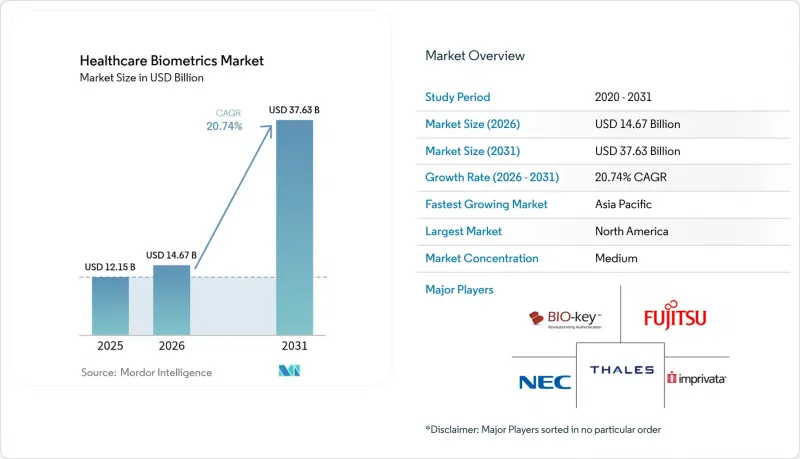
의료용 생체인식 시장 규모는 2025년 121억 5,000만 달러에서 2026년에는 146억 7,000만 달러로 확대되고, 2026년부터 2031년까지 CAGR 20.74%를 기록하며 2031년에는 376억 3,000만 달러에 달할 것으로 예측됩니다.
본 보고서는 기술별(단일 요소 인증, 행동 생체 인증 등), 구성요소별(하드웨어, 소프트웨어, 서비스), 용도별(환자 식별·추적 등), 최종사용자별(병원·진료소 등), 지역별(북미, 유럽, 아시아태평양, 중동 및 아프리카, 남미)로 분류되어 있습니다. 시장 예측은 금액(달러) 기준으로 제시되어 있습니다.
세계 의료용 생체인식 시장의 동향 및 인사이트
정부의 전자 신분증 및 전자건강기록(EHR) 의무화
각국의 디지털 ID 프로그램에 따라 의료 분야에서의 생체 인증이 의무화되고 있습니다. 일본의 ‘마이넘버’ 건강보험증은 2024년 12월 기준 의료기관 도입률이 92.5%에 달하며, 8,100만 명의 국민이 얼굴 인식 단말기와 연동하고 있습니다. 인도의 ‘아유슈만 바라트 디지털 미션(Ayushman Bharat Digital Mission)’에서는 6억 5,000만 건 이상의 생체 인증 의료 계정이 등록되어, 원격 등록 및 기록 접근이 간소화되었습니다. 에스토니아는 전자 서비스 기반 전체에 AI 기반 신원 확인 기능을 통합함으로써 이 모델을 더욱 확장하고 있습니다. 미국에서는 ‘21세기 치료법(21st-Century Cures Act)’의 준수 요건에 따라 병원이 비밀번호 기반 로그인을 보다 강력한 인증 요소로 대체해야 하므로, 생체 인증을 통한 싱글 사인온(SSO) 도입이 가속화되고 있습니다. 이러한 조치들이 결합되어 경기 사이클에 관계없이 지속적인 수요가 확보되고 있습니다.
심각해지는 의료 정보 사칭 및 데이터 유출
2024년에 발생한 체인지 헬스케어(Change Healthcare)에 대한 랜섬웨어 공격에서는 1억 건이 넘는 미국 기록이 유출되었으며, 이는 사상 최악의 데이터 유출 사건이 되었습니다. 그 후, 카이저 퍼머넌트(Kaiser Permanente) 및 기타 네트워크에서 발생한 사건들은 이 업계가 사이버 범죄와 불법적인 데이터 공유에 취약하다는 점을 여실히 드러내고 있습니다. 전미 의료 사기 방지 협회(National Health Care Anti-Fraud Association)에 따르면, 연간 사기 피해액은 680억 달러에 달하며, 그 대부분은 신원 확인 오류에서 기인합니다. 퓨 자선 신탁(Pew Charitable Trusts)의 추산에 따르면, 대조 오류만으로도 시스템에 연간 60억 달러의 손실을 초래하고 있습니다. 이러한 재정적 위험으로 인해 생체 인증은 단순한 선택적 지출에서 이사회 차원의 우선 과제로 그 위상이 바뀌고 있습니다.
높은 장비 및 통합 비용
스캐너, 서버 및 현장 지원에 대한 설비 투자는 여전히 막대한 수준입니다. 소규모 의료 기관의 경우 시스템을 신속하게 상각할 만큼의 거래량이 부족하기 때문에 투자 수익률(ROI) 모델이 개선되었음에도 불구하고 도입 속도는 더딘 편입니다. 기존 의료 정보 시스템과의 복잡한 연동에는 전문 통합 업체가 필요하며, 이는 도입 비용을 상승시키고 있습니다. 클라우드 기반의 ‘생체 인증 서비스(BaaS)’는 하드웨어 수요를 어느 정도 줄여주지만, 규모의 경제 효과를 얻기 전까지는 고액의 구독료가 빠듯한 예산을 압박할 가능성이 있습니다.
부문 분석
2025년에는 병원 입원 절차에 정착된 성숙하고 비용 효율적인 스캐너 덕분에 단일 요소 인증이 36.74%라는 가장 큰 매출 점유율을 차지했습니다. 그럼에도 불구하고 정확도, 사칭 방지 능력, 장애 복구 기능이 전체 의료용 생체인식 시장에서 전략적인 구매 기준으로 자리 잡으면서, 멀티모달 엔진은 연평균 성장률(CAGR) 23.92%로 가장 빠르게 성장하고 있습니다. NEC의 맞춤형 암 백신용 얼굴 인증 시스템은 다중 모드 설계가 정밀 의료 워크플로우를 어떻게 지원하는지 보여주는 좋은 예입니다. 키 입력 리듬이나 포인터 움직임을 추적하는 행동 생체 인증은 백그라운드 보안 대책으로서 전자건강기록(EHR)에 도입되고 있습니다. 한편, 비접촉식 조작이 필수적인 무균 환경에서는 홍채 인증이나 정맥 인증이 보급되고 있습니다. 오거부율을 낮추는 기반 모델의 비약적인 발전으로 인해, 금세기 말까지 멀티모달 인증이 지문 인증과 동등한 수준에 도달할 것으로 전망됩니다.
현재 각 벤더사는 얼굴, 음성, 홍채, 행동 신호를 단일 소프트웨어 개발 키트(SDK)로 통합하는 프레임워크를 판매하고 있으며, 이를 통해 통합에 따른 부담이 경감되고 있습니다. 병원 측에서는 도입 후 출입 카드 분실 건수가 40% 감소했다는 보고가 있으며, 이를 통해 환자 중심의 디지털 프로젝트에 할당할 운영 예산을 확보하고 있습니다. 그러나 센서의 저렴한 비용과 의료진의 높은 친숙도가 이유로, 예산이 제한된 시설에서는 여전히 지문 인증 시스템이 선호되고 있습니다.
시설들이 입구용 키오스크, 진료 현장용 기기, 모바일 리더기를 업그레이드한 결과, 2025년 매출액 중 하드웨어가 51.44%를 차지했습니다. 예측 기간 동안 컨설팅, 워크플로우 매핑, 규정 준수 보장을 정액제 패키지에 포함시킴으로써 전문 서비스 및 관리형 서비스는 연평균 성장률(CAGR) 22.18%를 기록하며 장비 부문을 능가할 것입니다. SailPoint의 Imprivata ID 거버넌스 사업부 인수는 의료 분야 특유의 전문 지식에 대한 평가가 높아지고 있음을 보여줍니다.
통합의 복잡성은 여전히 중요한 판매 포인트로 남아 있습니다. 의료 서비스 제공자들은 생체 인증을 임상 치료 과정과 연동하고, HL7/FHIR과의 호환성을 확보하며, 감사 추적을 유지하는 서비스에 생체 인증 총 예산의 40-60%를 할당하고 있습니다. 관리형 서비스는 24시간 모니터링, 알고리즘 자동 업데이트, 분기별 편향 테스트를 제공함으로써 사이버 보안 인력 부족에 직면한 병원 IT 팀의 부담을 덜어주고 있습니다.
지역별 분석
2025년, 북미는 의료용 생체인식 시장을 주도하며 매출 점유율 36.25%를 기록했습니다. 이는 HIPAA의 엄격한 시행, BIPA(일리노이주 개인정보 보호법)에 따른 소송 위험, 그리고 EHR(전자건강기록)의 급속한 보급에 힘입은 결과입니다. 병원 측에 따르면, 정보 유출과 관련된 비용 회피 및 워크플로우 효율화를 고려할 때, ROI(투자 회수 기간)는 최단 22개월에 달한다고 합니다. 연방 정부 기관은 재향군인 진료 등록을 위해 다중 모드 키오스크의 시범 운영을 진행 중이며, 조달 대상을 확대하고 있습니다.
유럽은 공공 부문의 강력한 인센티브에 힘입어 이러한 추세를 이어가고 있습니다. ‘유럽 건강 데이터 공간(European Health Data Space)’은 국경을 초월한 데이터 인프라 구축을 위해 8억 1,000만 유로(9억 4,100만 달러)를 배정했으며, 이 중 상당 부분은 일반 데이터 보호 규정(GDPR)의 ‘프라이버시 바이 디자인’조항을 충족하기 위해 생체 인증 제어가 필요합니다. 스칸디나비아 국가들의 의료 시스템에서는 이미 환자 포털에 얼굴 인증이 통합되어 있으며, 비밀번호 없이 로그인할 수 있어 88%라는 사용자 만족도를 기록하고 있습니다.
아시아태평양은 가장 빠르게 움직이고 있습니다. 인도의 ‘아유슈만 바라트’에서는 현재 하루 약 100만 건의 생체 인증 ID가 발급되고 있으며, 이는 이 지역이 카드 기반 시스템을 비약적으로 추월하고 있는 규모를 여실히 보여줍니다. 일본에서는 ‘마이넘버’ 건강보험증 도입을 통해 전국의 1차 진료소에서 비접촉식 얼굴 인식이 실현되고 있습니다. 한편, 중국에서는 병원에 얼굴 인식 결제 레인을 도입하여 약국 대기 줄을 30% 단축하는 동시에 현금 처리 비용을 절감하고 있습니다. 이러한 진전이 연평균 성장률(CAGR) 24.02%를 뒷받침하고 있으며, 2031년까지 아시아태평양의 매출액이 북미 수준에 근접할 것으로 전망됩니다.
라틴아메리카, 중동 및 아프리카는 형성기에 접어들었습니다. 브라질과 아랍에미리트(UAE)의 시범 프로젝트에서는 생체 인증 ID와 백신 접종 기록을 연동하고 있어, 초기 단계이긴 하지만 확고한 노력이 나타나고 있습니다. 자금 면의 제약이나 인프라 부족으로 인해 단기적인 도입 규모는 제한되고 있지만, 다자간 의료 디지털화 보조금을 통해 향후 10년 후반에 걸쳐 도입이 가속화될 것으로 예상됩니다.
기타 혜택:
- 엑셀 형식의 시장 예측(ME) 시트
- 3개월간의 애널리스트 지원
자주 묻는 질문
목차
제1장 소개
제2장 조사 방법
제3장 주요 요약
제4장 시장 구도
제5장 시장 규모와 성장 예측
제6장 경쟁 구도
제7장 시장 기회와 향후 전망
KSM 26.09.03According to Mordor Intelligence, the healthcare biometrics market size is expected to grow from USD 12.15 billion in 2025 to USD 14.67 billion in 2026 and is forecast to reach USD 37.63 billion by 2031 at 20.74% CAGR over 2026-2031.
This report is Segmented by Technology (Single-Factor Authentication, Behavioral Biometrics, and More), Component (Hardware, Software, and Services), Application (Patient Identification and Tracking, and More), End User (Hospital and Clinics, and More), and Geography (North America, Europe, Asia-Pacific, Middle East and Africa, South America). The Market Forecasts are Provided in Terms of Value (USD).
Global Healthcare Biometrics Market Trends and Insights
Government E-ID & EHR Mandates
National digital-identity programs are making biometric verification obligatory in healthcare. Japan's "My Number" insurance cards reached 92.5% provider uptake by December 2024, linking 81 million citizens to facial-recognition terminals. India's Ayushman Bharat Digital Mission enrolled more than 650 million biometric health accounts, simplifying remote registration and record access. Estonia extends the model by embedding AI-driven identity checks across its e-services stack. In the United States, 21st-Century Cures Act compliance pressures hospitals to replace password log-ins with stronger factors, accelerating uptake of biometric single-sign-on. Collectively, these measures ensure enduring demand across economic cycles.
Escalating Medical Identity Theft & Data Breaches
The Change Healthcare ransomware attack compromised over 100 million American records in 2024, the worst breach on record. Subsequent incidents at Kaiser Permanente and other networks illustrate the sector's vulnerability to both cybercrime and unauthorised data-sharing. The National Health Care Anti-Fraud Association pegs annual fraud at USD 68 billion, much of it rooted in misidentification. Pew Charitable Trusts calculates that matching errors alone cost the system USD 6 billion annually. These financial exposures are moving biometrics from discretionary spend to board-level priority.
High Device & Integration Costs
Capital outlays for scanners, servers, and on-site support remain substantial. Smaller practices lack the transaction volume to amortise systems quickly, slowing roll-outs even as return-on-investment models improve. Complex interfacing with legacy health-information systems demands specialist integrators and hikes implementation spend. While cloud-hosted biometric-as-a-service (BaaS) eases some hardware needs, premium subscriptions can strain tight budgets until economies of scale arrive.
Other drivers and restraints analyzed in the detailed report include:
- Rapid EHR Adoption Driving Secure Log-In Demand
- Tele-Health Identity Onboarding Surge
- Privacy & Regulatory Compliance Hurdles
For complete list of drivers and restraints, kindly check the Table Of Contents.
Segment Analysis
Single-factor authentication held the largest revenue share of 36.74% in 2025, courtesy of mature, cost-effective scanners entrenched in hospital admissions. Nevertheless, multimodal engines are scaling fastest on a 23.92% CAGR as accuracy, spoof resistance, and fail-over capability become strategic purchase criteria across the healthcare biometrics market. NEC's facial-matching system for personalised cancer vaccines exemplifies how multimodal design supports precision medicine workflows.Behavioural biometrics, tracking keystroke cadence and pointer dynamics, is entering EHRs as a background safeguard. Meanwhile, iris and vein recognition gain traction in sterile environments where contact-free operation is vital. Foundation-model breakthroughs lowering false-reject rates are likely to propel multimodal options toward parity with fingerprints by decade-end.
Vendors now sell frameworks that orchestrate face, voice, iris, and behavioural signals in a single software development kit, reducing integration overheads. Hospitals cite a 40% drop in access-card loss incidents post-deployment, freeing operational budgets for patient-centric digital projects. Yet fingerprint systems still appeal to budget-constrained facilities because of inexpensive sensors and wide clinician familiarity.
Hardware commanded 51.44% of 2025 revenue as facilities upgraded entry kiosks, point-of-care devices, and mobile readers. Over the forecast horizon, professional and managed services outpace equipment at 22.18% CAGR by bundling consulting, workflow mapping, and regulatory assurance into fixed-fee packages. SailPoint's purchase of Imprivata's identity-governance line signals the growing premium on healthcare-specific domain knowledge.
Integration complexity remains a critical selling point. Providers allocate 40-60% of total biometric budgets to services that align authentication with clinical-care pathways, ensure HL7/FHIR compatibility, and maintain audit trails. Managed offerings deliver round-the-clock monitoring, automatic algorithm updates, and quarterly bias testing, relieving hospital IT teams that face cybersecurity staffing gaps.
Complete Report Scope:
- By Technology
- Single-factor Authentication
- Fingerprint Recognition
- Facial Recognition
- Iris Recognition
- Vein/Palm Recognition
- Behavioral Biometrics
- Multi-factor Authentication
- Multimodal Biometrics
- Biometric-as-a-Service (BaaS)
- Single-factor Authentication
- By Component
- Hardware
- Software
- Services
- By Application
- Patient Identification & Tracking
- Medical Record / Data-Centre Security
- Care-provider Authentication
- Tele-Health & Remote Onboarding
- Pharmacy & Controlled-Substance Dispensing
- Home / Remote Patient Monitoring
- By End User
- Hospitals & Clinics
- Diagnostic & Research Laboratories
- Insurance & Payers
- Home Care & Aged Care Facilities
- Pharma & Life Science Companies
- By Geography
- North America
- United States
- Canada
- Mexico
- Europe
- Germany
- United Kingdom
- France
- Italy
- Spain
- Rest of Europe
- Asia-Pacific
- China
- Japan
- India
- Australia
- South Korea
- Rest of Asia-Pacific
- Middle East & Africa
- GCC
- South Africa
- Rest of Middle East & Africa
- South America
- Brazil
- Argentina
- Rest of South America
- North America
Geography Analysis
North America led the healthcare biometrics market in 2025 with 36.25% revenue share, propelled by stringent HIPAA enforcement, BIPA litigation risk, and rapid EHR penetration. Hospitals report ROI windows as short as 22 months when factoring breach-related cost avoidance and workflow efficiencies. Federal agencies are piloting multimodal kiosks for veteran-care enrolment, broadening procurement pools.
Europe follows with robust public-sector incentives. The European Health Data Space earmarks EUR 810 (USD 941) million for cross-border data infrastructure, much of which requires biometric controls to meet the General Data Protection Regulation's privacy-by-design clause. Scandinavian health systems already embed facial verification in patient portals, clocking 88% user-satisfaction scores for password-less log-ins.
Asia-Pacific is the fastest mover. India's Ayushman Bharat now issues roughly 1 million biometric IDs daily, illustrating the scale at which the region is leapfrogging card-based systems. Japan's roll-out of My Number insurance cards brings contactless face authentication to primary-care clinics nationwide. China, meanwhile, deploys hospital facial-payment lanes that shorten pharmacy queues by 30% and lower cash-handling costs. These advances underpin a 24.02% CAGR that will lift Asia-Pacific close to North American revenue levels by 2031.
Latin America, the Middle East, and Africa are entering a formative phase. Pilot projects in Brazil and the United Arab Emirates tie biometric ID to vaccination records, indicating early but firm commitment. Funding constraints and infrastructure gaps temper near-term volumes, yet multilateral health-digitisation grants are expected to accelerate adoption through the second half of the decade
- Thales Group
- NEC
- Fujitsu Ltd
- Bio-Key International
- Imprivata
- Suprema
- ZKTeco Inc
- IDEMIA
- HID Global
- Crossmatch
- 3M Cogent
- Integrated Biometrics
- Lumidigm
- FaceTec
- Aratek
- M2SYS
- Vision-Box
- Certis ID
- CLEAR
- Redrock Biometrics
- AnyVision
Additional Benefits:
- The market estimate (ME) sheet in Excel format
- 3 months of analyst support
TABLE OF CONTENTS
1 Introduction
- 1.1 Study Assumptions & Market Definition
- 1.2 Scope of the Study
2 Research Methodology
3 Executive Summary
4 Market Landscape
- 4.1 Market Overview
- 4.2 Market Drivers
- 4.2.1 Government E-ID & EHR Mandates
- 4.2.2 Escalating Medical Identity Theft & Data Breaches
- 4.2.3 Rapid EHR Adoption Driving Secure Log-In Demand
- 4.2.4 Tele-Health Identity Onboarding Surge
- 4.2.5 Biometric Wearables for Smart-Hospital IoT
- 4.2.6 AI-Powered Multimodal Accuracy Breakthroughs
- 4.3 Market Restraints
- 4.3.1 High Device & Integration Costs
- 4.3.2 Privacy & Regulatory Compliance Hurdles
- 4.3.3 Algorithmic Bias Litigation Risk
- 4.3.4 EHR-Biometric API Interoperability Gaps
- 4.4 Porter's Five Forces Analysis
- 4.4.1 Threat of New Entrants
- 4.4.2 Bargaining Power of Buyers
- 4.4.3 Bargaining Power of Suppliers
- 4.4.4 Threat of Substitute Products
- 4.4.5 Intensity of Competitive Rivalry
5 Market Size & Growth Forecasts (Value in USD)
- 5.1 By Technology
- 5.1.1 Single-factor Authentication
- 5.1.1.1 Fingerprint Recognition
- 5.1.1.2 Facial Recognition
- 5.1.1.3 Iris Recognition
- 5.1.1.4 Vein/Palm Recognition
- 5.1.2 Behavioral Biometrics
- 5.1.3 Multi-factor Authentication
- 5.1.4 Multimodal Biometrics
- 5.1.5 Biometric-as-a-Service (BaaS)
- 5.1.1 Single-factor Authentication
- 5.2 By Component
- 5.2.1 Hardware
- 5.2.2 Software
- 5.2.3 Services
- 5.3 By Application
- 5.3.1 Patient Identification & Tracking
- 5.3.2 Medical Record / Data-Centre Security
- 5.3.3 Care-provider Authentication
- 5.3.4 Tele-Health & Remote Onboarding
- 5.3.5 Pharmacy & Controlled-Substance Dispensing
- 5.3.6 Home / Remote Patient Monitoring
- 5.4 By End User
- 5.4.1 Hospitals & Clinics
- 5.4.2 Diagnostic & Research Laboratories
- 5.4.3 Insurance & Payers
- 5.4.4 Home Care & Aged Care Facilities
- 5.4.5 Pharma & Life Science Companies
- 5.5 By Geography
- 5.5.1 North America
- 5.5.1.1 United States
- 5.5.1.2 Canada
- 5.5.1.3 Mexico
- 5.5.2 Europe
- 5.5.2.1 Germany
- 5.5.2.2 United Kingdom
- 5.5.2.3 France
- 5.5.2.4 Italy
- 5.5.2.5 Spain
- 5.5.2.6 Rest of Europe
- 5.5.3 Asia-Pacific
- 5.5.3.1 China
- 5.5.3.2 Japan
- 5.5.3.3 India
- 5.5.3.4 Australia
- 5.5.3.5 South Korea
- 5.5.3.6 Rest of Asia-Pacific
- 5.5.4 Middle East & Africa
- 5.5.4.1 GCC
- 5.5.4.2 South Africa
- 5.5.4.3 Rest of Middle East & Africa
- 5.5.5 South America
- 5.5.5.1 Brazil
- 5.5.5.2 Argentina
- 5.5.5.3 Rest of South America
- 5.5.1 North America
6 Competitive Landscape
- 6.1 Market Concentration
- 6.2 Market Share Analysis
- 6.3 Company Profiles (includes Global level Overview, Market level overview, Core Segments, Financials as available, Strategic Information, Market Rank/Share for key companies, Products & Services, and Recent Developments)
- 6.3.1 Thales Group
- 6.3.2 NEC Corporation
- 6.3.3 Fujitsu Ltd
- 6.3.4 Bio-Key International
- 6.3.5 Imprivata Inc
- 6.3.6 Suprema Inc
- 6.3.7 ZKTeco Inc
- 6.3.8 IDEMIA
- 6.3.9 HID Global
- 6.3.10 Crossmatch
- 6.3.11 3M Cogent
- 6.3.12 Integrated Biometrics
- 6.3.13 Lumidigm
- 6.3.14 FaceTec
- 6.3.15 Aratek
- 6.3.16 M2SYS
- 6.3.17 Vision-Box
- 6.3.18 Certis ID
- 6.3.19 CLEAR
- 6.3.20 Redrock Biometrics
- 6.3.21 AnyVision
7 Market Opportunities & Future Outlook
- 7.1 White-space & Unmet-need Assessment


