

|
시장보고서
상품코드
2121471
해양 AUV 및 ROV : 시장 점유율 분석, 업계 동향과 통계, 성장 예측(2026-2031년)Offshore AUV And ROV - Market Share Analysis, Industry Trends & Statistics, Growth Forecasts (2026 - 2031) |
||||||
 Mordor Intelligence
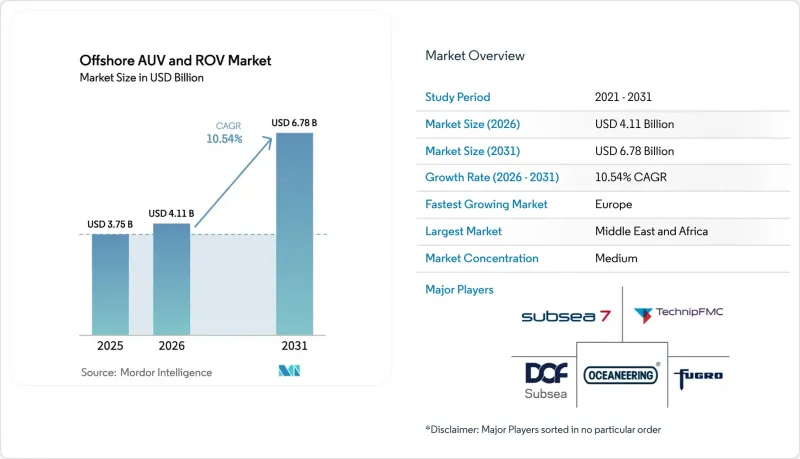
해양 AUV 및 ROV 시장 규모는 2026년에 41억 1,000만 달러로 평가되고 있어 2031년까지 67억 8,000만 달러에 달할 것으로 예측됩니다.
이는 예측 기간 동안 연평균 성장률(CAGR) 10.54%를 기록하는 것으로, 해당 부문의 급속한 수익화 진전과 견조한 수요 요인을 뒷받침합니다.
본 보고서는 차량 유형(ROV 및 AUV), 차량 등급(작업용 등급 및 관측용 등급), 내수심(얕은 바다, 중층 수역, 심해),추진 시스템(전기식, 유압식, 하이브리드식), 활동 내용(점검·수리·유지보수 등), 최종 사용자용도(석유 및 가스, 해양 풍력 등), 지역(중동 및 아프리카, 유럽 등)별로 분류되어 있습니다.
전 세계 해양 AUV 및 ROV 시장 동향과 인사이트
2024년 이후 원유 가격 회복에 따른 심해 탐사·생산(E&P) 투자의 급증
브렌트 원유 가격은 2025년 내내 배럴당 80달러 이상으로 안정세를 보였으며, 팬데믹으로 인한 경기 침체기에 정체되었던 초심해 프로젝트의 최종 투자 결정이 재개되었습니다. 페트로브라스는 2024년부터 2028년까지의 설비 투자로 1,020억 달러를 계상했으며, 그 중 80%를 수심 2,000미터를 초과하는 프리솔트층 유전에 배정했습니다. 이러한 유전에서는 라이저 설치 및 트리 개입 작업에 각각 내구성이 뛰어난 작업용 ROV가 필요합니다. 셰브론은 2026년 업스트림 부문 설비 투자를 10% 증액하여 멕시코만 타이백 사업과 서아프리카 탐사 프로젝트를 우선시하고 있습니다. 이러한 프로젝트에서는 리그 가동 시간을 최소화하기 위해 상주형 검사용 드론이 필요합니다. 전 세계 해양 설비 투자액은 2027년까지 1,800억 달러에 달할 것으로 예상되며, 이는 2023년 대비 22% 증가한 수치입니다. 이 증가분의 60%는 심해 프로젝트가 차지할 것으로 전망됩니다. 해체 시기가 연기되면서 노후화된 북해 플랫폼의 가동 기간이 연장됨에 따라, 피로 상태 평가 및 가동 중단 중인 유정의 봉쇄가 가능한 점검용 ROV에 대한 수요가 유지되고 있습니다.
유럽, 아시아태평양, 미국에서 해양 풍력 발전 설비 용량의 확대가 가속화되고 있습니다.
세계풍력에너지협의회(GWEC)에 따르면, 2024년에 신규 가동을 시작한 해양 풍력 발전 용량은 35GW이며, 그중 28GW를 유럽과 중국이 차지했습니다. 국제에너지기구(IEA)는 고정식 및 부유식 해양 풍력 발전소가 상업 운영 단계에 도달함에 따라 2027년까지 연간 신규 도입량이 40GW를 넘어설 것으로 전망하고 있습니다. 영국의 도거 뱅크(Dogger Bank)는 3.6GW 규모로, 멀티빔 소나와 해저 지층 프로파일러를 탑재한 전기 추진식 AUV를 통해 연중 내내 케이블 매설 상태를 검증해야 합니다. 덴마크의 ‘에너지 아일랜드(Energy Island)’ 이니셔티브는 2030년까지 10GW를 목표로 하고 있으며, Energinet의 기준에 따라 송전망의 신뢰성을 유지하기 위해 어레이 간 케이블의 실시간 검사가 의무화되어 있습니다. 일본은 2025년에 11개의 촉진 구역을 지정했으며, 이에 따라 미쓰비시 중공업은 태풍의 영향을 받기 쉬운 해역에서 부유식 플랫폼의 계류 상태를 확인하기 위해 ROV를 활용한 시험을 실시했습니다. 대만이 2026년까지 5.6GW의 목표를 제시함에 따라, 오스트에드(Austed)와 JERA는 강한 해류 환경에서의 침식 모니터링을 위해 전용 해저 조사선단을 계약했습니다.
캘리포니아주, 뉴질랜드, EU 일부 지역의 얕은 해역 석유 및 가스 개발 허가 금지
캘리포니아주는 행정명령 N-82-20에 따라 해양 시추 모라토리엄을 2030년까지 연장했습니다. 이에 따라 주 수역 내 신규 임대 계약이 동결되었으며, 산타바바라 해협의 얕은 해역에서 ROV 수요가 감소했습니다. 뉴질랜드의 ‘크라운 광물법’ 개정에 따라 2024년부터 새로운 해양 탐사가 영구적으로 금지되었으며, 해저 로봇 기술의 활용은 타라나키 분지의 노후 자산 해체 조치로 방향이 전환되었습니다. 덴마크는 기후 협정에 따라 2024년에 북해에서의 새로운 라이선스 입찰을 중단하고, 플랫폼 철거 일정을 앞당겼습니다. 탐사 활동은 감소하고 있지만, EU 지침 2013/30/EU 등의 규제에 따라 유정 봉쇄 및 구조물 철거가 의무화되어 있어, 폐광 작업에서의 ROV 활용은 계속되고 있습니다.
부문별 분석
2025년, ROV는 해양 AUV 및 ROV 시장 점유율의 90.8%를 차지하며, 밸브 작동이나 핫 스터브 작업과 같은 실시간 조작 작업에서 ROV가 필수적임을 입증하고 있습니다. 그러나 운영업체들이 광범위한 파이프라인 조사 및 환경 모니터링에 AUV를 도입함에 따라, 자율형 플랫폼을 대상으로 하는 해양 AUV 및 ROV 시장 규모는 연평균 성장률(CAGR) 13.5%로 확대될 것으로 예측됩니다. 페트로브라스는 2025년, 프레솔트층의 유망 지역을 매핑하기 위해 12대의 AUV를 도입하여, 예인식 어레이에 비해 조사 비용을 50% 절감했습니다. 규제 측면에서도 명확화가 진행되고 있으며, 심의 중인 IMO SOLAS 개정안에서는 자율형 해저 차량이 무인 시스템으로 분류될 전망이어서, 이에 따라 보험상의 장벽이 완화되고 도입이 가속화될 가능성이 있습니다.
해양 AUV 및 ROV 업계에서는 양극화가 진행되고 있습니다. 유선식 작업용 ROV는 힘 피드백 제어를 갖춘 이동형 매니퓰레이터로 진화하고 있는 반면, 자율형 차량은 합성 개구 소나 및 자력계를 통합하는 센서 퓨전 허브로서의 역할을 수행하고 있습니다. 사브(SAAB)사의 ‘세이버투스(Sabertooth)’와 같은 하이브리드 모델은 유선 모드와 무선 모드를 전환할 수 있습니다. 미국 해군은 2025년 기뢰 처리용으로 동종 기체를 2,500만 달러 상당 발주했습니다. 방위 분야의 사양은 상업 규격으로 확산될 것으로 예상되며, 듀얼 모드를 통한 범용성에 대한 수요를 더욱 강화할 것입니다.
2025년 시점에서 작업용 ROV는 해양 AUV 및 ROV 시장 규모의 74.2%를 차지하고 있으며, 2031년까지 연평균 성장률(CAGR) 12.1%를 기록하며 계속해서 주도적인 위치를 유지할 것으로 전망됩니다. 얕은 해역의 해양 풍력 발전소에서 케이블 점검이나 밸브 조작에는 경량 작업용 기체가 주류를 이루는 반면, 브라질이나 서아프리카의 수심 4,000미터에서는 중작업용 기체가 라이저 연결 작업을 담당하고 있습니다. Soil Machine Dynamics사의 eWROV와 같은 전동식 워크클래스 기체는 갑판 위의 중량을 40% 줄여, 더 소형인 DP-1 선박에서의 전개가 가능하게 할 뿐만 아니라 일일 용선료도 절감합니다.
관측용 차량은 재투하 없이 레이저 계측과 절단 작업을 전환할 수 있는 다목적 워크클래스 플랫폼을 사업자들이 선호하기 때문에 수요가 주춤하고 있습니다. 후구로(Fugro)사의 ‘Blue Essence’는 그라인더와 레이저 스캐너를 교체 가능하게 탑재할 수 있는 모듈식 워크클래스 구조의 좋은 예이며, 작업 비용 절감에 기여하고 있습니다. OSPAR에 기반한 환경 배출 규제로 인해 전동 구동으로의 전환이 가속화되고 있으며, 이는 워크클래스 수요를 더욱 부추기고 있습니다.
지역별 분석
2025년에는 중동 및 아프리카이 매출의 36.1%를 차지하며 1위를 기록했습니다. 이는 사우디 아람코의 ‘마르잔’ 확장 프로젝트와 카타르 에너지의 ‘노스 필드 이스트’ 프로젝트에서 해저 트리 설치 및 플로우라인 감시를 위해 80대 이상의 워크클래스 ROV가 필요했기 때문입니다. 2025년에 7개 해저 기업에 수여된 ADNOC의 16억 5,000만 달러 규모의 EPC 계약은 200킬로미터에 달하는 인프라에 대한 상주형 검사 드론 도입을 위한 이 지역의 노력을 뒷받침하고 있습니다. 나이지리아의 봉가 사우스웨스트 유전 및 남아프리카공화국의 불루파다 탐사 지역은 심해용 ROV에 대한 수요를 더욱 부추기고 있는 반면, 이집트의 졸 가스전은 수년에 걸쳐 IRM(점검·유지보수·수리) 수요를 지속적으로 창출하고 있습니다. 정치적 리스크와 에너지 전환 정책이 장기적인 상승 여력을 억제하고 있지만, 단기적인 탄화수소 관련 투자는 여전히 견조한 모습을 보이고 있습니다.
유럽에서는 해양 풍력 발전의 확대와 북해에서의 해체 의무화를 배경으로, 2031년까지의 연평균 성장률(CAGR)이 18.7%로 가장 높은 성장세를 보일 것으로 예측됩니다. 도거 뱅크의 최종 단계에서는 스캔 기능이 탑재된 AUV를 통한 지속적인 케이블 건전성 점검이 필수적입니다. 노르웨이의 ‘Hydrone-R’ 상주 드론은 가혹한 환경 하에서 선박의 가동 일수를 연간 40일 단축하고 있습니다. 덴마크의 크리거스 플라크(Kriegers Flak)와 독일의 7GW 규모 발트해 입찰로 인해 얕은 해역 대응형 차량에 대한 수요가 증가하고 있는 반면, 프랑스의 부유식 풍력 발전 시범 사업에서는 AUV를 활용한 계류 감시가 요구되고 있습니다. OSPAR 위원회 규정에 따르면, 발전 중단 후 3년 이내에 구조물을 철거해야 하며, 해체를 위한 ROV의 신속한 투입이 권장되고 있습니다.
아시아태평양, 남미, 북미가 나머지 해양 AUV 및 ROV 시장을 나누어 가지고 있습니다. 중국은 2025년에 6.3GW 규모의 해양 풍력 발전 설비를 설치하고, 유속이 강한 해역에서 동적 케이블 매설에 ROV를 투입했습니다. 일본 고토(五島) 앞바다에서 진행 중인 부유식 풍력 발전 시범 사업에서는 태풍에도 견딜 수 있는 계류 설비의 점검에 AUV가 활용되고 있습니다. 브라질에서는 프레솔트층 자산에서 하루 290만 배럴의 원유를 생산하고 있어, 수심 2,000미터를 넘는 심해에서 ROV를 통한 지원이 필요합니다. 미국 멕시코만에서는 성숙한 자산에 대한 ROV 수요가 지속되고 있으며, 동부 해안의 해양 풍력 발전 프로젝트가 새로운 검사 요건을 창출하고 있습니다. 캐나다는 2025년에 대서양 연안 주에서 탐사용 임대 계약을 시작하여, 향후 ROV 도입을 위한 기반을 마련했습니다.
기타 혜택:
- 엑셀 형식 시장 예측(ME) 시트
- 3개월간의 애널리스트 지원
자주 묻는 질문
목차
제1장 서론
제2장 조사 방법
제3장 주요 요약
제4장 시장 구도
제5장 시장 규모와 성장 예측
제6장 경쟁 구도
제7장 시장 기회와 향후 전망
LSH 26.09.02According to Mordor Intelligence, the offshore AUV and ROV market size is valued at USD 4.11 billion in 2026 and is projected to reach USD 6.78 billion by 2031, registering a 10.54% CAGR over the forecast period, underscoring the sector's rapid monetization curve and resilient demand drivers.
This report is Segmented by Vehicle Type (ROV and AUV), Vehicle Class (Work-Class Vehicle and Observatory-Class Vehicles), Depth Rating (Shallow, Mid-Water, and Deep-Water), Propulsion System (Electric, Hydraulic, and Hybrid), Activity (Inspection, Repair, and Maintenance, and More), End-User Application (Oil and Gas, Offshore Wind, and More), and Geography (Middle East and Africa, Europe, and More).
Global Offshore AUV And ROV Market Trends and Insights
Upsurge In Deep-Water E&P Spending Post-2024 Oil-Price Recovery
Brent crude stabilized above USD 80 per barrel through 2025, reinstating final investment decisions on ultra-deep projects that had stalled during the pandemic downturn. Petrobras allocated USD 102 billion for 2024-2028 capital spending, with 80% directed to pre-salt fields exceeding 2,000 meters, each requiring heavy-duty work-class ROVs for riser installation and tree intervention. Chevron raised upstream capex by 10% for 2026, prioritizing Gulf of Mexico tie-backs and West African prospects that demand resident inspection drones to minimize rig time. Global offshore capital expenditure is projected to climb to USD 180 billion by 2027, a 22% rise over 2023, with deep-water projects accounting for 60% of incremental spending. Extended field life for aging North Sea platforms, owing to delayed decommissioning, is sustaining demand for inspection ROVs capable of evaluating fatigue and plugging suspended wells.
Accelerating Offshore Wind Capacity Build-Outs In Europe, APAC & U.S.
The Global Wind Energy Council recorded 35 GW of new offshore wind commissioned in 2024, with Europe and China delivering 28 GW. The International Energy Agency projects annual additions above 40 GW by 2027 as fixed-bottom and floating arrays reach commercial operation. The United Kingdom's Dogger Bank, at 3.6 GW, requires year-round cable-burial verification via electric-propulsion AUVs outfitted with multibeam sonar and sub-bottom profilers. Denmark's Energy Island initiative aims for 10 GW by 2030, mandating real-time inspections of inter-array cables to preserve grid reliability under Energinet standards. Japan designated 11 promotion zones in 2025, prompting Mitsubishi Heavy Industries to trial ROVs for floating-platform mooring checks in typhoon-exposed waters. Taiwan's 5.6 GW target by 2026 has driven Orsted and JERA to contract dedicated subsea fleets for scour monitoring in high-current environments.
Shallow-Water O&G Licence Bans In California, New Zealand, Parts Of EU
California extended its offshore drilling moratorium to 2030 via Executive Order N-82-20, freezing new leases within state waters and curtailing shallow-water ROV demand in the Santa Barbara Channel. New Zealand's Crown Minerals Act amendment imposed a permanent ban on new offshore exploration in 2024, re-directing subsea robotics toward decommissioning of legacy Taranaki basin assets. Denmark halted new North Sea licensing rounds in 2024 under its Climate Agreement, accelerating platform removal timelines. Although exploration declines, regulatory directives such as EU Directive 2013/30/EU obligate well plugging and structure removal, sustaining ROV utilization for abandonment campaigns.
Other drivers and restraints analyzed in the detailed report include:
- Remote-Operations Cost Savings above 40% Via ROC/USV-AUV Workflows
- AI-Enabled Multi-Modal Inspection Vehicles Reducing IRM Downtime
- Tight Global Supply Of Deep-Rated Li-Ion Batteries (Subsea Qualified)
For complete list of drivers and restraints, kindly check the Table Of Contents.
Segment Analysis
ROVs captured 90.8% of the offshore AUV and ROV market share in 2025, a testament to their indispensability for real-time manipulation tasks such as valve actuation and hot-stab operations. The offshore AUV and ROV market size for autonomous platforms, however, is projected to expand at a 13.5% CAGR as operators deploy AUVs for wide-area pipeline surveys and environmental monitoring. Petrobras deployed 12 AUVs in 2025 to map pre-salt prospects, lowering survey costs by 50% compared to towed arrays. Regulatory clarity is emerging: pending IMO SOLAS amendments would classify autonomous subsea vehicles as unmanned systems, potentially easing insurance hurdles and accelerating uptake.
The offshore AUV and ROV industry is witnessing a bifurcation: tethered work-class ROVs evolve into mobile manipulators with force-feedback control, while autonomous vehicles serve as sensor-fusion hubs integrating synthetic-aperture sonar and magnetometers. Hybrid models like Saab's Sabertooth can toggle between tethered and untethered modes; the U.S. Navy ordered USD 25 million worth of such units for mine neutralization in 2025. Defense specifications are expected to cascade into commercial standards, reinforcing demand for dual-mode versatility.
Work-class ROVs held 74.2% of the offshore AUV and ROV market size in 2025 and will retain leadership with a projected 12.1% CAGR to 2031. Light work-class units dominate cable inspections and valve manipulations in shallow-water wind farms, while heavy work-class vehicles manage riser connections at 4,000-meter depths in Brazil and West Africa. Electric work-class variants such as Soil Machine Dynamics' eWROV reduce deck weight by 40%, enabling deployment from smaller DP-1 vessels and lowering daily charter rates.
Observatory-class vehicles trail as operators favor multi-role work-class platforms that can shift between laser metrology and cutting tasks without re-mobilization. Fugro's Blue Essence exemplifies modular work-class architecture capable of carrying a grinder or laser scanner interchangeably, trimming campaign costs. Environmental discharge regulations under OSPAR are accelerating the transition to electric actuation, further reinforcing work-class demand.
Complete Report Scope:
- By Vehicle Type
- ROV
- AUV
- By Vehicle Class
- Work-class
- Light Work-class
- Medium Work-class
- Heavy Work-class
- Observatory-class
- Work-class
- By Depth Rating
- Shallow (Up to 300 m)
- Mid-water (300 to 1,000 m)
- Deep-water (Above 1,000 m)
- By Propulsion System
- Electric
- Hydraulic
- Hybrid
- By Activity
- Drilling and Development
- Construction and Installation
- Inspection, Repair and Maintenance (IRM)
- Decommissioning
- Environmental Monitoring
- By End-user Application
- Oil and Gas
- Offshore Wind
- Defense and Security
- Research and Academia
- Aquaculture and Marine Infrastructure
- By Geography
- North America
- United States
- Canada
- Mexico
- Europe
- United Kingdom
- Norway
- Denmark
- Germany
- France
- Russia
- Rest of Europe
- Asia-Pacific
- China
- India
- Japan
- South Korea
- ASEAN Countries
- Rest of Asia-Pacific
- South America
- Brazil
- Argentina
- Colombia
- Rest of South America
- Middle East and Africa
- Saudi Arabia
- United Arab Emirates
- Qatar
- South Africa
- Egypt
- Nigeria
- Rest of Middle East and Africa
- North America
Geography Analysis
Middle East and Africa led with 36.1% of revenue in 2025 as Saudi Aramco's Marjan expansion and Qatar Energy's North Field East project required more than 80 work-class ROVs for subsea-tree installation and flowline monitoring. ADNOC's USD 1.65 billion EPC contract awarded to Subsea 7 in 2025 underscores the region's commitment to resident inspection drones for 200 kilometers of infrastructure. Nigeria's Bonga Southwest field and South Africa's Brulpadda prospect add further pull for deep-water ROVs, while Egypt's Zohr gas continues to generate multiyear IRM demand. Political risk and energy-transition policies temper long-term upside, but near-term hydrocarbon spend remains strong.
Europe is forecast to post the fastest CAGR at 18.7% through 2031, driven by offshore wind expansion and North Sea decommissioning mandates. Dogger Bank's final phase necessitates continuous cable integrity checks via scanning AUVs. Norway's Hydrone-R resident drone reduces vessel days by 40 per year in harsh conditions. Denmark's Kriegers Flak and Germany's 7 GW Baltic auctions intensify demand for shallow-rated vehicles, while France's floating-wind pilots require AUV-mediated mooring surveillance. OSPAR Commission rules stipulate structure removal within three years of production cessation, pushing rapid ROV mobilization for dismantling.
Asia-Pacific, South America, and North America share the remainder of the offshore AUV and ROV market. China installed 6.3 GW of offshore wind in 2025, deploying ROVs for dynamic cable burial in high-current zones. Japan's floating-wind pilots off Goto rely on AUVs for typhoon-resilient mooring inspection. Brazil produced 2.9 million barrels per day from pre-salt assets, necessitating deep-water ROV support at depths beyond 2,000 meters. The U.S. Gulf of Mexico sustains ROV demand for mature assets, and the East Coast wind pipeline is triggering new inspection requirements. Canada initiated exploratory leasing in Atlantic provinces in 2025, laying the groundwork for future ROV deployments.
- Oceaneering International Inc.
- Subsea 7 SA
- Fugro NV
- TechnipFMC plc
- DOF Subsea AS
- DeepOcean AS
- Saipem SpA
- Helix Energy Solutions Group Inc.
- Kongsberg Maritime
- Saab AB (Ocean-eye)
- Teledyne Technologies Inc.
- Forum Energy Technologies
- Soil Machine Dynamics (SMD)
- Nauticus Robotics Inc.
- Ocean Infinity
- Reach Subsea
- IKM Subsea
- Modus Subsea Services
- Bluefin Robotics
- SeaRobotics Corp.
Additional Benefits:
- The market estimate (ME) sheet in Excel format
- 3 months of analyst support
TABLE OF CONTENTS
1 Introduction
- 1.1 Study Assumptions & Market Definition
- 1.2 Scope of the Study
2 Research Methodology
3 Executive Summary
4 Market Landscape
- 4.1 Market Overview
- 4.2 Market Drivers
- 4.2.1 Upsurge in deep-water E&P spending post-2024 oil-price recovery
- 4.2.2 Accelerating offshore wind capacity build-outs in Europe, APAC & U.S.
- 4.2.3 Remote-operations cost savings above 40 % via ROC/USV-AUV workflows
- 4.2.4 Resident subsea robotics hubs at ?1 km depth (Equinor, Petrobras pilots)
- 4.2.5 AI-enabled multi-modal inspection vehicles reducing IRM downtime
- 4.2.6 Growing defense budgets for seabed-infrastructure protection (AUKUS, NATO)
- 4.3 Market Restraints
- 4.3.1 Shallow-water O&G licence bans in California, New Zealand, parts of EU
- 4.3.2 Tight global supply of deep-rated Li-ion batteries (sub-sea qualified)
- 4.3.3 Tariff-driven surge in specialty-alloy & servo-motor import costs (US-2025)
- 4.3.4 Acoustic spectrum crowding hindering reliable subsea comms in brownfields
- 4.4 Supply-Chain Analysis
- 4.5 Technological Outlook
- 4.6 Regulatory Landscape
- 4.7 Porter's Five Forces
- 4.7.1 Bargaining Power of Suppliers
- 4.7.2 Bargaining Power of Buyers
- 4.7.3 Threat of New Entrants
- 4.7.4 Threat of Substitutes
- 4.7.5 Competitive Rivalry
5 Market Size & Growth Forecasts
- 5.1 By Vehicle Type
- 5.1.1 ROV
- 5.1.2 AUV
- 5.2 By Vehicle Class
- 5.2.1 Work-class
- 5.2.1.1 Light Work-class
- 5.2.1.2 Medium Work-class
- 5.2.1.3 Heavy Work-class
- 5.2.2 Observatory-class
- 5.2.1 Work-class
- 5.3 By Depth Rating
- 5.3.1 Shallow (Up to 300 m)
- 5.3.2 Mid-water (300 to 1,000 m)
- 5.3.3 Deep-water (Above 1,000 m)
- 5.4 By Propulsion System
- 5.4.1 Electric
- 5.4.2 Hydraulic
- 5.4.3 Hybrid
- 5.5 By Activity
- 5.5.1 Drilling and Development
- 5.5.2 Construction and Installation
- 5.5.3 Inspection, Repair and Maintenance (IRM)
- 5.5.4 Decommissioning
- 5.5.5 Environmental Monitoring
- 5.6 By End-user Application
- 5.6.1 Oil and Gas
- 5.6.2 Offshore Wind
- 5.6.3 Defense and Security
- 5.6.4 Research and Academia
- 5.6.5 Aquaculture and Marine Infrastructure
- 5.7 By Geography
- 5.7.1 North America
- 5.7.1.1 United States
- 5.7.1.2 Canada
- 5.7.1.3 Mexico
- 5.7.2 Europe
- 5.7.2.1 United Kingdom
- 5.7.2.2 Norway
- 5.7.2.3 Denmark
- 5.7.2.4 Germany
- 5.7.2.5 France
- 5.7.2.6 Russia
- 5.7.2.7 Rest of Europe
- 5.7.3 Asia-Pacific
- 5.7.3.1 China
- 5.7.3.2 India
- 5.7.3.3 Japan
- 5.7.3.4 South Korea
- 5.7.3.5 ASEAN Countries
- 5.7.3.6 Rest of Asia-Pacific
- 5.7.4 South America
- 5.7.4.1 Brazil
- 5.7.4.2 Argentina
- 5.7.4.3 Colombia
- 5.7.4.4 Rest of South America
- 5.7.5 Middle East and Africa
- 5.7.5.1 Saudi Arabia
- 5.7.5.2 United Arab Emirates
- 5.7.5.3 Qatar
- 5.7.5.4 South Africa
- 5.7.5.5 Egypt
- 5.7.5.6 Nigeria
- 5.7.5.7 Rest of Middle East and Africa
- 5.7.1 North America
6 Competitive Landscape
- 6.1 Market Concentration
- 6.2 Strategic Moves (M&A, Partnerships, PPAs)
- 6.3 Market Share Analysis (Market Rank/Share for key companies)
- 6.4 Company Profiles (includes Global level Overview, Market level overview, Core Segments, Financials as available, Strategic Information, Products & Services, and Recent Developments)
- 6.4.1 Oceaneering International Inc.
- 6.4.2 Subsea 7 SA
- 6.4.3 Fugro NV
- 6.4.4 TechnipFMC plc
- 6.4.5 DOF Subsea AS
- 6.4.6 DeepOcean AS
- 6.4.7 Saipem SpA
- 6.4.8 Helix Energy Solutions Group Inc.
- 6.4.9 Kongsberg Maritime
- 6.4.10 Saab AB (Ocean-eye)
- 6.4.11 Teledyne Technologies Inc.
- 6.4.12 Forum Energy Technologies
- 6.4.13 Soil Machine Dynamics (SMD)
- 6.4.14 Nauticus Robotics Inc.
- 6.4.15 Ocean Infinity
- 6.4.16 Reach Subsea
- 6.4.17 IKM Subsea
- 6.4.18 Modus Subsea Services
- 6.4.19 Bluefin Robotics
- 6.4.20 SeaRobotics Corp.
7 Market Opportunities & Future Outlook
- 7.1 White-space & Unmet-need Assessment


