

|
시장보고서
상품코드
2121474
자동차 사이버 보안 : 시장 점유율 분석, 업계 동향과 통계, 성장 예측(2026-2031년)Cybersecurity For Cars - Market Share Analysis, Industry Trends & Statistics, Growth Forecasts (2026 - 2031) |
||||||
 Mordor Intelligence
자동차 사이버 보안 시장 규모는 2026년에 47억 5,000만 달러로 추정되고 있으며, 2025년 40억 9,000만 달러에서 2031년에는 100억 3,000만 달러에 달할 것으로 예측됩니다.
또한 2026-2031년 연평균 성장률(CAGR) 16.12%를 기록할 전망입니다.
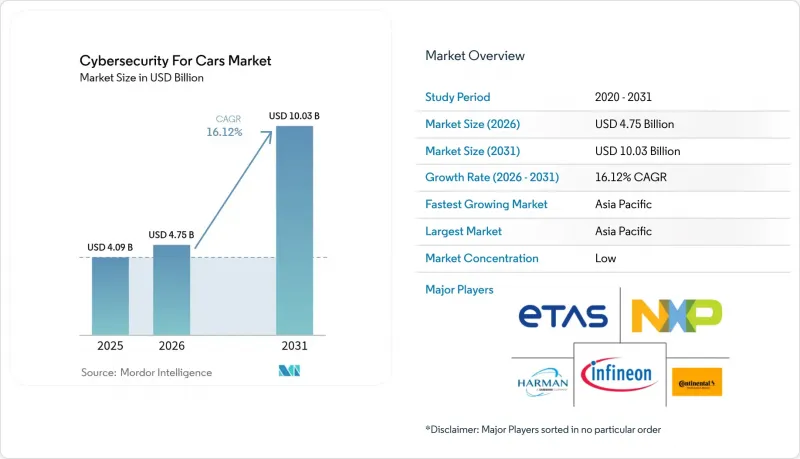
본 보고서는 솔루션 유형(소프트웨어 기반, 하드웨어 기반 등), 보안 유형(네트워크 보안, 용도 보안 등), 차량 유형(승용차, 소형 상용차 등), 용도(인포테인먼트, 텔레매틱스 및 커넥티비티 등), 형태(차량 탑재형 및 외부 클라우드 서비스),및 지역별로 분류되어 있습니다. 시장 예측은 금액(달러) 기준으로 제시되어 있습니다.
전 세계 자동차 사이버 보안 시장 동향 및 인사이트
규제 요건이 근본적인 변화를 주도
현재 전 세계 형식 인증은 엔드투엔드 보안을 입증할 수 있는지 여부에 달려 있습니다. UNECE R155만 해도 2030년까지 21억 달러 규모의 규정 준수 관련 비즈니스 기회가 창출될 것입니다. 이는 각 OEM 업체가 69개의 공격 벡터를 추적하고, 차량의 전체 수명 주기에 걸친 지속적인 모니터링을 입증해야 하기 때문입니다. ISO/SAE 21434는 개념 단계 및 폐기 단계에 사이버 보안 공학을 명확히 규정하고 있어, 자동차 제조업체들은 전문 팀 확충을 서둘러야 하는 상황에 놓여 있습니다. 일본과 미국에서도 유사한 규제가 도입되고 있어, 이로 인해 선행자 불리함이 해소되고 전 세계적으로 기준이 표준화되고 있습니다.
커넥티드카의 대수 증가로 인해 공격 대상 영역이 확대되고 있습니다.
현대 자동차에는 최대 150개의 ECU와 1억 줄의 코드가 탑재되어 있으며, 그 양은 2030년까지 3배로 불어날 가능성이 있어 기존 방어 체제에 큰 부담을 주고 있습니다. 사고의 43%는 이미 백엔드 서버에서 발생하고 있으며, 공격의 95%는 원격으로 이루어지고 있습니다. 5G 기반 V2X 통신은 텔레매틱스 게이트웨이를 노출시키는 고대역폭 공격 벡터를 추가하는 한편, 딜러의 IT 시스템을 표적으로 하는 랜섬웨어는 차량의 경계를 넘어선 공급망의 취약성을 부각시키고 있습니다.
레거시 아키텍처와의 통합 비용이 도입을 저해하고 있습니다.
레거시 플랫폼에 150대 이상의 ECU를 사후 장착할 경우, 차량 개발 예산이 15-20% 증가할 가능성이 있습니다. 콘티넨탈이 2022년에 겪은 정보 유출 사건은 공급업체 네트워크의 취약성을 드러냈으며, 막대한 비용이 소요되는 아키텍처 재검토를 불가피하게 만들었습니다. 이러한 재정적 부담으로 인해, 규정 준수 기한이 임박했음에도 불구하고 양산 브랜드에서의 도입이 지연되고 있습니다.
부문 분석
소프트웨어 기반 플랫폼은 2025년 매출의 40.55%를 차지하며, 임베디드 방화벽, 보안 펌웨어, 런타임 침입 감지가 융합되는 ‘소프트웨어 정의 차량(SDV)’ 시대에서 그 중심적인 역할을 부각시키고 있습니다. 그러나 각 OEM 업체들이 갭 분석, 위협 모델링, 감사 준비를 전문 자문업체에 외주화함에 따라 컨설팅 주도형 서비스는 연평균 성장률(CAGR) 19.1%로 확대되고 있습니다. 자동차 사이버 보안 시장에서는 지속적인 모니터링과 UNECE R155 문서화 지원을 결합할 수 있는 벤더에 대한 평가가 높아지고 있으며, 이러한 역량은 하만의 엔드투엔드 WP.29 패키지에서 두드러지게 나타납니다.
또한, 전문 서비스는 하드웨어 보안 모듈, PKI 제품군, 클라우드 SOC 플랫폼이 까다로운 개발 일정 속에서 상호 운용되어야 할 경우, 다중 벤더 통합을 조정하는 역할도 수행하고 있습니다. 이러한 영역을 아우르는 조정을 통해 서비스 제공업체는 규정 준수 로드맵의 주요 관문 관리자로서의 입지를 확립하고 있으며, 수익은 정기적인 평가 및 관리형 감지 계약으로 이동하고 있습니다. 그 결과, 자동차 사이버 보안 시장에서는 소프트웨어 라이선스 제공업체가 수명 주기 전반에 걸친 수익을 확보하기 위해 서비스 리테이너 조항을 포함하는 등의 제휴가 잇따르고 있습니다.
2025년에도 암호 키, 보안 부팅, ECU 수준의 방화벽이 여전히 기반을 이루고 있기 때문에 엔드포인트 제어는 29.62%의 점유율을 유지했습니다. 그러나 자동차 제조업체들이 데이터 레이크, OTA 오케스트레이션, 차량 함대 분석을 차량 외부로 이전함에 따라 클라우드 방어는 연평균 성장률(CAGR) 20.6%로 급속히 확대되고 있습니다. Upstream과 Google Cloud의 제휴와 같은 협력에 힘입어, 자동차 사이버 보안 시장에서 클라우드 보호 시장 규모는 분기마다 확대되고 있습니다. 2024년 폭스바겐의 데이터 유출 사고에서 얻은 교훈은 텔레메트리 암호화가 불충분할 경우 평판 하락으로 이어질 수 있음을 보여주었습니다.
네트워크 계층의 세분화 및 TLS v1.3으로의 업그레이드는 클라우드의 성장과 병행하여 진행되고 있지만, 차량이 매주 마이크로서비스를 다운로드하게 됨에 따라 용도 중심의 보안 강화가 필수적입니다. 무선 보안은 여전히 ‘라스트 마일’이며, 현재 플래토닝 및 V2I 신호 전달의 기반이 되는 5G 링크를 보호하고 있습니다. 가상 ECU가 작업을 엣지로 오프로드함에 따라, 차량 내 보안 대책과 원격 AI 지원 분석을 결합한 하이브리드 아키텍처가 자동차 사이버 보안 시장 전체의 새로운 청사진으로 자리 잡고 있습니다.
지역별 분석
아시아태평양은 2025년에 매출의 35.12%를 차지하고 연평균 성장률(CAGR) 19.5%를 나타낼 것으로 예측되어, 자동차 사이버 보안 시장에서 가장 빠르게 확대될 지역이 될 전망입니다. 중국 내 커넥티드 전기차(EV) 생산 확대는 V2G 지원 PKI 및 ECU 강화 제품군의 대규모 조달을 촉진하고 있는 반면, 일본이 UNECE 규정을 조기에 준수한 덕분에 공급업체의 인증 프로그램이 가속화되고 있습니다. 한국의 5G 고속도로 구축은 실시간 무선 패치 적용 기술에 대한 수요를 높이고 있으며, 인도의 부상하는 수출 의지는 ISO 21434 준수 도구에 대한 투자를 촉진하고 있습니다. 이러한 동향들이 맞물리면서, 지역 벤더들은 데이터 상주 요건을 준수하는 구역 내에서 호스팅되는 저지연 클라우드 SOC 서비스를 제공해야 하는 압박을 받고 있습니다.
북미는 성숙해 가면서도 계속 진화하는 시장이며, 고급 차량 등급과 견고한 보험 생태계가 사이버 보안의 수익화를 촉진하고 있습니다. 2025년 3월에 시행될 미국의 ‘커넥티드 차량 규정’에 따라, 각 OEM 업체는 공급망 내에 제재 대상 부품이 있는지 감사할 의무가 있으며, 조달은 국내산 칩셋 및 보안 모듈로 전환되고 있습니다. 캐나다의 Tier 1 공급업체들은 지리적 근접성과 규제 일관성을 활용하여 보안이 강화된 이더넷 백본을 통합하고 있습니다. 한편, 멕시코의 조립 공장에서는 적시 생산(JIT) 물류를 노리는 랜섬웨어 증가에 대응하기 위해 관리형 보안 서비스가 도입되고 있습니다. 유럽은 여전히 규제 동향의 선도자이자 연구 개발의 거점입니다. 독일에는 보쉬, ETAS, 콘티넨탈과 같은 주요 공급업체들이 거점을 두고 있지만, 콘티넨탈에서 과거에 발생한 정보 유출 사건은 중앙 집중형 아키텍처의 취약성을 여실히 드러냈습니다. 프랑스와 영국은 공공 보조금을 양자 내성 자동차 암호화 기술에 투자하고 있으며, ENX VCS 감사 프레임워크는 ISO 21434에 추가되는 형태로 공급업체 평가의 표준화를 도모하고 있습니다. 동유럽의 엔지니어링 거점은 경쟁력 있는 인재를 공급하고 있지만, 전쟁과 관련된 사이버 제재로 인해 조달 전략이 재검토되고 있습니다.
기타 혜택:
- 엑셀 형식 시장 전망(ME) 시트
- 3개월간의 애널리스트 지원
자주 묻는 질문
목차
제1장 서론
제2장 조사 방법
제3장 주요 요약
제4장 시장 구도
제5장 시장 규모와 성장 예측
제6장 경쟁 구도
제7장 시장 기회와 향후 동향
LSH 26.09.02According to Mordor Intelligence, cybersecurity for cars market size in 2026 is estimated at USD 4.75 billion, growing from 2025 value of USD 4.09 billion with 2031 projections showing USD 10.03 billion, growing at 16.12% CAGR over 2026-2031.
This report is Segmented by Solution Type (Software-Based, Hardware-Based, and More), Security Type (Network Security, Application Security, and More), Vehicle Type (Passenger Cars, Light Commercial Vehicles, and More), Application (Infotainment, Telematics and Connectivity, and More), Form Type (In-Vehicle and External Cloud Services), and Geography. The Market Forecasts are Provided in Terms of Value (USD).
Global Cybersecurity For Cars Market Trends and Insights
Regulatory mandates drive fundamental change
Global homologation now hinges on demonstrating end-to-end security. UNECE R155 alone creates a USD 2.1 billion compliance opportunity by 2030 as OEMs must track 69 attack vectors and prove continuous monitoring throughout vehicle lifecycles. ISO/SAE 21434 hardcodes cybersecurity engineering into concept and decommission phases, prompting carmakers to expand specialist teams. Similar rules emerge in Japan and the United States, eliminating first-mover disadvantages and standardizing baselines worldwide.
Connected-vehicle fleet expansion multiplies attack surfaces
Modern cars host up to 150 ECUs and 100 million lines of code-volumes that could triple by 2030, stressing legacy defenses. Backend servers already account for 43% of incidents, and 95% of attacks originate remotely. 5G-based V2X exchanges add high-bandwidth vectors exposing telematics gateways, while ransomware targeting dealership IT highlights supply-chain vulnerabilities beyond the vehicle perimeter.
Legacy architecture integration costs constrain adoption
Retrofitting 150-plus ECUs in legacy platforms can add 15-20% to vehicle development budgets. Continental's 2022 breach illustrated supplier-network exposure and forced expensive architecture reviews. Such financial drag delays roll-outs among volume brands, even as compliance deadlines loom.
Other drivers and restraints analyzed in the detailed report include:
- ADAS proliferation elevates safety-critical risks
- Vehicle-to-Grid integration creates bidirectional pathways
- Automotive cybersecurity talent shortage limits execution
For complete list of drivers and restraints, kindly check the Table Of Contents.
Segment Analysis
Software-based platforms held 40.55% of 2025 revenue, underscoring their centrality in a software-defined vehicle era where embedded firewalls, secure firmware, and runtime intrusion detection converge. Consulting-led offerings, however, are on a 19.1% CAGR ascent as OEMs outsource gap analyses, threat modeling, and audit preparation to specialist advisors. The cybersecurity for cars market increasingly rewards vendors capable of bundling continuous monitoring with UNECE R155 documentation support, a capability visible in HARMAN's end-to-end WP.29 packages.
Professional services also orchestrate multi-vendor integration when hardware security modules, PKI suites, and cloud SOC platforms must interoperate inside tight development timelines. Such cross-domain coordination positions service providers as primary gatekeepers of compliance roadmaps, shifting revenue toward recurring assessment and managed-detection contracts. Consequently, the cybersecurity for cars market is witnessing alliances where software licensors embed service retainer clauses to secure lifetime margins.
Endpoint controls retained a 29.62% share in 2025 because cryptographic keys, secure boot, and ECU-level firewalls remain foundational. Yet cloud defenses are racing ahead at 20.6% CAGR as automakers shift data lakes, OTA orchestration, and fleet analytics off-board. The cybersecurity for cars market size for cloud protection is swelling each quarter, buoyed by collaborations such as Upstream's tie-up with Google Cloud. Incident lessons from the 2024 Volkswagen data breach showed that insufficient encryption of telemetry can cascade into reputational damage.
Network-layer segmentation and TLS v1.3 upgrades ride parallel with cloud growth, while application-centric hardening becomes imperative as vehicles download microservices weekly. Wireless security remains the final mile, guarding 5G links that now underpin platooning and V2I signalling. As virtual ECUs offload tasks to the edge, hybrid architectures combining in-vehicle enforcement with remote AI-assisted analytics form the emerging blueprint across the cybersecurity for cars market.
Complete Report Scope:
- By Solution Type
- Software-Based
- Hardware-Based
- Professional Services
- Integration
- Other Solutions
- By Security Type
- Network Security
- Application Security
- Cloud Security
- Endpoint Security
- Wireless Security
- By Vehicle Type
- Passenger Cars
- Light Commercial Vehicles
- Heavy Commercial Vehicles
- Electric Vehicles (BEV/HEV/PHEV)
- By Application
- Infotainment
- Telematics and Connectivity
- Powertrain/Propulsion Control
- ADAS and Safety
- Charging Infrastructure and V2G
- By Form Type
- In-Vehicle (Embedded)
- External Cloud Services
- By Geography
- North America
- United States
- Canada
- Mexico
- South America
- Brazil
- Argentina
- Chile
- Rest of South America
- Europe
- Germany
- United Kingdom
- France
- Italy
- Spain
- Russia
- Rest of Europe
- Asia-Pacific
- China
- India
- Japan
- South Korea
- Malaysia
- Singapore
- Australia
- Rest of Asia-Pacific
- Middle East and Africa
- Middle East
- United Arab Emirates
- Saudi Arabia
- Turkey
- Rest of Middle East
- Africa
- South Africa
- Nigeria
- Rest of Africa
- Middle East
- North America
Geography Analysis
Asia-Pacific commanded 35.12% revenue in 2025 and is projected to grow at 19.5% CAGR, making it the fastest-advancing geography within the cybersecurity for cars market. China's scaling of connected-EV production fuels large-scale procurement of V2G-ready PKI and ECU hardening suites, while Japan's early alignment with UNECE rules accelerates supplier certification programs. South Korea's 5G highways amplify demand for real-time over-the-air patching technologies, and India's emergent export ambitions trigger investments in ISO 21434 compliance tooling. Collectively, these dynamics push regional vendors to deliver low-latency cloud SOC services hosted within data-residency-compliant zones.
North America represents a mature yet evolving arena where premium vehicle trims and robust insurance ecosystems encourage cybersecurity monetization. The United States Connected Vehicles Rule, effective March 2025, forces OEMs to audit supply chains for sanctioned components, redirecting procurement toward domestic chipsets and security modules. Canada's tier-one suppliers leverage proximity and regulatory alignment to integrate secure Ethernet backbones, while Mexico's assembly plants adopt managed-security services to counter rising ransomware aimed at just-in-time logistics. Europe remains a regulatory trendsetter and R&D hub. Germany hosts flagship suppliers such as Bosch ETAS and Continental, although the latter's prior breach highlighted vulnerabilities in centralized architecture. France and the United Kingdom channel public grants into quantum-safe automotive cryptography, while the ENX VCS audit framework overlays ISO 21434 to standardize supplier assessments. Eastern European engineering hubs contribute competitive talent, though war-related cyber sanctions reshape sourcing strategies.
- Continental AG
- Harman International (Samsung)
- Bosch ETAS GmbH
- Infineon Technologies AG
- NXP Semiconductors NV
- Cisco Systems Inc.
- DENSO Corporation
- Visteon Corporation
- Delphi Technologies plc
- Honeywell International Inc.
- Argus Cyber Security Ltd.
- Karamba Security Ltd.
- Arilou Technologies Ltd.
- Escrypt GmbH
- Secunet Security Networks AG
- Upstream Security Ltd.
- VicOne Inc. (Trend Micro)
- GuardKnox Cyber-Technologies Ltd.
- BlackBerry QNX
- SafeRide Technologies Ltd.
- Cybellum Technologies Ltd.
- Trillium Secure Inc.
- Vector Informatik GmbH
- Comsec Automotive Ltd.
- GuardSquare NV
- AutoCrypt Co. Ltd.
Additional Benefits:
- The market estimate (ME) sheet in Excel format
- 3 months of analyst support
TABLE OF CONTENTS
1 INTRODUCTION
- 1.1 Study Assumptions and Market Definition
- 1.2 Scope of the Study
2 RESEARCH METHODOLOGY
3 EXECUTIVE SUMMARY
4 MARKET LANDSCAPE
- 4.1 Market Overview
- 4.2 Market Drivers
- 4.2.1 Regulatory mandates (UNECE R155/R156, ISO 21434) compliance wave
- 4.2.2 Rapid growth in connected-vehicle fleet and 5G/V2X roll-outs
- 4.2.3 ADAS/autonomous feature proliferation elevating cyber-risk
- 4.2.4 Vehicle-to-Grid (V2G) bidirectional charging introduces new attack surface
- 4.2.5 Usage-based-insurance discounts tied to certified cyber-hardening
- 4.2.6 OEM monetisation of OTA security updates in software-defined cars
- 4.3 Market Restraints
- 4.3.1 High integration cost and legacy E/E architectures
- 4.3.2 Fragmented standards and certification overload
- 4.3.3 Acute shortage of automotive-grade cyber-talent
- 4.3.4 Post-warranty liability concerns for long-life vehicles
- 4.4 Industry Value Chain Analysis
- 4.5 Regulatory Landscape
- 4.6 Technological Outlook
- 4.7 Industry Attractiveness - Porter's Five Forces Analysis
- 4.7.1 Bargaining Power of Suppliers
- 4.7.2 Bargaining Power of Buyers
- 4.7.3 Threat of New Entrants
- 4.7.4 Threat of Substitutes
- 4.7.5 Intensity of Competitive Rivalry
- 4.8 Impact of Macroeconomic Factors on the Market
5 MARKET SIZE AND GROWTH FORECASTS (VALUES)
- 5.1 By Solution Type
- 5.1.1 Software-Based
- 5.1.2 Hardware-Based
- 5.1.3 Professional Services
- 5.1.4 Integration
- 5.1.5 Other Solutions
- 5.2 By Security Type
- 5.2.1 Network Security
- 5.2.2 Application Security
- 5.2.3 Cloud Security
- 5.2.4 Endpoint Security
- 5.2.5 Wireless Security
- 5.3 By Vehicle Type
- 5.3.1 Passenger Cars
- 5.3.2 Light Commercial Vehicles
- 5.3.3 Heavy Commercial Vehicles
- 5.3.4 Electric Vehicles (BEV/HEV/PHEV)
- 5.4 By Application
- 5.4.1 Infotainment
- 5.4.2 Telematics and Connectivity
- 5.4.3 Powertrain/Propulsion Control
- 5.4.4 ADAS and Safety
- 5.4.5 Charging Infrastructure and V2G
- 5.5 By Form Type
- 5.5.1 In-Vehicle (Embedded)
- 5.5.2 External Cloud Services
- 5.6 By Geography
- 5.6.1 North America
- 5.6.1.1 United States
- 5.6.1.2 Canada
- 5.6.1.3 Mexico
- 5.6.2 South America
- 5.6.2.1 Brazil
- 5.6.2.2 Argentina
- 5.6.2.3 Chile
- 5.6.2.4 Rest of South America
- 5.6.3 Europe
- 5.6.3.1 Germany
- 5.6.3.2 United Kingdom
- 5.6.3.3 France
- 5.6.3.4 Italy
- 5.6.3.5 Spain
- 5.6.3.6 Russia
- 5.6.3.7 Rest of Europe
- 5.6.4 Asia-Pacific
- 5.6.4.1 China
- 5.6.4.2 India
- 5.6.4.3 Japan
- 5.6.4.4 South Korea
- 5.6.4.5 Malaysia
- 5.6.4.6 Singapore
- 5.6.4.7 Australia
- 5.6.4.8 Rest of Asia-Pacific
- 5.6.5 Middle East and Africa
- 5.6.5.1 Middle East
- 5.6.5.1.1 United Arab Emirates
- 5.6.5.1.2 Saudi Arabia
- 5.6.5.1.3 Turkey
- 5.6.5.1.4 Rest of Middle East
- 5.6.5.2 Africa
- 5.6.5.2.1 South Africa
- 5.6.5.2.2 Nigeria
- 5.6.5.2.3 Rest of Africa
- 5.6.5.1 Middle East
- 5.6.1 North America
6 COMPETITIVE LANDSCAPE
- 6.1 Market Concentration
- 6.2 Strategic Moves
- 6.3 Market Share Analysis
- 6.4 Company Profiles (includes Global level Overview, Market level overview, Core Segments, Financials as available, Strategic Information, Market Rank/Share for key companies, Products and Services, and Recent Developments)
- 6.4.1 Continental AG
- 6.4.2 Harman International (Samsung)
- 6.4.3 Bosch ETAS GmbH
- 6.4.4 Infineon Technologies AG
- 6.4.5 NXP Semiconductors NV
- 6.4.6 Cisco Systems Inc.
- 6.4.7 DENSO Corporation
- 6.4.8 Visteon Corporation
- 6.4.9 Delphi Technologies plc
- 6.4.10 Honeywell International Inc.
- 6.4.11 Argus Cyber Security Ltd.
- 6.4.12 Karamba Security Ltd.
- 6.4.13 Arilou Technologies Ltd.
- 6.4.14 Escrypt GmbH
- 6.4.15 Secunet Security Networks AG
- 6.4.16 Upstream Security Ltd.
- 6.4.17 VicOne Inc. (Trend Micro)
- 6.4.18 GuardKnox Cyber-Technologies Ltd.
- 6.4.19 BlackBerry QNX
- 6.4.20 SafeRide Technologies Ltd.
- 6.4.21 Cybellum Technologies Ltd.
- 6.4.22 Trillium Secure Inc.
- 6.4.23 Vector Informatik GmbH
- 6.4.24 Comsec Automotive Ltd.
- 6.4.25 GuardSquare NV
- 6.4.26 AutoCrypt Co. Ltd.
7 MARKET OPPORTUNITIES AND FUTURE TRENDS
- 7.1 White-Space and Unmet-Need Assessment


