

|
시장보고서
상품코드
2121520
소구경 탄약 : 시장 점유율 분석, 산업 동향 및 통계 데이터, 성장 예측(2026-2031년)Small Caliber Ammunition - Market Share Analysis, Industry Trends & Statistics, Growth Forecasts (2026 - 2031) |
||||||
 Mordor Intelligence
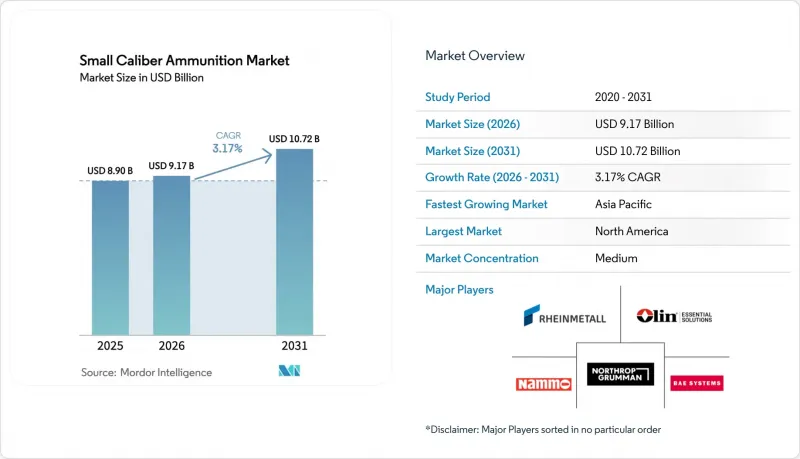
Mordor Intelligence에 의하면, 소구경 탄약 시장 규모는 2025년 89억 달러에서 2026년에는 91억 7,000만 달러로 성장하고, 2026-2031년 CAGR 3.17%로 성장을 지속하여 2031년에는 107억 2,000만 달러에 달할 것으로 예측됩니다.
본 보고서는 구경(5.56 mm, 6.8 mm, 7.62 mm, 9 mm, 12. 7 mm, 기타 구경), 무기 플랫폼(권총, 소총, 경기관총, 기관단총, 산탄총), 탄환 유형(황동, 구리, 기타),치사성(치사성, 비치사성), 최종 용도(군사, 기타), 지역(북미, 유럽, 기타)별로 분류되어 있습니다. 시장 예측은 금액(달러)으로 제시되어 있습니다.
세계 소구경 탄약 시장 동향 및 인사이트
고성능 구경을 중심으로 한 군용 탄약의 현대화
미 육군의 NGSW 프로그램에서는 6.8 mm 탄약의 양산을 위한 레이크시티 시설 개보수에 2,040만 달러가 배정되었으며, 이는 1963년 이후 미 육군 최전방 보병 부대에 있어 최초의 구경 변경이 됩니다. 새로운 탄약은 사거리 말단 에너지가 30% 향상되어, 고성능 방탄조끼를 관통할 수 있습니다. 동맹국 군은 기존 5.56mm 플랫폼에서 전환하는 데 드는 비용을 평가했습니다. 예를 들어, 호주는 상호 운용성에 대한 우려로 실전 데이터 수집을 기다리겠다며 2024년 9월 소총 현대화를 연기했습니다. 2027년까지 NATO 회원국 3개국이 6.8mm 구경을 채택한다면, 이 분야는 소구경 탄약 시장의 성장률을 2배로 끌어올릴 가능성이 있습니다. 그러나 NATO 규격이 존재하지 않아 병참 측면에서 과제가 발생하고, 미국 이외의 지역에서의 채택이 지연될 우려가 있습니다.
국방 예산 증액이 실전용 및 훈련용 탄약에 대한 지속적인 수요를 뒷받침
각국 국방부는 2024년 소총용 탄약 배정액을 12% 증액했습니다. 미국 국방부(DoD)는 우크라이나로 보내진 비축량을 보충하고 훈련 처리 능력을 강화하기 위해 2025 회계연도 조달 예산으로 18억 달러를 요청하고 있습니다. 폴란드를 포함한 나토(NATO) 회원국들은 2027년까지 전시 비축량을 3배로 늘리겠다고 약속했으며, 이로 인해 연간 4억 발이 추가될 것입니다. 현재 레이크시티사의 생산 능력 16억 발 중 85%를 정부 계약이 차지하고 있어, 이로 인해 민간 시장 공급량이 감소하고 있을 뿐만 아니라 2023년 이후 소매 가격이 15-20% 상승했습니다. 높은 수준의 기본 발주량 덕분에 소구경 탄약 시장은 경기 순환에 따른 침체의 영향을 덜 받고 있습니다. 미 육군의 훈련용 소비량은 이미 연간 3억 5,000만 발을 초과하고 있지만, 전투 준비 기준의 엄격화에 따라 더욱 증가할 것으로 예측됩니다. 그 결과, 국방 예산은 안정적인 수요 기반을 제공하며, 중기적으로는 공급업체의 수익 전망을 확보하게 될 것입니다.
총기 및 탄약 수출 규제 강화가 국제 무역 흐름을 제한
2024년 3월에 개정된 미국 ITAR(국제무기거래규정)에 따라 주요 탄약 부품이 재분류되어 라이선스 취득 절차에 60-90일이 추가로 소요됨에 따라, 필리핀으로부터의 4,500만 달러 규모 수주가 지연되었습니다. 마찬가지로, 2024년 7월 EU의 이중용도 규제 개정으로 인해 NATO 비회원국에 대한 판매 시 최종 사용자 증명서 제출이 의무화됨에 따라, 사우디아라비아로 향하던 3,000만 유로(3,532만 달러) 규모의 출하가 차단되었습니다. 이러한 규제상의 병목 현상으로 인해 계약은 규제가 완화된 지역의 생산자로 흘러가고 있으며, 규정 준수 비용 증가로 인해 서유럽 기업들의 이익률은 8-12% 하락하고 있습니다.
부문 분석
5.56mm 구경은 2025년 매출의 33.28%를 차지하며, 소구경 탄약 시장에서 가장 큰 점유율을 기록하고 있습니다. 이러한 우위는 거의 모든 NATO 군용 소총과 수백만 정의 민간용 카빈총에서 널리 사용되고 있기 때문입니다. 단가 0.38달러라는 비용 덕분에 전 세계적으로 100억 발이 넘는 재고가 유지되고 있으며, 이는 시장에서 기존 구경에 대한 꾸준한 수요를 보장하고 있습니다.
대조적으로, 비교적 새로운 6.8mm 탄약은 단가가 약 1.20달러이지만, 500미터에서 에너지가 30% 더 높으며 레벨 IV 장갑을 관통할 수 있는 능력을 갖추고 있습니다. 이는 미 육군의 ‘차세대 분대 무기(NGSW)’ 프로그램이 요구하는 ‘오버매치’ 요건을 충족합니다. 레이크시티 공장의 2,040만 달러 규모 개보수를 통해 2026년까지 생산량을 680만 발 늘려 5,000만 발로 확대될 전망입니다. 그러나 생산 능력이 2억 발을 넘고 불량률이 3% 미만으로 떨어지는 2029년까지는 7.62mm 탄약과의 가격 평준화가 달성될 가능성은 낮을 것으로 보입니다.
저비용으로 대량 생산되는 5.56mm 탄약 계약으로 공장의 가동률은 확보되어 있지만, 6.8mm 탄약의 소규모 생산에서는 이익률이 600-800 베이시스 포인트 높아집니다. 사격 경기 선수들은 탄도가 평탄하다는 점 때문에 6.8mm 구경에 주목하고 있으며, 재장전용 부품의 입수가 용이해짐에 따라 애프터마켓에서 수요가 예상됩니다. 2027년까지 NATO 회원국 3개국이 이 구경을 채택한다면, 2031년까지 6.8mm 부문은 소구경 탄약 시장의 8% 이상을 차지할 가능성이 있습니다.
더 광범위한 채택이 이루어지지 않는다면, 미국 내 배치 완료 후 수요는 정점에 달할 것으로 예측됩니다. 기존의 7.62mm 탄약은 기관총과 저격소총에서 여전히 중요한 역할을 하고 있습니다. 반면, 미국에서 2,150만 건의 휴대 허가증에 힘입은 9mm 구경은 타의 추종을 불허하는 규모의 경제 혜택을 누리며, 연간 약 187억 발이 유통되고 있습니다. 주요 운영상의 위험 중 하나는 상호 운용성입니다. 6.8mm에 관한 NATO 규격이 없다면, 연합군의 병참에서 공급 경로의 중복이 발생하여 원정 비용이 12-15% 증가할 가능성이 있습니다.
소총은 2025년 매출의 41.28%를 차지하며, 탄약 요구 사항을 거의 변경하지 않는 단계적 업그레이드가 진행되고 있음에도 불구하고 소구경 탄약 시장에서 우위를 유지하고 있습니다. 서브머신건(SMG)은 미국 특수작전사령부(USSOCOM)의 1만 5,000정의 MCX 래틀러 발주에 힘입어 각 기관에서의 채택이 확대되고 있어, 연평균 성장률(CAGR) 4.98%를 나타낼 것으로 예측됩니다.
9mm 탄약은 5.56mm 탄약의 4분의 1에 불과한 저렴한 가격 덕분에 고정된 예산 내에서 훈련 처리 능력을 향상시키는 데 기여하고 있습니다. 권총은 플랫폼 관련 수요의 약 28%를 차지하고 있으며, 허가 소지자가 100만 명 증가할 때마다 5년 동안 최대 6억 5,000만 발의 추가 수요가 예상됩니다. 경기관총은 훈련 시 소비량이 매우 많지만 대규모 교체 프로그램이 없어 수요는 제한적입니다.
아음속 5.56mm 탄을 발사하는 소음기 장착 단총신 소총은 SMG와의 중복이 점점 더 늘어나고 있어, 물류 담당자는 서로 다른 구경의 재고로 인한 비용 증가를 피하기 위해 재고 계획을 최적화해야 합니다. 통합 예측 소프트웨어에 따르면, 정예 부대는 틈새 구경 탄약을 8-10% 과잉 보유하고 있으나, 2028년까지 데이터 기반 공급 관리 도구가 성숙해짐에 따라 이러한 비효율성은 감소할 것으로 예측됩니다.
샷건은 여전히 틈새 플랫폼이지만, 특수 돌격용 슬러그 탄약의 경우 50%의 프리미엄 가격이 책정되어 있어 판매량이 적더라도 수익성을 확보하고 있습니다. 소총의 판매량은 여전히 1위를 차지하고 있지만, SMG 및 특수 플랫폼이 수익원을 다각화하여 주기적인 수요 변동을 완화하고 있습니다.
지역별 분석
2024년에는 미국의 8,498억 달러 규모의 국방 예산과 활기찬 민간 사격 문화에 힘입어 북미가 매출 점유율 29.95%로 1위를 차지했습니다. 레이크시티 육군 탄약 공장만 해도 미군의 소구경 탄약 수요의 약 85%를 공급하고 있을 뿐만 아니라, 상업용 잉여분을 시장에 판매하고 있습니다. 무연 사냥을 장려하는 연방 및 주 정부 프로그램 덕분에 제품의 다양성은 높은 수준을 유지하고 있으며, 지역 생산자들은 무독성 배합 개발에 연구 개발 자금을 할당할 수밖에 없는 상황입니다.
아시아태평양은 가장 빠른 성장 궤도를 보이고 있으며, 2031년까지의 연평균 성장률(CAGR)은 4.12%입니다. 인도의 ‘아트마니르바르 바라트(Atmanirbhar Bharat)’ 정책에 따라 국산 탄약 라인에 막대한 투자가 이루어지고 있으며, 기존 공급업체로부터의 조달 지연으로 인해 뉴델리는 공급업체 기반을 확대되고 있습니다. 남중국해 및 동중국해의 지역적 긴장은 각국이 비축량을 강화하는 또 다른 동기가 되고 있습니다. 예를 들어, 한국은 세계 최대 규모의 105mm 탄약 비축량을 유지하고 있으며, 파트너국에 이를 제공하는 데 적극적인 자세를 보이고 있습니다.
유럽에서는 우크라이나 분쟁으로 인해 공급 부족이 드러난 것을 계기로 산업 기반 재구축이 진행되고 있습니다. 라인메탈(Rheinmetall)사는 포탄의 연간 생산량을 한 자릿수 증가시켰으며, 9개국이 참여하는 SAAT 이니셔티브에서는 상호 운용성을 확보하기 위한 통일된 탄약 규격 확립을 목표로 하고 있습니다. 동시에, 유럽화학물질청(ECHA)의 납 규제 로드맵에 따라 유럽의 제조업체들은 구리 기반 탄환에 대응할 수 있도록 생산 라인을 개조해야 하는 상황에 처해 있습니다.
기타 혜택:
- Excel 형식 시장 예측(ME) 시트
- 3개월간의 애널리스트 지원
자주 묻는 질문
목차
제1장 서론
제2장 분석 방법
제3장 주요 요약
제4장 시장 구도
제5장 시장 규모·성장률 예측
제6장 경쟁 구도
제7장 시장 기회와 향후 전망
LSH 26.09.02According to Mordor Intelligence, the small caliber ammunition market size is expected to grow from USD 8.9 billion in 2025 to USD 9.17 billion in 2026 and is forecast to reach USD 10.72 billion by 2031 at a 3.17% CAGR over 2026-2031.
This report is Segmented by Caliber (5. 56 Mm, 6. 8 Mm, 7. 62 Mm, 9 Mm, 12. 7 Mm, and Other Calibers), Weapon Platform (Handguns, Rifles, Light Machine Guns, Sub-Machine Guns, and Shotguns), Bullet Type (Brass, Copper, and More), Lethality (Lethal and Less Lethal), End Use (Military, and More), and Geography (North America, Europe, and More). The Market Forecasts are Provided in Terms of Value (USD).
Global Small Caliber Ammunition Market Trends and Insights
Military Ammunition Modernization Anchored in High-Performance Calibers
The US Army's NGSW program allocated USD 20.4 million to upgrade Lake City facilities for mass production of 6.8 mm rounds, marking the first caliber change for frontline US infantry since 1963. The new cartridge delivers 30% greater down-range energy, enabling penetration of advanced body armor. Allied forces are evaluating the costs of transitioning from entrenched 5.56 mm platforms. For instance, Australia postponed its rifle modernization in September 2024, pending the collection of field data, due to concerns about interoperability. If three NATO members adopt the 6.8 mm caliber by 2027, the segment could double the growth rate of the small-caliber ammunition market. However, the lack of a NATO standard complicates logistics and may slow adoption outside the US.
Defense Budget Growth Fueling Sustained Demand for Operational and Training Rounds
Defense ministries increased small-arms ammunition allocations by 12% in 2024, with the US Department of Defense (DoD) requesting USD 1.8 billion for FY 2025 procurement to replenish stocks sent to Ukraine and enhance training throughput. NATO partners, including Poland, are committed to tripling wartime reserves by 2027, adding 400 million additional rounds annually. Government contracts now account for 85% of Lake City's 1.6 billion-round capacity, reducing availability for the commercial market and raising retail prices by 15-20% since 2023. Elevated baseline orders shield the small-caliber ammunition market from cyclical downturns. Training consumption, already exceeding 350 million rounds annually for the US Army, is expected to rise as readiness standards become stricter. Consequently, defense appropriations provide a stable demand foundation, ensuring supplier revenue visibility in the medium term.
Stricter Firearm and Ammunition Export Controls Limiting International Trade Flows
Revised US ITAR regulations in March 2024 reclassified key cartridge components, adding 60-90 days to licensing processes and delaying a USD 45 million order from the Philippines. Similarly, the EU's July 2024 dual-use update now requires end-user certificates for sales to non-NATO buyers, which has blocked a EUR 30 million (USD 35.32 million) shipment to Saudi Arabia. These regulatory bottlenecks are redirecting contracts to producers in less-regulated jurisdictions, resulting in an 8-12% reduction in the margins of Western firms due to higher compliance costs.
Other drivers and restraints analyzed in the detailed report include:
- Rising Civilian Ownership and Sporting Interest Sustaining Commercial Ammunition Sales
- Environmental Regulations Accelerating Transition to Lead-Free Ammunition
- Ongoing Supply Chain Disruptions Affecting Primer and Propellant Availability
For complete list of drivers and restraints, kindly check the Table Of Contents.
Segment Analysis
The 5.56 mm caliber accounted for 33.28% of the 2025 revenue, representing the largest share of the small-caliber ammunition market. This dominance is attributed to its widespread use in nearly all NATO service rifles and millions of civilian carbines. Its unit cost of USD 0.38 supports a global inventory exceeding 10 billion cartridges, ensuring the resilience of legacy calibers in the market.
In contrast, the newer 6.8 mm cartridge, priced at approximately USD 1.20 per unit, delivers 30% higher energy at 500 meters, capable of penetrating Level IV armor. This meets the overmatch requirements of the US Army's Next Generation Squad Weapon (NGSW) program. A USD 20.4 million retrofit at Lake City is expected to increase production by 6.8 million rounds to 50 million by 2026. However, price parity with 7.62 mm rounds is unlikely before 2029, when production capacity exceeds 200 million rounds, and scrap rates drop below 3%.
While low-cost, high-volume 5.56 mm contracts ensure factory utilization, smaller production runs of 6.8 mm rounds yield margins 600-800 basis points higher. Competitive shooters are exploring the 6.8 mm caliber for its flat trajectory, indicating potential aftermarket demand as reloading components become more accessible. If three NATO allies adopt the caliber by 2027, the 6.8 mm segment could account for over 8% of the small caliber ammunition market by 2031.
Without broader adoption, demand is expected to plateau after the US completes its fielding. Legacy 7.62 mm rounds remain relevant for machine guns and marksman rifles. In comparison, the 9 mm caliber, supported by 21.5 million US carry permits, moves approximately 18.7 billion cartridges annually, benefiting from unmatched economies of scale. A key operational risk is interoperability; without a NATO standard for 6.8 mm, coalition logistics could face duplicated supply lines, resulting in increased expeditionary costs of 12-15%.
Rifles accounted for 41.28% of 2025 revenue, maintaining their dominance in the small-caliber ammunition market, despite incremental upgrades that rarely alter ammunition requirements. Sub-machine guns (SMGs) are projected to grow at a 4.98% CAGR, driven by USSOCOM's 15,000-unit MCX Rattler order, which has spurred wider adoption among agencies.
The affordability of 9 mm cartridges, at one-quarter the cost of 5.56 mm rounds, supports higher training throughput within fixed budgets. Handguns contribute approximately 28% of platform-linked demand, with each additional million permit holders driving up to 650 million extra rounds over five years. Light machine guns generate significant training consumption but are constrained by the lack of major replacement programs.
Suppressed short-barrel rifles firing subsonic 5.56 mm rounds are increasingly overlapping with SMGs, requiring logisticians to optimize stocking plans to avoid inflated costs from mixed-caliber inventories. Integrated forecasting software indicates that elite units overstock niche calibers by 8-10%, an inefficiency expected to decline as data-driven supply tools mature by 2028.
Shotguns remain a niche platform but command 50% premiums on specialty breaching slugs, ensuring profitability even at modest volumes. While rifles will continue to lead in volume, SMGs and specialized platforms are diversifying revenue streams and mitigating fluctuations in cyclic demand.
Complete Report Scope:
- By Caliber
- 5.56 mm
- 6.8 mm
- 7.62 mm
- 9 mm
- 12.7 mm
- Other Calibers
- By Weapon Platform
- Handguns
- Rifles
- Light Machine Guns (LMGs)
- Sub-Machine Guns (SMGs)
- Shotguns
- By Bullet Type
- Brass
- Copper
- Steel
- Others
- By Lethality
- Less Lethal
- Lethal
- By End Use
- Military
- Homeland Security
- Civilian
- By Geography
- North America
- United States
- Canada
- Mexico
- Europe
- United Kingdom
- France
- Germany
- Russia
- Rest of Europe
- Asia-Pacific
- China
- India
- Japan
- South Korea
- Rest of Asia-Pacific
- South America
- Brazil
- Rest of South America
- Middle East and Africa
- Middle East
- Saudi Arabia
- United Arab Emirates
- Rest of Middle East
- Africa
- South Africa
- Rest of Africa
- Middle East
- North America
Geography Analysis
North America led with a 29.95% revenue share in 2024, powered by the US's USD 849.8 billion defense budget and a vibrant civilian shooting culture. The Lake City Army Ammunition Plant alone supplies approximately 85% of the US military's small-caliber requirements, while selling commercial overruns to the market. Federal and state programs promoting lead-free hunting keep product diversity high, forcing local producers to allocate R&D funds toward non-toxic formulas.
The Asia-Pacific region shows the fastest trajectory, with a 4.12% CAGR through 2031. India's Atmanirbhar Bharat policy has directed substantial investment toward indigenous ammunition lines, and procurement delays from traditional suppliers are pushing New Delhi to expand its vendor base. Regional flashpoints in the South and East China Seas further motivate nations to build up their stockpiles. South Korea, for instance, maintains one of the world's largest inventories of 105 mm ammunition and has signaled its willingness to provide it to partners.
Europe is retooling its industrial base after the Ukraine conflict exposed supply shortfalls. Rheinmetall has increased its annual artillery shell output by an order of magnitude, and the nine-country SAAT initiative aims to establish a harmonized ammunition standard to ensure interoperability. At the same time, the European Chemicals Agency's lead-restriction roadmap compels European manufacturers to retrofit lines for copper-based bullets.
- Northrop Grumman Corporation
- Elbit Systems Ltd.
- Olin Corporation
- CBC Global Ammunition
- Nammo AS
- BAE Systems plc
- Beretta Holding S.A.
- Hornady Manufacturing, Inc.
- Fiocchi Munizioni S.p.A.
- Denel SOC Ltd.
- MESKO S.A.
- PT Pindad
- SIG SAUER, Inc.
- FN HERSTAL
- Sellier & Bellot a.s. (Colt CZ Group SE)
- Barnaul Ammunition
- Prvi Partizan A.D.
- Rheinmetall AG
Additional Benefits:
- The market estimate (ME) sheet in Excel format
- 3 months of analyst support
TABLE OF CONTENTS
1 INTRODUCTION
- 1.1 Study Assumptions and Market Definition
- 1.2 Scope of the Study
2 RESEARCH METHODOLOGY
3 EXECUTIVE SUMMARY
4 MARKET LANDSCAPE
- 4.1 Market Overview
- 4.2 Market Drivers
- 4.2.1 Military ammunition modernization anchored in high-performance calibers
- 4.2.2 Defense budget growth fueling sustained demand for operational and training rounds
- 4.2.3 Rising civilian ownership and sporting interest sustaining commercial ammunition sales
- 4.2.4 Environmental regulations accelerating transition to lead-free ammunition
- 4.2.5 Lightweight polymer and hybrid casings driving multi-nation trials
- 4.2.6 Simulation and indoor training demand boosting specialized rounds
- 4.3 Market Restraints
- 4.3.1 Stricter firearm and ammunition export controls limiting international trade flows
- 4.3.2 Ongoing supply chain disruptions affecting primer and propellant availability
- 4.3.3 Rising raw material costs for copper and antimony inflating manufacturing expenses
- 4.3.4 Gradual defense pivot toward directed-energy weapons and unmanned system lethality reducing long-term demand
- 4.4 Value Chain Analysis
- 4.5 Regulatory Landscape
- 4.6 Technological Outlook
- 4.7 Porter's Five Forces Analysis
- 4.7.1 Threat of New Entrants
- 4.7.2 Bargaining Power of Buyers
- 4.7.3 Bargaining Power of Suppliers
- 4.7.4 Threat of Substitute Products
- 4.7.5 Intensity of Competitive Rivalry
5 MARKET SIZE AND GROWTH FORECASTS (VALUE)
- 5.1 By Caliber
- 5.1.1 5.56 mm
- 5.1.2 6.8 mm
- 5.1.3 7.62 mm
- 5.1.4 9 mm
- 5.1.5 12.7 mm
- 5.1.6 Other Calibers
- 5.2 By Weapon Platform
- 5.2.1 Handguns
- 5.2.2 Rifles
- 5.2.3 Light Machine Guns (LMGs)
- 5.2.4 Sub-Machine Guns (SMGs)
- 5.2.5 Shotguns
- 5.3 By Bullet Type
- 5.3.1 Brass
- 5.3.2 Copper
- 5.3.3 Steel
- 5.3.4 Others
- 5.4 By Lethality
- 5.4.1 Less Lethal
- 5.4.2 Lethal
- 5.5 By End Use
- 5.5.1 Military
- 5.5.2 Homeland Security
- 5.5.3 Civilian
- 5.6 By Geography
- 5.6.1 North America
- 5.6.1.1 United States
- 5.6.1.2 Canada
- 5.6.1.3 Mexico
- 5.6.2 Europe
- 5.6.2.1 United Kingdom
- 5.6.2.2 France
- 5.6.2.3 Germany
- 5.6.2.4 Russia
- 5.6.2.5 Rest of Europe
- 5.6.3 Asia-Pacific
- 5.6.3.1 China
- 5.6.3.2 India
- 5.6.3.3 Japan
- 5.6.3.4 South Korea
- 5.6.3.5 Rest of Asia-Pacific
- 5.6.4 South America
- 5.6.4.1 Brazil
- 5.6.4.2 Rest of South America
- 5.6.5 Middle East and Africa
- 5.6.5.1 Middle East
- 5.6.5.1.1 Saudi Arabia
- 5.6.5.1.2 United Arab Emirates
- 5.6.5.1.3 Rest of Middle East
- 5.6.5.2 Africa
- 5.6.5.2.1 South Africa
- 5.6.5.2.2 Rest of Africa
- 5.6.5.1 Middle East
- 5.6.1 North America
6 COMPETITIVE LANDSCAPE
- 6.1 Market Concentration
- 6.2 Strategic Moves
- 6.3 Market Share Analysis
- 6.4 Company Profiles (includes Global level Overview, Market level overview, Core Segments, Financials as available, Strategic Information, Market Rank/Share for key companies, Products and Services, and Recent Developments)
- 6.4.1 Northrop Grumman Corporation
- 6.4.2 Elbit Systems Ltd.
- 6.4.3 Olin Corporation
- 6.4.4 CBC Global Ammunition
- 6.4.5 Nammo AS
- 6.4.6 BAE Systems plc
- 6.4.7 Beretta Holding S.A.
- 6.4.8 Hornady Manufacturing, Inc.
- 6.4.9 Fiocchi Munizioni S.p.A.
- 6.4.10 Denel SOC Ltd.
- 6.4.11 MESKO S.A.
- 6.4.12 PT Pindad
- 6.4.13 SIG SAUER, Inc.
- 6.4.14 FN HERSTAL
- 6.4.15 Sellier & Bellot a.s. (Colt CZ Group SE)
- 6.4.16 Barnaul Ammunition
- 6.4.17 Prvi Partizan A.D.
- 6.4.18 Rheinmetall AG
7 MARKET OPPORTUNITIES AND FUTURE OUTLOOK
- 7.1 White-space and Unmet-need Assessment


