

|
시장보고서
상품코드
2121535
리그닌 제품 : 시장 점유율 분석, 산업 동향 및 통계 데이터, 성장 예측(2026-2031년)Lignin Products - Market Share Analysis, Industry Trends & Statistics, Growth Forecasts (2026 - 2031) |
||||||
 Mordor Intelligence
Mordor Intelligence에 의하면, 리그닌 제품 시장 규모는 2025년 7억 2,942만 달러에서 2026년에는 7억 6,064만 달러로 성장하고, 2026-2031년 CAGR 4.28%로 성장을 지속하여 2031년에는 9억 3,799만 달러에 달할 것으로 예측됩니다.
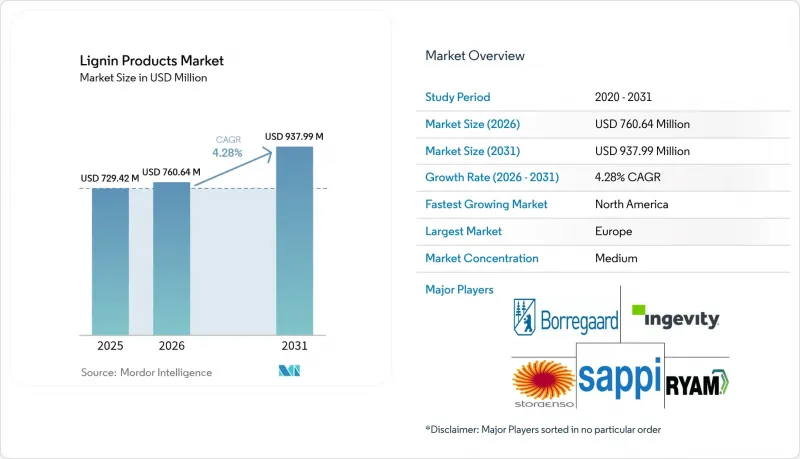
본 보고서는 원료별(아황산염 펄프법, 셀룰로오스계 에탄올,크라프트 펄프법, 소다 펄프법), 제품 유형별(리그노설폰산염, 크라프트 리그닌, 기타 제품 유형), 용도별(분산제, 콘크리트 첨가제, 기타 용도), 지역별(아시아태평양, 북미, 유럽, 남미, 중동 및 아프리카)로 분류되어 있습니다. 시장 전망은 금액(달러) 기준으로 제시되어 있습니다.
세계 리그닌 제품 시장 동향 및 분석
고성능 콘크리트 혼화제에 대한 수요 증가
아시아태평양 및 라틴아메리카의 인프라 확장에 따라 유동성을 향상시키면서 시멘트 사용량을 줄이는 고성능 감수제에 대한 수요가 증가하고 있습니다. 리그닌계 혼화제는 물-시멘트 비율을 낮추고, 압축 강도를 15-20% 향상시키는 동시에 시멘트 사용량을 8-12% 절감합니다. LEED 인증 획득을 목표로 하는 건설사들은 고층 빌딩이나 교통 인프라 프로젝트에서 내재된 탄소량을 줄일 수 있기 때문에 이러한 바이오 유래 솔루션을 선호하고 있습니다. 중국과 인도의 그린 빌딩 기준에서는 현재 천연 유래 혼화제가 권장되고 있으며, 이는 규제 측면에서의 뒷받침이 되어 상용화를 가속화하고 있습니다. 각 생산 업체들은 고성능 콘크리트 사용을 규정하는 대규모 도시권 및 고속도로 계약에 대응하기 위해 생산 능력을 확대되고 있습니다. 스마트 시티에 대한 투자가 꾸준히 증가하고 있는 만큼, 중기적으로는 리그닌계 슈퍼플라스틱라이저에 대한 지속적인 수요가 예상됩니다.
동물 영양 분야에서의 리그닌계 사료 결합제 보급
항생제계 성장 촉진제를 규제하는 유럽의 규제에 따라 사료 배합 업체들은 리그노설폰산염계 결합제로의 전환을 추진하고 있습니다. 연구에 따르면, 당밀 기반 시스템에 비해 펠릿의 내구성이 25-30% 향상되어, 이로 인해 사료 분진 감소 및 운송 시 손실 절감으로 이어지고 있습니다. 특정 리그닌 분획은 반추동물의 장내 미생물 군집을 활성화시키는 프리바이오틱스 작용을 가지고 있어, 사료 제조업체는 프리미엄 가격으로 판매할 수 있게 되었습니다. 덴마크와 네덜란드의 제조업체들은 지역 펄프 공장에서 현지산 리그닌 유도체를 조달한 결과, 물류 비용을 12-15% 절감할 수 있었습니다고 보고하고 있습니다. 북미의 생산자들도 대형 통합 기업들이 항생제 미사용 밸류체인을 목표로 삼고 있는 만큼, 유사한 전략을 채택하고 있습니다. 아시아태평양의 축산 업체들이 고부가가치 단백질로 전환하고 사료 배합의 효율 향상을 추구하고 있어, 장기적인 전망은 계속해서 견조합니다.
추출 공정에 따른 품질 편차
크래프트, 아황산염, 소다 리그닌 간의 황 함량 및 분자량 차이는 일관된 사양을 필요로 하는 사용자에게 조달을 복잡하게 만들고 있습니다. 아황산염계 리그닌은 황 함량이 20-30% 더 높고 수지의 경화 속도에 영향을 미치기 때문에 별도의 가공 프로토콜이 필요합니다. 하류 기업들은 병행 재고 관리와 이중 인증 프로그램을 유지하고 있으며, 이로 인해 공급망 비용이 8-12% 증가하고 있습니다. 소규모 제지 공장에서는 각 로트를 인증하기 위한 분석 실험실을 보유하고 있는 경우가 드물어, 이로 인해 마진이 낮은 판매 채널로 시장 진입이 제한되고 있습니다. 공통된 시험 기준이 확립되고 클라우드 기반 추적성 플랫폼이 성숙해질 때까지는 단기적인 불확실성이 남아 있습니다. 따라서 특수 분야에서 보다 광범위한 채택을 실현하기 위해서는 품질 표준화가 매우 중요합니다.
부문 분석
아황산염 펄프 제조와 관련된 리그닌 제품 시장 규모는 풍부한 공급량과 분산제로서의 입증된 성능을 바탕으로 2025년에는 전 세계 시장 가치의 76.62%를 차지하며 가장 큰 비중을 차지했습니다. 셀룰로오스계 에탄올 플랜트공급량은 훨씬 적지만, 수익성이 높고 4.95%의 연평균 성장률(CAGR)을 기록하고 있어 2031년까지 가장 역동적인 공급원 범주가 될 전망입니다. 미국 재생 가능 연료 기준(RFS) 및 EU의 재생에너지 지침 II(RED-II)에 따른 생산 인센티브로 인해, 바이오 정제소는 리그닌 분리 설비의 도입을 촉진하고 있으며, 이를 통해 에탄올 매출의 12-15%에 해당하는 수익을 창출하고 있습니다. 주로 유럽과 중국에서 운영되는 아황산 펄프 제조업체들은 회수 수율 최적화와 콘크리트 및 사료용 맞춤형 등급의 출시를 통해 시장 내 입지를 유지하고 있습니다. 소다 펄프 공정은 인도와 동남아시아에서 틈새 시장으로서 중요한 위치를 차지하고 있으며, 농업 잔여물을 처리하여 저회분 리그닌을 생산하고, 이를 지역 섬유용 화학제품에 공급하고 있습니다.
셀룰로오스계 에탄올 유래 리그닌은 일반적으로 크라프트 펄프 유래의 것보다 회분 함량이 적고 분자량 분포가 좁은 특징이 있어, 특수 폴리머 분야에서 높은 부가가치를 창출하고 있습니다. 자동차용 복합재료의 시범 사용자들은 연속 섬유 방적에 도움이 되는 예측 가능한 유변학적 특성을 높이 평가했습니다. 에탄올 생산자들이 생산 능력을 확대함에 따라 이 고품질 리그닌공급량이 증가하여, 바이오연료와 특수 화학제품의 밸류체인 간 연계가 강화되고 있습니다. 아황산염 법에 의한 생산량은 다른 공급원을 압도적으로 상회하고 있지만, 특히 탄소 관련 수익원이 수익성에 영향을 미치는 상황에서 경쟁 구도는 단순한 생산량이 아니라 1톤당 가치에 좌우되고 있습니다.
지역별 분석
2025년, 유럽은 전 세계 시장 가치의 33.55%를 차지했습니다. 이는 통합된 임업 산업과 엄격한 기후 정책이 리그닌의 조기 활용을 촉진하고 있기 때문입니다. 핀란드와 스웨덴의 펄프 공장에서는 새로운 수익원을 확보하기 위해 추출 라인 개조가 진행되고 있는 한편, 독일의 콘크리트 및 자동차 부문에서는 안정적인 수요가 예상됩니다. REACH 화학물질 규제로 인해 배합 제조업체들은 바이오 유래 원료로의 전환을 촉진받고 있어 수요 전망이 개선되고 있습니다. ‘호라이즌 유럽’ 연구 지원금을 통해 바닐린 및 탄소섬유 분야의 시범 도입이 가속화되면서, 이 지역의 혁신 리더십이 확고해지고 있습니다.
북미는 2031년까지 연평균 성장률(CAGR) 5.08%로 가장 높은 성장세를 보일 전망입니다. 이는 연방 정부의 셀룰로오스계 연료 의무화 정책이 리그닌 공급을 확대하고, 자동차 업계의 경량화 노력이 지속 가능한 복합재료에 대한 요구 수준을 높이고 있기 때문입니다. 미국에서는 교량 및 교통 인프라 현대화를 목표로 하는 ‘초당적 인프라 법안’을 배경으로, 콘크리트 혼화제용 리그닌 제품 시장 규모가 확대되고 있습니다. 캐나다의 임업 기업들은 저배출 소재를 우대하는 주 정부의 탄소 가격 제도를 바탕으로, 풍부한 북부 산림 자원을 활용하여 펄프 이외의 분야, 즉 특수 리그닌으로의 다각화를 추진하고 있습니다. 또한, 멕시코의 건설 붐도 혼합제 수입 수요를 창출하며 북미 대륙 전체 수요를 보완하고 있습니다.
아시아태평양은 도입 초기 단계에 있지만, 큰 성장 잠재력을 지니고 있습니다. 중국의 급속한 도시화로 인해 콘크리트 소비량이 증가하고 있으며, 국가 기준에서도 리그닌계 고성능 감수제가 인정되기 시작했습니다. 인도에서는 농업 잔여물을 이용한 소다 펄프 공법의 규모 확대가 진행되고 있으며, 현지 사료 및 염료 분산제용으로 비용 경쟁력이 있는 리그닌이 생산되고 있습니다. 일본은 전자기기용 수지에 리그닌의 방향족 골격을 활용하고 있으며, 한국에서는 리그닌 유래 화학물질이 친환경 조달 목록에 포함되어 있습니다. 진행 중인 아세안(ASEAN)의 인프라 정비 계획과 육류 생산 확대가 다각적인 수요를 창출하고 있지만, 국경을 넘는 무역에서는 규격의 조화가 매우 중요해질 것입니다.
기타 혜택:
- Excel 형식 시장 예측(ME) 시트
- 3개월간의 애널리스트 지원
자주 묻는 질문
목차
제1장 서론
제2장 분석 방법
제3장 주요 요약
제4장 시장 구도
제5장 시장 규모·성장률 예측
제6장 경쟁 구도
제7장 시장 기회와 향후 전망
LSH 26.09.02According to Mordor Intelligence, the lignin products market size is expected to grow from USD 729.42 million in 2025 to USD 760.64 million in 2026 and is forecast to reach USD 937.99 million by 2031 at 4.28% CAGR over 2026-2031.
This report is Segmented by Source (Sulfite Pulping, Cellulosic Ethanol, Kraft Pulping, and Soda Pulping), Product Type (Lignosulfonate, Kraft Lignin, and Other Product Types), Application (Dispersant, Concrete Additive, and Other Applications), and Geography (Asia-Pacific, North America, Europe, South America, and Middle East and Africa). The Market Forecasts are Provided in Terms of Value (USD).
Global Lignin Products Market Trends and Insights
Rising Demand for High-Performance Concrete Admixtures
Infrastructure expansion across Asia-Pacific and Latin America raises the need for superplasticizers that improve flow while lowering cement consumption. Lignin-based admixtures reduce water-cement ratios, boosting compressive strength by 15-20% and cutting cement use by 8-12%. Construction firms pursuing LEED certification favor these bio-based solutions because they lower embodied carbon in high-rise and transportation projects. Green-building codes in China and India now endorse natural admixtures, providing a regulatory pull that accelerates commercialization. Producers scale up capacity to keep pace with large metro and highway contracts that specify performance concrete. Steady gains in smart-city investments anticipate durable demand for lignin superplasticizers through the medium term.
Uptake of Lignin-Based Feed Binders in Animal Nutrition
European regulations that restrict antibiotic growth promoters have moved feed formulators toward lignosulfonate binders. Studies show 25-30% better pellet durability versus molasses systems, translating into lower feed dust and reduced transport losses. Specific lignin fractions exhibit prebiotic activity that enhances ruminant gut microbiota, allowing feed companies to price at a premium. Danish and Dutch manufacturers report 12-15% logistics cost savings after sourcing local lignin derivatives from regional pulp mills. North American producers adopt similar strategies as large integrators target antibiotic-free supply chains. The long-term outlook remains strong as Asia-Pacific livestock operators shift toward higher-value protein and require efficiency gains in compound feed.
Quality Variability Across Extraction Processes
Differences in sulfur content and molecular weight between kraft, sulfite, and soda lignin complicate procurement for users that require consistent specifications. Sulfite variants carry 20-30% higher sulfur, impacting resin cure kinetics and demanding tailored processing protocols. Downstream firms maintain parallel inventories and dual qualification programs, inflating supply-chain spending by 8-12%. Smaller mills rarely possess analytical labs to certify each batch, restricting market access to low-margin outlets. Near-term uncertainty remains until shared testing standards emerge and cloud-based traceability platforms mature. Quality harmonization is therefore pivotal for broader adoption in specialty segments.
Other drivers and restraints analyzed in the detailed report include:
- Valorisation of Pulp-Mill Side-Streams for Circular Revenue
- Breakthrough Lignin-to-Vanillin Bioconversion Routes
- Competition from Sugar-Derived Bio-Aromatics
For complete list of drivers and restraints, kindly check the Table Of Contents.
Segment Analysis
The lignin products market size linked to sulfite pulping totaled the bulk of global value, securing 76.62% in 2025 on the back of abundant volumes and well-known performance in dispersants. Cellulosic ethanol plants offer much smaller but higher-margin flows, and their 4.95% CAGR makes them the most dynamic source category to 2031. Production incentives under the U.S. Renewable Fuel Standard and EU RED-II encourage biorefineries to integrate lignin separation units, adding revenue equal to 12-15% of ethanol sales. Sulfite operators, chiefly in Europe and China, defend position by optimizing recovery yields and launching tailor-made grades for concrete and feed. Soda pulping keeps niche importance in India and Southeast Asia, processing agricultural residues into low-ash lignin for regional textile chemicals.
Cellulosic ethanol lignin typically displays lower ash and narrower molecular-weight distribution than kraft material, granting it a premium in specialty polymers. Pilot users in automotive composites value the predictable rheology that aids continuous fiber spinning. As ethanol producers scale capacity, supply of this high-quality lignin grows, tightening integration between biofuel and specialty chemical chains. Although sulfite volumes dwarf other sources, competitive dynamics hinge on value per ton rather than tonnage alone, especially as carbon revenue streams influence profitability.
Complete Report Scope:
- By Source
- Sulfite Pulping
- Cellulosic Ethanol
- Kraft Pulping
- Soda Pulping
- By Product Type
- Lignosulfonate
- Kraft Lignin
- High-Purity Lignin
- Soda Lignin
- Other Product Types
- By Application
- Dispersant
- Concrete Additive
- Animal Feed
- Resins
- Other Applications
- By Geography
- Asia-Pacific
- China
- India
- Japan
- South Korea
- ASEAN Countries
- Rest of Asia-Pacific
- North America
- United States
- Canada
- Mexico
- Europe
- Germany
- United Kingdom
- France
- Italy
- Russia
- NORDIC Countries
- Rest of Europe
- South America
- Brazil
- Argentina
- Rest of South America
- Middle East and Africa
- Saudi Arabia
- South Africa
- Rest of Middle East and Africa
- Asia-Pacific
Geography Analysis
Europe held 33.55% of global value in 2025 because integrated forest industries and strict climate policies foster early lignin valorization. Pulp mills in Finland and Sweden retrofit extraction lines to capture new revenue, while German concrete and automotive sectors absorb steady volumes. REACH chemicals regulation nudges formulators toward bio-derived inputs, improving demand visibility. Horizon Europe research grants accelerate pilot deployments in vanillin and carbon-fibre, solidifying the region's innovation leadership.
North America posts the fastest 5.08% CAGR through 2031 as federal cellulosic fuel mandates widen lignin supply and automotive lightweighting efforts raise the bar on sustainable composites. The lignin products market size for concrete admixtures climbs in the United States on the back of the Bipartisan Infrastructure Law, which modernizes bridges and transit. Canadian forestry companies leverage abundant boreal resources to diversify beyond pulp into specialty lignin, supported by provincial carbon-pricing mechanisms that favor low-emission materials. Mexico's construction boom also creates room for admixture imports, rounding out continental demand.
Asia-Pacific stands at an earlier adoption curve yet offers vast upside. China's rapid urbanization elevates concrete consumption, and state standards begin to recognize lignin superplasticizers. India scales soda pulping for agri-residue, producing cost-competitive lignin for local feed and dye dispersants. Japan exploits lignin's aromatic backbone in electronics resins, while South Korea includes lignin-based chemicals in green-procurement lists. Ongoing ASEAN infrastructure initiatives and growing meat production foster multipronged demand, though standards harmonization will be critical for cross-border trade.
- Borregaard AS
- Burgo Group S.p.A.
- Domsjo Fabriker AB
- Ingevity
- Lignin Industries AB
- MetGen
- Metsa Group
- NIPPON PAPER INDUSTRIES CO., LTD.
- RYAM
- Sappi Ltd
- Stora Enso
- Suzano S/A
- UPM Biochemicals
- Valmet
Additional Benefits:
- The market estimate (ME) sheet in Excel format
- 3 months of analyst support
TABLE OF CONTENTS
1 Introduction
- 1.1 Study Assumptions and Market Definition
- 1.2 Scope of the Study
2 Research Methodology
3 Executive Summary
4 Market Landscape
- 4.1 Market Overview
- 4.2 Market Drivers
- 4.2.1 Rising Demand for High-Performance Concrete Admixtures
- 4.2.2 Uptake of Lignin-Based Feed Binders in Animal Nutrition
- 4.2.3 Valorisation of Pulp-Mill Side-Streams for Circular Revenue
- 4.2.4 Breakthrough Lignin-To-Vanillin Bioconversion Routes
- 4.2.5 Automotive Push for Lignin-Derived Bio-Carbon Fibre
- 4.3 Market Restraints
- 4.3.1 Quality Variability Across Extraction Processes
- 4.3.2 Competition from Sugar-Derived Bio-Aromatics
- 4.3.3 Lack of International Lignin Product Standards
- 4.4 Value Chain Analysis
- 4.5 Porter's Five Forces
- 4.5.1 Bargaining Power of Suppliers
- 4.5.2 Bargaining Power of Buyers
- 4.5.3 Threat of New Entrants
- 4.5.4 Threat of Substitute Products
- 4.5.5 Degree of Competition
5 Market Size and Growth Forecasts (Value)
- 5.1 By Source
- 5.1.1 Sulfite Pulping
- 5.1.2 Cellulosic Ethanol
- 5.1.3 Kraft Pulping
- 5.1.4 Soda Pulping
- 5.2 By Product Type
- 5.2.1 Lignosulfonate
- 5.2.2 Kraft Lignin
- 5.2.3 High-Purity Lignin
- 5.2.4 Soda Lignin
- 5.2.5 Other Product Types
- 5.3 By Application
- 5.3.1 Dispersant
- 5.3.2 Concrete Additive
- 5.3.3 Animal Feed
- 5.3.4 Resins
- 5.3.5 Other Applications
- 5.4 By Geography
- 5.4.1 Asia-Pacific
- 5.4.1.1 China
- 5.4.1.2 India
- 5.4.1.3 Japan
- 5.4.1.4 South Korea
- 5.4.1.5 ASEAN Countries
- 5.4.1.6 Rest of Asia-Pacific
- 5.4.2 North America
- 5.4.2.1 United States
- 5.4.2.2 Canada
- 5.4.2.3 Mexico
- 5.4.3 Europe
- 5.4.3.1 Germany
- 5.4.3.2 United Kingdom
- 5.4.3.3 France
- 5.4.3.4 Italy
- 5.4.3.5 Russia
- 5.4.3.6 NORDIC Countries
- 5.4.3.7 Rest of Europe
- 5.4.4 South America
- 5.4.4.1 Brazil
- 5.4.4.2 Argentina
- 5.4.4.3 Rest of South America
- 5.4.5 Middle East and Africa
- 5.4.5.1 Saudi Arabia
- 5.4.5.2 South Africa
- 5.4.5.3 Rest of Middle East and Africa
- 5.4.1 Asia-Pacific
6 Competitive Landscape
- 6.1 Market Concentration
- 6.2 Strategic Moves
- 6.3 Market Share/Ranking Analysis
- 6.4 Company Profiles (includes Global-level Overview, Market-level Overview, Core Segments, Financials, Strategic Information, Market Rank/Share, Products and Services, Recent Developments)
- 6.4.1 Borregaard AS
- 6.4.2 Burgo Group S.p.A.
- 6.4.3 Domsjo Fabriker AB
- 6.4.4 Ingevity
- 6.4.5 Lignin Industries AB
- 6.4.6 MetGen
- 6.4.7 Metsa Group
- 6.4.8 NIPPON PAPER INDUSTRIES CO., LTD.
- 6.4.9 RYAM
- 6.4.10 Sappi Ltd
- 6.4.11 Stora Enso
- 6.4.12 Suzano S/A
- 6.4.13 UPM Biochemicals
- 6.4.14 Valmet
7 Market Opportunities and Future Outlook
- 7.1 White-space and Unmet-Need Assessment


