

|
시장보고서
상품코드
2121544
나노 페인트 및 나노 코팅 : 시장 점유율 분석, 산업 동향 및 통계 데이터, 성장 예측(2026-2031년)Nano Paints And Coatings - Market Share Analysis, Industry Trends & Statistics, Growth Forecasts (2026 - 2031) |
||||||
 Mordor Intelligence
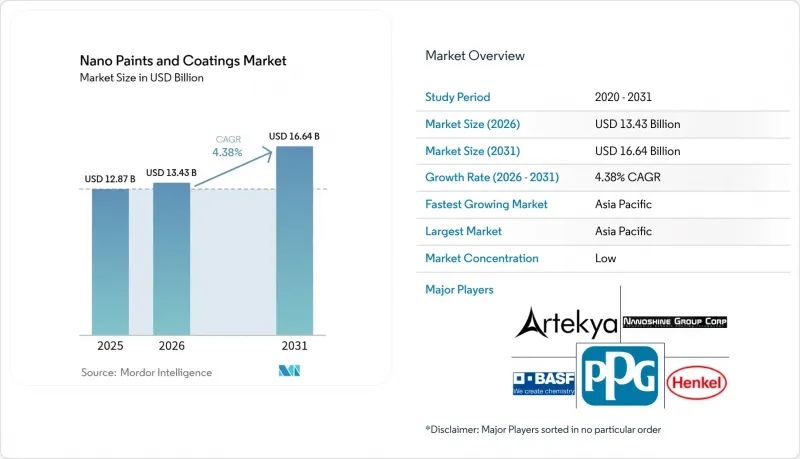
Mordor Intelligence에 의하면, 2026년 나노 페인트 및 나노 코팅 시장 규모는 134억 3,000만 달러로 추정되고 있으며, 2025년 128억 7,000만 달러에서 성장하여 2031년 예측은 166억 4,000만 달러에 이르고, 2026-2031년 CAGR 4.38%를 기록할 전망입니다.
본 보고서는 수지 유형(그래핀, 탄소나노튜브, 나노 TiO₂ 등),제조 방법(일렉트로스프레이·일렉트로스피닝, 화학 증착 등), 최종 사용자 산업(항공우주 및 방위, 자동차, 생의학 등), 지역(아시아태평양, 북미, 유럽, 남미, 중동 및 아프리카)별로 분류되어 있습니다. 시장 예측은 금액(달러) 기준으로 제시되어 있습니다.
세계 나노 페인트 및 나노 코팅 시장 동향 및 인사이트
항공우주 및 방위 분야의 내식성 및 경량화 추진
미국 국방부(펜타곤)의 추산에 따르면, 군사 장비의 부식으로 인한 비용은 연간 230억 달러에 달하며, 구조적 경량성과 우수한 보호 성능을 겸비한 나노 코팅의 도입이 가속화되고 있습니다. 실제 데이터에 따르면, 나노기술을 응용한 코팅층 덕분에 해군용 항공기의 기체 정비 주기가 단축되었을 뿐만 아니라, 제빙 특성으로 인해 혹독한 기후 조건에서도 항공기의 실전 배치 태세가 향상되고 있습니다. 미국 해군의 SBIR(중소기업 혁신 연구) 프로그램 하에서 진행되고 있는 프로젝트는 기초 연구 단계에서 함대 현장 시험 단계로 전환되고 있으며, 이는 엄격한 인증 기준이 신규 시장 진출기업을 제한하는 동시에 인증을 받은 공급업체에 대한 지속적인 수요를 보장하고 있음을 보여줍니다. 방위 조달 전략에서는 총 소유 비용(TCO)을 낮춘 플랫폼이 중시되기 때문에 중량, 내구성 및 환경 노출과 관련된 과제를 해결하는 일회 도포형 나노 첨가제가 점점 더 사양으로 지정되고 있습니다.
EV용 열·방화·안전 코팅 수요 증가
급속한 전동화의 진전에 따라 배터리 시스템에는 더 높은 에너지 밀도와 더 엄격한 안전 기준이 요구되고 있습니다. 특수한 나노층은 열을 신속하게 방출하고 난연성 장벽을 형성함으로써 셀과 인접한 부품을 보호합니다. EV 팩용 Resonac사의 단열 제품은 활발한 상업적 개발이 진행되고 있음을 보여줍니다. 탄소 및 그래핀 분산액은 절연 내력을 저해하지 않으면서 열전도성을 발휘하며, OEM의 안전 프로토콜을 준수합니다. 이와 동시에, 차량 내 온도를 10°C 낮추는 현대자동차의 나노 냉각 필름과 같은 승객 편의 솔루션은 부수적인 용도로의 확산을 보여주고 있습니다. 열 폭주를 억제하는 내용을 포함한 규제 체계가, 특히 배터리 생산 능력이 가장 높은 아시아태평양에서 양산 도입을 가속화하고 있습니다.
나노 소재의 높은 제조 비용
전용 CVD 반응기, 수율이 낮은 배치 처리, 그리고 엄격한 순도 요건으로 인해 단가는 여전히 높은 수준을 유지하고 있습니다. 기술적 성능상의 이점이 있음에도 불구하고 막대한 설비 투자가 필요하기 때문에 가격에 민감한 용도(예: 일반 소비자용 가구 등)에서의 도입이 지연되고 있습니다. 벤처 캐피털의 자금 투입은 계속되고 있으며, 포지 나노(Forge Nano)의 4,000만 달러 자금 조달도 민간 부문의 지원을 뒷받침하고 있지만, 많은 규모 확대 프로그램은 여전히 시범 단계에 머물러 있어 비용이 급격히 하락하기보다는 서서히 낮아질 것으로 보입니다. 각 제조업체들은 비용 절감을 위해 인라인 측정, 전구체 재활용 및 하이브리드 습식 화학 공정을 추구하고 있지만, 수익성 분기점은 여전히 프리미엄 용도에 의존하고 있습니다.
부문 분석
2025년, 나노 TiO2는 나노 도료 및 코팅 시장에서 38.62%의 점유율을 유지했습니다. 안정적인 제조, 광촉매에 의한 자가 세정 성능, 그리고 높은 비용 효율성이 파사드, 자동차 트림, 실내 스모그 방지 패널에서의 채택을 뒷받침하고 있습니다. OLED 유리의 10분의 1 가격으로 TiO2 나노 입자를 사용한 초대형 투명 스크린을 생산하는 한국의 파일럿 라인은 이 소재의 확장성을 입증하고 있습니다. 그래핀은 아직 규모가 작지만, 배터리용 히트 스프레더 및 전자파 차폐재에 대한 수요가 증가함에 따라 2031년까지 연평균 성장률(CAGR) 4.93%를 나타낼 것으로 전망됩니다. 탄소나노튜브는 구조적 강성, 전도성, 경량화가 요구되는 항공우주 분야나 고급 가전제품에서 여전히 틈새 시장용 선택지로 자리 잡고 있습니다. 나노 SiO₂는 인프라의 수명을 연장하는 시멘트 첨가제로서 입지를 넓혀가고 있으며, 나노 ZnO는 의료기기 및 스마트폰용 자외선 차단 코팅으로 자리 잡고 있습니다. 향후 성장은 시너지 효과를 가져오는 특성을 확보하기 위해 여러 나노 입자를 조합한 하이브리드 배합에 달려 있습니다.
이산화티타늄 수지 용도의 나노 페인트 및 나노 코팅 시장 규모는 꾸준히 확대될 것으로 예상되는 반면, 그래핀 시장 점유율은 공급망의 확대 및 반응 장치의 생산 능력 증강에 힘입어 더욱 급속히 확대될 전망입니다. 이러한 추세를 보완하듯, 바이오 유래 전구체나 무용제 분산액을 사용하여 탄소 발자국을 줄이는 친환경 합성 경로의 추진도 병행되고 있습니다.
지역별 분석
아시아태평양은 2025년에 전 세계 매출의 45.05%를 차지하며, 연평균 성장률(CAGR) 4.65%로 1위 자리를 유지할 전망입니다. 중국의 전자 제품 공급망, 일본의 재료 과학 클러스터, 그리고 한국의 디스플레이 제조 공장이 안정적인 기반을 보장하고 있습니다. ‘중국 제조 2025’의 우선순위와 일본의 ‘문샷(Moon Shot)’ 연구개발 목표와 같은 정책적 인센티브로 인해 나노 생산 능력이 가속화되고 리드타임이 단축되고 있습니다. 현지 CVD 반응로 공급업체들은 최상위 대기업 외에도 기술을 보급하는 데 기여하고 있으며, 중규모 코팅 제조업체들이 나노 제품을 인증받을 수 있도록 지원하고 있습니다.
북미 수요 동향은 항공우주, 방위, 의료기기를 중심으로 전개되고 있습니다. 미국 공군 유지보수 사령부 및 주요 우주 발사 기업들은 나노 코팅을 전략적인 유지보수 비용 절감 수단으로 간주하고 있습니다. 멕시코에서는 급성장하는 전기차(EV) 조립 생태계가 나노 단열 필름과 배터리 코팅 시스템을 수입하고 있으며, 이는 지역 공급망과 원활하게 통합되어 있습니다. 유럽에서는 친환경 설계와 근로자 안전이 중시되고 있어, REACH 규정 및 그린 빌딩 인증을 충족하는 나노 배합 수성 코팅의 채택이 촉진되고 있습니다. 독일의 자동차 1차 공급업체와 프랑스의 항공우주 OEM 기업들은 나노 코팅 전문 기업과 다년간의 프레임워크 계약을 체결하고 있습니다.
남미에서는 브라질의 교통 회랑 인프라 개보수 사업과 아르헨티나의 셰일가스 개발 관련 사업이 나노 코팅 기술 도입에 박차를 가하고 있습니다. 염수 분무, 고습도, 강한 자외선에 노출되는 환경에서는 고성능 코팅에 대한 수요가 증가하고 있으며, 현지 주요 도료 제조업체들은 일본 및 독일의 나노 소재 제조업체와 제휴하여 배합의 현지화를 추진하고 있습니다. 중동의 에너지 업계에서는 사워 부식에 대응하기 위해, 유정 내 펌프나 수출 파이프라인에 나노 코팅을 시범 도입하는 작업이 진행되고 있습니다. 한편, 아프리카 성장의 열쇠를 쥐고 있는 것은 상수도망이며, 내부에 도포된 나노 실란트 덕분에 고온 환경에서의 누수율이 감소하고 있습니다.
기타 혜택:
- Excel 형식 시장 예측(ME) 시트
- 3개월간의 애널리스트 지원
자주 묻는 질문
목차
제1장 서론
제2장 분석 방법
제3장 주요 요약
제4장 시장 구도
제5장 시장 규모·성장률 예측
제6장 경쟁 구도
제7장 시장 기회와 향후 전망
LSH 26.09.02According to Mordor Intelligence, nano paints & coatings market size in 2026 is estimated at USD 13.43 billion, growing from 2025 value of USD 12.87 billion with 2031 projections showing USD 16.64 billion, growing at 4.38% CAGR over 2026-2031.
This report is Segmented by Resin Type (Graphene, Carbon Nanotubes, Nano-TiO2, and More), Method (Electrospray and Electrospinning, Chemical Vapor Deposition, and More), End-User Industry (Aerospace and Defense, Automotive, Biomedical, and More), and Geography (Asia-Pacific, North America, Europe, South America, Middle East and Africa). The Market Forecasts are Provided in Terms of Value (USD).
Global Nano Paints And Coatings Market Trends and Insights
Aerospace and defense corrosion-light-weight push
Pentagon estimates that corrosion costs USD 23 billion each year across military equipment, intensifying the adoption of nano coatings that combine structural lightness with superior protection. Field data show nano-engineered layers lowering maintenance cycles on naval airframes, while icephobic properties enhance aircraft readiness in extreme climates. Programs under the U.S. Navy SBIR banner are moving from bench research to fleet trials, illustrating that rigorous certification barriers simultaneously limit new entrants and guarantee durable demand for validated suppliers. As defense procurement strategies favor platforms with reduced total ownership cost, single-application nano formulations that solve weight, durability, and environmental exposure challenges are increasingly specified.
Increase in demand for EV thermal-fire-safety coating
Rapid electrification pushes battery systems toward higher energy density and stricter safety standards. Specialized nano layers dissipate heat swiftly and form fire-retardant barriers, protecting cells and adjacent components. Resonac's thermal insulation product for EV packs highlights active commercial development. Carbon and graphene dispersions deliver thermal conductivity without sacrificing dielectric strength, matching OEM safety protocols. In parallel, passenger-comfort solutions such as Hyundai's nano cooling film that cuts cabin temperature by 10 °C demonstrate spill-over into ancillary applications. Regulatory frameworks that incorporate thermal runaway containment accelerate volume adoption, especially in Asia-Pacific, where battery production capacity is highest.
High production cost of nanomaterials
Specialized CVD reactors, low-yield batch processes, and stringent purity requirements keep unit costs elevated. Capital requirements delay adoption in price-sensitive uses such as consumer furniture, despite technical performance benefits. Venture capital continues to inject funds-Forge Nano's USD 40 million raise underscored private backing-but many scale-up programs remain in pilot phase, pointing to gradual cost attrition rather than abrupt drops. Producers pursue inline metrology, precursor recycling, and hybrid wet-chemistry steps to cut expenses, yet breakeven economics still hinge on premium applications.
Other drivers and restraints analyzed in the detailed report include:
- Growing requirement for high performance coatings
- Increasing demand from infrastructure sector
- Nano-toxicity regulatory uncertainty
For complete list of drivers and restraints, kindly check the Table Of Contents.
Segment Analysis
Nano-TiO2 kept its 38.62% hold on the nano paints & coatings market in 2025. Stable manufacturing, photocatalytic self-cleaning performance, and cost efficiency drive its acceptance on facades, automotive trims, and indoor anti-smog panels. Korean pilot lines producing ultra-large transparent screens using TiO2 nanoparticles at one-tenth the price of OLED glass underscore this material's scalability. Graphene, although capped at a modest base, posts a 4.93% CAGR through 2031 as demand from battery heat spreaders and electromagnetic shielding intensifies. Carbon nanotubes remain a niche choice for aerospace and high-end consumer electronics where structural stiffness, conductivity, and weight savings converge. Nano-SiO2 extends its presence in cement additions that lengthen infrastructure life, and nano-ZnO secures UV-blocking coatings for medical devices and smartphones. Future growth leans on hybrid recipes pairing multiple nanoparticles to secure synergistic properties.
The nano paints & coatings market size for titanium dioxide resin applications is projected to widen steadily, while graphene's share expands faster under supply chain releases and reactor capacity additions. Complementing that trajectory is a parallel push for green synthesis routes that use bio-derived precursors or solvent-free dispersion to cut carbon footprint.
Complete Report Scope:
- By Resin Type
- Graphene
- Carbon Nanotubes
- Nano-TiO2 (Titanium Dioxide)
- Nano-SiO2 (Silicon Dioxide)
- Nano-ZnO
- Nano Silver
- By Method
- Electrospray and Electrospinning
- Chemical Vapor Deposition (CVD)
- Physical Vapor Deposition (PVD)
- Atomic Layer Deposition (ALD)
- Aerosol Coating
- Self-Assembly
- Sol-Gel
- By End-User Industry
- Aerospace and Defense
- Automotive
- Electronics and Optics
- Biomedical
- Food and Packaging
- Marine
- Oil and Gas
- Other End-user Industries (Energy and Power, Construction and Infrastructure, etc.)
- By Geography
- Asia-Pacific
- China
- India
- Japan
- South Korea
- ASEAN Countries
- Rest of Asia-Pacific
- North America
- United States
- Canada
- Mexico
- Europe
- Germany
- United Kingdom
- France
- Italy
- Rest of Europe
- South America
- Brazil
- Argentina
- Rest of South America
- Middle East and Africa
- Saudi Arabia
- South Africa
- Rest of Middle East and Africa
- Asia-Pacific
Geography Analysis
Asia-Pacific anchored 45.05% of global revenue in 2025, keeping the lead with a 4.65% CAGR outlook. China's electronics supply chains, Japan's materials science clusters, and South Korea's display fabs guarantee a stable baseline. Policy incentives, such as China's Made-in-China 2025 priorities and Japan's Moonshot R&D goals, accelerate nano production capability, shortening lead times. Local CVD reactor suppliers help diffuse technology beyond top-tier conglomerates, enabling mid-size coating shops to certify nano offerings.
North America's demand profile centers on aerospace, defense, and medical devices. U.S. Air Force sustainment commands and space launch primes view nano-layering as strategic maintenance cost reducers. Mexico's ascending EV assembly ecosystem imports nano thermal films and battery coating systems, integrating seamlessly with regional supply. Europe champions eco-design and worker safety, thus driving the adoption of nano-formulated water-borne coatings that satisfy REACH and green building labels. Germany's automotive Tier-1 suppliers and France's aerospace OEMs lock up multi-year framework agreements with nano-coating specialists.
South America injects momentum from infrastructure rehabilitation commitments in Brazil's transport corridors and Argentina's shale play servicing. Exposure to salt spray, high humidity, and UV intensity places a premium on high-performance coatings, and local paint majors partner with Japanese and German nanomaterial producers to localize blends. The Middle East's energy sector trials nano layers on downhole pumps and export pipelines to combat sour corrosion, while Africa's growth story lies in water networks, where internally applied nano sealants cut leak rates under high ambient heat.
- Aculon
- Artekya Teknoloji
- BASF
- Europlasma NV
- Graphene NanoChem
- GVD Corporation
- Henkel AG and Co. KGaA
- I-CanNano
- Nanofilm
- Nanoshine Group Corp
- Pearl Global Ltd.
- Pellucere
- PPG Industries, Inc.
- SIA Naco Technologies
- Starshield Technologies Pvt Ltd
- Tesla NanoCoatings Inc.
Additional Benefits:
- The market estimate (ME) sheet in Excel format
- 3 months of analyst support
TABLE OF CONTENTS
1 Introduction
- 1.1 Study Assumptions and Market Definition
- 1.2 Scope of the Study
2 Research Methodology
3 Executive Summary
4 Market Landscape
- 4.1 Market Overview
- 4.2 Market Drivers
- 4.2.1 Aerospace and defense corrosion-light-weight push
- 4.2.2 Increase in demand for EV thermal-fire-safety coating
- 4.2.3 Growing requirement for high performance coatings
- 4.2.4 Inceasing demand from infrastructure sector
- 4.2.5 Rise in utilization from electronics and consumer goods
- 4.3 Market Restraints
- 4.3.1 High production cost of nanomaterials
- 4.3.2 Nano-toxicity regulatory uncertainty
- 4.3.3 Graphene CVD reactor supply bottlenecks
- 4.4 Value Chain Analysis
- 4.5 Porter's Five Forces
- 4.5.1 Bargaining Power of Suppliers
- 4.5.2 Bargaining Power of Consumers
- 4.5.3 Threat of New Entrants
- 4.5.4 Threat of Substitute Products and Services
- 4.5.5 Degree of Competition
5 Market Size and Growth Forecasts (Value)
- 5.1 By Resin Type
- 5.1.1 Graphene
- 5.1.2 Carbon Nanotubes
- 5.1.3 Nano-TiO2 (Titanium Dioxide)
- 5.1.4 Nano-SiO2 (Silicon Dioxide)
- 5.1.5 Nano-ZnO
- 5.1.6 Nano Silver
- 5.2 By Method
- 5.2.1 Electrospray and Electrospinning
- 5.2.2 Chemical Vapor Deposition (CVD)
- 5.2.3 Physical Vapor Deposition (PVD)
- 5.2.4 Atomic Layer Deposition (ALD)
- 5.2.5 Aerosol Coating
- 5.2.6 Self-Assembly
- 5.2.7 Sol-Gel
- 5.3 By End-User Industry
- 5.3.1 Aerospace and Defense
- 5.3.2 Automotive
- 5.3.3 Electronics and Optics
- 5.3.4 Biomedical
- 5.3.5 Food and Packaging
- 5.3.6 Marine
- 5.3.7 Oil and Gas
- 5.3.8 Other End-user Industries (Energy and Power, Construction and Infrastructure, etc.)
- 5.4 By Geography
- 5.4.1 Asia-Pacific
- 5.4.1.1 China
- 5.4.1.2 India
- 5.4.1.3 Japan
- 5.4.1.4 South Korea
- 5.4.1.5 ASEAN Countries
- 5.4.1.6 Rest of Asia-Pacific
- 5.4.2 North America
- 5.4.2.1 United States
- 5.4.2.2 Canada
- 5.4.2.3 Mexico
- 5.4.3 Europe
- 5.4.3.1 Germany
- 5.4.3.2 United Kingdom
- 5.4.3.3 France
- 5.4.3.4 Italy
- 5.4.3.5 Rest of Europe
- 5.4.4 South America
- 5.4.4.1 Brazil
- 5.4.4.2 Argentina
- 5.4.4.3 Rest of South America
- 5.4.5 Middle East and Africa
- 5.4.5.1 Saudi Arabia
- 5.4.5.2 South Africa
- 5.4.5.3 Rest of Middle East and Africa
- 5.4.1 Asia-Pacific
6 Competitive Landscape
- 6.1 Market Concentration
- 6.2 Strategic Moves
- 6.3 Market Share(%)/Ranking Analysis
- 6.4 Company Profiles (includes Global level Overview, Market level overview, Core Segments, Financials as available, Strategic Information, Market Rank/Share, Products and Services, Recent Developments)
- 6.4.1 Aculon
- 6.4.2 Artekya Teknoloji
- 6.4.3 BASF
- 6.4.4 Europlasma NV
- 6.4.5 Graphene NanoChem
- 6.4.6 GVD Corporation
- 6.4.7 Henkel AG and Co. KGaA
- 6.4.8 I-CanNano
- 6.4.9 Nanofilm
- 6.4.10 Nanoshine Group Corp
- 6.4.11 Pearl Global Ltd.
- 6.4.12 Pellucere
- 6.4.13 PPG Industries, Inc.
- 6.4.14 SIA Naco Technologies
- 6.4.15 Starshield Technologies Pvt Ltd
- 6.4.16 Tesla NanoCoatings Inc.
7 Market Opportunities and Future Outlook
- 7.1 White-space and Unmet-Need Assessment


