

|
시장보고서
상품코드
2121610
이탈리아의 풍력발전 : 시장 점유율 분석, 업계 동향과 통계, 성장 예측(2026-2031년)Italy Wind Energy - Market Share Analysis, Industry Trends & Statistics, Growth Forecasts (2026 - 2031) |
||||||
 Mordor Intelligence
Mordor Intelligence에 의하면, 이탈리아의 풍력발전 시장 규모(설치용량 기반)는 2025년 13.33기가와트에서 2026년에는 13.73기가와트로 확대되고, 2026-2031년 CAGR 3.02%로 성장을 지속하여 2031년에는 15.94기가와트에 이를 것으로 예측됩니다.
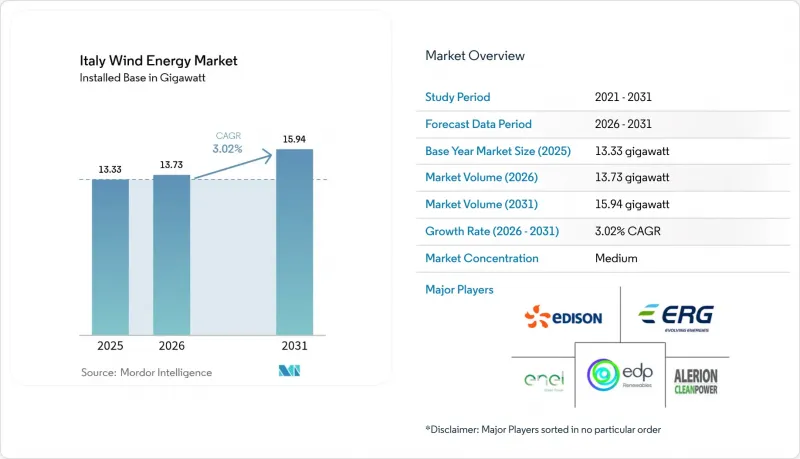
본 보고서는 입지(육상 및 해상), 터빈 출력(3MW 미만, 3-6MW, 6MW 이상), 용도(유틸리티 규모, 상업 및 산업용, 커뮤니티 프로젝트)별로 분류되어 있습니다. 시장 규모 및 전망은 설치 용량(GW)으로 표시되어 있습니다.
이탈리아 풍력 발전 시장 동향 및 인사이트
재생에너지 입찰 프로젝트 확대
이탈리아의 FER2 법령에서는 해상 풍력 발전에 대해 185유로/MWh(199.8달러/MWh)의 행사가격을 정한 양방향 CfD(차액결제계약)가 도입되어, 시장 가격에 따른 수익의 불확실성이 해소되고 프로젝트의 부채 금융이 촉진되고 있습니다. 유럽연합 집행위원회는 2028년까지 아드리아해 및 이오니아해의 기가와트급 부유식 프로젝트를 포함한 4.59 GW 규모의 신규 재생에너지 용량을 아우르는 355억 유로(383억 달러) 규모의 계획을 승인했습니다. ‘Agnes-1-2’(700 MW) 및‘Energia Wind 2020’(330 MW)에 대한 환경 허가가 승인됨에 따라, 계획 단계에서 착공 준비 완료 단계로 전환되고 있음을 보여주고 있으며, 2024년 하반기 경매를 거쳐 각 프로젝트는 2025년부터 2026년에 걸쳐 착공을 향해 나아가고 있습니다.
NECP에 따른 인허가 개혁의 기세
정령 제190/2024호 및 ‘재생에너지 통합법(Testo Unico Rinnovabili)’에 따라 원스톱 시스템과 표준화된 환경 영향 평가가 도입되어, 평균 승인 기간이 14년에서 5년 미만으로 단축되었습니다. ‘에너지 릴리스 2.0’ 조치로 인해 계통 연계 절차가 가속화되는 한편, 공익이 우선된다는 추정 하에 법적 이의 제기가 제한됩니다. 2024년 10월 해양 공간 계획의 채택으로 해상 구역의 경계 설정에 드디어 확실성이 확보되었습니다.
장기화되는 지방자치단체의 인허가 절차와 NIMBY(인근 주민의 반대) 움직임
국가 차원의 절차 간소화 노력에도 불구하고, 경관 및 관광에 대한 우려로 인해 일부 지역에서는 프로젝트 진행이 지연되거나 중단되고 있습니다. 사르데냐 섬의 일시적인 모라토리엄으로 인해, 인가는 받았으나 아직 건설되지 않은 용량이 2.5GW 남아 있어 개발사의 보유 비용이 장기화되고, 입찰 낙찰부터 실제 가동 개시까지의 간격이 확대되고 있습니다.
부문별 분석
이탈리아 풍력 발전 시장에서는 육상 발전소가 주류를 이루고 있으며, 2025년에는 13.3 GW를 차지하여 이는 설비 용량의 99.78%에 해당합니다. 그러나 해상 풍력 발전의 신규 도입으로 인해 2031년까지 그 점유율은 연평균 성장률(CAGR) 71.6%로 약 4.9%까지 상승할 것으로 예측되며, 이 부문의 주요 성장 동력이 될 전망입니다. 이탈리아 풍력 발전 시장은 부유식 기초 기술이 반도의 가파른 대륙붕 문제를 극복하고, 수심 60-200미터 해역에 수 메가와트급 터빈을 도입함으로써 뚜렷한 전환기를 맞이하고 있습니다.
Med Wind, Krimisa, Messapia 등 초기 해상 프로젝트에서는 15-18MW급 터빈이 채택되어, 이를 통해 기초 수를 줄이고, 발전소 부대 설비(BOP) 비용을 절감하며, 건설 기간을 단축하고 있습니다. 해양 공간 계획 및 FER2 경매 가격 책정에 따른 규제 확실성은 EU 부흥 기금과 맞물려 부채를 통한 자금 조달을 가능하게 하고 있습니다. 풀리아주와 칼라브리아주에서의 리파워링을 통해 육상 풍력 발전의 성장은 지속되고 있지만, 신규 건설 부지는 부족해지고 있어 이탈리아 풍력 발전 시장에서 해상 풍력의 중요성이 높아지고 있음을 여실히 보여주고 있습니다.
기타 혜택:
- 엑셀 형식 시장 예측(ME) 시트
- 3개월간의 애널리스트 지원
자주 묻는 질문
목차
제1장 서론
제2장 조사 방법
제3장 주요 요약
제4장 시장 구도
제5장 시장 규모와 성장 예측
제6장 경쟁 구도
제7장 시장 기회와 향후 전망
LSH 26.09.02According to Mordor Intelligence, the Italy wind energy market size in terms of installed base is expected to grow from 13.33 gigawatt in 2025 to 13.73 gigawatt in 2026 and is forecast to reach 15.94 gigawatt by 2031 at 3.02% CAGR over 2026-2031.
This report is Segmented by Location (Onshore and Offshore), Turbine Capacity (Less Than 3 MW, 3 To 6 MW, and Above 6 MW), and Application (Utility-Scale, Commercial and Industrial, and Community Projects). The Market Size and Forecasts are Provided in Terms of Installed Capacity (GW).
Italy Wind Energy Market Trends and Insights
Renewable-energy auction pipeline expansion
Italy's FER2 decree establishes two-way CfDs with a EUR 185/MWh (USD 199.8/MWh) strike price for offshore wind, eliminating merchant revenue uncertainty and facilitating project debt financing. The European Commission approved a EUR 35.5 billion (USD 38.3 billion) scheme spanning 2028 that encompasses 4.59 GW of new renewable capacity, including gigawatt-scale floating projects in the Adriatic and Ionian Seas. Environmental approvals for Agnes-1-2 (700 MW) and Energia Wind 2020 (330 MW) show the funnel converting from intent to shovel-ready status, with late-2024 auctions moving projects toward 2025-2026 construction starts
NECP-aligned permitting reform momentum
Legislative Decree 190/2024 and the Testo Unico Rinnovabili introduce a single-window system and standardized environmental assessments, trimming the average approval cycle from fourteen to under five years. The Energy Release 2.0 measure accelerates grid-connection procedures, while a presumption of overriding public interest limits legal challenges. Adoption of maritime spatial plans in October 2024 finally brings certainty to offshore zone delimitation.
Lengthy local-permitting & NIMBY pushback
Despite national streamlining efforts, several regions slow or halt projects due to concerns over landscape and tourism. Sardinia's temporary moratorium leaves 2.5 GW of authorized but unbuilt capacity, extending carrying costs for developers and widening the gap between tender awards and actual commissioning.
Other drivers and restraints analyzed in the detailed report include:
- Corporate-PPA pull from hard-to-abate industries
- Floating-offshore wind resource unlock
- Solar-PV cost-competitiveness pressure
For complete list of drivers and restraints, kindly check the Table Of Contents.
Segment Analysis
Onshore assets dominated the Italian wind energy market, accounting for 13.3 GW in 2025, which is equivalent to 99.78% of the installed capacity. Yet offshore additions are forecast to lift the location's share to about 4.9% by 2031 on a 71.6% CAGR, making it the sector's prime growth engine. The Italy wind energy market is tracking a clear pivot as floating foundations overcome the peninsula's steep continental shelf, bringing multi-megawatt turbines to waters 60-200 meters deep.
Early offshore projects, such as Med Wind, Krimisa, and Messapia, leverage 15- to 18-MW machines that reduce foundation counts, lower balance-of-plant costs, and shorten construction timelines. Regulatory certainty from maritime spatial plans and FER2 auction pricing aligns with EU recovery funds to unlock debt financing. Onshore growth continues through repowering in Puglia and Calabria; yet, incremental sites are scarcer, underscoring the rising importance of offshore wind for the Italian wind energy market.
Complete Report Scope:
- By Location
- Onshore
- Offshore
- By Turbine Capacity
- Up to 3 MW
- 3 to 6 MW
- Above 6 MW
- By Application
- Utility-scale
- Commercial and Industrial
- Community Projects
- By Component (Qualitative Analysis)
- Nacelle/Turbine
- Blade
- Tower
- Generator and Gearbox
- Balance-of-System
List of Companies Covered in this Report:
- Enel Green Power
- ERG SpA
- Edison SpA
- EDP Renovaveis
- Alerion Clean Power SpA
- PLT Energia Srl
- Renvico Holding
- Italian Vento Power Corp. Srl
- GreenIT (Plenitude/CDP Equity)
- Falck Renewables-BlueFloat
- Renexia SpA
- Terna Rete Elettrica Nazionale
- General Electric Co.
- Siemens Gamesa Renewable Energy SA
- Vestas Wind Systems AS
- Nordex SE
- MingYang Smart Energy
- Hitachi Energy Ltd.
- Prysmian Group
- Senvion GmbH
Additional Benefits:
- The market estimate (ME) sheet in Excel format
- 3 months of analyst support
TABLE OF CONTENTS
1 Introduction
- 1.1 Study Assumptions & Market Definition
- 1.2 Scope of the Study
2 Research Methodology
3 Executive Summary
4 Market Landscape
- 4.1 Market Overview
- 4.2 Market Drivers
- 4.2.1 Renewable-energy auction pipeline expansion
- 4.2.2 NECP-aligned permitting reform momentum
- 4.2.3 Corporate-PPA pull from hard-to-abate industries
- 4.2.4 Floating-offshore wind resource unlock
- 4.2.5 Grid-digitalisation & storage synergy
- 4.3 Market Restraints
- 4.3.1 Lengthy local-permitting & NIMBY pushback
- 4.3.2 Solar-PV cost-competitiveness pressure
- 4.3.3 Euro-wind-turbine supply-chain inflation
- 4.4 Supply-Chain Analysis
- 4.5 Regulatory Landscape
- 4.6 Technological Outlook
- 4.7 Porter's Five Forces
- 4.7.1 Threat of New Entrants
- 4.7.2 Bargaining Power of Suppliers
- 4.7.3 Bargaining Power of Buyers
- 4.7.4 Threat of Substitutes
- 4.7.5 Competitive Rivalry
- 4.8 PESTLE Analysis
5 Market Size & Growth Forecasts
- 5.1 By Location
- 5.1.1 Onshore
- 5.1.2 Offshore
- 5.2 By Turbine Capacity
- 5.2.1 Up to 3 MW
- 5.2.2 3 to 6 MW
- 5.2.3 Above 6 MW
- 5.3 By Application
- 5.3.1 Utility-scale
- 5.3.2 Commercial and Industrial
- 5.3.3 Community Projects
- 5.4 By Component (Qualitative Analysis)
- 5.4.1 Nacelle/Turbine
- 5.4.2 Blade
- 5.4.3 Tower
- 5.4.4 Generator and Gearbox
- 5.4.5 Balance-of-System
6 Competitive Landscape
- 6.1 Market Concentration
- 6.2 Strategic Moves (M&A, Partnerships, PPAs)
- 6.3 Market Share Analysis (Market Rank/Share for key companies)
- 6.4 Company Profiles (includes Global level Overview, Market level overview, Core Segments, Financials as available, Strategic Information, Products & Services, and Recent Developments)
- 6.4.1 Enel Green Power
- 6.4.2 ERG SpA
- 6.4.3 Edison SpA
- 6.4.4 EDP Renovaveis
- 6.4.5 Alerion Clean Power SpA
- 6.4.6 PLT Energia Srl
- 6.4.7 Renvico Holding
- 6.4.8 Italian Vento Power Corp. Srl
- 6.4.9 GreenIT (Plenitude/CDP Equity)
- 6.4.10 Falck Renewables-BlueFloat
- 6.4.11 Renexia SpA
- 6.4.12 Terna Rete Elettrica Nazionale
- 6.4.13 General Electric Co.
- 6.4.14 Siemens Gamesa Renewable Energy SA
- 6.4.15 Vestas Wind Systems AS
- 6.4.16 Nordex SE
- 6.4.17 MingYang Smart Energy
- 6.4.18 Hitachi Energy Ltd.
- 6.4.19 Prysmian Group
- 6.4.20 Senvion GmbH
7 Market Opportunities & Future Outlook
- 7.1 White-space & Unmet-Need Assessment


