

|
시장보고서
상품코드
2121614
발포 폴리프로필렌 폼(EPP) : 시장 점유율 분석, 업계 동향과 통계, 성장 예측(2026-2031년)Expanded Polypropylene (EPP) Foam - Market Share Analysis, Industry Trends & Statistics, Growth Forecasts (2026 - 2031) |
||||||
 Mordor Intelligence
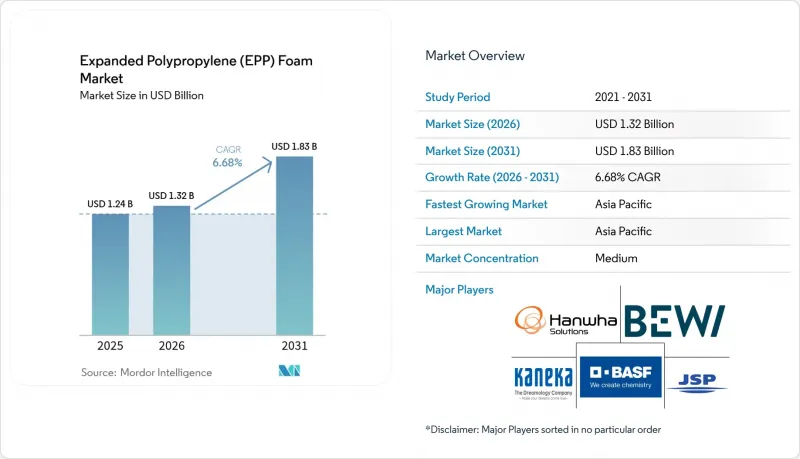
Mordor Intelligence에 의하면, 발포 폴리프로필렌 시장 규모는 2025년 12억 4,000만 달러에서 2026년에는 13억 2,000만 달러로 성장하고, 2026-2031년 CAGR 6.68%로 성장을 지속하여 2031년에는 18억 3,000만 달러에 달할 것으로 예측됩니다.
본 보고서는 원재료(합성 폴리프로필렌 및 바이오 폴리프로필렌), 발포체 유형(가공 EPP, 성형 EPP, 기타 발포체), 용도(자동차, 식품 포장,HVAC, 스포츠 및 레저 등) 및 지역(아시아태평양, 북미, 유럽, 남미, 중동 및 아프리카)별로 분류되어 있습니다. 시장 예측은 금액(달러) 기준으로 제시되어 있습니다.
세계 발포 폴리프로필렌 폼(EPP) 시장 동향 및 인사이트
자동차 경량화 및 안전성 수요
자동차 제조업체들은 2030년까지 10-20%의 경량화를 목표로 하고 있으며, 2024년 이후 출시된 일본 승용차 플랫폼의 65%에서 발포 폴리프로필렌 폼(EPP)의 채택을 의무화하고 있습니다. 유럽에서 2025년 UN ECE R94 측면 충돌 규정이 개정됨에 따라 에너지 흡수 기준치가 15% 상향 조정되었으며, B필러 보강재의 경우 무거운 폴리우레탄에서 발포체로 대체되는 추세가 가속화되고 있습니다. EV 프로그램은 이러한 추세를 더욱 강화하고 있습니다. EPP는 충격 보호와 단열성을 겸비하고 있어, 경량화 여지가 적은 리튬 이온 배터리 팩의 내부 마감재로 점점 더 많이 채택되고 있습니다.
전자상거래용 보호 포장재의 급성장
2024년부터 2025년에 걸쳐 국경을 넘는 소포 처리량은 2배로 증가했습니다. 또한, 재사용 가능한 EPP 완충재는 섬유판에 비해 파손률을 30-50% 낮추기 때문에 발포 폴리프로필렌 폼(EPP) 시장은 풀필먼트 센터에 없어서는 안 될 요소가 되었습니다. 소노코(Sonoco)사가 2024년에 출시한 ‘EnviroFlex’ 트레이는 반송 시 쌓아 보관할 수 있어 10-15회의 운송을 견디면서도 역물류 비용을 20% 절감합니다. 비용은 여전히 장벽으로 남아 있습니다. 단가가 EPS보다 20-30% 비싸기 때문에 도입은 고가의 전자 기기로 제한되고 있습니다.
저가형 EPS 및 기타 발포 소재와의 경쟁
발포 폴리스티렌(EPS)은 범용 용도에서 EPP에 비해 20-30%의 비용 우위를 유지하고 있으며, 식품 포장이나 가구 분야에서는 EPP의 뛰어난 재사용성에도 불구하고 여전히 가격 민감도가 충분히 높아 전환에 저항이 있습니다. 콜드체인 식품 포장은 이러한 상충 관계를 여실히 보여줍니다. EPP로 제작된 단열 컨테이너는 10-15회의 재사용 주기를 견디는 반면, EPS는 2-3회에 그치지만, EPP의 초기 단가가 8-12달러인 데 비해 EPS는 3-5달러이므로,역물류 인프라가 제한적인 소규모 유통업체에게는 장벽이 되고 있습니다. 이 프로토타입은 여전히 상용화 전 단계이지만, 바이오 유래 폴리프로필렌 원료의 양산화가 지연될 경우, 유사 소재로 인해 EPP의 지속가능성이라는 포지셔닝이 훼손될 위험이 있음을 여실히 보여주고 있습니다.
부문 분석
2025년 시점에서 합성 폴리프로필렌은 발포 폴리프로필렌 시장의 원자재 규모 중 91.78%를 차지하고 있으며, 2031년까지 연평균 성장률(CAGR) 6.89%로 확대되고 있습니다. 바이오 유래 함유율은 여전히 매우 낮은 수준이지만, 네스테(Neste)와 리온델바셀(LyondellBasell)이 재생 가능 원료의 생산 규모를 확대함에 따라 2029년까지 전 세계 바이오플라스틱 생산 능력에서 상당한 점유율을 차지할 것으로 예측됩니다. 철저한 원가 관리와 결정화도의 허용 범위가 엄격하기 때문에 자동차용 및 포장재용에서는 합성 등급이 계속해서 주도적인 위치를 차지하고 있습니다. 스포츠 헬멧 등 소비자용 제품의 경우, 바이오 EPP의 15-20%에 달하는 가격 프리미엄이 수용되고 있으며, 이것이 연평균 성장률(CAGR)이 완만하게 나타나는 요인이 되고 있습니다.
탄소 발자국 감축을 목표로 하는 브랜드 소유주들은 미국 및 유럽 규제 당국의 승인을 기다리는 한편, 식품 접촉 용도에서 바이오 PP-EPP의 시범 도입을 추진하고 있습니다. 따라서 발포 폴리프로필렌 시장에서는 고수익성 틈새 시장에서 안정적인 화석 유래 공급망과 지속가능성을 전면에 내세운 브랜딩 간의 균형이 이루어지고 있습니다.
지역별 분석
아시아태평양은 2025년에 발포 폴리프로필렌 폼(EPP) 시장의 42.22%를 차지하며, 연평균 성장률(CAGR) 7.15%로 성장할 전망입니다. 중국에서는 2,800만 대의 자동차가 생산되었으며, 신차 플랫폼의 55%에서 EPP가 채택되었습니다. 일본의 JSP, 카네카, 세키스이 화학은 생산량의 60%를 해외로 수출하고 있으며, 수직 통합된 수지 공급 체계와 낮은 증기 에너지 비용이 15-20%의 비용 우위를 가져다주고 있음이 입증되었습니다.
북미 시장 점유율은 EPA의 연비 규제로 인해 경량화가 시급해짐에 따라 견조한 성장이 예상됩니다. 세키스이 플라스틱의 오하이오 공장은 2026년에 가동을 시작하여 디트로이트로의 리드타임을 40% 단축할 전망입니다. 캐나다의 일회용 플라스틱 금지 조치는 재사용 가능한 포장재 수요를 촉진하고 있으며, 멕시코의 자동차 생산 대수 350만 대는 현지 성형 수요를 끌어올리고 있습니다.
유럽 시장 점유율은 에너지 가격 변동과 미세 플라스틱 규제의 영향으로 명목상의 성장에 그칠 전망입니다. 북유럽 국가들의 탄소중립 건축 기준에 따라 2025년에는 BEWi사의 지오폼 단열재 수요가 35% 증가했습니다. 남미와 중동 및 아프리카는 합쳐서 8%의 신흥 시장을 형성하고 있으며, 브라질과 사우디아라비아의 친환경 건축 규정에 힘입어 성장하고 있습니다.
기타 혜택:
- 엑셀 형식 시장 예측(ME) 시트
- 3개월간의 애널리스트 지원
자주 묻는 질문
목차
제1장 서론
제2장 조사 방법
제3장 주요 요약
제4장 시장 구도
제5장 시장 규모와 성장 예측
제6장 경쟁 구도
제7장 시장 기회와 향후 전망
LSH 26.09.02According to Mordor Intelligence, the expanded polypropylene foam market size is expected to grow from USD 1.24 billion in 2025 to USD 1.32 billion in 2026 and is forecast to reach USD 1.83 billion by 2031 at a 6.68% CAGR over 2026-2031.
This report is Segmented Into Raw Material (Synthetic Polypropylene and Bio-Based Polypropylene), Foam (Fabricated EPP, Molded EPP, and Other Foams), Application (Automotive, Food Packaging, HVAC, Sports and Leisure, and More), and Geography (Asia-Pacific, North America, Europe, South America, and the Middle East and Africa). The Market Forecasts are Provided in Terms of Value (USD).
Global Expanded Polypropylene (EPP) Foam Market Trends and Insights
Automotive Lightweighting and Safety Demand
Vehicle makers target 10-20% mass reduction by 2030 and have specified expanded polypropylene foam in 65% of the Japanese passenger-car platforms launched since 2024. Europe's 2025 update to UN ECE R94 side-impact rules raised energy-absorption thresholds by 15%, accelerating foam substitution for heavier polyurethane in B-pillar reinforcements. EV programs intensify this pull; EPP combines impact protection with thermal insulation, so it increasingly lines lithium-ion packs where weight offsets are scarce.
Boom in E-commerce Protective Packaging
Cross-border parcels doubled between 2024 and 2025, and reusable EPP dunnage lowers damage rates by 30-50% versus fiberboard, making the expanded polypropylene foam market indispensable to fulfillment centers. Sonoco's 2024 EnviroFlex trays nest for return shipping, cutting reverse-logistics costs 20% while surviving 10-15 trips. Cost remains the friction point: units are 20-30% pricier than EPS, limiting uptake to high-value electronics.
Competition from Cheaper EPS and Other Foams
Expanded polystyrene maintains a 20-30% cost advantage over EPP in commodity applications, and food packaging and furniture segments remain price-sensitive enough to resist switching despite EPP's superior reusability. Cold-chain food packaging illustrates the trade-off: EPP insulated containers survive 10-15 reuse cycles versus 2-3 for EPS, but the initial unit cost of USD 8-12 for EPP versus USD 3-5 for EPS deters small-scale distributors with limited reverse-logistics infrastructure. The prototype remains pre-commercial, yet it underscores the risk that adjacent materials will erode EPP's sustainability positioning if bio-based polypropylene feedstock scales slowly.
Other drivers and restraints analyzed in the detailed report include:
- 3D Steam-chest Molding Enables Complex Auto Parts
- Adoption in Electric-Vehicle Battery Thermal Management Packs
- Limited Steam-chest Molding Capacity Ex-Asia
For complete list of drivers and restraints, kindly check the Table Of Contents.
Segment Analysis
Synthetic polypropylene accounted for 91.78% of the expanded polypropylene foam market size for raw materials in 2025, expanding at a 6.89% CAGR to 2031. Bio-based content remains very low but is forecast to reach a decent share of global bioplastics capacity by 2029 as Neste and LyondellBasell scale renewable feedstocks. Cost discipline and tight crystallinity tolerances keep synthetic grades in pole position for automotive and dunnage. Consumer-facing goods such as sports helmets accept the 15-20% premium for bio-EPP, underpinning slower CAGR growth.
Brand owners seeking lower carbon footprints are piloting bio-PP EPP in food-contact trials pending regulatory clearance in the United States and Europe. The expanded polypropylene foam market, therefore, balances secure fossil-based supply chains against sustainability branding in high-margin niches.
Complete Report Scope:
- By Raw Material
- Synthetic Polypropylene
- Bio-based Polypropylene
- By Foam Type
- Fabricated EPP
- Molded EPP
- Other Foams
- By Application
- Automotive
- Dunnage/Industrial Packaging
- Furniture
- Food Packaging
- HVAC
- Sports and Leisure
- Other Applications
- By Geography
- Asia-Pacific
- China
- India
- Japan
- South Korea
- ASEAN Countries
- Rest of Asia-Pacific
- North America
- United States
- Canada
- Mexico
- Europe
- Germany
- United Kingdom
- France
- Italy
- Spain
- Russia
- Rest of Europe
- South America
- Brazil
- Argentina
- Rest of South America
- Middle-East and Africa
- Saudi-Arabia
- South Africa
- Rest of Middle-East and Africa
- Asia-Pacific
Geography Analysis
Asia-Pacific held 42.22% of the expanded polypropylene foam market in 2025 and will increase at a 7.15% CAGR. China produced 28 million vehicles and specified EPP in 55% of new car platforms. Japan's JSP, Kaneka, and Sekisui ship 60% of output overseas, proving that vertically integrated resin supply plus low steam energy costs confer a 15-20% cost advantage.
North America's market share is poised for decent growth, as EPA mileage rules force lightweighting. Sekisui Plastics' Ohio plant goes live in 2026, trimming Detroit lead times 40%. Canada's single-use plastics ban drives reusable dunnage, and Mexico's 3.5-million-unit auto output boosts local molding.
Europe's market share is about experience nominal growth, checked by energy volatility and microplastics rules. Net-zero building codes in the Nordics lifted geo-foam insulation demand 35% for BEWi in 2025. South America and the Middle East-Africa together form an emerging 8% slice, stimulated by Brazil's and Saudi Arabia's green-building ordinances.
- ALPLA
- Armacell
- BASF
- BEWi (IZOBLOK)
- Clark Foam Products Corporation
- Foampartner
- Furukawa Electric Co., Ltd.
- Hanwha Solutions
- JSP
- K K Nag Pvt. Ltd
- Kaneka Corporation
- Knauf Industries
- Polyfoam Australia Pty Ltd
- Sekisui Plastics Co.
- Signode Industrial Group Llc
- Sonoco Products Company
- SSW PearlFoam GmbH
- Woodbridge
- Zotefoams Plc
Additional Benefits:
- The market estimate (ME) sheet in Excel format
- 3 months of analyst support
TABLE OF CONTENTS
1 Introduction
- 1.1 Study Assumptions and Market Definition
- 1.2 Scope of the Study
2 Research Methodology
3 Executive Summary
4 Market Landscape
- 4.1 Market Overview
- 4.2 Market Drivers
- 4.2.1 Automotive lightweighting and safety demand
- 4.2.2 Boom in e-commerce protective packaging
- 4.2.3 3-D steam-chest molding enables complex auto parts
- 4.2.4 Adoption in Electric vehicle battery thermal management packs
- 4.2.5 Net-zero buildings using EPP geo-foam insulation
- 4.3 Market Restraints
- 4.3.1 Competition from cheaper EPS and other foams
- 4.3.2 Limited steam-chest molding capacity ex-Asia
- 4.3.3 Micro-plastics pellet-loss regulations tightening
- 4.4 Value Chain Analysis
- 4.5 Porter's Five Forces
- 4.5.1 Bargaining Power of Suppliers
- 4.5.2 Bargaining Power of Buyers
- 4.5.3 Threat of New Entrants
- 4.5.4 Threat of Substitutes
- 4.5.5 Degree of Competition
- 4.6 Price Analysis
5 Market Size and Growth Forecasts (Value)
- 5.1 By Raw Material
- 5.1.1 Synthetic Polypropylene
- 5.1.2 Bio-based Polypropylene
- 5.2 By Foam Type
- 5.2.1 Fabricated EPP
- 5.2.2 Molded EPP
- 5.2.3 Other Foams
- 5.3 By Application
- 5.3.1 Automotive
- 5.3.2 Dunnage/Industrial Packaging
- 5.3.3 Furniture
- 5.3.4 Food Packaging
- 5.3.5 HVAC
- 5.3.6 Sports and Leisure
- 5.3.7 Other Applications
- 5.4 By Geography
- 5.4.1 Asia-Pacific
- 5.4.1.1 China
- 5.4.1.2 India
- 5.4.1.3 Japan
- 5.4.1.4 South Korea
- 5.4.1.5 ASEAN Countries
- 5.4.1.6 Rest of Asia-Pacific
- 5.4.2 North America
- 5.4.2.1 United States
- 5.4.2.2 Canada
- 5.4.2.3 Mexico
- 5.4.3 Europe
- 5.4.3.1 Germany
- 5.4.3.2 United Kingdom
- 5.4.3.3 France
- 5.4.3.4 Italy
- 5.4.3.5 Spain
- 5.4.3.6 Russia
- 5.4.3.7 Rest of Europe
- 5.4.4 South America
- 5.4.4.1 Brazil
- 5.4.4.2 Argentina
- 5.4.4.3 Rest of South America
- 5.4.5 Middle-East and Africa
- 5.4.5.1 Saudi-Arabia
- 5.4.5.2 South Africa
- 5.4.5.3 Rest of Middle-East and Africa
- 5.4.1 Asia-Pacific
6 Competitive Landscape
- 6.1 Market Concentration
- 6.2 Strategic Moves
- 6.3 Market Share(%)/Ranking Analysis
- 6.4 Company Profiles (includes Global Overview, Market Overview, Core Segments, Financials, Strategic Information, Products and Services, Recent Developments)
- 6.4.1 ALPLA
- 6.4.2 Armacell
- 6.4.3 BASF
- 6.4.4 BEWi (IZOBLOK)
- 6.4.5 Clark Foam Products Corporation
- 6.4.6 Foampartner
- 6.4.7 Furukawa Electric Co., Ltd.
- 6.4.8 Hanwha Solutions
- 6.4.9 JSP
- 6.4.10 K K Nag Pvt. Ltd
- 6.4.11 Kaneka Corporation
- 6.4.12 Knauf Industries
- 6.4.13 Polyfoam Australia Pty Ltd
- 6.4.14 Sekisui Plastics Co.
- 6.4.15 Signode Industrial Group Llc
- 6.4.16 Sonoco Products Company
- 6.4.17 SSW PearlFoam GmbH
- 6.4.18 Woodbridge
- 6.4.19 Zotefoams Plc
7 Market Opportunities and Future Outlook
- 7.1 White-space and unmet-need assessment


