

|
시장보고서
상품코드
2121657
항공기 상태 모니터링 시스템 : 시장 점유율 분석, 업계 동향과 통계, 성장 예측(2026-2031년)Aircraft Health Monitoring Systems - Market Share Analysis, Industry Trends & Statistics, Growth Forecasts (2026 - 2031) |
||||||
 Mordor Intelligence
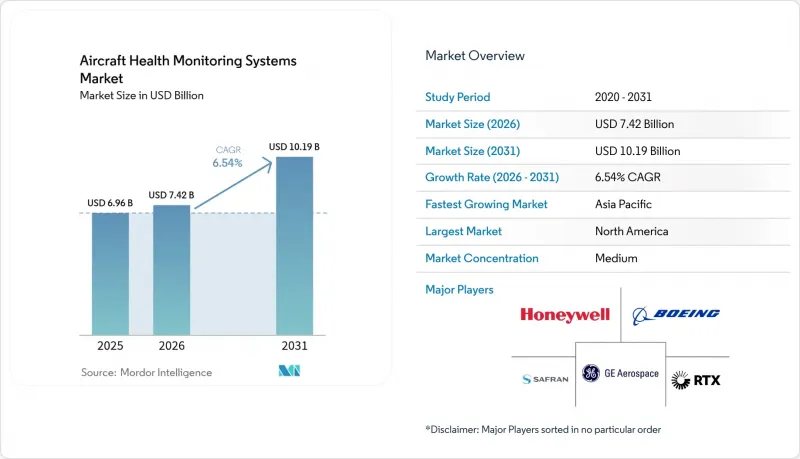
Mordor Intelligence에 따르면 항공기 상태 모니터링 시스템 시장 규모는 2025년에 69억 6,000만 달러로 평가되며, 2026년 74억 2,000만 달러에서 2031년에는 101억 9,000만 달러에 달할 것으로 예측되며, 예측 기간(2026-2031년) 동안 CAGR은 6.54%가 될 전망입니다.
본 보고서는 최종사용자(OEM, 항공사, MRO), 하위 시스템(엔진 등), 구성요소(하드웨어, 소프트웨어, 서비스), 장착 방식(라인 핏 및 레트로핏), 전송 방식(기내형 및 지상형), 항공기 유형(고정익기 등), 지역(북미, 유럽, 아시아태평양 등)별로 분류되어 있습니다. 시장 예측은 금액(달러) 기준으로 제시되어 있습니다.
세계 항공기 상태 모니터링 시스템 시장의 동향 및 인사이트
예지 정비의 필요성
각 항공사는 데이터 기반의 예측 정비를 도입한 후, 예정에 없던 정비 건수가 현저히 감소했다고 보고하고 있으며, 허니웰(Honeywell)사는 예측 정확도가 99%에 달해 부품의 조기 교체를 피할 수 있었다고 밝혔습니다. 인건비 상승과 엔진 정비 공장 입고율 증가로 인해, 특히 신세대 제트기가 비행 1회당 테라바이트 규모의 센서 데이터를 생성하는 상황에서, 예측 정비는 예산 압박에 대한 전략적 헤지 수단이 되었습니다. 그 결과, 항공기 상태 모니터링 시스템 시장은 단순한 선택적 분석 도구에서 핵심 운영 인프라로 전환되었으며, 정기 정비 기간 중에 이상을 감지하는 알고리즘이 통합되게 되었습니다. 또한, 도입이 확대됨에 따라 리스 회사 및 금융 기관에게 중요한 자산 가동률 지표도 개선되었습니다. 이러한 요인들이 종합적으로 작용하여, 항공기 상태 모니터링 시스템 시장 전체에 걸쳐 향후 수년간 강력한 투자 촉진요인으로 작용하고 있습니다.
비행 데이터 및 FOQA 데이터에 관한 규제 요건
FAA(미국 연방항공청)가 개정된 ‘비행 운영 품질 보증(FOQA)’ 지침에 따라, 미국의 운항 사업자는 지속적인 데이터 모니터링 프로그램의 도입이 의무화되었습니다. ICAO(국제민간 항공기구) 및 EASA(유럽항공안전청)의 규정도 이러한 입장을 반영하여, 요구 사항을 구조 부품 및 노후화된 항공기의 안전성까지 확대했습니다. 최대 이륙 중량(MTOW)이 20,000kg을 초과하는 운항 사업자는 현재 대규모 데이터세트를 보관하고 분석할 의무가 있으며, 이러한 규정 준수 요건이 모니터링 소프트웨어 및 보안 레코더의 확실한 고객층을 창출하고 있습니다. FOQA 조사 결과를 악용하여 항공사에 불이익을 주는 것을 방지하기 위한 조치가 자발적인 도입을 촉진하여 항공기 상태 모니터링 시스템 시장을 더욱 확대시켰습니다.
사이버 보안 및 데이터 무결성 위험
2024년 GAO(미국 정부 감사원)의 조사에서는 데이터 변조를 허용할 가능성이 있는, 패치가 적용되지 않은 항공 전자 장비 소프트웨어 및 공급망의 취약점이 지적되었습니다. IBM의 보고서에 따르면, 2020년 이후 항공 분야의 사이버 사고는 74% 증가했습니다. 센서가 침해되면 지상 직원에게 잘못된 파라미터가 전송되어 예측 대시보드에 대한 신뢰가 훼손되고, 검증이 완료될 때까지 항공기 운항이 중단될 수 있습니다. 규제 당국은 일관된 규정을 마련했으나, 운항 사업자에게는 암호화, 네트워크 분할 및 지속적인 모니터링 도구 도입에 따른 통합 비용이 여전히 과제로 남아 있습니다. 이러한 불확실성으로 인해 일부 개조 프로그램이 연기되면서 항공기 상태 모니터링 시스템 시장의 단기적인 성장이 억제되고 있습니다.
부문 분석
2025년, 항공사는 항공기 상태 모니터링 시스템 시장의 53.68%를 차지하고 있으며, 이는 운항 신뢰성과 승객 안전에 대한 직접적인 책임을 반영한 것입니다. 많은 국적 항공사는 착륙 몇 시간 전에 이상을 경고하는 OEM 대시보드를 도입하여 부품의 사전 배치 및 턴어라운드 시간 단축을 가능하게 하고 있습니다. ‘디지털 퍼스트’를 내세우는 스타트업 기업들이 완전히 연결된 기단으로 운항을 시작함에 따라, 항공사용 항공기 상태 모니터링 시스템의 시장 규모는 꾸준히 확대될 것으로 예상됩니다. 독립 정비·수리·정비(MRO) 사업자들은 분석 대시보드를 활용하여 OEM 패키지에 필적하는 고부가가치 계약을 제공하고 있으며, 연평균 성장률(CAGR) 7.31%라는 견실한 전망을 보이고 있습니다. 이러한 성장은 격납고 체류 시간을 75% 단축하는 루프트한자 테크닉(Lufthansa Technik)의 AI 기반 점검 플랫폼과 같은 계약을 통해 뒷받침되고 있습니다. 데이터 공유 프로토콜은 여전히 현안으로 남아 있습니다. 항공사는 자체 비행 프로필에 대한 인사이트를 보호하고자 하는 반면, MRO 사업자는 예측 모델을 정교화하기 위해 데이터 접근이 필요하기 때문입니다. 그 결과, 상호 접근을 보장하는 파트너십이 항공기 건전성 모니터링 시장 전체의 조달 관행을 혁신하고 있습니다.
이와 동시에, 리스 회사는 잔존 가치 추적을 지원하는 표준화된 데이터 형식을 요구하며 항공사들에게 공통 인터페이스 채택을 촉구했습니다. 저비용 항공사들은 벤더 종속을 피하기 위해 비독점적 사양의 소프트웨어를 채택함으로써 개방형 아키텍처를 통한 경쟁을 촉진했습니다. 대형 네트워크 항공사의 규모의 경제는 계속해서 센서 일괄 조달 계약을 뒷받침하고 있습니다. 그러나 지역 항공사들도 현재 구독 방식으로 클라우드 분석을 활용하고 있어, 항공기 건전성 모니터링 시스템 시장으로의 진입 경로를 확대하고 있습니다.
2025년에는 항공 추진 시스템이 전 세계 매출의 41.85%를 차지했으며, 이는 비행 안전성과 비용 측면에서 엔진 상태 모니터링이 얼마나 중요한지 여실히 드러내고 있습니다. 고바이패스비 터보팬의 높은 유지보수 비용으로 인해 첨단 진동 및 성능 분석의 도입이 정당화되었으며, 엔진 OEM 기업들은 항공기 상태 모니터링 시스템 업계의 선구자가 되었습니다. 한편, 항공기 구조 분야는 광섬유 변형 센서와 매립형 브래그 격자의 경량화 및 저가화가 진행됨에 따라 연평균 성장률(CAGR) 6.92%로 확대될 것으로 예측됩니다. 복합재 동체를 채택한 와이드바디 항공기를 운항하는 항공사들은 눈에 보이지 않는 층간 박리를 실시간으로 파악하기를 원하고 있어, 구조 건전성 대시보드에 대한 수요가 증가하고 있습니다.
규제 당국이 일부 수동 검사를 대체하는 가상 검사 기록을 승인하면, 항공기 상태 모니터링 시스템 시장에서 구조용 분야의 점유율은 더욱 확대될 가능성이 있습니다. 시뮬레이션된 하중 맵에 실시간 변형 데이터를 중첩하는 디지털 트윈 플랫폼을 통해 설계 변경 주기가 단축되어, 각 OEM 업체에게 새로운 서비스 수익 기회가 창출되고 있습니다. 한편, 항공전자, 환경 제어 및 보조동력장치(APU) 분야에서는 항공기 제조사의 성능 보증 조항을 충족하기 위해 모니터링 범위가 확대되었습니다. 여러 시스템의 분석 결과를 단일 조종석 화면에 통합하는 시장 진입 기업들은 항공기 상태 모니터링 시스템 시장에서 점유율을 더욱 확대할 것으로 전망됩니다.
지역별 분석
북미는 FAA 규제, 성숙한 MRO 인프라, 그리고 디지털 서비스의 조기 도입이 맞물려 2025년 항공기 상태 모니터링 시스템 시장에서 40.12%를 차지하며 계속해서 주요 수익원으로 자리매김했습니다. 미국의 항공사들은 새로운 안전 규정을 준수하는 25시간 기록형 레코더로 기존의 퀵 액세스 레코더를 교체하기 시작하며, 꾸준한 업그레이드 주기를 추진하고 있습니다. 캐나다 항공사들도 마찬가지로, 겨울철 신뢰성 확보를 위해 엔진 헬스 키트를 도입하며 지역 수요의 견조함을 유지했습니다. 이 지역의 항공기 상태 모니터링 시스템 시장 규모는 엄격한 사이버 규정 준수 요건을 배경으로 한 자릿수 중반대의 성장률을 유지할 것으로 예측됩니다.
아시아태평양은 2031년까지 연평균 성장률(CAGR) 7.02%를 기록하며 가장 높은 성장률을 보일 것으로 전망됩니다. 중국, 인도, 인도네시아, 태국의 국내 노선망은 운항 일정 회복 단계에서 최적화 단계로 전환되었으며, 이용률이 높은 협폭기 기단 관리에 예측형 대시보드를 활용하고 있습니다. 신형 A320neo 및 B737-8을 도입한 항공사들은 출고 시 기본으로 탑재된 진단 기능을 활용하여 항공기 건전성 모니터링 시장의 확대에 기여했습니다. 각국 정부는 클라우드 분석을 활용하여 제3자로부터 수주를 확보하고, 지역의 자급자족을 강화하는 국산 MRO 역량 육성을 추진했습니다.
유럽에서는 EASA 주도의 안전 관리 시스템 개혁에 따라 노후화된 기체에 대한 구조 건전성 평가가 의무화됨에 따라 꾸준한 교체 수요가 나타났습니다. 루프트한자 테크닉, 에어프랑스-KLM 및 여러 저비용 항공사들은 모니터링 데이터를 활용하여 부품 풀을 최적화함으로써, 탄소 가격 정책으로 인한 압박 속에서도 수익 회복력을 높였습니다. 이 지역의 디지털 트윈 연구 컨소시엄은 EU의 자금 지원을 받아 분석의 고도화를 촉진하는 한편, 항공기 상태 모니터링 시스템 시장이 더 광범위한 항공우주 혁신 목표에서 전략적 요소로 계속 자리매김할 수 있도록 보장했습니다.
기타 혜택:
- 엑셀 형식의 시장 전망(ME) 시트
- 3개월간의 애널리스트 지원
자주 묻는 질문
목차
제1장 소개
제2장 조사 방법
제3장 주요 요약
제4장 시장 구도
제5장 시장 규모와 성장 예측
제6장 경쟁 구도
제7장 시장 기회와 향후 전망
KSM 26.09.07According to Mordor Intelligence, the aircraft health monitoring systems market size was valued at USD 6.96 billion in 2025 and estimated to grow from USD 7.42 billion in 2026 to reach USD 10.19 billion by 2031, at a CAGR of 6.54% during the forecast period (2026-2031).
This report is Segmented by End User (OEMs, Airlines, and MRO), Subsystem (Engines, and More), Component (Hardware, Software, and Services), Fit (Line-Fit and Retrofit), Transmission Mode (Onboard and Ground-Based), Aircraft Type (Fixed-Wing, and More), and Geography (North America, Europe, Asia-Pacific, and More). The Market Forecasts are Provided in Terms of Value (USD).
Global Aircraft Health Monitoring Systems Market Trends and Insights
Predictive Maintenance Imperative
Airlines reported notable cuts in unscheduled maintenance events after adopting data-driven prognostics, with Honeywell indicating 99% prediction accuracy that avoided premature part removals. Rising labor costs and higher engine shop-visit rates made predictive maintenance a strategic hedge against budget pressure, especially as new-generation jets produce terabytes of sensor data per flight. Therefore, the aircraft health monitoring systems market transitioned from optional analytics to core operational infrastructure, embedding algorithms that flag anomalies during scheduled turnarounds. Wider adoption also improved asset-utilization metrics valuable to lessors and financiers. Collectively, these factors underpin a strong, multi-year stimulus for investment across the aircraft health monitoring systems market.
Regulatory Mandates for Flight and FOQA Data
The FAA's revised Flight Operational Quality Assurance circular compelled US operators to institute continuous data-monitoring programs. ICAO and EASA rules mirrored this stance, extending requirements to structural components and aging-aircraft safety. Operators above 20,000 kg MTOW must now archive and analyze large data sets, turning compliance into a guaranteed buyer pool for monitoring software and secure recorders. Protection measures that shield airlines from punitive misuse of FOQA findings fostered voluntary uptake, further enlarging the aircraft health monitoring systems market.
Cyber-security and Data-Integrity Risks
A 2024 GAO review pinpointed unpatched avionics software and supply-chain weaknesses that could permit data manipulation. IBM recorded a 74% jump in aviation-sector cyber incidents since 2020. A compromised sensor may feed spurious parameters to ground crews, undermining trust in predictive dashboards and potentially grounding aircraft until verification. Regulators drafted cohesive rules, yet operators still face integration costs for encryption, network segmentation, and continuous-monitoring tools. These uncertainties have postponed some retrofit programs and curbed near-term expansion of the aircraft health monitoring systems market.
Other drivers and restraints analyzed in the detailed report include:
- Rapid Commercial Fleet Expansion
- Connected-Aircraft and IoT Ecosystem Maturity
- High Capex/Retrofit Integration Cost
For complete list of drivers and restraints, kindly check the Table Of Contents.
Segment Analysis
Airlines held 53.68% of the aircraft health monitoring systems market in 2025, reflecting their direct accountability for dispatch reliability and passenger safety. Many flag carriers embedded OEM dashboards that flag anomalies hours before landing, allowing part pre-positioning and faster turnarounds. The aircraft health monitoring systems market size for airlines is expected to progress steadily as digital-first start-ups enter service with fully connected fleets. Independent maintenance, repair, and overhaul providers posted a brisk 7.31% CAGR outlook, using analytics dashboards to deliver value-added contracts that rival OEM packages. Their growth has been propelled by deals such as Lufthansa Technik's AI-based inspection platform that cuts hangar time by 75%. Data-sharing protocols remain a sticking point because airlines aim to preserve proprietary flight-profile insights while MROs need access to refine predictive models. Consequently, partnerships that guarantee reciprocal access reshape procurement norms across the Aircraft Health Monitoring market.
In parallel, leasing companies demanded standardized data formats that support residual-value tracking, nudging airlines toward common interfaces. Low-cost carriers embraced non-proprietary software to sidestep vendor lock-in, stimulating open-architecture competition. The scale advantages of major network airlines continue to underpin bulk sensor-procurement agreements. Yet, regional players now tap cloud analytics on a subscription basis, widening entry pathways into the aircraft health monitoring systems market.
Aero-propulsion systems generated 41.85% of global revenue in 2025, underscoring the centrality of engine condition monitoring to flight safety and cost. High-bypass turbofan maintenance bills justify sophisticated vibration and performance analytics, making engine OEMs early movers in the aircraft health monitoring systems industry. Aircraft structures, however, are projected to advance at a 6.92% CAGR as fiber-optic strain sensors and embedded Bragg gratings become lighter and cheaper. Airlines that operate composite-fuselage wide-bodies seek real-time insight into hidden delamination, elevating demand for structural-health dashboards.
The aircraft health monitoring systems market share of structural applications could widen further once regulators accept virtual inspection records in lieu of some manual checks. Digital twin platforms that overlay live strain data onto simulated load maps have shortened engineering-change cycles, opening new service revenues for OEMs. Meanwhile, avionics, environmental control, and auxiliary power units expanded monitoring to satisfy airframers' performance-guarantee clauses. Market participants that blend multi-system analytics into a single cockpit view stand to capture incremental share within the aircraft health monitoring systems market.
Complete Report Scope:
- By End User
- OEMS
- Airlines
- MRO
- By Sub-system
- Engines
- Avionics
- Aircraft Structures
- Environmental Control and Ancillary Systems
- By Component
- Hardware
- Sensors
- Avionics
- Flight Data Management Systems
- Connected Aircraft Solutions
- Ground Services
- Software
- Onboard Software
- Diagnostics Analytics
- Prognostics Analytics
- Services
- Integration and Customisation
- MRO/Condition-Monitoring Services
- Hardware
- By Fit
- Line-fit
- Retrofit
- By Transmission Mode
- Onboard
- Ground-based
- By Aircraft Type
- Fixed-Wing
- Commercial Aviation
- Narrowbody Aircraft
- Widebody Aircraft
- Regional Transport Aircraft
- Military Aviation
- Fighter Aircraft
- Transport Aircraft
- Special Mission Aircraft
- Business and General Aviation
- Business Jets
- Light Aircraft
- Commercial Aviation
- Rotary Wing
- Commercial Helicopters
- Military Helicopters
- Military Unmmaned Aerial Vehicles
- Advanced Air Mobility
- Fixed-Wing
- By Geography
- North America
- United States
- Canada
- Mexico
- Europe
- Germany
- United Kingdom
- France
- Russia
- Rest of Europe
- Asia-Pacific
- China
- India
- Japan
- South Korea
- Australia
- Rest of Asia-Pacific
- South America
- Brazil
- Rest of South America
- Middle East and Africa
- Middle East
- United Arab Emirates
- Saudi Arabia
- Israel
- Rest of Middle East
- Africa
- South Africa
- Rest of Africa
- Middle East
- North America
Geography Analysis
North America remained the principal revenue center with 40.12% of the aircraft health monitoring systems market in 2025 as FAA mandates, mature MRO infrastructure, and early digital-service adoption converged. US carriers began replacing legacy quick-access recorders with 25-hour versions that align with new safety mandates, driving a steady upgrade cycle. Canadian operators similarly adopted engine-health kits for winter reliability, keeping regional demand resilient. The aircraft health monitoring systems market size within the region is forecast to retain mid-single-digit growth amid strict cyber-compliance requirements.
Asia-Pacific is projected to post the fastest 7.02% CAGR through 2031. Domestic networks in China, India, Indonesia, and Thailand moved from schedule recovery to optimization, relying on predictive dashboards to manage high-utilization narrow-body fleets. Airlines deploying new A320neo and B737-8 aircraft obtained factory-installed diagnostics, expanding the Aircraft Health Monitoring market. Governments promoted indigenous MRO capability, which leveraged cloud analytics to win third-party business, reinforcing regional self-sufficiency.
Europe delivered steady replacement demand amid EASA-driven safety-management-system reforms that compel structural-health assessments on aging airframes. Lufthansa Technik, Air France-KLM, and multiple low-cost carriers used monitoring data to refine parts pooling, improving profit resilience under carbon-pricing pressure. The region's digital-twin research consortia attracted EU funding, enhancing analytic sophistication and ensuring that the aircraft health monitoring systems market remains a strategic component of broader aerospace innovation goals.
- The Boeing Company
- General Electric Company
- RTX Corporation
- Honeywell International Inc.
- Safran SA
- Rolls-Royce plc
- Meggitt PLC
- Curtiss-Wright Corporation
- FLYHT Aerospace Solutions Ltd.
- Lufthansa Technik AG
- MTU Aero Engines AG
- Ultra Precision Control Systems (Ultra Group)
- Eve Holding, Inc.
- Airbus SE
- EXSYN Aviation Solutions
- RSL Electronics Ltd.
Additional Benefits:
- The market estimate (ME) sheet in Excel format
- 3 months of analyst support
TABLE OF CONTENTS
1 INTRODUCTION
- 1.1 Study Assumptions and Market Definition
- 1.2 Scope of the Study
2 RESEARCH METHODOLOGY
3 EXECUTIVE SUMMARY
4 MARKET LANDSCAPE
- 4.1 Market Overview
- 4.2 Market Drivers
- 4.2.1 Predictive maintenance imperative
- 4.2.2 Regulatory mandates for flight and FOQA data
- 4.2.3 Rapid commercial fleet expansion
- 4.2.4 Connected-aircraft and IoT ecosystem maturity
- 4.2.5 Digital-twin-driven virtual sensor modelling
- 4.2.6 On-board edge-AI avionics processors
- 4.3 Market Restraints
- 4.3.1 Cyber-security and data-integrity risks
- 4.3.2 High capex/retrofit integration cost
- 4.3.3 Operator-lessor-OEM data-ownership disputes
- 4.3.4 Sensor ruggedization limits on ageing fleets
- 4.4 Value Chain Analysis
- 4.5 Regulatory Landscape
- 4.6 Technological Outlook
- 4.7 Porter's Five Forces Analysis
- 4.7.1 Threat of New Entrants
- 4.7.2 Bargaining Power of Buyers
- 4.7.3 Bargaining Power of Suppliers
- 4.7.4 Threat of Substitutes
- 4.7.5 Competitive Rivalry
5 MARKET SIZE AND GROWTH FORECASTS (VALUE)
- 5.1 By End User
- 5.1.1 OEMS
- 5.1.2 Airlines
- 5.1.3 MRO
- 5.2 By Sub-system
- 5.2.1 Engines
- 5.2.2 Avionics
- 5.2.3 Aircraft Structures
- 5.2.4 Environmental Control and Ancillary Systems
- 5.3 By Component
- 5.3.1 Hardware
- 5.3.1.1 Sensors
- 5.3.1.2 Avionics
- 5.3.1.3 Flight Data Management Systems
- 5.3.1.4 Connected Aircraft Solutions
- 5.3.1.5 Ground Services
- 5.3.2 Software
- 5.3.2.1 Onboard Software
- 5.3.2.2 Diagnostics Analytics
- 5.3.2.3 Prognostics Analytics
- 5.3.3 Services
- 5.3.3.1 Integration and Customisation
- 5.3.3.2 MRO/Condition-Monitoring Services
- 5.3.1 Hardware
- 5.4 By Fit
- 5.4.1 Line-fit
- 5.4.2 Retrofit
- 5.5 By Transmission Mode
- 5.5.1 Onboard
- 5.5.2 Ground-based
- 5.6 By Aircraft Type
- 5.6.1 Fixed-Wing
- 5.6.1.1 Commercial Aviation
- 5.6.1.1.1 Narrowbody Aircraft
- 5.6.1.1.2 Widebody Aircraft
- 5.6.1.1.3 Regional Transport Aircraft
- 5.6.1.2 Military Aviation
- 5.6.1.2.1 Fighter Aircraft
- 5.6.1.2.2 Transport Aircraft
- 5.6.1.2.3 Special Mission Aircraft
- 5.6.1.3 Business and General Aviation
- 5.6.1.3.1 Business Jets
- 5.6.1.3.2 Light Aircraft
- 5.6.1.1 Commercial Aviation
- 5.6.2 Rotary Wing
- 5.6.2.1 Commercial Helicopters
- 5.6.2.2 Military Helicopters
- 5.6.3 Military Unmmaned Aerial Vehicles
- 5.6.4 Advanced Air Mobility
- 5.6.1 Fixed-Wing
- 5.7 By Geography
- 5.7.1 North America
- 5.7.1.1 United States
- 5.7.1.2 Canada
- 5.7.1.3 Mexico
- 5.7.2 Europe
- 5.7.2.1 Germany
- 5.7.2.2 United Kingdom
- 5.7.2.3 France
- 5.7.2.4 Russia
- 5.7.2.5 Rest of Europe
- 5.7.3 Asia-Pacific
- 5.7.3.1 China
- 5.7.3.2 India
- 5.7.3.3 Japan
- 5.7.3.4 South Korea
- 5.7.3.5 Australia
- 5.7.3.6 Rest of Asia-Pacific
- 5.7.4 South America
- 5.7.4.1 Brazil
- 5.7.4.2 Rest of South America
- 5.7.5 Middle East and Africa
- 5.7.5.1 Middle East
- 5.7.5.1.1 United Arab Emirates
- 5.7.5.1.2 Saudi Arabia
- 5.7.5.1.3 Israel
- 5.7.5.1.4 Rest of Middle East
- 5.7.5.2 Africa
- 5.7.5.2.1 South Africa
- 5.7.5.2.2 Rest of Africa
- 5.7.5.1 Middle East
- 5.7.1 North America
6 COMPETITIVE LANDSCAPE
- 6.1 Market Concentration
- 6.2 Strategic Moves and Funding
- 6.3 Market Share Analysis
- 6.4 Company Profiles (includes Global-level Overview, Market-level Overview, Core Segments, Financials, Strategic Information, Market Rank/Share, Products and Services, Recent Developments)
- 6.4.1 The Boeing Company
- 6.4.2 General Electric Company
- 6.4.3 RTX Corporation
- 6.4.4 Honeywell International Inc.
- 6.4.5 Safran SA
- 6.4.6 Rolls-Royce plc
- 6.4.7 Meggitt PLC
- 6.4.8 Curtiss-Wright Corporation
- 6.4.9 FLYHT Aerospace Solutions Ltd.
- 6.4.10 Lufthansa Technik AG
- 6.4.11 MTU Aero Engines AG
- 6.4.12 Ultra Precision Control Systems (Ultra Group)
- 6.4.13 Eve Holding, Inc.
- 6.4.14 Airbus SE
- 6.4.15 EXSYN Aviation Solutions
- 6.4.16 RSL Electronics Ltd.
7 MARKET OPPORTUNITIES AND FUTURE OUTLOOK
- 7.1 White-space and Unmet-Need Assessment


