

|
시장보고서
상품코드
2121661
PMMA 마이크로스피어 : 시장 점유율 분석, 업계 동향과 통계, 성장 예측(2026-2031년)PMMA Microspheres - Market Share Analysis, Industry Trends & Statistics, Growth Forecasts (2026 - 2031) |
||||||
 Mordor Intelligence
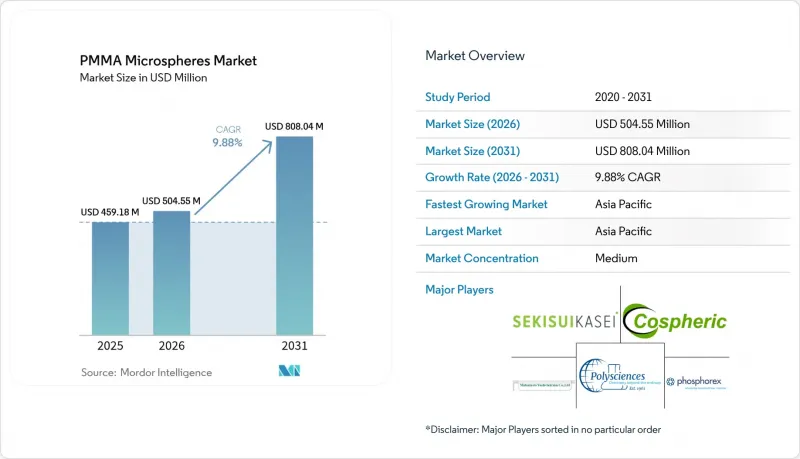
Mordor Intelligence에 의하면, PMMA 마이크로스피어 시장 규모는 2025년 4억 5,918만 달러에서 2026년에는 5억 455만 달러에 이르고, 2026-2031년 CAGR 9.88%로 성장을 지속하여 2031년까지 8억 804만 달러에 달할 것으로 예측됩니다.
본 보고서는 용도별(광확산제, 무광제, 화장품 첨가제 등), 최종 사용자 산업별(생명과 및 의료, 퍼스널케어 및 화장품, 전자제품 등), 입자 크기(0-30마이크론, 30-100마이크론, 100마이크론 초과), 지역(아시아태평양, 북미, 유럽, 남미, 중동 및 아프리카)별로 분류되어 있습니다. 시장 예측은 금액(달러) 기준으로 제시되어 있습니다.
전 세계 PMMA 마이크로스피어 시장 동향 및 인사이트
저침습 미용 치료 분야에서 PMMA 피부 필러 수요 증가
PMMA 마이크로스피어를 20% 함유하고 있으며, FDA 승인을 받은 유일한 영구 주입제인 ‘벨라필(Bellafill)’은 최대 15년간 지속되는 주름 개선 효과를 제공합니다. 4,725건의 엉덩이 확대 수술에서 보고된 0.011%라는 낮은 육아종 발생률은 이 제품의 장기적인 안전성을 입증합니다. 30-50µm 범위의 마이크로스피어는 식균 작용에 저항하면서도 콜라겐의 내생 생성을 촉진하여 내구성 있는 조직 지지를 제공합니다. 대용량 바디 컨투어링에의 사용이 안면 미용을 넘어 환자층을 확대하며, PMMA 마이크로스피어 시장을 견인하고 있습니다. 클리닉에서는 재치료 빈도의 감소가 높이 평가되고 있어, 의료용 등급 공급업체에게 안정적인 수요를 창출하고 있습니다.
약물 전달 및 색전 요법에서의 용도 확대
PMMA 마이크로스피어는 폴리스티렌에 비해 비특이적 단백질 결합이 적어 서방형 시스템에서 생체 적합성을 향상시킵니다. 표면의 카르복실기는 약물의 결합성을 높이며, 1.19 g/cc의 밀도는 원심 분리 처리를 용이하게 합니다. 50 nm의 기공을 가진 단분산 다공성 입자의 연속 생산을 통해 현재는 항암제 용출 비드를 제조할 수 있게 되었습니다. 연속 생산을 통해 비용 절감과 배치 간 일관성 향상이 기대되므로 상업적 관심이 높아지고 있습니다.
영구성 피부 필러의 안전성에 대한 규제 당국의 면밀한 검토
FDA 승인을 받은 PMMA계 필러는 단 1개 제품에 불과하여, 증거 요건의 엄격함이 부각되고 있습니다. 유해 사건은 주입 깊이와 상관관계가 있으며, 점막하 주입은 결절 형성 위험을 높이기 때문에 시술자에 대한 교육이 의무화되어 있습니다. 소 콜라겐을 운반체로 사용하는 제품에 대한 피부 테스트 의무화로 인해 비용이 증가하고 있습니다. 신흥 시장에서는 규제가 강화되고 있어 승인까지의 기간이 장기화될 가능성이 있으며, 임상적 내구성의 이점이 있음에도 불구하고 광범위한 보급이 제한될 우려가 있습니다.
부문 분석
2025년, PMMA 마이크로스피어 시장 점유율의 34.78%를 화장품 첨가제 용도가 차지했습니다. 이는 실키한 질감, 소프트 포커스 효과, 그리고 유효 성분의 제어된 방출을 제공한다는 점에서 높이 평가받고 있습니다. 프리미엄 스킨케어, 컬러 코스메틱, 자외선 차단 제품의 경우, 안전 감사 요건을 충족하기 위해 의료용 등급으로 MMA 잔류량이 적은 비드가 계속해서 지정되고 있습니다. 그러나 EU의 미세 플라스틱 규제로 인해 대량 생산되는 대중용 로션은 바이오 충전제로 전환되고 있으며, PMMA 수요는 씻어내지 않는 유형의 세럼이나 타겟이 명확한 안티에이징 제품 라인으로 이동하고 있습니다. 세라믹 폴로젠의 용도는 연평균 성장률(CAGR) 11.55%로 확대되고 있습니다. 이는 적층 가공된 알루미나 및 지르코니아 부품에서 내열 충격성에 필수적인 균일한 기공 네트워크를 형성하기 위해 희생되는 PMMA 템플릿이 필요하기 때문입니다. 디스플레이 필름용 광산란제 및 산업 용도료의 무광화 첨가제는 각각 에너지 효율 향상과 저광택 마감을 실현함으로써 한 자릿수 중반대의 성장세를 유지하고 있습니다. 개질 플라스틱용 첨가제 및 도료·잉크용 첨가제 부문에서는 PMMA 마이크로스피어가 충격 강도 및 유변학 제어를 향상시키기 때문에 안정적인 수요가 나타나고 있습니다.
지역별 분석
2025년에는 아시아태평양이 PMMA 마이크로스피어 시장 점유율의 39.05%를 차지하며 1위를 기록했습니다. 중국의 디스플레이 패널 제조업체, 일본의 정밀 화학 전문 기업, 그리고 한국의 가전 브랜드가 견조한 수요의 기반을 형성하고 있습니다. 스미토모 화학의 싱가포르 사업 재편을 포함한 생산 능력 통합으로 인해, 이 지역공급은 특수 등급으로 전환되고 있지만, 2031년까지의 판매량 증가율은 연평균 성장률(CAGR) 10.44%를 유지할 전망입니다. 반도체 및 의료기기 공급망에 대한 정부의 지원책으로 인해, 하류 분야의 소비는 더욱 확대되고 있습니다.
북미에서는 FDA의 엄격한 기준이 호재로 작용하여, 주사용 필러 및 진단 기구용 ISO 13485 준수 비드의 국내 생산이 촉진되고 있습니다. ‘벨라필(Bellafill)’ 브랜드가 안정적인 의료 수요 기반을 구축하고 있는 한편, 위스콘신주에 본사를 둔 누리용(Nouryon)사는 포장재 및 건설용 첨가제용 특수 마이크로스피어의 생산 규모를 확대되고 있습니다. 의약품 전달 스타트업에 대한 연구개발 세액 공제 및 벤처 캐피털의 자금 지원 덕분에, 범용 제품의 생산량이 해외로 이전되는 상황 속에서도 혁신 주도형 수요는 유지되고 있습니다.
유럽은 폴리머 미세 입자에 관한 규제가 가장 엄격한 지역이지만, 독일과 네덜란드의 선진 제조 거점에서는 PMMA 마이크로스피어가 고수익률을 자랑하는 코팅, 자동차용 광학 기기, 그리고 체내에서 사용되는 의료기기로 공급되고 있습니다. 각 생산 기업은 EU의 순환 경제 목표에 부합하는 바이오 또는 화학적 재활용 원료에 대한 투자를 추진하고 있으며, 소폭이지만 수익성 높은 성장을 유지하고 있습니다. 남미, 중동 및 아프리카는 여전히 신흥 기회 지역으로, 의료 인프라 확충과 인프라용 코팅재의 채택 확대가 수요 증가를 이끌고 있으나, 수입 의존도와 규제 불균일성이 급속한 확장을 저해하고 있습니다.
기타 혜택:
- 엑셀 형식 시장 예측(ME) 시트
- 3개월간의 애널리스트 지원
자주 묻는 질문
목차
제1장 서론
제2장 조사 방법
제3장 주요 요약
제4장 시장 구도
제5장 시장 규모와 성장 예측
제6장 경쟁 구도
제7장 시장 기회와 향후 전망
LSH 26.09.09According to Mordor Intelligence, the PMMA microspheres market size is expected to grow from USD 459.18 million in 2025 to USD 504.55 million in 2026 and is forecast to reach USD 808.04 million by 2031 at 9.88% CAGR over 2026-2031.
This report is Segmented by Application (Light Diffusing Agent, Matting Agent, Cosmetic Additive, and More), End-User Industry (Lifesciences & Medical, Personal Care & Cosmetics, Electronics, and More), Particle Size (0-30 Mm, 30-100 Mm, Greater Than 100 Mm), and Geography (Asia-Pacific, North America, Europe, South America, Middle East & Africa). The Market Forecasts are Provided in Terms of Value (USD).
Global PMMA Microspheres Market Trends and Insights
Growing Demand for PMMA Dermal Fillers in Minimally-Invasive Aesthetics
Bellafill, the only FDA-approved permanent injectable containing 20% PMMA microspheres, delivers wrinkle correction that persists for up to 15 years. A low 0.011% granuloma incidence reported across 4,725 gluteal-augmentation procedures underscores long-term safety. Microspheres in the 30-50 µm range resist phagocytosis yet foster collagen ingrowth, providing durable tissue support. Large-volume body-contouring usage is expanding the PMMA microspheres market by broadening the patient base beyond facial aesthetics. Clinics value reduced retreatment frequency, creating steady pull-through for medical-grade suppliers.
Expanding Use in Drug-Delivery & Embolization Therapies
PMMA microspheres offer lower nonspecific protein binding than polystyrene, improving biocompatibility in controlled-release systems. Surface carboxyl functionality enhances drug conjugation, while the density of 1.19 g/cc eases centrifugation handling. Continuous production of monodisperse porous particles with 50 nm pores now supports oncology drug-eluting beads. Commercial interest is rising as continuous manufacturing cuts costs and tightens batch consistency.
Regulatory Scrutiny Over Permanent Dermal-Filler Safety
Only one PMMA-based filler has FDA clearance, underscoring rigorous evidence requirements. Adverse events correlate with injection depth; submucosal placement increases nodule formation, prompting practitioner training mandates. Mandatory skin tests for bovine collagen carriers add cost. Emerging markets are tightening regulations, potentially lengthening approval timelines, and limiting broad uptake despite clinical durability advantages.
Other drivers and restraints analyzed in the detailed report include:
- Rising Utilisation in Personal-Care Formulations for Texture Enhancement
- Microfluidic Diagnostic Devices Requiring PMMA Calibration Beads
- MMA Monomer Price Volatility Impacting Production Costs
For complete list of drivers and restraints, kindly check the Table Of Contents.
Segment Analysis
Cosmetic Additive applications held 34.78% of PMMA microspheres market share in 2025, valued for imparting silky texture, soft-focus optics, and controlled release of actives. Premium skincare, color cosmetics, and suncare continue to specify medical-grade, low-residual MMA beads to satisfy safety audits. EU microplastic rules, however, are shifting large-volume mass-market lotions toward bio-based fillers, redirecting PMMA demand into leave-on serums and targeted anti-aging lines. Ceramic Porogen uses are accelerating at an 11.55% CAGR, as additive-manufactured alumina and zirconia components require sacrificial PMMA templates to engineer uniform pore networks critical for thermal-shock resistance. Light-diffusing agents in display films and matting additives in industrial coatings sustain mid-single-digit growth by delivering energy efficiency and low-gloss finishes, respectively. Modified Plastic Additive and Paints & Inks Additive segments absorb steady volumes where PMMA microspheres improve impact strength and rheology control.
Complete Report Scope:
- By Application
- Light Diffusing Agent
- Matting Agent
- Cosmetic Additive
- Ceramic Porogen
- Modified Plastic Additive
- Paints and Inks Additive
- Other Applications
- By End-user Industry
- Lifesciences and Medical
- Personal Care and Cosmetics
- Electronics
- Paints and Coatings
- Plastics
- Ceramics and Composites
- Other End-user Industries
- By Particle Size
- 0 - 30 µm
- 30 - 100 µm
- Greater than 100 µm
- By Geography
- Asia-Pacific
- China
- Japan
- India
- South Korea
- Rest of Asia-Pacific
- North America
- United States
- Canada
- Mexico
- Europe
- Germany
- United Kingdom
- France
- Italy
- Rest of Europe
- South America
- Brazil
- Argentina
- Rest of South America
- Middle East and Africa
- Saudi Arabia
- South Africa
- Rest of Middle East and Africa
- Asia-Pacific
Geography Analysis
Asia-Pacific led with 39.05% of PMMA microspheres market share in 2025. China's display-panel makers, Japanese fine-chemicals specialists, and South Korean consumer-electronics brands provide a robust demand backbone. Capacity consolidation, including Sumitomo Chemical's Singapore restructuring, nudges regional supply toward specialty grades yet maintains volume growth through 2031 at a 10.44% CAGR. Government incentives for semiconductor and medical-device supply chains further broaden downstream consumption.
North America benefits from stringent FDA standards, which favor domestic output of ISO-13485-compliant beads for injectable fillers and diagnostics. The Bellafill franchise anchors steady medical demand, while Wisconsin-based Nouryon has scaled specialty microsphere output for packaging and construction additives. R&D tax credits and venture capital funding in drug-delivery start-ups sustain innovation-driven consumption even as commodity volumes migrate offshore.
Europe faces the most restrictive polymer-micro-particle regulation, yet advanced-manufacturing bases in Germany and the Netherlands channel PMMA microspheres into high-margin coatings, automotive optics, and implantable medical devices. Producers are investing in bio-based or chemically recycled feedstocks that align with EU circular-economy goals, sustaining modest but profitable growth. South America and the Middle East & Africa remain emerging opportunity zones where growing healthcare infrastructure and infrastructure coatings uptake create incremental demand, though import dependence and regulatory variability temper rapid expansion.
- Bangs Laboratories, Inc.
- CD Bioparticles
- Cospheric LLC
- EPRUI Biotech Co.,Ltd.
- Goodfellow Cambridge Ltd.
- Heyo Enterprises Co., Ltd.
- Kayaku AM.
- Matsumoto Yushi-Seiyaku Co.,Ltd
- microParticles GmbH
- Phosphorex
- Polysciences
- Sekisui Kasei Co., Ltd.
- Sumitomo Chemical Co., Ltd.
- Sunjin Beauty Science
Additional Benefits:
- The market estimate (ME) sheet in Excel format
- 3 months of analyst support
TABLE OF CONTENTS
1 Introduction
- 1.1 Study Assumptions and Market Definition
- 1.2 Scope of the Study
2 Research Methodology
3 Executive Summary
4 Market Landscape
- 4.1 Market Overview
- 4.2 Market Drivers
- 4.2.1 Growing demand for PMMA dermal fillers in minimally-invasive aesthetics
- 4.2.2 Expanding use in drug-delivery and embolization therapies
- 4.2.3 Adoption as light-diffusing and matting agents in LED/LCD, coatings
- 4.2.4 Rising utilisation in personal-care formulations for texture enhancement
- 4.2.5 Microfluidic diagnostic devices requiring PMMA calibration beads
- 4.3 Market Restraints
- 4.3.1 Regulatory scrutiny over permanent dermal-filler safety
- 4.3.2 MMA monomer price volatility impacting production costs
- 4.3.3 Limited global capacity for monodisperse high-precision grades
- 4.4 Value Chain Analysis
- 4.5 Porter's Five Forces
- 4.5.1 Bargaining Power of Suppliers
- 4.5.2 Bargaining Power of Buyers
- 4.5.3 Threat of New Entrants
- 4.5.4 Threat of Substitutes
- 4.5.5 Degree of Competition
5 Market Size and Growth Forecasts (Value)
- 5.1 By Application
- 5.1.1 Light Diffusing Agent
- 5.1.2 Matting Agent
- 5.1.3 Cosmetic Additive
- 5.1.4 Ceramic Porogen
- 5.1.5 Modified Plastic Additive
- 5.1.6 Paints and Inks Additive
- 5.1.7 Other Applications
- 5.2 By End-user Industry
- 5.2.1 Lifesciences and Medical
- 5.2.2 Personal Care and Cosmetics
- 5.2.3 Electronics
- 5.2.4 Paints and Coatings
- 5.2.5 Plastics
- 5.2.6 Ceramics and Composites
- 5.2.7 Other End-user Industries
- 5.3 By Particle Size
- 5.3.1 0 - 30 µm
- 5.3.2 30 - 100 µm
- 5.3.3 Greater than 100 µm
- 5.4 By Geography
- 5.4.1 Asia-Pacific
- 5.4.1.1 China
- 5.4.1.2 Japan
- 5.4.1.3 India
- 5.4.1.4 South Korea
- 5.4.1.5 Rest of Asia-Pacific
- 5.4.2 North America
- 5.4.2.1 United States
- 5.4.2.2 Canada
- 5.4.2.3 Mexico
- 5.4.3 Europe
- 5.4.3.1 Germany
- 5.4.3.2 United Kingdom
- 5.4.3.3 France
- 5.4.3.4 Italy
- 5.4.3.5 Rest of Europe
- 5.4.4 South America
- 5.4.4.1 Brazil
- 5.4.4.2 Argentina
- 5.4.4.3 Rest of South America
- 5.4.5 Middle East and Africa
- 5.4.5.1 Saudi Arabia
- 5.4.5.2 South Africa
- 5.4.5.3 Rest of Middle East and Africa
- 5.4.1 Asia-Pacific
6 Competitive Landscape
- 6.1 Market Concentration
- 6.2 Strategic Moves
- 6.3 Market Share(%)/Ranking Analysis
- 6.4 Company Profiles (includes Global level Overview, Market level overview, Core Segments, Financials as available, Strategic Information, Market Rank/Share for key companies, Products and Services, and Recent Developments)
- 6.4.1 Bangs Laboratories, Inc.
- 6.4.2 CD Bioparticles
- 6.4.3 Cospheric LLC
- 6.4.4 EPRUI Biotech Co.,Ltd.
- 6.4.5 Goodfellow Cambridge Ltd.
- 6.4.6 Heyo Enterprises Co., Ltd.
- 6.4.7 Kayaku AM.
- 6.4.8 Matsumoto Yushi-Seiyaku Co.,Ltd
- 6.4.9 microParticles GmbH
- 6.4.10 Phosphorex
- 6.4.11 Polysciences
- 6.4.12 Sekisui Kasei Co., Ltd.
- 6.4.13 Sumitomo Chemical Co., Ltd.
- 6.4.14 Sunjin Beauty Science
7 Market Opportunities and Future Outlook
- 7.1 White-space and Unmet-need Assessment


