

|
시장보고서
상품코드
2121667
헬스케어 예측 분석 : 시장 점유율 분석, 업계 동향과 통계, 성장 예측(2026-2031년)Healthcare Predictive Analytics - Market Share Analysis, Industry Trends & Statistics, Growth Forecasts (2026 - 2031) |
||||||
 Mordor Intelligence
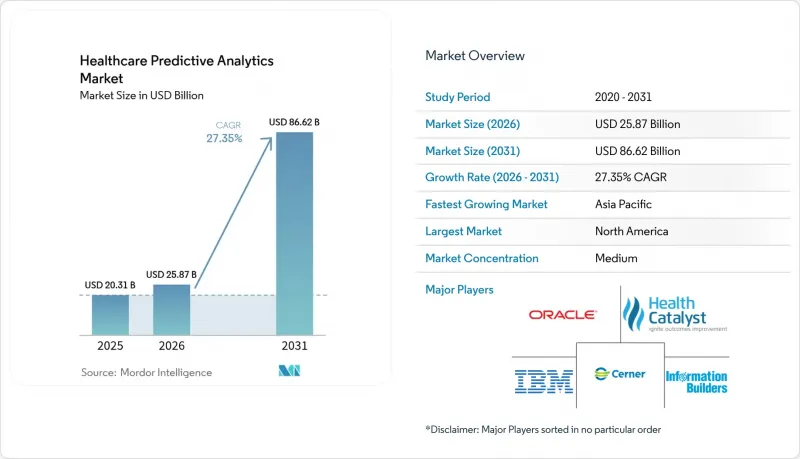
Mordor Intelligence에 따르면 헬스케어 예측 분석 시장 규모는 2025년 203억 1,000만 달러에서 2026년에는 258억 7,000만 달러로 확대되고, 2026년부터 2031년까지 CAGR 27.35%를 기록하며 2031년에는 866억 2,000만 달러에 달할 것으로 예측됩니다.
본 보고서에서는 업계를 용도별(임상 데이터 분석, 재무 데이터 분석 등), 분석 유형별(기술적 분석, 예측 분석 등), 구성요소별(소프트웨어 등), 제공 형태별(온프레미스 등), 및 지역별(북미, 유럽, 아시아태평양, 중동 및 아프리카, 남미)로 분류하고 있습니다. 시장 예측은 금액(달러) 기준으로 제시되어 있습니다.
세계 헬스케어 예측 분석 시장의 동향 및 인사이트
맞춤형 의료 및 근거 기반 의료의 도입
의료 서비스 제공자는 멀티오믹스 데이터와 사회적 결정 요인에 대한 정보를 위험 평가 엔진에 통합하여 정밀 의학을 추진하는 동시에 유해 사건을 줄이고 있습니다. 2025년에 발표된 FDA 지침에는 투명성이 높고 편향이 완화된 알고리즘을 촉진하는 라이프사이클 관리의 개요가 제시되어 있습니다. 현재 대규모 학술 기관에서는 AI 예산의 거의 절반을 맞춤형 모니터링 및 진단 솔루션에 할당하고 있습니다. 유전체 데이터와 전자건강기록(EHR)의 통합으로 종양학 분야의 획기적인 발전이 가속화되고 있으며, 이를 조기에 도입한 기관들은 더욱 개인화된 치료 계획 덕분에 환자 참여도가 향상되었다고 보고하고 있습니다.
가치 기반 보상 모델에 따른 효율화 압력
성과 개선과 비용 절감을 평가하는 대체 지불 제도 덕분에 실시간 위험 계층화가 일상 업무에 통합되고 있습니다. 미국 CMS(의료보험서비스센터)의 인센티브로 인해 두 자릿수 영업이익률 향상을 실현하는 신속한 도입이 촉진되고 있습니다. 의료 기관은 예측적 트리아지를 활용하여 예정에 없던 입원을 방지하고, 급성기 이후 서비스를 조정함으로써 분석 투자에 대해 120%를 넘는 수익을 달성하고 있습니다. 또한, 적시 알림은 인력 배치 최적화에도 기여하여, 2022년 이후 인력 부족으로 급증한 초과 근무 수당을 절감하고 있습니다.
부족한 엔터프라이즈급 데이터 인프라
분산된 아키텍처가 데이터세트 통합을 방해하고 있어, 경영진의 94%가 2024년 최우선 과제 상위 3가지 중 하나로 업그레이드를 꼽고 있습니다. 조직 내 데이터 리터러시가 높다고 응답한 비율은 고작 28%에 그쳐 모델의 실용화가 지연되고 있습니다. 소규모 병원의 경우, 실시간 추론에 필수적인 클라우드 전환이나 고성능 컴퓨팅 노드에 대한 자금 조달이 난항을 겪고 있어 프로젝트 일정이 지연되고, 임상 현장에서의 조기 성과 달성이 제한되고 있습니다.
부문 분석
2025년, 헬스케어 예측 분석 시장에서 재무 분석은 27.35%의 점유율을 유지했습니다. 이는 수익 주기 최적화와 부정 탐지가 주도한 결과입니다. 정액제 계약에서는 코딩 오류나 청구 거부에 대해 벌금이 부과되기 때문에 이 부문은 여전히 매우 중요합니다. 이와 동시에, 임상 분석 분야의 헬스케어 예측 분석 시장 규모는 연평균 성장률(CAGR) 29.60%로 확대될 것으로 예상되며, 이는 의료 제공자들이 치료 결과의 격차를 해소하고 치료를 개인화하려는 의도를 반영한 것입니다. 임상 분야의 도입 사례로는 패혈증 경보, 사망률 예측, 수술실 일정 관리 등이 있으며, 이는 환자 안전 및 자원 활용 측면에서 측정 가능한 개선을 가져오고 있습니다.
합성 데이터에 대한 지속적인 투자를 통해 희귀질환 모델링이 강화되고 있으며, 결핵 관련 연구에서는 91%의 진단 정확도를 달성했습니다. 이 기능은 현재 보다 광범위한 임상 분석 제품군에 통합되어 있습니다. 인구 건강 모듈은 보험 청구 데이터, 약국 데이터, 사회적 결정 요인 등의 정보를 집계하여 예방적 아웃리치를 지원합니다. 운영 및 공급망용 애플리케이션은 재고 보유 비용 절감 및 수술 건수 균형 조정을 통해 부가가치를 창출하며, 헬스케어 예측 분석 시장의 장기적인 성장을 뒷받침하는 다양한 수요 프로필을 형성하고 있습니다.
2025년, 조직들이 과거 성과에 대한 기본적인 가시성을 추구함에 따라 헬스케어 예측 분석 시장에서 설명형 도구의 매출 점유율은 50.85%를 차지했습니다. 이러한 플랫폼은 첨단 기술로의 발판 역할을 하고 있지만, 그 성숙도는 변화하고 있습니다. 인지 분석(Cognitive Analytics)에 기인한 헬스케어 예측 분석 시장 규모는 비정형 메모를 분석하는 자연어 처리 및 환자 요약문을 생성하는 생성형 AI에 힘입어 연평균 성장률(CAGR) 36.10%로 확대될 전망입니다.
규제 프레임워크에 따라 현재 적응형 알고리즘이 허용되면서, 정적인 스코어카드에서 개입 방안을 제안하는 능동적인 AI로의 전환이 가속화되고 있습니다. 설명 가능성은 여전히 필수적이며, 각 벤더는 변수의 영향을 추적할 수 있는 해석 가능한 계층을 통합하여 규정 준수 팀의 요구 사항을 충족하고 있습니다. 아직 발전 단계에 있는 처방형 모듈은 투약량 조정이나 인력 배치 변경을 권장합니다. 동종 업계 기업과의 벤치마킹에 따르면, 조기 도입 기업들은 의사결정 주기를 3분의 1로 단축했으며, 이는 전사적인 더 광범위한 도입을 촉진하고 있습니다.
지역별 분석
북미는 EHR(전자건강기록)의 광범위한 보급, CMS(미국 의료보험서비스센터)의 품질 인센티브, 그리고 FDA(미국 식품의약국)의 적극적인 감독에 힘입어 2025년 헬스케어 예측 분석 시장의 전 세계 매출의 37.75%를 차지했습니다. 주요 통합 의료 제공 네트워크에서는 임상, 재무, 운영 각 분야에 걸쳐 학제간 분석 팀을 운영하며, 검증된 모델을 생성하여 병원의 의사결정 센터에 정보를 제공하고 있습니다. 분석 투자에 대한 평균 수익률은 120%를 초과하여 지속적인 예산 편성이 뒷받침되고 있습니다.
유럽은 충분한 자금이 투입된 국가 차원의 디지털화 계획과, 데이터 보호 및 알고리즘 투명성을 우선시하는 유럽연합(EU)의 AI법에 힘입어 그 뒤를 따르고 있습니다. 독일, 영국, 프랑스에서는 초기 비용을 보전하고 공급업체 인증을 가속화하는 정부 보조금이 제공되고 있습니다. 윤리 심사 위원회는 도입으로 인해 대중의 신뢰를 잃는 것을 방지하고 있지만, 행정 절차가 번거로워 미국에 비해 상용화 속도는 더딘 편입니다.
아시아태평양은 2031년까지 연평균 성장률(CAGR) 30.95%를 기록할 것으로 예상되며, 헬스케어 예측 분석 시장의 성장 중심지가 될 전망입니다. 중국, 일본, 인도의 각국 보험 제도 개혁이 원격의료, 클라우드 호스팅, AI 연구를 뒷받침하며 대규모 보급을 촉진하고 있습니다. 민관 파트너십을 통해 병원의 IT 인프라가 쇄신되고 있으며, 지역 클라우드 제공업체들은 주권법에 부합하기 위해 데이터센터의 현지화를 추진하고 있습니다. 전략적 로드맵에서는 질병 감시 및 재난 대응을 위한 예측 분석이 우선순위로 지정되어 있어, 이를 통해 지역의 장기적인 성장 모멘텀이 확고해지고 있습니다.
기타 혜택:
- 엑셀 형식의 시장 예측(ME) 시트
- 3개월간 애널리스트 지원
자주 묻는 질문
목차
제1장 소개
제2장 조사 방법
제3장 주요 요약
제4장 시장 구도
제5장 시장 규모와 성장 예측
제6장 경쟁 구도
제7장 시장 기회와 향후 전망
KSM 26.09.07According to Mordor Intelligence, the healthcare predictive analytics market size is expected to grow from USD 20.31 billion in 2025 to USD 25.87 billion in 2026 and is forecast to reach USD 86.62 billion by 2031 at 27.35% CAGR over 2026-2031.
This report Segments the Industry Into by Application (Clinical Data Analytics, Financial Data Analytics, and More), Analytics Type (Descriptive, Predictive, and More), Component (Software, and More), Mode of Delivery (On-Premise, and More), and Geography (North America, Europe, Asia-Pacific, Middle East and Africa, South America). The Market Forecasts are Provided in Terms of Value (USD).
Global Healthcare Predictive Analytics Market Trends and Insights
Personalized & Evidence-Based Medicine Adoption
Providers embed multi-omic and social-determinant inputs into risk engines, advancing precision therapies and reducing adverse events. FDA guidance issued in 2025 outlines lifecycle controls that encourage transparent, bias-mitigated algorithms. Large academic centers now allocate nearly half of AI budgets to personalized monitoring and diagnostics solutions. Genomic-EHR integration accelerates oncology breakthroughs, and early adopters report higher patient engagement scores due to more individualized care plans.
Efficiency Pressure from Value-Based Reimbursement Models
Alternative payment arrangements reward outcome improvements and cost containment, pushing real-time risk stratification into daily workflows. CMS incentives in the United States spur rapid deployments that demonstrate double-digit operating margin gains. Health systems use predictive triage to prevent unplanned admissions and coordinate post-acute services, achieving documented returns on analytics investments above 120%. Timely alerts also aid staffing optimization, reducing overtime expenses that escalated after 2022 labor shortages.
Inadequate Enterprise-Grade Data Infrastructure
Fragmented architectures hinder dataset consolidation, with 94% of executives flagging upgrades as a top-three priority in 2024. Only 28% report high organizational data literacy, slowing model operationalization. Smaller hospitals struggle to finance cloud migrations or high-performance compute nodes critical for real-time inference, extending project timelines and limiting early clinical wins.
Other drivers and restraints analyzed in the detailed report include:
- Need to Curb Avoidable Healthcare Expenditure
- Proliferation of IoT / Wearable Data Streams
- Shortage of Analytics-Savvy Healthcare Professionals
For complete list of drivers and restraints, kindly check the Table Of Contents.
Segment Analysis
Financial analytics retained 27.35% of the healthcare predictive analytics market in 2025, driven by revenue cycle optimization and fraud detection. The segment remains vital because capitated contracts penalize coding errors and denials. In parallel, the healthcare predictive analytics market size for clinical analytics is projected to climb at a 29.60% CAGR, reflecting provider intent to close outcome gaps and personalize therapy. Clinical deployments span sepsis alerts, mortality prediction, and operating-room scheduling, generating measurable improvements in patient safety and resource use.
Continued investment in synthetic data augments rare-disease modeling a tuberculosis study achieved 91% diagnostic accuracy and this capability is now bundled into wider clinical analytics suites. Population health modules aggregate claims, pharmacy, and social-determinant inputs, supporting proactive outreach. Operations and supply-chain applications add incremental value by trimming inventory carry costs and balancing surgical caseloads, rounding out a diversified demand profile that supports long-run expansion of the healthcare predictive analytics market.
Descriptive tools held 50.85% revenue share of the healthcare predictive analytics market in 2025 as organizations sought basic visibility into historical performance. Those platforms act as feeders for advanced techniques, but maturity is shifting. The healthcare predictive analytics market size attributed to cognitive analytics will expand at a 36.10% CAGR, underpinned by natural language processing that parses unstructured notes and generative AI that drafts patient summaries.
Regulatory guardrails now permit adaptive algorithms, accelerating the migration from static scorecards to agentic AI that proposes interventions. Explainability remains essential: vendors embed interpretable layers that trace variable influence, satisfying compliance teams. Prescriptive modules, still nascent, recommend medication titration or staffing changes. Peer benchmarking suggests early users cut decision cycles by one-third, favoring deeper enterprise roll-outs.
Complete Report Scope:
- By Application
- Clinical Data Analytics
- Financial Data Analytics
- Research Data Analytics
- Operations & Supply-Chain Management
- Other Niche Applications
- By Analytics Type
- Descriptive
- Predictive
- Prescriptive
- Cognitive
- By Component
- Software
- Services
- Hardware
- By Mode of Delivery
- On-Premise
- Cloud-Based
- Hybrid
- By Geography
- North America
- United States
- Canada
- Mexico
- Europe
- Germany
- United Kingdom
- France
- Italy
- Spain
- Rest of Europe
- Asia-Pacific
- China
- Japan
- India
- Australia
- South Korea
- Rest of Asia-Pacific
- Middle East & Africa
- GCC
- South Africa
- Rest of Middle East & Africa
- South America
- Brazil
- Argentina
- Rest of South America
- North America
Geography Analysis
North America generated 37.75% of 2025 global revenue for the healthcare predictive analytics market, buoyed by widespread EHR penetration, CMS quality incentives, and proactive FDA oversight. Leading integrated delivery networks deploy multi-disciplinary analytics teams that span clinical, financial, and operational domains, producing validated models that feed hospital command centers. Average returns on analytics investments exceed 120%, reinforcing recurrent budgeting.
Europe follows with well-funded national digitization plans and the European Union AI Act, which prioritizes data protection and algorithmic transparency. Germany, the United Kingdom, and France support government grants that offset start-up costs and accelerate vendor certification. Ethical review boards further insulate deployments from public trust erosion, though administratively heavy processes slow commercialization relative to US timelines.
Asia-Pacific is projected to record a 30.95% CAGR through 2031, making it the growth epicenter of the healthcare predictive analytics market. National payer reforms in China, Japan, and India underwrite telehealth, cloud hosting, and AI research, catalyzing mass adoption. Public-private partnerships upgrade hospital IT estates, and regional cloud providers localize data centers to comply with sovereignty laws. Strategic roadmaps prioritize predictive analytics for disease surveillance and disaster preparedness, cementing long-term regional momentum.
- Allscripts
- Oracle
- IBM (Merative & Watson Health)
- Optum
- SAS Institute
- Health Catalyst
- MedeAnalytics
- Mckesson
- Verisk Analytics
- Cerner
- Epic Systems
- SCIO Health Analytics
- Truven Health Analytics
- AyasdiAI
- HealthEC
- Inovalon
- Information Builders
- Alteryx
- AdvancedMD
- Clarify Health
Additional Benefits:
- The market estimate (ME) sheet in Excel format
- 3 months of analyst support
TABLE OF CONTENTS
1 Introduction
- 1.1 Study Assumptions & Market Definition
- 1.2 Scope of the Study
2 Research Methodology
3 Executive Summary
4 Market Landscape
- 4.1 Market Overview
- 4.2 Market Drivers
- 4.2.1 Personalized & Evidence-Based Medicine Adoption
- 4.2.2 Efficiency Pressure from Value-Based Reimbursement Models
- 4.2.3 Need to Curb Avoidable Healthcare Expenditure
- 4.2.4 Proliferation of Iot / Wearable Data Streams
- 4.2.5 Integration of Social-Determinant Datasets into Models
- 4.2.6 Rapid Growth of Synthetic Data Tools for Rare-Event Prediction
- 4.3 Market Restraints
- 4.3.1 Inadequate Enterprise-Grade Data Infrastructure
- 4.3.2 Shortage of Analytics-Savvy Healthcare Professionals
- 4.3.3 Heightened Regulatory Scrutiny Over Algorithmic Bias
- 4.3.4 Interoperability Gaps for Unstructured & Genomics Data
- 4.4 Porter's Five Forces Analysis
- 4.4.1 Threat of New Entrants
- 4.4.2 Bargaining Power of Buyers
- 4.4.3 Bargaining Power of Suppliers
- 4.4.4 Threat of Substitutes
- 4.4.5 Intensity of Competitive Rivalry
5 Market Size & Growth Forecasts (Value in USD)
- 5.1 By Application
- 5.1.1 Clinical Data Analytics
- 5.1.2 Financial Data Analytics
- 5.1.3 Research Data Analytics
- 5.1.4 Operations & Supply-Chain Management
- 5.1.5 Other Niche Applications
- 5.2 By Analytics Type
- 5.2.1 Descriptive
- 5.2.2 Predictive
- 5.2.3 Prescriptive
- 5.2.4 Cognitive
- 5.3 By Component
- 5.3.1 Software
- 5.3.2 Services
- 5.3.3 Hardware
- 5.4 By Mode of Delivery
- 5.4.1 On-Premise
- 5.4.2 Cloud-Based
- 5.4.3 Hybrid
- 5.5 By Geography
- 5.5.1 North America
- 5.5.1.1 United States
- 5.5.1.2 Canada
- 5.5.1.3 Mexico
- 5.5.2 Europe
- 5.5.2.1 Germany
- 5.5.2.2 United Kingdom
- 5.5.2.3 France
- 5.5.2.4 Italy
- 5.5.2.5 Spain
- 5.5.2.6 Rest of Europe
- 5.5.3 Asia-Pacific
- 5.5.3.1 China
- 5.5.3.2 Japan
- 5.5.3.3 India
- 5.5.3.4 Australia
- 5.5.3.5 South Korea
- 5.5.3.6 Rest of Asia-Pacific
- 5.5.4 Middle East & Africa
- 5.5.4.1 GCC
- 5.5.4.2 South Africa
- 5.5.4.3 Rest of Middle East & Africa
- 5.5.5 South America
- 5.5.5.1 Brazil
- 5.5.5.2 Argentina
- 5.5.5.3 Rest of South America
- 5.5.1 North America
6 Competitive Landscape
- 6.1 Market Concentration
- 6.2 Market Share Analysis
- 6.3 Company Profiles (includes Global level Overview, Market level overview, Core Segments, Financials as available, Strategic Information, Market Rank/Share for key companies, Products & Services, and Recent Developments)
- 6.3.1 Allscripts Healthcare Solutions
- 6.3.2 Oracle Corporation
- 6.3.3 IBM (Merative & Watson Health)
- 6.3.4 Optum
- 6.3.5 SAS Institute
- 6.3.6 Health Catalyst
- 6.3.7 MedeAnalytics
- 6.3.8 McKesson
- 6.3.9 Verisk Analytics
- 6.3.10 Cerner Corporation
- 6.3.11 Epic Systems
- 6.3.12 SCIO Health Analytics
- 6.3.13 Truven Health Analytics
- 6.3.14 AyasdiAI
- 6.3.15 HealthEC
- 6.3.16 Inovalon
- 6.3.17 Information Builders Inc.
- 6.3.18 Alteryx
- 6.3.19 AdvancedMD
- 6.3.20 Clarify Health
7 Market Opportunities & Future Outlook
- 7.1 White-space & Unmet-need Assessment


