

|
시장보고서
상품코드
2121675
자동차용 총륜구동 : 시장 점유율 분석, 업계 동향과 통계, 성장 예측(2026-2031년)Automotive All-wheel-drive - Market Share Analysis, Industry Trends & Statistics, Growth Forecasts (2026 - 2031) |
||||||
 Mordor Intelligence
Mordor Intelligence에 따르면 자동차용 총륜구동 시장 규모는 2026년에 401억 4,000만 달러로 추정되며, 2025년 374억 4,000만 달러에서 확대되어 2031년에는 568억 2,000만 달러에 달할 것으로 예측됩니다.
2026년부터 2031년까지 연평균 성장률(CAGR) 7.20%로 성장할 것으로 전망됩니다.
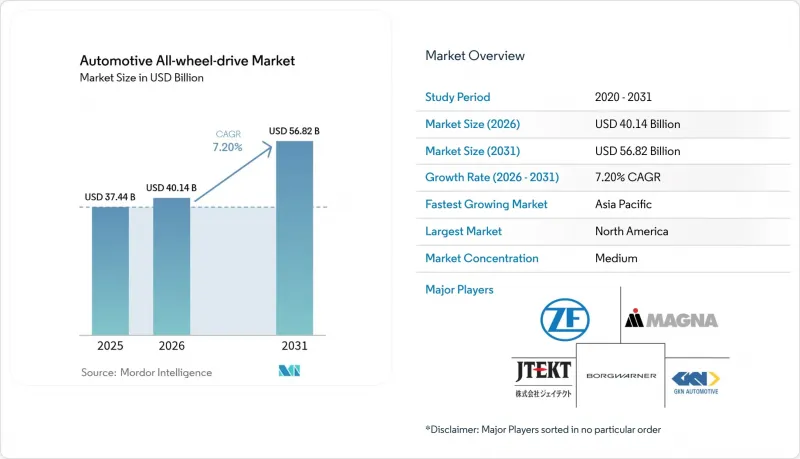
본 보고서는 차량 유형(승용차 및 상용차), 구동 방식(내연기관(ICE), 하이브리드 전기자동차(HEV) 등), 시스템 유형(파트타임/수동 AWD, 풀타임/자동 AWD 등), 구성품(트랜스퍼 케이스 등), 판매 채널 및 지역별로 분류되어 있습니다. 시장 전망은 금액(달러) 기준으로 제시되어 있습니다.
세계 자동차용 총륜구동 시장의 동향 및 인사이트
세계 SUV 및 CUV 수요의 급증
세계 SUV 및 크로스오버 차량의 생산 대수는 2030년까지 2,800만 대에 달할 것으로 예상되며, 구동 시스템이 옵션에서 기본 사양으로 전환됨에 따라 AWD를 탑재한 차량의 비율은 2025년 45%에서 65%로 상승할 것으로 전망됩니다. 구매자들은 주로 포장도로를 주행하는 경우라 하더라도 AWD를 심리적 안전성의 프리미엄으로 인식하는 경향이 강해지고 있습니다. 현재 중국 브랜드들은 AWD를 경쟁력 있는 기본 가격에 포함시켜 신흥 시장에서 기존에 존재하던 비용 장벽을 낮추고 있습니다. 각 OEM 업체들은 AWD와 ADAS 패키지를 결합하여 제공하는 경우가 많으며, 이를 통해 안전성을 강조하는 동시에 순이익률 향상을 도모하고 있습니다. 소비자의 실용성을 중시하는 태도가 연중 내내 수요를 뒷받침하고 있어, 자동차용 총륜구동 시장은 겨울철 계절적 변동에 대한 의존도가 낮아지고 있습니다.
전동화가 주도하는 듀얼 모터 방식 e-AWD의 보급
SAE 테스트에 따르면, 듀얼 모터 방식의 BEV는 추가적인 기계식 AWD를 채택한 싱글 모터 레이아웃에 비해 에너지 효율이 9% 향상되었습니다. 샤프트와 트랜스퍼 케이스를 제거함으로써 경량화가 이루어지고, 정밀한 토크 제어가 가능해집니다. 상용차 사업자에게는 유지보수 비용 절감과 모든 차축에서의 회생제동으로 인한 이점이 있습니다. 현대자동차의 새로운 하이브리드 플랫폼은 e-AWD가 ICE(내연기관)와 풀 BEV 아키텍처의 가교 역할을 수행하면서 비용을 절감하는 구조를 보여주고 있습니다.
2WD와 비교한 부품 원가 상승 및 연료·에너지 효율 저하
아르곤 국립연구소의 시뮬레이션에 따르면, 기존 AWD는 제조 비용을 1,500-3,000달러 증가시키고, 내연기관(ICE)의 연비를 약 1-2 mpg 저하시킵니다. 현대 ‘아이오닉 5’의 데이터 시트가 보여주듯이, 듀얼 모터 사양의 BEV에서는 주행 거리가 10-15% 감소합니다. 제조사들은 비용을 분산시키기 위해 AWD를 기본 사양으로 장착하는 경우가 많지만, 이로 인해 가격을 중시하는 부문에서는 진입 가격이 상승하게 됩니다. 배터리 가격은 계속해서 하락하고 있지만, 단기적으로는 이러한 비용 증가가 신흥 시장에서의 판매 장벽이 되고 있습니다.
부문 분석
2025년, 승용차는 자동차용 총륜구동 시장의 65.12%를 차지했습니다. 이는 SUV와 크로스오버, 그리고 사륜구동을 장착한 세단이 증가함에 따라 트랙션 컨트롤이 틈새 옵션에서 주류 기능으로 변화했음을 보여줍니다. 각 OEM 업체들은 사륜구동에 안전 장비 및 인포테인먼트 패키지를 결합함으로써, 예측 가능한 토크 전달을 평가하는 규제 시험 주기를 충족하는 동시에 판매 가격을 인상하고 있습니다. 소비자들은 젖은 노면이나 결빙된 노면에서도 AWD가 일 년 내내 제공하는 안정감을 중요하게 여기고 있으며, 보험사들도 그 이점을 보험료 인하에 반영하는 경우가 많아 온난한 지역에서도 AWD의 보급이 촉진되고 있습니다. 고급차 브랜드에서는 소프트웨어 제어 토크 벡터링을 활용하여 등급별로 주행 역학을 차별화하고, AWD 기능을 체험형 판매 포인트로 포지셔닝함으로써 높은 잔존 가치를 유지하고 있습니다.
상용차 시장은 2031년까지 연평균 성장률(CAGR) 7.75%로 가장 빠른 성장세를 보이고 있습니다. 이는 소포 배송, 공공 사업, 긴급 대응 차량들이 다양한 적재량과 기상 조건 하에서도 업무에 필수적인 가동 시간을 확보하기 위해 AWD를 채택하고 있기 때문입니다. 전동화된 액슬은 트랜스퍼 케이스를 없애 설치 과정을 간소화하고, 유지보수로 인한 가동 중단 시간을 단축하는 동시에, 대도시권에서 확산되고 있는 제로 배출 규제에도 대응하고 있습니다. 플릿 텔레매틱스 데이터에 따르면, 전동 AWD는 휠 스핀으로 인한 타이어 마모를 줄이고 회생제동 효율을 높이기 때문에 초기 비용은 높지만, 총 소유 비용(TCO)을 개선하는 것으로 확인되었습니다. 저배출 상업용 운송에 대한 정부의 인센티브와 더욱 엄격해진 안전 감사로 인해 AWD 채택률은 더욱 가속화되고 있으며, 향후 차량 구매 주기에서 AWD는 핵심 요건으로 자리매김하고 있습니다.
2025년 시점에서도 자동차용 총륜구동 시장 규모의 83.60%는 여전히 내연기관(ICE)이 차지하고 있었으나, 듀얼 모터 구성으로 인해 트랜스퍼 케이스 비용이 절감되고,토크 정밀도가 향상됨에 따라 배터리식 전기 파워트레인은 연평균 성장률(CAGR) 9.95%로 점유율을 확대하고 있습니다. ICE 중심 플랫폼에서는 하이브리드 AWD를 제공하기 위해 전륜 또는 후륜에 전동 모듈을 탑재하는 사례가 증가하고 있으며, 이는 배출가스 규제 강화에 대비한 미래 지향적인 투자로 자리 잡고 있습니다. 배터리 가격 하락과 정부의 인센티브가 맞물려 총소유비용(TCO) 격차가 줄어들고 있으며, 이에 따라 각 OEM 업체들은 주류 가격대에 걸쳐 AWD를 탑재한 BEV를 출시하고 있습니다. 연료전지에 대한 노력은 새로운 상업적 가능성을 보여주고 있습니다. BMW와 토요타가 2028년 수소 SUV 개발을 위해 제휴한 것은 장거리 주행 능력과 전동 AWD를 결합하여 가혹한 주행 조건이나 한랭 지역의 노선을 대응하기 위함입니다. 듀얼 모터 아키텍처는 소프트웨어를 통한 수익 창출의 길도 열어주며, 자동차 제조사가 OTA(Over-the-Air)를 통해 성능 업그레이드를 제공할 수 있게 해줍니다. 탄소 배출량에 대한 제재로 인해 내연기관(ICE)의 운영 비용이 증가하는 시장에서는 이러한 전동화 시스템이 더욱 탄력을 받고 있으며, e-AWD는 트랙션, 효율성 및 규제 준수에 있어 새로운 기준으로 자리매김하고 있습니다.
지역별 분석
북미는 2025년 자동차용 총륜구동 시장에서 42.80%의 점유율을 유지했습니다. 이는 눈길이나 기복이 심한 지형, 보험료율 우대 조치와 같은 과제에 직면한 픽업 트럭, SUV 및 플릿 부문의 견조한 수요 덕분입니다. 미국에서는 규제 당국이 AWD와 의무화된 안전 기술을 결합함으로써 그 보급을 촉진하고 있습니다. 캐나다에서는 겨울철 트랙션이 기본 요건으로 규정되어 있어 경차 부문에서 AWD 보급률이 가장 높습니다. 아시아태평양은 연평균 성장률(CAGR) 8.33%를 기록하며 가장 빠르게 성장하고 있는 지역입니다. 중국 자동차 제조사들은 AWD를 주력 수출 차종에 탑재하여 기존 2WD 차량보다 저렴한 가격으로 경쟁사를 제치고, 가성비 뛰어난 트랙션에 대한 전 세계의 인식을 새롭게 하고 있습니다. 인도에서는 인도 최초의 양산형 AWD 전기자동차인 ‘마르티 스즈키 e-비탈라’가 출시되면서, 첨단 구동계 기술의 보급이 진행되고 있음이 두드러지게 나타나고 있습니다. 한국에서는 현대자동차와 기아자동차의 전체 라인업에서 e-AWD의 확대가 계속되고 있는 반면, 일본에서는 하이브리드 AWD의 전통을 살려 전 세계로 사업을 확장하고 있습니다. 유럽에서는 성능을 유지하면서 유로 7 배기가스 규제 목표를 달성하기 위한 유력한 수단으로 전동화 AWD가 채택되어, 완만하지만 꾸준한 성장을 보이고 있습니다. 유럽의 프리미엄 브랜드들은 ‘일반 안전 규정 II’를 준수하는 ADAS와 통합된 정교한 토크 벡터링을 통해 차별화를 꾀하고 있습니다. 남미와 아프리카는 현재 시장 규모가 작지만, 인프라 정비와 수입 관세 인하로 인해 AWD 크로스오버의 소매 가격이 하락하고 있는 것을 배경으로, AWD 채택이 확대되고 있습니다.
기타 혜택:
- 엑셀 형식의 시장 예측(ME) 시트
- 3개월간의 애널리스트 지원
자주 묻는 질문
목차
제1장 소개
제2장 조사 방법
제3장 주요 요약
제4장 시장 구도
제5장 시장 규모와 성장 예측
제6장 경쟁 구도
제7장 시장 기회와 향후 전망
KSM 26.09.07According to Mordor Intelligence, the automotive all-wheel drive market size in 2026 is estimated at USD 40.14 billion, growing from 2025 value of USD 37.44 billion with 2031 projections showing USD 56.82 billion, growing at 7.20% CAGR over 2026-2031.
This report is Segmented by Vehicle Type (Passenger Cars and Commercial Vehicles), Propulsion Type (Internal-Combustion Engine (ICE), Hybrid Electric Vehicle (HEV), and More), System Type (Part-Time/Manual AWD, Full-Time/Automatic AWD, and More), Component (Transfer Case, and More), Sales Channel, and Geography. The Market Forecasts are Provided in Terms of Value (USD).
Global Automotive All-wheel-drive Market Trends and Insights
Soaring SUV and CUV Demand Worldwide
Global SUV and crossover output is forecast to hit 28 million units by 2030, and the share fitted with AWD is expected to climb from 45% in 2025 to 65% as traction systems shift from optional to default packaging. Buyers increasingly view AWD as a psychological safety premium even when driving predominantly on paved roads. Chinese brands now bundle AWD with competitive base pricing, lowering the historical cost barrier in emerging markets. OEMs frequently pair AWD with bundled ADAS suites, reinforcing safety credentials and boosting net margins. The utility mindset of consumers sustains year-round demand, making the automotive all-wheel drive market less dependent on winter seasonality.
Electrification-Driven Adoption of Dual-Motor e-AWD
Dual-motor BEVs achieve 9% better energy efficiency than single-motor layouts using add-on mechanical AWD according to SAE testing . Eliminating shafts and transfer cases cuts weight and unlocks precise torque control. Commercial operators benefit from lower maintenance and regenerative braking on all axles. Hyundai's new hybrid platform illustrates how e-AWD bridges ICE and full BEV architecture while containing costs.
Higher BOM Cost and Fuel/Energy Penalty vs 2WD
Traditional AWD adds USD 1,500-3,000 to build cost and reduces ICE fuel economy by roughly 1-2 mpg according to Argonne simulations . BEV range drops 10-15% in dual-motor versions, as demonstrated by the Hyundai Ioniq 5 data sheet. Manufacturers often convert AWD into standard equipment to dilute cost, yet this raises entry prices in value-focused segments. Battery prices continue to fall, but the near-term penalty remains a sales hurdle in emerging markets.
Other drivers and restraints analyzed in the detailed report include:
- Tightening Crash-Avoidance and Traction Safety Mandates
- Consumer Shift to Performance Handling in Premium Segments
- Magnet and Semiconductor Supply Bottlenecks for e-Actuators
For complete list of drivers and restraints, kindly check the Table Of Contents.
Segment Analysis
Passenger cars captured 65.12% of the automotive all-wheel drive market share in 2025, illustrating how SUVs, crossovers, and increasingly AWD-equipped sedans have moved traction management from niche option to mainstream expectation. OEMs pair AWD with bundled safety and infotainment packages, boosting transaction prices while satisfying regulatory test cycles that reward predictable torque delivery. Consumers value the year-round confidence AWD offers on wet or icy roads, and insurers often reflect that benefit in lower premiums, reinforcing adoption even in temperate regions. Premium marques also use software-defined torque vectoring to differentiate ride dynamics across trim levels, turning AWD capability into an experiential selling point that supports higher residual values.
Commercial vehicles post the fastest expansion at a 7.75% CAGR through 2031 as parcel, utility, and emergency fleets adopt AWD to ensure mission-critical uptime under varied payloads and weather conditions. Electrified axles simplify installations by eliminating transfer cases, lowering maintenance downtime, and meeting zero-emission mandates spreading across large urban centers. Fleet telematics confirm that electric AWD reduces wheel-spin-related tire wear and enhances regenerative braking efficiency, improving total cost of ownership despite higher upfront prices. Government incentives for low-emission commercial transport and stricter safety audits further accelerate specification rates, positioning AWD as a core requirement for future fleet procurement cycles.
Internal combustion engines still represented 83.60% of the automotive all-wheel drive market size in 2025, but battery-electric powertrains are rising at a 9.95% CAGR as dual-motor layouts erase transfer-case costs and sharpen torque accuracy. ICE-centric platforms increasingly embed electric front or rear modules to offer hybrid AWD, future-proofing investments against tightening emissions rules. Reduced battery prices and government incentives jointly narrow the total-cost-of-ownership gap, prompting OEMs to launch AWD-equipped BEVs across mainstream price bands.Fuel-cell initiatives indicate fresh commercial potential: BMW's collaboration with Toyota on a 2028 hydrogen SUV aims to pair long-range capability with electric AWD for heavy-duty or cold-weather routes. Dual-motor architectures also open software monetization paths, letting automakers sell performance upgrades over the air. In markets where carbon penalties inflate ICE running costs, these electrified systems gain further momentum, positioning e-AWD as the new baseline for traction, efficiency, and compliance.
Complete Report Scope:
- By Vehicle Type
- Passenger Cars
- Hatchbacks and Sedans
- SUVs and Crossovers
- Commercial Vehicles
- Light Commercial Vehicles
- Heavy Trucks and Buses
- Passenger Cars
- By Propulsion Type
- Internal-Combustion Engine (ICE)
- Hybrid Electric Vehicle (HEV)
- Battery Electric Vehicle (BEV)
- Fuel-Cell Electric Vehicle (FCEV)
- By System Type
- Part-Time/Manual AWD
- Full-Time/Automatic AWD
- Electric/e-AWD (Dual-Motor, Quad-Motor)
- Active Torque-Vectoring AWD
- By Component
- Transfer Case
- Differential (Center, Front, Rear)
- Coupling and Clutch Pack
- Prop-Shaft and Drive Shaft
- Control Unit and Software
- By Sales Channel
- OEM-Installed
- Aftermarket Retrofit
- By Geography
- North America
- United States
- Canada
- Rest of North America
- South America
- Brazil
- Argentina
- Rest of South America
- Europe
- Germany
- United Kingdom
- France
- Italy
- Spain
- Russia
- Rest of Europe
- Asia Pacific
- China
- Japan
- India
- South Korea
- Australia
- Rest of Asia Pacific
- Middle East and Africa
- Saudi Arabia
- United Arab Emirates
- Turkey
- South Africa
- Rest of Middle East and Africa
- North America
Geography Analysis
North America retained 42.80% of the automotive all-wheel drive market in 2025 with robust demand from pickups, SUVs, and fleet segments that confront snow, mixed terrain, and insurance rating incentives. U.S. regulators coupling AWD with mandated safety technologies reinforce uptake. Canada exhibits the highest AWD penetration among light vehicles because winter traction is a baseline expectation.Asia Pacific is the fastest-growing region at an 8.33% CAGR. Chinese OEMs embed AWD into mainstream exports that undercut traditional two-wheel-drive competitors on price, reshaping global perceptions of cost-effective traction. India's introduction of the Maruti Suzuki e-Vitara, the country's first mass-market AWD EV, highlights the democratization of advanced driveline capability. South Korea continues to scale e-AWD across Hyundai and Kia portfolios, while Japan leverages hybrid AWD heritage for global deployments.Europe shows steady but less dramatic growth, with electrified AWD as a favored route to meet Euro 7 emission goals while preserving performance. The continent's premium marques differentiate through fine-grained torque vectoring, integrated with ADAS aligned to General Safety Regulation II. South America and Africa remain smaller today yet illustrate rising adoption on the back of infrastructure upgrades and import duty reductions that lower retail prices for AWD crossovers.
- BorgWarner Inc.
- GKN Automotive (Melrose)
- ZF Friedrichshafen AG
- Magna International Inc.
- JTEKT Corporation
- Toyota Motor Corporation
- Nissan Motor Co. Ltd
- Continental AG
- Eaton Corporation PLC
- American Axle & Manufacturing
- Dana Inc.
- Haldex AB
- Hyundai Motor Company
- Audi AG
- BMW Group
- Mercedes-Benz Group AG
- Schaeffler AG
- Mahle GmbH
- Stellantis N.V.
Additional Benefits:
- The market estimate (ME) sheet in Excel format
- 3 months of analyst support
TABLE OF CONTENTS
1 Introduction
- 1.1 Study Assumptions & Market Definition
- 1.2 Scope of the Study
2 Research Methodology
3 Executive Summary
4 Market Landscape
- 4.1 Market Overview
- 4.2 Market Drivers
- 4.2.1 Soaring SUV and CUV demand worldwide
- 4.2.2 Electrification-driven adoption of dual-motor e-AWD
- 4.2.3 Tightening crash-avoidance and traction safety mandates
- 4.2.4 Consumer shift to performance handling in premium segments
- 4.2.5 Climate-volatility prompting OEM AWD standardisation
- 4.2.6 OTA-enabled software torque-vectoring architectures
- 4.3 Market Restraints
- 4.3.1 Higher BOM cost and fuel/energy penalty vs 2WD
- 4.3.2 Magnet and semiconductor supply bottlenecks for e-actuators
- 4.3.3 Range-loss concern in battery-EVs
- 4.3.4 Autonomous-driving shift toward efficiency-optimised drivelines
- 4.4 Value / Supply-Chain Analysis
- 4.5 Technological Outlook
- 4.6 Regulatory Landscape
- 4.7 Porter's Five Forces
- 4.7.1 Threat of New Entrants
- 4.7.2 Bargaining Power of Buyers
- 4.7.3 Bargaining Power of Suppliers
- 4.7.4 Threat of Substitutes
- 4.7.5 Intensity of Rivalry
5 Market Size & Growth Forecasts (Value (USD))
- 5.1 By Vehicle Type
- 5.1.1 Passenger Cars
- 5.1.1.1 Hatchbacks and Sedans
- 5.1.1.2 SUVs and Crossovers
- 5.1.2 Commercial Vehicles
- 5.1.2.1 Light Commercial Vehicles
- 5.1.2.2 Heavy Trucks and Buses
- 5.1.1 Passenger Cars
- 5.2 By Propulsion Type
- 5.2.1 Internal-Combustion Engine (ICE)
- 5.2.2 Hybrid Electric Vehicle (HEV)
- 5.2.3 Battery Electric Vehicle (BEV)
- 5.2.4 Fuel-Cell Electric Vehicle (FCEV)
- 5.3 By System Type
- 5.3.1 Part-Time/Manual AWD
- 5.3.2 Full-Time/Automatic AWD
- 5.3.3 Electric/e-AWD (Dual-Motor, Quad-Motor)
- 5.3.4 Active Torque-Vectoring AWD
- 5.4 By Component
- 5.4.1 Transfer Case
- 5.4.2 Differential (Center, Front, Rear)
- 5.4.3 Coupling and Clutch Pack
- 5.4.4 Prop-Shaft and Drive Shaft
- 5.4.5 Control Unit and Software
- 5.5 By Sales Channel
- 5.5.1 OEM-Installed
- 5.5.2 Aftermarket Retrofit
- 5.6 By Geography
- 5.6.1 North America
- 5.6.1.1 United States
- 5.6.1.2 Canada
- 5.6.1.3 Rest of North America
- 5.6.2 South America
- 5.6.2.1 Brazil
- 5.6.2.2 Argentina
- 5.6.2.3 Rest of South America
- 5.6.3 Europe
- 5.6.3.1 Germany
- 5.6.3.2 United Kingdom
- 5.6.3.3 France
- 5.6.3.4 Italy
- 5.6.3.5 Spain
- 5.6.3.6 Russia
- 5.6.3.7 Rest of Europe
- 5.6.4 Asia Pacific
- 5.6.4.1 China
- 5.6.4.2 Japan
- 5.6.4.3 India
- 5.6.4.4 South Korea
- 5.6.4.5 Australia
- 5.6.4.6 Rest of Asia Pacific
- 5.6.5 Middle East and Africa
- 5.6.5.1 Saudi Arabia
- 5.6.5.2 United Arab Emirates
- 5.6.5.3 Turkey
- 5.6.5.4 South Africa
- 5.6.5.5 Rest of Middle East and Africa
- 5.6.1 North America
6 Competitive Landscape
- 6.1 Market Concentration
- 6.2 Strategic Moves
- 6.3 Market Share Analysis
- 6.4 Company Profiles (includes Global Level Overview, Market Level Overview, Core Segments, Financials as Available, Strategic Information, Market Rank/Share for Key Companies, Products and Services, SWOT Analysis, and Recent Developments)
- 6.4.1 BorgWarner Inc.
- 6.4.2 GKN Automotive (Melrose)
- 6.4.3 ZF Friedrichshafen AG
- 6.4.4 Magna International Inc.
- 6.4.5 JTEKT Corporation
- 6.4.6 Toyota Motor Corporation
- 6.4.7 Nissan Motor Co. Ltd
- 6.4.8 Continental AG
- 6.4.9 Eaton Corporation PLC
- 6.4.10 American Axle & Manufacturing
- 6.4.11 Dana Inc.
- 6.4.12 Haldex AB
- 6.4.13 Hyundai Motor Company
- 6.4.14 Audi AG
- 6.4.15 BMW Group
- 6.4.16 Mercedes-Benz Group AG
- 6.4.17 Schaeffler AG
- 6.4.18 Mahle GmbH
- 6.4.19 Stellantis N.V.
7 Market Opportunities & Future Outlook
- 7.1 White-space & Unmet-Need Assessment


