

|
시장보고서
상품코드
2121694
광섬유 압력 센서 : 시장 점유율 분석, 산업 동향과 통계, 성장 예측(2026-2031년)Fiber Optic Pressure Sensors - Market Share Analysis, Industry Trends & Statistics, Growth Forecasts (2026 - 2031) |
||||||
 Mordor Intelligence
Mordor Intelligence에 의하면, 광섬유 압력 센서 시장 규모는 2025년에 38억 달러로 평가되었고, 2026년41억 5,000만 달러에서 2031년까지 64억 8,000만 달러에 이를 것으로 예측되며, 예측 기간(2026-2031년) CAGR은 9.29%를 기록할 전망입니다.
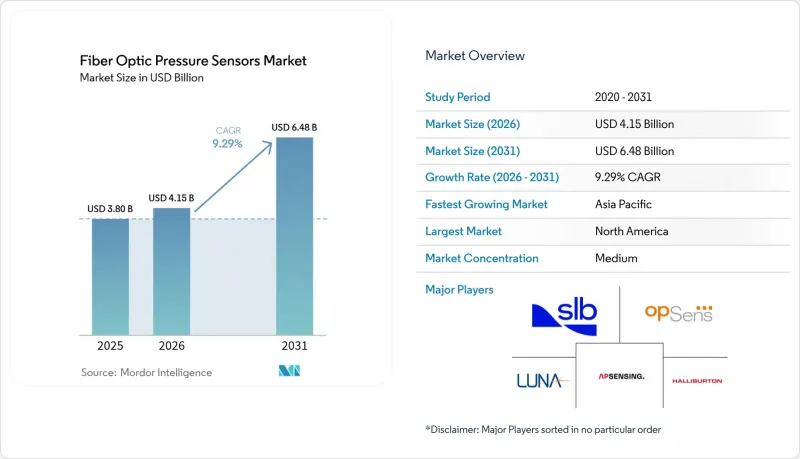
본 보고서는 유형별(유선, 무선), 기술별(파브리-페로, 파이버 브래그 그레이팅, 기타),용도별(석유 및 가스, 산업 자동화, 헬스케어 및 의료기기, 기타), 도입 환경별(광산·지하, 산업용 지상 시설, 생체 내·생물 의학, 기타), 지역별로 분류되어 있습니다. 시장 예측은 금액(달러) 기준으로 제시되어 있습니다.
전 세계 광섬유 압력 센서 시장 동향 및 인사이트
파브리-페로형 MEMS 공진기의 급속한 소형화
양산용 리소그래피 기술을 통해 풀 스케일 정확도 ±0.01%를 유지하면서 10마이크로미터 이하의 캐비티 치수가 실현되었습니다. 이러한 비약적인 발전으로 인해 공간 제약이 있는 의료기기에서 2kPa라는 저압 감지가 가능해졌으며, 감도는 기존 폴리머 센서보다 80% 이상 높습니다. 캐비티의 소형화를 통해 실리콘 포토닉스 공정 흐름을 이용한 웨이퍼 레벨 집적화를 실현함으로써 응답 시간이 단축되고 단위 비용이 절감됩니다. 현재 소형 센서는 구조적 무결성을 해치지 않으면서 카테터를 이용한 심혈관 모니터링, 항공우주 분야의 고속 액추에이터 피드백, 임베디드 배터리 셀 진단에 대응하고 있습니다. 생산량이 증가함에 따라, 광섬유 압력 센서 시장의 유선 및 무선 부문은 채널당 가격 하락과 성능 향상이라는 두 가지 이점을 모두 누리게 될 것입니다.
분산형 광섬유 감지 장치의 비용 절감
실리콘 포토닉스의 통합으로 2020년 이후 감지 장치의 가격은 약 60% 절감되었으며, 서브 나노미터(sub-nm)급 파장 분해능이 일반적인 산업 예산 범위 내에서 실현 가능해졌습니다. 현재 저가형 장치에서도 2.5µε의 정확도와 1초 미만의 응답 시간을 실현하고 있어, 교량, 터널, 파이프라인의 구조 건전성 모니터링 도입이 가속화되고 있습니다. 중국은 11.3%의 점유율로 전 세계 도입을 주도하고 있으며, 대규모 스마트 공장 구축에 있어 비용 경쟁력이 입증되고 있습니다. 엣지 분석용 펌웨어 덕분에 데이터 백홀의 필요성이 더욱 줄어들어, 원격지 자산에 대한 가치 제안이 강화됨과 동시에 광섬유 압력 센서 시장 전체의 보급이 촉진되고 있습니다.
피에조 저항식 센서와의 비교에서 높은 평균 판매 가격(ASP)
특히 예산 상한선이 여전히 엄격한 멀티센서 산업 자동화 프로젝트의 경우, 단가가 2-3배 높은 상황이 지속되고 있습니다. 전용 감지 하드웨어는 단순한 스트레인 게이지 컨디셔너에 비해 자본 비용을 상승시키고 있습니다. 그러나 부식성 환경이나 고온 환경에서의 유지보수 비용 절감으로 인해 자산의 전체 수명 주기 동안 초기 비용이 상쇄되므로, 단계적인 교체가 진행되고 있습니다. 실리콘 포토닉스의 규모 확대에 따라 2028년까지 대량 생산 라인에서 가격 차이가 거의 동일한 수준으로 축소될 것으로 예상되며, 광섬유 압력 센서 시장에 대한 이러한 제약이 완화될 전망입니다.
부문 분석
2025년에는 유선 장치가 매출의 72.20%를 차지하며, 지하 완공 설비, 파이프라인 회랑, 산업용 용광로 등 고신뢰성 자산에서 그 입지를 확고히 다졌습니다. 유선 장치용 광섬유 압력 센서 시장 규모는 정유시설 개보수 및 LNG 터미널 확장에 따라 꾸준히 확대될 것으로 예측됩니다. 무선 전송이 불안정한 환경에서도 물리적 연결을 통해 수 킬로미터에 달하는 광섬유 전 구간에 걸쳐 신호의 무결성이 보장됩니다.
연평균 성장률(CAGR) 11.6%로 성장하고 있는 무선 노드는 배선으로 인해 무게, 복잡성 또는 안전상의 위험이 발생하는 설치 현장에 대응하고 있습니다. 체내 이식형 의료기기, 배터리 셀, 회전 기계에서는 비동기식으로 판독이 이루어지는 배터리가 필요 없는 패시브 태그가 활용되고 있습니다. 초저전력 광 감지 장치의 비용이 지속적으로 하락함에 따라, 대상 고객층이 얼리 어답터를 넘어 확대되어 광섬유 압력 센서 시장 전체 수요를 끌어올리고 있습니다.
파브리-페로형 센서는 1밀리바 이하의 분해능과 200°C에서의 내구성을 바탕으로 매출 점유율의 46.40%를 차지했습니다. 현재 10마이크로미터 이하로 축소된 마이크로 캐비티 설계 덕분에 피하 주사 바늘이나 좁은 지질 시추 구멍에 내장할 수 있게 되어, 광섬유 압력 센서 시장에서 주도적인 입지를 공고히 하고 있습니다.
한편, FBG 어레이는 연평균 성장률(CAGR) 12.9%로 가장 빠르게 성장할 전망입니다. 한 가닥의 광섬유에 수백 개의 그레이팅을 다중화함으로써, 구조 건전성 모니터링 및 장거리 파이프라인 프로젝트에서 포인트당 비용을 절감합니다. 고속 복조기는 ±1pm의 안정성을 실현하여, 내진성이 강화된 건물의 모니터링 및 고층 빌딩의 풍하중 분석을 향상시킵니다. 감지 비용의 감소에 따라 FBG의 보급이 확대되면서 파브리-페로 방식의 지배력은 약화될 것으로 보이지만, 광섬유 압력 센서 시장의 총 잠재 수익은 확대될 전망입니다.
지역별 분석
2025년에는 북미가 매출의 37.50%를 차지하며 1위를 기록했습니다. 이는 셰일 가스전 전역에 걸친 엄격한 안전 기준과 전기차(EV)용 배터리 공장 확장에 힘입은 결과입니다. 첨단 제조에 대한 연방 정부의 장려책과 대형 유전 서비스 기업의 존재가 신속한 시제품 개발과 조기 상용화를 촉진하고 있습니다. 또한, 항공우주 프로그램에서도 비행에 필수적인 시스템에 광학식 게이지가 채택되어, 광섬유 압력 센서 시장에서 해당 지역의 혁신적 우위를 더욱 공고히 하고 있습니다.
아시아태평양은 2031년까지 11.7%라는 가장 높은 연평균 성장률(CAGR)을 나타낼 전망입니다. 전 세계 분산형 센싱 도입에서 중국이 11.3%의 점유율을 차지하고 있다는 사실은 정부 주도의 스마트 팩토리 확산을 뒷받침하고 있습니다. 일본의 주요 정밀 자동차 기업들은 배터리 냉각 루프에 광학 센서를 탑재하고 있는 반면, 인도에서는 정유시설 확장에 따라 고온 계측 수요가 증가하고 있습니다. 실리콘 포토닉스의 지역적 비용 우위 덕분에 감지 장치 생산이 가속화되고, 국내에서의 입수 가능성이 확대되면서 광섬유 압력 센서 시장 전체의 성장을 뒷받침하고 있습니다.
유럽에서는 자동차 제조, 석유화학 처리, 해상 풍력 발전을 기반으로 안정적인 도입이 진행되고 있습니다. 독일이 전 세계 광센서 도입에서 9.4%의 점유율을 차지하고 있는 것은 산업 자동화 부문에서 오랫동안 이어온 리더십을 반영합니다. 영국의 해저 사업자들은 북해의 새로운 설비 수명 연장 프로젝트의 물결에 대응하기 위해 웨트메이트형 광 커넥터를 채택하고 있습니다. 프랑스의 항공우주 부문에서는 실시간 구조 진단을 위한 광 어레이의 채택이 확대되고 있으며, 이는 광섬유 압력 센서 시장 전체의 꾸준한 성장세를 가속화하고 있습니다.
기타 혜택
- 엑셀 형식 시장 예측(ME) 시트
- 3개월간의 애널리스트 지원
자주 묻는 질문
목차
제1장 서론
제2장 조사 방법
제3장 주요 요약
제4장 시장 구도
제5장 시장 규모와 성장 예측
제6장 경쟁 구도
제7장 시장 기회와 향후 전망
LSH 26.09.02According to Mordor Intelligence, the fiber optic pressure sensors market size was valued at USD 3.8 billion in 2025 and estimated to grow from USD 4.15 billion in 2026 to reach USD 6.48 billion by 2031, at a CAGR of 9.29% during the forecast period (2026-2031).
This report is Segmented by Type (Wired, Wireless), Technology (Fabry-Perot, Fiber Bragg Grating, and More), Application (Oil & Gas, Industrial Automation, Healthcare & Medical Devices, and More), Installation Environment (Down-hole/Sub-surface, Industrial Surface Plants, In-vivo/Biomedical, and More), and Geography. The Market Forecasts are Provided in Terms of Value (USD).
Global Fiber Optic Pressure Sensors Market Trends and Insights
Rapid Miniaturization of Fabry-Perot MEMS Cavities
Mass-production lithography now delivers cavity dimensions below 10 µm while preserving +-0.01% full-scale accuracy. This leap enables pressure detection as low as 2 kPa in space-constrained medical devices, outperforming conventional polymer sensors by 80% sensitivity. Smaller cavities shorten response times and lower unit cost through wafer-level integration that follows silicon-photonics process flows. Miniature sensors now support catheter-based cardiovascular monitoring, high-speed aerospace actuation feedback, and embedded battery-cell diagnostics without compromising structural integrity. As production volumes climb, the wired and wireless segments of the fiber optic pressure sensors market both benefit from higher performance at reduced price per channel.
Cost-Down of Distributed Fiber-Optic Interrogation Units
The integration of silicon photonics has trimmed interrogation-unit pricing by roughly 60% since 2020, placing sub-nanometer wavelength resolution within reach of routine industrial budgets. Low-cost units now achieve 2.5 µε accuracy and sub-1 s response time, accelerating structural-health-monitoring adoption in bridges, tunnels, and pipelines. China leads global deployments with 11.3% share, validating cost competitiveness in large-scale smart-factory rollouts. Edge-analytics firmware further reduces data-backhaul needs, strengthening the value proposition in remote assets and boosting overall uptake of the fiber optic pressure sensors market.
High ASP Versus Piezo-Resistive Sensors
A 2-3 X unit-price premium persists, particularly in multi-sensor industrial automation projects where budget ceilings remain strict. Specialized interrogation hardware inflates capital cost compared to simple strain-gauge conditioners. Yet maintenance savings in corrosive or high-temperature sites offset initial spend over asset life cycles, encouraging gradual substitution. Silicon-photonics scale-up is expected to shrink the gap to near parity in high-volume lines by 2028, easing this restraint on the fiber optic pressure sensors market.
Other drivers and restraints analyzed in the detailed report include:
- OEM Integration in EV Battery-Pack Thermal-Runaway Safety
- Mandatory Down-Hole Digitalization Targets in Oil & Gas
- Connector Standardization Lag in Subsea Systems
For complete list of drivers and restraints, kindly check the Table Of Contents.
Segment Analysis
Wired devices represented 72.20% of revenue in 2025, cementing their role in high-integrity assets such as downhole completions, pipeline corridors, and industrial furnaces. The fiber optic pressure sensors market size for wired units is projected to rise steadily alongside refinery upgrades and LNG terminal expansions. Physical connectivity guarantees signal integrity across kilometers of fiber in environments where wireless propagation is unreliable.
Wireless nodes, growing at a 11.6% CAGR, address installations where cabling adds weight, complexity, or safety risk. Implantable medical devices, battery cells, and rotating machinery capitalize on battery-free passive tags interrogated asynchronously. Continuous cost declines in ultra-low-power optical interrogators widen the addressable base beyond early adopters, lifting overall demand within the broader fiber optic pressure sensors market..
Fabry-Perot sensors held 46.40% revenue share thanks to sub-milli-bar resolution and robustness at 200 °C. Their micro-cavity designs, now below 10 µm, allow integration in hypodermic needles and narrow geological perforations, reinforcing leadership within the fiber optic pressure sensors market share.
FBG arrays, however, will expand the fastest at 12.9% CAGR. A single fiber multiplexes hundreds of gratings, trimming per-point cost for structural-health-monitoring and long-haul pipeline projects. High-speed demodulators achieve +-1 pm stability, enhancing earthquake-resilient building surveillance and high-rise wind-load analysis. As interrogation costs fall, FBG uptake moderates Fabry-Perot dominance while enlarging total addressable revenue for the fiber optic pressure sensors market.
Complete Report Scope:
- By Type
- Wired
- Wireless
- By Technology
- Fabry-Perot
- Fiber Bragg Grating
- Intensity-Based
- Other Technologies
- By Application
- Oil and Gas
- Industrial Automation
- Healthcare and Medical Devices
- Automotive and Mobility
- Consumer Electronics
- Petrochemical
- Other Applications
- By Installation Environment
- Down-hole / Sub-surface
- Industrial Surface Plants
- In-vivo / Biomedical
- Aerospace and UAV
- Marine and Subsea Structures
- By Geography
- North America
- United States
- Canada
- Europe
- United Kingdom
- Germany
- France
- Russia
- Rest of Europe
- Asia-Pacific
- China
- India
- Japan
- Rest of Asia-Pacific
- South America
- Brazil
- Argentina
- Rest of South America
- Middle East and Africa
- GCC Countries
- Turkey
- South Africa
- Rest of Middle East and Africa
- North America
Geography Analysis
North America led with 37.50% revenue in 2025, supported by rigorous safety codes across shale plays and expanding EV battery plants. Federal incentives for advanced manufacturing and the presence of oilfield service majors foster rapid prototyping and early commercial launches. Aerospace programs also adopt optical gauges for flight-critical systems, reinforcing the region's innovation edge within the fiber optic pressure sensors market.
Asia-Pacific posts the strongest 11.7% CAGR to 2031. China's 11.3% share of global distributed sensing deployments evidences government-driven smart-factory rollouts. Japan's precision automotive giants integrate optical sensors in battery cooling loops, while India's refinery expansions demand high-temperature gauging. Regional cost advantages in silicon photonics accelerate interrogation-unit output, broadening domestic availability and stimulating overall growth in the fiber optic pressure sensors market.
Europe records stable uptake anchored in automotive manufacturing, petrochemical processing, and offshore wind. Germany's 9.4% share of global optical deployments reflects long-standing leadership in industrial automation. United Kingdom subsea operators embrace wet-mate optical connectors for a new wave of North Sea life-extension projects. France's aerospace sector increasingly favors optical arrays for real-time structural diagnostics, adding to steady momentum across the fiber optic pressure sensors market.
- AP Sensing GmbH
- Baker Hughes Company
- Halliburton Company
- Honeywell International Inc.
- Infineon Technologies AG
- Luna Innovations Incorporated (incl. FISO Technologies)
- NXP Semiconductors N.V.
- Omron Corporation
- Opsens Inc.
- Panasonic Holdings Corporation
- Pressure Profile Systems Inc.
- Robert Bosch GmbH
- Schlumberger Limited (SLB)
- STMicroelectronics N.V.
- Texas Instruments Incorporated
- Yokogawa Electric Corporation
- ABB Ltd.
- Broadcom Inc.
- Rockwell Automation Inc.
- Sumitomo Electric Industries Ltd.
Additional Benefits:
- The market estimate (ME) sheet in Excel format
- 3 months of analyst support
TABLE OF CONTENTS
1 INTRODUCTION
- 1.1 Study Assumptions and Market Definition
- 1.2 Scope of the Study
2 RESEARCH METHODOLOGY
3 EXECUTIVE SUMMARY
4 MARKET LANDSCAPE
- 4.1 Market Overview
- 4.2 Market Drivers
- 4.2.1 Rapid miniaturisation of Fabry-Perot MEMS cavities
- 4.2.2 Cost-down of distributed fiber-optic interrogation units
- 4.2.3 OEM integration in EV battery-pack thermal-runaway safety
- 4.2.4 Mandatory down-hole digitalisation targets (OandG)
- 4.2.5 Edge-analytics in smart factories (under-reported)
- 4.2.6 Implantable smart-catheter RandD funding spike (under-reported)
- 4.3 Market Restraints
- 4.3.1 High ASP vs piezo-resistive sensors
- 4.3.2 Connector standard-isation lag in subsea systems
- 4.3.3 Scarcity of opto-qualified technicians (under-reported)
- 4.3.4 IP fragmentation around micro-cavity designs (under-reported)
- 4.4 Value / Supply-Chain Analysis
- 4.5 Regulatory Landscape
- 4.6 Technological Outlook
- 4.7 Porter's Five Forces Analysis
- 4.7.1 Threat of New Entrants
- 4.7.2 Bargaining Power of Buyers
- 4.7.3 Bargaining Power of Suppliers
- 4.7.4 Threat of Substitutes
- 4.7.5 Intensity of Rivalry
5 MARKET SIZE and GROWTH FORECASTS (VALUE)
- 5.1 By Type
- 5.1.1 Wired
- 5.1.2 Wireless
- 5.2 By Technology
- 5.2.1 Fabry-Perot
- 5.2.2 Fiber Bragg Grating
- 5.2.3 Intensity-Based
- 5.2.4 Other Technologies
- 5.3 By Application
- 5.3.1 Oil and Gas
- 5.3.2 Industrial Automation
- 5.3.3 Healthcare and Medical Devices
- 5.3.4 Automotive and Mobility
- 5.3.5 Consumer Electronics
- 5.3.6 Petrochemical
- 5.3.7 Other Applications
- 5.4 By Installation Environment
- 5.4.1 Down-hole / Sub-surface
- 5.4.2 Industrial Surface Plants
- 5.4.3 In-vivo / Biomedical
- 5.4.4 Aerospace and UAV
- 5.4.5 Marine and Subsea Structures
- 5.5 By Geography
- 5.5.1 North America
- 5.5.1.1 United States
- 5.5.1.2 Canada
- 5.5.2 Europe
- 5.5.2.1 United Kingdom
- 5.5.2.2 Germany
- 5.5.2.3 France
- 5.5.2.4 Russia
- 5.5.2.5 Rest of Europe
- 5.5.3 Asia-Pacific
- 5.5.3.1 China
- 5.5.3.2 India
- 5.5.3.3 Japan
- 5.5.3.4 Rest of Asia-Pacific
- 5.5.4 South America
- 5.5.4.1 Brazil
- 5.5.4.2 Argentina
- 5.5.4.3 Rest of South America
- 5.5.5 Middle East and Africa
- 5.5.5.1 GCC Countries
- 5.5.5.2 Turkey
- 5.5.5.3 South Africa
- 5.5.5.4 Rest of Middle East and Africa
- 5.5.1 North America
6 COMPETITIVE LANDSCAPE
- 6.1 Market Concentration
- 6.2 Strategic Moves
- 6.3 Market Share Analysis
- 6.4 Company Profiles (includes Global level Overview, Market level overview, Core Segments, Financials as available, Strategic Information, Market Rank/Share for key companies, Products and Services, and Recent Developments)
- 6.4.1 AP Sensing GmbH
- 6.4.2 Baker Hughes Company
- 6.4.3 Halliburton Company
- 6.4.4 Honeywell International Inc.
- 6.4.5 Infineon Technologies AG
- 6.4.6 Luna Innovations Incorporated (incl. FISO Technologies)
- 6.4.7 NXP Semiconductors N.V.
- 6.4.8 Omron Corporation
- 6.4.9 Opsens Inc.
- 6.4.10 Panasonic Holdings Corporation
- 6.4.11 Pressure Profile Systems Inc.
- 6.4.12 Robert Bosch GmbH
- 6.4.13 Schlumberger Limited (SLB)
- 6.4.14 STMicroelectronics N.V.
- 6.4.15 Texas Instruments Incorporated
- 6.4.16 Yokogawa Electric Corporation
- 6.4.17 ABB Ltd.
- 6.4.18 Broadcom Inc.
- 6.4.19 Rockwell Automation Inc.
- 6.4.20 Sumitomo Electric Industries Ltd.
7 MARKET OPPORTUNITIES AND FUTURE OUTLOOK
- 7.1 White-space and Unmet-Need Assessment


